No Farmers No Food may be a wasted opportunity for UK Farming in its current form. But personal attacks on those leading it are no better than any one of us shooting at our own hand

A few days ago, I wrote and published a blog where I outlined why No Farmers No Food (NFNF) campaign will achieve nothing, whilst it could also end up doing UK Farming and Food Production considerable harm.

To do so meant mentioning the founder, James Melville. I don’t know James personally, but because of my ongoing interest in politics and the true depth of the problems that the U.K. is facing, I have been aware of him since he first appeared as a growing voice in what I’ll call the anti-lockdown ‘movement’ that appeared in the summer of 2020 following the first lockdowns.

Whilst I have discussed my reasoning that NFNF will not be able to achieve anything more than the range of existing organisations that are already working on the issues UK farming faces or have tried to do so before, it is also important to recognise what this new campaign is doing differently: NFNF has reached a much wider audience and has captured the imagination of people in ways that many of the existing lobbyist organisations supporting UK Farming have not done, so far.

The impact of NFNF is down to marketing and online campaigning. Or rather, making the best of the communication mediums that are currently available to anyone or any organisation that wants to change anything in the public realm, and isn’t already in a position where they have a platform where they could have the same effect just by opening their mouths.

The people who could do that – who arguably should already be doing that on behalf of UK Agriculture, are the people who are already in power. The people who we have elected and the people with roles in the establishment, who aren’t getting the things that they should be right. Because they are putting what’s important to them or what’s important to the people who are important to them, first.

Having the exposure that James has generated repeatedly since he emerged online, or being one of those people with public responsibility who isn’t using it as they should be, all adds up to the same outcome, IF there is no understanding or appreciation of the cause of the problems beyond an obsession with their effects, along with an appreciation of how everything in government, politics and the establishment really works today. Which genuinely isn’t anything like what most of us expect – even some of those within it.

Appearing to have a platform, with growing support and ‘breakthrough’ messages that give the immediate belief that those behind it can achieve things, will bring many different people and interests out of the woodwork who want to use that exposure for themselves. Usually because they aren’t getting the level of success with their own approaches, that they can see that new platform has.

It’s this visually-derived focus that brings groups like Together, climate deniers, right-wingers, anti-Brexiteers, and all sorts of different people with badges those who disagree with their priorities have given them, who identify with the issues that UK Farmers face tom banners like NFNF.

They see a vehicle that could be the answer to whatever problem they see as the priority, believing that their ‘fix’ will be the one that fixes everything for everyone else too.

The biggest obstacle to a successful outcome or resolution to all the common issues that Farmers share, is what we are now seeing unfolding in the disagreements about NFNF.

Different groups and individuals are attacking each other or piling in on individuals who have said something they don’t like about their take on what NFNF are going to do, and using links, affiliations and everything but the issues around what will actually work, when the point is being missed that in its current form, with the current mentality and the current lack of genuine engagement of a kind that social media simply cannot give, there will be nothing meaningful that NFNF can achieve.

The truth is that there is a massive range of people with different skills, experiences and talents that need to be involved in any movement that is going to succeed in delivering change for UK Farmers and Food Producers, where so many have already failed or been bought off with meaningless compromises before.

The parallels between this new campaign and how entry to the current political system works are frightening. Success in one area of business, obtaining a platform or just getting yourself elected doesn’t equip anyone with the understanding that it takes to do anything and certainly not where the realms of public policy interconnect and interacting with a completely broken system are concerned.

We shouldn’t doubt the good intent behind NFNF. But it’s been said that the road to hell is paved with good intentions and a large number of rightly angry, desperate and frustrated people are getting carried away by an idea that presents a good story, that in reality will end up a very long way from what it now seems.

We cannot have all the things that we want. That much is clear from the reality that we are all living through.

We need to focus upon the things that we genuinely need.

What we have the power to do is recognise the key things or rather the aims that we have in common. Such as saving U.K. Farming and making sure that everyone in the U.K. has everyday access to good, healthy, natural and farm-grown food.

It’s easy to dismiss workable solutions on the basis that they don’t appear to deliver the solutions that we want. But that’s really the most important point.

If we work together to deliver what’s right for everyone and not just what we want, what we want is likely to be delivered or will become a lot nearer by doing so.

We will then be winning multiple times over. Rather than fighting each other for no good purpose and not delivering anything to help anyone at all.

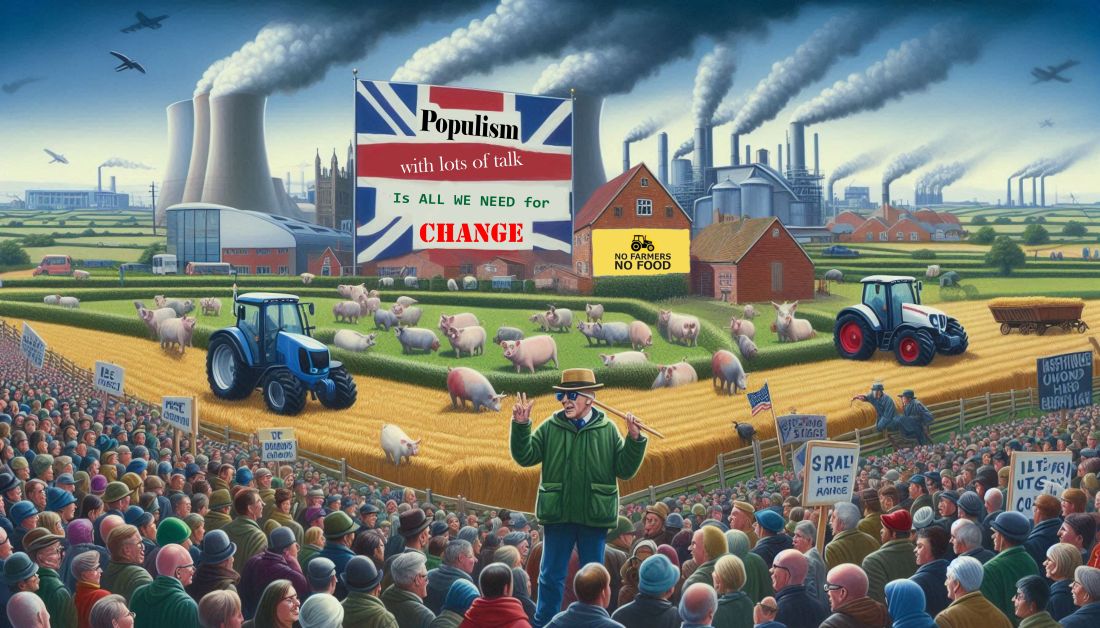
Why No Farmers No Food won’t help. But could certainly cause UK Farmers and Food Security a lot more harm instead

Like many with a careful eye on the problems our Farmers are facing and the massive issues that currently surround everything with UK food production and the access that everyone has to food, I had a moment of hope when I first saw that simple but effective ‘No Farmers, No Food’ yellow badge and black tractor, on social media just a few weeks ago.

What I saw next or rather what I couldn’t see concerned me. That was the absence of any detail about who was behind this Twitter account that was quickly gaining followers, and most importantly who and what the people behind it are all about.

For anyone who did a basic search on Google around that time, it would have been quickly obvious that no organisation in the U.K. with that name exists. But that there has been a very similar campaign built around No Farms No Food No Future in the USA since at least 2018.

It wasn’t long before a scattering of the people who represent not only farmers, but also different areas of the massive range of issues that are tied up in U.K. agriculture’s problems, began to openly question the populist nature of the account and what were its real intentions.

Regrettably, however well intended, populism can create a lot of buy in from vulnerable people very quickly. But then has a habit of hurting those same people very badly just as soon as it’s clear the hollow words don’t actually work.

It wasn’t long before the ‘founder’ of No Farmers No Food finally outed himself. For those watching the political terrain and current affairs with an eye on social media, it wasn’t any great surprise to see that James Melville was that name.

I only know of James because his posts are almost continuously hitting my timeline. I may have even briefly followed him when he first appeared there some months after the first lockdown in 2020. When dissent against lockdowns, social distancing and all the madness suddenly became popular to talk and publish about ‘out loud’.

To be very fair, James is clearly a very talented marketing specialist. He knows how to rack up followers, likes and a lot of popularity online.

But follows, likes and hundreds of thousands of people nodding their heads in agreement as they sit down to have a poo, a successful political campaign with real tangible, life-changing outcomes does not alone make!

Everyone is capable of change and as George Bernard Shaw once said, ‘Those who cannot change their minds cannot change anything.’

So, the growing promises and popularity of the No Farmers No Food ‘campaign’ certainly hadn’t been a subject I’ve wanted to tackle directly by name, before there was any documented outline of what they intend to do and what really underpins their cause.

Last night, No Farmers No Food released a document that not only outlined what they see themselves about and what they see their value as being. It also leaned heavily on the words and feeling of farmers of different kinds who are desperately looking for change across the U.K. (A copy of the NFNF Press Release from 19 February 2024 can be found at the bottom)

There’s nothing wrong with anything that has been said. Other than the fact that Farmers and those that support them are even having to say it.

However, just because there is strength of feeling  and so  many within the industry and within the communities that surround it who are looking for solutions and someone who is going to instigate change, it  doesn’t mean that the first few people with a visible loud haler and some words that everyone  thinking about these issues can relate to, will be any different to anything or anyone who has come before.

This is where the real danger of what looks and sounds like something new and different presents. I’m afraid to say that I have not read anything in the release that I haven’t seen attempted or even being worked on by existing organisations, right now, or even before.

Farmers don’t need another group or organisation, that has a louder voice and gets more follows, but doesn’t get anything done. Even though good marketing plans and clever words will make it look like they have or that they can.

Regrettably, clever words, clever marketing and clever narratives are everything that’s already wrong with how the establishment, the respective UK governments and the politicians within them operate.

No organisation or groups of organisations are going to win friends by putting out adverts about the margins that farmers receive that might mention profit, but leave the scanning reader with the impression that after selling a kilogram of apples to a supermarket, the grower actually only receives 3p, when the pack price on the shelf is over £2.

This kind of approach is no different to scoring an own-goal. Not because the detail is technically wrong. But because mirroring the actions of those who are already blind will achieve absolutely nothing, whilst it also shows the same kind of sleight of hand or manipulation used by politicians that many members of the public are now desperate to move away from.

Strong, effective marketing from people with the skills and ability like James, have massive power to help and to create the change that is now necessary, IF Farming across the UK is to be saved from a destructive fate that many suspect, but very few really see. However, marketing is only a small part of that formula, because there’s a lot more than simple but effective messaging that needs to be achieved.

What the people heading popular campaigns say and what they represent isn’t the pathway to change itself. Even if they appear to be able to open lots of doors.

Yes, It’s nice to know that there are all sorts of people from all backgrounds and industries who are able to hear stories and compelling lines that they can all identify with when they are unhappy about a world that is giving everyone plenty to be unhappy about.

But where’s the purpose?

Where are the solutions that actually work?

Where is the real recognition that the problems aren’t about the subjects themselves, but rather how politics, the political system and the establishment itself works?

The only way to win against politicians who are incompetent, self-interested and only listening to advisers and so-called experts (with their own agendas), because when it comes to their real responsibilities they are massively out of their depth, is to play the political game even better than they and the people who support them can.

That doesn’t begin with any kind of strategy that relies on the politicians, their advisors or the establishment being the ones who are going to change.

Whilst it continues to be in some kind of ascendency, No Farmers No Food could very quickly win what appear to be concessions from the Sunak government and from whatever will follow. But the realities that underpin that and the direction that this entire political class are committed to taking UK Food Production will soon again begin to show – after Farmers and everyone who supports them will have been misled again into wasting what is now becoming invaluable time.

The reason that the many organisations that include big names such as the NFU and Food, Farming and Countryside Commission – who are covering so much of the ground that the wish list published yesterday mentioned already, aren’t achieving the results we all know they should be, is they are either too big, too London-centric, or like so many of us still believe that there is some kind of gentlemanly set of rules at work within the establishment that guarantee that as long as you do things the right way, the right things will end up being done in return for you.

Sadly, those days are long gone.

The power that farmers have to change much more than the destiny of farming itself, isn’t something that anyone can waste time waiting for permission to use.

Everyone is looking for solutions and answers from people who really don’t care about UK Farming.

People who are certain that they are right and farmers are wrong, because they genuinely believe that food will never be a problem, as it will always be available from elsewhere.

Please don’t continue to make the same mistakes. Boxing clever is the only way UK Farming can now succeed.

Populism will not save Farming. But practicality can and will

The one thing that everyone linked to U.K. Agriculture and Food Production will agree on is that the industry is in crisis. But what the crisis is, what caused it, what will fix it and what approach or what thinking must be prioritised to do so are very different things.

The stakes could not be higher. Farming is quickly becoming unviable for growing numbers of farmers. The land they vacate is coming out of production and not being passed to the next generation or anyone fighting to find their way in. Retailers are exhaustively abusing their relationships with farmers and growers, and the establishment remains blithely confident that the U.K. will never be short of supplies.

Because countries as far away as Australia and New Zealand will always be there to step into the gap and meet every shortfall.

All of this whilst the latest figures suggest that the amount of food that the U.K. produces for its own use only reaches around 52-54%.

That the food we all eat just seems to keep on coming gives the lie to what the real food crisis is. And the fragility of our food supply is hiding in plain sight.

The complexity of the issues involved regrettably mean it is increasingly easy for anyone within the industry who is worried about the future, to be looking for a banner or message to get behind. One that relates enough to their own experience and makes sense of whatever they believe everyone else going through the same experience needs to do.

Unfortunately, messages that can become such a point of focus are therefore very dangerous. They deceive people into believing in a shared purpose that isn’t necessarily there.

This means that time, energy and perhaps even risks or gambles are taken on political vehicles or strands of unanchored activism that sound as if they will deliver results and perhaps even become the next big thing.

Some call this populism. It’s happening within farming right now, fuelled in no small part by the growing unrest involving farmers across Europe who have even gone as far as laying a meadow along once of the key routes into Paris.

Ploughing roads, fertilising the walls of ministry offices, shutting down travel or even manning the barricades might sound very attractive to people even beyond the farming and food production community itself. But what would be the purpose? What would U.K. farmers be trying to achieve? What would it all be for?

Everyone has a different perspective on the issues; what is happening and what really needs to happen, to get the result and to sort all the problems out.

By rushing to protest, no matter how inspiring the pictures from Europe might seem, the real opportunity could be so easily lost. The growing power of the frustration, impatience and lack of trust of the establishment, retailers and big money, who are collectively causing so much harm and distress, could too easily be lost. Worse still, misdirection of this untapped potential could too easily be used against what’s left of the power the industry has to influence its own future.

Protests without purpose will also always fail. Wasting a lot of time and probably money that few can really afford. However, the real cost of responding to the dog whistles rarely blown by those with skin in the game, will be the future of UK Farming and Food Production itself.

Any form of protest that isn’t really thought out in terms of what it needs to achieve and then fails, will inevitably be seen as a whimsical exercise by people ‘on the extreme’.

There is a high probability that any form of mass protest implemented without thought will be repurposed by the establishment to fit the narrative that UK Agriculture is archaic in its current form and must adhere to new ways of thinking and practices. Systems and ways of working that in the longer term, don’t feature what you and I recognise as Farming in any relevant form.

I wish that I could say that the alternative way to facilitate change is easy, and just as easy to understand.

There are people working within and supporting the industry who in some cases have overseen massively useful work on the future of farming in the UK and what needs to change.

The evidence is there to demonstrate that a whole range of problems genuinely exists.

Some of the work done is incredibly good and well-informed. But even in the case of those working very closely with Government, politicians and industry leaders every day, there is not enough appreciation of just how complex the political-government-establishment-public sector relationship and the interaction between them has become.

Worse still, there is very little focus on how the massively misled expectations of members of the public as well as industry professionals and small business owners can possibly be met, when the realities of the future we face are now undoubtedly facing in a very different way.

There are barriers to progress everywhere, and the lens of best intentions doesn’t see these for the problem that they really are. Yet we have years of disappointments with public policy to confirm that it is so.

The control of food is power.

Once we are able to understand the role of food in every one of its aspects and forms, we then and only then, have a chance to recognise that the whole direction of farming and the current production and output-based focus it has, is constructed of policies that simply make no economic sense. We can see what they are really there for.

UK Agriculture has no power and no say in its future today. This must change.

Over the past 40-50 years, all that power and influence has been slowly and yes, deliberately been drained away to wherever we think the money still is, and then beyond.

The future of farming that works for us all is one that fits with and interacts closely with the benefits of production and supply to the surrounding community fixed firmly in mind.

Its form more closely resembles the kind of farm structures and sizes that older generations will remember well. It builds upon community, true localism and a healthy relationship with social enterprises or not-for-profit cooperatives in every potential form.

However, the narratives we overwhelmingly hear today tell us that progress can only ever go one way.

Yet the progress the establishment is driving us all towards isn’t focused on humans, on health, on being happy. It’s all about money, and the wealth of an ever smaller few.

But as the friction in the markets, the talk of politicians and the cost-of-living crisis keep warning us, the monetary and financial system that we have, has actually had its day.

The real progress that will keep farmers farming and people healthy and fed adequately with what they need, isn’t based on a direction where money and all the forces that drive it can continue to be in the driving seat for very long.

The future of food and food production is about community, locality, smaller or more tradition scale and about people working in and around food production being remunerated properly for doing proper, fulfilling jobs.

Local Farms and the role they will play in providing many of the foods, drinks and goods that will make that possible, are at the heart of the future of Food Production.

Farmers have the power to influence this change of direction in a very practical way. But government and the big money interests riding off the destruction of UK farming aren’t going to pay for it.

It’s time for the industry to take a worthwhile risk on its future.

Otherwise, it won’t be long before there isn’t anything left taking a risk for.