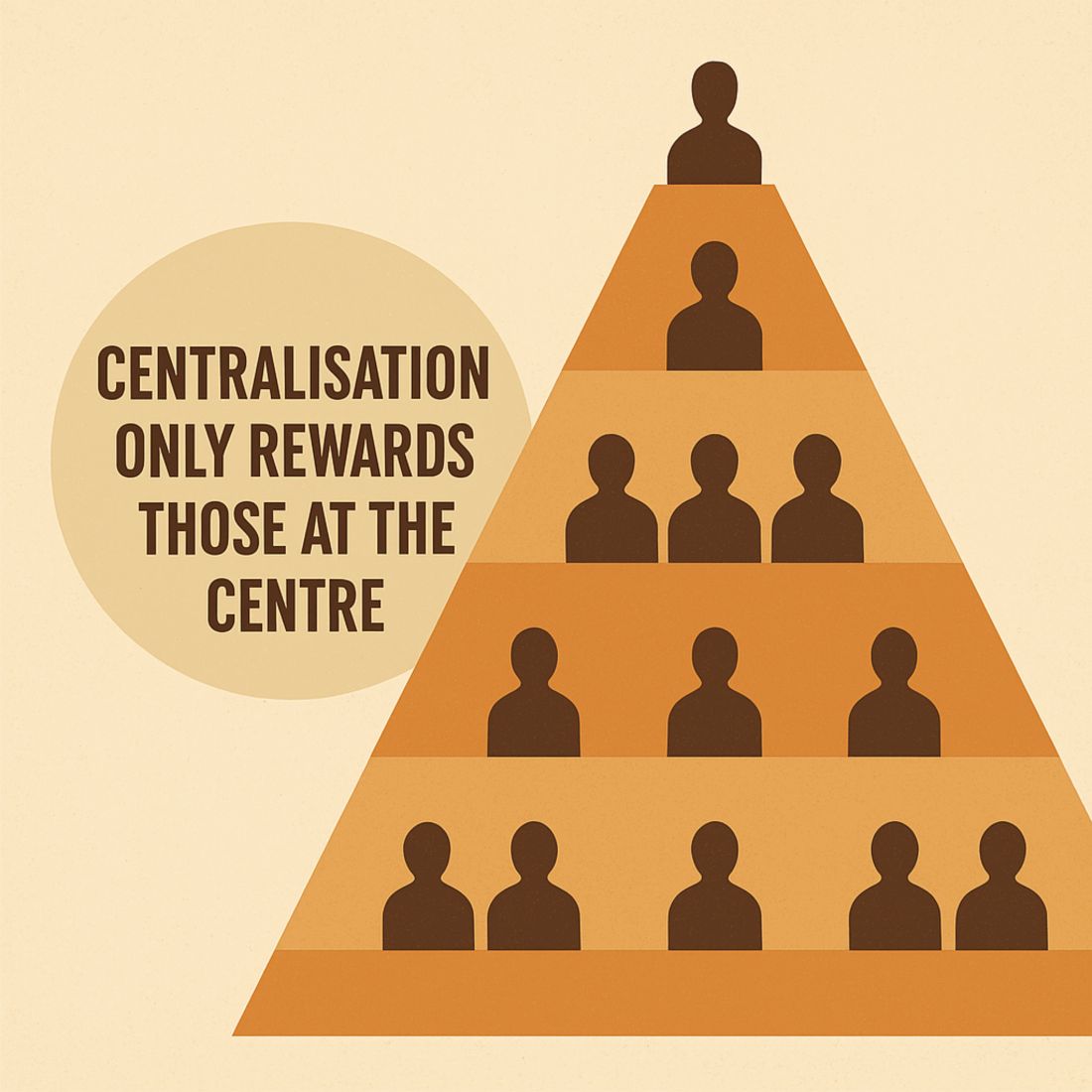
Centralisation Only Rewards Those at The Centre

For months I’ve been writing about The Local Economy & Governance System (LEGS) and The Basic Living Standard. Yet I’m always aware of a deeper challenge: until people truly see the mechanics of the money‑centric system we live in – not just the symptoms, but the structure – the need for a paradigm shift can feel abstract.

The irony is that the evidence sits in front of us every day. The system hides in plain sight. But because we have been conditioned to treat money as the unquestionable centre of life, we rarely recognise how deeply it shapes our behaviour, our morality, our relationships, our communities, and even our understanding of what it means to be human.

Money today is not simply a medium of exchange. It has become the organising principle of society – the lens through which value is defined, the gatekeeper of freedom, the arbiter of worth, and the mechanism through which power is accumulated. And because money has been elevated to this position, the consequences extend far beyond currency itself. They reach into motivation, identity, governance, and the very structure of our lives.

This is why centralisation exists.

This is why it grows.

This is why it always rewards those at the centre – and harms everyone else.

The money–power–centralisation equation

The relationship is simple:

Money → Wealth → Power → Control → Centralisation

Everyone understands this at some level. Even those with the least money know that having money gives them more control over their own lives.

But as you move up the hierarchy of the money‑centric system, the dynamic changes. Money no longer gives control over your own life – it gives control over other people’s lives.

And once that dynamic exists, centralisation becomes inevitable.

Centralisation is not an accident.

It is not a side‑effect.

It is the natural outcome of a system built on scarcity, hierarchy, and accumulation.

The more money someone has, the more they can centralise power. The more power they centralise, the more money they can extract.

The cycle feeds itself.

This is the architecture of the money‑centric paradigm.

What centralisation really is

People often imagine centralisation as a simple chain of command. But in reality, it is a network of overlapping chains – each one transferring power, ownership, and influence upward, away from the people affected by decisions and toward a distant centre.

Every chain works the same way:

  • power flows upward
  • responsibility flows downward
  • accountability disappears
  • humanity is lost

And because these chains replicate across every sector – politics, business, food, media, technology, governance – they form a vast web of dependency and control.

Centralisation is not just structural.

It is psychological.
It is cultural.
It is economic.
It is moral.

It is the mechanism through which the money‑centric system maintains itself.

The trick: centralisation is sold as “efficiency”

One of the most effective illusions of the money-centric system is the way centralisation is presented as:

  • reasonable
  • intelligent
  • cost‑effective
  • efficient
  • modern
  • inevitable

People are told that centralisation “reduces duplication”, “streamlines services”, “saves money”, or “improves coordination”.

But the truth is simple:

Centralisation always reduces the number of people with power.

It always increases the distance between decision‑makers and those affected.

It always concentrates wealth and influence in fewer hands.

And because distance removes empathy, centralisation always leads to dehumanisation.

Where we see centralisation at work

You can see the pattern everywhere:

  • Politics – power pulled upward into party machines, donor networks, and distant executives.
  • Government – “devolution” used as a cover for regional centralisation, reducing local representation and increasing control from Westminster.
  • Globalisation – local economies hollowed out as production and decision‑making move offshore.
  • Corporate structures – small businesses replaced by multinational giants.
  • Supply chains – farmers and producers trapped by supermarket monopolies.

In every case, the story is the same:

Centralisation removes local agency and transfers power upward.

The dehumanisation effect

As centralisation grows, the number of links between people and the centre increases. Each link removes a layer of humanity.

When decision‑makers have no direct contact with the people affected by their decisions, they stop seeing them as people at all.

This is why:

  • Policies harm communities without anyone taking responsibility
  • Corporations exploit workers and environments without remorse
  • Governments impose rules without understanding consequences
  • Systems become cold, bureaucratic, and indifferent

Centralisation creates distance.

Distance removes empathy.

Lack of empathy enables harm.

This is the psychological architecture of the money‑centric world.

The damage centralisation has caused

We have been told for decades that centralisation “makes life easier” and “reduces cost”. But the lived reality is the opposite:

  • People cannot afford to live independently on a minimum wage.
  • Communities have lost identity, cohesion, and purpose.
  • Local businesses have been replaced by corporate monoliths.
  • Supply chains have become fragile and exploitative.
  • The environment has been degraded for profit.
  • Wealth has been transferred upward at unprecedented speed.

Centralisation has not reduced cost.

It has redistributed cost – downward.

Onto the people least able to bear it.

This is not a glitch. It is the design.

Localisation: the antithesis of centralisation

Centralisation only exists because the system is built on hierarchy, scarcity, and accumulation.

Remove those foundations, and centralisation has no purpose.

This is why genuine localisation – not the fake “devolution” offered by governments, but true community‑level autonomy – is the natural alternative.

Local systems:

  • Operate without hierarchy
  • Are built on relationships
  • Are grounded in lived reality
  • Prioritise needs over profit
  • Are transparent and accountable
  • Reconnect people to the consequences of decisions

People trust local leadership because it is human, visible, and accountable.

They do not trust distant leaders they never meet, cannot reach, and did not choose.

Locality is the natural scale of human systems. Centralisation is the unnatural one.

Why this matters now

Centralisation is not just a political or economic issue.

It is the structural expression of the money‑centric worldview.

And because the money‑centric system is collapsing – financially, socially, environmentally, morally – the centralised structures built upon it are collapsing too.

This is the doorway moment.

We can continue rearranging the furniture inside a collapsing room.

Or we can step through the doorway into a new paradigm – one built on locality, contribution, community, and human dignity.

Centralisation is the problem.

Localisation is the solution.

LEGS is the structure that makes localisation possible.

The Basic Living Standard is the foundation that makes it humane.

The Revaluation is the shift in consciousness that makes it visible.

Once you see the doorway, you cannot unsee it.

And once you understand centralisation, you understand why nothing will change until we leave the old room behind.

The role of British Farmers has been neglected at our peril. Sadly, the politicians won’t see it until it’s too late, so it’s the Farmers who will have to begin the localised food supply chain revolution instead

Farmers are by nature, the most creative and entrepreneurial managers, engineers and technical workers that I know. They are, or rather they become these multitalented vocational giants by living lives that involve operational management, frequently calling them into action at any time, 24hrs a day, 365 days a year – pretty much from the day that they are born.

Farmers are, in effect, the complete antithesis of our Members of Parliament and the political class. And it’s because of the lack of understanding and respect for what British Farmers do, that the politicians we have – whether in Government or not, have allowed British Agriculture and all of the industries allied to and feeding into it, to reach the state that they are now in.

The problems that British Farmers face remain closely aligned to what their European counterparts are experiencing.

Indeed, whilst many from what in 2016 was the Remain camp are still pushing the narrative that leaving the EU and the whole Brexit vote was a gargantuan mistake, those same people are strangely silent when it comes to comment or discussion on what Farmers within in the EU Member nations are facing right now.

Across Europe, unelected bureaucrats and out of touch politicians are pushing an agenda which will see Nation States close down some of the very best food production in the world. All at a time when supply chains are already collapsing, there are growing food shortages and in no time at all it will not just be hungry people who are out of sight and out of mind that could be the ones who are about to starve or go without.

What underscores the futility and the madness of this perverse strategy, pursued by people who have never been at the hard end of an operational business in their life, is the reality that their grand plan mirrors the ridiculous decisions made by the political classes across Europe not only to shelve and mothball, but to destroy fossil fuel burning energy plants and sources. All coming under the ridiculous assumption that buying in supplies and services from elsewhere from across the World is not only safe, but can be sold to the public as being green and therefore alright.

Yes, you did read that correctly. The leading classes of Europe and the UK too, are and have for some time quite literally been shutting down, wilfully neglecting and even deliberately destroying our own national systems of production.

The politicians we have elected to look after our best interests have been making us all vulnerable to whoever they then do some kind of deal to buy replacement supplies and services from.

All of this is so that Politicians can pay lip service to fulfilling an impossibly idealistic promise of achieving Net Zero – or some other departure from reality based narrative they are pushing that isn’t just economic with the truth, but is an outright lie.

Why is the lie so important? The lie that the politicians tell is so important, because it’s just another lie to cover up the impact of another very big and very damaging lie about the benefits of globalisation and commercialisation – which is what the EU was always really about.

The irony should be lost on none of us that Globalisation and greed-based Commercialism are the real and genuine cause of all of the climate and environmental problems that we do genuinely have.

Equally, we should be under no illusion that the climate and environmental problems that we do genuinely have would go into free fall, in the direction of positive change, the moment that we stepped back from the money is god and a profit led existence, and allowed on-shoring, relocalisation and the protectionism that is now essential to the UKs future to be restored.

Whilst it will never be said about the European Union, even by many of the Brexiteers who never really understood this part of the EU Membership travesty themselves, the EU and everything about it has just been one disastrous exercise in globalisation and commercialisation.

The Common Market and everything that followed as part of the EU Project evolution was a self-serving spin off of the Globalisation myth, repackaged with the lie that with the overarching politicisation and centralisation of the European sub version, the issues that befall the removal of international barriers and the many risks it brings on a Global level, would never be our own.

As many of us can already see with just the Energy Crisis alone, this foolishness – however well intended, doesn’t work when so many differences of opinion, cultures and different ways of being are involved.

We can all see what has happened as a result of Western Governments responding as they have to the war in Ukraine, when the same politicians had destroyed our own self sufficiencies in order to ‘open up the doors’.

This is just the tip of the iceberg when it comes to the impact of all the very poor decision making that got into full swing long before Brexit, Covid and Ukraine were ever in the frame.

Sadly, the system collapse that so many within the elites, the establishment and our own government are doing so much to hide, is already well underway.

It’s just the case that we are not all going over the cliff at the same moment in time. That’s why not all of us can see it. YET.

However, the fall of an entire industry that will affect all of us – our Farming Industry – is most definitely already underway. And we fail to realise, accept and understand this at our peril.

Yes, food is on the supermarket shelves. We can still get just about everything we could possibly want. So you are probably asking the question, ‘Why should we be worried about Farmers and British Agriculture now?

Sadly, we will not believe that life can be any different to what it is now, until it already is.

If you need an example that makes sense of this, cast your mind back to the beginning of 2020 when the first lockdown began and then life changed for us all in an instant.

We may have forgotten Social Distancing and Lockdowns for now. But many of the direct consequences of disastrously poor decision making on the part of our politicians is only just beginning to materialise now, nearly three years on.

Amongst all of the issues which are currently popular, the ability of the UK to feed itself is strangely absent from that list. Yet the UK Food supply is now at massive risk of collapse – That’s the supply of the food that we need to meet our basic needs and not the ridiculous variety of imported and mass processed items and ingredients that we have become used to.

Our Basic food supply is at risk for a number of reasons. These include the centralisation and globalisation of food supply chains which are going to collapse; the way that British Agriculture has been placed at the mercy of innumerable agents, resellers, speculators, traders and middle men who take massive profits whilst adding no value and push farm prices down, whilst pushing retail prices up; and decades of reconditioning under the auspices of EU membership that has led British Farmers to rely on subsidies that have taken away the incentive and freedom to compete.

There are many more.

The situation regarding our food supply is much more complicated and serious than it is possible to do real justice here.

The real tragedy and threat to us all, is that because our Politicians created or led the implementation of the market structures that are currently at work – even though they did so in no small part on behalf of the EU – everyone, and most importantly our Farmers, are expecting our politicians to ensure that every issue created by Brexit, along with the collapse of global supply chains and the fallout of other events such as the War in Ukraine, will be dealt with – as it is perfectly reasonable and logical for us to be able to expect.

They have not. They are not. They will not be addressed by the politicians we have.

I have been writing at length about the changes, challenges and difficulties we face. But this isn’t just the interpretation of one former politician and businessman sharing the reasoning of their own concerns. A former head of MI5 has warned about the issue of food security, as well as the National Farmers Union itself have been sounding the alarm.

The real problem that even these very credible sources cannot counter, is that our politicians are so out of touch and prioritise whatever they believe to be in their best interests.

It is not until you really begin to understand just how out of touch with reality our politicians actually are, that you can then start to consider and appreciate that the British People are heading for an extraordinary amount of pain, that would have been both unnecessary and avoidable IF we had politicians that fulfilled their responsibilities as they always should do.

Getting people and especially Farmers to realise and understand that the solutions will not come from this government or any new government that is formed from the political parties or groups that are known to us and that we have on offer to us today is challenging indeed. Especially as it means that the solutions we now need, through restructuring, onshoring and relocalising supply chains to a what we would recognise as being conversant with a much more traditional form, MUST be led with British Farmers and all of the related industries right out in front. Just as the political change that we all so desperately need must also come from the grassroots up.

I began writing this blog by making reference to the ingenuity and industriousness of our Farmers. This has already been well illustrated by the many ways that members of the Farming Community have already diversified their businesses, to become manufacturers, growers, producers and retailers of a very different kind, taking back control and managing every step of the process from farm to fork themselves, or working collaboratively on a very small localised scale, where it can quite literally be said that many hands make light work.

Whilst our Politicians will not accept this probably until it is too late to avert further harm, UK self sufficiency in food production, as well as the majority of the key things or basics that we are going to need, is not only now strategically key to our future. This is how world events and the UKs circumstances will soon dictate that they MUST be.

We cannot wait for the politicians to change their minds, or it wont just be the cost of living crisis, but shortages of basic foods that make British People hungry too.

Our existing politicians will always exhibit loyalty to the very system that has broken the back of British Farming for no other reasons than greed, profit and control. The existing Public Policies on Farming, Fisheries and Food have certainly never been for the purposes of benefiting UK Industries or British consumers – no matter the lies and the lies to cover up those lies that we have been continually told.

Please can we all wake up before its too late and there is nothing left to work with. We need a revolution in farming and we need it to happen now.

It will not come from the top and must run from the grassroots up. Farmers must be at the middle of local food supply – the way it should always have been.