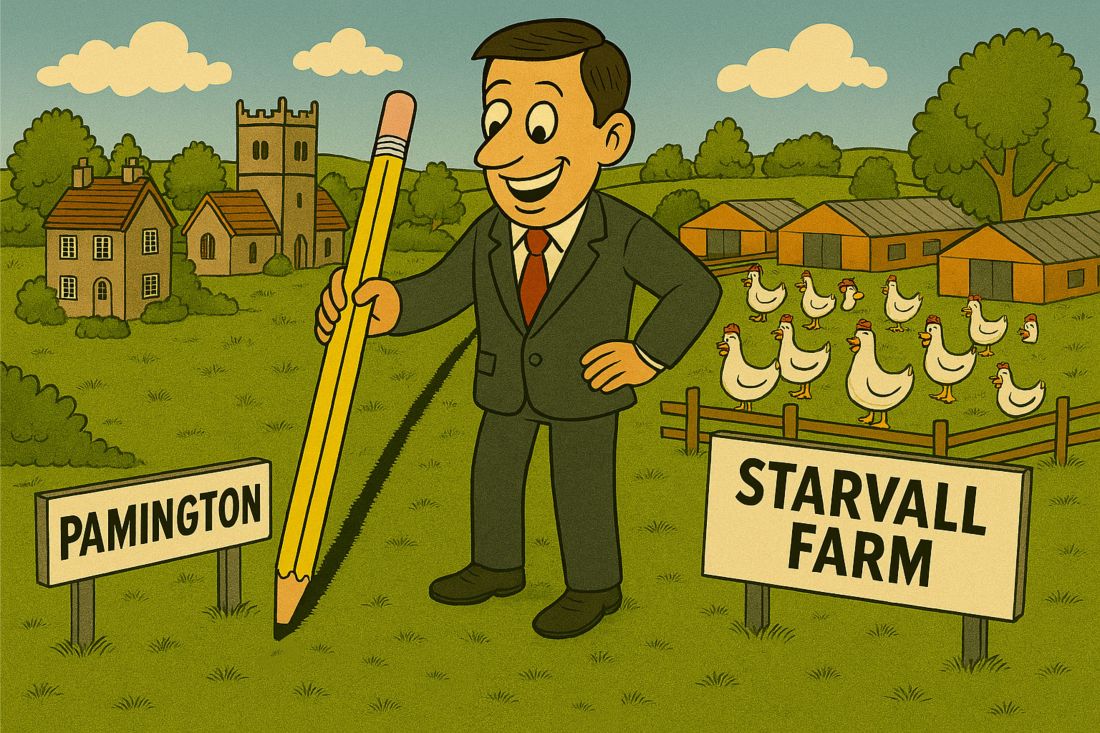
Starveall Chicken Farm & Pamington Village: A solution to the access issues is now genuinely possible

As many of you will by now be aware, I attended the Meeting of Ashchurch Rural Parish Council this evening and took the opportunity provided by the Council for me to give my Borough Councillor’s Report to provide the following announcement and information concerning the Chicken Farm at Starveall and the use of Starveall Lane:
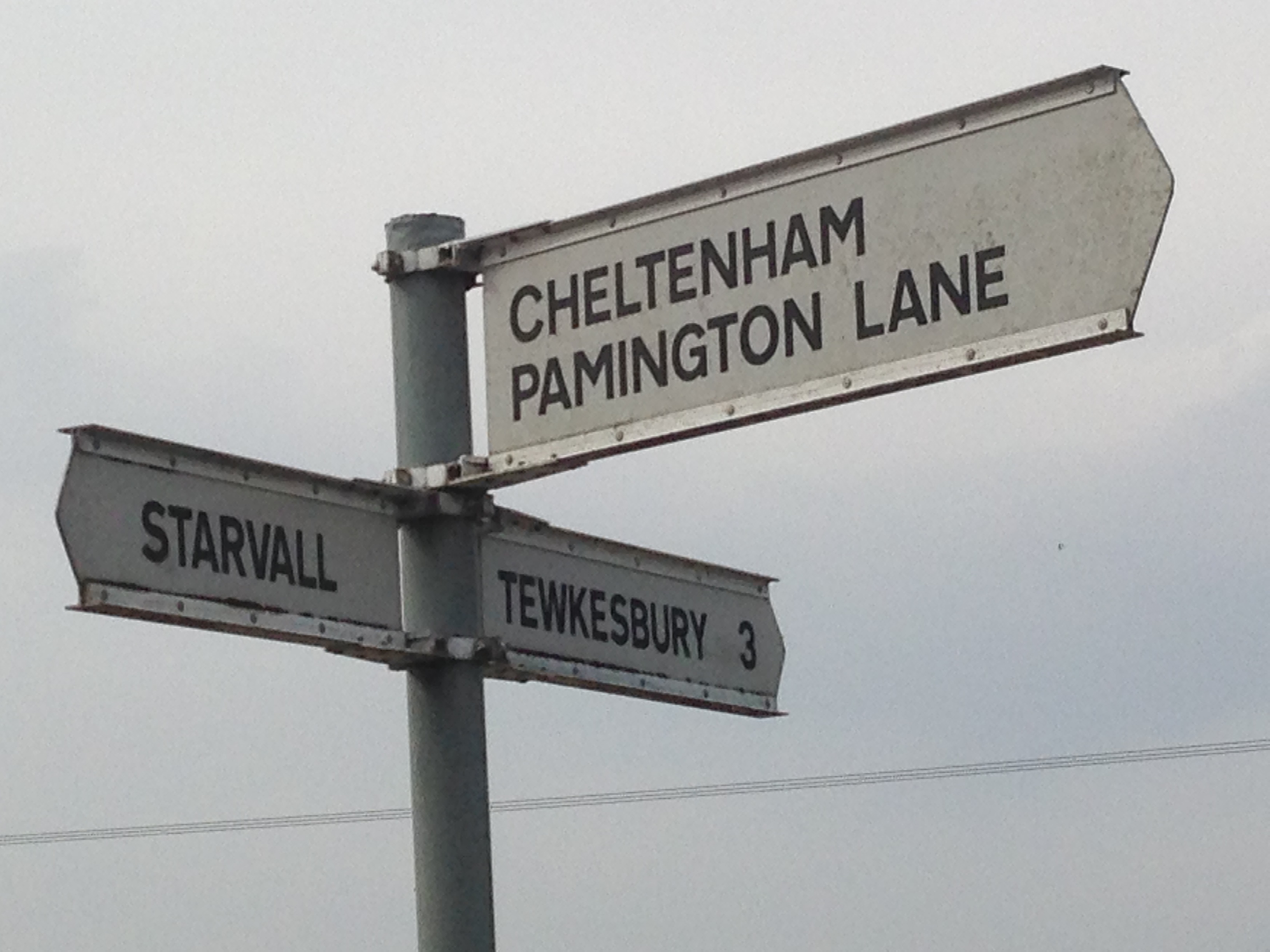
Starveall 10

Madam Chair, if I could beg your indulgence, the news and information that I would like to share with both the Council and those Residents present may take me a few minutes more to cover than I would normally need for normal Borough business.

I do however feel that given the very specific circumstances and nature of the matter, this is perhaps the best place and time to bring this to everyone’s attention and feel sure that in a just a few minutes time you will agree with and understand my reasons for doing so.

To all of you listening, I would respectfully ask that you let me cover all the points I have ready to give you tonight before asking questions or making comments.

I will attempt to cover all eventualities that I am aware of within what I am about to say. I will also publish the full version of this on my Blog later this evening and make a copy available to the Parish Clerk for inclusion in the Minutes of this evenings Meeting.

Madam Chair, Councillors, Ladies & Gentlemen; over recent weeks and for a good time before, it would be fair to say that there has been an incredible amount of frustration, disbelief and dare I say it, bad feeling amongst many concerning both the Plans for a Chicken Farm at Starveall, and the change in use and anticipated reconstruction of Starveall Lane.

Before I go any further with what I have to say, I must with some regret make very clear right now that whatever happens as a result of this Meeting and the content discussed herein, there is currently no Legal device or approach that any one of us can now employ that would guarantee that the construction of the Chicken Unit at Starveall itself will not go ahead.

Indeed, many of the people present have learned through the process of this specific Application that the Planning system is arguably very detached from the realities of the issues which affect local people and the localities in which they live. We would probably all agree that our experiences to date well and truly give the lie to the concept of Localism in its strictest sense.

The fact is that the Planning system is arbitrary at best and the injustices of this one-size-fits-all approach to development are amplified beyond any reasonable doubt by the indifference demonstrated by political groups and their Members within Local Authorities who now make decisions based upon what they perceive to be the inevitability of a situation, rather than giving a voice to issues which in just one situation like this one in Pamington might bring about positive changes for the many more planning applications which will affect communities across the Country to come.

It’s wrong, but it’s real and I now have to ask for you all to accept that with Planning Granted, the Chicken Farm itself will most definitely be built, and as things currently stand, Starveall Lane will be developed and all poultry related traffic will come down Pamington Lane from the A46 and then use a heavily reconstructed and covered-over Lane that has until now provided pleasure for far too many people to mention, over a period which extends way beyond the lifetimes of any person in this room.

So with this in mind, you will now most likely be wondering what cheery news I as your Borough Councillor could possibly bring to this table that would make my request for you all to come this evening in any way necessary.

I can only begin by saying that in Planning terms, rarely does the opportunity for a Community such as this to get a ‘second bite of the cherry’ after the gavel of planning-permission-granted has fallen.

Whilst the Chicken Farm itself must now be considered a fait accompli in real terms, I can now tell you all that this is not the case as far as the use of Starveall Lane is concerned.

I must in fact tell you that there is now a very real second and alternative option that I am about to table to you this evening, which has the potential to take all of the poultry related traffic well away from the Village and thereby change the whole dynamic of what has become a very dark situation that we as a community have until today faced for some weeks without any hope of change.

Some people will be historically aware that the possibility of building an access route away from the Village was originally a consideration of FC Jones & Co and the Partner taking responsibility for this Development specifically, Mr Kinsey Hern.

However at that time – which we are talking about in terms of years, rather than days or months – and I will add, somewhat understandably, there was perhaps no will on the part of anyone opposed to the plans to take any action which might in someway suggest acquiescence or indeed support for the construction of the Chicken Farm – which as I am at pains again to say is now an eventuality that we cannot in any way influence.

It was therefore perhaps always assumed thereafter, that access would depend on the use of Starveall Lane, which I now believe it fair to say has become a much bigger issue in Pamington than the Farm itself and especially so after it became clear that whilst any potential breach of the terms of the Planning could instantly be seized upon, there was in reality absolutely no way that any of us can prevent the changes coming to the Lane, unless Mr Hern should himself consider doing so, which today Ladies and Gentleman I am very pleased to be able to tell you that he and his Partners are willing to do.

I have delayed requesting the opportunity to discuss this possibility with you all until I had reached a stage through a series of discussions and meetings, where I have found myself confident beyond the balance of probability that what is now being tabled represents the very best solution for Pamington, when everything is put completely in context – something that I will now aim to do for all of you.

I will cover the points of the proposed alternative. I will then discuss the issues that this may raise. I will then consider the ways that these further issues may well be addressed and will add right now that this will actually be in ways which are certainly not located behind closed doors.

The Proposal:

1.) To seek permission to build a completely new track or roadway running East from the Chicken Farm site. Immediately beneath the Southern property boundary of Pamington Court Farm and exiting or joining the B4079 on the second of the Severn Bends as you travel North from the A435.
2.) To seek an amendment of Condition 10 of the existing Planning Permission concerning Hours of Operation from the existing 7am to 9pm for deliveries and collections excluding Sundays and Bank Holidays so that there can be:

  • Access for deliveries between 7am and 9pm Monday to Friday, 8am to 1pm Saturdays and under exceptional circumstances, that these be allowed to take place on Saturday afternoons, Sundays or indeed Bank Holidays if for any reason the feed supply chain should have broken down – for instance there is literally a break down at the feed mill which interferes with what I understand to be quite a precisely coordinated delivery and supply operation.
  • Access for collections only be given flexibility to allow for activity outside these times to include during the night. This would I understand equate to no more than 20 nights out of 365 other than in the most exceptional of circumstances.
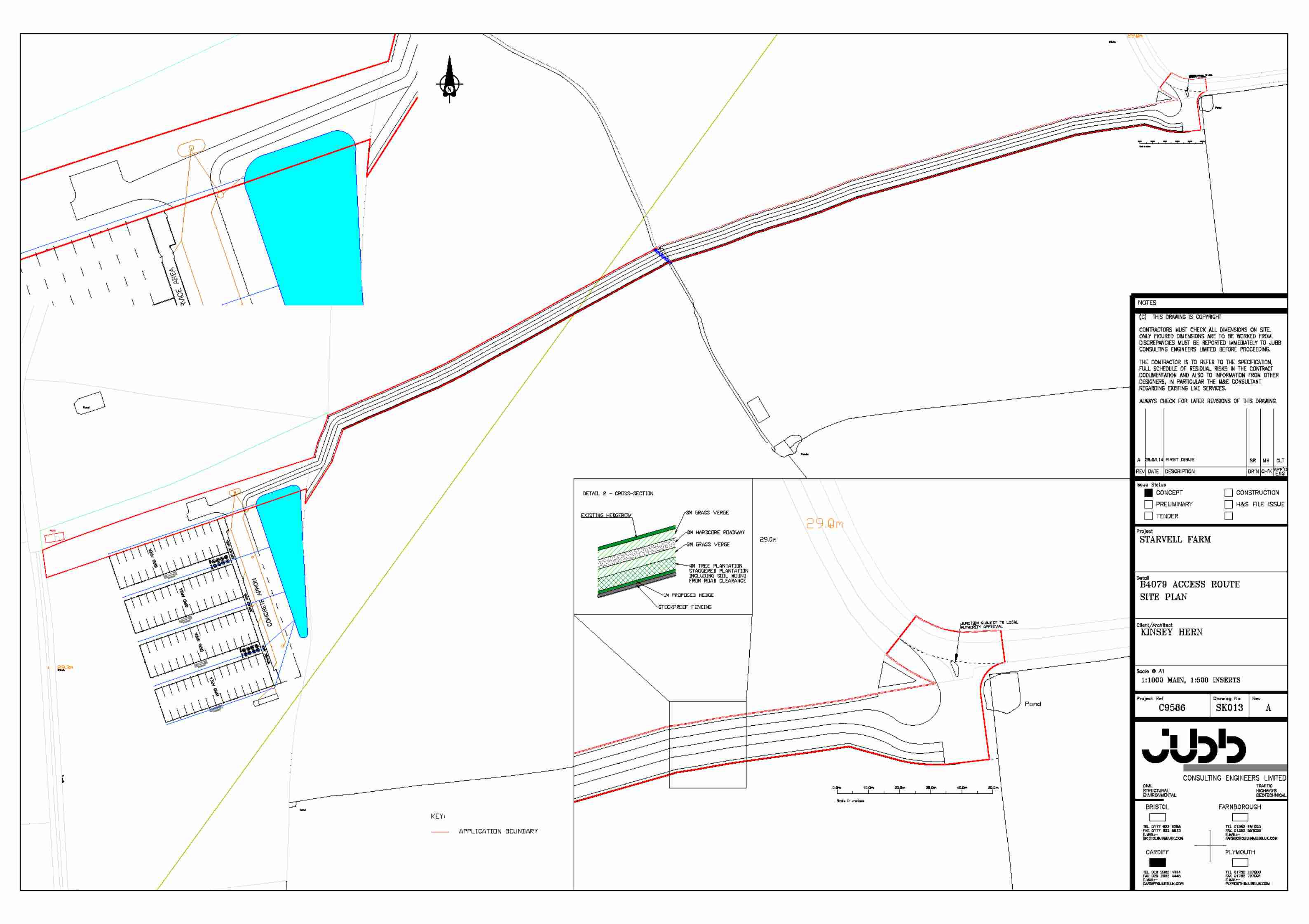
Copyright FC Jones & Co. Diagram reproduced for information purposes only and should only be considered as a guide and not as an authoritative source. Information is subject to change.

The issues:

  • Building this track or roadway without the involvement of any other land purchase – however small, will I understand require a left-handed exit from the proposed trackway or roadway to the B4079.
  • This specific eventuality will I understand require all poultry related traffic to exit and potentially enter the site via the Eastern edge of Pamington, travelling to and possibly from Aston Cross.
  • This would inevitably lead to the poultry related traffic travelling along the Eastern fringes of Pamington Village on at least the Northern journey which essentially moves a critical aspect of the problem from one end of the Village to the other – albeit with more appropriate road access and the added dimension that lorries would be moving slower in consideration of animal welfare issues – but with the requirement and therefore acceptance of greater flexibility of the times when HGV’s would be accessing the Chicken Farm.

It is safe to say that Residents at one end of the Village will therefore be breathing a great sigh of relief at the prospect of what the proposal on the table brings. However, its coming to fruition without any adjustment would inevitably lead to as much concern – if not more – for residents at the other.

Addressing the issues:

The reality of and chronology of the events which have led us to this point are difficult to describe as they include many different perspectives and have clearly caused varying levels of distress to many Residents, which as your Borough Councillor have concerned me greatly throughout.

Indeed I regret that I was only given the opportunity to interject fully in the period immediately before the Application first went to the Borough’s Planning Committee and at a point where there was really little more that I could do but advise on what was most likely to happen given the information I had available to me at the time.

Nonetheless, I have taken every opportunity, as I might add has Councillor Gordon Shurmer who also became involved at a similar time, to explore every possibility and approach which has remained, even after Permission was granted. This itself has latterly led me into dialogue with Mr Hern and the position I find myself in here today.

Fundamentally, the proposal on the table is a better option just as it stands right now for the Village, given everything that I know and understand to date.

For this reason I would ask that you all understand that I will have to be supportive of it in the sense that if it can be achieved – it will be a far better solution and situation for the Village as a whole, rather than the conclusion which will otherwise be faced by the people in this Village who I represent.

However, I am not overlooking the very real impact that the proposal will have on Residents at the Eastern end of the Village and I have to say that somewhat thankfully, neither is Mr Hern, who both accepts, would like and is prepared to undertake the work necessary to build an entrance and exit to the proposed trackway or roadway which I understand would then require all HGV traffic to avoid the Village completely and route it to the A435, thereby removing the poultry related vehicles and the subsequent threat of noise from Pamington completely.
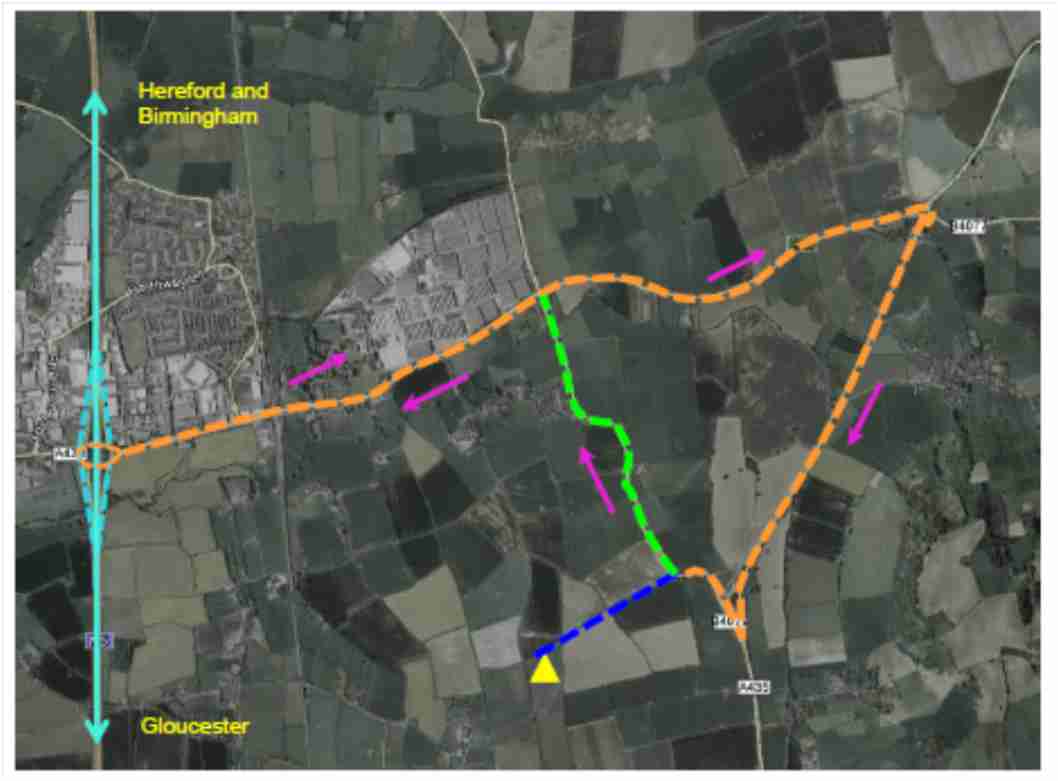
Image courtesy of FC Jones & Co. For information and guidance purposes only.

This however will require bridges to be built where today and for some of us present there will be very little will to do so.

To make it work, there will need to be a level of direct engagement and dialogue which rises above the personal feelings of animosity and grievance that I know and understand to exist, and recognises that there is a solution which through collaborative working and a spirit of getting the very best from this situation for everyone in the Village as it stands – can actually be achieved.

In very basic terms, this much better solution is dependent really upon just one thing.

Were it to be the case that more land were available for purchase – which is basically a relatively small triangular area at the West side of the proposed entrance and exit to the track or roadway, I have been given a commitment that subject again to the obvious approvals, FC Jones & Son would not only be willing to change the proposals for a left-hand exit from the site, they would also be happy to develop the entrance so that it is geared for HGV access and egress to the A435, and to as such take all steps necessary to make this happen.

So before I go any further, I would like to at this point make clear that I believe that if this can be achieved and gain the necessary approval, this solution should be seen as an even bigger positive step beyond the proposal already on the table, which itself should really be viewed in context as a gift to the Village when all things are considered.

Taking the proposals that one step further is akin to a quantum leap from the situation that on arrival at this Meeting, many of you will still have been expecting that the Village was guaranteed to face for the future and we would all perhaps be well served in attempting to find benefit from an appreciation of that.

For just that reason alone, I will be happy to facilitate any discussions necessary to achieve this aim on the understanding that the good will which is now clearly evident will be reciprocated on all sides and that there is a genuine desire on the part of all involved to get a solution which is genuinely the very best that we can achieve in the circumstances for everyone in Pamington.

The trade off:

The reality of this situation is that you, the Villagers want Heavy Goods Traffic kept as far away from the Village as possible and certainly off Starveall Lane, which it is safe to say that everyone wishes to be maintained and kept in it’s current state indefinitely.

On the other hand, Mr Hern appreciates this and has by his own admission stated to me that he had never anticipated that the issues surrounding Starveall Lane would create the level of animosity that it has, and which he certainly acknowledges.

On one part, Mr Hern is very keen to address this situation in the hope of moving things positively forward with you all. I do believe he is genuine in his wish to do so and to take the opportunity to address the issues over Starveall Lane whilst he is also seeking to address some of his own concerns which relate to the restriction of flexibility for what is effectively a 24/7, 365 day a year business, which may even seem less intense in terms of HGV access journeys through the area with the amendment for Hours of Operation that he would in parallel be seeking.

Beyond the stage we are here at today, Mr Hern is furthermore prepared to go the full distance – subject to the necessary support and permission being given or granted – and give us all a solution which resolves issues which otherwise and subject to the choices of people in this room, could still remain completely unresolvable.

Even the proposal as it stands is not a cheap option for FC Jones & Co financially and when all aspects of constructing a completely new trackway or roadway are considered, the financial cost will I understand be around double that which it will be to resurface Starveall Lane and place passing areas in Pamington Lane – which I must stress will remain the course of action if either alternative should for any reason prove not to be viable.

Any environmental consideration such as loss of existing hedging will be more than offset by a planned planting scheme which would cover the entire length of the new trackway or roadway and I understand this goes way beyond the expectation of what would be required in these circumstances.

However, probably one of the biggest wins as a result of seeing this proposal through is that the Applicant has made the commitment following the receipt of advice given by Tewkesbury Borough Planning Officers that in receipt of and as part of the process of Planning Permission being granted to build the track or roadway in either format, FC Jones & Co will enter into what I understand to be a commitment that would be facilitated through what is known as a Unilateral Undertaking under the Planning Act to rescind all rights of access for poultry related traffic on and along Starveall Lane.

I hope you will all agree that this is not an offer to be taken in any way lightly.

The current situation:

As we meet here tonight, I can now tell you that considerable effort has been going on behind the scenes and especially so over the past two to three weeks.

This has involved not only Mr Hern and his Advisors who I can now tell you have made considerable inroads towards these Proposals in terms of ecological surveys, land purchase and traffic surveys.

Approaches have also been made to the various Agencies with required involvement such as Gloucestershire Highways and although they would of course be consulted formally as part of the Application process which will be necessary, I understand that in principle there are unlikely to be objections to either form of the Proposal based on what is known to me at this moment in time.

The efforts to date have also involved considerable input and advice from Borough Officers who have helped me with my work on this in what have been far from day-to-day circumstances. My thanks goes to all of them for taking on board the comments and concerns that I have raised in respect of the previous Application process and the subsequent approach taken to dealing with all issues, which regrettably may not be fully apparent to all of you at this stage.

The proposal – as it stands with access travelling via the East of Pamington – is basically ready to go.

It has however been held up by Mr Hern at my request, so that I could bring this before you all today in the hope that we can together hopefully find the necessary will and means to facilitate a position where the Applicant can pursue the very best option for everyone concerned,  with access to and from the A435.

Without change and therefore your support, it is currently planned for this Proposal to be submitted this Wednesday as a full Planning Application to Tewkesbury Borough Council. On this basis you will therefore appreciate how quickly we will need to work together with Mr Hern to take the additional steps necessary and for a genuine commitment to be made to doing so in order for the process to be held up that bit longer whilst any further accommodations are dealt with and put in place for the benefit of all concerned.

Conclusion:

I have little option but to say that Pamington has what is genuinely and in effect the opportunity to get the very best possible out of a bad deal.

I know that you don’t want the Chicken Farm at Starveall, but that ship has well and truly sailed.

What we have on the table here represents what in these circumstances is the silver bullet that I know many of you and not least of all The Hill Family and Pamington Residents Association have been looking for over a period of many painful weeks and months.

I have taken the time to look at and consider all of this and even gone as far as to approach Mr Hern concerning remedies for the damage on Starveall Lane which has caused such recent levels of concern.

Even though this specific matter itself would normally be an issue for Gloucestershire Highways, given our understanding of some of those involved and the way the process works, it may take many weeks to obtain a result which could otherwise be delivered much sooner and potentially in a much more agreeable way.

I am confident that with your support, a new approach is now possible and imminently achievable which will as good as sort this one issue out in perhaps just the few days to come, whilst potentially giving everyone the sleep filled nights that I am sure you are now after as part of a much bigger and much happier solution for all.

I must conclude by stressing that nothing I have tabled here today is in any way guaranteed.

It is subject to a great many things, not least of all the support of you all in principle and throughout the necessary Legal processes which must be cleared in response to the proposals which will be made.

It will inevitably require from some of you a willingness to engage in dialogue which nobody will believe will in the first instance to be easy, but if done fairly and considerately, will benefit each and every one of the people here and within the wider community which is involved.

Without support of any kind, there remains a very good chance that Starveall Lane will soon be in use as a quasi-industrial roadway.

With just a little will and support, we might see Starveall Lane saved and traffic moved to the East of the Village.

However with all the support given that we all can possibly provide, there is a genuine chance that Starveall Lane will remain just the same, and what is more, that Pamington will never have to witness the poultry related traffic travelling to or from the Chicken Farm whilst it is built or for the period of its operation thereafter.

I can only end by asking you all most sincerely to see this opportunity for what it really is, and consider how I am sure you were all feeling about this before I began speaking.

Thank you all.


Update:

From the response at the Meeting there is clearly support to move forward and after initial conversations with both Mr Hill and Mr Hern, the first Meeting to discuss next stages is likely to take place in the next couple of days.

Thank you for your support.


Flooding: It’s wet, getting wetter and the funds are drying up. Government Reform and Policy change is the only way to get all the protection that we need and that process must start now

Flooding and the affects that it can have on all of us has been a consistent theme since the very beginning of my time as a local Councillor near Tewkesbury.

In July-August 2007, Adam spent over 2 weeks coordinating and delivering bottled water across the Ashchurch with Walton Cardiff Ward. Pictured here in Pamington delivering to the service point set up by then County Councillor Gordon Shurmer
In July-August 2007, Adam spent over 2 weeks coordinating and delivering drinking water supplies across the Ashchurch with Walton Cardiff Ward. Pictured in Pamington unloading at a service point set up by then County Cllr Gordon Shurmer

If you come from outside the immediate area, memories of the summer of 2007 and the notoriety of the July ‘Floods’ in Gloucestershire tend to focus attention more on the water shortages that hit the County for those who still remember, rather than the significant and extremely rapid flooding event responsible which took place in just one day on Friday 20th July 2007.

In less than 48 hours, the life that we all so easily take for granted was compromised. Not because of a war, famine or catastrophic crash of our economy, but because the drinking water in our taps was literally switched off when flood water polluted the tanks at the Mythe Water Treatment Plant near Tewkesbury. These floods suddenly affected everyone, and not just those who had been flooded out; many of whom were themselves within whole neighbourhoods where river torrents coming through your home would normally be the very last thing on your mind on a midsummer day.

The complacency and complete lack of urgency demonstrated by officials that follows an event of this magnitude when life is perceived to be ‘back to normal’ is a strange thing to deal with if you have had firsthand experience of it. But this is exactly what people in Tewkesbury and the surrounding Villages have had to frustratingly deal with ever since and what the people of the Somerset Levels have clearly had to endure now too.

Sadly, Towns, Villages, Hamlets, Communities and Businesses simply at risk of flooding don’t have the newsworthiness of water in the way it does when it literally covers the ground. This is a real problem for anyone living with the realities of these events as news teams seldom camp out for anything good. Most people would much prefer not to have the camera crews taking up semi-permanent residence ever again to report such stories. But it seems that it will take exactly that to happen before any sense of urgency to deal with existing and weather-changing threats or those that Developers may indeed be creating, will be adequately addressed.

Taking nothing away from the many people who spent up to a year living in caravans on their driveways after the 2007 pluvial ‘event’ who now also have insurance ‘blight’ as a result, some areas around Tewkesbury and Gloucester such as the historic Village of Walton Cardiff in the Ashchurch with Walton Cardiff Ward that I represent regularly have to face the prospect of river or fluvial flooding too.

Residents there have sadly come to be so used to it, that one homeowner with the means to do so has even bought an amphibious buggy which he uses to help other Residents when the roads become impassable. Whilst community-minded in the extreme, I will probably be far from alone in having concerns that such acts are taken by Government Politicians to mean that there is a general acceptance on the part of those living with the risk of flooding that they are simply happy with the status quo. Let me tell you; they aren’t.

The constant threat of both types of flooding is never far from the minds of those whose homes are at risk of either the flooding that it is ‘reasonable’ to expect, or that which ‘normal’ disaster planning doesn’t allow for that comes in the form of events that the Environment Agency and other Organisations communicate in terms such as ‘a one in a hundred year event’.

The problem is that the Floods in question aren’t only happening once every one hundred years or whatever the particular ‘banding’ may be and the type of lottery derived statistics that are being used as this benchmark for support to our communities is now proving to be a form of gamble that’s only paying off for those who are most distant from the problem.

There are actually some very painful realities sitting behind the lack of support for our communities. Getting the results that we all need relies on a significant number of issues needing to be addressed and whilst I have no intention of dismissing the action that the Prime Minister and Eric Pickles are now reactively taking to the Somerset problems in particular, it is only by dealing with all the problems comprehensively – and accepting that matters which on the face of it have little to do with Flooding also have an effect – that there will ever be any genuine first and meaningful steps to dealing with this situation in its truest depth.

The interactive nature of these contributory issues with other seemingly non-related Policies make statements like that made by the the Environment Agency Head Lord Smith last week potentially misleading. Suggesting that there may be a hard choice to be made over whether we protect Towns and Cities or Rural Areas is arguably very subjective indeed. Whilst in the sense of funding for defence and maintenance work accurate, a statement like this doesn’t take into consideration the other contributory issues that come with it. The issues include:

Funding

In isolation, we can all easily draw the conclusion that solving Flood Defence problems is just about the money that Local Authorities, Central Government Departments and Non Government Organisations such as the Environment Agency have to spend. But it isn’t.

Essentially any work that is undertaken does have to be paid for by the public purse as Flood Prevention is fundamentally in the public interest. However, the days when such an issue in itself was enough to trigger an immediate and responsive spend on a ‘size doesn’t matter’ basis has long gone – if it ever actually existed before in anything other than wartime.

The problem for us today is that the Country is now effectively bankrupt after generations of profligate spending by Government on Policies which are considered populist only in the sense of the number of votes that they will win. They should have been in the best interests of the wider community – which is arguably how every political decision should actually be made.

Budgets are and will most likely continue to be cut from all Publicly Funded Organisations and will continue to do so whilst the gargantuan plate-spinning effort to keep the Economy and Public Spending from smashing on the floor continues. Lack of discussion and reference to the National Debt, whilst overplay on the prospect of reaching a zero Deficit in maybe a few years time is a key indicator of the high stakes game that is already well in play. Any upward change in spending that might come from a change in Government could actually bring matters to a conclusion even sooner.

The £100 Million promised just to the Somerset Levels alone this week might sound like a lot of money to those struggling to survive on an average wage. But in real terms and without any unfortunate pun intended, it is in reality a mere drop in the ocean of the fund that would actually be needed to cover the cost of protecting the UK against Flooding if no other options were to be genuinely considered.

Painful as it is to accept, the fact is that without significant change in the way that all parts of Government raise and spend money, there will never be anywhere near enough funds to address the Flooding problems with a cash only solution and Government really needs to start being straight with people about this.

Planning

Prevention is almost certainly better than waiting to work on a cure. Whilst many people who have experience of a Flood Event will already have significant anecdotal evidence to illustrate how building on flood plains has exacerbated the problems that we already face, it is the Planning Policies and Procedures which exist today that provide part of the greatest threat to both individual properties and whole communities.

Unloading water at the Wheatpieces Community Centre, Walton Cardiff, near Tewkesbury, following the July 2007 Floods
Unloading bottled drinking water at the Wheatpieces Community Centre, Walton Cardiff, near Tewkesbury, following the July 2007 Floods

A good example is that Planning Policy arguably only takes fluvial flooding into account, the effects of which themselves can open to the bizarrest forms of interpretation possible. A case which demonstrates this well would be the Wheatpieces Development within my Ward, some of which is well known locally to have been built on what was mapped historically as flood plain. However, I understand that it is not considered to be as such for Planning purposes by the Environment Agency – and therefore Planners – because the houses built on these areas were erected on built up land or infill which when the earthworks were completed then complied with the requirement of being the required ground level height above Ordnance Datum Newlyn, which I also understand was at the time of Permission being granted, some 12 Feet.

Such an undertaking is for current Planning purposes apparently enough to quantify that a development has not been constructed on Floodplain, but then gives sparse consideration for the knock on effects that creating an island in the middle of natures own flood remedy will have had on properties that would otherwise have been at significantly less risk of flooding. Build as many reed beds and flood tanks under a new development as you like, but when storms of the nature we are now experiencing come in the increasingly menacing way that they do, such developments can be akin to dropping a breeze block into an overflowing bath.

Some will call it cynical to say this, but evidence strongly suggests that the deficiencies in Planning Policy today leave existing homes and developments open to threat from the increased risk of flooding which is created by new developments – the properties upon which are unlikely to face the same threat. Couple this with the headlong rush by successive governments to build houses as the silver bullet to solve all ills, and you might begin to realise the level of threat that a Planning Policy which does not consider the whole picture has actually become. Planning Policy isn’t actually working in the best interests of anybody other than the Politicians, builders and companies that lend people the money to buy the new houses.

The irresponsibility of the Government and Opposition in hanging the fate of the Economy and those desperate for affordable homes on house building is not only fueling the growth of an already uncontrollable credit bubble; it is also determining a fate of misery and loss to the owners and occupants for many existing homes who will almost certainly be put at greater risk of flooding.

The role of ‘Respondents’ of the Planning Process

Symptomatic of our correctness culture has been the exponential rise of the Quango and distribution of powers to what are non-elected Bodies, some of whom don’t even report to Government Ministers. A number of these are involved in both the Planning system as ‘Respondents’, but also within the other processes which relate to Flood Prevention.

A great weight of responsibility has been given to many of these Organisations and their opinion, view or interpretation of their Policy in relation to specific cases and subsequently are seen to have what can sometimes feel like limitless power to those who have witnessed it.

Alone, their objections can halt an application on the spot, whilst the absence of an objection from any such Respondent can and does lead Members of Planning Committees to conclude that objecting to an application is little more than a futile act, as with these agencies not objecting, a Planning Inspector will surely approve it should the Application then go to Appeal.

With all working to very centralised; one-size-fits-all Policies which are without any real consideration for the very localised issues that the Planning System does encounter and specifically Flooding issues, the realities of the influence that these bureaucratic entities have is significant. Developers know that if they table Applications that effectively tick all the boxes that each of these Organisations have on their checklists, Local Authority Planning Committees simply won’t have a prayer if a developer then takes a rejection to Appeal  – which they rarely have hesitation in doing so.

The influence that these Organisations have over the Planning Process is simply too much and is at best an arbitrary way of dealing with what are ever increasingly sensitive issues that require a level of interpretation, consideration and understanding which genuinely reflects locality and the concept of Localism that the Coalition Government has done so much to sell itself upon.

Maintenance – when money isn’t a problem

The Environment Agency once again plays a critical role in the preventative maintenance which is already or should already be undertaken on watercourses and rivers, as do Local Borough, District, County and Unitary Authorities that have Drainage responsibilities.

The often complex relationships or rather chain of decision making that arises as a result of multiple organisations or ‘stakeholders’ being involved in a decision relating to Flood Prevention will almost always cause delays, or worse still, like the Planning Process, will result in one of them being perceived to carry more weight, and for the buck to effectively stop with them. In a compensation and blame culture, taking action actually appears to be the very last thing on the mind of the Representatives of these Organisations, and this can serve no purpose other than their own.

Sadly I do not recall one conversation with Residents or indeed other Politicians which has reflected positively upon the work of the Environment Agency. I have spoken to Farmers who have watercourses and rivers crossing their properties and most look back comparatively fondly on one of the forerunners of the Environment Agency, the National Rivers Authority (NRA) which is remembered for a much more proactive, less obstructive and therefore constructive approach to clearance and dredging.

I can remember seeing specially modified tractors working the banks of the contributory rivers to the Severn during the period of the NRA’s tenure and it is clear that anecdotal evidence of the benefit of such work correlates well with a period when fluvial flooding seemed to affect a whole lot less of the area.

The NRA itself adopted the responsibilities which were once included within the portfolio of the ten former Regional Water Authorities with what we now know to be this expensive, but critical form of work not being adopted by the privatised Water Companies. One could easily conclude that the formation of the Environment Agency and absorption of the NRA within it in 1996 was seen as the ideal time to cut back on proactive and costly Flood Prevention works and that this may have been considered a much safer time to do so rather than the late Eighties when Privatisation itself took place.

I will add that one of my own experiences of questioning an Environment Agency Representative during a post-flood seminar held at Tewkesbury Abbey in the weeks following the 2007 Flood, I can honestly say that I found the responses given to my questions on dredging and clearance to be conflicting. I walked away with the distinct impression that giving excuses rather than any meaningful response was the chosen modus operandi  of this Organisation – even when they might have honestly said  ‘there isn’t the money available’.

Distance and lack of situational objectivity on the part of decision makers

Flooding is an issue that is simply not recognised for the problem that it is right now, has been and will be by Government and the Staff of the Organisations that matter. People making  decisions do not have the first hand knowledge or exposure not only to the Flood incidents themselves, but to what can be the very localised nature of the contributory factors as they exist today and how they may come into play as the result of apparently unleashed development.

Officers of all the Organisations discussed who may be rightly and properly qualified to be called experts arguably don’t use their expertise in the way that the public should rightly expect. Tick box decision making appears to have replaced that of using common sense and recognising the need to seek the fullest perspective, arguably for little more reason than the threat which comes from taking responsibility within the protectionist culture which is now an inherent part of Government Administration.

The earlier system of buck-passing which grew decision making into a very expensive system of ‘one-job, one-role; keep passing it on until we can justify engaging a consultant’, has systematically inflated the size of ‘back room operations’, and taken money that was available away from frontline service delivery, where ironically as a result, the need for even more precise and robust decision making becomes ever more critical. We can all see the results.

The Weather

There is no question that weather patterns are changing. We don’t however know if this is due to a phenomenon like global warming, or whether it is actually part of very extensive climate changing cycles which have affected the earth historically, and which there is evidence to suggest might be the case.

Whatever the cause, it is clear that Government and the Organisations involved have not developed a proactive bias to Flood Prevention measures and that the approach taken is far more reactive in nature. It is what could easily be called ‘out of site; out of mind’ management, as work only seems to be concentrated on issues which are in the Public view – or can be guaranteed to be regularly so.

Many will probably be quietly asking whether the ‘intensity’ of effort now focussing on Somerset will for instance continue once the roads are passable and life is deemed to have returned to ‘normal’.

These are apparently ‘irregular’ events after all. But it was indeed telling that the Military first arrived in the form of just two Personnel who apparently decided that there was nothing at that point which they could do. Given that much of the amphibious and landing–type craft which could at very least help these stranded Communities are likely to be based with Royal Marine and Royal Naval Units in the South and South West anyway, should it really have been that difficult to put some of these vehicles on low-loading lorries and get them to the Levels within a few hours? 

Either way, attitudes must change even if the funds are limited. Government has been entrusted with great power on our behalf along with the responsibility to use it. So why aren’t they?

The painful reality is that there are likely to be other contributory factors that I and certainly others are not aware of, but which are important all the same.

Money is the overriding factor which has, is and will continue to inhibit the development of capital flood defence projects whether they are inland, riverside or on the coast and there is a danger that neither the realistic sums which could be raised for these projects, nor the changes in the many other policy areas that could positively assist will come into being unless there is a complete change in the way that Politicians assess, develop and then act upon their priorities.

Tewkesbury in Flood. Image thanks to www.theguardian.com
Tewkesbury in Flood. Image thanks to http://www.theguardian.com

As we have seen in Tewkesbury with the effect on water supply; in Devon with the effect on Railways and in Somerset with the effect upon land and roads; doing nothing places critical Infrastructure at risk. So funnelling truckloads of borrowed cash into any service or benefit that will put around 350 MP’s or more in power for the next five years when all they will then do is think about doing the same again – all to the incalculable cost of the majority of Taxpayers – can simply no longer be sustained.

With money being the problem that the Government doesn’t want to talk about, it is unlikely that any Minister will stand up any time soon and simply say ‘we don’t have the money to do all the work that needs doing’. Even less likely would be finding one of them saying and actually meaning ‘we don’t have all the money, but we will make all the changes that we possibly can which will serve all of your interests’ best’.

When these Politicians have moved past the sound bites, the portrayals of being belated men of action and giving hollow apologies when pinned down by interviewers, the best advice any Politician could now take would be to stop treating the Electorate like they are idiots and that the issues facing Government are beyond their understanding.

Good communication crosses all barriers and honesty coupled with the emotional intelligence that can only be utilised by those who are fully ‘in touch’ with issues will surely build the foundations of a wholly different kind of support. They might start by:

Listening Locally

It will be in everyone’s interests to develop a culture where local voices are heard even when they don’t have the profile of people like Michael Eavis, the founder of the Glastonbury Festival who wrote a very useful and telling article in the Mail on Sunday on 2nd February 2014.

Mr Eavis brought precisely the kind of invaluable and historical knowledge of the Somerset Levels to the table that no doubt many people could, if they were given the opportunity to do so.

Too much useful information is discounted because of the emotional buy-in that often accompanies very local issues and which is often badged as being Nimby-ism. Yes, there are people who will say no to everything simply because they don’t want change or others who make demands simply because they want something for themselves. But applying this very negative and destructive view on anyone who is promoting a local view, without taking adequate steps to discern the value from what they may be saying, is ultimately selling everyone short and is far from the hallmark of a fully enlightened form of Politics.

Reforming the Planning System and creating Local Planning Courts to make Localism really mean something and empower local people in the process

In the absence of the money that we need being available without either borrowing or taking money from services which may actually be invaluable elsewhere, Planning and its reform will be a key factor in proactively addressing future Flood Events.

Power of veto – whether negative or indeed positive, should never be held in the hands of unelected bureaucrats or people who are neither trained nor prepared to make decisions which truly reflect the very localised and area specific issues which relate to flooding.

We must move away from tick-box decision making which brings little more than the one-size-fits-all mentality to almost every Planning Application that will have an affect on the wider community and particularly so when it comes to Flooding.

Agencies and Local Authorities should inform, but ultimately not define the planning process and the only eventuality in which Government Ministers should intervene should be at moments when the genuine National interest overrides that of the local community and those who will be directly impacted by developments within it.

This could be done by transferring all Planning Decisions to a local ‘Planning Court’, in which evidence could be given by the Applicants, all respondents and interested parties to a Judge or panel, but where the power of appeal is limited to the same or a similarly localised Court, and where the Policies upon which decisions are based are those developed democratically by the Local Council’s themselves.

Such a process would be much more tailored to localised needs and allow and encourage Agencies to advise rather than administer, and leave people feeling much more empowered when it comes to their fate. It would also give the opportunity to consider new forms of information that come available through advances in technology and understanding, such as up-to-date computerised flood or water behaviour mapping, which would allow considerations to be made for issues such as pluvial flooding, which is likely to become ever relevant.

Central Government would have its role to play in assisting this by changing all appropriate Policies to reflect a genuine need-led, rather than projected development requirement and bringing into being all forms of legislation to prevent economic reliance and profiteering from building developments and multiple property ownership which skews the market.

Moving responsibility for Preventative Maintenance back to the Water Companies

It seems incredible that dredging and maintenance didn’t remain the responsibility of the Water Companies after Privatisation, but now makes a great deal more sense as we begin to gain a better understanding of the true costs involved and the resistance of any private company to undertake work which may be in the public interest, but which itself is distinctly non-profitable in nature.

The Water Companies gain significant benefit from the use of rivers and watercourses both as a source of water and as a route of discharge for treated effluent which no longer has value in its current form. These Companies could once again be harnessed with the responsibility for all the services that they once were before Privatisation and thereby take a more commercial approach to long term flooding defence and maintenance provision, which it would seem most natural for them to do so.

With successive Governments already responsible for failing to adequately regulate the profiteering nature of these Companies, the risk that the transfer of this responsibility would be seen as just another opportunity to raise fees would be real. As such, this would be another vital area where Government would have policy making work to do, but where the blood and guts approach of a return to real conviction and end-user focus politics could really make a profound difference in future flooding risk, whilst also dealing with key components of the real cost of living crisis.

Government Reform to facilitate the Funding that can come from no other source

Ultimately, only significant capital spending of a level which the Country currently cannot afford would provide the sea defences, river defences and perhaps even dykes of the kind seen in the Netherlands that the UK may now actually need to protect against and limit existing threats that exist right now. And there is of course the requirement to ‘future-proof’ or to then prevent against the impact and escalation which comes from the changes in weather patterns.

The money to do this will never be available whilst Government spending continues on the levels based only upon election-focussed service provision and a benefits system which propagates legitimate abuse. The services which attract most public money are themselves at risk from the same black financial cloud hovering above us, but could be run far more cost effectively – and arguably at lower cost – with the kind of holistic, joined-up and end-user focus reform that so many services provided by Government now need. Public servants must be encouraged to move away from the ‘what’s will be the benefit or risk to me’ culture and start focussing on a ‘how we can do the best possible for Taxpayers’ culture instead.

Sticking plaster solutions are no answer either to Flooding issues or to the many other problems which the Government faces. Parliamentarians seem so unwilling to tackle complex policy making and reform for the greater good and meanwhile, almost everyone else suffers.

Getting to the place where communities need to be; a place where they feel safe, protected and able to maintain a basic standard of living that doesn’t require lending money or a compromise of the services that they should be able to expect is a long and tough journey.  People must again be trusted locally by Parliamentarians and empowered to deal with the matters which relate only to their own fate, without centralised Policy or non-elected bureaucrats being able to override them.

A Coalition Government will never be equipped to even begin taking the steps which will be necessary to achieve this because they are by their very nature a relationship built upon compromise. You will never get the very best solution for all when a compromise has been necessary.

We can only hope that the next Government will take their responsibilities to all of us far more seriously. But with things looking as they are, it may not happen next time either.

See Adam’s related Blogs on:

Flooding

Dealing with the Energy Companies

Why the Political focus on house building is wrong

The Real Cost of Living Crisis

The influence of Utility Providers on the cost of living

Building on the Greenbelt could be avoided if Politicians were prepared to tackle the causes of Housing Crisis head on. Their failure to do so may leave many of these new homes empty and not just immigrants living in modern-day slums which are currently known as ‘beds in sheds’…

On a day that the reality of modern day, back-garden ‘beds-in-sheds’ or rather the slums springing up across the UK to house immigrants hit the pages, we also see the news that more than half of Councils plan to build on our green belt.

You may be forgiven for thinking that there is an obvious link. But the only real relationship between these two issues – neither of which should arguably have ever have become fact, is that they provide a very telling story not only about the excessive cost of housing, but also the very painful reality that members of our communities from one end to the other are being overlooked by Government Policy.

In a recent blog, I discussed the issues that sit rather uncomfortably behind the incessant drive on the part of Politicians to build more and more houses as a method of stimulating the economy and solving the UK’s housing crisis, whilst actually doing anything but.

As they do so, they are overlooking the permanent damage that will be inflicted upon Towns and Villages up and down the Country, whilst failing to demonstrate either an understanding of the factors which are causing the problems for so many people, or indeed how many more issues that this form of recklessness sold to us as responsibility will cause.

My own concerns about the foolishness which is leading the development of these Policies throughout the Local Authority Network and specifically at local level – where many Councillors behaviour can most politely be described as being very similar to that of Lemmings going off a cliff, is well known.

My inbox regularly has mail which has been written by local people from right across the area that Tewkesbury Borough Council covers who are rightly and quite simply horrified by the Plans which are now well on the way to being put in place. In many cases these very Plans are being very effectively picked apart by these impassioned members of the public who have very little experience of how the Planning System actually works. Will it make any difference? Probably not.

I recognise the value in the arguments they make. Somehow things really don’t add up when questions about the impact on such essential matters as future infrastructure, the merging of historically separate Towns and both fluvial AND pluvial flooding issues seem to go unanswered.

I also appreciate that I may be doing a disservice to the multitude of other very localised issues which face other communities across the Country which are just as important to the people that live there, but which I have overlooked just because I don’t have first-hand knowledge of them and most respectfully have no reason to do so.

The problem is that the Policy frameworks and guidance on which all local ‘Strategies’ are being set have been stewarded into being by Westminster-based Politicians who should not only know and understand these things, they seem oblivious to the fact that their own knowledge and outlook is actually so limited and are just as immune to hearing or seeing the very clear messages that are out there to tell them all about it.

With Politicians drunk and dependent upon the power and retention of their own positions, and whilst they bound around oblivious to the issues that are facing everyone else, there are sadly no forms of breathalyser out there which will demonstrate just how out of control the drivers of this vehicle may be for the unknown period it will take before it crashes and causes us all some significant damage.

The one thing that is certain is that concreting over the green belt to build houses that nobody can actually be sure we will need won’t solve the housing crisis on its own.

In fact, without dealing with the real issues that sit behind the housing problem and tackling them head on, many more people will find themselves unable to afford to live in them anyway and may have to face the unenviable horror of joining those who are living in what should by now have been consigned to long-term history in the form of anachronistic slums.

Education is currently failing the UK because the system we have in place today is based on the flawed idea that Equality is about sameness. True Equality comes with acceptance of the real differences that exist between us and in giving each and every one of us the best shot possible…

images (2)Equality is one of the greatest aims for any Country to have, whilst perhaps one of the most misinterpreted and therefore destructive concepts that that the UK has embraced.

Negative forms of discrimination have made many thinkers believe that the solution comes in the form of their positive counterparts. Yet the point has been severely missed that prejudicial forms of discrimination always relate to a form of favouritism or bias as a flipside on the other, and that this inevitable partnership necessarily follows wherever a form of positive discrimination may be used.

Just as racism and colour prejudice, sexism, discrimination against the elderly or disabled have and arguably in some cases continue to been a problem for many, giving special treatment or creating favourable circumstances for specific or what some prefer to call ‘underrepresented groups’ can be equally destructive and in some cases will actually affect many more, through little more than a legitimised form of disadvantage which many are simply too afraid to even talk about.

Social engineering is nothing new. But the silent subjugation which hides beneath the velvet glove of political correctness and an often misguided war for equalities is something entirely different. It now risks the identity of culture which has been at the heart of British life for many generations and which arguably kept us at the forefront of world industry, science and learning well in to the 20th Century.

Of all the parts of life where we should be getting the fight for the equality of opportunity ‘right’, Education is probably the most essential, because of the key role that it plays for individuals, communities, industries and therefore the evolution of our entire culture – en-masse.

But at some point, somebody somewhere confused practicality with idealism. They exchanged the reality that being fair to everyone by giving them the educational opportunities that most fit individual need will give us all the best start in life, with the idealist view that putting everyone in the same environment and using the same forms of education, would somehow lead to everyone turning out the same.

It doesn’t. And the reason it doesn’t is because the only difference that should matter when it comes to education is that whatever the circumstances or how we are physically perceived by others, we are all different and we all learn differently.

So no matter what background we come from; whether we are rich or poor; black or white; male or female; able bodied or disabled, we all accumulate knowledge in different ways and will only achieve the very best that we as individuals can, if diversity within educational opportunities matches the diversity that exists with learning ability and indeed counters the factors which are external to learning but upon which learning and the ability to learn have been for too long so foolishly placed.

Whilst ‘dumbing-down’ or developing an educational standard based upon little more than ‘the lowest common denominator’ fills those who abhor anything even perceptively elitist in nature with complete joy, lowering academic standards for the more-academically-inclined simply reduces the numbers of those who would otherwise excel and therefore contribute differently and arguably more greatly to our society as a whole.

However, the real tragedy in all this is based upon all those who are not academically attuned at school age. Many who are unequipped to rise to such theoretical standard, perhaps because of nothing more than circumstances in their lives. Many, who just need their learning to be more practically and vocationally inclined – perhaps only at that time.

We all lose from the approach that has been adopted, as what is in effect manifest ignorance of those whose ability lies not with their heads but with their hands, is or has created a lost generation which unwittingly and in most cases unwillingly lend themselves to many of the welfare, benefits and crime statistics that so many of us know to be so wrong, but have to accept as being just the way that it is.

The lack of foresight and basic understanding of our fellow man that has led these socialist agendas which have pursued this ideology of everyone being the same, are not only destroying the lives and future chances of individuals who could make a considerable contribution to our society – were they given the fullest opportunity to do so; they are contributing to the creation an entire sub-culture of socially disadvantaged, socially inept and socially immobile people who are blighted by the media propagated caricatures that have been landed upon them by the same libertarian and quixotic idealists who inadvertently put those same people there.

Glorification of celebrity, fame, sensationalism and money have led many of us to forget that the very basic forms of all occupations are about us; about life; about putting food on the table; about being healthy; about being happy; about getting us where we need to go. Our values have somehow gone wrong and we have forgotten that every job or occupation is important and that we should all value them as such for the contribution that they make in our lives and the value that they bring to our society.

The ironies of this saga do not stop there. If we continue to flat-line the contribution that we make to the opportunities we give to the up-and-coming generations in the form of free education, the best opportunities really will be left as the preserve of the financially rich who can arguably afford a tailored level of education for their children which simply becomes unavailable anywhere else. If you are of those who think that Politics is skewed in favour of a privately educated elite right now, look what could soon begin to follow in the not too distant future.

Both socialism and liberalism as they exist are flawed. They are little more than idealistic philosophies that make no allowance for the realities of cause and effect, and if we don’t address this failure to address the need for balance in every aspect of life and policy that Government touches soon, the results simply do not bear thinking about.

The role that education plays in all our lives and how it reaches and extends into all parts of our culture, make it probably the very best place to start in addressing what could easily be called the regressive steps that the drive for ill-considered forms of equality have so far engineered.

Every part of the education system needs reform, which will only be controversial for those who continue to put their own ideas first, above the needs and requirements of others. Perhaps we could:

Reintroduce Grammar Schools in every District: The pathway of education for children to which so many parents aspire, Grammar Schools offer a benchmark in education and discipline that it has become unfashionable to appreciate vocally. This social anathema should be dispelled for the foolishness that it is and the opportunity should exist for all academically able children to gain a place at a Grammar School if they can attain the examination standards required and do not have alternative means to access a like-for-like education.

Reintroduce the 11+: With Numeracy and Literacy Skills at a low point, we simply must return to an acceptable level of basic education at this key age so that children are equipped to engage fully during adolescence in our increasingly information-based age, and employers can be sure that young people can not only understand, but also be understood. (Please follow this link for an insight on the 11+.)

Reintroduce real and vocationally based Apprenticeships at 14: Probably the most vital step that needs to be taken is to recognise that not all children are academically inclined and that the system today is failing too many young people because it has not nurtured them in a way which fits their learning processes. In simple terms, children are usually ‘head or hands’ and therefore more theoretically or practically able in their learning processes. In isolation, neither of these qualities is a sign of intelligence, yet children who simply aren’t academically able to make the best of the school environment are all too often considered disruptive and can of course be an unnecessary distraction for those who are suited to school learning. As we grow older, we can all appreciate how little we knew but how much we thought we knew when we were in our teens and providing a stewarded environment from 14 for young people who are better suited to life outside the academic environment would give them the opportunity to take guided steps into the adult world, whilst earning an appropriate level of pay and giving a staffing option to commerce and industry that could make a significant difference to business. Either subsidising roles or supporting complimentary training courses at Tertiary Colleges could still deliver a saving in real terms, whilst providing an investment in the individual, taking them off the streets, whilst supporting British industry with a potentially parallel vocational route to age 21 that would more than adequately make up in time-served experience and the hands-on accumulation of skills for life what academically biased young people gain via a complete route of full-time education.

Reintroduce National Service: With a break or shorter form of Apprenticeship, those young people taking the vocational route could perhaps choose to finish their training in the Armed Services from 18-21, with the option being there as a requirement to attend for all young people not being in education or Apprenticed vocational training between those ages. Those ‘finishing’ training could bring skills from industry that the armed services need at a time that a pool of such experience could be highly beneficial. Either way and however those young people came to join, there is no question that a military grounding would provide a sense of value and self-worth for people who might otherwise never receive it. Such a pathway could open the door either to an extended military career or to the motivation and direction to move forward and make the best of the other opportunities that are on offer to those who value themselves and what they will inevitably gain to do it.

Return to more challenging forms of Exams at 16 and 18: The earlier part of this Coalition Government saw a series of attempts by Education Secretary Michael Gove to reform exams and return to the former O’ Level and A ‘Level or Baccalaureate standards. It’s a desperate shame that he was prevented from doing so as the realities of the flaws in our Education system would quickly become evident and would perhaps highlight just how severely our children are being failed by a system which is currently geared to treating everyone as if they were exactly the same; a system that is benchmarked for its quality not by aspiration, but by the rule of the lowest common denominator. Life is by its very nature challenging and the exams that we take at 16 and 18 should genuinely represent the milestones that they are, rather than just being something that we do. If degrees are to again have the meaning to industry that they once had, it necessarily follows that these checkpoints of the educational pathway should be high on expectation too.

Restructure the way that Higher Education is funded: The Government cannot afford to fund the number of places within Higher Education that the drive to give everyone a degree has required. The fallout from this has of course been the creation of Tuition Fees which in themselves are creating lifetimes of debt for students who may have been a great deal happier taking other routes to learning. The fragility of funding streams has driven many Higher Education establishments to behave more and more like businesses as their focus moves from providing the best education for students to ensuring the survival of the organisations – and the jobs that they provide. This does not contribute to society on a wider level and the focus needs to return to providing the best Degrees possible and not necessarily the ones that generate the best fees from providing them. Bringing the return of value to pre-University level and parallel vocational forms of education would counter much of this, but as with areas such as the NHS and Local Government, there has to be a recognition of the need for overall change as part of a new bigger and reforming picture. This could realistically mean the loss of University Status or even closure for some institutions. But what was really wrong with polytechnics anyway.

Refocus on exam-based scholarship entry opportunities to all private schools for children whose families would otherwise be unable to afford them: Whilst some would happily see the demise of private schools in much the same way as Grammars have all but disappeared, Private Schools should always have their place, if nothing more than to allow those who can afford to pay the choice to do so. However, such institutions should also be available to children who would thrive with the support of such an environment and the schools themselves should be required to make a certain number of places available through exam-based scholarships each year for children who have the academic ability to meet the standards of each specific school, but would otherwise be held back by lack of financial resources.

Stop bringing the blame-claim-culture into schools and let teachers get on with educating: Parents do have a role to play too and I will not be alone in remembering the absolute horror which our parents would experience upon learning that we had been in trouble or had been reprimanded for being disruptive in school. The balance has changed and there is now an unwritten expectation that all children are perfect and that they can never be at fault. The complaints culture and accompanying insinuation that a complaint is just a step away from a claim is paralysing disciplinary standards with the creation of fear on the part of Teachers to act against unruly children who only 30 years ago would have had a string of detentions or worse from the school, along with a right good rollocking from their parents just as soon as they returned home.

Introduce standard educational apps on all electronic devices which will be used by children: Technology and the influence that it has upon us all is marching ahead at a hellish pace. Children are already using tablet computers before they can do many other things. We are currently missing the opportunity to work with manufacturers and potential sponsors to utilise these devices which immediately make fascinated children a captive audience.  The development of standard apps which can be used to develop reading, language and other skills for the benefit of children and that of the education system which will very soon follow could be immeasurable. There is no doubt that Government should be working closely with manufacturers and Companies such as Google, to develop acclimatised software which is included within the operating platform of the machines at the point of sale and makes the very best of the learning opportunity which is literally presented for them there at hand.

Education by its very nature is supposed to assist the evolution of people, rather than becoming a tool which does little more than help a society to regress. Great ideas will not help all people if they are not developed with the needs of every single person in mind and education is currently failing in the UK because the system we have in place today is based on the flawed idea that Equality is about sameness.

It’s time that we stopped trying to force people to change in ways that they simply cannot be changed; accept the good that exists in the real differences between us, and start giving each and every one of our children and young people their very best shot.

images (31)

Source of top Image unknown

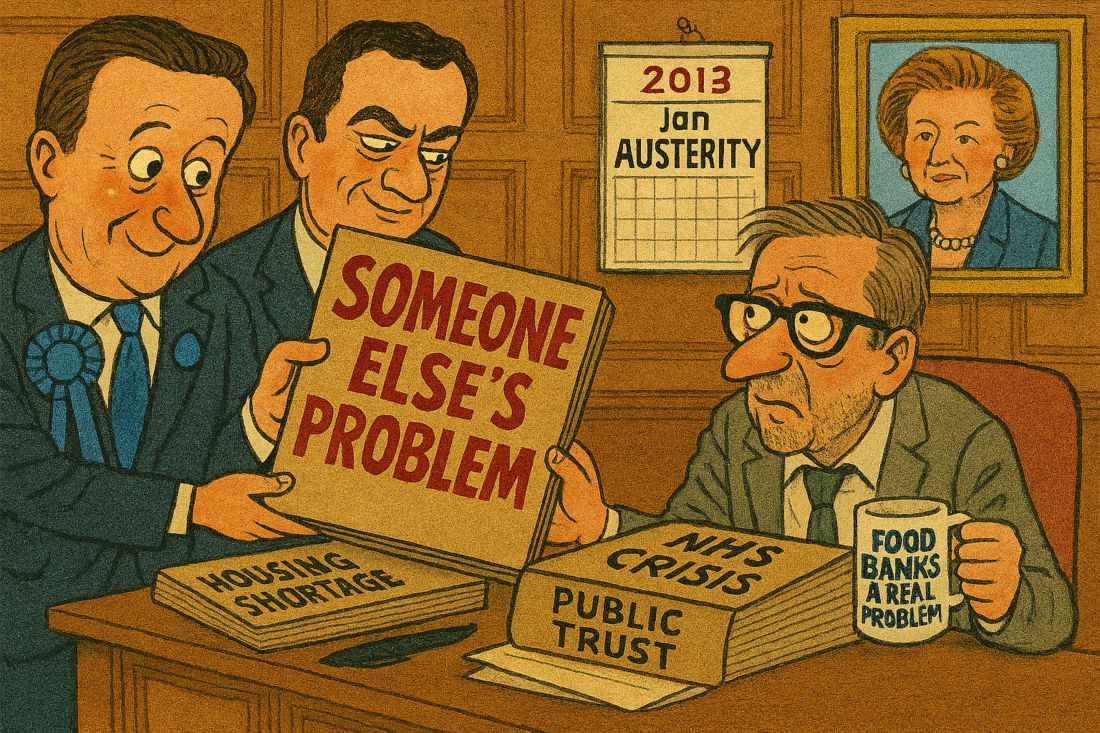
Food banks are here to stay for as long as Politicians keep acting as if poverty is someone else’s problem

Fill yourself with festive cheer, for the deficit should be defunct in just a few more years!

The Government does indeed seem to be peacock-proud of its fiscal management which has manifested itself in the form of great optimism during the recent Autumn Statement.

Strange then that little mention should be made or focus placed upon the spiralling debt mountain that as a Nation, we the UK currently sit upon, or what might happen if economic forces beyond Osborne and the Bank of England dictate that borrowing money can no longer remain so inordinately cheap.

However, insulated as we may seem from the realities of an economic meltdown bluffingly put on hold whilst politicians still have the ability to do nothing more than concentrate on the next election, the fact is that the only real difference between the debt that the Government ‘manages’ on our behalf and the financial problems facing so many of the Voters who unwittingly put them there is that people living in the real world have no elaborate schemes or devices to hide the problems that they currently face.

Being in touch with the painful realities of UK life for those who have the worry of meeting their monthly bottom line is a gift which seems to have eluded many of the Political Class.

Only this week, Lord Freud intimated that Local Authorities should pick up responsibility for funding food banks; an act which in itself demonstrates the severe lack of understanding that those in Government have of the problems which people genuinely face.

It is all too clear that they have no idea what steps really need to be taken simply to arrest the backward slide in living standards which is already stretching far beyond the realms of the financially poor. It is an unspoken truth that is changing the way that just about everyone without the joy of having a surplus income before pay day are having to cope with, each and every month.

Localism has of course given the lie to the idea that more and more services and methods of support will be provided at local level, by local organisations for local people.

What the Localism Agenda doesn’t contain within all the talk that has gone with it however, is that whilst Westminster politicians audibly pass the buck to their Local Authority counterparts with one hand, they are systematically stripping them of the resources and ability to maintain their existing responsibilities with the other.

Without cutting existing services, raising Council Tax beyond 5%, using savings, cashing in publically owned property or borrowing, there is simply no way that Local Authorities can take on a National problem locally without outside help to do it. And when the only politicians that have the ability to tackle the causes of the problems facing so many people head on are sat in London, it is at best disingenuous if not bordering on pure fantasy to even hint that the real cost of living crisis is something which confines itself to communities at a very local level.

People would be starving right now, were it not for the tremendous efforts of the organisations and individuals who are working so hard to help those many people who are already experiencing a regular sequence of hours in need.

Food banks are a treatment for a problem, but by no means a cure.

Ministers really must start recognising this now, rather than seeming to be content to do little more than pretend that the problem doesn’t exist; or worse still, to behave in such a way to suggest that the many people experiencing both the extremities and day-to-day realities of contemporary poverty have somehow knowingly chosen to be there.

download (19)

If you have found this article whilst researching food banks, further information about Tewkesbury Food bank can be found at www.tewkesbury.foodbank.org.uk or for those in other areas, please see this link on the Trussell Trust Website.