I’ve just published another free-to-read version of a booklet that I have put together as a website that you will find at www.ourlocalfuture.com
Our Local Future is available as a Kindle Book too, and runs through the key changes to the way society functions that would make everything work much better for everyone and create a happy, healthy, safe and secure environment for us all.
I’ve written this latest Book, because I’m fed up of listening to everyone who knows this or knows that, wasting valuable time arguing that only they know the next steps we, as a culture and society should take, to put everything right.
People who should really know better are focused only on the journey and who controls it. Instead of considering the destination and what the outcomes will be that solve all our problems and create a world and culture where Balance, Fairness and Justice can be experienced by all.
Meanwhile, the constant debates over who or what is to blame; whether problems like climate change and the need for Foodbanks are real; or who is right vs who is wrong are just making everything that’s already wrong exponentially worse.
More often than not, these ‘blockers’ who let their egos get in the way, are the very same people who hear a new idea or proposal and immediately say ‘It won’t work’. Usually, because they only want change for everyone else, IF they can be certain that they will gain in some way, or at the very least don’t believe that they could lose.
Change is no longer a choice. It’s happening around all of us right now. And the difficulties we face are going to get worse before there’s any chance that things will get better.
The unspoken truth or secret ingredient that we all have to accept is that by embracing change that will help to make sure everyone has the best experience of life that they can, we will all end up with a system of governance and way of life that works in every good way that we could possibly wish for ourselves.
The fact those with power and influence don’t understand what Poverty really is makes the ‘solutions’ they come up with potentially more harmful to those in need, rather than making the genuine difference that so many who have been left behind now need.
As someone who experienced poverty as a child, a research project for a Postgraduate Course project in late 2023 enabled Adam to compare the realities of living in Poverty in the UK today, to the experiences from the 70’s and 80’s that were his own.
In his own words, ‘The experience was sobering’ and the brief paper he wrote for assessment based on his question ‘Is Poverty invisible to those who don’t experience it’ is contained within this short Book.
Today, Adam often states: “You have to experience or be touched by Poverty to understand it.”
Even though the political terrain was different, from the point of view that the British Electorate were days away from trusting Boris Johnson with an Election Result that very few saw coming because the Conservatives promised to get Brexit done, the truth of the matter was that many areas of the UKs public policy had already gone massively wrong.
Regrettably, it had been doing so for a time that has spanned many different governments, led by different political parties, before.
Within months, we were all subjected to the stupidity and poor leadership that manifested itself in the form of both the Government and the wider political response to Covid 19 and the Covid Pandemic.
We are unlikely to have experienced all the fall-out and consequences of such levels of incompetence and political delinquency that were set in motion, even now.
However, back in early December 2019, I decided to commit all the things a ‘good’ government would actually do to paper. I then shared it with the world.
Since then, The Makeshift Manifesto seems to have been a popular read. So, earlier this year, as I contemplated the run up to the coming General Election, I began to question whether I should revisit the book and update it to reflect what has changed and where the further problems with Public Policy have developed over the 4+ years of time since the first edition was published.
With the original work set up on a screen and being sat ready to dive straight in, it didn’t take many moments for me to realise that if ‘good’ policy was no more than a wish list at the time of the last General Election, because of the quality of the politicians we had back then, the uncomfortable fact is that with the political options we have available today, such suggestions would be pretty much impossible to deliver through the current structure of government, in any meaningful way.
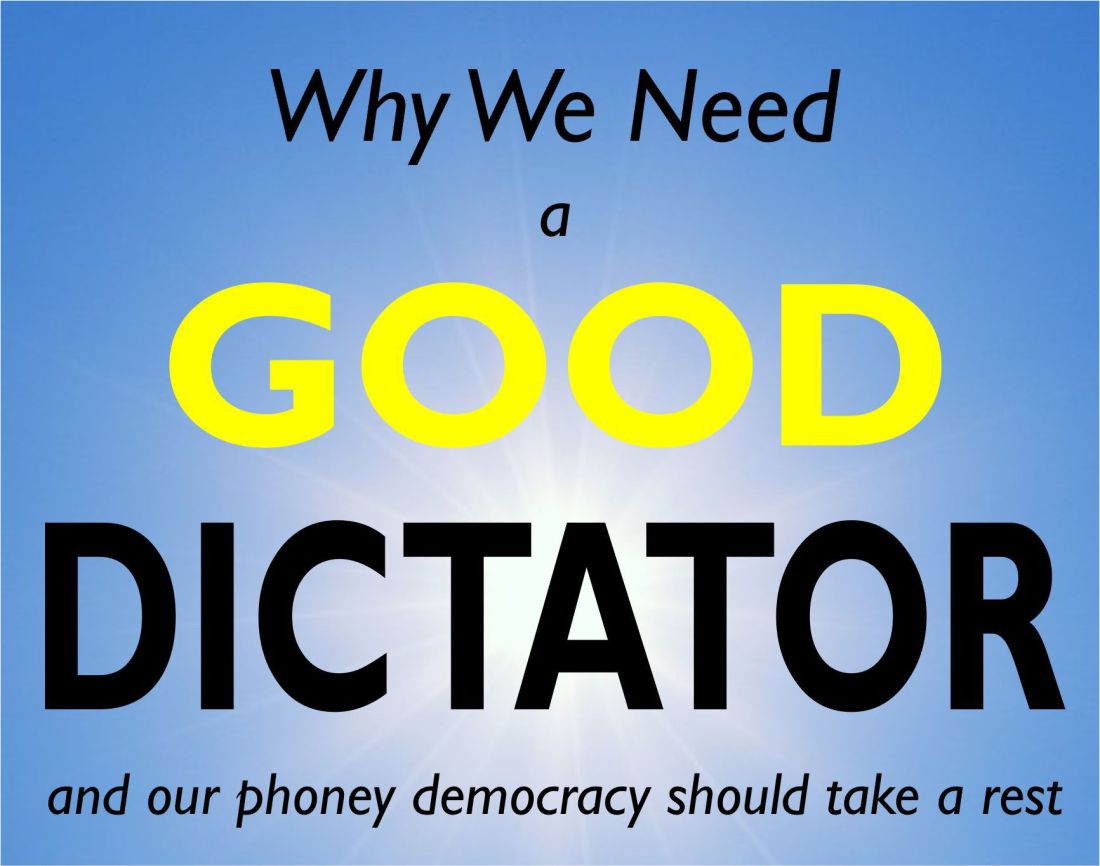
But at this point I realised, that without people being open to the change that is possible now and which I covered in the book Officially None Of The Above, or there being some kind of Black Swan event that has the power to change everyone’s minds, the only way that meaningful change could be delivered throughout government, the public sector and within every area of Public Policy itself, would be with pure single-mindedness. The kind that could only be achieved if it was driven and directed by one person with the power necessary to command and dictate that massive scale of change.
I worked this thorough as briefly as it was possible to do so.
Leaning on different books that I have written and published over the past two years that included A Community Route and The Grassroots Manifesto, I also added a policy wish list that would be good for everyone, but that in today’s reality, it would only be possible for Good Dictator to deliver and achieve.
There remains a very big question about whether the individual exists who:
Would have the knowledge and experience necessary to change such a massively broken system for the better
Has the desire, drive, motivation and public spiritedness to see it through
Possesses the ethics, morality and principles to stay true to the public cause, when there would be so much temptation to cast what’s in the best interests of others aside
After completing and publishing the book, I concluded that in times as we face today, where politicians and those who aspire to be politicians don’t see any route other than their own, and the public itself has surrendered to the idea that all ‘public’ problems are the responsibility of someone, somewhere else, if nothing else should change in the way we view the importance of the things that are common to us all, the solution of having a Good Dictator, might end up being the only way forward for us all.
Like most people whose comments I’ve seen, I am a big fan of Clarkson’s Farm. I don’t think there’s one episode of the 22 I’ve already watched that hasn’t ticked all of the boxes for good, all-round entertainment in a field which isn’t exactly full of other big beasts.
In case it’s important, I’ve watched 6 of the 8 episodes of series 3 and the final 2 will probably work their way into the weekend schedule as some kind of diversionary treat.
Just as I’ve previously tweeted in responses to comments and thoughts by the Farming Press and some of the Farmers I follow, my view as someone who has maintained links with Farming whilst I’ve worked for charities, run my own businesses and was an elected local councillor for 12 years, is that the series has done a massive amount in breaching the gap between farmers and the food chain, and the public or consumers. Something that’s very important bearing in mind that it’s where the strongest and most meaningful relationship in the UKs food chain really should be.
Whether we consider Clarkson’s ‘Let’s test everything I can think of’ approach to farming 1000 acres in the Cotswolds as contrived or planned, or quite literally as anyone new to farming with enough money to experiment in every direction might behave, the fact remains that there is real public benefit to this show and what it shares.
The money spent and the honesty, transparency or insight being provided hasn’t failed to demonstrate just how complex and bureaucratic UK Farming has become, and how difficult being a Farmer in the UK really now is.
What is more and perhaps most importantly, Clarkson’s Farm openly demonstrates that UK Agriculture is at massive risk.
British Farming simply doesn’t generate the income for landowners and agricultural workers that an industry providing one of the most essential and non-negotiable parts of our daily lives really should.
Meanwhile, the shops that sell everything ‘on their behalf’ are achieving billions in profits as a return.
Whilst I’m not sure the leaps in thinking made by Amazon Prime subscribers will have yet reached a point where everyone recognises that there’s probably an equivalent to Diddly Squat in the form of a farm gate farm shop that’s much closer to home, Clarkson’s Farm is shining a light on real-World or rather real-UK Food Security issues that no other rural-life programme has or could.
If there’s anything annoying about the programme at all, it’s the attitude and approach on the part of so many involved, who have probably stood in the way of this very popular series doing a whole lot more for us all.
The reality that not only Jeremy Clarkson, but all UK farmers have to face is that whatever the level of government, whether it’s a local council in Oxfordshire, DEFRA or any department in Whitehall, the whole of the public sector system works in its own particular way.
There is a way of working with everyone who sits within the processes where decisions are made and few Civil Servants and Government Officers will value anyone telling them how anything they have control over or responsibility for, should work. No matter who those telling them are or who they might be.
Wrong as it may be, its just the way that things work.
The problem is made significantly worse because so much of the legislation and directives set at the centre or in London are left ‘open to translation’ at local level. And interpretation can go either way, depending upon many things under consideration which often fall way outside how any logical explanation or understanding would suggest everything works.
Like it or not, Clarkson was pretty much on a date with destiny from the start. It was inevitable that there would be a clash of cultures when it came to working with any formal body.
As a councillor, I experienced and at least tried to console the distress that the feeling of unfairness and injustice of the government system visits on people who are morally correct in their position, but nonetheless feel very let down by the way the technical legality of the system works.
I really do wish that Clarkson might have taken a different approach. He almost certainly could have demonstrated that for both Diddly Squat and an entire Industry that’s now in deep trouble, real success and long-term benefits are achievable, just by stepping back, counting to ten and approaching ‘the game’ in a very different way.
It’s nearly the middle of April and 2024 has been a washout. You don’t need to be a farmer to know there’s little that feels normal about the wet weather and I know I’m not alone in feeling like it’s been raining nonstop since Christmas.
Is there a conspiracy at work? Is the weather being manipulated? Is this all part of some concocted grand plan?
Well, in terms of the things we should really be worried about, getting lost in the debate over whether Mother Nature or some malevolent force is behind the growing threat of a failed harvest this summer is the only real rabbit hole there is to fall down.
Hopeful as I am for our struggling farmers, that the weather will turn around and put everything back on track, the sober way to start thinking about issues that should really be concerning anyone looking at the wider U.K. food security and production situation is to question how decision makers will frame what may soon be recognised as the 2024 harvest crisis and how they will then respond.
Of all the food security issues we are facing today, which include but are not limited to deglobalisation, climate change, retail profiteering, political ineptitude and anything that falls under the manufactured problems that need a logic defying solution too, weather should never have been the one problem that has the potential to end up making our fragile food security situation even worse.
The reality that we and our farmers face, is that a failed harvest across in 2024 will play straight into the hands of those who believe and advocate that the U.K. doesn’t need to grow its own food.
There is an unsettling belief at work within the establishment that our food supply can always be guaranteed to come from somewhere abroad, and that new technologies and factory foods – like ground up insects, lab growing and warehouse production – will solve all problems. This mindset results in the fallacious idea that there is little reason to continue pandering to farmers who can only be productive when they are a) told what to grow, and then b) are paid for doing so.
Farmers are being set up to fail
For an essential industry already in crisis and under attack from an establishment that views food security and all of the highly beneficial add ons that U.K. produced food can give British people as trivia they can do without, the ongoing storm is one that couldn’t have landed at a less helpful time.
The real risk to U.K. farmers is that government will make token gestures, but in truth do very little to help the industry in the immediate aftermath.
This is likely to lead to many more business exits for what should really be thriving farming businesses, and a situation arising quickly where the U.K. becomes perilously close to losing the ability to feed itself, even at emergency or wartime levels, using recognisable farming methods that are beneficial for everyone involved in the food chain.
Whilst there is growing unrest among farmers, a belief that the powers that be will eventually step in and save the day still regrettably persists.
It is regrettably fair to say that the misconception that government understands the risks to an already critically vulnerable food supply is easily dismissed when we consider that the equivalent of around only 54% of the food we eat is currently grown in the U.K.
Decision makers either don’t see the risk or they don’t want to see the risk. And whichever it is, the result for U.K. farmers, U.K. food production and U.K. food security is pretty much the same.
U.K. farming, the infrastructure that supports it and the legislation that facilitates it might not be anywhere near able to feed the uk population without help today.
But that doesn’t mean that it cannot. It certainly doesn’t mean that the industry shouldn’t redirect, reform and repurpose where needed, so that U.K. food sovereignty is no longer viewed as being pie in the sky.
The wide range of green, environmental, climate, food quality, nutrition, transparency and other farm and food related issues, that have different activists fighting each other for air would all be resolved by getting behind U.K. farmers and food production to refocus. U.K. agriculture will only be saved by moving away from the Globalist/EU production models to one that puts locality and traditional methods at the centre – albeit in a 21st century form.
The power for change sits within the hands of our farmers themselves and the trades that align around U.K. agriculture.
Although many still don’t see it this way, it would be wise for anyone and everyone with an interest in being able to grow or eat a regular, sustainable supply of good, healthy and nutritious food to watch carefully what the establishment does and how it responds if the realities of a 2024 harvest crisis begin to unfold.




 Adam Tugwell