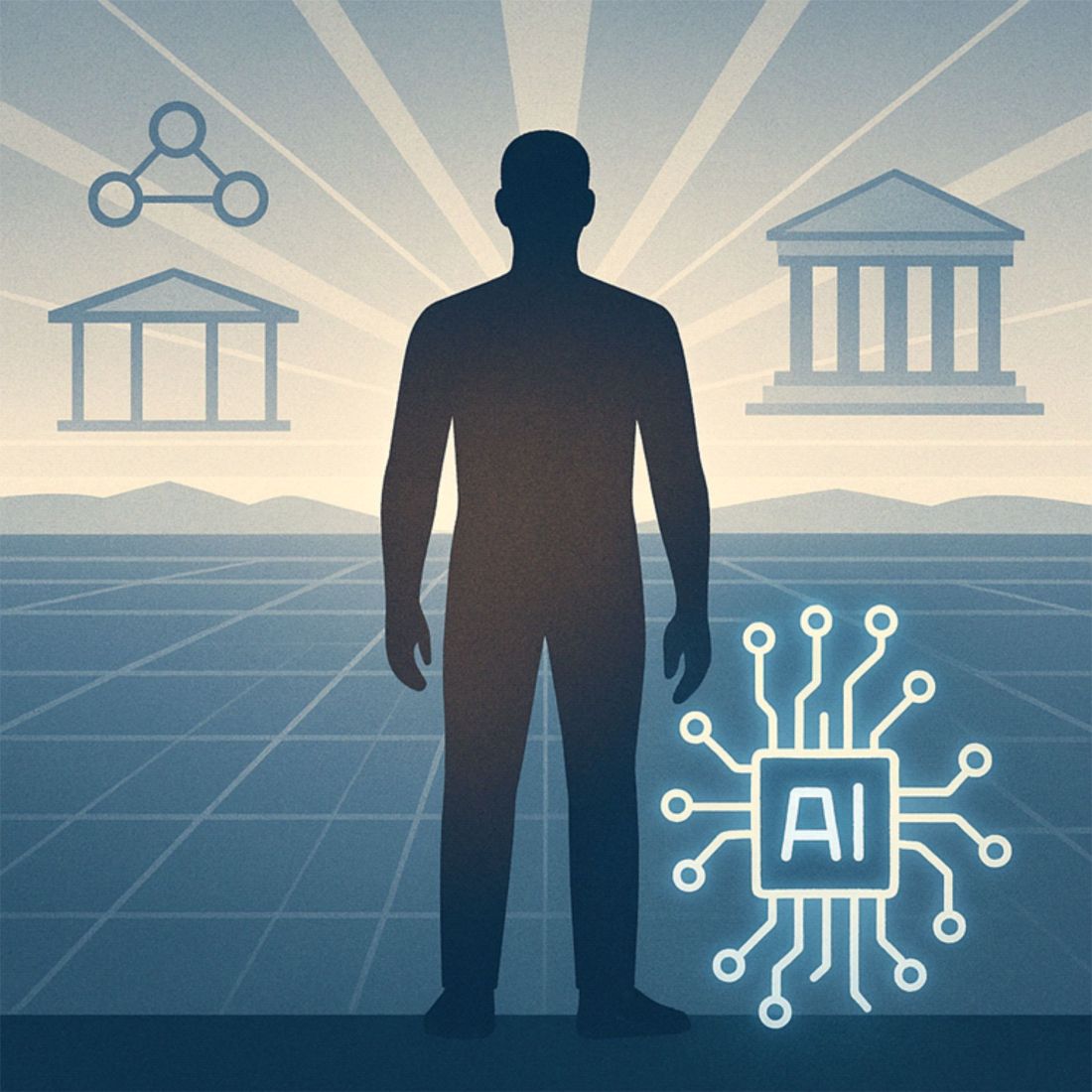
The Human Sovereignty Charter for Artificial Intelligence – Published on 3 March 2026 – establishes a constitutional‑style framework designed to ensure that AI systems always remain subordinate to human authority, aligned with human dignity, and governed in ways that protect individuals, communities, and democratic values.
It provides a principled foundation for organisations, institutions, and governments seeking to adopt responsible, human‑centred approaches to AI.
The Charter is built on the belief that technology must enhance human life rather than replace human judgement, labour, or autonomy.
It sets out clear obligations for those who design, deploy, or manage AI systems, and it defines the rights and protections that individuals and communities retain in an AI‑enabled society.
Key Takeaways
1. Human sovereignty is non‑negotiable
The Charter asserts that humans must always remain the final decision‑makers. AI may support judgement, but it must never override, replace, or diminish human agency.
2. AI must serve human dignity and wellbeing
Every use of AI must be evaluated through the lens of human impact. Systems that undermine dignity, fairness, or community cohesion are incompatible with the Charter.
3. Transparency and accountability are mandatory
Organisations must be able to explain how AI systems work, what data they use, and how decisions are made. Hidden or unaccountable systems are prohibited.
4. Communities have rights, not just individuals
The Charter recognises that AI affects groups as well as people. Communities have the right to protection from harmful deployment, surveillance, or automated decision‑making.
5. AI must not replace human labour or judgement
Automation cannot be used to remove meaningful work, displace human expertise, or centralise power in ways that weaken democratic or social structures.
6. Oversight must be independent and ongoing
AI governance cannot be left to the organisations that build or profit from the systems. Independent oversight, community participation, and transparent review processes are essential.
7. Consent and understanding are essential
People have the right to know when AI is being used, how it affects them, and what alternatives exist. Consent must be informed, meaningful, and revocable.
8. Data belongs to people, not systems
The Charter reinforces that personal and community data must be protected, minimised, and used only with clear justification and safeguards.
9. AI must be designed for safety, not optimisation
The goal is not to make AI as powerful or efficient as possible, but to ensure it remains safe, predictable, and aligned with human values.
10. The Charter is adaptable and future‑proof
It includes mechanisms for amendment, review, and evolution as technology changes, ensuring it remains relevant and effective over time.
What the Charter Enables
A shared ethical foundation for organisations adopting AI
A governance model that prioritises human rights and community wellbeing
A practical framework for policymakers and institutions
A safeguard against harmful, opaque, or exploitative AI practices
A clear statement of human‑centred values in a rapidly changing technological landscape
Who the Charter Is For
Policymakers and public institutions
Educators and academic researchers
Technologists and AI developers
Community leaders and civil society organisations
Citizens seeking clarity on their rights in an AI‑enabled world
Why It Matters Now
AI is advancing faster than most governance systems can respond. Without clear principles, societies risk drifting into forms of automation that erode human judgement, weaken democratic accountability, and centralise power.
The Charter provides a structured, principled response – one that protects what is uniquely human while still enabling responsible technological progress.
Selective morality in business and government is still self‑interest – and AI exposes that truth.
“Selective morality in business and government is self‑interest nonetheless.”
Selective morality in business and government is still self‑interest. You either act ethically in every instance, or you aren’t acting ethically at all.
Amid the fear, excitement, and confusion surrounding the rapid rise of AI, remarkably little attention is paid to the words and behaviour of the people driving it. Tech leaders tend to appear only when unveiling the next breakthrough, not when answering for the consequences of the last one.
Much of the public debate focuses on whether AI will destroy more jobs than it creates, and whether ideas like universal basic income could soften the blow.
Industry figures often speak as if a post‑work utopia is inevitable – a world where everything is paid for and nobody needs to labour. But this narrative conveniently ignores the obvious question: who funds such a system when millions, perhaps billions, are stripped of agency, purpose, and the ability to contribute?
We may be heading toward a future in which vast numbers of people have nothing to do, no way to regain independence, and no meaningful choices left.
The myth that AI will “improve life for everyone” is easy to sell while the technology still feels novel and addictive. But nobody has invested billions into AI for altruistic reasons. The motivation is profit, power, and control – and the benefits will not be evenly shared.
Some of those leading the charge may genuinely believe they are building a utopia. But intelligence is not morality, and we routinely mistake technical brilliance for ethical authority.
We make the same mistake in politics when we assume legality and morality are interchangeable.
Recent events have made this clearer. A major AI company publicly pushed back against the US government’s desire to use its systems for military purposes. Whatever one thinks about AI on the battlefield, the episode revealed something crucial: the industry can say “no” when it wants to. The idea that AI’s advance is unstoppable or outside human control is a convenient fiction. The people building these systems can halt or redirect progress – they simply choose not to when the consequences fall on everyone else.
I’m not opposed to technological progress. I’ve written about AI for years, and I believe it can improve human life in extraordinary ways. But the greatest danger is not sentience or runaway autonomy. It is the fact that AI is being built and steered by people whose incentives are profit and dominance, not human flourishing.
AI should exist to elevate human life, not to replace human purpose.
Yet those controlling its development are already choosing which impacts they want and which they don’t. Their occasional flashes of “morality” appear only when their own interests are threatened.
If genuine morality had guided AI’s development, we would already see clear safeguards, transparent policies, and protections against the harms we are now scrambling to address.
Instead, we see selective ethics deployed only when convenient.
Policymakers and tech companies share responsibility for what AI becomes. But morality applied only at moments of their choosing is not morality at all. It is strategy – and we should treat it as such.
Further Reading: Context, Consequences, and Control
The essays below expand on the central claim of this piece: that AI is not a neutral force, and that selective ethics – applied only when convenient – undermine both human dignity and democratic control.
Together, they form a coherent critique of technological inevitability, post‑work mythology, and the moral shortcuts taken by those shaping the AI future.
I. First Principles: Work, Human Worth, and Moral Limits
These pieces establish the ethical baseline: why work matters beyond income, and why technological capability does not equal moral justification.
This essay argues that work is not merely an economic function but a cornerstone of identity, agency, and social stability. It challenges the assumption that replacing human labour is an unqualified good, framing job displacement as a moral issue rather than a technical inevitability. It provides essential grounding for the claim that AI should serve human life, not hollow it out.
Building on the above, this piece confronts the “can therefore should” logic that dominates technology discourse. It draws a clear distinction between capability and responsibility, reinforcing the argument that ethical restraint is a choice – one that is currently being avoided rather than exercised.
This essay proposes a human‑first principle for automation: AI should supplement human effort, not pre‑empt it. It directly supports the central thesis that AI replacing human purpose is a failure of governance and values, not progress.
II. The Economic Myth: UBI, Abundance, and the Illusion of Care
These essays dismantle the comforting narrative that mass automation will be offset by generosity, redistribution, or effortless abundance.
This piece directly interrogates the promise of universal basic income as a solution to large‑scale job loss. It exposes UBI as a political placeholder rather than a structural answer, asking who truly benefits from a system where agency is removed and compensation replaces participation.
This essay challenges the faith placed in future benevolence from those currently accumulating unprecedented wealth through automation. It reinforces the argument that selective morality is strategic, not principled – and that promises of future fairness ring hollow when present injustice is ignored.
III. Power, Control, and the Fiction of Inevitability
These works expose how narratives of inevitability mask human decision‑making, profit incentives, and political convenience.
This essay strips away the rhetoric of progress to reveal the economic motivations driving AI adoption. It aligns closely with the claim that AI is not being developed altruistically, and that public benefit is often an afterthought rather than a design goal.
This piece broadens the lens from AI alone to systems of governance and infrastructure. It reinforces the idea that outcomes are shaped by power structures, not technology itself – supporting the argument that “unstoppable AI” is a narrative used to avoid accountability.
IV. Actions vs. Words: When Ethics Become Strategy
This final piece directly confronts performative morality and selective restraint.
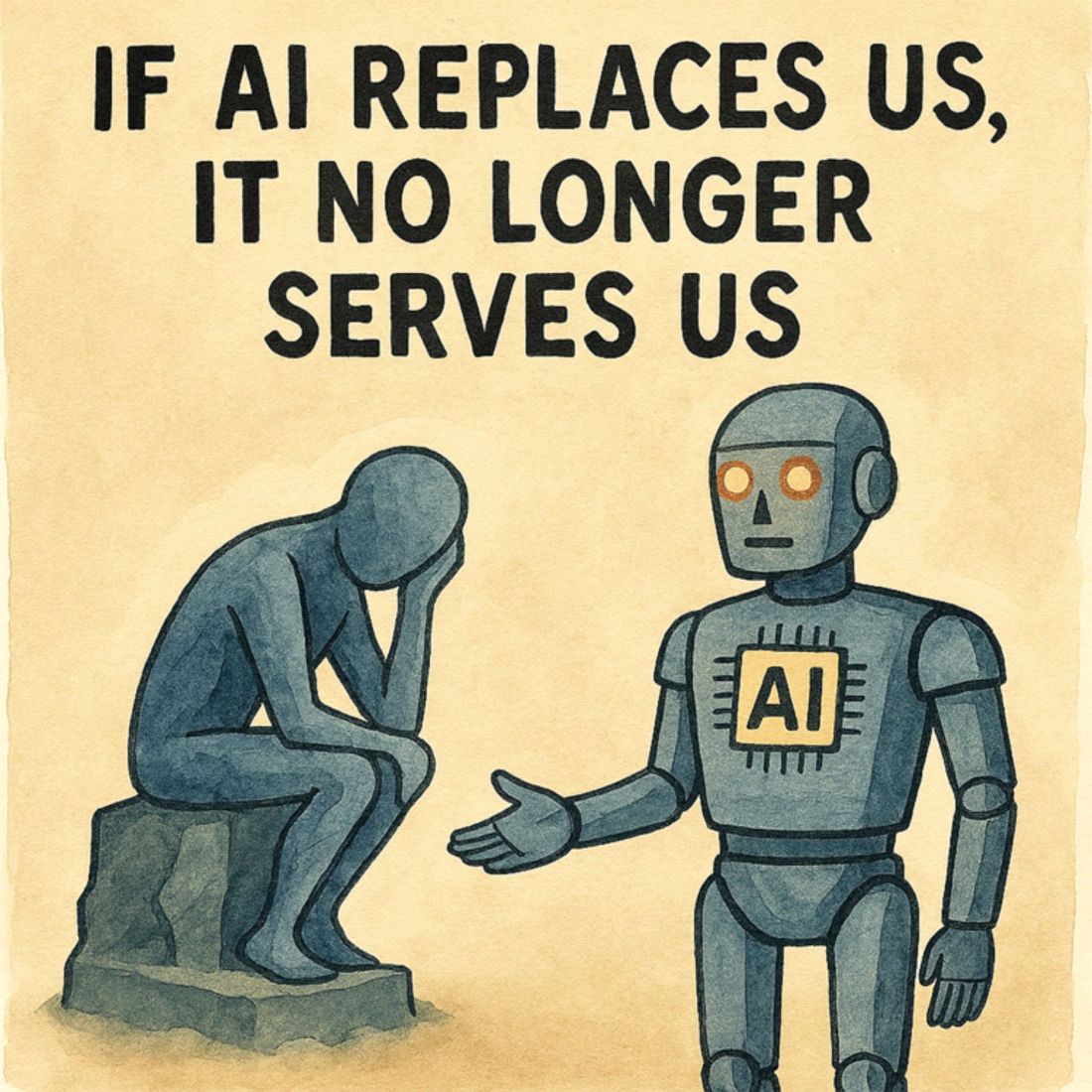
Serving as a thematic bridge to the present essay, this work critiques public ethical posturing unaccompanied by meaningful change. It underlines the central warning of If AI Replaces Us, It No Longer Serves Us: morality applied only when convenient is not morality – it is strategy.
There is growing disquiet, fear, and quiet concern about the turbulence we are experiencing in the world, alongside a deep, intrinsic sense that nothing is as it should be – and that it will never be the same again.
Yet at the heart of this unsettling feeling lies confusion. The prevailing narratives insist that with AI now here, and the technology it commands about to permeate every conceivable part of our lives, humanity should be grateful.
We are told we stand on the cusp of a new age, where surrendering to AI will deliver a dream life unlike anything mankind has ever known.
Some are already suspicious, beginning to question what the rollout of this digital revolution will truly mean.
Others believe the only way to progress – or to feel in control of either the real or digital worlds – is to recapture what they perceive as the “good times,” attempting to fix everything as if it were possible to freeze life and live forever in a single moment of the past.
Uncomfortable as it may be, the time has arrived for everyone to begin asking the hard questions: what happens next, and where will we find ourselves in a future that is no longer a distant shadow on the horizon, but already towering above us right now.
The Watershed Moment We Cannot Ignore
The Coming Crisis of Agency & Survival
The answer to the question so many wish to avoid is that, if we continue on our current path, ordinary people will be left with no means to provide for themselves. They will have no income to pay others to do so, and neither government nor business will exist with the resources or the intent to supply even the basic essentials necessary for the masses to survive.
Everything we know – whether or not we recognise its connection to our current reality – has been moving in this direction for as long as most of us have been alive.
There has been a steady erosion of agency, independence, and self‑resourcefulness for ordinary human beings, first through the transfer of all forms of wealth, and now, taking place through the progressive takeover of every aspect of working life and function by both existing and rapidly emerging forms of AI.
Whilst many today spend quiet moments fearing the apparent opening of immigration floodgates and the erasure of Western culture, society, and life as we know it, others, for reasons seemingly unknown, appear to have embraced a suicidal empathy that insists the only correct behaviour of Western society is to destroy itself in order to prioritise all others.
AI’s Encroachment on Everyday Life
Yet everyone fails to see that the impending and critical threat to everything we hold dear has already been welcomed into our governments, our businesses, our technology, and the very functionality of daily life, and is so deeply embedded that it now resides in our computers and our phones.
The Myth of Effortless Utopia
AI, along with the robotics and technology now emerging to support it, is becoming the option of choice for carrying out the majority – if not all – tasks across what we currently understand as life.
This development will soon mean that, for the majority of us, there will soon be no reason for work to continue to exist.
Exploitation and Systemic Transformation
Whilst many of us hear talk of the AI takeover, the reduction in new hiring and training opportunities across numerous professions and industries, and the replacement of jobs of all kinds, we fail to connect these developments with the rising welfare bill as people find themselves with no choice but to accept a life of unemployment.
The New Divide: Inclusion and Exclusion
Nor do we pause for a moment to consider the pressing question: What does it mean when there is no job left for you?
The Last Chance for Human Agency
Yes, many truly believe the stories openly shared by members of the elite community driving this change – that in no time at all, life will become cheap and effortless for everyone because AI and machines can do everything.
The Value of Effort and Contribution
People really do believe we are about to step into a new and previously unrecognisable utopia, where the system has eliminated the need for human industry, effort, and value in the form of contribution, and instead provides everything we can imagine, free of charge and experienced as if life were one giant, permanent holiday for us all.
Historic Patterns and Systemic Endgame
Such benevolence, hinted at in the form of words from these few, and the feeling it inspires about our future, is one that few can fail to imagine.
Indeed, the words and the ease with which life now comes at us makes it very easy to accept the disproportionate levels of wealth for the few that has been encouraged by the progress of this new technical revolution.
People are taking for granted that once the evolution of everything needed to perform every task that human beings carried out across all functions of life is complete, these are the very same few who will then happily smile and sit back while everything they own and have developed works and provides for all of us in return for absolutely nothing. All whilst we continually maintain an ever‑improving standard of life and receive a universal basic income that covers every requirement beyond the luxurious permanence of 24‑hour leisure, which is somehow ever present and that we somehow believe we would actually enjoy.
In truth, we do not need to understand how or why we arrived here to see the situation for what it really is. The fundamental truths are already available for us all to observe, consider, and comprehend, hiding in plain sight: the masses have been used and exploited to create the very means that will ultimately be implemented to destroy humanity as we know it.
As this has all progressed, we have all been fed and indoctrinated with stories, technology, forms of easy wealth, and advances convincing us that things can only ever improve along this path and that a golden age awaits.
At the same time, we have given our consent to puppet politicians who have willingly changed and enforced every rule necessary to facilitate this under the veil of progress -driven not by principle, but by submission to those with power and self‑serving agendas, lured by promises of glory and gain that appeal to their true, hidden selves.
Many struggle to believe that those we have elected, and those who have grown rich or benefitted so greatly from the rewards of leadership in a modern world and society, could truly be so cruel. Yet does it matter whether we – or even they – accept that as truth, when the outcome fast approaching, without a change in our direction, will inevitably be exactly the same?
Within the world and its structures – The System as it operates, functions, and controls every part of life today – the true divide of them and us lies between those whom the system will continue to carry and cater for once the concept of human independence no longer exists, and the masses who have no further use, whom the system will either choose to exclude or find some means to remove.
This is neither a horror story nor a work of fiction. The only uncertainty – without a change in direction – lies in when and how events will unfold that bring about the critical period of transition.
Today, humanity still possesses agency, choice, and the power to pursue an alternative pathway – even though so many of us are sleep‑running toward the end of freedom’s existence, actively embracing and welcoming the very tools that will soon replace the need for us within our own lives.
The fundamental truth of any life worth living is that there can be no reward without effort, and that effort itself is the pathway to reward when life is grounded in truth.
We hold no value to anyone or anything if we do not contribute or participate when we are able. There are no free rides for anyone or anything, unless they come in the form of charity – or unless we ourselves assume the role, if deemed desirable, of pets.
History repeats this truth time and again. We need only look further to see how power is abused by the powerful—how they seek to control everything they find useful, and how quickly they dispose of it when they do not.
Everything about the moneocratic, money‑centric, top‑down, centralised, hierarchical, and patriarchal system was ultimately designed to end this way.
The arrival of technology – and finally AI – has brought humanity to a genuine watershed moment, an endgame in which we must either abandon the unsustainable way of life to which we have become addicted and embrace one that restores balance, fairness, and justice for all, or continue living the lie created by those who profit from our subservience.
If we choose the latter, we will participate in it until the moment we realise we no longer hold any value, and the destiny imposed upon us by others has arrived.
The Alternative Pathway
The temptation for many, upon realising what has happened and what is happening, is to believe that all we need to do is step back a few years and remove the most corrosive technological advances that have entered our lives.
As simple as the removal of AI might seem – even if we were able to overhaul politics and replace politicians with those who agree – the real damage to society and culture has not come from technology or its advances themselves. It comes from the reasoning, motives, intent, and forms of control behind them.
These forces have long been at work, reshaping how everything functions across society – manipulating and redirecting life so that what we have already become is accepted as normal.
The way we live, work, conduct business, relate to others, and even relate to ourselves must return, rediscover, and recreate a way of being that transforms our system of values.
Our entire value set must shift so that we understand and expect meaning from life in ways that, by today’s standards, may seem counterintuitive or even alien.
The Human Value Imperative:
We must embrace the reality that everyone is equal, and that the only difference between us lies in our roles, functions, and contributions within society—roles that are always dynamic and open to change.
We all need to accept that differences do not make us different when it comes to what is ethically, morally, and fundamentally right.
We all need to accept, understand, and embrace that no person should be advantaged over another by circumstances beyond their own efforts or control.
We must accept that deviation or allowances beyond these principles will always lead to growing unfairness—even when special circumstances seem justified or privileges are believed not to be abused.
We must accept that hierarchies are not a natural system of order, even though the need for order in society means that some will naturally take the lead.
We all need to share responsibility and take part in collective choices that shape the aspects of life we share.
We all need to contribute to the community in whatever ways we can.
We all need to work and actively contribute to shared life whenever we are genuinely able.
We must live by the principle that the responsibility we have toward others is the same responsibility we owe to ourselves.
We all need to accept that once our needs are met, nothing is gained if any one of us seeks to have, take, or control more.
We must accept that true abundance means having as much as we need, not everything we want.
We must accept that people are the greatest source of value, and that real economics should be centred on that value.
We must embrace the reality that full employment is both natural and normal when employment is defined by all forms of contribution, not just financial return.
We must welcome and protect the truth that locality, and the transparency it brings to every kind of relationship, is key to maintaining and benefiting from a system we can trust to be fair, balanced, and just.
We must ensure that AI and all technologies are used only to support human life and enhance working practices—not to replace jobs or create circumstances in which any human being is considered useless.
When we commit to all of these principles, we can begin to envision a society and way of life that truly functions as it should with equity, equality and accountability for all – one that is transformed in almost every possible way.
The Turning Point: Choosing Freedom and a Better Future
For many of us, the uncomfortable reality we must face is that passive inaction – or continuing to accept life under the control of others, believing things will simply carry on as they are – poses an existential threat that is all too real. It is a danger that extends beyond the confines of Orwell’s 1984 and, for those who truly value their lives, could mean something far worse.
The choice – while we still have one- is to not only accept but to embrace an alternative path.
This path, though carrying forward some familiar aspects of the world around us, demands that every part of our lives be lived in a fundamentally different way: a way where people, community, and the environment come first; where power rests with the individual, their freedom, and their personal sovereignty; and where the whole experience of life unfolds in a completely new direction.
The Local Economy & Governance System Framework: A Path to Empowerment
Exploring the Local Economy & Governance System
Visualising a different world – how it operates, what it requires of us, what we must give, how we work together, and how frameworks of rules function (rather than laws that micromanage every part of life, as is increasingly the case today) – may sound simple. Yet their adoption, interpretation, and our response to them within a system centred on empowering every person, rather than controlling them in every conceivable way, will be fundamentally different.
This shift will inevitably provoke resistance, not least because we have become addicted to the unsustainable, money‑centric way of living that dominates our lives today.
The Local Economy & Governance System provides a detailed picture of these frameworks, showing how this new people‑centric model will look and how it can be implemented.
Perhaps the most important element of this new world is that it will be built upon direct, participatory democracy – a system entirely unlike the hollow or pretend democracy that defines the moneyocratic world we currently inhabit.
Participatory Democracy: Power in the Hands of People
Participatory democracy means that everyone takes part in the decision‑making processes that shape public policy.
It ensures that we all hold the power to change or remove the public representatives we choose and appoint.
This requires a level of accountability and participation that is not only regular and personal, but far greater than the limited choice we currently have – voting every four or five years for candidates selected by someone else.
There is much to consider about the processes that enable true participatory democracy and how it can work effectively and diligently.
One of the most striking differences between this future system and what we have today is that there will be no political parties.
Instead, public representatives will be chosen directly by the community – respected individuals with proven commitment to serving the best interests of everyone involved.
From Possibility to Reality: A System That Works for Everyone
The Local Economy & Governance System will work because it prioritises people, community, and the environment in ways that may seem inconceivable today.
It places value on personal sovereignty and the freedom that comes from living lives defined by who we truly are, rather than by external factors and reference points that remain under someone else’s control.
Yes, the practical mechanics of LEGS will work – and they will work well – if we choose to embrace them.
After all, the dysfunctional world we inhabit today has appeared to “work” only because we came to believe in it, even as it has harmed so many of us.
We must not underestimate the ability, ingenuity, and creativity of humankind to deliver and implement solutions that succeed under any circumstances, when motivated and convinced it is right to do so.
Together, we can reclaim power and value and build a new world and system that functions with equity, equality, and open accountability for everyone – just as a truly civilised society always should.
Together, we can turn possibility into reality and create a society that truly works for everyone.
The Choice Before Us
We stand at a decisive moment in human history.
The turbulence we feel, the erosion of agency, and the encroachment of systems that strip away our independence are not distant threats. They are realities already shaping our lives.
The arrival of AI and the technologies that support it has brought us to a genuine watershed: either we continue down the path of dependency and control, or we choose to reclaim balance, fairness, and justice through new systems built on empowerment, community, and sovereignty.
The Local Economy & Governance System, grounded in participatory democracy and people‑centric values, offers a practical and principled alternative.
It is not a utopia promised by elites, nor a nostalgic return to the past, but a framework for living that restores meaning to contribution, accountability, and shared responsibility.
Human ingenuity has always risen to meet the greatest challenges. If we believe it right to do so, we can build a society that works for everyone – where equity, equality, and open accountability are not ideals but lived realities.
The choice is ours. To continue sleepwalking into a future where humanity holds no value, or to awaken and embrace the possibility of a new civilisation. One that honours freedom, restores dignity, and ensures that life itself remains worth living.
Talking about and thinking about narratives isn’t just important today. It’s essential if you are to arm yourself with the truth and ultimately stand any chance of not being driven completely mad.
Unfortunately, the reasons that make critical thinking necessary, as we absorb and digest any of the information that constantly flows towards us, usually through the digital devices that we carry, are not just as simple as working out the credibility of sources, identifying the truth, or filtering out the rampant levels of views and opinion which have regrettably become the bigger part of the content of all news.
It is increasingly necessary to identify where names and the nomenclature or branding of ideas, approaches, systems and even recognisable activities have been deliberately changed with the intention to confuse. Usually to create the misleading idea, in our minds, that somebody is doing something or selling something to us that is completely new or specialised beyond our comprehension. Just so that they can gain advantage over us until such time as we have worked it all out.
Regrettably, the establishment – that’s government, the public sector and all the big businesses and money organisations that are actually running things – has reached the point where they change the names of everything, either to make more money or benefit themselves, or increasingly to give the impression they have stopped or moved away from doing anything that has been publicly outed as being wrong. But for whatever reason that’s important to them, they intend to keep on doing it anyway and believe they need to nothing more to cover it up than change the name.
The more things change, the more they stay the same
Whilst it would be foolish not to acknowledge the power for good that some forms of digital technology and artificial intelligence have – in the right hands and when being used for the right reasons, the way that so many of us have taken the coming technical or AI revolution as read, and seem to have just accepted that many will no longer have jobs as a result, does illustrate the danger that we have become to both ourselves and to our own future. All because we don’t ask questions and simply accept whatever we are being told to believe – usually because it’s come from the voice of someone remote who we don’t even know!
The rather inconvenient truth that all those creating new terminology for whatever they control, are trying to control or attempting to regain control of; is that there isn’t much going on that’s genuinely new, as we consider life in the aspect of 360 degrees around us.
It is just made to look and feel that way.
Indeed, most of us would quickly grasp this, if we were to refuse to just accept the sales pitch and ask what they are selling us, what it will do and how it works.
This approach is applicable to method as well as to machine.
We would all be wise to take time to consider everything that touches our lives in some way, in terms of the pathways that bring it to us, how it works, who benefits and why those interests have brought them to us as and when they have.
Some would say ‘Oh it’s obvious!’
But is it really? And has it ever been?
Magic only works on us, when we don’t understand whatever is happening
Sadly, many of us are all too happy to accept the premise that what we don’t know can’t hurt us.
We accept that names, memes, keywords, industry terms and abbreviations mean that whoever is using them knows things that we do not. Usually making those people more knowledgeable and therefore powerful than we are, with a somewhat strange accompanying surrender to the misplaced idea that we should simply shut up.
Exploding the very dangerous myth about people who are considered to be experts and specialists, often in ways that are taken to mean they have universal understanding of everything, when they most often have been doing just one job; have studied more about the subject than us, and have been given a qualification by someone else who is actually just like them, is now becoming essential.
Not just to stop ourselves from being played like complete fools. But because the idiocy and self-aggrandisement that blankets so many of the people in positions of power, influence, control and that we therefore revere, are hiding behind the façade of terms we don’t understand, just to benefit themselves whilst all the time creating a very unhappy and unhealthy world that for us, that is never really going to work in our favour for as long as people like this have influence and control.
Dishonesty is regrettably rampant throughout everything that the establishment now does. Not necessarily because everyone within the establishment is dishonest. But because the way that normal people like you and I are being exploited, manipulated and used, so that those doing these things can benefit in some way, is simply now accepted as being the ‘normal’ way things work and therefore as being the done thing, for everyone.
Using and abusing others at any level is not ok. And as we find ourselves transiting a tumultuous period of inevitable change, one of the things that we should all be striving for to experience in whatever new world awaits us on the other side, is that lying, manipulation and the abuse of any person for any reason by another, just so that the abuser can become advantaged in some way, should be outlawed and treated as the horrible crime that it really is.
Everyone’s ability to work and be financially secure is vital to humanity, whereas accepting an unnecessary AI and Tech-Takeover that nobody genuinely needs will ultimately only benefit the few
The narrative now dictating to us that the Tech and AI Takeover is inevitable is tiring. Not least of all, because the whole idea that progress can and will only go one way is a myth.
Indeed, the myth that the AI and Tech Takeover is now inevitable serves only those who stand to benefit from everything being pushed this one, very specific and wholly unnecessary way.
Granted, many of us do feel that once technology has arrived and it is in our lives, there is no choice but to accept whatever the implications and outcomes of its arrival might be. Even when for increasing numbers of us it is beginning to become frighteningly clear that we and everything that we know may be about to be affected in some disastrous, life-changing way.
However, you may want to ask yourself, ‘Is this tech takeover, and what is going to change a voluntary choice that I am making?’
Did you consciously agree with the direction everything that touches your life digitally is now going?
Did you agree to changes that may quickly lead to you or people you know having no work or hope of ever getting another job?
Did you knowingly allow the parallel, digital universe and the role of arbitrary judgements about you and everything you are, do or can be, to walk in and begin the process of taking over each and every part of your life through the clever use of man-made codes which have been called algorithms?
So many of us fall into the trap of going along with the idea that jobs we know of today will no longer be required or even exist within perhaps just a matter of months because we are told that it represents progress and that the changes that the introduction of new AI-based technologies across life will be better for us all.
But when the narratives and words of politicians, tech gurus and influencers say all or everyone, just exactly who are they really referring to?
Are you going to benefit and in what way?
Are those benefits real, or are they just distractions that appear to make the very small and seemingly meaningless things that we do every day much easier?
Are those benefits really meaningful and long-lasting, or do they cover up how the small wins everything outside of us tells us we need actually covering up the real, long-term losses in our lives that unless we quickly wake up, we will never be able to replace?
Regrettably, few of us are even thinking about the impact and consequences of the changes that we have accepted for the simple reason that everything we have seen and experienced so far, whether it’s the way we shop, are able to access so much through apps or online, or are able to access whatever we believe we want in mere moments online, leaves us with the idea that AI and anything related to digital tech can and will only ever be good for us.
But what was wrong with the way things were two years ago; five years ago, or ten years ago, where the tech that we had in our lives or that we had access to was concerned?
Didn’t life work just as well, and perhaps in some ways that may seem unrelated even better then?
Have computers, smartphones and digital tech really benefitted our lives in the ways that we are led to believe? Or have they actually disadvantaged us and changed our lives in ways that make us very unhappy and create what for some are unmentionable problems, in so many other ways?
Technology and technological improvement or progress is a phenomenon that we must begin looking at in relation to ourselves, the people we care about and those who we have real face to face contact with, regularly within our communities; You know – people living in the real world that is OFFLINE!
Do we actually need a world where we and those people around us do not have jobs and cannot work, because a machine or different software systems can now do all the things that every person does at work, or once did?
Do those people who don’t have jobs really benefit from no longer having work?
Is the best use of AI and new technology to replace us? Or the best use of AI and new technology to assist us?
Surely there can be no doubt that the world around us would be a much better place to live and experience if everyone who can work, does work; and that in return for doing a full weeks work, they in turn receive enough money or remuneration of whatever kind to ensure that they can cover the cost or be able to secure all the basic essentials that give them independence, rather than a situation now evolving where the masses look like they are soon to be left behind.
Where is the drive really coming from for jobs to be lost and make it all seem necessary?
Who benefits from it appearing to be a foregone conclusion that ending jobs and mass redundancy is not a choice that is any of ours to decide?
What we can be sure of is it will not ultimately be people like you and me.
Technology and the advancement of technology and AI is like everything right across life that is being driven by the quest for greater and continuing profits, and the wealth, control, power and influence that quickly follows behind.
We don’t see it because we aren’t supposed to and that’s why what’s really changing underneath what we can see is actually leaving us, our communities and our humanity behind.
The choices being made about the way that new technology is being rolled out and used are not being made in the best interests of the masses. Because if they were, they would not be threatening to take away jobs and resulting in outcomes like the destruction of communities and to lives that it will bring.
If the purposes driving AI and new Tech were genuinely about improving life for all, the changes underway would not be beginning to impact us all negatively, just so that business owners, tech owners and those that benefit can elevate themselves in every way, whilst their actions and choices begin to leave everyday normal people like you and I behind.
Yes, the idea that all jobs, tasks and requirements could be met by machines, software and automation will sound appealing if it means that everyone can do and have whatever they might want without ever having to do a day’s work or lift a finger in effort, ever again.
But just how real do you or anyone that you know believe that idea to be?
Do you really think that the tech companies and those who control AI and digital technology are working day and night at an incredible pace to create a utopia where we all do nothing, pay for nothing, are given everything for free and have whatever we want in our lives without paying for it or working for it?
Wouldn’t we be seeing and experiencing signs of this great giveaway already, if they really were on the altruistic pathway to greatest giveaway to everyone else ever known?
The answer is that whoever and whatever is controlling all of this only has the benefits to themselves in mind. Or they would be happy for AI, for tech and the advancements that are available to be used only to improve life and working conditions for everyone, rather than them being imposed at the head of a revolution, deliberately hidden in plain sight, that is apparently set to leave the majority of the people across the world behind.
The narrative about the role of AI is a myth and the creation of a prophecy that can and will only become true, because we believe the narratives and respond to them as if they were already true. Not Because they are actually real and the AI takeover is as complex or on its imminent way to sentience or being genuinely all-knowing in any way.
The irony is that if we continue to believe the hype; continue to be fooled into thinking AI can and will do all we are being told it will, simply because we have been blindsided by the speed that it works and what we have seen it do so far, we will walk into an elephant trap where the masses will have made themselves irrelevant and we will soon be of no use to those who are controlling all of this and believe it is their right to exploit everything and the lives of all others, if it will help them to achieve whatever they want to do.
The advances in digital technology and Artificial Intelligence are just another step in a long-term process of centralisation and power transfer by design, where the power and Personal Sovereignty that all human beings should have the right to enjoy, has slowly but surely been stolen, but with our manufactured consent.
Our independence and personal power have been progressively eroded and transferred to organisations and people who have no idea who we are, what we do and know nothing about the communities and places where we live.
Yet they now find themselves on the cusp of being able to control every part of our lives and existence through the removal of our independence, making life dependent upon them and their system, which can and will only be able to exist because we have failed to question and reject the idea that this all represents progress for humanity.
Without change, the creation of a mass sub-class of people who can do nothing more than exist – if it is indeed possible for them to continue to do so – is now inevitable and the only way our subservience to this system and what it is dictating can take us.
To be clear, the AI Takeover and technology revolution that we are being conditioned to expect is not necessary. It is not legitimate at any level or in any way.
Technology and innovation should always be used to benefit the whole of mankind. Not just those who create it, own it, regulate it or pay for it, with money they would never have even had, if they had not first corrupted and manipulated the monetary and economic systems of the world so that it would appear to have legitimately gifted them everything that they now have.
Life and what it should offer every person was never meant to be this way.
Power over us all was never meant to be concentrated within the hands of just a few.
Centralisation, remoteness and the dehumanisation of every process and function that maintains and provides for life was never meant to be funnelled into the hands of others. People who will soon have the ability to choose whether other people live or die, based on using the digital chains that our own eagerness to have more of everything has unwittingly enabled them to wrap around a lot more than just our wrists.
Walking away from a system that puts money and the technology that enables it first, as the absolute priority before the masses of people is key to creating a different future. A good future for all, where everyone once again has the opportunity to be free, to be independent and to enjoy fulfilling the functions necessary to create and maintain a genuinely good life. All the time working together and collaborating only with those strictly necessary within our communities to provide everything that is essential for life in a real, localised world where everyone and everything can be trusted, because it can always be seen.
Simplicity of life; simplicity of governance; simplicity of business models and structures; simplicity of money and the systems that only administer it are key to improving every part of life and creating the equitable experiences and opportunities that only real justice, fairness and balance in everything can provide.
Yes, the technology we have certainly has its place.
But the place of tech is to help humanity; not replace it.
People need jobs more than anyone needs a Tech Takeover. Because we all need to function in the world; to contribute to it and to what we all need from each other collectively in some way, and then in return receive whatever we need that will at the very least meet all of our essential and basic needs, so that we can function and support those we care about without ever having to seek or become reliant upon help.
We must reject the use of AI, Tech and the takeover of real life by the digital universe.
We need to get back to basics with the prioritisation of businesses and business structures that are essential to life being sustainable and maintained locally.
Businesses that employ people need to be sized in such ways that mean everyone in every community has work to do and a contribution to make within a system where everyone who can work does work and receives everything they need to be functionally independent and therefore able to meet all their own needs.
Imagine the 21st century equivalent of the village green, where every essential and basic need for members of the community is met by small businesses dedicated to meeting just the needs of the people that everyone knows and meets face to face, pretty much each and every day.
Businesses that are and only ever will be big enough to provide services and goods to the people they serve as specialists in whatever it is that they do. So that customers always have the best experience possible for them to have, and the business itself prioritises just those needs and pays all of the staff and its working shareholders fairly and justly, ensuring that retail prices will never exceed an affordable relationship with what everything genuinely costs.
This scenario is not only possible. It has now become necessary, if we want to enjoy lives that are built around values and care for everyone, for our communities and the environment that supports us. Rather than pursuing a desperate path to make life and everything we ever do about whatever material wealth, possessions and power that we have.
Money, profit and everything that prompts and promotes the greed that underpins it are the real reasons for centralisation and the transfer of control.
There is no humane reason for any person to become impoverished by the implementation of any form of technology that isn’t being used purely for the benefit of humanity or the public good.



 Adam Tugwell