
For most of modern British politics, elections have offered a reassuring sense of choice. Parties compete, leaders rise and fall, and voters decide who should take the reins. It feels dynamic. It feels consequential. It feels as if the direction of the country hinges on who wins and who loses.
But beneath that familiar surface lies a more uncomfortable truth: the outcomes we live with are shaped far more by policy frameworks than by the personalities who temporarily occupy office. And because those frameworks barely change from one government to the next, the political choices we make often deliver results that look remarkably similar.
This is the part of politics we rarely talk about.
It is also the part that matters most.
Why Voters Don’t See the Real Problem
It’s not that voters are apathetic or foolish. It’s that the system is designed to make policy almost invisible.
- Personalities dominate the media because they’re easier to package into stories.
- Policy operates in slow motion, so cause and effect rarely line up neatly.
- Institutions constrain governments, making radical shifts difficult even when promised.
- Parties benefit from keeping policy obscure, because it shields them from accountability.
So voters naturally focus on what they can see: the people.
And they act on what feels intuitive: keeping certain politicians out, tactically voting, or chasing the next leader who “sounds different”.
But this instinct leads to a predictable trap.
The Misdiagnosis That Keeps the System Stuck
When voters believe the problem is who gets into power, they behave as if blocking one politician will automatically produce a better outcome. Yet because the underlying policy assumptions remain the same, the “law of unintended consequences” takes over:
- A vote cast to stop one outcome simply empowers another version of the same system.
- The new government inherits the same constraints and produces the same frustrations.
- Voters feel betrayed, and the cycle repeats.
This is why British politics feels increasingly circular.
We keep changing the cast, but the script never changes.
Parties Respond With Presentation, Not Substance
The traditional parties understand this dynamic better than they admit.
Instead of rethinking policy, they compete on image.
This is why rising figures are often chosen for their communication skills rather than their policy depth. Kemi Badenoch’s apparently planned promotion of younger, social‑media‑savvy MPs like Katie Lam is a clear example: it signals renewal without requiring the party to confront the deeper question of whether its policy programme still fits the world it operates in.
Rebranding is easier than rebuilding.
But it doesn’t solve the problem.
Meanwhile, the World Has Moved On
The most destabilising force in British politics today isn’t ideology or partisanship. It’s the widening gap between:
- a rapidly changing world, and
- a policy framework built for a different era.
Energy markets are volatile.
Food supply chains are fragile.
Geopolitical tensions are rising.
Economic assumptions that held for decades no longer apply.
These pressures expose the limits of a system that has been patched, stretched, and repackaged – but not fundamentally updated. Even though real people are getting hurt.
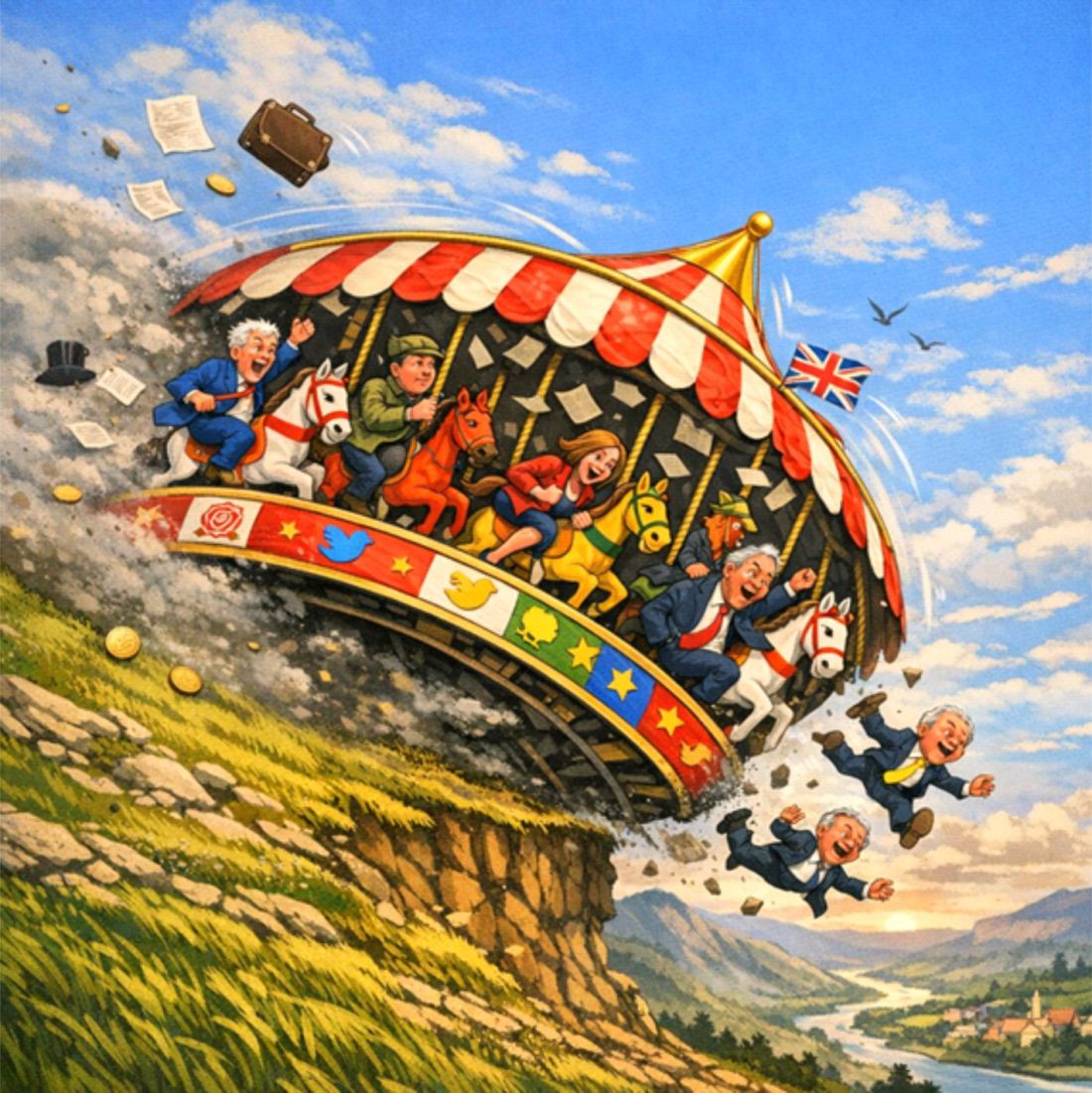
The Merry‑Go‑Round Has Already Broken Loose
For years, voters have treated elections like choosing a different horse on a familiar ride. The movement felt predictable, the risks manageable, the outcomes contained.
But the merry‑go‑round has already rusted off its hinge.
It is on its side, picking up speed, racing downhill.
And yet we continue to behave as if staying on the ride – or switching horses – will somehow change where it’s heading.
The danger is not that we choose the wrong rider.
The danger is that we fail to see the ride itself is no longer stable.
Why Newer Parties Are Rising
The Greens and Reform are gaining ground not because they have more charismatic personalities, but because they offer something the traditional parties have avoided: policy divergence.
They challenge the shared assumptions that have defined British politics for decades.
Whether voters agree with them or not, they represent a break from the consensus that has kept outcomes so uniform.
This is why the traditional three parties are in turmoil.
They are fighting a communications war in a world that now demands a policy rethink.
The Only Way to Change Course
Real change will not come from:
- blocking certain politicians
- swapping leaders
- or chasing the next “fresh face”
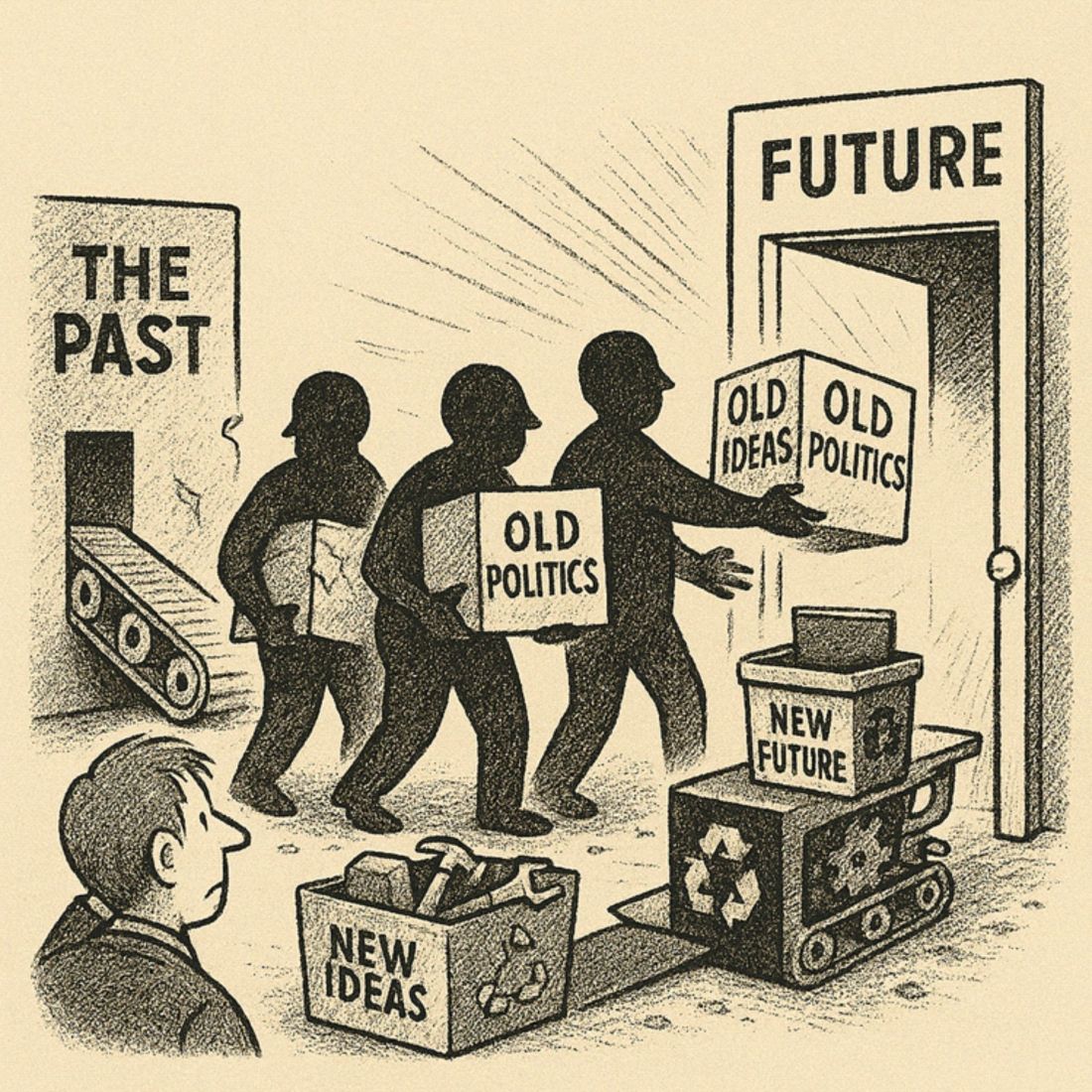
It will come from recognising that the foundations of the system – the policy frameworks that shape every decision – need to be rebuilt.
The most radical act a voter can take today is not to switch parties, but to question the assumptions all parties share.
Because until those assumptions change, the outcomes won’t.
And the merry‑go‑round will keep accelerating toward the edge.

 Adam Tugwell