
Reflecting on the December 2025 publication and its foundations in The Local Economy & Governance System (November 2025)
This document serves as a guided companion to From Principle to Practice, published on 24 December 2025, and to its foundational predecessor, The Local Economy & Governance System, released on 20 November 2025.
Together, these two works form a coherent blueprint for a new way of organising human life – one that places People, Community, and The Environment at the centre of society.
Both books are available on Kindle and can also be read online at adamtugwell.blog
This companion is not a summary of the books, nor a replacement for reading them.
Instead, it is designed to help readers approach the material with the mindset required to truly understand it.
LEGS is not an adaptation of the existing money‑centric system. It is not a reform, a patch, or a variation on familiar economic structures.
It is a clean‑slate design – a return to natural human principles that have been obscured by centuries of systems built around accumulation, scarcity, and control.
To read the book well, the reader must be conscious of a subtle but powerful reflex: the tendency to interpret new ideas through the lens of the old system.
This reflex is not a flaw in the reader. It is a conditioned response created by a lifetime inside a system that taught us to see money as the centre of life, work as the measure of worth, and survival as something to be earned.
This companion exists to help the reader recognise that reflex, set it aside, and engage with the material as it was intended – as a fresh start.
Overview
From Principle to Practice expands the conceptual foundations laid out in the earlier LEGS publication and translates them into a complete, functioning system.
It explains how value is created, how essentials are secured, how money circulates, how contribution is shared, and how governance becomes local, transparent, and participatory.
But more importantly, it invites the reader to imagine a world not shaped by the assumptions of the money‑centric system.
It asks the reader to consider what society would look like if we designed it today – not from inherited structures, but from natural human needs and behaviours.
The book is not ideological. It is structural.
It is not theoretical. It is practical.
It is not utopian. It is human.
Key Themes
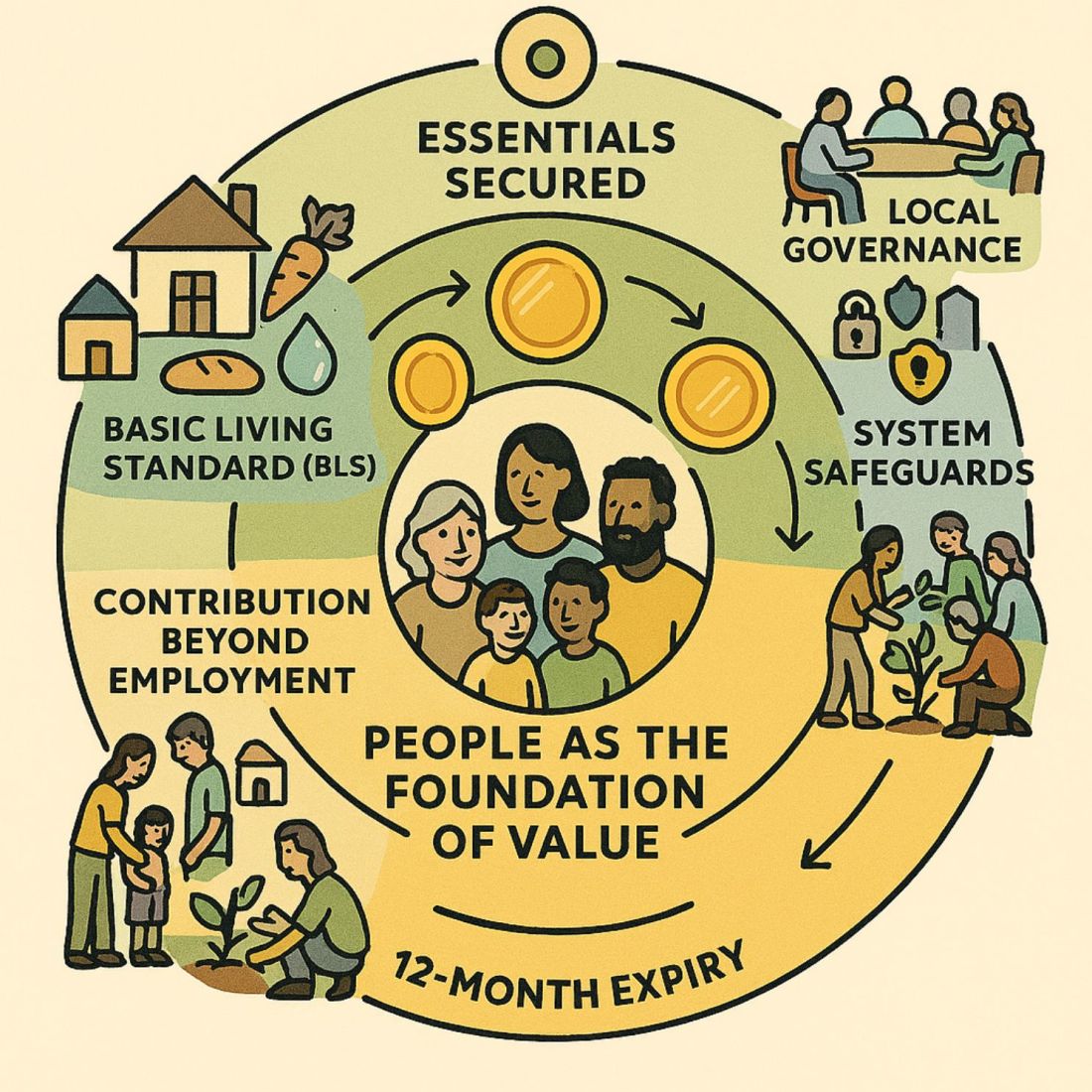
1. People as the Foundation of Value
The central premise of LEGS is that people – not money, markets, or institutions – are the true source of economic value.
This is not a metaphor. It is a structural principle.
The system quantifies value based on people, their stage of life, and their capacity for contribution.
In doing so, it restores dignity to every individual, regardless of wealth, status, or productivity.
2. Essentials as a Protected Foundation
The Basic Living Standard (BLS) is not a benefit or a safety net. It is the baseline of dignity that full‑time work must guarantee.
By securing essentials structurally, the system removes fear as the organising force of society.
When survival is no longer a commodity, people regain the freedom to think, act, and live without coercion.
3. Money as a Circulating Tool
Money in LEGS is designed to circulate, not accumulate.
It expires after 12 months, ensuring that it remains a tool of exchange rather than a store of power.
This design removes the addictive behaviours – hoarding, speculation, scarcity creation – that distort human life under the money‑centric system.
4. Contribution Beyond Employment
LEGS recognises that valuable work extends far beyond paid employment.
Caregiving, learning, community work, environmental stewardship, and social support are all essential to a healthy society.
The system acknowledges these contributions structurally, not symbolically.
5. Locality as the Anchor of Stability
Value, money, trade, and governance all operate at the community level.
This strengthens resilience, reduces dependency on distant systems, and restores the natural human scale of economic life.
6. Governance as a Participatory Practice
The Circumpunct replaces hierarchical power structures with a flat, transparent, community‑led model.
Governance becomes a living practice, not a distant authority.
7. A System Designed to Resist Capture
Every safeguard – from money expiry to fixed values for essentials – exists to prevent the system from being manipulated, centralised, or distorted.
LEGS is intentionally designed to protect itself from the very forces that corrupted previous systems.
Key Messages
1. You cannot understand LEGS by comparing it to the current system
The money‑centric system is built on scarcity, competition, and accumulation.
LEGS is built on contribution, locality, and shared responsibility.
These frameworks are incompatible. Attempting to interpret LEGS through the logic of the old system will distort it.
2. The old system creates addictive patterns
People unconsciously cling to the idea that money must accumulate, that essentials must be earned, that success is numerical, and that security must be purchased.
These patterns are not natural – they are conditioned.
LEGS requires the reader to recognise and release them.
3. LEGS is a clean‑sheet design
It is not a variation of capitalism, socialism, or communism.
It is a return to natural human principles that predate all of them.
4. The system works because it aligns with human reality
People thrive when essentials are secure, contribution is shared, governance is local, and money cannot dominate life.
LEGS restores these conditions.
Core Takeaways
1. The greatest challenge is mental carry‑over
Readers must actively notice when they are interpreting LEGS through the lens of wages, markets, profit, or hierarchy.
These assumptions belong to the system that is now collapsing and cannot be carried into a new one.
2. LEGS is a complete system
Money, value, essentials, contribution, governance, and trade are interdependent.
Understanding one requires understanding the whole.
3. Essentials are guaranteed through structure
The BLS is not charity.
It is the structural foundation of the economy.
4. Money expires to prevent harm
Expiry is not punitive. It is protective.
It ensures that money remains a tool, not a weapon.
5. Contribution is universal
Everyone contributes according to capacity.
No one is excluded or left behind.
6. Local governance prevents capture
The Circumpunct ensures that decisions remain with the people they affect.
7. LEGS is a return to natural human living
It aligns with the rhythms of community, the cycles of nature, and the realities of human behaviour.
Closing Reflection
This companion exists to help the reader approach From Principle to Practice with the mindset required to understand it.
The book is not asking the reader to imagine a slightly improved version of the world they know.
It is asking them to imagine a world built on natural principles – contribution, locality, transparency, and shared responsibility.
To see that world clearly, the reader must temporarily set aside the assumptions of the money‑centric system.
Only then does the coherence, practicality, and humanity of LEGS become visible.
 Adam Tugwell