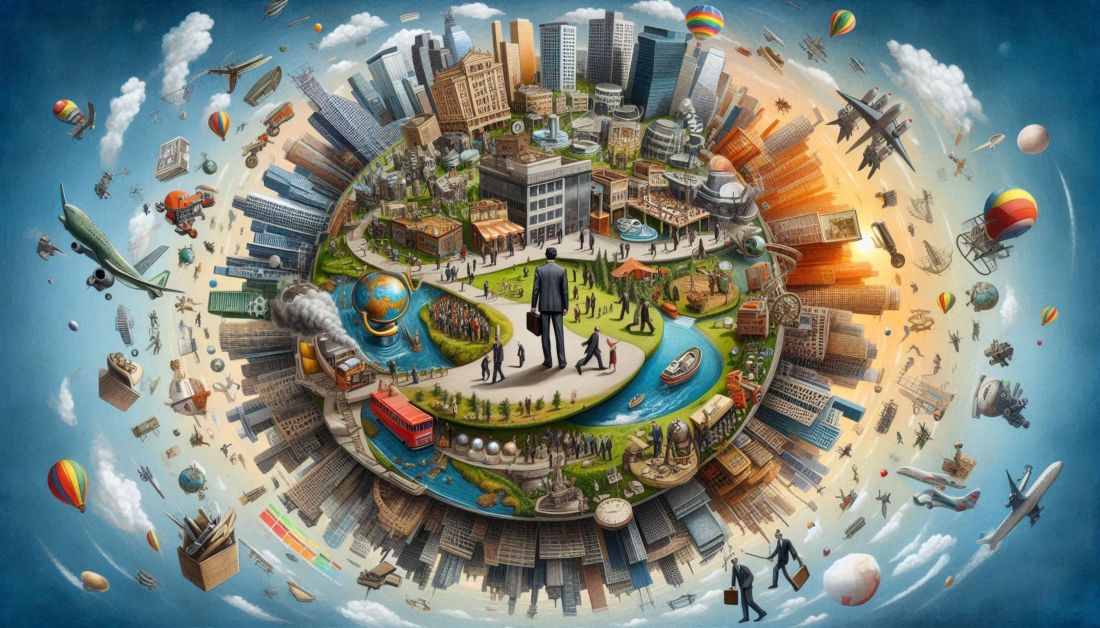
The Local Economy & Governance System (LEGS): Escaping the AI Takeover and Building a Human Future

The Future Is No Longer Distant

There is growing disquiet, fear, and quiet concern about the turbulence we are experiencing in the world, alongside a deep, intrinsic sense that nothing is as it should be – and that it will never be the same again.

Yet at the heart of this unsettling feeling lies confusion. The prevailing narratives insist that with AI now here, and the technology it commands about to permeate every conceivable part of our lives, humanity should be grateful.

We are told we stand on the cusp of a new age, where surrendering to AI will deliver a dream life unlike anything mankind has ever known.

Some are already suspicious, beginning to question what the rollout of this digital revolution will truly mean.

Others believe the only way to progress – or to feel in control of either the real or digital worlds – is to recapture what they perceive as the “good times,” attempting to fix everything as if it were possible to freeze life and live forever in a single moment of the past.

Uncomfortable as it may be, the time has arrived for everyone to begin asking the hard questions: what happens next, and where will we find ourselves in a future that is no longer a distant shadow on the horizon, but already towering above us right now.

The Watershed Moment We Cannot Ignore

The Coming Crisis of Agency & Survival

The answer to the question so many wish to avoid is that, if we continue on our current path, ordinary people will be left with no means to provide for themselves. They will have no income to pay others to do so, and neither government nor business will exist with the resources or the intent to supply even the basic essentials necessary for the masses to survive.

Everything we know – whether or not we recognise its connection to our current reality – has been moving in this direction for as long as most of us have been alive.

There has been a steady erosion of agency, independence, and self‑resourcefulness for ordinary human beings, first through the transfer of all forms of wealth, and now, taking place through the progressive takeover of every aspect of working life and function by both existing and rapidly emerging forms of AI.

Whilst many today spend quiet moments fearing the apparent opening of immigration floodgates and the erasure of Western culture, society, and life as we know it, others, for reasons seemingly unknown, appear to have embraced a suicidal empathy that insists the only correct behaviour of Western society is to destroy itself in order to prioritise all others.

AI’s Encroachment on Everyday Life

Yet everyone fails to see that the impending and critical threat to everything we hold dear has already been welcomed into our governments, our businesses, our technology, and the very functionality of daily life, and is so deeply embedded that it now resides in our computers and our phones.

The Myth of Effortless Utopia

AI, along with the robotics and technology now emerging to support it, is becoming the option of choice for carrying out the majority – if not all – tasks across what we currently understand as life.

This development will soon mean that, for the majority of us, there will soon be no reason for work to continue to exist.

Exploitation and Systemic Transformation

Whilst many of us hear talk of the AI takeover, the reduction in new hiring and training opportunities across numerous professions and industries, and the replacement of jobs of all kinds, we fail to connect these developments with the rising welfare bill as people find themselves with no choice but to accept a life of unemployment.

The New Divide: Inclusion and Exclusion

Nor do we pause for a moment to consider the pressing question: What does it mean when there is no job left for you?

The Last Chance for Human Agency

Yes, many truly believe the stories openly shared by members of the elite community driving this change – that in no time at all, life will become cheap and effortless for everyone because AI and machines can do everything.

The Value of Effort and Contribution

People really do believe we are about to step into a new and previously unrecognisable utopia, where the system has eliminated the need for human industry, effort, and value in the form of contribution, and instead provides everything we can imagine, free of charge and experienced as if life were one giant, permanent holiday for us all.

Historic Patterns and Systemic Endgame

Such benevolence, hinted at in the form of words from these few, and the feeling it inspires about our future, is one that few can fail to imagine.

Indeed, the words and the ease with which life now comes at us makes it very easy to accept the disproportionate levels of wealth for the few that has been encouraged by the progress of this new technical revolution.

People are taking for granted that once the evolution of everything needed to perform every task that human beings carried out across all functions of life is complete, these are the very same few who will then happily smile and sit back while everything they own and have developed works and provides for all of us in return for absolutely nothing. All whilst we continually maintain an everimproving standard of life and receive a universal basic income that covers every requirement beyond the luxurious permanence of 24hour leisure, which is somehow ever present and that we somehow believe we would actually enjoy.

In truth, we do not need to understand how or why we arrived here to see the situation for what it really is. The fundamental truths are already available for us all to observe, consider, and comprehend, hiding in plain sight: the masses have been used and exploited to create the very means that will ultimately be implemented to destroy humanity as we know it.

As this has all progressed, we have all been fed and indoctrinated with stories, technology, forms of easy wealth, and advances convincing us that things can only ever improve along this path and that a golden age awaits.

At the same time, we have given our consent to puppet politicians who have willingly changed and enforced every rule necessary to facilitate this under the veil of progress -driven not by principle, but by submission to those with power and self‑serving agendas, lured by promises of glory and gain that appeal to their true, hidden selves.

Many struggle to believe that those we have elected, and those who have grown rich or benefitted so greatly from the rewards of leadership in a modern world and society, could truly be so cruel. Yet does it matter whether we – or even they – accept that as truth, when the outcome fast approaching, without a change in our direction, will inevitably be exactly the same?

Within the world and its structures – The System as it operates, functions, and controls every part of life today – the true divide of them and us lies between those whom the system will continue to carry and cater for once the concept of human independence no longer exists, and the masses who have no further use, whom the system will either choose to exclude or find some means to remove.

This is neither a horror story nor a work of fiction. The only uncertainty – without a change in direction – lies in when and how events will unfold that bring about the critical period of transition.

Today, humanity still possesses agency, choice, and the power to pursue an alternative pathway – even though so many of us are sleep‑running toward the end of freedom’s existence, actively embracing and welcoming the very tools that will soon replace the need for us within our own lives.

The fundamental truth of any life worth living is that there can be no reward without effort, and that effort itself is the pathway to reward when life is grounded in truth.

We hold no value to anyone or anything if we do not contribute or participate when we are able. There are no free rides for anyone or anything, unless they come in the form of charity – or unless we ourselves assume the role, if deemed desirable, of pets.

History repeats this truth time and again. We need only look further to see how power is abused by the powerful—how they seek to control everything they find useful, and how quickly they dispose of it when they do not.

Everything about the moneocratic, money‑centric, top‑down, centralised, hierarchical, and patriarchal system was ultimately designed to end this way.

The arrival of technology – and finally AI – has brought humanity to a genuine watershed moment, an endgame in which we must either abandon the unsustainable way of life to which we have become addicted and embrace one that restores balance, fairness, and justice for all, or continue living the lie created by those who profit from our subservience.

If we choose the latter, we will participate in it until the moment we realise we no longer hold any value, and the destiny imposed upon us by others has arrived.

The Alternative Pathway

The temptation for many, upon realising what has happened and what is happening, is to believe that all we need to do is step back a few years and remove the most corrosive technological advances that have entered our lives.

As simple as the removal of AI might seem – even if we were able to overhaul politics and replace politicians with those who agree – the real damage to society and culture has not come from technology or its advances themselves. It comes from the reasoning, motives, intent, and forms of control behind them.

These forces have long been at work, reshaping how everything functions across society – manipulating and redirecting life so that what we have already become is accepted as normal.

The way we live, work, conduct business, relate to others, and even relate to ourselves must return, rediscover, and recreate a way of being that transforms our system of values.

Our entire value set must shift so that we understand and expect meaning from life in ways that, by today’s standards, may seem counterintuitive or even alien.

The Human Value Imperative:

  1. We must embrace the reality that everyone is equal, and that the only difference between us lies in our roles, functions, and contributions within society—roles that are always dynamic and open to change.
  2. We all need to accept that differences do not make us different when it comes to what is ethically, morally, and fundamentally right.
  3. We all need to accept, understand, and embrace that no person should be advantaged over another by circumstances beyond their own efforts or control.
  4. We must accept that deviation or allowances beyond these principles will always lead to growing unfairness—even when special circumstances seem justified or privileges are believed not to be abused.
  5. We must accept that hierarchies are not a natural system of order, even though the need for order in society means that some will naturally take the lead.
  6. We all need to share responsibility and take part in collective choices that shape the aspects of life we share.
  7. We all need to contribute to the community in whatever ways we can.
  8. We all need to work and actively contribute to shared life whenever we are genuinely able.
  9. We must live by the principle that the responsibility we have toward others is the same responsibility we owe to ourselves.
  10. We all need to accept that once our needs are met, nothing is gained if any one of us seeks to have, take, or control more.
  11. We must accept that true abundance means having as much as we need, not everything we want.
  12. We must accept that people are the greatest source of value, and that real economics should be centred on that value.
  13. We must embrace the reality that full employment is both natural and normal when employment is defined by all forms of contribution, not just financial return.
  14. We must welcome and protect the truth that locality, and the transparency it brings to every kind of relationship, is key to maintaining and benefiting from a system we can trust to be fair, balanced, and just.
  15. We must ensure that AI and all technologies are used only to support human life and enhance working practices—not to replace jobs or create circumstances in which any human being is considered useless.

When we commit to all of these principles, we can begin to envision a society and way of life that truly functions as it should with equity, equality and accountability for all – one that is transformed in almost every possible way.

The Turning Point: Choosing Freedom and a Better Future

For many of us, the uncomfortable reality we must face is that passive inaction – or continuing to accept life under the control of others, believing things will simply carry on as they are – poses an existential threat that is all too real. It is a danger that extends beyond the confines of Orwell’s 1984 and, for those who truly value their lives, could mean something far worse.

The choice – while we still have one- is to not only accept but to embrace an alternative path.

This path, though carrying forward some familiar aspects of the world around us, demands that every part of our lives be lived in a fundamentally different way: a way where people, community, and the environment come first; where power rests with the individual, their freedom, and their personal sovereignty; and where the whole experience of life unfolds in a completely new direction.

The Local Economy & Governance System Framework: A Path to Empowerment

Exploring the Local Economy & Governance System

Visualising a different world – how it operates, what it requires of us, what we must give, how we work together, and how frameworks of rules function (rather than laws that micromanage every part of life, as is increasingly the case today) – may sound simple. Yet their adoption, interpretation, and our response to them within a system centred on empowering every person, rather than controlling them in every conceivable way, will be fundamentally different.

This shift will inevitably provoke resistance, not least because we have become addicted to the unsustainable, money‑centric way of living that dominates our lives today.

The Local Economy & Governance System provides a detailed picture of these frameworks, showing how this new people‑centric model will look and how it can be implemented.

Perhaps the most important element of this new world is that it will be built upon direct, participatory democracy – a system entirely unlike the hollow or pretend democracy that defines the moneyocratic world we currently inhabit.

Participatory Democracy: Power in the Hands of People

Participatory democracy means that everyone takes part in the decision‑making processes that shape public policy.

It ensures that we all hold the power to change or remove the public representatives we choose and appoint.

This requires a level of accountability and participation that is not only regular and personal, but far greater than the limited choice we currently have – voting every four or five years for candidates selected by someone else.

There is much to consider about the processes that enable true participatory democracy and how it can work effectively and diligently.

One of the most striking differences between this future system and what we have today is that there will be no political parties.

Instead, public representatives will be chosen directly by the community – respected individuals with proven commitment to serving the best interests of everyone involved.

To learn more about The Local Economy & Governance System, please visit: The Local Economy & Governance System Online Text or support my work by purchasing the book for Kindle.

From Possibility to Reality: A System That Works for Everyone

The Local Economy & Governance System will work because it prioritises people, community, and the environment in ways that may seem inconceivable today.

It places value on personal sovereignty and the freedom that comes from living lives defined by who we truly are, rather than by external factors and reference points that remain under someone else’s control.

Yes, the practical mechanics of LEGS will work – and they will work well – if we choose to embrace them.

After all, the dysfunctional world we inhabit today has appeared to “work” only because we came to believe in it, even as it has harmed so many of us.

We must not underestimate the ability, ingenuity, and creativity of humankind to deliver and implement solutions that succeed under any circumstances, when motivated and convinced it is right to do so.

Together, we can reclaim power and value and build a new world and system that functions with equity, equality, and open accountability for everyone – just as a truly civilised society always should.

Together, we can turn possibility into reality and create a society that truly works for everyone.

The Choice Before Us

We stand at a decisive moment in human history.

The turbulence we feel, the erosion of agency, and the encroachment of systems that strip away our independence are not distant threats. They are realities already shaping our lives.

The arrival of AI and the technologies that support it has brought us to a genuine watershed: either we continue down the path of dependency and control, or we choose to reclaim balance, fairness, and justice through new systems built on empowerment, community, and sovereignty.

The Local Economy & Governance System, grounded in participatory democracy and people‑centric values, offers a practical and principled alternative.

It is not a utopia promised by elites, nor a nostalgic return to the past, but a framework for living that restores meaning to contribution, accountability, and shared responsibility.

Human ingenuity has always risen to meet the greatest challenges. If we believe it right to do so, we can build a society that works for everyone – where equity, equality, and open accountability are not ideals but lived realities.

The choice is ours. To continue sleepwalking into a future where humanity holds no value, or to awaken and embrace the possibility of a new civilisation. One that honours freedom, restores dignity, and ensures that life itself remains worth living.

Breaking The Money Myth: Rethinking Value, Exchange, and Equality

An Economy That Cannot Function Without Money Will Not Work for Anything Else

Coming to terms with the role money plays in our lives is challenging for most people. But the difficulty doesn’t end there.

We have come to value money not just as a tool, but as the benchmark by which we measure everything in life.

This leads us to a deeper truth—one that must be faced, rejected, and overcome: an economy that functions for money, with money, or through money cannot, will not, and does not work for anything else.

An economy should always serve People, Community, and the Environment. These are the only foundations that truly support a good life and foster genuine equality for all.

Most people instinctively reject the idea that any form of economy or trade could operate without money. This reaction stems not from truth, but from habit. We’ve grown so accustomed to money being present in every transaction that we take it for granted—not because it’s inherently necessary for exchange.

The reality is this: an economy designed for the people must be capable of operating without money, currency, or any medium whose value can be universally—or nationally—controlled or manipulated by external parties.

Instead, value must be determined solely by those directly involved: the buyer, the seller, and the facilitator (or a community body that sets local trade rules for the exchange of essential goods and services).

This doesn’t mean money or currency must be eliminated entirely. Rather, it means that their value must remain free from inflationary or deflationary forces.

Any variation in exchange value must reflect only the true worth of the goods, services, or contributions involved.

The Moneyless Economic System

The essential shift—both in action and mindset—is from a system where money is required in every transaction, to one where the exchange of life’s necessities does not inherently depend on money at all.

One of the fundamental truths of our world is that not all things are equal. However, the way we treat people and the planet should be equal and fair for all.

It follows, then, that money—or any form of currency used as a medium of exchange—should not be governed by a universal benchmark, especially when that benchmark can be manipulated by a powerful few to serve their own interests.

It is normal that we all contribute work to meet our needs. Therefore, the things we need should be accessible to everyone, based on the value of what they can offer through their work.

The imbalance in this equation today arises not from scarcity, but from the greed of those who control access to what others need.

This imbalance is reinforced by systems of privilege, power, and the illusion of ownership that steps beyond the requirements of genuine personal need.

Government is Broke(n): Collapse Now or Collapse Later?

Tuesday marked the rather strange pre-budget speech or open warning call from the Labour government, shouting all too loudly that Tax rises are inevitable and heading our way.

Whilst Farage attempted to get ahead of the game by making bold a bold statement on Monday about a future Reform government cutting spending on Welfare, and then Kemi Badenoch followed Reeves online with a speech that pretty much adds up to the same, the commonality between the positions of all these politicians will be missed by many for being remarkably similar, if indeed not the same.

Yes, you may ask yourself how exactly this could actually be. But the key element of one party raising Taxes whilst failing to cut spending, whilst others promise to cut spending whilst freezing or lowering taxes is fundamentally the same – because these approaches are all about saving the economic system and the economy that we have – and absolutely nothing to do with putting people and the lives of people first.

Few realise and even fewer understand that Reeves really isn’t the architect of the problem the U.K. (and the wider world) now faces.

That responsibly has been held and passed through many different hands over a period that exceeds decades of time, whilst a monetary and economic system has been introduced and then encouraged to take over every part of life and what we know as economy, with laws, regulation and even the legal system itself abused and manipulated to make money work in a way which suggests that its supply is endless.

Meanwhile, everything that has productive value to the U.K. and its economy has been destroyed, or outsourced, leaving almost nothing that can be used to sustain a sovereign nation behind. And now, even our ability to feed ourselves with our own farms on an accelerated pathway to being destroyed.

The growth that politicians obsess about has not been through any genuine notion or understanding of growth as everyday people and small business owners understand it but has instead been borne of the fear of people who should never have held the reins of power.

Politicians who fall over themselves to find, create and manipulate ways to ‘borrow’ more and more money in the form of the bonds that the government sells, which when funnelled into the right areas of public spending will multiply many times over as each pound changes hands between different business, with each transaction then meaning just the one pound is counted against GDP and ‘growth’, multiple times.

GDP then facilitates the accounting trick of all accounting tricks. Where public debt is never paid off but is cleverly reduced as a percentage of the ‘growing’ GDP balance, meaning that other than paying ‘interest’ on that ‘borrowing’, what is supposed to be a debt that gets smaller in relation to the U.K. productivity or GDP, should never actually need to be paid off at all.

What the politicians never understood – beyond agreeing to facilitate and legalise a system that basically made being in power as being as simple as a) doing what whoever pulls the strings tells you, and b) having to do nothing else other than save or spend, is the corrupt money and economic system that they have legitimised through deregulation and changes in all sorts of laws and rules, has legalised the theft of the business and infrastructure that once made the UK great, also enabled this Country to be able to pay its own way through the natural methods of productivity or what we might see as things like industry, which up until the Second World War were ours, and only ours.

Finding ways to create ‘growth’ has become progressively more desperate. Not just for Starmer, Reeves and co; but for every politician who has been anywhere near real power for a very long time. All as part of a process that dates back to at least 1971, when the FIAT money lie was properly embedded and the last remnants of the gold standard were left behind.

The same money and economic system that has been used to disproportionately enrich the few, whilst giving them the power to exploit and impoverish the masses, is also the reason why growing numbers of people can no longer afford to live. It’s why we have a minimum wage that doesn’t actually provide those who earn it anywhere near enough money to live independently and have lives which we would recognise as being their own.

As we now watch the welfare bill spiralling out of control – not because people don’t want to work – but because the system we have has pushed them and in many cases held them there – we are staring down the barrel of the gun that is the AI takeover, where many millions more jobs will be lost. Not because they need to be. But so those controlling this shit show can earn and profit even more.

The government is broke and broken. Raising taxes is the only way that they can service the forlorn hope that enough growth can be create that will turn on the taps of borrowed money once more, so that the real damage that is now bursting into open sight from decades of mismanagement and yes treachery can hopefully be hidden.

Then the politicians can resume taking their happy place in the limelight of the Westminster merry go round and the wheels of money myths will spin for another day and avoid hitting the ground of reality once more.

Unfortunately for us all, the reality that the U.K. has pretty much zero productivity left means that the money, cash, property and ownership we have of anything is the only potential saviour in terms of financial resources that out of their depth politicians actually have available to them.

If a new politician or political leads were able to take over today and face up to the situation and see and be honest about all of this for what it really is, they would recognise that the choice they have is to either embrace the collapse which has been inevitable from the moment that private interests took over money and the economy, or keep playing along – which means taxing and taking from everyone and everything, until everything collapses anyway, and nobody has anything left worth having – because the need to save their own skin and position dictated that there was simply no other way.

Overview

Key Messages Simplified

• The UK government is financially broken, and politicians are trapped between two bad options: accept collapse now or prolong it by taxing and impoverishing the public.

• Rachel Reeves’ pre-budget speech signals inevitable tax rises, driven by a £50bn shortfall and falling productivity.

• Other parties, like Reform UK and the Conservatives, offer economic strategies, whether through spending cuts or tax freezes, that are all variations of the same flawed approach: preserving the current economic system at the public’s expense.

Core Arguments

1. The Economic System Is Rigged

• Decades of deregulation and manipulation have created a monetary system that benefits the wealthy while hollowing out UK productivity.

• GDP growth is an illusion, inflated by repeated transactions rather than genuine value creation.

• Public debt is never truly repaid—it’s masked by GDP growth, allowing borrowing to continue indefinitely.

2. Political Consensus Protects the System, Not the People

• Whether politicians raise taxes or cut spending, they’re all trying to save the same broken system, not improve lives.

• Reeves, Farage, and Badenoch are functionally aligned, despite different rhetoric.

3. Collapse Is Inevitable Without Radical Change

• UK productivity has been destroyed, with industries outsourced and even UK agriculture now being undermined.

• AI-driven job losses will worsen inequality. Not because they’re necessary, but because they’re profitable for elites.

• The only remaining assets people and small businesses have —cash, property, and ownership—are now becoming the last financial lifelines for the government and politicians who simply shouldn’t have the power that they do.

Final Warning

• Politicians must either confront collapse honestly or continue taxing until everything collapses anyway.

• New leadership must be willing to reject the current system, rather than perpetuate it for personal or political survival.

Overtaxed, Overburdened, Overpowered: The role of the UK State has become all bread and no jam for too many of us, and we are fast approaching a place called stop

Each of us see the problems this country is facing from different points of view.

Whilst conversations about the crisis now unfolding with a range of different people would almost certainly deliver a range of common themes, the emphasis, value or meaning of each of them will almost certainly be different.

However, the one commonality, which isn’t about anything that we all have in common at all, would be the solutions that almost all of us will have based on our own world view, that in the bigger scheme of things, may be in no way similar at all.

Ironically, because so many of us have so many interpretations of the whys, hows and whats that have got us all here, and share them with what will be a relative few, we spend next to no time – if indeed any time at all, thinking about any of the common problems that we all really do share.

We certainly don’t think about the ways we can work together to create a better way of life for everyone and then how we get the leaders and mechanisms in place that will actually get us there.

The devil is in the detail

It really is no accident that the UK is in the kind of mess that it is. Because life has become so very complicated – and deliberately so.

The more detail, the more distracting and the more impossible a solution to just about anything might seem. Even to those amongst us who really can see that the status quo cannot continue and that no matter how bought into the things we like about the way we live – which we want to keep but don’t recognise that they are actually the part of the problem that’s making everything so impossible to fix – we really do need to snap out of the fixation with noise that’s doing none of us any good.

We must recognise that the things that work well for everyone and will work even better for everyone are much simpler than what we have been convinced we need.

It is inevitable that we will keep tripping ourselves up each and every time we think of the next step as being only about putting our own self-interest first.

Unfair, Unjust and Unworkable living, demonstrated best by Tax

Perhaps the best example of how we get lost and misdirected by the detail of what needs to change for us, rather than focusing on what needs to change so that it works for everyone, relates to the question of tax, taxation and everything else that means people like you and I are stumping up cash that we could often do with being able to spend, just so we can live without debt or in some cases rely on handouts or even food banks.

Yes, even framing the ‘tax issue’ this way will make some prickly – and that really is the point.

The UK Tax code is today thought to be over 21,000 pages and 10 million words long, giving everyone the distinct impression that the subject of how the bill for government action and delivery gets paid for (ostensibly on our behalf), needs to be tailored specially to everyone as if bespoke governance is the only kind of governance that’s really fair to everyone.

Have you heard of Tax Freedom Day?

This is ‘The day when Britons stop paying tax and start putting their earnings into their own pocket’. Or alternatively, the final day of the year when every penny we’ve earned goes to the government – if we start counting on January 1st, which was this year (2025) calculated as being June 11th by the Adam Smith Institute.

The reason I’m using this figure isn’t to piss anyone off by drawing attention to the fact that as an average, we arguably all work for no other reason than to keep the wheels of government turning every year for at least 5 months.

I’m doing so because it may be the only way to look at the relationship all taxpayers have with the government in the same way. Given how easy it is to get sidetracked by the question of what everyone earns!

June 11th 2025 was the 162nd day of the year (as 2025 is not a leap year), and with 365 days in 2025, this means that in comparative terms, people are giving over 44% of their earnings (162 days divided by 365 days), before they can even begin to think about what they need to spend money on, in turn before anything that they might actually want.

For a moment, let’s forget the amount anyone is actually earning for themselves, as we know that some have considerably more than others, whilst many just don’t have anywhere near what it takes to live without struggling to make ends meet, and then take it as read that everyone is giving up 44 Pence in every Pound they earn (£0.44).

After realising just how much of everything we do have taken from wages and then what we pay for that includes some form of tax, it doesn’t take much to realise that government or rather the model of government that we have is simply unaffordable, unsustainable and that we must do everything we can to find a different and much better way to pay for the things that we share.

Regrettably, the complexity of rules and regulations supposedly there to benefit and protect us don’t stop at taxation.

One of the reasons that every part of life, that doesn’t already relate to the question of financial affordability in some way, seems so difficult or restricted, is because our freedoms and therefore our independence from the system and government are already being actively controlled in many different silent rules that have deliberately been put there using the excuses like health and safety, and protecting us or someone in some way.

Even if we aren’t actively being followed around by a police officer all the time the fact that we are aware of and abiding by these rules usually adds up to being the same.

Government isn’t what it should or was ever supposed to be

Whilst many would actually like to see the wealthiest in our society directly paying at least 44% of their income to the government to help run everything outside of our front doors, we still need to keep some perspective when it comes to the obvious question we will come back to in a moment about who pays and begin with the question, ‘Does government actually work?’

Government certainly functions. Even the deepest or most vocally critical of what government in the UK does will find it difficult to argue otherwise.

Because no matter the organisation or service that comes under the rather large umbrella of government, they all continue to do something. Even if they are not delivering what we might agree to be the correct results. And that’s the only reason it can be argued that it all works.

However, functioning and succeeding are not the same thing.

The time is long overdue that we all took a very hard and questioning  look at every part of government and decided what, if anything, public services should or could be; just exactly where the scope and reach of government should end, and then and only then, what many believe to be the most important question of all, ‘How whatever government and the public sector does is paid for and by whom’.

Whilst it remains the case that there are services, infrastructure and even public facing roles that every modern society needs to be provided by the community, so that everyone can have universal experiences and opportunities which will always be the same, no matter who, where or what you are, the practical approach to not-for-profit service delivery – which this really should in almost all cases be, is not the same as the public sector and system of governance that we have today.

Every part of government and the public sector that we have today is focused on delivering (political) and therefore biased agendas which will inevitably advantage some people more than others in some way. Or is all about the jobs, terms and conditions for whoever the incumbent employees are who currently have the jobs.

There have always been politicians, officers and suppliers who for many reasons have chosen to advantage themselves in some way, if and where they failed to have the integrity to exercise their roles properly. And regrettably, it’s the position of trust we gave them all that enabled them to behave in such questionable ways.

Yet even more shocking reality that we all face today is that the whole public sector and everything that runs within it is now dysfunctional in terms of delivery in some of the most critical ways.

It has only been able to become this way because decisions have either been made (or not made) at the very top by people who really should have known better, and whose actions have allowed or facilitated everything that serves the public unwinding in this way.

Money before People

Regrettably, like so many areas of life today, the role of money – which stretches far beyond the scope of the tax question that we’ve already considered – is also the key element within the dysfunctionality of government and public services across the UK. Because the poor leaders that we have are obsessed with the idea that the only way any problem can and will be fixed is by having enough money to spend – no matter where it comes from, which is itself is these days even better for some politicians who dare not do anything which could restrict what they are already committed to spend.

Idealism and agendas cost a lot of money. Because their implementation requires the creation of systems, rules and infrastructure somebody wants but nobody needs.

The very perverse outcome from decades of government and the public sector serving itself, its people and whoever or whatever influences them, is that the changes that have been made in every way imaginable to support this are now costing too much for either the Taxpayer or government itself to sustain.

We have a VERY BIG problem. Because nobody in government or who wishes to form one either can or will be honest about the true depth and breadth of the mess that the UK is now in.

With Tax rises thought to be well on their way this coming Autumn, the reality that too many of us face is the 44% (or probably much more) that we are already contributing to this public sector black hole through so many of the things that we buy, pay for or earn, are set to keep going up.

All to cover the exploding costs of incompetence, waste and the furtherance of playing up to what are very dangerous egos. Because somewhere in amongst all of this the point has been lost that government does not and never did have the right to exist over the people that it was created to represent.

For any kind of government to be unrepresentative of the people it represents, would by its very nature and intended purpose mean that it represents someone or something else.

Money: The drug wrecking everything to enrich and empower the few

The way that money actually works, how it is controlled and worst but not least, how it is actually created at will, is the truth that sits behind everything bad, that few of us will willingly believe.

It’s much easier to believe that it is all good rather than even having the potential to be bad – even when almost everyone can see the destruction that money or the lack of it is causing to everyone in some way or form.

At the heart of the money tree and its root and branch system sits the mechanisms that supposedly fund government, but actually do so by doing everything to help grow the volume of money that is in circulation, so that the public spending – and the only way that politicians know how to get themselves out of trouble, can leverage ‘growth’ so that the entire shitshow can be hid.

Unfortunately for all of us, the exponential growth of the ‘money’ that has entered circulation, particularly since the responses of government to the Global Financial Crisis of 2008 and the Covid Pandemic of 2020, has wildly contributed to the inflationary spiral that accompanies such an expansion of available cash.

The creation of money that doesn’t relate to anything else like productivity or output devalues the money and incomes that normal people already have, as well as what they have the ability to earn.

It does so at breakneck speed whilst the real value of everything is funnelled towards those who control and benefit from what is a fully legal, legitimised but nevertheless completely corrupt system that appears real, because they have typically become millionaires and billionaires in the process.

Put simply, the lowest paid and most vulnerable now have zero chance of ever being able to earn enough to live independently of benefits, charity, debt or worse.

For as long as the money madness continues, the bubble containing all of those who are branded as being a drain on the system will rapidly continue to expand.

The leadership void or black hole

When a country has such shit, incompetent leadership, and has done for the period of time that the UK has, it wouldn’t be unfair for any of us to be asking, ‘How did we get them?’ and ‘How did they get to where they are?’.

However, as we all need to realise, very few of us do ask these questions or indeed any questions that are like them. And because we don’t, each time an election takes place locally or nationally, we are, as a majority, making the same mistakes over and over again.

We are chewing at the very same shit sandwich with the bits just wrapped differently with words, rosettes and faces – all hiding the same miserable self-interested and dangerously incompetent content that always delivers outcomes that are the same.

Because we have a very bad, self-destructive habit of going along with the idea that the political fairies come along and give us all a genuine choice at election time – as all good democracies surely would, we have not only accepted that government after government and council after council has worked on all of our behalf. We have also jumped into an elephant trap of our own making that tells us these same fairies will deliver the politicians to choose from at the next election, who will sort out and solve the very same mess that they and their own kind created (with a little help from their friends) in the first place.

Sadly, there are no exceptions to the reality that we must face that there are no real leaders in politics today.

The so-called leadership we see, and what the people we identify as leaders say, is much more likely to be aligned with us hearing and seeing whatever we need to fuel our own confirmation biases than it either is or ever will be about the solutions and outcomes that we might not be ready to hear about, but nonetheless actually need.

Victim or Victimiser: There is no longer an in between

As a society and culture, we are collectively suffering what might be the worst type of addiction of all. Simply because it is majority of us are addicted rather than the few.

Meaning that that same majority is completely out of touch with the realities of what that addiction does and will remain so, until the supply runs out – which is where all those who cannot afford to live independently within the current system have or are beginning to find out.

Money, or rather the way that money is used by those who control the system – and that means government and politicians, who are very much under their control too, has become the key factor in every equation and consideration in our lives.

The role of money and its reach has dehumanised everything to the point where money and the power, influence and control it is perceived to give at every level of life has become more important than the value of life and community itself.

Few realise just how their lives are completely at the mercy of the ability to spend, borrow and achieve the momentary of transitory hit that this money centric, Moneyocracy we inhabit demands of everyone and which is enforced by the barrage of non stop marketing and remote, typical digital pressure which comes at us constantly and demands that we all conform.

Money; what it does, what it can do and what it says about you is the qualification and gatekeeper that runs through every part of functional life and if you are in, you are in and if you are out, you really are all the way out and fully at the mercy of those who continue to be ‘in’.

The tragedy of the system is the ruthless and methodical way that human behaviour has been used against the masses by the few and the experts they pay who understand it.

The sweeties and trinkets that have been flowing towards for decades have only been bettered by what has appeared to be the endless ability to secure more and more credit to buy it with, all the time becoming more and more essential to secure as real earnings and wealth have been stripped by the printing of all this extra ‘pretend’ or non existent money that even relatively wealthy people have no chance of keeping up with.

The irony is that those of us who continue to believe we benefit from what the establishment is doing and therefore acquiesce or go along with it are – through our actions – making those who cannot the victims.

All for no better reason than this whole situation could not exist without the elites treating the masses as a resource that is not real. But is instead just like oil, coal, precious metals, forests, farms, land and even animals – and just something else for those who ‘own them’ to exploit.

We all need to contribute to what we share in life. But real life cannot continue if we are required to contribute everything we have

Whilst we must all accept it is correct for everyone to contribute to the upkeep and maintenance of the systems and infrastructure that serve us all, from the moment we step onto the pavement or road outside of our homes, what we share is not and never should become more important than the right to have a fully independent, functioning and self supported life experience.

The system that we have discussed is at breaking point and cannot continue as it has, or as it is today.

Those in charge don’t know how to do anything other than borrow or tax us. And as the system can no longer sustain the borrowing that idealism and agendas have made necessary, the current government are now looking at everything they can tax beyond everything they already do.

One way or another, the system is going to collapse. Because we are all living unsustainably in a system that itself is unsustainable and at the centre of which is a plague which is the absence of real leadership, replaced with what is instead no better than incompetent management that makes it the most unsustainable part of it all.

Real life and a money-centric economy are mutually exclusive outcomes

Government already costs us way too much – even at 44%.

That’s before we even begin to consider the work and additional value to public service that charities and other nonprofit organisations bring, that we are all in one way or another contributing to too.

The whole model of economics needs to be restructured and redeveloped so that it supports life, rather than feeding off it like the giant parasite that the financial system and the role that government plays in it now is.

A realistic level for everyone to contribute to ‘the community’ would be around 10% – without any form of exception for anyone.

We should also be considering the added requirement that everyone able to work also contributes the equivalent of 10% of their working time and the skills and experience they offer, to help make our communities, their governance and infrastructure work.

Thereby creating real buy-in and ownership for what we all share, whilst drastically cutting the scope and influence of an out-of-control sector, and the ballooning costs that are actually paying for lots of agendas snd idealistic ideas, but very little that is actually about people and certainly nothing that’s doing everyone equally any good.

The identity, qualification and process of finding good leaders

Good public leaders, public representatives and public servants, would not facilitate or contribute to the creation, implementation and furtherance of agendas, ideologies and idealism that doesn’t serve the genuine best interests of those who they have been elected, appointed or recruited to serve.

Yet we have been experiencing decades of exactly that. And we have no hope that this will change if we continue to rely on a system that needs to change giving us the leaders who will then do the right thing when it comes to the delivery of that change.

Contrary to accepted thought, we do not need money to play the role across society that it has been deliberately engineered to do.

Power and control are certainly not a gift that should be secured within the hands of a distant, faceless, unanswerable few who we will never meet and whether intended or not, are treating humanity as a resource and no better than a numbers game that they can do with as they like. All as if they are now, as the result of decades of manipulating the system and bending it to their will, the new gods of everything with everyone else’s destiny theirs and only theirs to decide.

The truth that few see is that the centralisation and push for remote control of everything that globalisation and everything that walks alongside it has been, has been the active and complete restructuring of our society and culture, so that nothing can or will work without the say so and direction of those who make all the decisions.

None of this was accidental. Locality, local relationships, local businesses, local supply chains, local decision making and everything that goes with it promotes sovereignty and independence. It encourages and grows a living environment and cultural model that is good for everyone other than those who want to advantage themselves and be in power or control.

Meanwhile, the downsides of centralisation and everything that goes with it are the for every one of us to see.

However, despite the various attempts, compelling rhetoric and highly credible narratives that work so well when playing up to the addiction for material living that we currently have, there is an alternative and much better alternative to running life and everything that we and our communities need. And the real upside of this real alternative is that it centres completely around putting normal people and our local communities back in control.

The fact that generations of political leaders and those they favour or are influenced by have misused and abused their position to create a system with faux legitimacy – simply by legalising immorality to make it appear moral and therefore unquestionable, doesn’t make it right. And it certainly doesn’t become right, just because those in power today continue to insist and behave as if it is so.

We have a legitimate right to hold power and control over our own destiny.

The power of collective decision making should sit as part of a new structure of governance within our communities, amongst people and representatives who we ourselves select and know we can trust.

A moral obligation arguably also exists to reset the entire system and the various devices such as money and the tools of governance the existing system uses, so that we once again bring the focus of everything in life back to people, to humanity and to creating the best kind of environment that we can to ensure that every person has the life experience that everyone – and not just a selective few should have.

However, nobody else will step up or step in to do this for us – no matter how compelling or necessary this might seem.

Whether addicted or not, the choice and the steps necessary to return power to people and to our communities, and with it the creation of a genuine democracy we can all trust and believe in, are ours and only ours to take.

Nobody in the public sphere today can or will do this. None of them will give us back the influence that is rightly ours. Because they all imagine themselves as leaders who can only lead by having absolute control over everyone and everything else.

We don’t have a roadmap agreed for the future.

But there are plenty of ideas we can share about the outcomes that will serve all of us equally well and in a balanced, fair and just way.

This is where the conversation should start.

The one thing we can be sure of is that real leaders do actually lead. But also know that it is real equality, balance, fairness and justice that applies equally to everyone where the pathway to everything good for everyone really starts.

Links:

Future Economics must be tied only to people, their contribution, what is important to sustain good, fair and balanced lives, and legal currency must never again be open to speculation and manipulation

You don’t need to be a trained economist to know that the model of economics the world uses and the way economics is revered like work of the gods today is wrong.

In fact, it is probably better if you aren’t, and that you aren’t involved in economics, banking or corporate wealth creation either. As you are much more likely to be objective and untainted by ‘being in the tent’ in some way.

The misplaced ingenuity of the economic system and how it works has made it as complex as it is mind boggling. But that doesn’t give any surety or guarantee that how it works and what it achieves is in any way good.

For those actually thinking about why money is the common factor in everything across the world that is now going wrong, the complexity of the economic system is being exposed to light as the smokescreen that it is giving the hallucination of credibility to all the darkness and malevolence that has been so cleverly hidden within.

How can something so clever and complex not be real, is a question that many would employ as a riposte to counter the suggestion that there is absolutely no legitimacy to the FIAT monetary system, MMT, Free Markets, Globalisation and Neoliberal Orthodoxy that we have been subjected to for 5 decades or more.

But isn’t it the case that any good game that feels good to play is only good for those playing, because of the complexities and therefore levels for ‘the players’ that are involved?

How many carrots does it cost to buy a wheel?

To really understand why the world now has got the relationship with money so wrong – even though it was deliberately made this way by corrupt interests who have changed the laws so that their crimes have been legitimised and wiped clean – we really do need to stop for a moment, count to ten and think about what money is, or rather was really intended for.

In so far as the accepted narrative of human history goes, the whole pathway of our development has been progress that moved towards today in a linear fashion, stepping off from very primitive times when man couldn’t even speak, let alone farm for food.

The point here is not to argue whether or not any accepted version of the evolution of man is true. But to set the first picture back at a point when everything was considerably more simple. Long before more and more of those complex ideas or complexities became involved in how people trade.

Then, as now; different people did different things and produced different foods, goods and services to others as the direct result of whatever it was that they did.

For the purposes of this explanation, let’s assume that there are already fishers, farmers, growers, millers, bakers, saddlers, farriers, blacksmiths, cheese and butter makers, butchers, water carriers and pretty much someone or some small business providing all the different forms of foods, goods and services that we need to provide for life, from around a village green.

Some days a baker doesn’t want fish and a fisher certainly doesn’t want a saddle or leather goods daily. Even though they probably need something made to protect them against the elements from time to time.

However, everyone needs something regularly. Whether it’s for their own consumption, or it’s there to help them complete and provide output or goods from their own work.

Bartering and exchange, or swapping goods or even hours of work are of course a very straightforward and sensible way for two parties to make a transaction when one has something available that the other needs.

But the real benefit of bartering and exchange comes from being localised. And its weakness soon showed when the transactions were required to take place over distance, or for items – like that saddle or something equally special – which in day-to-day terms, are rather obscure.

Money, or coins of some kind used at first, created a transactional value, or to be more accurate, a medium of exchange.

The creation of a medium of exchange meant that one person’s goods or efforts could be exchanged for coins that could then be exchanged for whatever that person wanted themselves. All without there being any excessive delays or the need for a very complex or convoluted chain of different transactions to be involved.

The beauty of the system, at that point, was that the money in use could only relate to the agreed value of the transaction.

It would have been good for everyone, once the related practicalities involved were ironed out, if that system had continued without further ‘progress’. The relationship we all have with money could then have remained the same in relative terms – as that unit of exchange and nothing more.

Unfortunately for mankind, progress very quickly created wealth disparity or what we call wealth inequality today.

This imbalance was itself made progressively worse by the inter-generational transfer of property and wealth (and the power it buys) which has snowballed over time. Quite literally meaning that people can be advantaged or disadvantaged by birth, even before any one of the many other factors that skew life opportunities can come into view.

One of the most unfortunate elements of the human condition is the innate desire to always possess and accumulate more. For no better reason than the basic fear we all have of experiencing lack. With the rather perverse dimension that those who have more guard it more jealously than others, probably because they believe they have much more to lose.

The power and influence that money has given people who really weren’t fit to have the responsibility they had over the lives of others, has only got worse over time.

As industry and technology has improved and made it easier and easier to avoid genuine consideration for the consequences of their actions upon others, the human cost has become increasingly irrelevant, whenever the opportunity to make more profit was involved.

When promissory notes or what we know as cash came into being, a giant leap forward was taken towards the system that we have now, where the accepted wisdom is that the value of the money – or what we are agreeing to exchange as being representative of money – is being exchanged under a mutual understanding of trust, that is shared across society, and not just between the people where the specific transactions are involved.

Trust is of course belief. And as those with power and influence at the centre of the banking system realised that having currencies pinned or anchored to anything meant that they could only ever use or suggest they were able to use the money or sensible multiples of the money that they knew they either held, were owed or could earn within a certain time frame, they knew that they would have to create a new system that would release these chains. So that in terms of the money that they could create and use in the future, the only restraints would be dictated by them.

We should be under no illusion that this process of creating an economic system that could lead to limitless wealth and the control of everything for those who controlled it, wasn’t a plan that developed overnight.

The economic system that we have today was created and implemented over decades and carefully constructed so that it would make life much easier for the interests and in particular the politicians who needed to be bought. So that the useful idiots who gained power under the illusion of democracy would obligingly pave the way with system changes that have legitimised this otherwise criminal system at every step of the way therein.

When everything is about money, the answers to every question can only be found in monetary terms.

The money we have today and the way that it comes to and is taken from us – the economy – is the direct result and design of this massive, corrupt and inhuman game that the worlds wealthy, powerful and influential – the elites, decided to play.

The money we have in our pockets, bank accounts and have the ability to earn changes value quickly at the will or as a result of the actions of others.

Meanwhile, the direction of travel for the general population has always been that we are and always would become increasingly poor, as the value of the money which is typically what the poorest in society have only been able to hold, decreases faster than the rate at which our skills and experience develop or there is any chance to earn more so that we can keep up with or counteract the fall.

It was always intended to be this way. As those with wealth always knew that the real wealth was the control of assets and anything and everything that could then rented out to everyone. All as the world became increasingly poorer and their ability to grow control and rent out everything the money they created had bought them gave them even more.

It is ironic that billionaires now have so many zeros on their balance sheets. As everyone who has been a victim of what is probably mankind’s greatest con is now beginning to realise that they have been left with zero. Or if they are lucky, a diminishing amount of liquid capital that isn’t worth a lot more.

I would like to add at this stage that this essay is not an attack on any individual for whatever it is that they may believe they possess, control or have influence over today. Many of those with excessive wealth, power and influence today have just played along with the rules of a very clever game. One that has removed the balance, Justice and morality from every part of life and has done it so successfully that the poison it has replaced values with is embedded across cultures and normal life to the point that even the academics and leaders in finance and economics believe in the legitimacy and correctness of an entire system which is bewilderingly anti-human at its very core.

In simple terms

The simplicity of the mechanics of an economic system and more specifically a monetary system that revolves around private banks creating money from nothing – a process which is carefully hidden from view – so that government always looks like it is borrowing  or rather selling bonds to private interests to finance everything, whilst those banks also lend money that doesn’t exist to us through loans, finance, credit cards and even pay day loans, really do make it horrendously difficult to accept that this is one massive confidence scam. Especially as everything is hidden in plain sight by little more than the disinterest that we typically have in anything that goes beyond having our perceived needs met.

However, let’s think about it as if we were reading a story about two friends at the start of their working lives; one with the motivation to work hard and deliver through their own industry, whilst the other has had life easy and just wants to find another easy way to get more, and we can then perhaps see how this gargantuan scam rolls out when exposed to light.

The diligent and easy living friends talk one day, looking at property that they would both like to own.

The diligent friend commits to working hard and earning the money to buy what they would like to own and leaves, promising to catch up when this outcome has been achieved.

Meanwhile, the easy living friend knows that he has the contacts and ideas necessary to go away and print enough of the money he needs to buy that same property today. And that he can do this from nothing, which will work out well for him but not his friend, so long as he doesn’t speak openly about what he’s doing. Uses his contacts to change a few rules so that what he’s doing is legal. And he doesn’t keep printing more money to buy everything else so that it becomes obvious what he’s been doing all along. Afterall, nobody will know if he uses the money he then earns from renting out that property to pay all that money back…

The money that the easy living friend has created, has just increased the amount of money that exists.

This means that because there isn’t actually any more property, production or anything else with ‘real’ value that corresponds to the increasing  pool of money, all of the money that’s available is now worth much less than it was.

The real world impact of this fantasy being made reality is that the diligent friend will have to worker harder, longer or both, to pay for the property that the easy living friend has just taken without effort.

What is more, the easy living friend is now offering to rent the property he’s bought to the diligent friend who now realises that he may never be able to afford to buy it.

If you can see and understand the basic mechanics of how this situation works, you only need scale up the same principles to understand how the massive, growing amount of money – and the ridiculous inflation and the growing cost of living problem we are all facing, has been created and is now growing at a ridiculous rate.

It is an unavoidable, inescapable fact that if one person or set of people are able to buy real, tangible things that have value to us – whatever those things might be – with money that doesn’t actually exist, they can take lawful possession of those things and do with them whatever they so choose – as any legitimate owner would be able to do so.

However, the illegitimate creation of the money and the legitimised theft of assets, businesses, infrastructure and everything else imaginable that it has financed means what they have been doing is just one part of a multifaceted crime against everyone else.

The crimes that follow the created money pathways include the impoverishment of the masses.

Yet they become even worse when we consider that public services and infrastructure such as utility companies have been bought up with fake money.

Entire business sectors like the pub trade and small, local shops have also all become unviable because fake money has financed industry expansion of big retail and all their centralised supply chains, that would not otherwise have been possible.

To cap that all off, markets and the practices of big business and finance have been deregulated through the drive for ‘Free Markets’. So that those making money can make more and more, because the rules that once protected us all and small independent businesses have been removed, whilst regulations that cost us, exclude us and disqualify us from our own independence and from taking part have instead been imposed under the pretence that they help and protect us.

The whole pathway of illegitimate money creation using the FIAT system leads or rather has led to the doorstep of nothing less than worldwide system control.

The only thing that now gives us the opportunity to save ourselves from a very challenging fate is the reality that those with their hands in the till have already broken too many of the rules of their own game.

The whole system is starting to collapse before the great reset or imposition of the next new world order has conclusively been imposed.

The Future of Money

I could stop there. But in lifting the stone or exposing what lies beneath it to light I am certainly not alone.

Before continuing further, I would encourage anyone who has read this far to do their own research and use as many different sources and mediums as they can to uncover and draw their own conclusions about all of this and what is really going on.

My real interest and passion is what happens next for us and for our future. Once we have got through this horrid time and whatever turbulence and challenges that we now face, once we have got to the other side and left them all behind.

Whilst I have written extensively about what a good working model for our future society would look like in Our Local Future, I have also spent time sharing thoughts and ideas about the way money and commerce would work, in books from Levelling Level, to An Economy for the Common Good and The Basic Living Standard too.

What we should perhaps all be able to conclude – once we have dealt with our own addictions and attachment to the way that endless money supposedly works for us all now – is that money should never hold its own value. Should never be speculated upon, and the power of its creation and policing should never be under private control.

What is more, the value of legal currency should never be pinned to anything that can itself vary in value, especially when whatever that currency is pinned to is in short supply or can be controlled manipulatively or otherwise at will.

People are the only legitimate economic constant

If everyone did what they do, only took what they need and were happy to share or exchange what they didn’t with whoever needed it in return for something they did in return, there would never be need of money of any kind, ever again.

Whilst I can see that to many the idea that everyone just does what they do today for nothing and that in return, they get just enough of what they need of everything else in return might seem fanciful, this suggestion does nonetheless make a very important point about everyone only taking or expecting to have access to what they actually need.

Need is NOT the same thing as want.

Too much want is what has led to a situation where there are people right across the world today who don’t have access just to the things that they need.

An economy – a legitimate economy – will function only to provide for the needs of people within it.

There isn’t an argument that can counter this legitimately. Any argument made against this, no matter how compelling or well elucidated, is inevitably built upon one person being able to obtain or accumulate more things than others. Because the alternative system favours their interests more.

These are the fundamental basics of greed.

Locality based economies and economics

Everyone who can, should play their part or contribute to the function of a legitimate economy, in whatever role they are able. So that everyone who is active, then comes together to become the sum of all the parts – with the sum of those parts being the community, which because of what members can do together collaboratively, will be greater than what everyone would be able to do by working alone.

The value of a legitimate economy should therefore be based upon the number of people who are active within it and include what they input or contribute to that economy individually and therefore collectively.

If every member of the community does what they should be doing, and the needs of everyone being met are always prioritised and planned for or budgeted for as they should be, the whole system will move closely towards self-containment, with the amount of money in circulation always being closely related to the number of heads within the population.

A localised and online local market exchange system that focuses on bartering and exchange for foods, goods, services and work being made universally available alongside cash and digitally transferable money, should also exist so that everything works in a circular fashion and everyone’s particular needs are always met in ways that favour everyone.

The needs for public service, infrastructure, community activities and everything beyond should be met by everyone who is able to work volunteering the equivalent of 1/10 of their working week and their skills or experience to the community. Thereby meeting whatever needs and community income generation requirement there may then be.

Excess goods produced, surplus service capacity and over production which is specialist to the community would also be traded with other communities and traded where any additional requirements beyond the scope of community production exist.

The blight of greed-driven thinking

The only reason that an economic system that will work like this, which promotes freedom and financial independence of the masses, would not work, is because those who would no longer be able to define themselves as being different to others through the accumulation of additional and unnecessary wealth will argue that it isn’t practical and cannot work.

Even within a genuinely egalitarian approach to economics based along these lines, it is a fact that some could always do better, because they choose to do so through their own industry. Whilst many others – and the majority at that, would be happy to just make the contribution that was absolutely necessary, knowing that they would be happy, healthy, safe and secure because all of their basic and essential needs were being met.

It is part of the capitalist myth that entrepreneurialism and creativity in commerce cannot exist when the ability to earn or rather profit is capped.

The real truth of the matter is that everyone will be productive and make a valuable contribution when anything that goes beyond what it takes to look after themselves and those who depend on them is a choice and the ability to just live a normal life without dependency on anything beyond themselves hasn’t been denied by the actions of others.

Nobody has the right to take or have more than they need and certainly not when it can only come to them through the exploitation and infliction of pain and suffering of any kind upon others.

Links: