
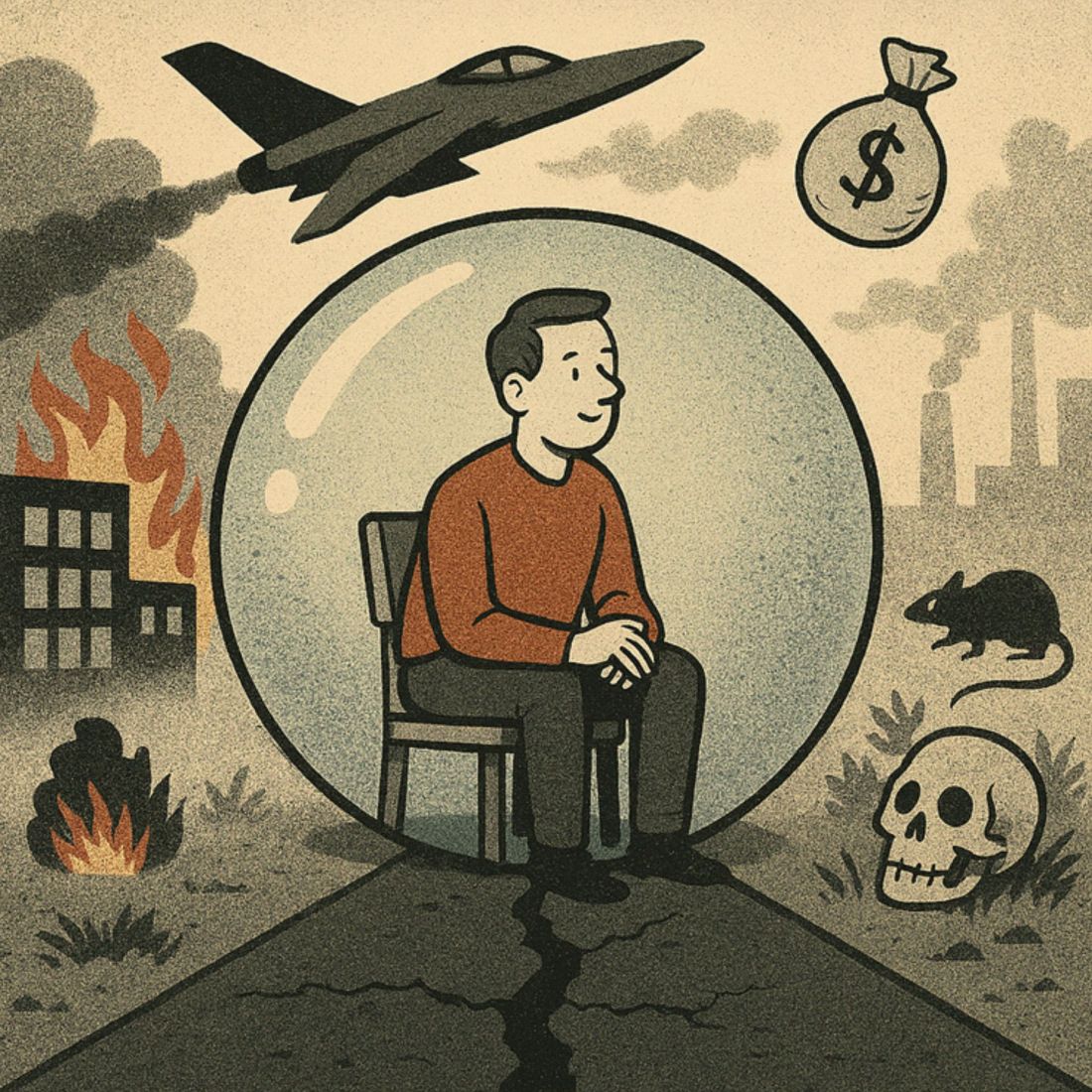
The solutions we need won’t come from anything we already do. Because it’s everything we already do that caused the problems.
The Familiar Path That Led Us Here
Right now, people believe they’re seeing the full picture. They believe they understand the crisis, the chaos, the uncertainty – because the surface‑level symptoms are impossible to ignore.
But the deeper reality is still being missed. Not because it’s hidden, but because most people aren’t yet in a place where they can recognise what they’re looking at.
Perspectives shape perception. And when perspectives are shaped by habit, fear, conditioning, or the comfort of familiar narratives, they filter out the very things that matter most.
That’s why so many warning signs are dismissed. Why so many contradictions go unchallenged. Why people can feel informed while still being completely unaware of what’s actually unfolding.
Understanding doesn’t come from information alone. It comes from readiness – from the moment when someone’s internal landscape shifts enough for them to finally see what was always there.
Until that readiness arrives, even the clearest truth will look like noise, exaggeration, or irrelevance.
And that’s the challenge we face: not just to speak truth, but to recognise that truth only lands when the conditions allow it to.
Seeing Through the Fog of Perspectives
In times like these, people assume they’re fully aware of what’s happening around them.
The noise is loud, the chaos is visible, and the headlines never stop. It creates the illusion of clarity – as if simply noticing the disruption means understanding its cause.
But awareness and understanding are not the same thing.
Much of what matters is still out of view. Not because it’s hidden, but because most people aren’t yet equipped to recognise the patterns behind the events.
They see the symptoms, not the structure.
They see the fallout, not the forces shaping it.
They see the drama, not the design.
That’s why so many explanations sound far‑fetched to those who aren’t ready for them. Why warnings are dismissed. Why truths are labelled extreme until the moment they become obvious.
And this is the danger: when people believe they already see everything, they stop looking for what they’ve missed.
Rattles in the Vehicle We Thought Was Safe
We are, metaphorically speaking, passengers in a vehicle we don’t realise is breaking or already broken.
We race along, ignoring the rattles, because it’s still moving.
We convince ourselves everything’s fine, right up until the moment it stops and we’re forced to accept that we’ve broken down.
The warning signs are everywhere. No matter your business, sector, or situation, the red flags are waving from every direction in plain sight. But because the wheels are still turning – or appear to be – we keep believing that a change of driver or a quick pit stop is all we need.
We imagine that after a brief pause, the journey will resume, more comfortable than before, with a better seat and a better view.
But the vehicle – whether you can picture it as a car, train, or bus – represents everything we do and everything we believe we’ve always done.
The road beneath it is the path we’ve been set upon, shaped by our behaviours, expectations, attitudes, approaches, and the values we’ve allowed to guide us.
The Quiet Ways We All Contributed
And here’s the uncomfortable truth: no matter what problem you’re facing, no matter what crisis is unfolding, if it involves decisions made by others, then yes – you can probably identify who’s responsible. But at some level, we all share responsibility. We all helped build the road.
Even if we didn’t make the active choices that led us here, into this mess, we made choices nonetheless.
When we avoided risk, chose the easy option, kept quiet to avoid rocking the boat, ignored the truth, or failed to do what was right – we took action. And often, that action was simply allowing those with hidden agendas to get their way.
Everything has a cost.
For decades, we’ve been conditioned by manipulation, sleight of hand, and narratives designed to convince us that non‑conformity leads to isolation.
But the real cost has been far greater.
Everything that once held value – our businesses, workplaces, sports, social spaces, food, water, money, communication, education, jobs, reputations – has been diminished.
Not by accident, but by design. So it could be reformed, centralised, and ultimately placed under someone else’s control – even while we still believe we own it.
This includes the institutions people still trust by default: government, the public sector, and the systems built around them. They were supposed to safeguard society, yet they’ve become part of the machinery that has allowed decline, mismanagement, and manipulation to take root. Not because everyone within them is corrupt, but because the structures themselves are no longer fit for purpose – and haven’t been for a long time.
Understanding Comes Only When We’re Ready
The problems we face — in farming, hospitality, industry, with people, community, the environment, government, the public sector – all stem from the same system. From all the “everythings” each and every one of us do.
No matter our background or bubble, it all adds up to the same thing: the trouble the world is now in.
And what we’ve done and been doing so far cannot or will not fix it.
It doesn’t matter if we wait for a change in government while continuing to elect candidates chosen by people we don’t know.
It doesn’t matter if we keep believing the establishment is structured to serve us, or that it has the integrity to do so.
It doesn’t matter if we trust the financial system, or believe that inflation and the cost of living are beyond anyone’s control.
If we don’t change the fundamental building blocks – of life, economics, and governance – then no matter who’s in charge, things will only get worse.
And we’ll keep being told they’re getting better.
Crisis as Catalyst
Today, life just happens to us.
Business, money, governance – they’re systems we’re expected to show up for, participate in, and conform to. That’s it.
But conformity is what brought us here. And we’re standing at the doorway of something that, once we step through it, may quickly reveal that there is no way back.
It’s only this way and we only got here because we surrendered our power – more often than not without ever realising that we had even given it up.
Building Something That Puts People First
If we want to change anything – even the smallest thing – in the world around us, we must participate. We must play our part. That’s what living a proper life demands.
And if we want things not just to improve, but to become truly better, then we must all get involved.
The collapse we’re experiencing offers something rare: the chance to see and experience life differently. A chance that wouldn’t have come if things had continued as they were. Which they no longer can.
As circumstances worsen and reality begins to speak for itself, we have a choice.
We can take back our power. We can work with the people we know – the people we share our lives with – to reclaim genuine control. To put people, community, and the environment first.
The Local Economy & Governance System (LEGS) – built upon The Basic Living Standard – offers a new structure for the future.
LEGS isn’t a shortcut, and it isn’t a promise that someone else will fix things for us.
LEGS is simply a framework that puts people, community, and the environment back at the centre of life – where they always should have been.
What comes next won’t be shaped by governments, institutions, or systems that have already failed us. It will be shaped by the choices we make now, the conversations we have with the people around us, and the willingness we each find to choose and step through the doorway in front of us, that leads to a Future that no one else can define.
The world we knew is ending. But what replaces it is still ours to decide.
Further Reading
1. Awakening & How We Perceive the Crisis
Understanding how people ‘wake up’ to what’s really happening
There’s No Fast‑Track to Awakening
Link: https://adamtugwell.blog/2026/01/05/theres-no-fast-track-to-awakening/
A reflection on why meaningful awareness can’t be forced or rushed. People don’t see deeper truths until they are personally ready, no matter how clear the evidence appears.
Beliefs We Accept as Our Own Are Destroying Everything — Including Who We Really Are
Link: https://adamtugwell.blog/2025/09/16/beliefs-we-accept-as-our-own-are-destroying-everything-including-who-we-really-are/
Explores how inherited assumptions shape society’s decline and block real understanding or change.
The Choice – A Waking Up Story (Full Text)
Link: https://adamtugwell.blog/2025/07/19/the-choice-a-waking-up-story-full-text/
A narrative‑style exploration of what it feels like to realise the system doesn’t work the way we once believed.
2. The Hidden System Behind Society’s Problems
What’s really driving the chaos people can see – but don’t fully understand
The War Behind the World We Know
Link: https://adamtugwell.blog/2026/01/05/the-war-behind-the-world-we-know/
Examines the unseen mechanisms and competing interests that shape global events and public perception.
Safe Shores – The Pathway That Led to the Local Economy Governance System and the Basic Living Standard
Link: https://adamtugwell.blog/2025/12/29/safe-shores-the-pathway-that-led-to-the-local-economy-governance-system-and-the-basic-living-standard/
Shows how decades of systemic decline created the conditions that make new governance ideas not just desirable, but necessary.
After the Collapse – Who Gets the Blame?
Link: https://adamtugwell.blog/2025/11/12/after-the-collapse-who-gets-the-blame/
Explains why the wrong people and causes tend to be blamed when systems fail, and why this delays real solutions.
Choosing Outcomes Over Comfort – A Path to a Better Future
Link: https://adamtugwell.blog/2025/11/13/choosing-outcomes-over-comfort-a-path-to-a-better-future/
Looks at how comfort, convenience, and avoidance prevent individuals and communities from acting differently – even when change is essential.
3. Economics, Collapse & the Global Order
Why the economic system is failing – and what’s really behind it
Facing the Economic Collapse – The Real Crisis Behind Money, Wages, and Freedom
Link: https://adamtugwell.blog/2025/11/14/facing-the-economic-collapse-the-real-crisis-behind-money-wages-and-freedom/
Explores how wages, inflation, money creation, and governance combine into a crisis much deeper than people realise.
Money Is the Greatest Crime of Our Time
Link: https://adamtugwell.blog/2025/11/12/money-is-the-greatest-crime-of-our-time/
Reveals how the monetary system has been manipulated to serve central interests at the expense of the public.
Desperate Times, Desperate Resets
Link: https://adamtugwell.blog/2025/03/24/desperate-times-desperate-resets/
Discusses major societal “resets” and why moments of crisis are exploited to reshape systems from the top down.
The BRICS Money Bomb – Will a New Gold‑Backed Currency Flip the Global Order?
Link: https://adamtugwell.blog/2023/08/14/the-brics-money-bomb-will-a-new-gold-backed-currency-and-monetary-system-really-flip-the-global-order-or-does-the-end-of-world-peace-lie-immediately-ahead-essay/
Analyses the potential shift in global power if BRICS nations introduce a hard‑asset‑backed currency.
Trump’s Reset – Catalyst for Change, Doorway to Cataclysm, or Both?
Link: https://adamtugwell.blog/2025/04/29/trumps-reset-catalyst-for-change-doorway-to-cataclysm-or-both/
Investigates the destabilising ripple effects of political “resets” and their global economic consequences.
4. Politics, Institutions & Public Misunderstandings
Why political systems fail – and why people keep expecting them to work
The Contemporary Politician’s Dilemma
Link: https://adamtugwell.blog/2024/12/05/the-contemporary-politicians-dilemma/
Shows why modern politicians cannot meaningfully fix systemic problems — even when they want to.
Government Is Broken – Collapse Now or Collapse Later?
Link: https://adamtugwell.blog/2025/11/05/government-is-broken-collapse-now-or-collapse-later/
Explains why existing government structures are no longer fit for purpose and cannot deliver sustainable solutions.
Any Fool Can Be a Politician
Link: https://adamtugwell.blog/2025/10/07/any-fool-can-be-a-politician/
A sharp look at how politics attracts the wrong incentives, creating leaders unsuited to solving real‑world challenges.
Why People Can’t “Just Get a Job”
Link: https://adamtugwell.blog/2025/11/04/why-people-cant-just-get-a-job/
Breaks down the structural economic and social barriers that make simplistic advice meaningless.
5. The Local Economy & Governance System (LEGS) and the Basic Living Standard (BLS)
Practical frameworks for rebuilding society from the ground up
The Basic Living Standard – Freedom to Think, Freedom to Do, Freedom to Be
Link: https://adamtugwell.blog/2025/12/15/the-basic-living-standard-freedom-to-think-freedom-to-do-freedom-to-be-with-personal-sovereignty-that-brings-peace-to-all/
Introduces BLS as a foundation for genuine human freedom, community wellbeing, and resilience.
The Basic Living Standard Explained
Link: https://adamtugwell.blog/2025/10/24/the-basic-living-standard-explained/
A straight‑forward breakdown of what the BLS is, why it matters, and how it functions.
The Local Economy Governance System (Online Text)
Link: https://adamtugwell.blog/2025/11/21/the-local-economy-governance-system-online-text/
A reference version of the LEGS framework for those seeking a structural model for local governance.
From Principle to Practice – Bringing LEGS to Life (Full Text)
Link: https://adamtugwell.blog/2025/12/27/from-principle-to-practice-bringing-the-local-economy-governance-system-to-life-full-text/
A detailed, practical guide on implementing LEGS within a community context.
 Adam Tugwell