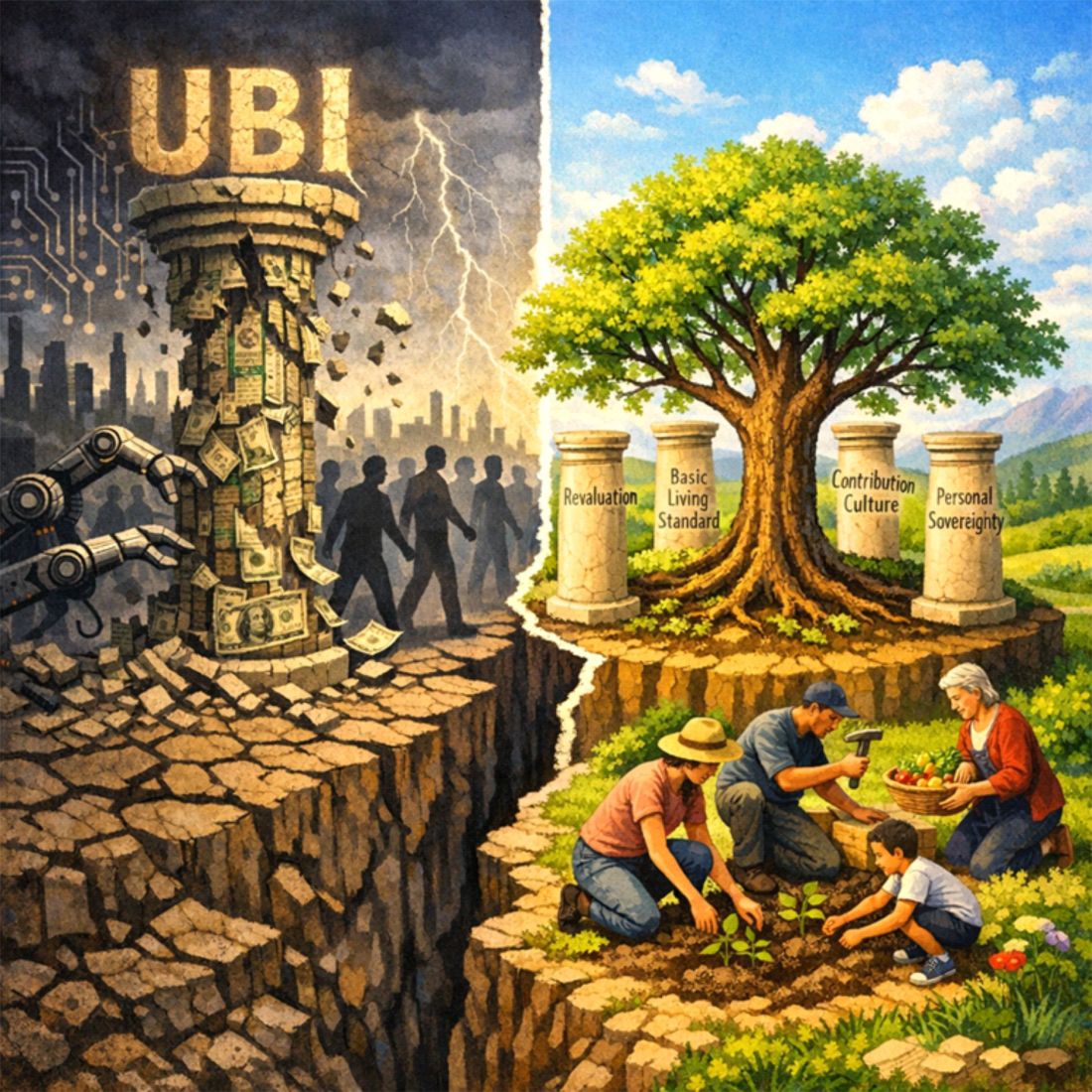
As AI Ends Work: Waking Up to the Illusion of UBI – and the Need for a New System

How the End of Work Exposes the Crisis of a Broken System

The Collapse of the Money-centric System

Value is the foundation of human life. It shapes how we live, how we relate to one another, and what we believe matters. Wherever we place value – and whatever we collectively agree has value – becomes the organising principle of our behaviour, our systems, and ultimately our civilisation. The value set we adopt determines not only how we live today, but the consequences that unfold tomorrow.

For most of human history, and certainly in the world we share today, the dominant value set is built around money. Not human experience. Not community. Not contribution. Not wellbeing. Money.

Our governments, institutions, systems of governance, economies, and the very fabric of daily life all orbit this single construct. Everything has become transactional because the value of money – what it costs, what we earn, what we accumulate, what we attract, what we are given – has become the lens through which we make decisions about the present and the future. Our interpretation of how money works, or how it has worked in the past, has become the compass by which we navigate life.

But the problem with money is not new. It began the moment money stopped being a simple medium of exchange – a tool to facilitate trade – and instead became the store of value itself, the point and purpose of value, the thing we pursued for its own sake.

This shift was accepted because it appeared logical, even sensible. It seemed like common sense. Yet in reality, it was the easy option – the lazy option – and it became the pivot point that set humanity on a path that would eventually lead us away from ourselves.

What few people have ever recognised – and fewer still have been willing to challenge – is that once money became the centre of value, our focus shifted away from people and the human experience. Instead, we became fixated on money itself, and then on the power, position, control, and influence that money could buy.

Human life became stratified by how much or how little of it we possessed. Success became synonymous with wealth. Poverty became synonymous with failure. And the human experience was reduced to a spectrum between rich and poor.

Over time, this became normalised. Wealth and poverty have existed for so long, in so many forms and nuances, that most people accept the wealth divide as a natural feature of life. Many even believe it is acceptable – that some should thrive while others go without, that some should have more than they could ever need while others struggle to meet the basics of life.

The dynamic has only worsened. The transition from feudalism to industrialisation was celebrated as progress, but the underlying imbalance remained. The gap between those who have and those who have not continued to widen. Eventually, it reached a point where no rule, regulation, or law could meaningfully correct it. The imbalance had become embedded in the system itself.

And as always, more wants more. The existence of social classes, and the aspiration to climb them, was never enough.

A point came when the elites – those who already held power – realised that if they wanted to accumulate even more, they would have to change the rules of the game. And who was there to stop them? They already controlled everything.

People talk endlessly about new world orders, Fabianism, the WEF, and other groups. But regardless of the motivations or the plans behind these movements and those who run and influence any government, the reality is simple: any value system has a finite total value within it, even if it grows. That value moves depending on the actions – whatever the motivation and whether conscious or unconscious – of those who control the system.

Under a ring‑fenced money system, such as the gold standard, no new money can be created. The total value is fixed. Even if the scales of wealth are pushed to their limits, the wealthy cannot accumulate beyond the system’s natural ceiling. They can own a lot, but they cannot conjure the value out of thin air that would enable the few to own and control everything.

This system – flawed as it most certainly was – remained in place until 1971. And only when we understand what changed in that moment can we understand what has happened to us since.

The creation of the fiat money system, which allowed those in control to create money at will, enabled the greatest transfer of wealth in human history. It allowed the already wealthy to become unimaginably wealthier by creating money that could then be used to buy everything of real value – businesses, infrastructure, land, resources, and the essentials of community life.

Ownership and power were transferred to people who could never have acquired them under a value system grounded in reality. The new system was built on methods that were dishonest and fundamentally false.

Ordinary people didn’t question it. Why would they? Their value system – money – still looked the same. A pound was still a pound. A dollar was still a dollar. But the reality had changed completely.

This is why life today looks so different from life 60 or 70 years ago. There are anomalies everywhere. A single average wage once supported a family, bought a home, and provided security. Today, even the national minimum wage is not enough for one person to survive without benefits, charity, or debt.

Because money is the centre of value, people have been conditioned to believe that if they have what they want, everything is fine. So the consequences of the fiat system – what it has done to people, communities, and the environment – have not been treated as the priority they should have been.

The West has been told that the last 80 years have been peaceful, that there are no real problems ahead, and that nothing fundamental could ever change. Meanwhile, laws, working practices, and – most importantly – technology have changed at an accelerating pace. Everything has changed while we believed we were standing still.

We can see clearly what the Industrial Revolution did. We understand why the labour movement emerged. Industrialisation devalued human effort by replacing or reducing the need for human labour with machines wherever it could be done.

Yet we have failed to notice the evolution happening beneath our feet today. People believe the world still works as it did after the Second World War. Very few see the catastrophe unfolding around us: the next great technological shift – the rise and takeover of AI.

Just as people once accepted that machines would replace or reduce the need for manual labour, many now accept that AI will replace cognitive labour. And they assume this means nobody will have to work.

There is a dangerous collective assumption that technology has been created for the betterment of humanity. But the reality is that modern technology – especially AI – has been developed for profit and control, not for helping and supporting humanity.

If it had been created to improve life, we would already be living in a world where even the poorest had enough, where jobs were secure, and where technology enhanced life rather than replacing it.

Instead, we are living through a neoliberal, globalist model powered by fiat money – a model that extracts value from people and concentrates it in the hands of a few.

Even the architects of this system know it cannot work. That is why figures like Sam Altman now promote UBI – Universal Basic Income – as the supposed solution, for the fast-approaching time when for growing numbers, there will no longer be any kind of work.

The Fiat Era, AI, and the False Promise of UBI

UBI has been tested in small‑scale trials around the world. The idea is simple: everyone receives a set amount of income, regardless of what they do. It is appealing because it promises security in a world where jobs are disappearing. It reassures people that even if AI replaces their work, they will still be able to live the life they know today.

But this belief rests on a dangerous misunderstanding.

People assume UBI means they will continue to live as they do now – with the same homes, the same comforts, the same access to goods and services – simply without needing to work. They imagine a world where machines do everything, and humans simply enjoy the benefits.

This is fantasy.

UBI, in the context of the system we have today, is idealism built on a lie. It assumes that money can be endlessly created to pay off debts that already represent money that does not exist. It assumes that the system can continue functioning even as the economic role of billions of people disappears. It assumes that those who own everything will willingly fund the lives of those who own nothing.

The technological revolution – and the speed at which it has unfolded – was only possible because of the fiat money system. A system that survives only because enough people still believe in it. A system where most people already own nothing, and where the underlying structure is already broken.

The people who own everything – the corporations, the financial institutions, the elites who control the levers of power – cannot run a world where machines do all the work and billions of people contribute nothing.

The equation does not balance.

A system where everyone takes but no one contributes cannot function.

UBI is simply a tool to maintain the illusion that money still matters, that the system still works, and that people still need the very system that is failing them.

If we continue removing jobs at the current rate, a point will come – soon – when people outside the protected classes will have no means to survive. Not because they lack ability. Not because they lack willingness. But because the system will no longer have a place for them.

The question is not whether technology is good or bad. Technology can be used to advance humanity. But the reality we face is that AI has been developed to remove human involvement, not to improve human life. It has been built to maximise profit, minimise cost, and eliminate the “problem” of human labour.

And this is where the truth becomes unavoidable:

UBI will not save us.
It cannot save us.
It was never designed to.

UBI is the last tool of a dying system – a sticking plaster on a wound that requires surgery. It is the final illusion offered by a worldview that has already collapsed under its own contradictions.

The dam is cracking.
The pressure is rising.
And UBI cannot hold it back.

There is another way – a way of living that embraces technology without using it to replace or devalue people. A way built on local economies and local governance, with the Basic Living Standard at its heart. A way that restores human value, dignity, and sovereignty.

A time is approaching – sooner than most realise – when we will have to choose. We can continue sleepwalking down the path we are on, a path controlled by a few, where most will find neither benefit nor happiness. Or we can choose to walk a different way – a way where each of us contributes, participates, and lives with genuine freedom and sovereignty.

The alternative may flatten hierarchies, decentralise power, and remove the obscene concentrations of wealth that exist today. But it will also create lives worth living – lives grounded in peace, purpose, and the true human value that comes from within us, not from the money system that has defined us for far too long.

The Turning Point: Why UBI Cannot Save a Collapsing System

UBI is being sold as a compassionate solution, a stabiliser, a safety net for a world without work. But the truth is far more uncomfortable:

UBI is the final illusion of a system that has already collapsed in every meaningful way.

It is the last tool available to a worldview that cannot admit its own failure. It is the final attempt to preserve a structure that has been unravelling for decades – a structure built on false value, false scarcity, false growth, and false promises.

The destruction of jobs was not an accident.
It was not an unfortunate by‑product of progress.
It was a deliberate choice – a choice made by those who benefit from a world where human beings are no longer required.

The system has been moving toward this point for generations:

  • first by replacing physical labour with machines
  • then by replacing skilled labour with automation
  • now by replacing cognitive labour with AI

At each stage, the justification was the same: progress.

At each stage, the consequences were the same: displacement.

At each stage, the winners were the same: those who already held power.

And now, as the final stage unfolds, the system has run out of excuses – and out of time.

The truth is simple:

A society built on money cannot survive when people no longer earn it.

A society built on work cannot survive when people no longer have it.

A society built on consumption cannot survive when people cannot afford to consume.

UBI does not solve this.
It cannot solve this.
It was never designed to solve this.

UBI is a sedative – a way to keep people calm while the system collapses around them. It is a way to delay the moment when the public realises that the world they were promised no longer exists.

But the dam is cracking.
The pressure is rising.
And UBI cannot hold it back.

A world where billions of people have no economic role is not a world that can be stabilised with monthly payments.

It is a world that requires a complete rethinking of value, contribution, governance, and the purpose of human life.

And that is where the real alternative begins.

The Alternative: A System That Solves the Root Causes

If UBI is the last illusion of a dying system, then the question becomes unavoidable:

What replaces it?

Not a reform.
Not a patch.
Not a new policy within the old worldview.

What replaces it must be a new operating system for society – one that addresses the root causes of the crisis, not the symptoms. One that works with human nature, not against it. One that restores dignity, purpose, and sovereignty to every person.

That system exists.

It is called the Local Economy & Governance System (LEGS), and it is built on four pillars:

  • The Revaluation
  • The Basic Living Standard
  • The Contribution Culture
  • Personal Sovereignty

Together, they form a coherent, humane, practical alternative to the collapsing money-centric world.

1. The Revaluation: Changing What We Value

The crisis we face did not begin with fiat money.
It did not begin with globalisation.
It did not begin with AI.

It began with a value system that placed money above people.

The Revaluation is the shift from:

Money-centric value → human centric value

It is the moment we stop measuring life through:

  • price
  • profit
  • productivity
  • accumulation

and begin measuring it through:

  • wellbeing
  • contribution
  • community
  • dignity
  • sustainability
  • fairness

Without this shift, nothing else can work.

With it, everything else becomes possible.

2. The Basic Living Standard: Security as a Universal Right

The Basic Living Standard (BLS) is not UBI.
It is not a handout.
It is not dependency.

It is a guarantee that every person can meet their essential needs – food, shelter, energy, water, healthcare, and participation – from a normal week’s contribution.

It breaks the link between survival and employment.
It removes fear, insecurity, and dependency.
It ensures that no one can fall below the basics of life.

And unlike UBI, it is not funded by printing money or taxing a collapsing economy.
It is built into the structure of the local economy itself.

The BLS is the economic foundation of a people‑first society.

3. The Contribution Culture: Work as Meaning, Not Survival

The Contribution Culture replaces the toxic idea that:

“If you don’t work, you don’t deserve to live.”

with:

“Everyone who can contribute, contributes – because contribution is meaningful, valued, and secure.”

In a Contribution Culture:

  • work is not coerced
  • work is not a punishment
  • work is not a transaction
  • work is not a competition
  • work is not a fight for survival

Work becomes:

  • participation
  • purpose
  • community
  • shared responsibility
  • a source of dignity

This is the cultural foundation of the alternative – and the antidote to the crisis of work in an AI‑dominated world.

4. LEGS: The Local Economy & Governance System

LEGS is the structural foundation – the practical framework that makes the Revaluation, the BLS, and the Contribution Culture real.

It is built on:

  • local economies
  • local food systems
  • local governance
  • participatory democracy
  • shared responsibility
  • transparency
  • decentralisation

LEGS solves the problems that have existed since long before fiat:

  • centralised power
  • hierarchical control
  • distance between decision‑makers and consequences
  • systems that cannot see the ground
  • economies that treat people as units
  • governance that manages people instead of serving them

And it solves the problems that fiat accelerated:

  • extraction
  • inequality
  • speculation
  • debt dependency
  • the illusion of infinite value

And it solves the problems that AI will make catastrophic:

  • the removal of jobs
  • the collapse of income
  • the loss of agency
  • the erosion of sovereignty
  • the concentration of power in the hands of a few

LEGS is not a policy.

It is a new operating system for society.

5. Personal Sovereignty: The Human Foundation

Personal sovereignty is the right – and responsibility – of every individual to live as a free, ethical, self‑directed human being.

It is protected through:

  • security
  • transparency
  • locality
  • shared responsibility
  • meaningful contribution

The money-centric system destroys sovereignty by creating dependency through UBI.

LEGS restores sovereignty by creating participation.

Why LEGS Works Where UBI Cannot

UBI tries to preserve the old system.
LEGS replaces it.

UBI depends on money.
LEGS depends on contribution.

UBI centralises power.
LEGS decentralises it.

UBI treats people as passive recipients.
LEGS treats people as active participants.

UBI assumes scarcity.
LEGS builds natural abundance.

UBI keeps people dependent.
LEGS restores personal sovereignty.

UBI is temporary.
LEGS is sustainable.

UBI is the illusion of security.
LEGS is the reality of it.

The Choice Ahead

Humanity is approaching a moment where the old system will no longer function – not because of fiat, not because of politics, but because AI will remove the economic role of billions of people.

UBI cannot solve this.

It was never meant to.

The only real alternative is a system that:

  • restores human value
  • guarantees security
  • redefines work
  • decentralises power
  • rebuilds community
  • and places people first in every sense

That system exists.

It is coherent.
It is humane.
It is practical.
It is necessary.

It is the Local Economy & Governance System, built on the Basic Living Standard, the Contribution Culture, and the Revaluation.

This is not a dream.
It is not a theory.
It is not a utopia.

It is the only path that deals with the root causes – not just the symptoms – of the unravelling we are living through.

And the time to choose it is now.

Further Reading:

1. An Overview of a People-First Society

https://adamtugwell.blog/2026/01/03/an-overview-of-a-people-first-society/
Why it’s critical: This article lays out the philosophical foundation for a people-centric society, directly addressing the shift away from money-centric values. It’s essential for grasping the big-picture vision that underpins all other proposals in this document.

2. The Local Economy & Governance System (LEGS): Online Text

https://adamtugwell.blog/2025/11/21/the-local-economy-governance-system-online-text/
Why it’s critical: This is the definitive resource on LEGS, the proposed alternative to the money-centric system that may soon look to UBI. It explains the system’s structure, principles, and practical mechanisms for replacing the current economic model. If you want to understand the practical solution, start here.

3. The Basic Living Standard: Explained

https://adamtugwell.blog/2025/10/24/the-basic-living-standard-explained/
Why it’s critical: This article clarifies the concept of the Basic Living Standard (BLS), a cornerstone of the LEGS system. It distinguishes BLS from UBI and explains why it’s a more sustainable and empowering approach.

4. The Contribution Culture: Transforming Work, Business, and Governance for Our Local Future with LEGS

https://adamtugwell.blog/2025/12/30/the-contribution-culture-transforming-work-business-and-governance-for-our-local-future-with-legs/
Why it’s critical: This article explores how LEGS redefines work and contribution, moving away from survival-based employment to meaningful participation. It’s vital for understanding the cultural transformation needed for the new system to succeed.

5. The Local Economy Governance System (LEGS): Escaping the AI Takeover and Building a Human Future

https://adamtugwell.blog/2025/12/04/the-local-economy-governance-system-legs-escaping-the-ai-takeover-and-building-a-human-future/
Why it’s critical: This piece directly addresses the impact of AI on work and society, and how LEGS offers a human-centred response to technological disruption. It’s especially relevant for readers concerned about the future of employment.

Why These Are Critical

These articles collectively provide:

  • The philosophical rationale for change.
  • A detailed blueprint for the proposed alternative system.
  • Clear explanations of the foundational concepts (BLS and Contribution Culture).
  • Direct responses to the challenges posed by AI and the collapse of traditional work.

The Local Economy & Governance System (LEGS): Escaping the AI Takeover and Building a Human Future

The Future Is No Longer Distant

There is growing disquiet, fear, and quiet concern about the turbulence we are experiencing in the world, alongside a deep, intrinsic sense that nothing is as it should be – and that it will never be the same again.

Yet at the heart of this unsettling feeling lies confusion. The prevailing narratives insist that with AI now here, and the technology it commands about to permeate every conceivable part of our lives, humanity should be grateful.

We are told we stand on the cusp of a new age, where surrendering to AI will deliver a dream life unlike anything mankind has ever known.

Some are already suspicious, beginning to question what the rollout of this digital revolution will truly mean.

Others believe the only way to progress – or to feel in control of either the real or digital worlds – is to recapture what they perceive as the “good times,” attempting to fix everything as if it were possible to freeze life and live forever in a single moment of the past.

Uncomfortable as it may be, the time has arrived for everyone to begin asking the hard questions: what happens next, and where will we find ourselves in a future that is no longer a distant shadow on the horizon, but already towering above us right now.

The Watershed Moment We Cannot Ignore

The Coming Crisis of Agency & Survival

The answer to the question so many wish to avoid is that, if we continue on our current path, ordinary people will be left with no means to provide for themselves. They will have no income to pay others to do so, and neither government nor business will exist with the resources or the intent to supply even the basic essentials necessary for the masses to survive.

Everything we know – whether or not we recognise its connection to our current reality – has been moving in this direction for as long as most of us have been alive.

There has been a steady erosion of agency, independence, and self‑resourcefulness for ordinary human beings, first through the transfer of all forms of wealth, and now, taking place through the progressive takeover of every aspect of working life and function by both existing and rapidly emerging forms of AI.

Whilst many today spend quiet moments fearing the apparent opening of immigration floodgates and the erasure of Western culture, society, and life as we know it, others, for reasons seemingly unknown, appear to have embraced a suicidal empathy that insists the only correct behaviour of Western society is to destroy itself in order to prioritise all others.

AI’s Encroachment on Everyday Life

Yet everyone fails to see that the impending and critical threat to everything we hold dear has already been welcomed into our governments, our businesses, our technology, and the very functionality of daily life, and is so deeply embedded that it now resides in our computers and our phones.

The Myth of Effortless Utopia

AI, along with the robotics and technology now emerging to support it, is becoming the option of choice for carrying out the majority – if not all – tasks across what we currently understand as life.

This development will soon mean that, for the majority of us, there will soon be no reason for work to continue to exist.

Exploitation and Systemic Transformation

Whilst many of us hear talk of the AI takeover, the reduction in new hiring and training opportunities across numerous professions and industries, and the replacement of jobs of all kinds, we fail to connect these developments with the rising welfare bill as people find themselves with no choice but to accept a life of unemployment.

The New Divide: Inclusion and Exclusion

Nor do we pause for a moment to consider the pressing question: What does it mean when there is no job left for you?

The Last Chance for Human Agency

Yes, many truly believe the stories openly shared by members of the elite community driving this change – that in no time at all, life will become cheap and effortless for everyone because AI and machines can do everything.

The Value of Effort and Contribution

People really do believe we are about to step into a new and previously unrecognisable utopia, where the system has eliminated the need for human industry, effort, and value in the form of contribution, and instead provides everything we can imagine, free of charge and experienced as if life were one giant, permanent holiday for us all.

Historic Patterns and Systemic Endgame

Such benevolence, hinted at in the form of words from these few, and the feeling it inspires about our future, is one that few can fail to imagine.

Indeed, the words and the ease with which life now comes at us makes it very easy to accept the disproportionate levels of wealth for the few that has been encouraged by the progress of this new technical revolution.

People are taking for granted that once the evolution of everything needed to perform every task that human beings carried out across all functions of life is complete, these are the very same few who will then happily smile and sit back while everything they own and have developed works and provides for all of us in return for absolutely nothing. All whilst we continually maintain an everimproving standard of life and receive a universal basic income that covers every requirement beyond the luxurious permanence of 24hour leisure, which is somehow ever present and that we somehow believe we would actually enjoy.

In truth, we do not need to understand how or why we arrived here to see the situation for what it really is. The fundamental truths are already available for us all to observe, consider, and comprehend, hiding in plain sight: the masses have been used and exploited to create the very means that will ultimately be implemented to destroy humanity as we know it.

As this has all progressed, we have all been fed and indoctrinated with stories, technology, forms of easy wealth, and advances convincing us that things can only ever improve along this path and that a golden age awaits.

At the same time, we have given our consent to puppet politicians who have willingly changed and enforced every rule necessary to facilitate this under the veil of progress -driven not by principle, but by submission to those with power and self‑serving agendas, lured by promises of glory and gain that appeal to their true, hidden selves.

Many struggle to believe that those we have elected, and those who have grown rich or benefitted so greatly from the rewards of leadership in a modern world and society, could truly be so cruel. Yet does it matter whether we – or even they – accept that as truth, when the outcome fast approaching, without a change in our direction, will inevitably be exactly the same?

Within the world and its structures – The System as it operates, functions, and controls every part of life today – the true divide of them and us lies between those whom the system will continue to carry and cater for once the concept of human independence no longer exists, and the masses who have no further use, whom the system will either choose to exclude or find some means to remove.

This is neither a horror story nor a work of fiction. The only uncertainty – without a change in direction – lies in when and how events will unfold that bring about the critical period of transition.

Today, humanity still possesses agency, choice, and the power to pursue an alternative pathway – even though so many of us are sleep‑running toward the end of freedom’s existence, actively embracing and welcoming the very tools that will soon replace the need for us within our own lives.

The fundamental truth of any life worth living is that there can be no reward without effort, and that effort itself is the pathway to reward when life is grounded in truth.

We hold no value to anyone or anything if we do not contribute or participate when we are able. There are no free rides for anyone or anything, unless they come in the form of charity – or unless we ourselves assume the role, if deemed desirable, of pets.

History repeats this truth time and again. We need only look further to see how power is abused by the powerful—how they seek to control everything they find useful, and how quickly they dispose of it when they do not.

Everything about the moneocratic, money‑centric, top‑down, centralised, hierarchical, and patriarchal system was ultimately designed to end this way.

The arrival of technology – and finally AI – has brought humanity to a genuine watershed moment, an endgame in which we must either abandon the unsustainable way of life to which we have become addicted and embrace one that restores balance, fairness, and justice for all, or continue living the lie created by those who profit from our subservience.

If we choose the latter, we will participate in it until the moment we realise we no longer hold any value, and the destiny imposed upon us by others has arrived.

The Alternative Pathway

The temptation for many, upon realising what has happened and what is happening, is to believe that all we need to do is step back a few years and remove the most corrosive technological advances that have entered our lives.

As simple as the removal of AI might seem – even if we were able to overhaul politics and replace politicians with those who agree – the real damage to society and culture has not come from technology or its advances themselves. It comes from the reasoning, motives, intent, and forms of control behind them.

These forces have long been at work, reshaping how everything functions across society – manipulating and redirecting life so that what we have already become is accepted as normal.

The way we live, work, conduct business, relate to others, and even relate to ourselves must return, rediscover, and recreate a way of being that transforms our system of values.

Our entire value set must shift so that we understand and expect meaning from life in ways that, by today’s standards, may seem counterintuitive or even alien.

The Human Value Imperative:

  1. We must embrace the reality that everyone is equal, and that the only difference between us lies in our roles, functions, and contributions within society—roles that are always dynamic and open to change.
  2. We all need to accept that differences do not make us different when it comes to what is ethically, morally, and fundamentally right.
  3. We all need to accept, understand, and embrace that no person should be advantaged over another by circumstances beyond their own efforts or control.
  4. We must accept that deviation or allowances beyond these principles will always lead to growing unfairness—even when special circumstances seem justified or privileges are believed not to be abused.
  5. We must accept that hierarchies are not a natural system of order, even though the need for order in society means that some will naturally take the lead.
  6. We all need to share responsibility and take part in collective choices that shape the aspects of life we share.
  7. We all need to contribute to the community in whatever ways we can.
  8. We all need to work and actively contribute to shared life whenever we are genuinely able.
  9. We must live by the principle that the responsibility we have toward others is the same responsibility we owe to ourselves.
  10. We all need to accept that once our needs are met, nothing is gained if any one of us seeks to have, take, or control more.
  11. We must accept that true abundance means having as much as we need, not everything we want.
  12. We must accept that people are the greatest source of value, and that real economics should be centred on that value.
  13. We must embrace the reality that full employment is both natural and normal when employment is defined by all forms of contribution, not just financial return.
  14. We must welcome and protect the truth that locality, and the transparency it brings to every kind of relationship, is key to maintaining and benefiting from a system we can trust to be fair, balanced, and just.
  15. We must ensure that AI and all technologies are used only to support human life and enhance working practices—not to replace jobs or create circumstances in which any human being is considered useless.

When we commit to all of these principles, we can begin to envision a society and way of life that truly functions as it should with equity, equality and accountability for all – one that is transformed in almost every possible way.

The Turning Point: Choosing Freedom and a Better Future

For many of us, the uncomfortable reality we must face is that passive inaction – or continuing to accept life under the control of others, believing things will simply carry on as they are – poses an existential threat that is all too real. It is a danger that extends beyond the confines of Orwell’s 1984 and, for those who truly value their lives, could mean something far worse.

The choice – while we still have one- is to not only accept but to embrace an alternative path.

This path, though carrying forward some familiar aspects of the world around us, demands that every part of our lives be lived in a fundamentally different way: a way where people, community, and the environment come first; where power rests with the individual, their freedom, and their personal sovereignty; and where the whole experience of life unfolds in a completely new direction.

The Local Economy & Governance System Framework: A Path to Empowerment

Exploring the Local Economy & Governance System

Visualising a different world – how it operates, what it requires of us, what we must give, how we work together, and how frameworks of rules function (rather than laws that micromanage every part of life, as is increasingly the case today) – may sound simple. Yet their adoption, interpretation, and our response to them within a system centred on empowering every person, rather than controlling them in every conceivable way, will be fundamentally different.

This shift will inevitably provoke resistance, not least because we have become addicted to the unsustainable, money‑centric way of living that dominates our lives today.

The Local Economy & Governance System provides a detailed picture of these frameworks, showing how this new people‑centric model will look and how it can be implemented.

Perhaps the most important element of this new world is that it will be built upon direct, participatory democracy – a system entirely unlike the hollow or pretend democracy that defines the moneyocratic world we currently inhabit.

Participatory Democracy: Power in the Hands of People

Participatory democracy means that everyone takes part in the decision‑making processes that shape public policy.

It ensures that we all hold the power to change or remove the public representatives we choose and appoint.

This requires a level of accountability and participation that is not only regular and personal, but far greater than the limited choice we currently have – voting every four or five years for candidates selected by someone else.

There is much to consider about the processes that enable true participatory democracy and how it can work effectively and diligently.

One of the most striking differences between this future system and what we have today is that there will be no political parties.

Instead, public representatives will be chosen directly by the community – respected individuals with proven commitment to serving the best interests of everyone involved.

To learn more about The Local Economy & Governance System, please visit: The Local Economy & Governance System Online Text or support my work by purchasing the book for Kindle.

From Possibility to Reality: A System That Works for Everyone

The Local Economy & Governance System will work because it prioritises people, community, and the environment in ways that may seem inconceivable today.

It places value on personal sovereignty and the freedom that comes from living lives defined by who we truly are, rather than by external factors and reference points that remain under someone else’s control.

Yes, the practical mechanics of LEGS will work – and they will work well – if we choose to embrace them.

After all, the dysfunctional world we inhabit today has appeared to “work” only because we came to believe in it, even as it has harmed so many of us.

We must not underestimate the ability, ingenuity, and creativity of humankind to deliver and implement solutions that succeed under any circumstances, when motivated and convinced it is right to do so.

Together, we can reclaim power and value and build a new world and system that functions with equity, equality, and open accountability for everyone – just as a truly civilised society always should.

Together, we can turn possibility into reality and create a society that truly works for everyone.

The Choice Before Us

We stand at a decisive moment in human history.

The turbulence we feel, the erosion of agency, and the encroachment of systems that strip away our independence are not distant threats. They are realities already shaping our lives.

The arrival of AI and the technologies that support it has brought us to a genuine watershed: either we continue down the path of dependency and control, or we choose to reclaim balance, fairness, and justice through new systems built on empowerment, community, and sovereignty.

The Local Economy & Governance System, grounded in participatory democracy and people‑centric values, offers a practical and principled alternative.

It is not a utopia promised by elites, nor a nostalgic return to the past, but a framework for living that restores meaning to contribution, accountability, and shared responsibility.

Human ingenuity has always risen to meet the greatest challenges. If we believe it right to do so, we can build a society that works for everyone – where equity, equality, and open accountability are not ideals but lived realities.

The choice is ours. To continue sleepwalking into a future where humanity holds no value, or to awaken and embrace the possibility of a new civilisation. One that honours freedom, restores dignity, and ensures that life itself remains worth living.

Universal Basic Income won’t genuinely help anyone, least of all our Farmers

There’s no such thing as a free lunch. So, when it comes to giving away money, anyone who thinks that a Universal Basic Income is going to help anyone and in particular our farmers, either has an agenda they aren’t sharing, or they don’t have any real understanding of the true cost of making UBI work.

UBI is certainly well intended. A lot of research and thinking has gone into the trials and projects where a localised equivalent of a guaranteed basic income has been tried.

The problem is UBI is a solution that uses the creation or printing of money to enable it to work.

Money creation or printing is an essential part of the FIAT monetary system that we have today. The same system that is the root cause of all the money related and inflationary problems that we and our farmers are facing.

It is ironic that giving cash handouts to farmers would only build upon the culture of dependency that now exists, where the conditioned over reliance on subsidies and guaranteed contracts have made farmers vulnerable to the greed underpinning big money and profiteering retailers. Corporate interests that are not only taking all the profit that would be available from the food chain if it were accurately priced, but they are also using their market positions to inflate prices even further so that they can continue to take even more, without giving a damn about the impact and consequences for us all.

Minded that every one of us needs food every day in pretty much the same way that we need water and the air that we breathe, it defies sense or logic that British Farmers should be in a situation where they cannot have a secure, financially sound and fair-income-paying business, in return for providing a service which really should be considered a public good.

That farmers cannot survive and there are now organisations suggesting that UBI is the answer makes very clear that the working model or operational platform for British Agriculture is broken.

This reality  is all the more alarming given the fact that in a time of growing world crisis, we only grow the equivalent of around 52% of our own food in the U.K.

Regrettably, the farming problem isn’t one that good politicians would be able to fix in isolation. Because the issues farmers are facing are interconnected with many other areas of public policy that are breaking down today. All for no bigger reason than we have now had decades of politicians and the political parties they represent that have become increasingly poor.

If good politicians were representing us all as they should be today, the focus on farming would be to use legislation to immediately end the profiteering, price manipulation and speculation taking place that keeps taking money from the food chain without adding any form of value.

The next step would likely be to provide financial support and other legislation to help farmers transform food production and the pathway to retail to a system which is a contemporary version of what we had historically, where food was produced and consumed locally and in much more original, unprocessed and therefore healthier forms.

However, we don’t have good politicians and when the eagerly anticipated General Election comes, we will not have the option of good politicians to choose from even then.

This leaves farmers with a very difficult choice. To remain at the mercy of poor politicians who say lots but do very little. Or step back from conformity with the current broken system, take the risk of funding change themselves and then taking the lead and working closely with consumers who are the other key stakeholders in the food chain, so that food security, healthy nutritious food, and viable food producing businesses supplying every one of our local communities are brought back.