
In early 2022, I embarked on the writing project ‘Levelling Level’.
The initial aim was to provide a written view of the then Tory Government Levelling Up Agenda, its genuine purpose, and to discuss what is really going on.
The published work focused the social and public policy problems the UK faces. How they came into being, and what is likely to happen if politicians, leaders and the government and/or the public sector system that they ‘lead’, think and operate, doesn’t change its approach or ‘narrative’.
The direction of Levelling Level paid particular attention to the growing possibility of a yet to come black swan event. One that most likely includes or is triggered by a financial crash and circumstances that resemble a contemporary equivalent of The Great Depression.
With future outcomes and the potential need to ‘survive and thrive’ through a coming period of unpredictable change, I wrote extensively of the need to refocus and repurpose our approach to Food Production.
If we were to adopt voluntary changes to the UK Food Chain now, it could mean the provision and supply of basic or essential foods (healthy, nutritious and grown as locally as possible) would be available, pre-crisis.
But also, that the available infrastructure and resources could be repurposed as quickly as possible to ensure that communities are fed within a future emergency period that follow unforeseen events or be available to us all through a prolonged period of instability where the availability of imported food is reduced or stopped for any reason.
The suggestions tabled within Levelling Level included the use of allotments, gardens, window boxes and home-based hydroponic systems. As home growing could provide immediate and shorter turnaround Food Production support, whilst agricultural land and facilities are repurposed for localised production and a fully transparent, short-as-possible food supply chain is implemented, that will be necessitated by such a crisis.
Levelling Level, the series of books that have followed and its more recent version ‘Days of Ends and New Beginnings’ have covered a generalist approach to the causes of problems across public policy.
However, it is clear that no matter the approach taken towards change that prioritises People, Food should be at the centre of everything. But is nonetheless taken for granted just as the air we breathe and the water we drink are, today.
Ultimately, the Books I have written work towards the proposal of using the current electoral and democratic system more effectively and democratically, with the series then proposing an entirely different, locally centric system of government. One where citizen power is embraced fully or would resemble what some are now calling ‘grassroots up’ governance.
Whilst a key takeaway of Levelling Level and the following Books was the proposal of a complete public policy related values or ethics shift, to pivoting future policy development around the societal and economic benchmark called ‘The Basic Living Standard’, it is the ability of people to feed themselves and to be able to access healthy, nutritious, basic (or essential) foods that will become the primary indicator of whether public policy is succeeding or has succeeded in alleviating food poverty.
It is fair to say that countless societal issues are likely to be resolved quickly, if and when governance is built upon the principle of ‘getting the right outcomes for Everyone’.
Food: The difficulties we see and the problem we don’t
Awareness of a ‘food supply problem’ certainly exists within the UK Farming Industry where the National Farmers Union (NFU) has been regularly championing the supply side issue.
However, the UK is now considered to be producing around the equivalent of around only 54% of the food the UK Population consumes.
Whilst it can be argued that the issue of Food Security fragility is now in the public consciousness, because the term has made it into the common lexicon via the ‘mainstream news’, a more discerning audience will understand that this statement indicates that the UK only produces the equivalent of 54% of our food.
Indeed, stating the level of ‘self-production’ of UK Food at 54% doesn’t consider or reveal that the UK supply chain could not supply even a fraction of the food that the UK Population would need to survive, if for any reason, UK borders were to become closed for any prolonged period of time.
The Challenge that we all now face
The perception of farmers and industry is one thing.
The Food Security ‘problem’ that the general public perceives and understand is another altogether.
This is well illustrated by the 2023 Report from the Food, Farming and Countryside Commission (FFCC) ‘Citizens are Hungry for Change’ which provided an accurate picture of public perception.
This work was researched from amongst those members of our society who are aware of a food problem. Whatever the specifics of that food problem might appear to be, to them.
Perception is everything. And certainly so, where the potential for societal change is concerned
Where the current narrative, economic or political paradigm are concerned, the views, experience and meaning that underpin the concerns of the Farming Industry, Interest Groups and the wider general public represent many different perspectives and priorities, and just as many different truths.
Different truths fuel very different agendas. And as pet agendas compete for oxygen, their champions do not take into consideration the bigger picture that is at work.
Those who are emotionally tied to furthering their own solutions and agendas remain oblivious to what really motivates, drives and creates the purpose underpinning ‘The System’ itself.
This means that work like that undertaken by the FFCC and lobbying pressure tabled by membership organisations like the NFU will only be used as a political football at best.
Nobody from outside Westminster is playing the same game that Westminster is playing and Westminster plays by rules which only it has so far framed.
Like many research projects that have been completed and published over decades, ‘credible research’ targeted at the political class of today can only result in token gestures which will only be about the creation of political capital. Rather than being about real, meaningful change or outcomes that are good for us all.
It is an uncomfortable truth we have yet to accept that the politicians and ‘leaders’ we have elected to represent us, cannot and will not rationalize the danger that the UK faces. Nor will they embrace the power that they actually have to change things for the better, today.
Learned helplessness: The foolish expectation that those with responsibility will do the right thing – because they are supposed to
The hard truth
UK Farmers and Food Producers have become reliant upon financial incentives from government and contractual arrangements from big businesses which have silently worked hand in hand to destabilize UK Food Production over a period now exceeding 50 years.
The issue of UK Food Security and Food Sustainability was never questioned during our Membership of the EU regionalized global political ‘project’.
Yet this is when the real damage to UK Food Production was done.
Everyone – including Farmers, were led to believe that globalized food chains would always meet the UKs Food needs.
Indeed, a constant flow of media reports about butter mountains, wine lakes and numerous other tales about ‘overproduction’ across The Common Market, European Economic Community and then The EU itself only served to endorse the myths that had been created suggesting that UK Farming was in decline and that UK Farmers could only thrive by ‘going with the flow’, in effect, complying with whatever they were told to grow, to produce, or to any commercial offer that seemed to provide income security of some kind.
What many who understand the wider rural community across the UK will know, is this approach is very much at odds with real life.
The UKs Farming, Rural, Fishing and Food Producing communities are culturally entrepreneurial and very creative in their approach to business, and to operational management in particular.
However, UK Farmers and Food Producers have been reprogrammed to believe that no such thing as a viable, fully-independent Food Producing Business exists.
Even though every person alive needs at least two healthy, nutritious meals every day.
Meanwhile, the conditioned position of deference to elected representatives and establishment figures has created a situation where the general population realise and understand that there are significant problems and perhaps even risks to the UK Food Supply. However, they also believe that the creation of solutions and the action it will take to deliver them are something that someone, somewhere else has the responsibility to do, and that those with that responsibility will do it too.
We are in the potentially disastrous situation where Farmers and Consumers, the two key stakeholders in the UK Food Supply Chain, do not accept that there is an alternative way that would be much better for Farmers and Consumers alike. Because every information source that is considered to be credible continues to tell us all that there isn’t any other way than the dysfunctional one that we have right now.
The risk we are running is that neither the Public nor Food Producers will accept the need for change until People across the UK are going hungry and the UK Farming Industry has been reduced to a form where it no longer has the ability to function in the alternative way that we actually need.
‘The absence of proof does not mean proof of absence.’
There is massive a massive risk of Food Shortages, if the UK waits until change is necessary before taking action.
If the UK waits to be led by events, we run the considerable risk of there being a gap in UK Food Production and Supply that could effect well in excess of 50% of the UK population.
Otherwise, it could easily reduce the access to Essential or Basic Foods for the entire UK Population.
However, most likely, the Population of the UK will experience a mixture of both. (Without considering the influence of ‘black market’ activity and the explosive levels of inflation that would appear, allowing those who have enough money to continue buying whatever they like, for as long as that money continues to hold value).
How power and influence work across the UK Food Chain today
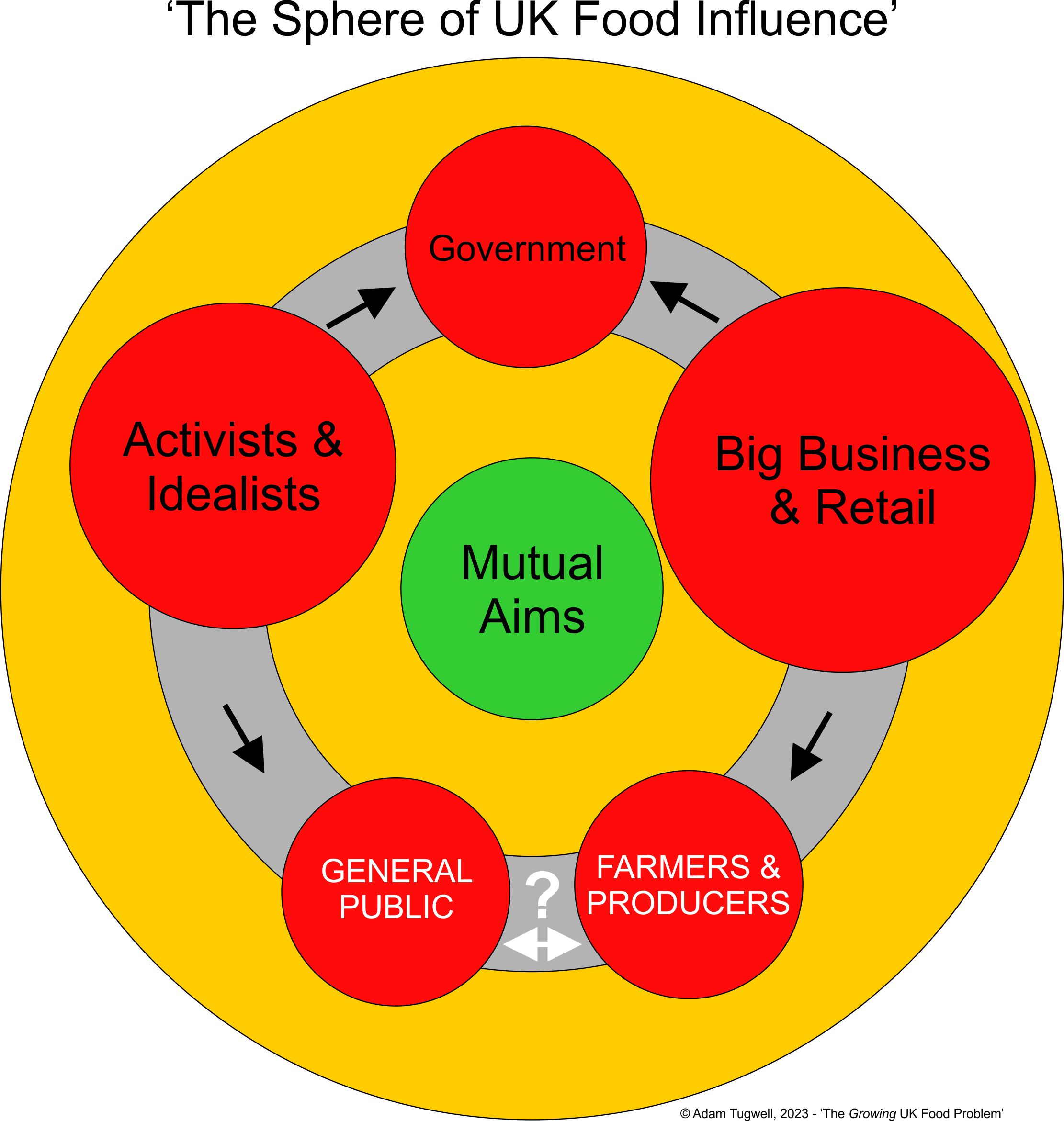
One of the most challenging aspects of the creation or instigation of meaningful change, is getting everyone to consider the alternative, an alternative system or an alternative way of doing things that doesn’t relate to The System that we all know and believe we understand.
The UK Population still expect ‘The System’ to provide the solutions to the societal problems that we have. Even though objective observation will almost certainly lead to the conclusion that it will not.
The majority of the UK Population, including experts, academics and many of those working in government departments or across the public sector do not understand that Public Policy is determined in ways that run completely contrary to what any of us should be able to expect.
Big Business and Big Retail have by far the biggest influence on both Government and the Food Supply Chain, either directly or indirectly. Because The System focuses on ‘growth’ as part of an economic model that prioritises profit for businesses over the needs of the Population itself.
Likewise, within the political and public sector sphere, those with influence who have ears to hear, give considerably more weight to fashionable activist and idealist causes (i.e., those with a louder voice), than the majority of the population or the Consumers themselves, who are the key stakeholders, alongside the producers themselves.
Most disconcertingly, whilst the relationship between Farmers and the Consumers they ultimately supply should be the most definable and robust of all within ‘The Sphere of UK Food Influence’, the relationship between the two Key Stakeholders is weakened to the point that it only genuinely exists beyond lip service where a local and direct farm-to-consumer ‘retail’ relationship exists.
And this itself will be subject to affordability and other accessibility factors that make it almost impossible to recognise in any meaningful way at all.
The Current Mindset or ‘Paradigm’
The System operates as it does because life is driven by the following key factors:
- Money and wealth-based power and influence.
- A cultural mindset that functions with a conditioned and steadily decreasing need for self-awareness and the respect for the law of consequence or law of cause and effect that this facilitates.
We are, to all intents and purposes living and existing within a Moneyocracy.
As the purpose of this work is to focus on UK Food Security issues, there is little to be gained from a diversion into the mindset or psychology that sits behind the leadership and influence-based problems that the UK faces here.
However, the distilled or filtered down version of every social and economic problem the UK faces relate to human nature. And specifically, how the majority of people without self-awareness and without an intrinsic values set behave when life revolves the financial value that can be attributed to every transaction or ‘thing’ outside of ‘the self’.
Forward Thinking and A Food Supply Solution for The Future
A Safe, Secure and Sustainable Food Supply that can service the needs of all UK Communities adequately, can only come from a refocused, repurposed, revitalised and above all Localised System of Farming and Food Production across the UK.
Regrettably, it is the case that beyond agenda-driven bubbles, of which there are indeed many, there is simply no interest in taking proactive steps to create an alternative and robust sustainable supply chain.
The need for the focus on outcomes and results is continually being lost on arguing about who runs things, or who’s solution and therefore agenda, is best.
Once we have stepped beyond the obsessive preoccupation of The Moneyocracy and are ready to embrace a People-centric economic model, we will be able to consider systems of Authentic Governance as suggested by my recent work ‘Our Local Future’. Also by The Glos Community Project, a proposal for a system of community owned and ‘franchised’ social enterprises, which I first published in July 2023, that had the creation of new, not-for-profit localised food production and retail cooperatives at its core.
The ’Glos Community’ Food Production model would sit between the two extremes that at one end is driven by regenerative, ‘sustainable’ and micro-farming principles and the extreme version where the current direction of travel is perhaps best described by bigger is better in every sense that this can mean.
The Sticking Point
The problem we face is that UK Farmers and all parts of the UK Food Chain are unlikely to embrace what is today viewed by the profit-obsessed as a backward way of thinking about advances in Farming and Food production.
This will continue until such time as the value set has shifted from money and ‘what’s important to me’, to one where basic values are restored and value is achieved in producing for the purpose of meeting basic needs, rather than what those with monetary power and influence want.
By adopting a public policy model based around Locality and Authentic Governance, all systems of business would ultimately refocus to a system that would see a localised and balanced Food Production and supply system as the most logical, sensible and practical to have. Because the motives, incentives and drivers will have fundamentally changed.
The barrier to change – that would be pivotal in so many profound ways, is that few will accept the need for this change or be willing to embrace the changes that will make it possible voluntarily.
The problems with Food Supply and Food Security are directly related to the current paradigm and the way that The Moneyocracy has effectively addicted everyone to measuring success, failure and happiness in terms of financial and material gain.
As with any genuine addiction, those addicted must accept that they are suffering an addiction before any action can be taken to address it. And when the majority of the Population are suffering from that same addiction to one or other level or degree, the voices that speak out or that are taken seriously when it comes to the process of healing, are very few and far between, indeed.
We face a reality where only an event of system-changing proportions or what would facilitate a genuine ‘paradigm shift’ will prove enough for business, communities and people to embrace the level of change necessary for a truly sustainable and secure system of UK food production to work.
How we will know when we have a Food Supply that works for us, rather than against us
The true health and wellbeing of society can be measured most effectively by everyone’s access to the supply of Basic and Essential Foods and the eradication of food poverty, where the eradication of food poverty is itself defined by access to an adequate, affordable, unhindered and properly prepared supply of Fresh, Basic, Healthy and Nutritious foods without recourse to using benefits, accessing charity or going into debt.
The current UK Food Paradigm
Whilst few will accept the reality that we currently face, we cannot and will not make progress towards the UK being genuinely ‘Food Secure’, unless and until we face up to some difficult truths:
- UK Agriculture and Food Producers are not capable of ‘feeding the country’ in an emergency.
- With the current dependence on government centric incentives and policy derived from specific interests, UK Agriculture and Food Supply will remain tied to the current narrative – no matter how destructive that will become at individual Farm Business level.
- UK Farmers and Food Producers will not embrace collective change voluntarily.
- The downward trajectory will continue until such an emergency or event takes place that makes change necessary.
- The immediate risk to us all is that the UK Farming Sector will reach a crisis point where it is incapable of being restored to a local supply chain model.
- Economic and societal change of the kind necessary to alleviate the social and financial issues experienced at the level of the individual require a values-based shift from money and profit, to one where fairness and equity to all individuals is prioritised.
- The most simple and effective policy tool to enable such a shift would be the implementation of a People-centric, Localised and Community-based system of Authentic Governance that places Food Production and Supply at the heart of everything.
The Future UK Food Paradigm
It is only with a realignment of values to those that will assure the self-sufficiency of every healthy, working adult, of all business systems and specifically those processes related to Food Production and Supply being Localised to support this that the UK can become ‘Food Secure’.
We must all become People-centric, rather than profit-centric, for sure.
Technological advances must not under any circumstances be allowed or encouraged to replace natural food growing and production and should be relied upon only to improve human life, health and experience.
The hard truth about UK Farming and Food Production we face today
We must regrettably consider and face up to the reality that whilst politicians, big business and the establishment will pay lip service to a growing crisis in UK Food Security, Farmers, Growers, other UK food producing sectors and those businesses aligned with them will likewise not accept that the solutions to a critical problem at both industry and Farm or Business level can come in any way other than from within the existing paradigm and mind-set itself.
The default position of the Industry today is: “it’s all about the bottom line. Government makes the rules and must therefore pay for the changes. Once they have accepted they are necessary.”
Sadly, this rather difficult truth can only lead to the conclusion that no matter how loudly those within and aligned with UK Agriculture sound the alarm and criticise those who we should all be able to expect to deliver on our behalf, Farmers and Food-producing business owners will neither accept and are not prepared to take the initiative and risk that will certainly secure the UKs Food Security, but will ultimately secure the future of many more of our farmers, and themselves too.
Economic and social change of the kind necessary that provide a safe, secure, happy and healthy environment, and with it a safe, secure accessible and affordable supply of fresh, local, nutritious and healthy food for the UK Population is therefore not possible without a paradigm shift that can only be created by a significant national or world event that ends both the ‘belief’ and with it the ‘addiction’ to the current money-based, profit-obsessed system that we are very unlucky to have.
 Adam Tugwell
2 thoughts on “The Growing UK Food Problem”