Understanding Foods We Can Trust: A Blueprint for Food Security and Community Resilience in the UK

Have you ever stood in the supermarket and wondered, “Where does my food really come from?” Or maybe you’ve asked yourself, “What would I do if those shelves were suddenly empty?”

If these questions have crossed your mind, you’re in good company. Food security is something we all depend on, but it’s easy to overlook – until a crisis makes us pay attention.

So, what does it actually mean to have food we can trust? How can we make sure our families and communities have access to nourishing, reliable food – no matter what’s happening in the world? And, perhaps most importantly, what role can each of us play in building a stronger, more resilient food system?

That’s why I’m excited to share some insights from my new Kindle book, Understanding Foods We Can Trust: A Blueprint for Food Security and Community Resilience in the UK, published on December 13, 2025.

This book brings together practical ideas and lessons from the Foods We Can Trust project and the website, www.foodswecantrust.org.

As you read on, I invite you to think about your own relationship with food:

  • Have you ever tried growing your own vegetables, even just a few herbs on the windowsill?
  • Do you know what’s actually in the food you eat every day?
  • Are there ways you could get involved in your local community to support food resilience?

Whether you’re a seasoned gardener, a community organiser, or simply someone who wants to make better choices at the shop, there’s something here for you.

So, let’s explore together how we can all help create a future where everyone has access to food they can trust.

Ready? Let’s dive in.

Introduction: Why Food Security Matters

Food is fundamental to survival, yet recent global events – pandemics, wars, climate extremes, and economic shocks – have exposed the fragility of our food systems.

Foods We Can Trust: A Blueprint for Food Security and Community Resilience in the UK is a call to action, urging individuals, families, and communities to rethink their relationship with food and reclaim power over what they eat and how it is produced.

The book emphasises that food security is not just a matter of policy or trade, but a deeply personal and urgent issue that affects everyone.

Part 1: What is Food Security?

Multiple Perspectives and Definitions

Food security is a complex concept, shaped by the perspectives of government, farmers, food producers, and the public.

The government often defines food security narrowly – if people can eat, they are food secure – focusing on the mere availability of food, regardless of its quality or origin.

Farmers, meanwhile, stress the importance of producing food within the UK and reducing reliance on imports.

The public’s view is more nuanced, encompassing concerns about nutrition, affordability, and trustworthiness.

Risks and Vulnerabilities

The UK is highly dependent on imported food, with only around 58% of food consumed or rather its equivalent produced domestically (and possibly less, depending on how statistics are calculated).

This reliance on global supply chains makes the UK vulnerable to disruptions, and the actual availability of UK-grown food for immediate consumption is much lower than official figures suggest.

If borders were closed, food shortages would quickly become a reality.

What True Food Security Should Mean

True food security goes beyond mere availability.

It should ensure that everyone can choose to eat enough foods that are good for them, meeting genuine nutritional needs at every mealtime, without fear of going without or uncertainty about the next meal.

Key ingredients of food security include reliability, availability, accessibility, nutrition, and affordability.

Barriers to Food Security

Factors such as cost, supply chain issues, ideological or religious restrictions, greed and profiteering, and insufficient income all contribute to food insecurity.

Many people in the UK do not earn enough to afford a healthy diet without assistance, and foodbanks have become a necessary but uncomfortable reality.

Manipulation and Partial Truths

Both government and farming industry narratives about food security contain elements of truth but are often incomplete or manipulated to serve particular interests.

This can lead to public misunderstanding and ineffective policy, even within the food producing sector itself.

Part 2: What Our Bodies Need Every Day

Nutrition is for Everyone

Understanding nutrition isn’t just for experts. Everyone who eats benefits from knowing the basics of what our bodies require to thrive, not just survive.

Nutrition is built on two main categories: macronutrients (carbohydrates, proteins, fats, fibre, and sugars) and micronutrients (vitamins and minerals like Vitamin A, B, C, D, calcium, iron, etc.).

Individual Needs Vary

Every person’s body and nutritional requirements are different, influenced by factors such as age, gender, activity level, and health status.

There is no one-size-fits-all approach to nutrition.

Critical Thinking About Nutrition Advice

Readers are encouraged to approach dietary information with a critical eye – questioning sources, understanding the difference between fact and opinion, and being wary of advice that serves commercial or ideological interests.

Empowerment Through Knowledge

By becoming more conscious of what we eat and understanding our nutritional needs, we can take greater control over our health and wellbeing, making food choices that support a secure and nourishing future.

Part 3: Foods We Can Farm, Catch, Harvest and Grow Locally in and around the UK

Rediscovering Local Abundance

The UK has a wide variety of fruits, vegetables, crops, livestock, fish, and dairy that can be farmed, caught, harvested, or grown locally.

This diversity is often underestimated compared to the convenience and variety of supermarket offerings.

Vulnerability of Global Supply Chains

Reliance on distant supply chains and imported ingredients leaves the UK food system exposed to risks and disruptions.

Local food production is a practical response to these vulnerabilities, offering greater resilience and sustainability.

Practical Lists and Insights

Foods We Can Trust: A Blueprint for Food Security and Community Resilience in the UK provides tables and lists of UK-grown produce, farmed and wild foods, and ideas for what can be cultivated in gardens, allotments, and community spaces.

These resources help readers understand what is possible when focusing on local food sources.

Empowering Individuals and Communities

By highlighting what can be grown or sourced locally, Foods We Can Trust: A Blueprint for Food Security and Community Resilience in the UK encourages readers to make more informed choices about the food they eat and support.

Whether as home growers, community organisers, or consumers, everyone can play a role in strengthening local food systems.

Part 4: Grow Your Own or ‘Home Growing’

Food Security Begins at Home and in the Community

While national policies matter, the most powerful solutions often start close to home.

Growing your own food, joining community initiatives, or working together as “citizen farmers” can help build a more secure, resilient, and nourishing food system for all.

The Fragility of the Current Food System

The UK’s food supply is more vulnerable than many realise.

Relying solely on supermarkets and long supply chains leaves communities at risk of shortages and disruptions.

Taking action before a crisis is now essential.

Practical Ways to Get Involved

There are many accessible methods for growing food, regardless of space or resources – that include window boxes, containers, grow bags, greenhouses, gardens, allotments, and hydroponics.

Foods We Can Trust: A Blueprint for Food Security and Community Resilience in the UK provides lists of vegetables, fruits, herbs, and even animals that can be grown or kept at home, as well as guidance on collaborative approaches like community gardens and cooperative farming.

Benefits Beyond Food

Growing your own food and participating in community initiatives offer more than just sustenance.

These activities can improve mental and physical wellbeing, foster social connection, and build local resilience.

Collaboration and Citizen Farming

Community gardens, share farming, and cooperative projects enable people to pool resources, share knowledge, and produce food collectively.

The “citizen farmer” model encourages everyone – regardless of background or resources – to contribute to local food production and security.

Overcoming Barriers

The section addresses challenges such as start-up costs, limited space, and the need for local support.

It offers suggestions for finding gardening clubs, sharing resources, and seeking guidance from local councils or organisations.

Conclusion: Building a Resilient Food Future

Adam Tugwell’s blueprint is both a practical guide and an invitation to question, learn, act, and share.

The future of food in the UK depends on our willingness to rethink, reconnect, and take responsibility for what we eat and how it is produced.

Food security begins with each of us, but its impact reaches far beyond our own plates.

By working together – as individuals, families, communities, and citizens – we can ensure that everyone has access to foods they can trust, and that our food system serves the needs of all.

Key Takeaways

  • Food security is multifaceted, involving availability, reliability, accessibility, nutrition, and affordability.
  • The UK is vulnerable due to reliance on global supply chains and insufficient domestic production.
  • True food security means everyone can access nutritious, trustworthy food without fear or uncertainty.
  • Local food production and home growing are vital for resilience and sustainability.
  • Community action and collaboration empower individuals and strengthen food systems.
  • Critical thinking and personal responsibility are essential for making informed food choices.
  • Everyone can contribute—whether by growing a few herbs, joining a community garden, or supporting local farmers.

Resources and Further Reading

The book provides extensive links to organisations, guides, and further reading for those interested in deepening their understanding or taking practical steps toward food security and resilience.

Buy the Book for Kindle

If you would like to read Foods We Can Trust: A Blueprint for Food Security and Community Resilience in the UK, it is available for Kindle on Amazon at the link immediately below.

Lessons from the Three Ghosts: Rediscovering the True Spirit of Christmas

So here we are again, racing through December with just a couple of weeks until Christmas – whatever that now means to each of us. For most, regrettably, it has little to do with what these annual rituals are really all about.

It is easy to focus on the commercialisation that now kicks into gear months ahead, where the joy of giving has been replaced by a false, momentary happiness revolving purely around what we receive.

That alone should be enough to make any one of us uncomfortable enough to reflect on the real meaning of Christmas – which, contrary to the assumptions of those who may not identify as Christian, is about care, consideration, and yes, love of the deepest kind. Not for ourselves, but for those who share our lives, and for the rest of mankind.

A Call for Reflection and Leadership

That so many of us miss the value of the symbolism surrounding us throughout December and into the new year, interpreting it only in the easiest ways that make sense, is a sad reflection of how we sleepwalk through life and events of every kind.

It also reminds us that we lack leadership – whether from politicians, national figures, or even the Church of England – that connects with the majority and offers a responsible, captivating view encouraging us to see the value of thinking differently, not just for one month but for the whole year through.

Indeed, in just the past few days, those paying attention will have seen the “race to the bottom” within the public realm continue apace.

Politicians encourage cuts in benefits that people actually need because the lowest‑paid work doesn’t cover life’s essentials, while ridiculing those set up to fail for daring to want a life beyond endless hours of toil.

Others speak of fairness in terms of redistributing wealth that doesn’t exist, taking from those who are just managing to sustain themselves today, while pushing us all quickly toward a day when very few will earn enough to pay their own way.

The tools and hands may look different. But the agendas driving these actors are the same.

Obsessed with taking everything we know and understand in one direction, they press forward without care, whilst we all fool ourselves into going along with the charade, paying lip service to change yet clinging to the false comfort of a system that convinces us life will always remain the same.

The Timelessness in Elements of Life

To be fair, some aspects of human life do remain constant – though not the ones we might first imagine.

What endures is how we react to circumstances, how they shape us, and the power they hold to change our outlook and actions.

The clothes, food, technology, transport, entertainment, and language may evolve, but these are only wrappers we mistake for progress.

When you recognise this, a whole new world of learning opens up.

History, books, and stories – however old or apparently antiquated – can reveal lessons and gateways to understanding we might otherwise dismiss.

The need to be open to Thinking Differently

Few would deny the world faces serious problems today. Yet the common response is to treat them as someone else’s responsibility. And as long as we can point to others to fix what we believe needs changing, we absolve ourselves of involvement.

This “I’m alright, so everything else must be” attitude is neither normal nor truly human in any way.

It illustrates how selfish and self‑oriented we have become and how easily we walk past the struggles of others because they do not touch us directly.

Complacency remains intact until pain enters our own lives – which we can be certain that at some point now, it will.

Dickens’ Timeless Lessons

With this very much in mind, watching Patrick Stewart’s wonderful portrayal of Ebenezer Scrooge the other evening, it struck me that Dickens’ true genius was not simply in crafting a magical, uplifting story of redemption. It was in showing that Scrooge’s encounters with the three Ghosts carry power and meaning transferable to our own time – even 180 years later.

Characters like Bob Cratchit, his family, and Scrooge’s nephew Fred remain relevant and symbolic, as do the gentlemen seeking donations and those whose lives revolve around the stock exchange.

Yet it is the Ghosts of Christmas Past, Present, and Future (or Yet to Come) who offer the deepest guidance. Their lessons, though seemingly obvious when spelled out, are profound opportunities for awareness that we may not readily grasp.

The Ghost of Christmas Past: The Journey of Self‑Awareness

Whilst Dickens made this part of the story a reflection of the key life events experienced by Scrooge, the unspoken message is the enduring role the past plays in the present – and yes, in our future too.

The experiences we have, how we reacted to them, and how they changed our behaviour continue to shape how we respond to whatever comes into our lives, in every present moment and the future thereafter.

It is a reminder that without conscious thought, we fail to see each day in life as being a blank sheet where we can treat each experience as being new.

Without recognising the change we are experiencing and have already experienced within ourselves, we are never the same after each encounter we have.

Even the very same situations in life that seem to repeat may play out in very different ways, just because of what has gone before.

The Ghost of Christmas Past invites us to reflect on who we truly are: what made us, and what drives the ways we behave.

Often, without realising it, we may be self‑sabotaging or setting ourselves up for a fall – all because we were never aware that something encountered long ago set us on a different path.

Self‑reflection and self‑awareness are perhaps the most useful, and therefore powerful, tools for life. And this is what the Chapter is really all about.

Knowing who we are and understanding why we are that person with the ‘lens’ that we have, gives us a very different outlook when it comes to relating to others and wherever our life may lead.

It allows us to see that whatever brought someone to the interaction they are having with us and why they are behaving as they are or doing what they do, usually carries far more meaning than what we can simply hear with our ears or see with our eyes.

The Ghost of Christmas Present: Awareness of Others

Armed with the appreciation that everyone and every situation has a backstory, and that very little we experience is ever as simple as it looks, the work of the Ghost of Christmas Present – who visibly ages and diminishes in presence and stature during the brief moments of the interaction – opens a portal and with it a view of all that is really going on for the others who step in and out of Scrooge’s life.

These are people directly affected by his words, actions, and deeds, even though until this point he has had no reason to see them in any other capacity or give them value beyond what he previously believed them to be.

He certainly doesn’t see to this point that he may have responsibility for outcomes or the ability to influence anything that happens within their lives.

“Why didn’t you ask?” is the poignant question the exuberant Ghost poses to Scrooge when the reality beyond his narrow view of the world begins to dawn.

Scrooge is touched by the presence of Tiny Tim and realises that the boy’s circumstances are not conducive to a pathway that will help him not only to thrive, but truly live.

Recognising that there are infinite stories we could ask about in our relationships and interactions with others to give them real meaning and depth, is a significant step towards considering the reach, impact, and consequences of what we say and do – even when those outcomes remain out of view.

Whilst asking such questions may not always be appropriate or even necessary, that awareness equips us with patience, understanding, and the practice of non‑judgement when others’ words or behaviour may feel annoying, but are not actually causing us any harm.

Understanding that what we do has an impact on the lives of everyone who shares our present is itself a powerful lesson for the way the world works today.

As with Scrooge, who was taking and accumulating more than he could ever personally need, he obtained material wealth by depriving others of what they required to meet their needs – simply because he wanted more than he needed, just for himself.

In doing so, he missed out on the human and spiritual nourishment that was always immediately available, ready to be returned through responses and outcomes from the simple acts of doing what was right for all others, all of the time.

Dickens did not leave the non‑material aspects of these lessons to chance. He also demonstrated very clearly what Scrooge was missing by failing to make the best of the relationships available to him with those closest, with Fred, his wife and Friends.

These relationships required only time and effort. Yet paid back a profit that could only be measured as a currency that enriches the heart, expressed through joy.

The Ghost of Christmas Future: Awareness of the Path You Are On

The magic of the three ghostly interactions truly comes into its own when Scrooge is invited to consider “what happens now.”

The story, of course, has the license that reality does not: it places Scrooge directly into those future situations, just as he has already been helped to review the present and the past.

To see how things will unfold if our behaviour, actions, expectations, and values remain unchanged would be a remarkable gift.

Jacob Marley’s chains – worn as the ghost who preceded them all and had tasted the painful fruit of his unacknowledged labours in life – made clear that everything we do, with consequences that are unfair for others, ultimately has consequences that we would not intend for ourselves, but rarely gives warning before it arrives as the outcomes we will meet in our future.

By the time it does, as far as change or the option to change is concerned, it is already far too late.

Bringing the Lessons Home

Returning to Reality: Time to Think more about the Impact of the Life we can choose, rather than the Life we Accept we have?

It is at this point that the magic of Dickens’ immortal classic A Christmas Carol inevitably fades, and you may already be asking: “What relevance does this have to me?”

The problem we all share – and not one we experience alone – is that too many of us are living lives that in many ways resemble those of a modern‑day Scrooge.

We fail to recognise it because the time, environment, and circumstances of our lives do not look or feel as though they could possibly be the same.

Irrespective of our role or place in society, our jobs or responsibilities, what we own or what we earn, we have become accustomed to thinking only of ourselves – even though we don’t see it that way.

Rarely, if ever, do we consider the impact of what we do, say, or how we act upon others – not only those we interact with directly, but also those who nonetheless share our lives, even though they are people we may never know, communicate with, or meet.

The world has conditioned us to believe that we can demand whatever we want without real cost or consequences – albeit within a framework that typically relates only to money and wealth, while the freedoms of every other kind that will allow us to be the humans that we are really supposed to be. are quietly and powerfully being shut down.

Like Scrooge before that fateful Christmas Eve, the lives we are living, and the lessons and opportunities we have to do things differently and for the better, have continually been missed or overlooked. Often because the easier path was chosen – or rather taken without conscious choice – never contemplating what pain we were stacking up for ourselves in store.

With the world changing rapidly, and turmoil soon likely to demand of each us a choice about our pathway to the future of the kind the unsolicited and unexpected visits from four ghosts demanded, we would all do well to reflect on the lessons Dickens, Scrooge, and his timeless characters have left us.

They offer us the opportunity to redeem lives that carry real meaning for everyone this Christmastime, well beyond just our own.

Key Takeaways

Before sharing a Christmas message, here are the reflections I hope to share from this work:

  • Christmas is an opportunity to reflect on values beyond commercialism—focusing on care, consideration, and genuine connection.
  • Our society often lacks leadership that inspires us to think differently and act with responsibility throughout the year.
  • The lessons of Dickens’ three Ghosts remain relevant:
    • The Ghost of Christmas Past reminds us to seek self-awareness and understand how our experiences shape our actions.
    • The Ghost of Christmas Present teaches us to be mindful of others, recognising the unseen stories and struggles in every life we touch.
    • The Ghost of Christmas Future urges us to consider the consequences of our choices and the legacy we leave behind.
  • True change begins with personal reflection and a willingness to act with empathy and intention—not just at Christmas, but every day.
  • By embracing these lessons, we can move from self-interest toward a life that enriches both ourselves and those around us.

A Christmas Greeting

Thank you for taking the time to read this blog, and for sharing in the reflections and stories I’ve offered throughout 2025.

No matter where you are, or what traditions you hold, I hope this season brings you moments of peace, connection, and hope.

May these lessons of Christmas reflection – self-awareness, compassion, and thoughtful action – guide you not only now, but in the year ahead.

Whatever Christmas means to you, I wish you joy, kindness, and the chance to experience the best of humanity.

Best wishes to All, Adam

The Future of Work: Redefining Value, Meaning, and Human-Centric Employment in the Age of AI and Economic Change

AI’s Crossroads: Choosing a Human-Centric Future for Work and Society

Artificial intelligence is rapidly transforming the world of work, automating roles created by money-driven systems and exposing the fragility of an economy built on profit and status rather than genuine human need.

Without a deliberate change in direction, society risks deepening inequality, eroding community, and reducing work to a function of control and dependency.

The current trajectory, shaped by decades of economic and technological planning, threatens to devalue essential contributions and undermine the foundations of freedom and dignity.

But this path is not inevitable. There is an alternative: a future where work is meaningful, communities are empowered, and the economy serves people – not the other way around.

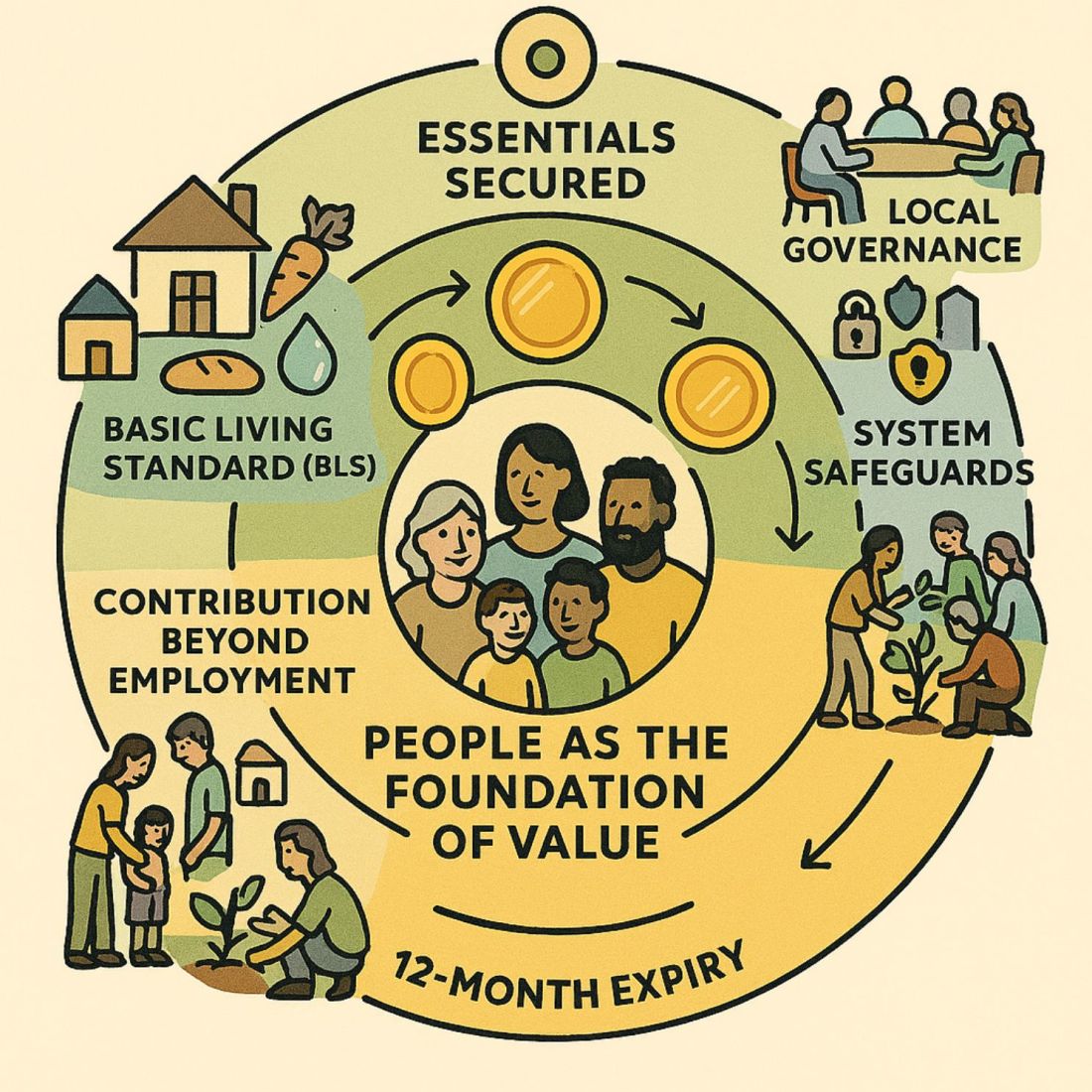
This work challenges the prevailing narrative and introduces The Local Economy and Governance System (LEGS) – a model for a human economy built on the basic living standard.

LEGS offers a practical framework for restoring value to real work, strengthening local governance, and ensuring that technological progress enriches lives rather than diminishes them.

The choice is ours: continue down the AI-led road of exclusion and control, or embrace a system that prioritizes human well-being, fairness, and genuine prosperity for all.

Rethinking Work in a Human-Centric Future

Beyond Money-Driven Roles

The work and employment of a better, human‑centric future will be real, tangible, and deeply meaningful. Unlike many roles today that exist primarily to prioritise the flow of money, this future will focus on impact, purpose, and the enrichment of human life.

The Challenge of New Realities

The near future is poised to introduce truths, realities, and perspectives about our lives that many will find extremely difficult to accept.

This difficulty arises because true freedom – freedom to do, freedom to think, and freedom to be – requires us to revalue everything: how we see, how we interact, and how we set expectations.

These expectations will need to operate in a completely different, yet ultimately rewarding, way.

Shifting Perceptions of Good and Bad

In this transformation, what seems good today may quickly be seen as bad, while what appears deficient or undesirable now may suddenly reveal itself as profoundly valuable.

One of the most striking areas where this reversal will become evident is in our daily relationship with work – what we do, and how we define the very act of working.

The Distortion of Work by Money

The concept of work itself has become twisted by its association with money and the reward of money for labour.

Work is widely accepted as “work” only if it pays a wage.

Within this framework, society has conditioned us to undervalue technical, hands‑on, manual, and physically demanding forms of labour.

These roles, despite their essential contribution, are treated as if they hold little real value.

The Rise of Professional Roles

Meanwhile, a whole range of so‑called “professional” roles – many of which either had no necessity or no clear purpose until recently – have emerged and now dominate the employment landscape.

Some of these roles did not even exist a few decades ago, yet they are rewarded and elevated far above the practical, human‑centric work that sustains daily life.

The Devaluation of Real Work in a Money-Centric Culture

When Real Jobs Lost Their Value

Money‑centric culture has made “non‑jobs” real while rendering real jobs valueless in the eyes of society.

Historically, work was simply whatever it took to make life function. People played different roles – some paid, some unpaid – to sustain a household.

There was an unspoken recognition that it takes diverse contributions from everyone to enjoy life together, no matter what those contributions might be.

The Shift to Consumerism and Financial Systems

This balance changed with the rise of consumerism and the adoption of the moneocratic FIAT financial system, reinforced by GDP metrics and decades of law and regulatory changes.

These shifts progressively pushed households into a world where every member had to work for financial reward before the essential tasks of maintaining a home could even be addressed.

Even self‑sufficiency – achieved through both employment and domestic work – was no longer enough to live on if one was engaged in “real jobs.”

Such jobs now attract only ‘minimum wage’, a measure that has never represented the true benchmark of what it takes for a household to live independently and for its members to experience genuine financial freedom and the peace of mind that it facilitates.

The Mechanics of Wealth Transfer

With an economic system so fundamentally bogus, it should come as little surprise that its clever mechanics were designed to transfer wealth to those in control.

To achieve this, the system had to create a mindset that persuaded the masses to facilitate what is, in reality, a crime against humanity – not only against those they were conditioned to believe were ‘lesser’, but ultimately also against themselves.

This required that people be “bought in” to a value set where a select few and those who took every step necessary to be like them, could become disproportionately rich by doing ‘jobs’ that required little effort – or none at all.

The Creation of Jobs and Economies of Scale

Jobs were reshaped and split off from existing roles as money began to demand output.

Economies of scale, hailed as progress, destroyed local businesses and community systems that had worked perfectly well and had the ability to facilitate self-sustained models of family life.

These practices imposed a new slavery to money, progressively making it our master.

Careers as Money Machines

Jobs that supported the growth of money‑centric culture became the new measure of success.

Young people have shifted from more traditional aims of living a balanced, all‑round life to pursuing careers defined not by trade, service, or goods, but by the pursuit of money.

Careers have become all about making money, expanding the ways to make money, and protecting every part of the machinery involved.

Quality of customer experience and the delivery that brings it seldom now sit at any industry or profession’s heart.

Entitlement and the Multigenerational Workforce

The splitting of systems into job categories defined people not by the real work they did, but by the possessions and status attached to their roles.

This slowly created a culture of entitlement.

A multigenerational workforce has emerged that takes much in life for granted, including the myth that wealth can only grow while jobs become less like work.

The belief that “what one wants is what one deserves” has spread, with the expectation that such entitlement can be imposed upon everyone encountered without consequence – even in the digital, parallel world.

Sleight of Hand at Scale

Those in created jobs believe life can only get easier, while those performing the essential tasks that make life work for everyone cannot earn enough to escape the constraints of their labour.

These ideas and the narratives that underpin them are little more than a distraction – a sleight of hand on an epic scale – deliberately hiding what has truly been happening at the cost of everyone involved.

The Switch in Values

The shift from valuing people and the work required to live, to valuing money as the only important thing, has made society lazy, entitled, and ill‑prepared.

People now accept change passively, no matter how illogical or damaging, even when the same destructive process repeats with increasingly bizarre and counterintuitive outcomes.

These changes almost always come at a cost to people, communities, and the environment, whilst being presented as having the best interests of everyone at their heart.

The Direction of Travel that the World as we know it is on

The Difficulty of Belief

People often find it hard to accept that all of this was deliberately planned by others.

Yet money – and the possession of wealth, power, control, and influence – is an extraordinarily powerful motivator.

For those who become addicted to it, there is almost no limit to what they will attempt or achieve.

The Mechanics of Power

When such individuals hold power, or gain access to those who do, they can reshape systems so that authority itself works in their best interests.

Slowly, almost imperceptibly, they change the structures of life so that everything begins to function in ways that serve them.

Long-Term Planning

The plans that have brought the world to its current state have not emerged overnight.

They have been underway for well over 150 years, steadily unfolding across generations.

This long trajectory has seen massive changes in the way international business is conducted. Changes that were only made possible through the upheaval of two world wars.

Unseen Problems Do Not Cease to Exist just because they are Unseen

The Hidden Nature of Change

Just because we cannot see or fully understand a problem does not mean it does not exist.

The adoption of a financial system that has created unprecedented wealth transfer – not only in the value of money itself, has also resulted in the ownership of business, property, and infrastructure, which has all steadily shifted into the hands of the few – at what could now be a disastrous cost to us all.

Technology as a Companion to Wealth Transfer

Alongside this financial transformation, technological progress has advanced in lockstep.

The chronology of events, from digital systems to information technology and hardware innovations, shows that these developments did not simply arrive at the moment we first experienced them.

They were planned, anticipated, and in many cases known to be possible for long periods of time.

Artificial Intelligence, and the AI takeover we now hear so much about, is not an isolated phenomenon. It is part of this broader strategy and plan, woven into the same trajectory that has shaped finance, ownership, and control.

The AI Takeover and Its First Victims

It is no accident that the first jobs to disappear in the AI takeover are those that are tied directly to the money project itself.

These roles, created and sustained by a system designed to prioritise financial mechanics and the transfer of wealth over human value, were always the most vulnerable to replacement.

Collective Choice and the Future of Work

The loss of other jobs, however, is not predetermined. It is our collective choice.

How we respond, adapt, and redefine the meaning of work in response to what is happening around us will ultimately determine the direction of the future.

Opening Ourselves to an Alternative Future

Awakening to a New Reality

Influencers are now beginning to ask the pressing question: “What happens to everyone whose job is taken by AI?”

At the same time, members of the elite openly declare that many jobs will no longer be needed within a decade.

People are slowly awakening to a new reality – one where the expectations we have been spoon‑fed and accepted so willingly, because life has seemed distractingly good, no longer add up.

This awakening is compounded by the fact that the economy itself sits on a knife edge.

Governments, behaving with illogical static rigidity, offer no meaningful response.

The contradictions are glaring, and the narrative no longer holds together.

The World Envisioned by the Few

The architects of this system – the people who designed and intend to run the world as they envisage it – have exploited and legitimised the theft of wealth, resources, and tools from the masses.

Through this process, they have been creating the foundations of a new world order built on control and deprivation.

Technology, ownership, and finance have been reshaped not to empower humanity, but to strip it of independence and place power firmly in the hands of the few.

The promise of “you will own nothing and be happy” is not a utopian vision. It is the culmination of a strategy that has taken from everyone to enrich the few, ensuring that the majority remain dependent while the architects consolidate control.

Systematic Devaluation of Real Work

It was purposefully engineered that people in manual, technical, and real jobs have been systematically devalued.

This devaluation has been reinforced by every institution and system.

Governments have deliberately abused their mechanisms to top up and subsidise wages, hiding the reality that the lowest paid wages are insufficient.

At best, this is exploitation; at worst, it is slavery – successfully concealed from view.

The True Value of Real Jobs

These real jobs are the ones that should be paying what it actually costs to live.

Yet the people in these roles – the very ones the new system will still need – will not willingly participate in servicing its demands if they are free to choose otherwise, especially when everyone else has been effectively cast aside.

Freedom as the Ultimate Threat

Freedom itself is the greatest threat to greed and to the furtherance of the moneycratic system.

Everything aligned with that system depends upon control.

True freedom undermines it, exposes it, and ultimately resists it.

Choosing Jobs That Make Life Work Rather Than Making Life Out of Work

The Dystopian System Already in Place

The dystopian system you may now be able to visualise is already baked in.

Within this dynamic, all the “non‑jobs” that the system has encouraged us to hero‑worship will inevitably disappear, replaced by AI.

The flow of money and wealth these roles facilitated has already reached its destination.

The elites are openly telling us this, and they are not trying to hide it.

The Fate of Technical Work

Yet not all jobs will vanish on the same timeline.

Technical roles – or at least a restricted number of them – will remain for longer than the created non jobs will.

This reality matters. It may be the knowledge of which jobs endure, and why, that provides people with the opportunity to resist and to choose a new direction, rather than surrendering to what otherwise appears to be a very dark fate.

All Jobs Must Have Meaning for People to Understand Their Value

The Illusion of a Life Without Work

Whilst we may like the idea of never working again and having every conceivable need met, there is nothing about this that is real.

The reality of being provided for in this way requires conformity and restricted behaviour.

No matter what toys or distractions we are given, such a life would resemble what we recognise today as being no different to that of a caged pet.

Activity as the Source of Value

Activity that contributes to a good life is not only necessary; it is fundamental to the value we each hold.

In the alternative future we must now consider seriously, contribution matters not because it is labelled as “work” or “employment,” but because it makes life good.

Any act that sustains or enriches life carries meaning, regardless of whether it fits the narrow definitions imposed by what the current system teaches us, or not.

The Irony of Non‑Jobs

It is ironic that people in high‑flying “non‑jobs” today often dream of simpler lives -baking cakes, crafting cheese, keeping animals, growing food, building with bricks and wood, or fabricating metal – rather than being controlled by the rules of a game and chained to a city desk.

The truth is that jobs with meaning are those that provide or support the provision of life’s essentials.

This is what every form of work, employment, or contribution should actually be about.

A Future That Serves People, Not Money

The future that serves people instead of money will be built upon direct relationships and locality.

 In such a future, everything will be transparent, and people will work and provide only for the people, communities, and environments that directly touch their own lives.

This is the foundation of meaningful work: activity that sustains life, nurtures community, and strengthens the bonds between people and the world around them.

Quality of Customer Experience and Locality Will Define Business Sizes – Not the Myth That Bigger Is Best

Freedom Through Localised Business

To choose freedom from the unnecessary oppression and exclusion that serves the few – and exists only by design – requires that we create businesses and operations focused on people, community, the environment, and their genuine needs.

True freedom lies in resisting the structures that prioritise profit over humanity and in building enterprises that serve life directly.

Rethinking Work and Economy

Some question how a future can exist where everyone works and still has enough.

Yet when work is about life rather than money, the realisation emerges that there is indeed enough of everything for everyone – provided we focus on need rather than the want that money‑centric thinking encourages for the benefit of the few.

In such a system, the economy ceases to be about job titles and power; it becomes about what we all do and achieve together.

Enough for Everyone

Everyone can work. Everyone can have a job. And everyone can have their needs met if we accept that there is no legitimate reason for any person to accumulate more than what meets their own needs.

Exploiting even the smallest advantage to gain whatever one desires undermines fairness and perpetuates inequality.

Integrity, Fairness, and Justice

Balance, fairness, and justice require integrity.

Everyone must act with the awareness that their choices affect others.

Taking more than one needs – no matter the opportunity, no matter how easy it may seem – always results in others having less. Even when the outcome is invisible to the one who takes.

Work With Meaning, Not Slavery

Work is necessary for everyone. But fulfilling work – work that sustains life and community – is not the same as financial slavery, where greed and exploitation are the only measures of value.

The future must be built on meaningful contribution, not on the hollow pursuit of wealth which can never and was never intended to be made available to and shared by everyone.

Key Takeaways

Before moving on to further resources, here are the central messages and insights from this work.

  • AI is Transforming Work: Artificial intelligence is rapidly automating roles created by money-driven systems, exposing the weaknesses of an economy built on profit and status rather than genuine human need.
  • Current Trajectory is Unsustainable: Without a deliberate change, society risks deepening inequality, eroding communities, and reducing work to a function of control and dependency.
  • Devaluation of Real Work: Essential manual and technical roles have been systematically undervalued, while “nonjobs” and money-centric careers have been elevated, distorting the meaning and value of work.
  • Freedom and Dignity at Stake: The existing system undermines freedom and dignity, making people passive in the face of damaging change and reinforcing cycles of exploitation and dependency.
  • A Human-Centric Alternative Exists: The Local Economy and Governance System (LEGS) offers a practical, human-centred framework for restoring value to real work, strengthening local governance, and ensuring that technological progress enriches lives rather than diminishes them.
  • The Choice is Ours: Society can continue down the AI-led path of exclusion and control, or embrace a system that prioritises human well-being, fairness, and genuine prosperity for all.

Further Reading

The following works are arranged to guide you through a clear progression: beginning with the foundational principles that challenge the myths of money and value, moving through critiques of collapse and exploitation, examining the role of technology and AI, and finally presenting the Local Economy Governance System (LEGS) as a practical blueprint for transformation. Taken together, they form a journey from diagnosis of the problem to the design of solutions, and ultimately to the vision of a sustainable, human‑focused future.

Foundations of Change

  1. One Rule Changes Everything – full text (20 December 2024)
    Introduces the single guiding principle that underpins systemic change, framing the rest of the discussion.
  2. Future economics must be tied only to people, their contribution, what is important to sustain good, fair and balanced lives – and legal currency must never again be open to speculation and manipulation (25 July 2025)
    Outlines the foundational principle that economics must serve people directly, not speculation or manipulation.
  3. The basic living standard explained (24 October 2025)
    Defines what a fair and sustainable living standard should look like in practice.

Collapse and Critique

  1. Breaking the money myth: rethinking value, exchange and equality (12 November 2025)
    Challenges the myths surrounding money and explores alternative ways of defining value and fairness.
  2. Money is the greatest crime of our time (12 November 2025)
    A powerful critique of how money has been weaponised against society and freedom.
  3. The coming collapse and the revaluation of everything needed to regain personal freedom and control (12 November 2025)
    Explores the inevitability of collapse and how revaluing essentials can restore freedom.
  4. Facing the economic collapse: the real crisis behind money, wages and freedom (14 November 2025)
    Examines the deeper crisis of wages, freedom, and exploitation hidden beneath economic collapse.

Technology and AI

  1. People need jobs more than AI and the tech revolution (1 September 2025)
    Argues that human work is essential for dignity and meaning, beyond the promises of automation.
  2. Technology and artificial intelligence should only fill jobs when no humans are available (13 November 2025)
    Argues for a human‑first approach to work, with AI as a last resort rather than a replacement.

Workforce and Revaluation

  1. Revaluing the workforce: escaping the grip of greed (26 November 2025)
    Calls for a revaluation of the workforce, freeing people from exploitation and restoring dignity to work.

LEGS and Transformation

  1. The Local Economy Governance System – online text (21 November 2025)
    Provides the full text of the Local Economy Governance System (LEGS) as a framework for change.
  2. LEGS – The Human Economy: a blueprint for transformation (1 December 2025)
    Introduces LEGS as a practical blueprint for building a human‑centric economy.
  3. The Local Economy Governance System (LEGS): escaping the AI takeover and building a human future (4 December 2025)
    Explains how LEGS can resist the AI takeover and create a sustainable, human‑focused future.

Closing Note

Taken together, these works reveal both the depth of the crisis and the clarity of the solutions.

They show how money has distorted value, how collapse is inevitable under the current system, and how technology – if left unchecked – will accelerate exploitation rather than liberation.

Yet they also illuminate a path forward: one built on fairness, locality, transparency, and human‑centric governance.

The choice is ours. By engaging with these ideas, we prepare ourselves not only to understand the scale of what is happening, but to act with integrity and courage in shaping a future that serves people, community, and the environment above all else.

Power and Distance: Why UK Politics Fails the Public and How Local Governance Can Restore Trust

As a writer, commentator, and former local councillor, I witness the frustration, anger, and despair felt by individuals and groups – such as our farmers – who struggle with a system where politics and government no longer work for them.

I share some of these feelings myself, not simply because their experiences are clearly unjust. But because of the persistent, unwritten expectation from people who are being hurt by all this, that these problems are only temporary.

Too often the problems are dismissed as misunderstandings or assumed to be issues that will resolve once new politicians are elected. Yet very recent history has shown us that changing politicians changes nothing: the downward trajectory of growing unfairness and imbalance continues, remaining at best unchanged.

It is fair to say there is a widespread disconnect between what the public rightly expects from the system and what we actually receive. This gap exists in part because we have been conditioned to believe that government, politics, and the public sector operate in a very black‑and‑white way – clear, predictable, and straightforward in how they function.

Public Perceptions vs. Reality

Whilst this view should be one that we could all rely upon, the reality is very different.

The complexity and mechanics of policymaking and delivery are extraordinarily difficult to navigate – well beyond what most people imagine. And this is before we even begin to confront the thorny issue of corrupt or self‑serving behaviour, whether by a single individual, multiple actors, or indeed by politicians, executives, managers, and officers across a nebulous hierarchy that stretches through many levels and points of influence.

Most people believe that power in Parliament works like this:

  • An election is called.
  • We vote for the person we think will best represent us in our constituency (though in practice, most people base this choice almost entirely on political party affiliation).
  • That representative then decides how to act when a policy comes up for a decision, guided by what is best for us.
  • If our chosen political party forms the government, the policy is enacted.

And we believe that everything necessary happens as a result of this, because all the public servants working in government departments, quangos, NGOs, and any other service funded – and therefore led – by the government (in other words, paid for by us) simply follow the instructions of politicians. After all, it is the politicians who are the legislators, elected to make those decisions on behalf of us all – isn’t it.

That, in principle, is how public policymaking and implementation across the UK should work. Yet the reality is that it rarely does, largely because:

  • The hierarchical structures and systems reaching across the public sector are simply too vast – too much “big government.”
  • Most importantly, very few politicians or public servants actually see it this way.

Barriers to Effective Policy Implementation

Regrettably, the vast and convoluted structure of the public sector, with its top‑down nature and multiple ‘decision makers,’ often distorts the process.

Commands that reach them are reinterpreted, repackaged, and passed along in ways that suit the direction they wish those instructions to take.

As a result, the action at the point of implementation can look very different from the original decision – not because that decision was unclear, but because countless influences and policies, each carrying their own interpretations, reshape and redirect almost everything along the way.

This happens even before the protectionist prejudices of public servants add further obstacles.

The outcome is that two very different results – the one envisaged and the one delivered – can exist under exactly the same name.

And that, of course, is how it works – assuming that what government says it is doing, and has done, truly matches the actions it takes.

Yet the clever use of words and interpretation often means that, even before a decision leaves Westminster, the outcome we expect and the outcome intended are already heading in completely opposite directions.

If this already sounds complicated and conflicted enough, we must also consider what influences our politicians, and how those influences shape their decisions.

We should ask whether the people we see on TV and hear on the radio – the very individuals we elected – are truly the ones sitting at the top, occupying the seats where the ultimate responsibility rests.

The Mechanics of Power in UK Politics

  • Political parties select candidates to run in elections for Parliament, local councils, and mayoralties (typically only where local decisions reflect the interpretation of national policy once local policy is adopted). More often than not, his is also where elected politicians receive an allowance or salary.
  • Parties choose candidates who will follow instructions from the party – or more specifically, from senior politicians within it – regardless of the constituency they represent after a successful election.
  • The area or location itself doesn’t matter. It’s a numbers game: just as the first‑past‑the‑post system (FPTP) elects the candidate (and therefore the party) with the most votes in a given area, Parliament and councils also make decisions based on majority votes. This is why the party with the most seats after an election forms the government or administration – it is assumed that the result of all votes thereafter will fall in line with them and whatever decisions they make.
  • Locally and nationally, leaders of councils, mayors, and the prime minister become the de facto decision‑makers of their administration, mayoralty, or Parliament, because there is an expectation that members of the party holding power or the majority will always vote the same way and do as instructed.
  • Any party aligned politician who fails to vote as required by the party risks losing favour. Depending on the importance of the vote, they may be excluded from the party (have the whip removed), fail to be reselected as a candidate, or at the very least be sidelined until they are seen to be behaving as expected.
  • Whips act as party enforcers, pressuring and often bullying sitting politicians into remembering who put them in their “job” and what they are really there to do and who they are there to do it for.
  • Leaders and mayors are typically expected to follow whatever the party leadership or prime minister in London demands in relation to national policy, though they retain some flexibility where decisions are entirely local.
  • Prime ministers are seen to hold the ultimate executive authority over what happens in Parliament. This is why they can appear to function like a president—unless they take deliberate steps to remind everyone that we have a parliamentary system, where things do not always work in that way.

That is how most people working in or around politics and the machinery of government interpret the power structure today.

The prevailing assumption is that whatever Parliament, the prime minister, or cabinet ministers say the government is doing – and why – is usually how everything will unfold, once public servants play their part and make it happen as expected.

However, beyond the reality that political parties typically decide who represents us – even though we perceive the list of party candidates on our ballot papers as offering what a genuine choice – there is also an assumption that anyone elected as a politician, and therefore as a public representative, is automatically qualified, experienced, and possesses the knowledge, understanding, and capability required to carry out the responsibilities of the ‘job’ they have been ‘chosen’ to do.

In reality, while some individuals put themselves forward as political candidates with genuine public service in mind – and possess both the background and, most importantly, the integrity required to carry out the role of being a public representative properly – the majority of those who reach political office, appearing on TV and speaking publicly, do not.

The majority of our politicians sought the ‘job’ rather than the responsibility – even though some have never seen it this way. But they were willing to say yes to anything and do whatever was necessary to secure a position of control, allowing them to appear as though they were leading, when all the time, they have been led.

Yes‑men or yes‑women—it makes no difference. Anyone who advances by saying “yes” to those who hold power over their progress, and never pauses to say “no” when decisions affect the lives of the people they are meant to represent, does not truly understand what it takes to lead.

And any politician who claims they merely “played along” until they were in charge, promising they would then do the right thing, cannot credibly be believed.

Leaders who cannot truly lead depend on those around them. The people with ‘supportive’ jobs offering ideas, suggestions, or solutions that give the illusion they can.

When politicians, especially very senior figures or those ‘singled out for great things,’ have to rely upon others to supply the words that are later seen to come from their own mouths, they become highly vulnerable to anyone with influence who can reach them and exert control in a seemingly ‘helpful’ way.

Influence of External Actors

Unfortunately, the system we live within today is money‑centric, and our entire framework of values is shaped in the same way.

It follows, then, that money, big business, and those who control or are sanctioned by them have become the people – or influencers – that politicians increasingly turn to for guidance and solutions.

This reliance grows stronger as they approach power. Because it is the only way that out-of-their-depth politicians can identify solutions that appear to work within the very system they are supposed to control.

Politicians are just as captivated – if not more so – by big names and high‑profile figures in business, finance, and global governance organisations – entities that are closely aligned and working together with them because of what is perceived to be the symbiotic relationship between government and money.

The same relationship plays out between the most senior public servants and the policy teams for all of the organisations that have real influence. Much of their time is spent behind the scenes collaborating with counterparts who represent the real interests that set government direction.

At this stage, it should be clear that the real forces driving and controlling central government – and shaping both what it appears to do and what it actually does from Westminster – are those who advise, ‘support,’ and influence the government and its subservient politicians.

What we see is little more than a carefully staged performance: a well‑developed display of theatrics and political cosplay delivered by the political classes, rolled out in every direction where real power is supposed to reside, designed to make it seem as though that is how the system truly works.

Remember that the imposters are usually the ones who believe they should be there.

They don’t work for us. They work for them.

Some politicians are certainly honest. Yet even among those, many are either naïve or fail to grasp how the bigger picture operates within a system that is fundamentally corrupt.

This silent corruption stems from the way individuals act. Whether in their own interests, in service of their party, or according to personal beliefs.

In more extreme cases however, there is plenty of anecdotal evidence to suggest politicians have been compromised by their own actions or bought off with promises of post‑parliamentary jobs, directorships, speaking fees, or an endless array of sweeteners.

These incentives encourage them to vote in ways that align with the company they keep in London, rather than prioritising what truly needs to happen to benefit the local people in the constituencies they are meant to represent – That’s people like you and me.

Regrettably, it is not only politicians who are distorted by the distance created by the current system and structure of government across the UK.

Public servants, working across the many organisations and tiers of government funded by the taxpayer, primarily focus on and prioritise the agendas and practices handed down by their employers. Employers who have long forgotten what it truly means to be public service organisations.

Instead, they have fostered a protectionist culture that encourages risk avoidance and discourages anything that might compromise career paths, gold‑plated pensions, or the safety of sticking rigidly to tick‑box processes.

As a result, public servants often shy away from tailoring their workload to meet the specific needs of the very members of the public they are appointed to serve.

Consequences of Leadership Gaps

The simplest interpretation of the events that have led to this system‑wide malaise might be to conclude that no public servant works for anyone other than themselves.

Yet the reality is more complex: institutional factors have long created an environment in which protectionism thrives. Chief among these is the absence of genuine leadership in Parliament and across key public sector organisations – institutions filled with individuals beholden to agendas other than those of the people they are meant to represent.

As a result, the public sector has effectively been on autopilot for a very long time, propelled by inertia and sustained by the convenient myth that everything continues exactly as it always has.

Limits of Leadership Change in Westminster

Many people hope that another change in government will be enough to resolve the problems now facing the country – issues that just as many seem to accept as having been caused by the current Labour government, and in only the 17 months it has been in power.

Sadly, while it would be great for there to be a quick, overnight solution – or a set of solutions – that could be easily implemented and pushed through under some new scheme such as Reform UK’s proposed ‘DOGE,’ the reality is different.

As you may already have gathered from what you’ve read above, the problems are now beyond systemic.

Believing that simply cutting budgets and arbitrarily slashing costs will be enough for the public sector to regain balance and correct itself is, like so many politicians who fail to see the bigger picture, dangerously naïve.

Beyond the rot we have already discussed, one of the truly colossal problems in fixing public services is the influence that money, markets, and big business already exert.

Added to this are external power-centric players such as the EU and global governance bodies like the WHO, UN, and WEF, whose policies and power have become inextricably intertwined with almost everything the UK public sector currently does.

In reality, if Reform were to begin slicing and dicing across the public sphere without coordinating – and thereby subjugating – its policies to the demands of today’s ‘key’ influencers, the strategy it proposes would quickly resemble a game of Jenga. The players might believe they have steady enough hands to start by removing the foundational layers, but the structure would inevitably become unstable very quickly indeed.

The leaders of Reform may yet prove themselves to be the “Jenga Boys” of public policy, As bringing the whole house of cards down almost as quickly as they take power—if that is what happens at the next General Election, is the outcome their rhetoric currently indicates will be most likely if they lead the next government.

Without exception, all of our politicians are currently tied into the system that is backed and pushed by the establishment.

If all they intend to do is reach for sticking plasters and offer superficial fixes, the result will inevitably be the same, and their suggested approach will merely speed the process of collapse up – if it isn’t already complete by then.

Systemic Breakdown: Causes and Implications

The reason attempts to ‘fix’ the public sector as we know it will not succeed is the inseparable relationship it has with everything else beyond government and controlled by the elites – relationships that revolve around money and a financial system that is fundamentally flawed and now destroying everything.

Put bluntly, everything harming people today is a direct consequence of how the entire money centric system operates, and how it has been operating for a very long time.

Whether the collapse comes from factors seemingly beyond politicians’ control, or directly from actions the next government and its leaders are knowingly prepared and brave enough to take, the reality remains the same: the only way to restore balance, fairness, and justice for everyone across all areas of life is if the current money‑centric system is either deliberately brought down or allowed to collapse on its own.

Then – and only then – will the majority of us be ready to embrace the kinds of changes that must take place across every part of the economy, governance, and daily life, so that, in time, something recognisable as genuine sanity can be restored.

If those in power act only in ways that serve their own local interests, why shouldn’t your power remain local and stay with you?

It would be easy to stop here – having laid out the detail of what is wrong – and leave it at that.

Yet if you are reading this, the chances are you already sense that something much bigger and more profound is wrong, even if it defies logic and is difficult to grasp in terms of what exactly those wrongs are. Or rather what the true causes of the problems have been.

The reality is that there is nothing easy to accept about how government and the public sector operate, especially when measured against what any of us should reasonably expect – and what our lived experience increasingly shows us instead.

Members of the public are not alone in their disbelief. The reality we face is that many of those perpetuating the problems within government, politics, and the public sector are acting as they do simply because they are told that this is how everything gets done.

That excuse only goes so far.

Institutional Failure

For many, the real implications of institutionalised failure to take responsibility for those you serve are far from victimless.

They manifest in scandals such as Rotherham, the Grooming Gangs, and the Post Office cases. Stories brought into the light only because many different people, through their lived experiences which they effectively share, revealed events that can ultimately be understood and summarised as being the same thing.

Individuals are being failed by our system of government every single day. Not only structurally and institutionally, but also by the politicians and public representatives who hold local seats across every tier of government.

Too often, they act in ways that serve themselves, rather than doing what is right for the people they are meant to represent.

The damage of distance

The dangerous myth of the digital age – one we have been encouraged to believe – is that every kind of information and guidance we need for life can be trusted to appear on the nearest screen.

While this may feel intimate in nature, it is in fact a remote interface that creates distance not only between us and the sources we too readily trust but also erodes the value of genuine relationships and social interactions that once filled the space in between.

The irony is that politicians and decision‑makers continue to keep everything local when it comes to their own sources of information and guidance.

While this is no excuse for the consequences of their actions – or for the harm caused by the system they have enabled- it does reveal something important.

When people recognise that power rests with them, they naturally turn to local resources and relationships. Facetoface interaction fosters trust in ways that distant sources never can, making it both sensible and effective to rely on what is close at hand rather than on remote influences.

The difference between us and the politicians – and those truly in power– is that they exploit the distance they have created between themselves and the public for their own benefit, all while constructing a narrative that insists whatever they do, and whatever harm they inflict, there is simply no alternative.

They can only do this because we have forgotten that the power they abuse is, in fact, ours.

If we were to recover, restore, and remember the true nature of our own power, we must return to relying on the people and communities around us – those who we can genuinely trust.

After all, the individuals you can look in the eye and interact with every day rarely have the opportunity to abuse that trust, and the behaviour such relationships foster and require makes exploitation far less possible.

A Vision for Local Governance and Economic Reform

Recognising how things could be different – and what it means to embrace an alternative system with all that comes with it – is an essential starting point for us all.

It will help shape or identify both the choices we will make and the responsibilities we must accept when the most obvious signs of collapse begin to appear.

When that moment comes, we will face a choice: to take a different path that restores power to ourselves, or to become fully enslaved and captive to a system that survives only because the power of each individual has been taken away and concentrated in the hands of one—or a few.

Be assured that once you realise you are there, those in control will have already put in place the safeguards necessary to ensure it can never be any other way again.

By now, everyone has heard of Orwell’s 1984 and the dystopian hell it depicts – a reality awaiting those who embrace and continue on the current path, only to discover, when it is already too late, that they have been stripped of all meaningful value.

The alternative is to reject the money‑centric, top‑down, hierarchical, and patriarchal system, that has long concealed the fact it has not only failed us. But has also enabled little more than sanitised or legalised criminal behaviour against us all.

Instead, we must embrace a system that places the dignity and freedom of every individual – rooted in people, community, and the environment – at the forefront of everything that we do.

The Local Economy & Governance System offers a new and alternative perspective, presenting the frameworks and rules that would shape a localised model of democracy and public policy‑making.

This system places what is right at the heart of every decision.

Decisions made by, or on behalf of, the people in each community, whose fates and destinies are inevitably and permanently intertwined.

Key Takeaways

Before exploring further reading and resources, it’s important to reflect on the central insights that we have shared.

The following key takeaways highlight the underlying causes of public distrust in UK politics, the influence of power structure and external actors, and the urgent need for reforms that refocus towards local governance.

These points offer a foundation for understanding both the challenges and the potential pathways toward restoring trust and accountability in public life.

  • Systemic Disconnect: There is a persistent gap between public expectations and the actual workings of UK politics and government. The complexity and hierarchical nature of the public sector often distort policy implementation, leaving many feeling unrepresented and frustrated.
  • Power Structures: Political parties and senior figures exert significant control over elected representatives, often prioritising party interests and external influences over genuine public service. This results in a system where decisions are shaped by those with power, rather than by the needs of local communities.
  • Influence of Money and External Actors: The increasing reliance on big business, financial interests, and global organisations has further distanced politicians and public servants from the people they are meant to serve. This money-centric system perpetuates unfairness and undermines trust.
  • Leadership Gaps: The absence of genuine leadership and accountability in both Parliament and the public sector has led to institutional inertia and protectionism, with public servants often prioritizing self-interest over public good.
  • Local Governance as a Solution: Restoring trust and balance requires a shift toward local governance, where decisions are made by and for communities. Face-to-face relationships and local accountability are essential for rebuilding trust and ensuring that power serves the public.
  • Call to Action: This work urges readers to recognise their own power, reject the current top-down, money-driven system, and embrace local, community-focused models of democracy and public policy-making.

Further Reading & Resources

To dive deeper into the challenges of governance, economics, and reform — and to explore practical ideas for change — these selected readings from Adam’s Archives provide context, critique, and pathways forward.

1. Foundations & Historical Context

2. Critiques of Politics & Leadership

3. Economic & Governance Challenges

4. Pathways Forward

The Local Economy & Governance System (LEGS): Escaping the AI Takeover and Building a Human Future

The Future Is No Longer Distant

There is growing disquiet, fear, and quiet concern about the turbulence we are experiencing in the world, alongside a deep, intrinsic sense that nothing is as it should be – and that it will never be the same again.

Yet at the heart of this unsettling feeling lies confusion. The prevailing narratives insist that with AI now here, and the technology it commands about to permeate every conceivable part of our lives, humanity should be grateful.

We are told we stand on the cusp of a new age, where surrendering to AI will deliver a dream life unlike anything mankind has ever known.

Some are already suspicious, beginning to question what the rollout of this digital revolution will truly mean.

Others believe the only way to progress – or to feel in control of either the real or digital worlds – is to recapture what they perceive as the “good times,” attempting to fix everything as if it were possible to freeze life and live forever in a single moment of the past.

Uncomfortable as it may be, the time has arrived for everyone to begin asking the hard questions: what happens next, and where will we find ourselves in a future that is no longer a distant shadow on the horizon, but already towering above us right now.

The Watershed Moment We Cannot Ignore

The Coming Crisis of Agency & Survival

The answer to the question so many wish to avoid is that, if we continue on our current path, ordinary people will be left with no means to provide for themselves. They will have no income to pay others to do so, and neither government nor business will exist with the resources or the intent to supply even the basic essentials necessary for the masses to survive.

Everything we know – whether or not we recognise its connection to our current reality – has been moving in this direction for as long as most of us have been alive.

There has been a steady erosion of agency, independence, and self‑resourcefulness for ordinary human beings, first through the transfer of all forms of wealth, and now, taking place through the progressive takeover of every aspect of working life and function by both existing and rapidly emerging forms of AI.

Whilst many today spend quiet moments fearing the apparent opening of immigration floodgates and the erasure of Western culture, society, and life as we know it, others, for reasons seemingly unknown, appear to have embraced a suicidal empathy that insists the only correct behaviour of Western society is to destroy itself in order to prioritise all others.

AI’s Encroachment on Everyday Life

Yet everyone fails to see that the impending and critical threat to everything we hold dear has already been welcomed into our governments, our businesses, our technology, and the very functionality of daily life, and is so deeply embedded that it now resides in our computers and our phones.

The Myth of Effortless Utopia

AI, along with the robotics and technology now emerging to support it, is becoming the option of choice for carrying out the majority – if not all – tasks across what we currently understand as life.

This development will soon mean that, for the majority of us, there will soon be no reason for work to continue to exist.

Exploitation and Systemic Transformation

Whilst many of us hear talk of the AI takeover, the reduction in new hiring and training opportunities across numerous professions and industries, and the replacement of jobs of all kinds, we fail to connect these developments with the rising welfare bill as people find themselves with no choice but to accept a life of unemployment.

The New Divide: Inclusion and Exclusion

Nor do we pause for a moment to consider the pressing question: What does it mean when there is no job left for you?

The Last Chance for Human Agency

Yes, many truly believe the stories openly shared by members of the elite community driving this change – that in no time at all, life will become cheap and effortless for everyone because AI and machines can do everything.

The Value of Effort and Contribution

People really do believe we are about to step into a new and previously unrecognisable utopia, where the system has eliminated the need for human industry, effort, and value in the form of contribution, and instead provides everything we can imagine, free of charge and experienced as if life were one giant, permanent holiday for us all.

Historic Patterns and Systemic Endgame

Such benevolence, hinted at in the form of words from these few, and the feeling it inspires about our future, is one that few can fail to imagine.

Indeed, the words and the ease with which life now comes at us makes it very easy to accept the disproportionate levels of wealth for the few that has been encouraged by the progress of this new technical revolution.

People are taking for granted that once the evolution of everything needed to perform every task that human beings carried out across all functions of life is complete, these are the very same few who will then happily smile and sit back while everything they own and have developed works and provides for all of us in return for absolutely nothing. All whilst we continually maintain an everimproving standard of life and receive a universal basic income that covers every requirement beyond the luxurious permanence of 24hour leisure, which is somehow ever present and that we somehow believe we would actually enjoy.

In truth, we do not need to understand how or why we arrived here to see the situation for what it really is. The fundamental truths are already available for us all to observe, consider, and comprehend, hiding in plain sight: the masses have been used and exploited to create the very means that will ultimately be implemented to destroy humanity as we know it.

As this has all progressed, we have all been fed and indoctrinated with stories, technology, forms of easy wealth, and advances convincing us that things can only ever improve along this path and that a golden age awaits.

At the same time, we have given our consent to puppet politicians who have willingly changed and enforced every rule necessary to facilitate this under the veil of progress -driven not by principle, but by submission to those with power and self‑serving agendas, lured by promises of glory and gain that appeal to their true, hidden selves.

Many struggle to believe that those we have elected, and those who have grown rich or benefitted so greatly from the rewards of leadership in a modern world and society, could truly be so cruel. Yet does it matter whether we – or even they – accept that as truth, when the outcome fast approaching, without a change in our direction, will inevitably be exactly the same?

Within the world and its structures – The System as it operates, functions, and controls every part of life today – the true divide of them and us lies between those whom the system will continue to carry and cater for once the concept of human independence no longer exists, and the masses who have no further use, whom the system will either choose to exclude or find some means to remove.

This is neither a horror story nor a work of fiction. The only uncertainty – without a change in direction – lies in when and how events will unfold that bring about the critical period of transition.

Today, humanity still possesses agency, choice, and the power to pursue an alternative pathway – even though so many of us are sleep‑running toward the end of freedom’s existence, actively embracing and welcoming the very tools that will soon replace the need for us within our own lives.

The fundamental truth of any life worth living is that there can be no reward without effort, and that effort itself is the pathway to reward when life is grounded in truth.

We hold no value to anyone or anything if we do not contribute or participate when we are able. There are no free rides for anyone or anything, unless they come in the form of charity – or unless we ourselves assume the role, if deemed desirable, of pets.

History repeats this truth time and again. We need only look further to see how power is abused by the powerful—how they seek to control everything they find useful, and how quickly they dispose of it when they do not.

Everything about the moneocratic, money‑centric, top‑down, centralised, hierarchical, and patriarchal system was ultimately designed to end this way.

The arrival of technology – and finally AI – has brought humanity to a genuine watershed moment, an endgame in which we must either abandon the unsustainable way of life to which we have become addicted and embrace one that restores balance, fairness, and justice for all, or continue living the lie created by those who profit from our subservience.

If we choose the latter, we will participate in it until the moment we realise we no longer hold any value, and the destiny imposed upon us by others has arrived.

The Alternative Pathway

The temptation for many, upon realising what has happened and what is happening, is to believe that all we need to do is step back a few years and remove the most corrosive technological advances that have entered our lives.

As simple as the removal of AI might seem – even if we were able to overhaul politics and replace politicians with those who agree – the real damage to society and culture has not come from technology or its advances themselves. It comes from the reasoning, motives, intent, and forms of control behind them.

These forces have long been at work, reshaping how everything functions across society – manipulating and redirecting life so that what we have already become is accepted as normal.

The way we live, work, conduct business, relate to others, and even relate to ourselves must return, rediscover, and recreate a way of being that transforms our system of values.

Our entire value set must shift so that we understand and expect meaning from life in ways that, by today’s standards, may seem counterintuitive or even alien.

The Human Value Imperative:

  1. We must embrace the reality that everyone is equal, and that the only difference between us lies in our roles, functions, and contributions within society—roles that are always dynamic and open to change.
  2. We all need to accept that differences do not make us different when it comes to what is ethically, morally, and fundamentally right.
  3. We all need to accept, understand, and embrace that no person should be advantaged over another by circumstances beyond their own efforts or control.
  4. We must accept that deviation or allowances beyond these principles will always lead to growing unfairness—even when special circumstances seem justified or privileges are believed not to be abused.
  5. We must accept that hierarchies are not a natural system of order, even though the need for order in society means that some will naturally take the lead.
  6. We all need to share responsibility and take part in collective choices that shape the aspects of life we share.
  7. We all need to contribute to the community in whatever ways we can.
  8. We all need to work and actively contribute to shared life whenever we are genuinely able.
  9. We must live by the principle that the responsibility we have toward others is the same responsibility we owe to ourselves.
  10. We all need to accept that once our needs are met, nothing is gained if any one of us seeks to have, take, or control more.
  11. We must accept that true abundance means having as much as we need, not everything we want.
  12. We must accept that people are the greatest source of value, and that real economics should be centred on that value.
  13. We must embrace the reality that full employment is both natural and normal when employment is defined by all forms of contribution, not just financial return.
  14. We must welcome and protect the truth that locality, and the transparency it brings to every kind of relationship, is key to maintaining and benefiting from a system we can trust to be fair, balanced, and just.
  15. We must ensure that AI and all technologies are used only to support human life and enhance working practices—not to replace jobs or create circumstances in which any human being is considered useless.

When we commit to all of these principles, we can begin to envision a society and way of life that truly functions as it should with equity, equality and accountability for all – one that is transformed in almost every possible way.

The Turning Point: Choosing Freedom and a Better Future

For many of us, the uncomfortable reality we must face is that passive inaction – or continuing to accept life under the control of others, believing things will simply carry on as they are – poses an existential threat that is all too real. It is a danger that extends beyond the confines of Orwell’s 1984 and, for those who truly value their lives, could mean something far worse.

The choice – while we still have one- is to not only accept but to embrace an alternative path.

This path, though carrying forward some familiar aspects of the world around us, demands that every part of our lives be lived in a fundamentally different way: a way where people, community, and the environment come first; where power rests with the individual, their freedom, and their personal sovereignty; and where the whole experience of life unfolds in a completely new direction.

The Local Economy & Governance System Framework: A Path to Empowerment

Exploring the Local Economy & Governance System

Visualising a different world – how it operates, what it requires of us, what we must give, how we work together, and how frameworks of rules function (rather than laws that micromanage every part of life, as is increasingly the case today) – may sound simple. Yet their adoption, interpretation, and our response to them within a system centred on empowering every person, rather than controlling them in every conceivable way, will be fundamentally different.

This shift will inevitably provoke resistance, not least because we have become addicted to the unsustainable, money‑centric way of living that dominates our lives today.

The Local Economy & Governance System provides a detailed picture of these frameworks, showing how this new people‑centric model will look and how it can be implemented.

Perhaps the most important element of this new world is that it will be built upon direct, participatory democracy – a system entirely unlike the hollow or pretend democracy that defines the moneyocratic world we currently inhabit.

Participatory Democracy: Power in the Hands of People

Participatory democracy means that everyone takes part in the decision‑making processes that shape public policy.

It ensures that we all hold the power to change or remove the public representatives we choose and appoint.

This requires a level of accountability and participation that is not only regular and personal, but far greater than the limited choice we currently have – voting every four or five years for candidates selected by someone else.

There is much to consider about the processes that enable true participatory democracy and how it can work effectively and diligently.

One of the most striking differences between this future system and what we have today is that there will be no political parties.

Instead, public representatives will be chosen directly by the community – respected individuals with proven commitment to serving the best interests of everyone involved.

To learn more about The Local Economy & Governance System, please visit: The Local Economy & Governance System Online Text or support my work by purchasing the book for Kindle.

From Possibility to Reality: A System That Works for Everyone

The Local Economy & Governance System will work because it prioritises people, community, and the environment in ways that may seem inconceivable today.

It places value on personal sovereignty and the freedom that comes from living lives defined by who we truly are, rather than by external factors and reference points that remain under someone else’s control.

Yes, the practical mechanics of LEGS will work – and they will work well – if we choose to embrace them.

After all, the dysfunctional world we inhabit today has appeared to “work” only because we came to believe in it, even as it has harmed so many of us.

We must not underestimate the ability, ingenuity, and creativity of humankind to deliver and implement solutions that succeed under any circumstances, when motivated and convinced it is right to do so.

Together, we can reclaim power and value and build a new world and system that functions with equity, equality, and open accountability for everyone – just as a truly civilised society always should.

Together, we can turn possibility into reality and create a society that truly works for everyone.

The Choice Before Us

We stand at a decisive moment in human history.

The turbulence we feel, the erosion of agency, and the encroachment of systems that strip away our independence are not distant threats. They are realities already shaping our lives.

The arrival of AI and the technologies that support it has brought us to a genuine watershed: either we continue down the path of dependency and control, or we choose to reclaim balance, fairness, and justice through new systems built on empowerment, community, and sovereignty.

The Local Economy & Governance System, grounded in participatory democracy and people‑centric values, offers a practical and principled alternative.

It is not a utopia promised by elites, nor a nostalgic return to the past, but a framework for living that restores meaning to contribution, accountability, and shared responsibility.

Human ingenuity has always risen to meet the greatest challenges. If we believe it right to do so, we can build a society that works for everyone – where equity, equality, and open accountability are not ideals but lived realities.

The choice is ours. To continue sleepwalking into a future where humanity holds no value, or to awaken and embrace the possibility of a new civilisation. One that honours freedom, restores dignity, and ensures that life itself remains worth living.