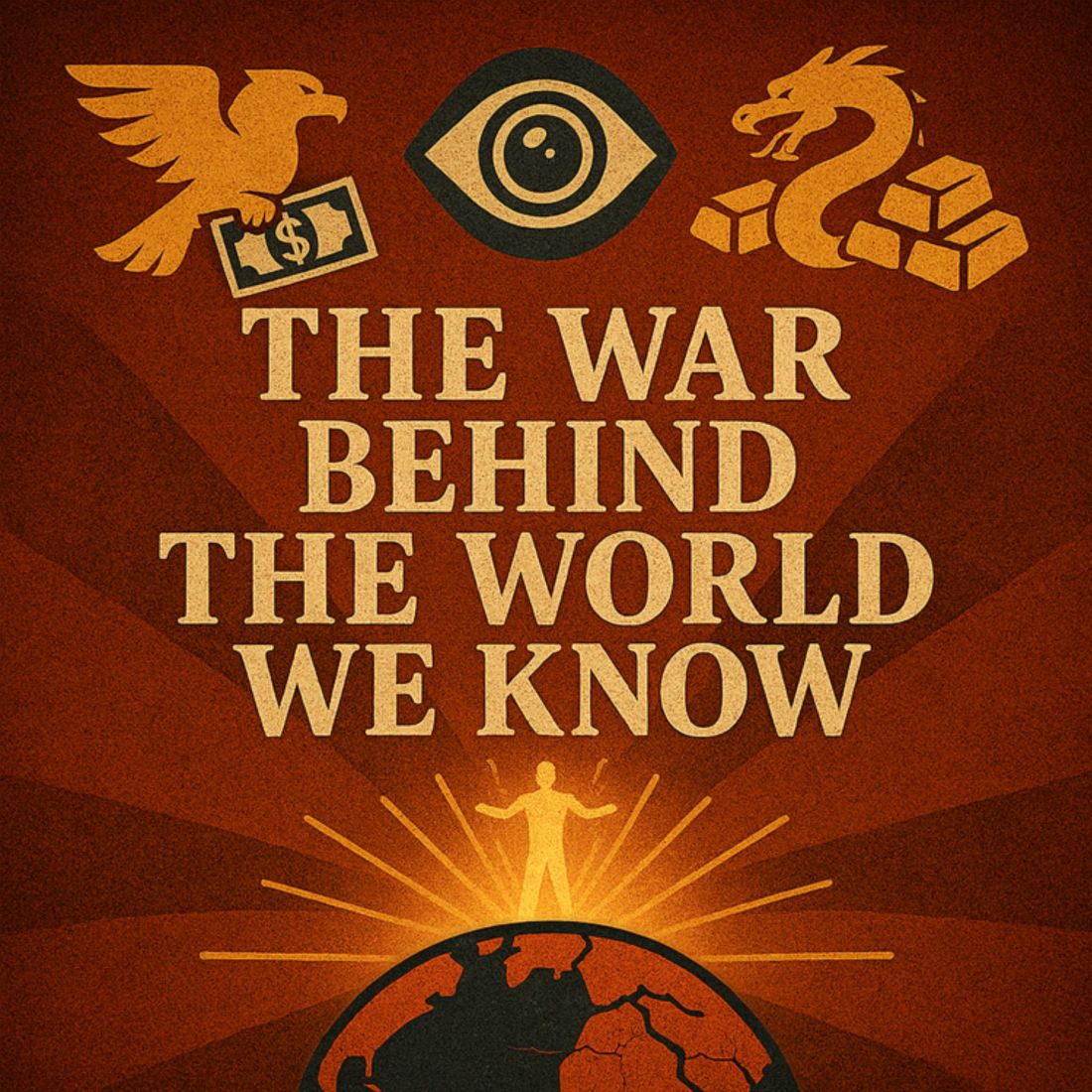
The War Behind the World We Know

The Three World Orders and the Coming Choice: How Venezuela, Iran, and a Fractured Global System Are Forcing Humanity Toward a Crossroads

Introduction: The Moment the Hidden Becomes Visible

Every era has a moment when the tensions that once simmered quietly beneath the surface suddenly break into the open.

For years, the world has been drifting toward such a moment – a slow, grinding collision between what are now three competing visions of global power.

Today, the events unfolding in Venezuela, the rising turbulence in Iran, and the escalating confrontation between the United States, Europe, and the BRICS nations suggest that the long‑brewing conflict may be about to erupt into something undeniable.

But this is not simply geopolitics. It is not just another chapter in the endless struggle between nations.

It is the beginning of a profound reckoning with the systems that govern our lives – systems built on money, control, and the belief that human beings exist to serve the machinery of power.

The world is approaching a crossroads where we may soon be forced to choose between a future defined by money and a future defined by people. And the chaos now emerging may be the catalyst that makes that choice unavoidable.

1. What We Think War Is – and What War Has Become

Most people still imagine war as something unmistakable: tanks crossing borders, cities burning, soldiers in trenches, and the kind of devastation that defined the two World Wars.

If not that, then the spectre of nuclear exchange – a few catastrophic decisions by powerful men who should know better.

But the world rarely repeats its past so neatly.

The turmoil now engulfing the UK, the US, Europe, and much of the world does not resemble the wars we were taught to recognise. It does not look like the wars in our history books. It does not feel like the wars our grandparents described.

And so we tell ourselves that we are not at war.

But we are.

We are in a war that:

• does not require armies,

• does not rely on bombs,

• and does not announce itself with declarations.

It is a war fought through currencies, sanctions, supply chains, digital systems, and the quiet rewriting of laws that reshape society without consent.

It is a war over who controls the world’s money, who defines the rules of global trade, and who gets to shape the future.

This is not a hot war.

It is not a cold war.

It is a systemic war – a war of structures, narratives, and economic weapons.

And the tragedy is that most people don’t see it, because we’ve been conditioned to believe war only counts when the bombs fall.

2. The Three World Orders Now Colliding

For years, competing visions of global power have been circling each other like predators. Each believes it will inherit the world. Each believes it is the rightful architect of the future.

Today, there are three:

A. Trump’s America: A Nationalist, Transactional Order

This world order is built on:

• tariffs,

• leverage,

• economic pressure,

• and the reassertion of US dominance.

It is a world where the dollar remains king – or dies trying.

A world where alliances are transactional, not ideological.

A world where power is measured in deals, not treaties.

B. The EU/WEF Technocratic Order

This vision is not nationalist but supranational.

It imagines:

• digital currencies,

• centralised governance,

• “managed democracy”,

• and a world run by global institutions rather than nation states.

It is a world where crises justify permanent oversight.

A world where stability is engineered, not chosen.

A world where freedom is redefined as compliance.

C. The BRICS Alternative

Led by Russia and China, this order is built on:

• gold reserves,

• commodity power,

• and the promise of a post‑Western financial system.

It is a world where the West no longer sets the rules.

A world where the dollar is dethroned.

A world where economic power shifts eastward.

These three systems are not merely competing.

They are colliding.

And the crises in Venezuela and Iran may be the sparks that ignite the confrontation they have been preparing for.

3. Venezuela, Iran, and the Fracture Point of a Global System

Venezuela: The Resource Flashpoint

Venezuela is not just a country in crisis. It is a nation sitting on some of the world’s largest oil reserves – a resource that all three world orders desperately need to control or deny to their rivals.

US intervention there is not simply humanitarian.

It is strategic.

It is economic.

It is systemic.

Iran: The Geopolitical Fuse

Iran is the crossroads of:

• energy routes,

• regional power,

• and global alliances.

Turbulence there threatens to destabilise not just the Middle East but the entire global economic system.

It forces the US, Europe, and BRICS into positions they can no longer hide behind diplomacy.

Together, Venezuela and Iran expose the truth:

the world’s systems are no longer stable enough to absorb shocks.

The fractures are widening.

The masks are slipping.

The stakes are rising.

4. The War for Money – and the Illusion That Money Is Real

The uncomfortable truth is that the world’s economic system has already collapsed in everything but name.

Western governments borrow money that doesn’t exist, from institutions that don’t create value, to sustain systems that no longer function.

The BRICS nations know this.

The EU knows this.

Trump knows this.

The fight is not about ideology.

It is about who controls the reset.

Gold, dollars, digital currencies – none of these have intrinsic value. They only work because we believe in them. And belief is collapsing.

When belief collapses, systems collapse.

When systems collapse, power grabs begin.

When power grabs begin, wars – of one kind or another – follow.

5. The Elites Are Fighting for Control. The People Are Fighting for Survival.

Whether the reset is driven by:

• Trump’s America,

• the EU/WEF bloc, or

• the BRICS alliance,

the outcome for ordinary people is the same:

none of these systems are designed with us in mind.

Every one of them is built on coercion, hierarchy, and the assumption that human beings exist to serve the system – not the other way around.

But humanity is exhausted.

Exhausted by selfishness.

Exhausted by elites who dress up control as progress.

Exhausted by being told that the only value we have is economic.

The coming clash may finally force a choice that has been avoided for generations.

6. A World Built on Money – or a World Built on People

The future does not have to belong to any of the three world orders now circling each other.

A different future is possible.

One built on:

• fairness,

• balance,

• justice,

• local sovereignty,

• genuine productivity,

• and the recognition that human beings are not economic units but living, thinking, feeling people.

A future where systems serve humanity, not the other way around.

But that future will not emerge by accident.

It will only emerge when enough people recognise that the war we are in is not between nations, but between worldviews.

One worldview says money is the measure of all things.

The other says people are.

And the chaos now unfolding may be the moment when the world is finally forced to choose.

Further Reading:

1. The Mechanics and Triggers of Systemic Collapse

These works explain why the current global order is fracturing and what might trigger a reset.

2. Competing World Orders and the Global Reset

These works focus on the power struggle between the US, EU/WEF, and BRICS, and the tools (like currency and governance) they use.

3. The Human Cost and the Search for Alternatives

These readings shift the focus from systems and elites to ordinary people and possible new directions.

4. Building a People-Centred Future

For those interested in solutions and new models, these articles offer practical ideas and frameworks.

There’s No Fast Track to Awakening

The path only opens when you walk it

In a world overflowing with spiritual labels, quick fixes, and people promising to “unlock” something inside you for the price of a subscription, it’s easy to forget a simple truth: awakening isn’t a shortcut, a status, or a badge you can buy. It’s a lived experience. A slow, uncomfortable, deeply human process that no amount of branding or belief can replace.

We’re all walking the same ground, equal in our confusion and our potential, and the only thing that separates one person’s path from another is the willingness to actually do the work.

This is about that work – and why there’s no fast track to awakening.

Between Shadows and Sun: The Honest Path to Awakening

Turbulent and troubling times – whether in our collective world or in the quiet corners of our personal lives – have a way of pushing us toward a search for meaning.

That search is natural, even necessary. But it can also become a two‑edged sword when desperation takes over and we slip into the mindset of “any port in a storm.”

In those moments, we’re not really seeking truth; we’re seeking relief. And relief, unfortunately, is the easiest thing in the world to sell.

Historically, “finding God” or returning to church was the familiar response to crisis. Today, the landscape is far more crowded. The options available to anyone “searching” have multiplied beyond recognition.

You can find new age speakers, astrologers, tarot readers, channellers, intuitives, mystics, and self‑proclaimed gurus online with the same ease you’d find a recipe for dinner.

The 21st century has thrown the doors wide open to unconventional thinking, and what began with the Mind, Body & Spirit shelves in bookshops around the millennium has now grown into a sprawling industry – an entire marketplace of spiritual identities, disciplines, and promises, each one ready to catch the eye of someone navigating rough waters.

As with anything in today’s world, there is good and bad in all of this. If you can apply critical thinking – real discernment – to the process of watching, listening, and exploring this spiritual smorgasbord, then a few false starts under the banner of “buyer beware” won’t derail you. They may even help.

But the challenge is that spirituality means very different things to different people, and that’s where the waters get muddied fast.

There’s a big difference between what works, what we think works, and what we desperately want to work.

A journey of personal discovery is, in itself, a good place for anyone to be. The path of self‑exploration – though often painful as we confront the realities that shape our personal truth – almost always leads to greater self‑awareness and a healthier understanding of who we are. And knowing who we are is the foundation for understanding who other people are – not in the superficial sense of personality, but in the deeper sense of recognising the processes, wounds, and experiences that make them who they are.

When it comes to having healthy relationships and a grounded view of the world, that’s not a bad place to start.

But like everything that becomes commercialised, spirituality has attracted its fair share of charlatans and false prophets. Social media has made them easy to find. They often have a very attractive bridge to sell – one that promises to make you different, better, more special, more righteous, more deserving. And all you have to do is commit, sign up, subscribe, or step aboard. It’s a seductive offer, especially when you’re hurting. But it’s also a distraction from the real work.

Starseeds, lightworkers, shamans, mystics – these labels may or may not have value in certain contexts. The problem isn’t the words themselves. It’s the way they’re used.

Many of today’s disciples of YouTube spirituality haven’t yet grasped the simple truth that whatever path you take – ancient, modern, religious, esoteric, or entirely your own – it all requires work.

And ironically, the work required isn’t the work many of these speakers are selling.

The work that no genuinely spiritual person can avoid is the ongoing effort to be the best, most human version of yourself in the form you currently occupy.

That means humility. That means responsibility. That means compassion. That means learning to forgive – not as a performance, not as a spiritual badge, but as a lived practice that dissolves ego and equalises your relationship with the world.

There is no easy route to redemption, no shortcut to “not coming back,” no spiritual identity that exempts you from the human experience.

You cannot bypass the messy, uncomfortable, deeply ordinary work of being a person.

You cannot escape the world without first giving back to it – fully, honestly, and without expectation.

Spirituality is not an exit strategy. It’s an invitation to participate more deeply.

Those who join a religion, sign up to a spiritual club, or adopt a label because it makes them feel superior or separate from others are missing the point entirely. They’re wasting time, energy, and often money. Because the cheapest, most direct, most effective way to get your life together and become the best spiritual version of yourself is to look inward and work with everything you already carry.

And here’s the part many people don’t want to hear: everyone is equal in this process. Everyone is the same, whether or not they understand who they really are.

No label changes that. No identity elevates you above anyone else. The only thing that matters – truly matters – is how you live, how you treat others, and how deeply you’re willing to face yourself.

Call yourself whatever you like. But unless you live it, you won’t be it.

A Deep‑Dive Guide to The Philosophy of a People First Society

1. How does this philosophy redefine the concept of “human nature”?

Traditional economic and political systems assume humans are primarily self‑interested, competitive, and motivated by scarcity.

This philosophy rejects that framing as a structural artefact, not a biological truth.

It argues that what we call “human nature” is largely a reflection of the systems we live within.

Change the environment → change the behaviour → change the outcomes.

In this view, human nature is:

  • relational
  • adaptive
  • cooperative under conditions of security
  • meaning‑seeking
  • contribution‑driven

This is a foundational departure from neoliberal and classical economic assumptions.

2. Why is security considered the precondition for contribution?

Because fear distorts behaviour.

A person in survival mode cannot:

  • think long‑term
  • act ethically
  • participate meaningfully
  • contribute creatively
  • engage in community life

The Basic Living Standard is therefore not a welfare mechanism – it is a psychological and structural prerequisite for a functioning society.

Security → stability → contribution → community → resilience.

3. How does this philosophy reinterpret the purpose of work?

Work is not a commodity.

Work is not a transaction.

Work is not a mechanism for survival.

Work is participation in the life of the community.

This reframing dissolves the coercive relationship between employer and employee and replaces it with a contribution‑based model where:

  • people work because they are part of a community
  • work is meaningful
  • contribution is voluntary but natural
  • survival is not conditional on employment

This is a profound shift from the industrial and neoliberal worldview.

4. Why is locality the “natural scale” of human systems?

Because human beings evolved in small, relational groups where:

  • accountability was direct
  • decisions were transparent
  • consequences were visible
  • relationships were personal

Large, centralised systems create:

  • abstraction
  • detachment
  • bureaucratic distance
  • moral disengagement
  • power concentration

Locality restores the natural feedback loops that keep systems ethical and functional.

5. How does this philosophy challenge the concept of economic growth?

It argues that growth is not a measure of wellbeing – it is a measure of throughput.

GDP increases when:

  • people get sick
  • disasters occur
  • housing becomes unaffordable
  • debt expands
  • consumption accelerates

Growth is therefore not neutral – it rewards harm.

A People First Society replaces growth with:

  • resilience
  • sufficiency
  • regeneration
  • wellbeing
  • contribution
  • community health

This is a paradigm shift from extractive economics to human‑centred economics.

6. What is the philosophical justification for limiting property ownership?

Property accumulation creates power accumulation.

Power accumulation creates inequality.

Inequality creates dependency and coercion.

The philosophy argues that no person has the moral right to own more than they can use, because unused property becomes a mechanism of control over others.

Housing is therefore a right, not a commodity.

This is not ideological – it is structural ethics.

7. How does this philosophy understand value?

Value is not price.

Value is not profit.

Value is not scarcity.

Value is defined as:

anything that improves the wellbeing, freedom, dignity, or resilience of people, communities, or the environment.

This reframing collapses the entire logic of the money‑centric worldview.

8. Why does the philosophy reject interest, speculation, and financialisation?

Because they allow people to accumulate wealth without contributing anything of value.

Interest and speculation:

  • extract value without creating it
  • distort prices
  • create artificial scarcity
  • concentrate power
  • destabilise communities
  • reward non‑contribution

A People First Society requires that value only flows from contribution, not from ownership or manipulation.

9. How does this philosophy view governance?

Governance is not authority.
Governance is not hierarchy.
Governance is not control.

Governance is collective decision‑making about shared life.

The Circumpunct model reflects this:

  • no permanent power
  • no hierarchy
  • no distance between decision and consequence
  • leadership as service, not status
  • transparency as a moral requirement

This is governance as participation, not governance as rule.

10. What role does The Revaluation play in the transition?

The Revaluation is the psychological and cultural pivot that makes systemic change possible.

It is the moment when people collectively realise:

  • money is not value
  • growth is not progress
  • employment is not contribution
  • hierarchy is not leadership
  • centralisation is not stability
  • scarcity is not natural
  • competition is not inevitable

Without this shift, LEGS would be resisted.

With it, LEGS becomes the obvious next step.

11. How does this philosophy address the problem of power?

By dissolving the mechanisms that create it:

  • property accumulation
  • financial accumulation
  • hierarchical governance
  • centralised decision‑making
  • opaque systems
  • dependency structures

Power is not redistributed – it is deconstructed.

The system is designed so that no individual or organisation can accumulate disproportionate influence.

12. Is this philosophy compatible with modern technology and AI?

Yes – but only under strict conditions:

  • technology must serve human agency
  • AI must never replace essential human roles
  • systems must remain understandable at the human scale
  • digital tools must have non‑digital alternatives
  • local communities must retain control

Technology is a tool, not a trajectory.

13. How does this philosophy define freedom?

Freedom is not the absence of rules.

Freedom is not consumer choice.

Freedom is not individualism.

Freedom is:

the ability to live without fear, contribute without coercion, and participate without exclusion.

This requires:

  • security
  • dignity
  • community
  • transparency
  • meaningful work
  • environmental stability

Freedom is therefore a collective achievement, not an individual possession.

14. What is the ultimate purpose of a People First Society?

To create the conditions in which:

  • every person can live a good life
  • every community can be resilient
  • every environment can regenerate
  • every individual can contribute meaningfully
  • no one is left behind
  • no one is exploited
  • no one is coerced into survival

This is the philosophical north star.

15. What is the biggest misconception about this philosophy?

That it is idealistic.

In reality, the current system is the idealistic one – it assumes:

  • infinite growth
  • infinite resources
  • infinite stability
  • infinite human tolerance for inequality

This philosophy is grounded in lived reality, human psychology, ecological limits, and community logic.

It is not utopian.

It is necessary.

Further Reading:

This “Further Reading” section offers a set of resources that will deepen your understanding of the Local Economy & Governance System (LEGS), the Basic Living Standard, and the broader philosophy of a people-first society.

Each link explores a different facet of the philosophy, from practical implementation to foundational principles. Engaging with these readings will provide you with richer context, practical examples, and a more nuanced grasp of the ideas behind LEGS.

Whether you are new to these concepts or seeking to apply them, these resources will help you connect theory to practice and inspire new ways of thinking about community, governance, and human flourishing.

Ordered List of Further Reading

  1. The Local Economy & Governance System (LEGS) – Online Text
    https://adamtugwell.blog/2025/11/21/the-local-economy-governance-system-online-text/

Summary:

This foundational text introduces the LEGS framework in detail, explaining how local economies and governance can be structured to prioritise human dignity, participation, and sustainability. It’s ideal for readers seeking a comprehensive overview of the system’s mechanics and philosophical underpinnings.

Benefit:

Start here for a solid grounding in the core ideas and practical structure of LEGS.

  1. The Basic Living Standard Explained
    https://adamtugwell.blog/2025/10/24/the-basic-living-standard-explained/

Summary:

This article breaks down the concept of the Basic Living Standard, clarifying what it means in practice and why it is central to a people-first society. It addresses common questions and misconceptions, making it accessible for those new to the idea.

Benefit:

Read this to understand the practical implications and necessity of guaranteeing basic security for all.

  1. The Basic Living Standard: Freedom to Think, Freedom to Do, Freedom to Be – With Personal Sovereignty That Brings Peace to All
    https://adamtugwell.blog/2025/12/15/the-basic-living-standard-freedom-to-think-freedom-to-do-freedom-to-be-with-personal-sovereignty-that-brings-peace-to-all/

Summary:

This piece explores the philosophical and ethical dimensions of the Basic Living Standard, linking it to personal sovereignty and collective peace. It’s a reflective essay that connects individual freedom with societal wellbeing.

Benefit:

Recommended for readers interested in the deeper values and ethical commitments behind the LEGS philosophy.

  1. From Principle to Practice: Bringing the Local Economy & Governance System to Life (Full Text)
    https://adamtugwell.blog/2025/12/27/from-principle-to-practice-bringing-the-local-economy-governance-system-to-life-full-text/

Summary:

This resource provides practical guidance and real-world examples of how to implement the LEGS philosophy. It bridges the gap between theory and action, offering insights for communities and individuals ready to make change.

Benefit:

Essential for those looking to move from understanding to action, with concrete steps and inspiration for local transformation.

  1. Visit the LEGS Ecosystem
    https://adamtugwell.blog/2025/12/31/visit-the-legs-ecosystem/

Summary:

This link offers an overview of the broader LEGS ecosystem, showcasing projects, communities, and ongoing initiatives. It’s a gateway to seeing the philosophy in action and connecting with others on the same journey.

Benefit:

Explore this to find community, resources, and inspiration for your own involvement in the LEGS movement.

An Overview of A People First Society

What is a People First Society?

A People First Society is one where people, community, and the environment come before money and profit.

It’s about making sure everyone has what they need to live well — and that everyone can contribute to the wellbeing of the whole.

Why does this matter?

Because too many people today are:

  • struggling to afford the basics
  • stressed, insecure, or isolated
  • working hard but still falling behind
  • disconnected from their community
  • living in systems that don’t put them first

A People First Society changes that.

What does this philosophy believe about people?

It starts with a simple truth:
People do best when they feel secure, trusted, and valued.

Most people want to:

  • help
  • contribute
  • belong
  • make a difference

When life isn’t a constant struggle, people naturally step up.

What is the Basic Living Standard?

It’s a guarantee that everyone can afford the essentials of life — food, housing, transport, clothing, communication, and social participation — from a normal week’s work.

No debt.
No welfare dependency.
No fear of falling through the cracks.

Just a fair foundation for everyone.

What is LEGS?

LEGS stands for the Local Economy & Governance System.
It’s a practical way of running communities so that decisions are made locally, transparently, and with everyone involved.

LEGS focuses on:

  • local food
  • local services
  • local decision‑making
  • local businesses that serve the community
  • local resilience and sustainability

It’s about bringing life back to the local level.

What is The Revaluation?

The Revaluation is the shift from seeing life through the lens of money to seeing it through the lens of people.

It’s a change in mindset:

  • from scarcity to security
  • from competition to contribution
  • from hierarchy to participation
  • from profit to wellbeing

It’s the moment we realise life can be organised differently – and better.

Is this anti‑business?

No.
It supports businesses that:

  • meet real needs
  • treat people fairly
  • protect the environment
  • strengthen the community

It only challenges businesses that exploit people or extract wealth without giving anything back.

Why is local decision‑making so important?

Because people understand their own community better than distant institutions do.

Local decision‑making means:

  • more accountability
  • more transparency
  • quicker solutions
  • stronger communities
  • decisions that actually make sense

It brings power back to the people it affects.

What does this philosophy say about the environment?

The environment isn’t a resource to use up – it’s the foundation of life.
A People First Society protects and regenerates the land, water, and ecosystems we depend on.

Healthy communities need a healthy environment.

What does “freedom” mean in a People First Society?

Freedom means being able to live without fear, contribute without pressure, and participate without barriers.

Real freedom requires:

  • security
  • dignity
  • opportunity
  • community
  • a healthy environment

Freedom is something we build together.

What’s the goal of all this?

To create a society where:

  • everyone has what they need
  • no one is left behind
  • communities are strong and resilient
  • people can contribute meaningfully
  • the environment is protected
  • life feels fair, connected, and human again

A People First Society is simply a society that works – for everyone.

Want to learn more?

This leaflet is a short introduction.

If you’d like a deeper explanation, more materials, or help sharing this philosophy in your community, just ask.

Further Reading:

  1. The Local Economy & Governance System (LEGS) – Online Text
    https://adamtugwell.blog/2025/11/21/the-local-economy-governance-system-online-text/
  2. The Basic Living Standard Explained
    https://adamtugwell.blog/2025/10/24/the-basic-living-standard-explained/
  3. The Basic Living Standard: Freedom to Think, Freedom to Do, Freedom to Be – With Personal Sovereignty That Brings Peace to All
    https://adamtugwell.blog/2025/12/15/the-basic-living-standard-freedom-to-think-freedom-to-do-freedom-to-be-with-personal-sovereignty-that-brings-peace-to-all/
  4. From Principle to Practice: Bringing the Local Economy & Governance System to Life (Full Text)
    https://adamtugwell.blog/2025/12/27/from-principle-to-practice-bringing-the-local-economy-governance-system-to-life-full-text/
  5. Visit the LEGS Ecosystem
    https://adamtugwell.blog/2025/12/31/visit-the-legs-ecosystem/