And we need a completely new Establishment to run and deliver everything too
Your politics, religion, ideas, background, age, education or anything else that has, can or will be used to divide us, does not matter when it comes to recognising that for every one of us, there are parts of life that simply don’t work in the UK, anymore.
Whether we are being affected and impacted directly, or the problems we recognise are just something happening to other people or different communities that we can somehow see, we all know that things aren’t working as they should. And the horrible truth is that for some of us, nothing is working at all.
We could go down the rabbit hole of trying to identify, apportion blame and then demand that politicians and government change whatever we identify as needing to be changed. Or, that they step aside so that they can be replaced by whoever we believe will do whatever it is that they either cannot or are choosing not to do.
Indeed, many are doing just that, and already expect that all it will take is just a change in government. So that we have ‘the right people’ in charge.
It’s a nice idea and it’s appealing to many of us. Because this pathway also leaves the real work, commitment and doing whatever it will take to enact change, to someone else.
Unfortunately, we’ve been here before. And very recently too.
In fact, many of us genuinely believed that the downward chaos of all the Conservative governments between 2010 and 2014, which was aided and abetted by the Liberal Democrats between 2010 and 2015, would unquestionably be stopped by the election of Keir Starmer and The Labour Party in July 2024. Because Labour was supposedly offering something new and would know what to do, or in any case could never possibly be as bad as what we already had, could they…
It took just a few months to prove the point that the power of our vote can have consequences that are completely out of our control.
Whilst some seem prepared to make the very same mistakes all over again, the reality is that as things stand today, we can no longer trust anything that politicians promise or offer us as part of an election manifesto. Because they are without fail behaving the same as all the politicians we have ever known and will inevitably go on and do whatever they want to do once they hold the power, we trusted them with.
And once they are elected, they will do whatever they want to whilst telling us that it’s in our best interests, knowing there is nothing that we can do about it democratically until the time of the next election comes around, when we will hopefully by then have forgotten whatever they have done which might then be years before.
Whether we voted or not, millions of us made the mistake of electing yet another group of politicians who are out of touch with real life; are motivated by all the wrong things and above all, have no real control over the apparatus of government and the legislative devices that should be at their disposal. Either because they are too frightened; are being very badly advised or misled; are out of their depth and really have no idea what they are doing and what they could do; or a mixture of them all.
This page is not here to make excuses for this government, the Sunak government or indeed any one of many governments before them both that have harboured and given favour to the wrong politicians and what decades of poor, absent and self-serving non-leadership has given us, whilst we are somehow always the ones who are getting everything wrong.
This page is here to make clear that politicians and the political class that we have today, right across the tiers of government in the UK, are just a part of a much bigger problem. And they are the only part of problem that we cannot otherwise see.
If we need a divorce, we go to a lawyer. If we need our car fixed, we go to a mechanic. If we want and extension built, we go to a builder. If we want a load of bread, we go to a baker. If we want a beer we go to a brewer. But for decades, we have gone to the Polling Stations on election day and chosen who we vote for from a list of candidates that only Political Parties have offered up.
Specialist professionals and tradespeople like these that provide goods and services that we genuinely need, learn a very specific craft. And they get better at what they do, because they spend all their working time doing just that.
Yet when it comes to everything to do with government, governance and how every kind of public service and are systems of rules and regulations are managed and designed across the UK, we currently leave strategy, planning and everything important in the hands of a few people who are always there to represent what they Political Party wants first. So-called politicians who cannot possibly know or understand every part of life they are making decisions upon, and certainly don’t have the leadership skills, experience or awareness to listen, consider and then act appropriately on our behalf, only after referencing all the people that they really should be, whilst being sure that they are being impartial and working in the best interests of everyone at all times, too.
Anyone with a platform, the words and a great speaking voice can sound like a leader. But leadership is about the actions that genuine leaders take and in the case of politics, the actions they take when none of us are either looking or able to see what they are doing; where they are doing it and who they are doing it (for or) with.
In other words, to lead any Country properly, it takes integrity, purpose and a commitment to public service before Party or anything else.
The evidence from what we can see today, tells us that no politician or would be leader in the public eye has this purpose, spirit or a level of integrity that we can put our trust in that in power, they will always do the right thing – even when it might require that they step up and do some very difficult and perhaps unpopular things.
We can all see that genuine leadership and integrity don’t exist within UK politics today.
Unfortunately, both have been absent for so long that the whole system has been so corrupted and become self-serving that it must be completely replaced.
The system is so established with the way it works and operates that it continues appearing to function. Whilst the reality is that in whichever direction we turn and begin to look, every part of it is either dysfunctional or going completely wrong.
The illusion of effectiveness is only held in place by the reality that like everyone else, our politicians have fallen into the trap of believing that every problem can be solved with money. And that if politicians have enough public money available to spend, every problem for them can be addressed. No matter the problems their inability to lead and acts of avoidance using that money will and have meant that we and people in every UK community subsequently face as a direct result of their ineptitude and what they have(n’t) done.
This isn’t a problem that can be fixed with politics or politicians who are just about the politics.
Because politics has become all about the politics and who’s in charge of the political process. Rather than being anything to do with results, outcomes or whatever gets done.
Politics is now the biggest distraction of them all when it comes to the change and scale of change that we need. Because the way that elections and the electoral cycle work mean that we really are just going around in circles, whilst everything gets worse, and we keep waiting for the merry go round to come full circle so that the whole problematic rotation can begin all over again.
Being right does not automatically make anyone else wrong; even when you have the loudest voice
The Penny appears to finally be dropping amongst the masses that power does not necessarily mean virtue. And it’s certainly no guaranteed of integrity either.
Meanwhile, for the powerful, reality is also now dawning that position, influence and how loud they may be in public (or how many people hear them) doesn’t mean that they can do anything they want and that the power they seem to have will automatically make anything they do right.
The problem is, belief that position and being seen to have won the argument, got the result or controlled the narrative – often with words, deeds and actions that are morally apprehensible when it comes to political power, have not only convinced the political classes that ‘do as I say, not as I do’ is baked in.
Politicians really have reached the point where they believe they are right, no matter the consequences or real human cost from whatever they do or what they say.
All because they are the ones deciding what’s right and what’s wrong.
Wrong things shape our beliefs and make them feel right
It’s not only a problem that public policy that isn’t really about the public at all is damaging lives, people, communities, the environment around us and the businesses that we need to survive and thrive.
The fact that sanitised but nonetheless tyrannical behaviour is coming at us constantly through every channel and digital stream that most of us regrettably consider to be credible sources, mean that many people are becoming conditioned with the belief that behaviour that is reflective of what our so-called leaders are doing is not only correct, but good for one and all.
The Dehumanisation of Life through remote-controlled Techno-Tyranny
Regrettably, there is an urgent need for us all to recognise that the dehumanised way of life that is progressively taking over with each and every step taken towards the Tech and AI Takeover, where it seems that every need possible can be met through the tap of a finger on our phones, is feeding into the nightmarish version of an increasingly dystopian life and living environment for us all.
It’s sucking up lies from each direction, whilst simultaneously convincing us that we still have freedom and choice.
We’ve lost sight of the very principles and values that equip us to function, communicate and interact with other human beings face-to-face. All within a rapid, dehumanising transformation process, that is currently succeeding in convincing otherwise very sensible people that the only guides and directives necessary for a successful life come from a smart phone or online.
What is more, the whole process has already began removing and questioning ‘common sense’, taking everything in life backwards.
We find grown adults fighting over whether the basic tenets of life are either wrong, right, open to interpretation or that taking what should be obvious as read and thereby offending somebody over what only they might ever believe is itself enough to justify ruining the other persons life.
We are the sum of our experiences
It really doesn’t matter who we are. One thing that we can almost certainly be sure that we have in common, is that if you or I were to stop and reflect upon our current view of the world; what everything means and how we see it; we would both be right.
We would both be right, because as individuals that’s what all the experiences up until this moment have taught every one of us. Even when our experiences may have been harmful to us, been incorrect (because of what others have done) or because for whatever reason, they are basically skewed.
Experience is cumulative too. Whilst none of us may wish to admit that the understanding we have of anything can only be as much as layer-deep, or that we have only reached a certain level of knowledge about anything; such limitation of understanding can therefore mean that what we believe to be right isn’t completely right.
It can certainly be very disconcerting to reckon with the reality that reaching GCSE, then A-level, then degree level, then masters level, then doctorate level in the same very specific subject may well mean that whilst we may have a very good and correct subjective view; in objective terms, even then, as an ‘expert’ or with even a recognised level of qualification, we are still a very long way from getting it right.
Misplaced confidence based on our beliefs being ‘who we are’, when our beliefs come from those who influence us
Recognising the value that we give to others when they have been awarded academic qualifications is one thing.
Then there is also the phenomena which is the way that we give credibility to others simply because they have a role (like politicians or public officers) and most alarming today, to influencers (which can mean many things), based on nothing more than the reality that they have a platform of some kind, where the number of people watching, following, liking or subscribing gives them credibility that reaches beyond all other things.
Oddly, when anyone speaking or even writing doesn’t appear to have one or more of these status anchors, we seem to consider whatever they are sharing to not have the same legitimacy. No matter the content of what they say. And if what they say contradicts our own message and belief system in some way, there is all too often the chance that we will simply assume that whatever they offer has no value and that they are therefore ‘wrong’.
Misplaced confidence based on our beliefs being ‘who we are’, when our beliefs come from the establishment, religion and the shibboleths they impose
Perhaps more difficult to consider and accept is the role and influence that what we might otherwise call cultural or societal norms have on our beliefs and therefore behaviour. Because we can all too easily believe that these are just the things that ‘normal’ people do.
How we behave in public. How we consider some behaviour and actions to be acceptable whilst others are not. How we consider right and wrong. How we look up or look down upon others – in ways that would be called prejudices in any other terms. Increasingly how we stop and question actions and behaviours that we had previously not given a second thought to because we considered them to be normal, but now we stop and feel guilty because we thought them.
These are all based upon the belief systems that are set, adapted and increasingly forced into our lives by the organisations that we recognise as being the establishment. And for some more than others, from our religions which can become the most important source or framework for our behaviours and what we expect for ourselves and from others across our lives.
Whilst we must recognise that some of the rules and social codes that have come from our system of governance and our religions can be very good for us and for everyone in very specific contexts, we also need to understand, accept and therefore recognise that many of the rules and social cues that we live by were or have been created as forms of social control.
They have been created and are used to foster and promote fear of something that is apparently outside of our control, so that what we do have control over can in turn then be restricted and therefore controlled by someone else.
For instance, there is no need to question the existence of a God, Source, universal force or whatever we may each choose to call the focus of what we might ultimately believe in, to recognise that words and interpretations can change each time they are passed on.
We must recognise that ultimately, to further the scope, reach, influence and power of religions, the people who benefit from being in control of those religions have created compelling stories and interpretations of those stories and what they may or may not require of us. All based upon material that has itself been passed on potentially many times, each time by another person who was never actually there at the time whenever the chain of these stories first began or could be witnessed firsthand.
Genuine, voluntary and uncoerced faith in the system and faith in a religion can be the same or should be the same. In that they are most powerful, most compelling and most beneficial to us and to others, when they are left to us all to recognise what we believe to be true and in turn to then apply our understanding of everything in terms of what we know to be wrong or to be right.
There is no system in existence that seeks to control or compel others coercively that is also unquestionably right or correct
Doing anything because someone with authority or because a book says so isn’t voluntary belief or choice.
It is dogmatic servitude that excuses itself by insisting that slavish adherence to whatever it teaches, automatically makes it right – even when it is very clearly wrong.
We are indeed fortunate that what we might call the societal operating system of British Culture is based upon the secularisation that the evolution of a Christian system has allowed to develop, that was itself probably only possible because of The Reformation and the otherwise questionable parts of the reign of King Henry VIII.
However, the freedom of thought and expression that becoming unshackled from the Church has ultimately brought has also made us massively vulnerable to anyone who understands how narratives, group thinking and the tools that media offers can be used to introduce and make us subservient to contrary systems of belief.
Indeed, alien beliefs that run contrary that everything our society has been built on have been progressively introduced and are reshaping societal beliefs, leading to people questioning their own common sense, whilst others simply accept philosophies and agendas that are ultimately not offering anything that is good for anyone and least of all you or me.
Fear is today being used to disproportionately exaggerate societal problems, in ways that have created the risk that those problems may quickly become even bigger problems that we would never otherwise have experienced.
Whilst learning to stop, count to ten and then think about what is being said, who is saying it, why they are saying it and what is really happening would help every one of us to uncover the truths that are good for us all to believe.
Finding and creating beliefs that we can trust
There exists no person, no government, no establishment and no religion that has the right to insist that either you or I believe whatever they say or require of us, without question.
Such expectation is an abuse of the rights of whoever they are victimising or making a victim of. Whether that victim is aware or sees their relationship as being that of a victim under an oppressor or not.
This is not a question of those with responsibility hiding information from those under their care that would otherwise be harmful to them.
This is about those with responsibility for others abusing the trust that others have given and that has been assumed from anyone who is vulnerable and then either ignorantly or deliberately misusing that trust to abuse they very people they are there to protect from such abuse.
We are in troubling times
Regrettably, few institutions now exist where integrity can be assured from the actions, behaviour and decisions from anyone that we don’t personally know and have no good reason to belief that they are and always will be as good as their word.
The digitisation and mission creep of the online world has exacerbated this greatly and made the overall process of dehumanising everything progressively worse.
The reality we must face is that if we want to own our own beliefs and develop them using reliable and trustworthy sources, we can and must only use face-to-face relationships and the benefits of the social interactions that remain open and available to us without accessing anything that is only available to us online.
The only relationship that matters is the one that’s right in front of us
For all the benefits that we may be able to agree upon, the latest forms of digital technology and artificial intelligence are also introducing a much bigger and malevolent dark side into the world as we know it.
Almost every system that has and is being introduced into daily life for you and me, is either already or soon will be used as a tool of control.
And these tools can and only will work as effectively as they do, because we believe that what they bring or give to us is good for us in ways that make us forget or overlook the freedoms they have replaced and ultimately the non-financial price that we pay.
Yes, AI for medicine, AI for diagnostics, AI for workplace safety and purposes like these are and will always be good uses. Especially so when they are not about profit but about improving life and therefore the common good.
But AI in any form that appears to make life easier, quicker, or that replaces the need for us or any person to do anything are not and will not be good for anyone other than those who profit from it.
The AI and Tech-takeover really doesn’t offer the whole of humanity anything that any of us need in day-to-day life. But it is set to take away a massive amount from us that we do.
Of all the beliefs that we have been conditioned to have, the belief that whatever is outside of us is better than us and that it reduces our value in any way, is the worst one possible for any of us to have.
When we interact properly with others and use all of the senses and skills that we have to communicate and to read, listen to and understand communication in the circumstances that can and only will ever be offered through real one-to-ones, we will soon begin to remember or realise that these are some of the very best sources of learning – and therefore belief development that any of us could ever have.
Once you become a number, it won’t matter what you believe
Relationships – that’s real relationships, with real people, in real life, really matter.
Once all those relationships have been lost and we no longer have the ability to interact normally beyond familial or friend-based relationships in person and everything else is done without people with names online, our opinions, what makes us happy, what makes us healthy and what is actually good for us will no longer matter. Because the humanity in relationships and therefore the values that make us human will have successfully been cast aside.
The most concerning aspect of the process and steps that are now taking us towards this destination is just how quick and therefore soon we will arrive there.
Whilst most of us still don’t even question what we have unknowingly given up and that has been taken from us, because we have accepted the belief that what has been given to us or that we have often actually paid money for has been good or even better for us in some way.
Thinking for yourself isn’t about being right. It’s all about thinking the right way
Whilst we may not have used this term here until now, critical thinking is the key for all of us to unlocking the door to the pathway that leads to understanding what everything in life is all about.
Critical thinking isn’t just the magical formula that gives us back the power to define our own belief system.
Critical thinking is the golden gift that enables us to recognise and understand the value of all the experiences that have made us and therefore to self-define who we are, and who we will be.
A certain truth that we would all benefit from learning, understanding and living is that none of us are right or will be right until the time that we recognise we are all right and that being right is just the next step in learning what else is right, until we all agree that right is exactly the same thing.
Talking about and thinking about narratives isn’t just important today. It’s essential if you are to arm yourself with the truth and ultimately stand any chance of not being driven completely mad.
Unfortunately, the reasons that make critical thinking necessary, as we absorb and digest any of the information that constantly flows towards us, usually through the digital devices that we carry, are not just as simple as working out the credibility of sources, identifying the truth, or filtering out the rampant levels of views and opinion which have regrettably become the bigger part of the content of all news.
It is increasingly necessary to identify where names and the nomenclature or branding of ideas, approaches, systems and even recognisable activities have been deliberately changed with the intention to confuse. Usually to create the misleading idea, in our minds, that somebody is doing something or selling something to us that is completely new or specialised beyond our comprehension. Just so that they can gain advantage over us until such time as we have worked it all out.
Regrettably, the establishment – that’s government, the public sector and all the big businesses and money organisations that are actually running things – has reached the point where they change the names of everything, either to make more money or benefit themselves, or increasingly to give the impression they have stopped or moved away from doing anything that has been publicly outed as being wrong. But for whatever reason that’s important to them, they intend to keep on doing it anyway and believe they need to nothing more to cover it up than change the name.
The more things change, the more they stay the same
Whilst it would be foolish not to acknowledge the power for good that some forms of digital technology and artificial intelligence have – in the right hands and when being used for the right reasons, the way that so many of us have taken the coming technical or AI revolution as read, and seem to have just accepted that many will no longer have jobs as a result, does illustrate the danger that we have become to both ourselves and to our own future. All because we don’t ask questions and simply accept whatever we are being told to believe – usually because it’s come from the voice of someone remote who we don’t even know!
The rather inconvenient truth that all those creating new terminology for whatever they control, are trying to control or attempting to regain control of; is that there isn’t much going on that’s genuinely new, as we consider life in the aspect of 360 degrees around us.
It is just made to look and feel that way.
Indeed, most of us would quickly grasp this, if we were to refuse to just accept the sales pitch and ask what they are selling us, what it will do and how it works.
This approach is applicable to method as well as to machine.
We would all be wise to take time to consider everything that touches our lives in some way, in terms of the pathways that bring it to us, how it works, who benefits and why those interests have brought them to us as and when they have.
Some would say ‘Oh it’s obvious!’
But is it really? And has it ever been?
Magic only works on us, when we don’t understand whatever is happening
Sadly, many of us are all too happy to accept the premise that what we don’t know can’t hurt us.
We accept that names, memes, keywords, industry terms and abbreviations mean that whoever is using them knows things that we do not. Usually making those people more knowledgeable and therefore powerful than we are, with a somewhat strange accompanying surrender to the misplaced idea that we should simply shut up.
Exploding the very dangerous myth about people who are considered to be experts and specialists, often in ways that are taken to mean they have universal understanding of everything, when they most often have been doing just one job; have studied more about the subject than us, and have been given a qualification by someone else who is actually just like them, is now becoming essential.
Not just to stop ourselves from being played like complete fools. But because the idiocy and self-aggrandisement that blankets so many of the people in positions of power, influence, control and that we therefore revere, are hiding behind the façade of terms we don’t understand, just to benefit themselves whilst all the time creating a very unhappy and unhealthy world that for us, that is never really going to work in our favour for as long as people like this have influence and control.
Dishonesty is regrettably rampant throughout everything that the establishment now does. Not necessarily because everyone within the establishment is dishonest. But because the way that normal people like you and I are being exploited, manipulated and used, so that those doing these things can benefit in some way, is simply now accepted as being the ‘normal’ way things work and therefore as being the done thing, for everyone.
Using and abusing others at any level is not ok. And as we find ourselves transiting a tumultuous period of inevitable change, one of the things that we should all be striving for to experience in whatever new world awaits us on the other side, is that lying, manipulation and the abuse of any person for any reason by another, just so that the abuser can become advantaged in some way, should be outlawed and treated as the horrible crime that it really is.
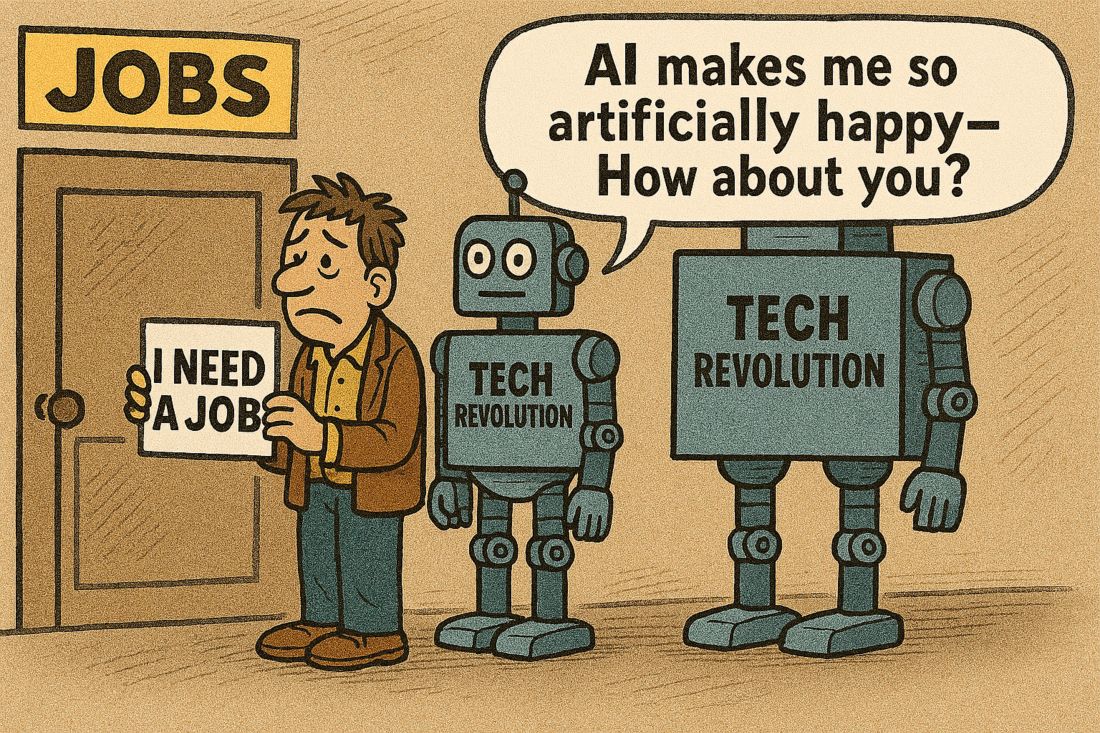
Everyone’s ability to work and be financially secure is vital to humanity, whereas accepting an unnecessary AI and Tech-Takeover that nobody genuinely needs will ultimately only benefit the few
The narrative now dictating to us that the Tech and AI Takeover is inevitable is tiring. Not least of all, because the whole idea that progress can and will only go one way is a myth.
Indeed, the myth that the AI and Tech Takeover is now inevitable serves only those who stand to benefit from everything being pushed this one, very specific and wholly unnecessary way.
Granted, many of us do feel that once technology has arrived and it is in our lives, there is no choice but to accept whatever the implications and outcomes of its arrival might be. Even when for increasing numbers of us it is beginning to become frighteningly clear that we and everything that we know may be about to be affected in some disastrous, life-changing way.
However, you may want to ask yourself, ‘Is this tech takeover, and what is going to change a voluntary choice that I am making?’
Did you consciously agree with the direction everything that touches your life digitally is now going?
Did you agree to changes that may quickly lead to you or people you know having no work or hope of ever getting another job?
Did you knowingly allow the parallel, digital universe and the role of arbitrary judgements about you and everything you are, do or can be, to walk in and begin the process of taking over each and every part of your life through the clever use of man-made codes which have been called algorithms?
So many of us fall into the trap of going along with the idea that jobs we know of today will no longer be required or even exist within perhaps just a matter of months because we are told that it represents progress and that the changes that the introduction of new AI-based technologies across life will be better for us all.
But when the narratives and words of politicians, tech gurus and influencers say all or everyone, just exactly who are they really referring to?
Are you going to benefit and in what way?
Are those benefits real, or are they just distractions that appear to make the very small and seemingly meaningless things that we do every day much easier?
Are those benefits really meaningful and long-lasting, or do they cover up how the small wins everything outside of us tells us we need actually covering up the real, long-term losses in our lives that unless we quickly wake up, we will never be able to replace?
Regrettably, few of us are even thinking about the impact and consequences of the changes that we have accepted for the simple reason that everything we have seen and experienced so far, whether it’s the way we shop, are able to access so much through apps or online, or are able to access whatever we believe we want in mere moments online, leaves us with the idea that AI and anything related to digital tech can and will only ever be good for us.
But what was wrong with the way things were two years ago; five years ago, or ten years ago, where the tech that we had in our lives or that we had access to was concerned?
Didn’t life work just as well, and perhaps in some ways that may seem unrelated even better then?
Have computers, smartphones and digital tech really benefitted our lives in the ways that we are led to believe? Or have they actually disadvantaged us and changed our lives in ways that make us very unhappy and create what for some are unmentionable problems, in so many other ways?
Technology and technological improvement or progress is a phenomenon that we must begin looking at in relation to ourselves, the people we care about and those who we have real face to face contact with, regularly within our communities; You know – people living in the real world that is OFFLINE!
Do we actually need a world where we and those people around us do not have jobs and cannot work, because a machine or different software systems can now do all the things that every person does at work, or once did?
Do those people who don’t have jobs really benefit from no longer having work?
Is the best use of AI and new technology to replace us? Or the best use of AI and new technology to assist us?
Surely there can be no doubt that the world around us would be a much better place to live and experience if everyone who can work, does work; and that in return for doing a full weeks work, they in turn receive enough money or remuneration of whatever kind to ensure that they can cover the cost or be able to secure all the basic essentials that give them independence, rather than a situation now evolving where the masses look like they are soon to be left behind.
Where is the drive really coming from for jobs to be lost and make it all seem necessary?
Who benefits from it appearing to be a foregone conclusion that ending jobs and mass redundancy is not a choice that is any of ours to decide?
What we can be sure of is it will not ultimately be people like you and me.
Technology and the advancement of technology and AI is like everything right across life that is being driven by the quest for greater and continuing profits, and the wealth, control, power and influence that quickly follows behind.
We don’t see it because we aren’t supposed to and that’s why what’s really changing underneath what we can see is actually leaving us, our communities and our humanity behind.
The choices being made about the way that new technology is being rolled out and used are not being made in the best interests of the masses. Because if they were, they would not be threatening to take away jobs and resulting in outcomes like the destruction of communities and to lives that it will bring.
If the purposes driving AI and new Tech were genuinely about improving life for all, the changes underway would not be beginning to impact us all negatively, just so that business owners, tech owners and those that benefit can elevate themselves in every way, whilst their actions and choices begin to leave everyday normal people like you and I behind.
Yes, the idea that all jobs, tasks and requirements could be met by machines, software and automation will sound appealing if it means that everyone can do and have whatever they might want without ever having to do a day’s work or lift a finger in effort, ever again.
But just how real do you or anyone that you know believe that idea to be?
Do you really think that the tech companies and those who control AI and digital technology are working day and night at an incredible pace to create a utopia where we all do nothing, pay for nothing, are given everything for free and have whatever we want in our lives without paying for it or working for it?
Wouldn’t we be seeing and experiencing signs of this great giveaway already, if they really were on the altruistic pathway to greatest giveaway to everyone else ever known?
The answer is that whoever and whatever is controlling all of this only has the benefits to themselves in mind. Or they would be happy for AI, for tech and the advancements that are available to be used only to improve life and working conditions for everyone, rather than them being imposed at the head of a revolution, deliberately hidden in plain sight, that is apparently set to leave the majority of the people across the world behind.
The narrative about the role of AI is a myth and the creation of a prophecy that can and will only become true, because we believe the narratives and respond to them as if they were already true. Not Because they are actually real and the AI takeover is as complex or on its imminent way to sentience or being genuinely all-knowing in any way.
The irony is that if we continue to believe the hype; continue to be fooled into thinking AI can and will do all we are being told it will, simply because we have been blindsided by the speed that it works and what we have seen it do so far, we will walk into an elephant trap where the masses will have made themselves irrelevant and we will soon be of no use to those who are controlling all of this and believe it is their right to exploit everything and the lives of all others, if it will help them to achieve whatever they want to do.
The advances in digital technology and Artificial Intelligence are just another step in a long-term process of centralisation and power transfer by design, where the power and Personal Sovereignty that all human beings should have the right to enjoy, has slowly but surely been stolen, but with our manufactured consent.
Our independence and personal power have been progressively eroded and transferred to organisations and people who have no idea who we are, what we do and know nothing about the communities and places where we live.
Yet they now find themselves on the cusp of being able to control every part of our lives and existence through the removal of our independence, making life dependent upon them and their system, which can and will only be able to exist because we have failed to question and reject the idea that this all represents progress for humanity.
Without change, the creation of a mass sub-class of people who can do nothing more than exist – if it is indeed possible for them to continue to do so – is now inevitable and the only way our subservience to this system and what it is dictating can take us.
To be clear, the AI Takeover and technology revolution that we are being conditioned to expect is not necessary. It is not legitimate at any level or in any way.
Technology and innovation should always be used to benefit the whole of mankind. Not just those who create it, own it, regulate it or pay for it, with money they would never have even had, if they had not first corrupted and manipulated the monetary and economic systems of the world so that it would appear to have legitimately gifted them everything that they now have.
Life and what it should offer every person was never meant to be this way.
Power over us all was never meant to be concentrated within the hands of just a few.
Centralisation, remoteness and the dehumanisation of every process and function that maintains and provides for life was never meant to be funnelled into the hands of others. People who will soon have the ability to choose whether other people live or die, based on using the digital chains that our own eagerness to have more of everything has unwittingly enabled them to wrap around a lot more than just our wrists.
Walking away from a system that puts money and the technology that enables it first, as the absolute priority before the masses of people is key to creating a different future. A good future for all, where everyone once again has the opportunity to be free, to be independent and to enjoy fulfilling the functions necessary to create and maintain a genuinely good life. All the time working together and collaborating only with those strictly necessary within our communities to provide everything that is essential for life in a real, localised world where everyone and everything can be trusted, because it can always be seen.
Simplicity of life; simplicity of governance; simplicity of business models and structures; simplicity of money and the systems that only administer it are key to improving every part of life and creating the equitable experiences and opportunities that only real justice, fairness and balance in everything can provide.
Yes, the technology we have certainly has its place.
But the place of tech is to help humanity; not replace it.
People need jobs more than anyone needs a Tech Takeover. Because we all need to function in the world; to contribute to it and to what we all need from each other collectively in some way, and then in return receive whatever we need that will at the very least meet all of our essential and basic needs, so that we can function and support those we care about without ever having to seek or become reliant upon help.
We must reject the use of AI, Tech and the takeover of real life by the digital universe.
We need to get back to basics with the prioritisation of businesses and business structures that are essential to life being sustainable and maintained locally.
Businesses that employ people need to be sized in such ways that mean everyone in every community has work to do and a contribution to make within a system where everyone who can work does work and receives everything they need to be functionally independent and therefore able to meet all their own needs.
Imagine the 21st century equivalent of the village green, where every essential and basic need for members of the community is met by small businesses dedicated to meeting just the needs of the people that everyone knows and meets face to face, pretty much each and every day.
Businesses that are and only ever will be big enough to provide services and goods to the people they serve as specialists in whatever it is that they do. So that customers always have the best experience possible for them to have, and the business itself prioritises just those needs and pays all of the staff and its working shareholders fairly and justly, ensuring that retail prices will never exceed an affordable relationship with what everything genuinely costs.
This scenario is not only possible. It has now become necessary, if we want to enjoy lives that are built around values and care for everyone, for our communities and the environment that supports us. Rather than pursuing a desperate path to make life and everything we ever do about whatever material wealth, possessions and power that we have.
Money, profit and everything that prompts and promotes the greed that underpins it are the real reasons for centralisation and the transfer of control.
There is no humane reason for any person to become impoverished by the implementation of any form of technology that isn’t being used purely for the benefit of humanity or the public good.
Any good salesman or marketing specialist knows and understands that the critical element to any successful campaign is the inclusion of a truth that has the power to eclipse all the other factors that may otherwise create red flags or food for thought that the more discerning buyer will certainly want time to think about.
It doesn’t matter what the truth is and how extraordinarily small it might be. The truth they use only has to be the one that reaches in where other truths cannot, so that it can create emotional buy-in that can overcome logic, whilst painting a very clear picture of a highly desirable outcome that the audience simply must have.
Whilst it will be much easier to relate this process to something like buying a car and what must be acknowledged as the marketing brilliance which has resulted in perhaps millions of us parting with our cash or more likely getting credit to secure the new car that we felt we must have, the reality is that the dynamics of this selling equation and the creation of buy-in is something that actually plagues us all across every area of our lives too.
Before anything else, it is important to recognise that the truth; what the truth is to us; what the truth is to everyone;and then what the genuine, real or absolute truth is, beyond that, can all be very different things. Whilst at the same time for each of us as individuals, any of these can seem very real – and therefore very true indeed.
Truth at the personal level often becomes synonymous with what the individual considers to be right or correct.
What is right can for any of us can in turn be as simple as a desirable outcome that answers the question, solves the problem or breaks down the barrier that the individual or a group of them together have in mind.
Of course, the greatest salesman or marketer knows that the biggest pay days will inevitably come from creating a question to answer, the solution to a problem or a bulldozer to blitz a barrier that the buyer didn’t even realise or know was actually there and needing to be addressed in the first place – but suddenly became a life-changing necessity, in the very same moment that they found out all about it – with the help of their narrative or advert.
The story or stories and the role that created ‘need’ has played in so much and with such wild implications throughout the ages of commercialism, media channels and now the digital world, are certainly something that we should all deeply consider.
However, it is the role of these forms of deliberate manipulation that have and are increasingly being used to sway public opinion – both by those within and against the establishment – that should concern us most and they have enormous potential to harm everyone and push everything into a new type of world, created on fearful beliefs, where there is no way for anyone to step back.
Ironically, the establishment know that the real truth about most things in life, isn’t all that attractive to normal people.
Dangling carrots and carefully crafted stories of greener grass that suggest an easy grab or on open gate if you do or buy whatever they say will inevitably seem much more attractive to the alternative. Which at immediate glance may appear gloomy, require effort, or a leap of faith in some way.
The number of policies, products and outcomes that have been sold to generations of us in this way – whether that be together, in groups or as individuals, is mind boggling.
Yet it’s not just the establishment and their pet politicians who manipulate and yes – brain wash us in this way.
With the media age has come the phenomenon which is the influencer. Meaning that even the most vacuous of speakers can win over the captive audience, which is you or I, from the screen that’s right in front of us. Just because they have said or done something or belonged to something that we like; they are already popular and followed by ‘our group’; or we have just decided that we like them and therefore want to listen to or watch them – as this somehow brings them and more of what we like straight into our lives.
Contrary to the generally accepted view, influencers aren’t just beautiful people or the people who entertain and ‘connect’ with us from the digital universe.
Influencers are politicians, commentators, journalists and all the would-be politicians and people who have designs on being the next Prime Minister of the UK or President of the Universe too.
It is also not uncommon for accidental influencers to hit the sweet spot of a message that plays to someone or some groups ‘truth’ too. As the example of a tweet that I saw just this morning demonstrates rather well, where someone I have never heard of has flagged a government contract award for contingency planning as something needing to be questioned. It was then picked up and run with by others as an ‘obvious’ sign that there are plans afoot for dealing with future events that indicate a government engaging in forward planning must mean that it has already planned something very sinister for us all.
The ‘truth’ for some, in this particular instance, has quickly pole-vaulted straight over the reality that central government, local government and many of the statutory organisations paid for by the taxpayer, that we see and experience in our lives each and every day, have to make plans for managing all sorts of eventualities. Just in case the worst events imaginable but nonetheless feasible should suddenly come into view.
The problem here, which illustrates the situation well, is that although this is a very specific suggested plan on the part of those tweeting and interpreting the information this way, what they are referring to is indeed a fixed government plan. And the fact that the government are indeed planning ahead for an operation or activity that could fit a range of different possibilities, that could of course include the one suggested, does nonetheless create the presence of truth – no matter how partial, fractional or ultimately inaccurate it may or may not turn out to be.
Whilst I tackled the topic of the dangers from self-fulfilling prophecies and todays false prophets a few days ago, the agents of change and however they got into that position are not themselves the message, answer, nor the outcome they might either suggest or lead so many of us to conclude.
The problem that we now have with messaging and narratives is that our castles of reality are being built upon the moving sands of weed covered fictions that look real because they are being deliberately or accidently sprinkled with expansive truths from whichever source we have decided we can trust.
That problem would be easier to tackle if this bogus reality was one that we could all agree upon and the question was as simple as shining a light on what’s really going on in every direction, which to all intents and purposes might be better labelled as being everyone’s inconvenient truths.
Unfortunately, it’s not.
With the wide and growing range of different truths that are being created and shared by different sources in every direction that we now look, the biggest challenge that anyone or rather that we all face, if we want to get back to being adults and tackling the real issues that need to be solved so that its ok for us all to relax and genuinely enjoy life, is that solving the problem of just one mistruth doesn’t solve any problem at all. Because there is an equally truthful take on the problem or answer walking up the algorithmic pathway right behind the one that is already knocking on our information gateway door.
There is an answer. But it really is an inconvenient truth that a lot of us aren’t going to like.



 Adam Tugwell