Fresh Food is the foundation of a happy, healthy and productive life. So why would anyone think humanity can survive by leaving the basic building blocks of good living behind?

There is nothing in life that everyone shares the same need for, whilst having such individual, specific or idiosyncratic approaches to, as food and what we eat.

Minded that to be healthy, we should all have access to at least 2 nutritious meals per day, it is amazing that so many of us think so little about the food that we eat. Where it comes from. What it consists of. And whether the food we are eating is actually benefiting or harming us, despite the fact that eating continues to be a socially shared activity, and what we put in our mouths is just as important as the air that we breathe.

The lack of interest or ‘taking food for granted’ of those who aren’t really thinking about the food that they eat, regrettably makes the issues that surround food and how it can be used to further the interests of those who are aware of that disconnect, very easy to exploit.

In times like those we are experiencing and with the very uncertain future that we currently have, this means we are quite literally in a situation where food cannot only be used to control us. Food can also be used as a way to hurt us both physically and emotionally, whilst Food Security and access to the supply of food is and can continue to become less safe, as it is progressively taken away from us as consumers and from the people who grow and produce it.

Food Complacency

On the face of it, too many of us are happy to accept the idea that if we have eaten and therefore, we are not hungry, it doesn’t matter what we actually eat.

Take that one step forward again. Many have an increasingly restricted choice about what they eat, because the priority of what they eat isn’t based on a decision between what might be on offer. It is based solely upon what the person or family can afford.

Whilst there are many who would happily debate the questions of whether food is a fundamental right or whether food is a public good, the fact is that we are only in a position where we can even have such a debate or that it is possible for these questions to exist, because there are other cultural, legal, ethical and many other manmade ‘rights’ that place some of us in a position where we can control what anyone or indeed any living thing on the planet can have access to.

Meanwhile, the questions that we should be asking but are not is whether it is right and proper within any part of Food Production and the supply chains around food, that any parts of it can or should be privately owned, and where they are, what those interests should allow them to do to food and how we access it.

The absence of ethics in profit-driven Food Production and Supply

Food is a basic requirement for life that we all share. Yet the processes, issues of ownership and what food can be used to achieve for anyone with the power to do so, have now become all that food is really about.

The entire food supply now revolves a global system that quickly moved way beyond improved methods for feeding larger numbers of people and became all about the money that can be made by those who are in control instead.

The creation of large food chains, where so little can be seen has meant that the real truths that have increasingly underpinned all parts of food production for so long can easily be hidden.

When so much of the food chain processes has been hidden and maximised for the profit that it can provide to vested interests, the next step for those who are driven by greed is to then manipulate and change the content of food so that every bit of profit that it contains from every ingredient that can be added, can then be exploited and profited from just the same.

Food in its most basic or natural forms is the healthiest for all of us that it is possible for it to be

Whilst basic processes such as milling, pasteurisation, cheesemaking, baking, hanging, smoking and all those things that are ancestors have been doing to store, preserve and create meals from basic, natural ingredients have done for centuries, it stands to reason that adding anything to food that isn’t readily available to us in some natural or hand-processed way, isn’t going to help anyone who eats it, because our digestion is designed to work naturally with foods that we eat in natural forms.

It’s an equation that doesn’t require us to understand science for us to make sense of. Because it really is common sense that we all eat food in its most basic or unadulterated forms.

The Taste Trap

Before reaching any conclusions, it’s also important to understand the role that sugar and salt, and more recently, anything that appears to improve the taste or feeling that we have from eating food that contains it has had, and the genuine take-away that we should be having from it.

It is thought that sugar was first recognised for its sweet properties around 8000 years ago. However, sugar didn’t come to Western attention until the time of The Crusades in the 11th century, and even then was a luxury until at least the 16th century when the first industrialised sugar processing began.

Although it ultimately comes from natural source, Sugar must be processed to be used in the way that we use it as a food ingredient and in the refined forms that we add it to drinks like coffee and tea.

Sugar in its modified or rather in its changed form is highly addictive. And if you understand the role that excess sugar plays in health-related conditions such as diabetes and obesity, it is also much easier to see the relationship that exists between eating any kind of food or ingredient that doesn’t resemble its original or natural form, and the impact that it can have on the human body.

The body is effectively tricked by unnatural ingredients and responds in what often end up being very destructive ways when those harmful ingredients are consumed regularly or in quantities that are simply too much for the very clever system that our bodies have to deal with.

In these modified forms, these artificial ingredients are no better than being a poison that becomes more and more dangerous in its cumulative forms.

In respect of the ingredients that are added to foods to enhance the taste and hide many other ingredients within processed foods and the UPFs that we wouldn’t otherwise consider eating, the line in the Savage Garden hit song ‘Affirmation’ – “junk food tastes so good, because it’s bad for you” is absolutely correct.

We are being conned into eating foods that we shouldn’t, so that those who make and sell them can continue to make a profit – with the true cost always being at the expense of our own health and wellbeing.

Whether we like it or not; whether we believe we have a choice of what we eat or not, as a nation, the UK is addicted to foods that are actually harming and, in some respects, killing us.

The people who are pushing us in this direction and want us to become even more reliant on manufactured food, rather than the fresh food that can only come from a local garden, field or farm, are very happy to exploit that addiction so that they can keep benefitting. Whilst the whole process is doing each of us and the whole of the UK more and more harm.

The Ethics of Food are about Taste all the same

The odd thing about taste is that it manifests as both a physical sensation and also in the way that we think. That’s how addictions generally work, after all.

So, when anyone becomes obsessed by a particular way of eating, because of the way that they think, the rules of addiction – and the need to force others to join us in that same addiction so that they can share that particular form of guilt, inevitably also play out, no matter how clever or compelling their arguments might be.

When people are at peace with their eating habits or indeed anything else that defines them as the person or the individual that they are, they will not experience any need to force their own approach into the lives of anyone else, no matter what the habits of those other people are, or indeed, what it might be that they eat.

It really shouldn’t matter what anyone else eats. The only thing that we should all be concerned with is that each and every one of us has access to natural, healthy and fresh food in an adequate quantity from which we can then exercise any health-related, ethical or other form of choice that doesn’t impact upon the choices of anyone else.

The Food Hangover is just one way we know that the food we eat isn’t good for us

Whilst few who drink alcohol would relate their drinking habits to being an addiction at any level, it is unlikely that anyone who has ever had more than a few sips and done so on a regular basis, hasn’t had a hangover at some point afterwards. Before they find themselves back in a place where they feel physically the same as they did previously.

Headaches, sickness, insomnia, feeling ‘groggy or lethargic’ or generally not feeling anything like ourselves, are typical post-alcohol reactions that we class as hangovers – because we have been drinking ethanol, which is a poison.

When we have been eating foods that are processed and are filled with many additives and manufactured ingredients, the results for any of us taking note, can be similar if not exactly the same.

Food that is natural or in forms that we can recognise in their original form when we eat them very rarely make us feel unwell. Unless we eat too much of them, or they haven’t been prepared in a way that removes any bacteria or anything else that can harm our bodies in some way.

The direction of UK Farming and Food Production is all about a greed-driven reliance upon manufactured food

It is at this point that it is time to recognise just how important the problem that UK Farmers are facing really is, for us all.

There isn’t some great conspiracy at work in the way that conspiracy theorists are increasingly presenting it.

However, there are people who for one reason or another have gained significant power and responsibility over the lives of others. They see it as being imperative that the whole world is changed so that everyone behaves in ways that they have decided that the world can sustain, which at the same time will coincidentally ensure that those same elites can continue making obscene profits, being quite literally ‘baked in’.

Everyone making money out of the masses eating manipulated ingredients that will cause increasing levels of health problems and in all probability lead to early deaths, isn’t worried about the nutritional value of the food that people eat.

The most important thing to all of them is ensuring that the masses can never make the argument that they are going hungry. In that way, no matter how bad the food may be for anyone, if its tasty and available, the elites will always remain in control.

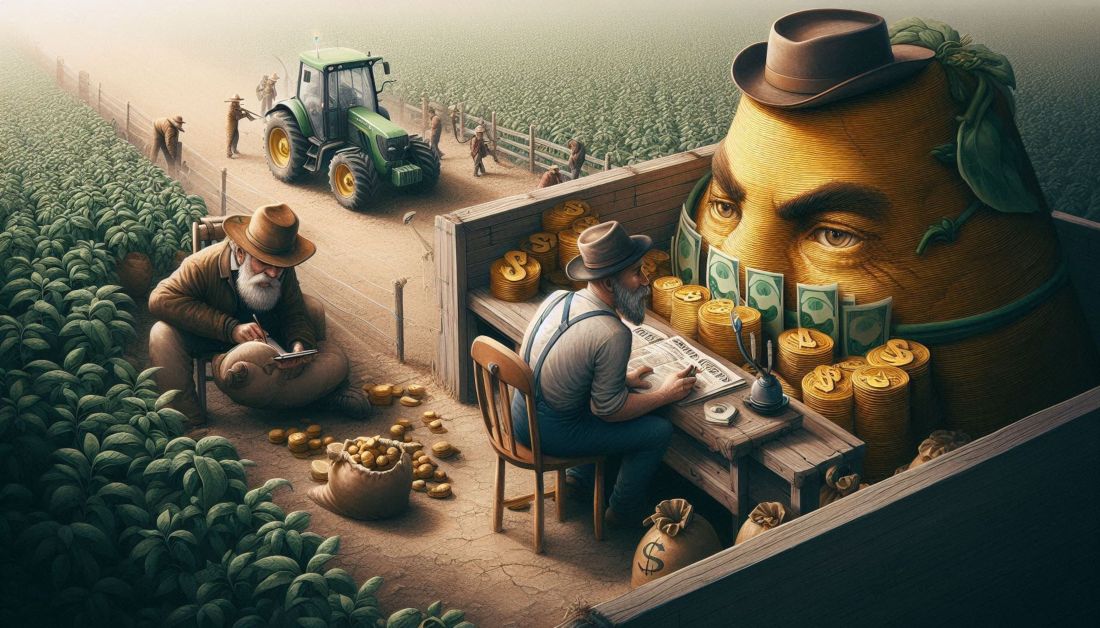
Today, UK Farmers still have choices over what they grow and how they grow it. Even though many are tied into contracts that are ultimately controlled by a very small number of companies who control the food supply and whose longer-term profit-making interests will benefit if independent Farmers go out of business, so that they can control even more of the food supply.

Those with roles that are there to help, don’t help anyone at all

The useful idiots that we now have in government and running policy and services across the public sector don’t help matters at all.

Whilst very few can accept this truth at first glance, the reality is that decades of farm and food production related subsidies have only served to move more and more of the power that our Farmers and Food Producers once had towards the big companies that incentivise and control politicians.

Meanwhile, Agriculture has become more and more dependent upon the political lead. Whilst local infrastructure and everything that supports local and independent food production has been progressively destroyed, either legislatively or in direct physical form.

If we can accept this – and that’s by no means an easy thing to do, we can also then accept that UK Farming and Food Production needs to go in the completely opposite direction, embracing much more traditional methods of food production and returning Farms, Farming and Food Production so that they are providing everyone with the basic, natural, healthy, nutritious and fresh forms of foods that we all actually need.

For us all to have and benefit from this, means that Agriculture and growing food must be right at the heart of our communities once more.

Mindful eating

The battle to save natural food production in the UK (and in other areas of the world too), only exists today, because so many of us take for granted the lives that we have and the continued access to food and everything else that makes life seem so easy. All without being conscious of the real cost to us, or without recognising that we do have a choice.

Greedy profiteering companies only produce foods that can harm us on the scale that they do so, because we keep on buying and eating them, without ever giving any thought to anything that these companies and the people behind them are doing.

If we all began looking at the ingredients of foods and take note of where the food or where the ingredients actually come from, we would very quickly see the difference between ‘natural’ food that we can recognise because it usually resembles its original form, and everything else which doesn’t look like or resemble anything that we could recognise in nature.

This is a very quick and effective way of being able to tell if eating or drinking anything, is likely to end up harming us in some way.

Changing the way we eat is how we keep our freedom to be who we are

The harsh truth that we all need to face:

The control of food is power and the power behind food is a way that those dependent on someone else’s food supply be controlled.

Whilst the UK Farming and Food Producing communities now have a massive fight on their hands to regain control of their own destiny – not least of all within that community, the fact remains that we can all help change the direction of UK (and World) Food Production by changing the way that we approach the food that we eat.

By doing so, we will ultimately help ourselves.

The smallest steps are the biggest when it comes to change of this kind. And if we all start to do what we can to reject processed foods and UPFs wherever and in any way that we find them or that they come into our lives, the impact that we can collectively have upon the food chain and the way that food is produced would become meaningful in no time at all.

Changing the eating habits that we have is not easy for anyone. Not least of all, because our habits are the truth we have chosen to believe.

However, the truths that we believe about food today are not truths that we can call or should be prepared to accept as our own.

Good, healthy, nutritious, locally produced fresh food IS a public good and we all deserve to be able to access enough of it every day and at prices that we can all easily afford.

We can only make this possible if each and every one of us exercises what still remains of our freedom of choice to change the world for the better, one choice at a time.

No Farmers No Food may be a wasted opportunity for UK Farming in its current form. But personal attacks on those leading it are no better than any one of us shooting at our own hand

A few days ago, I wrote and published a blog where I outlined why No Farmers No Food (NFNF) campaign will achieve nothing, whilst it could also end up doing UK Farming and Food Production considerable harm.

To do so meant mentioning the founder, James Melville. I don’t know James personally, but because of my ongoing interest in politics and the true depth of the problems that the U.K. is facing, I have been aware of him since he first appeared as a growing voice in what I’ll call the anti-lockdown ‘movement’ that appeared in the summer of 2020 following the first lockdowns.

Whilst I have discussed my reasoning that NFNF will not be able to achieve anything more than the range of existing organisations that are already working on the issues UK farming faces or have tried to do so before, it is also important to recognise what this new campaign is doing differently: NFNF has reached a much wider audience and has captured the imagination of people in ways that many of the existing lobbyist organisations supporting UK Farming have not done, so far.

The impact of NFNF is down to marketing and online campaigning. Or rather, making the best of the communication mediums that are currently available to anyone or any organisation that wants to change anything in the public realm, and isn’t already in a position where they have a platform where they could have the same effect just by opening their mouths.

The people who could do that – who arguably should already be doing that on behalf of UK Agriculture, are the people who are already in power. The people who we have elected and the people with roles in the establishment, who aren’t getting the things that they should be right. Because they are putting what’s important to them or what’s important to the people who are important to them, first.

Having the exposure that James has generated repeatedly since he emerged online, or being one of those people with public responsibility who isn’t using it as they should be, all adds up to the same outcome, IF there is no understanding or appreciation of the cause of the problems beyond an obsession with their effects, along with an appreciation of how everything in government, politics and the establishment really works today. Which genuinely isn’t anything like what most of us expect – even some of those within it.

Appearing to have a platform, with growing support and ‘breakthrough’ messages that give the immediate belief that those behind it can achieve things, will bring many different people and interests out of the woodwork who want to use that exposure for themselves. Usually because they aren’t getting the level of success with their own approaches, that they can see that new platform has.

It’s this visually-derived focus that brings groups like Together, climate deniers, right-wingers, anti-Brexiteers, and all sorts of different people with badges those who disagree with their priorities have given them, who identify with the issues that UK Farmers face tom banners like NFNF.

They see a vehicle that could be the answer to whatever problem they see as the priority, believing that their ‘fix’ will be the one that fixes everything for everyone else too.

The biggest obstacle to a successful outcome or resolution to all the common issues that Farmers share, is what we are now seeing unfolding in the disagreements about NFNF.

Different groups and individuals are attacking each other or piling in on individuals who have said something they don’t like about their take on what NFNF are going to do, and using links, affiliations and everything but the issues around what will actually work, when the point is being missed that in its current form, with the current mentality and the current lack of genuine engagement of a kind that social media simply cannot give, there will be nothing meaningful that NFNF can achieve.

The truth is that there is a massive range of people with different skills, experiences and talents that need to be involved in any movement that is going to succeed in delivering change for UK Farmers and Food Producers, where so many have already failed or been bought off with meaningless compromises before.

The parallels between this new campaign and how entry to the current political system works are frightening. Success in one area of business, obtaining a platform or just getting yourself elected doesn’t equip anyone with the understanding that it takes to do anything and certainly not where the realms of public policy interconnect and interacting with a completely broken system are concerned.

We shouldn’t doubt the good intent behind NFNF. But it’s been said that the road to hell is paved with good intentions and a large number of rightly angry, desperate and frustrated people are getting carried away by an idea that presents a good story, that in reality will end up a very long way from what it now seems.

We cannot have all the things that we want. That much is clear from the reality that we are all living through.

We need to focus upon the things that we genuinely need.

What we have the power to do is recognise the key things or rather the aims that we have in common. Such as saving U.K. Farming and making sure that everyone in the U.K. has everyday access to good, healthy, natural and farm-grown food.

It’s easy to dismiss workable solutions on the basis that they don’t appear to deliver the solutions that we want. But that’s really the most important point.

If we work together to deliver what’s right for everyone and not just what we want, what we want is likely to be delivered or will become a lot nearer by doing so.

We will then be winning multiple times over. Rather than fighting each other for no good purpose and not delivering anything to help anyone at all.

Sustainable Agriculture is part of the pathway to UK Food Security. But it wont work well for anyone until it works for everyone in the same way

My focus on Agri politics and the mass of issues that surround UK Food Security, Sustainable Agriculture and the growing problem of Food Poverty in the UK has made the past few months and my time at the Royal Agricultural University highly beneficial. Especially as I have began to look further and further outside my own social and professional circles to see if the troubling patterns that I already recognised, were evident in the same way elsewhere.

I have to be blunt and say that nothing I have experienced has given me any comfort. In all honesty, everything that I have seen has made me realise that the UKs Food Security and self-sustainability issues are significantly worse than I’d already concluded, and they are getting worse the whole time.

As you will have already read, Sustainability and Sustainable Agriculture are issues that are important to what I wish to share. However, the English language, the way that we multipurpose words and the obsession with subtext that most of us have, make communicating difficult issues that need to easily be grasped very difficult. Especially when alternative terms and their meanings can be used as a barrier that allow emotional ties to get in the way of progress and constructive dialogue.

There are very important distinctions to be made about Sustainable Farming in the context of what sustainability really is. Given that terms such as Regenerative Agriculture, Conservation Agriculture and Rewilding have been pushing their way into the Rural, Green, Environmental and Agricultural lexicon. As despite what should be very distinctive threads of commonality running throughout all of them, the differences between them and more importantly what everyone believes to be the most important priorities of each of them, are endlessly getting in the way.

Misunderstanding, misinterpreting and misrepresenting key benefits and issues is preventing everyone coming together to build upon shared commonality to identify and implement ways of working for the future that are meaningful and beneficial for everyone involved.

To add to the complication of addressing these issues, there is also a need to focus on methods and thinking that are likely to seem counterintuitive in a way that requires many of the most logical and business minded people that we could meet, to think about a future that looks very different to how it does today. A comfort zone we are resistant to leaving where every system, policy and story we encounter tell us all that the basics of everything that we accept without thinking, are always set to remain the same.

The priority of Farmers today is money. But farms cannot run profitably with profit being the priority anymore

So, this is a statement that will need some more thought. Surely it’s the case that every business is run to make money, isn’t it?

On the face of it, the argument that all businesses exist to make a profit is very sound. However, it is only sound because of the way that the world currently works and how we think, placing money at the heart of everything. Instead of prioritising the real reasons that any business exists, which are the products or the services that they provide to customers (or end users).

We can take this thought further. The real reason for providing those goods or services are to help, support or enable people to live, in whatever way that product or service will help those people to do so.

At risk of stating what should be obvious to everyone but actually isn’t, UK Agriculture, Food Production and UK Farms are about or should be about providing the UK population with a secure, accessible, ongoing supply of healthy, nutritional basic or essential foods. And they should do this collectively on the basis of providing the UK Population with the widest variety that is available to us from being grown, ideally as local to the end user as possible, but at the very least, from somewhere from within the geography of the nation state that we all share.

I don’t know a farmer who isn’t passionate about what they do.

Farming isn’t just a business. Farming is a vocation and lifestyle choice for all those who are genuinely committed to the industry, in what I will suggest is a healthy way.

However, as we have moved further and further away from subsistence farming the scale of risk has grown at the same pace as the commitment to production growth.

It has naturally followed that the power that Farmers and Food Producers in the UK once had, has progressively been surrendered to whoever will guarantee the greatest longevity of income. Even though it has now been arguably many years since such guarantees have also offered anything like what we would likely agree to be viable prices.

One of the reasons that Clarkson’s Farm on Amazon Prime has been such a good champion for UK Farmers is that it has lifted the lid on just how precarious Farming in the UK has now become. Yet few Farmers have the opportunity to do TV work or lean on the marketing power of celebrity to make a new farm shop or a brewery buy-in an instant hit.

The reality is that for many Farmers, it has been the culture of payments and subsidies that have taken over everything in Agriculture, alongside the ‘deals with the devil’ that have been made with traders and supermarkets, that are the only reason that what should be ridiculously successful food producing businesses stay afloat.

It is impossible for Farmers to stand still at a static or subsistence level as it once was, as ‘growth’ and therefore growing ‘turnover’ is the only way that earnings can be kept static.

The alternative for many being either to sell up or go broke.

Farmers, Food Producers and the entire UK Agricultural Industry are vulnerable to whatever the supermarkets, retailers, traders and the establishment demands of them next. Because they have surrendered their power to money, and forgotten how to do what they really do best.

Current thinking and every message that we hear tells us that big and bigger are the only way that things can now go. That ‘growth’ equals progress. Yet none of this is in any way true.

The future of Farming is the return to being a predominantly local, community-focused industry with emphasis on the production of foods and goods that local people need. Not what some want and only they can afford.

I realise that the immediate argument that will come back from many farmers who are thinking about the situation that they are really now in, will be that the infrastructure, support networks and governance (laws, rules and regulations) simply don’t exist to make anything like this work without financial support, and that just this factor alone, before anything like the economies of scale are considered, make any such move one that would be impossible to work.

It certainly looks that way. But without UK Farmers, Food Producers and Agriculturally aligned industries taking back their own power by taking those risks necessary for themselves now, the reality is that within perhaps only a few years, Farming as we recognise it in the UK today, will simply no longer exist.

It’s not just British Beef at stake: the future of U.K. food production and our food security is on a knife edge

So obsessed have we become with tech, the next big thing and the apparent ease with which we can get everything that we want, that we have forgotten what’s actually important in life. And when it comes to the basic essentials for life, there’s likely to be nothing more important than what we eat.

Just like the air that we breathe, it’s easy to take the supply of food for granted. Unless you are already one of the growing number of us who cannot always afford to buy enough.

Yet, it’s not even as simple as having access to the food that we genuinely need.

For half a century and probably more, the food we eat, the systems, the supply chains that provide it and the governance that is supposed to be there in place to maintain supplies of the things that meet our basic needs have been changed, manipulated and replaced from top to bottom and from left to right. For no better reason than to allow someone somewhere to make more and more money, without any regard for consequences or what for us – and for our farmers and growers, is already becoming a very high price.

To really grasp the horror story currently unfolding, there is need to have understanding of our political system, of human nature and how money runs the world and makes everything work. Not in the sense of how we see it or how we talk about it. But in the sense of how it all really is.

This past weekend saw Channel 4 give a platform to yet another attack on meat production and specifically beef farming, leaning very much upon the narrative that to tackle global warming, cutting down and ideally stopping eating meat is the best place for everyone to begin.

Never mind the queues of private jets lining up at the very same time to fly an ‘elite group’ of very rich people to a meeting where they can all work out plans to force more of their green rules on the public, all in the comfort of luxury hotel suites in Dubai.

Regrettably, many of the people gifted high profile platforms to speak passionately about the guilt people trying to eat a balanced diet should expereince for eating properly have become the useful idiots of a very cynical strategy. One being pushed by people who were never elected to their roles and so recognise that to have control over everything, they must gain control of any basic essentials for life that everyone seeking to exert their own freedoms and will must automatically prioritise first.

What they forget to mention – even when these same people have responsibility for public health, is that good, healthy and nutritious food, as part of a balanced natural diet, is the essential building block and foundation of a happy life.

So, why would anyone of sound mind want to destroy or kick the foundation of good, healthy and nutritious diets away?

You can be sure that its not anything to do with the methane that animals, humans and just about every natural biological process produces. But it certainly has a lot to do with money and the two things  that come with it: power and control.

Yes, it sounds like a conspiracy theory. But everything that the world is doing to itself today is thoroughly unsustainable.

The irony is that it is the same people, businesses and financial minds that created the false ‘need’ we have bought into who are responsible. On one hand, they have normalised unsustainable behaviour that has depleted the planets resources for no good reason. On the other they have systematically destroyed the governance and infrastructure that would make it easier for us to choose and adopt alternative ways of living that would be much healthier, affordable and sustainable too.

It is these same selfish and self-serving minds that are now determined to dictate the solutions to the problems they caused, so that we change and then behave in ways that will work better for them.

Food is power

Whilst it will make uncomfortable reading for farmers, including many great friends that I know, an entire industry populated by some of the most creative and entrepreneurial people imaginable has been reconditioned to accept grants, subsidies and ‘guaranteed’ contracts with big business and retailers as being ‘normal’. Instead of using their own freedom to do all the things that only British farmers and growers know how to do best.

The consequences of what is happening because of greed and self-interest are very serious indeed.

Yes, farms are going out of business and land is being taken out of production at an alarming rate. But the fact the food the U.K. grows or is capable of growing doesn’t often find itself into the mouths of the very people who live closest to the farms where it was grown is both part of the nightmarish reality that people in food poverty are suffering obesity and diabetes, and the accompanying reality that basic healthy fruit, veg and and high quality meat and fish that resembles its origin in an unadulterated form is now for many, simply too expensive to eat.

It shouldn’t be this way. Yet the travesty doesn’t end there.

Whilst we should all be able to depend on the public representatives that we have elected to put our health and the security of UK food production first, the reality we all have to face is that whether it’s the Conservatives this year, Labour or anyone else occupying No. 10 and the green benches to the right of the Speaker, next, none of these politicians have any idea of just how fragile the UK food supply is right now. Nor how serious even a few shortages of outside food supplies could make things get.

U.K. agriculture has reached the point where farmers, growers and the industries that are inextricably linked to U.K. food production will either choose to accept the risk of taking the steps necessary to facilitate its own revival or wait perhaps no more than just a couple of years and see everything that still exists swallowed up by some impractical idealists 2030-based agenda of some kind.

Farmers and the public are the two key stakeholders in U.K. food production and accompanying supply relationship. Yet neither farmers nor consumers have anything like the genuine say and influence that they should have.

It’s money, self interest and other people’s agendas at every step of the way.

The UKs Farmers shouldn’t have to lead the revolution of reality. But the reality is that a meaningful commitment to changing U.K. food supply and recreating the local infrastructure that would be able to make that work, will soon gather growing public support once the work has really begun.

Its then and only then that our hapless politicians will have no option but to follow.