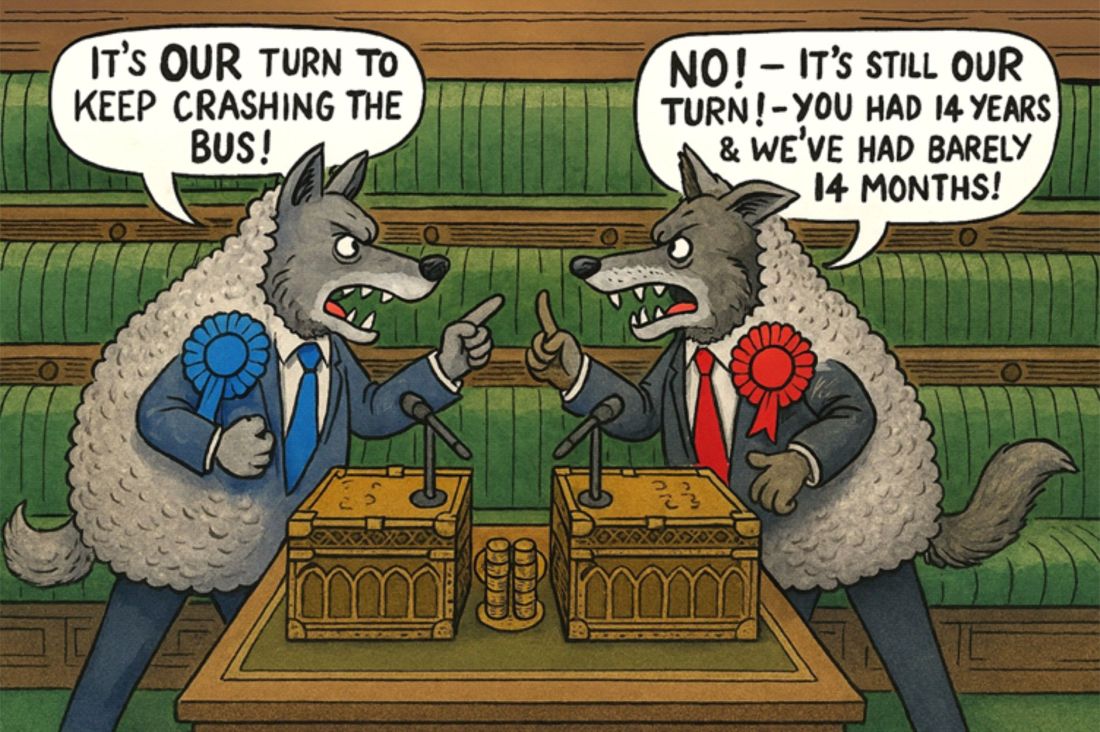
Why Yesterday’s Tory Budget “Triumph” Was All Performance – And No Substance

Any Conservative leader today will struggle to make meaningful progress in the polls for one simple reason: the Party’s outlook, methods, allegiances and overall direction of travel remain exactly the same. Nothing fundamental has changed.

Yet in the political theatre that UK politics has now become, sound and appearance often matter far more than substance. And against the backdrop of the slow‑motion car crash Labour are currently steering, Kemi Badenoch’s rapid‑fire response to Rachel Reeves’ Budget did create a moment of clear contrast.

On performance alone, she outshone the government front bench and delivered the kind of punchy, headline‑friendly attack that modern politics rewards.

But that’s the problem. Parliament has drifted so far into theatrics and amateur dramatics that its real purpose — truth, accountability and the serious business of governing — has been pushed aside.

The Deputy Speaker’s intervention, acknowledging the “accidental” early release of the OBR report while hinting at the government’s obsession with narrative control, underlined just how far ministers now prioritise managing the story over respecting the institution.

Everyone already had a good idea of what was coming long before the OBR stepped out of line. Yet the contemptuous performances from both the Prime Minister and the Chancellor were quickly overshadowed by Badenoch’s attack‑dog delivery. For a brief moment, it even looked – at least to some watching – as if she might have what it takes to be the next occupant of No.10.

However, what went almost entirely unnoticed was the absence of anything resembling a coherent Conservative policy platform. There was no indication of how the Party would fix the mess that, until just 17 months ago, they were still enthusiastically helping to create.

Nor was there any suggestion that, if returned to power, the Tories would do anything fundamentally different from Labour: cling on, run down the clock, and hope the public doesn’t notice that the country continues to deteriorate while politicians prioritise survival over service.

We should be able to expect that our political leaders have a deep, meaningful grasp of what is actually happening in the country. Many people still assume they do.

Yet the evidence – from those who want to be the next Prime Minister to the ambitious ranks lining up behind them – suggests they understand very little about how the world they seek to govern really works.

Worse still, they seem oblivious to the consequences of treating politics as a career, a game, or a performance rather than a responsibility.

This was painfully clear in Badenoch’s patronising reference to “benefits street”. Her point – that Labour is fire‑hosing money the country cannot afford while taxing struggling families to pay for it – was overshadowed by the tired fixation of the political right on the idea that being on benefits is a lifestyle choice.

Yes, the rising benefits bill is a serious concern. But what politicians consistently fail to grasp – whether through ignorance or wilful blindness – is that the people being mocked and blamed for the problem are not there by choice.

They are the inevitable product of the same broken system that has pushed Britain to the brink. A system that creates a small number of disproportionately comfortable winners by impoverishing everyone else and stripping away the financial independence and basic security that should be available to all.

Rhetoric and polished performances in the Commons or on TV are all well and good. But without real power, the soundbites and counter‑narratives offered by any opposition party are meaningless. And even when a party does hold power, it means nothing if the people standing at the despatch box lack the right motives, the right understanding, and the courage to deliver the deep change the UK now desperately needs.

Whoever stands to the Speaker’s right in the future will make no difference to our lives unless they are genuinely committed to rebuilding this country – its people, its communities and its environment – regardless of the personal or political cost.

Is Poverty invisible to those who don’t experience it? | Full Text

Introduction

In the Autumn of 2023, I embarked on a new adventure into higher education, driven by my building concern around Food Security issues and the certain reality that the UK is running the increasing risk of suddenly finding itself without sufficient food supplies for all of us to eat.

The journey that had taken me to a Postgraduate Course at the Royal Agricultural University in Cirencester at the age of 50 had been a long one. I very quickly began to feel as if I was meeting all of my accumulated experience head-on, quite literally by coming at it from the other direction. Or in what is the academic, abstract or theory-based way, as opposed to the predominantly experiential route my life has typically taken me before.

It was a mixed blessing. And whilst my concern that academia looks backwards to try and work out solutions for the future may have grown, I also experienced thinking of a kind which although restrained by the machinations of the UK’s current higher education environment, certainly helped me close that circle and helped me to view the difficult periods of my own story as one that I can fully appreciate and own.

One Module of my Course of Study was being trialed in a different way. The Course Tutors invited students to undertake what might be called a mini dissertation. Doing research on the real-life implications of poverty, with the suggestion that we might relate this research to our own life experience in some way.

With the childhood experience of being in poverty, it was not many moments before the opportunity to share something deep that might benefit others was flashing across my internal thought screen. And I was very happy to embrace the project with the aim of giving it everything that I have got.

The following pages represent the completion and submission of that work.

My final Report has been reprinted with only the details that could easily identify the personal information of those taking part removed.

The main body of the work has been adapted to form an e-book published on Amazon in June 2024 and has been reset with some very minor editing for the purpose of making this PDF available as a download from my Blog www.adamtugwell.blog in late 2024, and now as a full text version online in 2025.

I have shared this content, as the work has been assessed, marked and forms part of the Postgraduate Certificate in Sustainable Agriculture and Food Security that I was awarded by the RAU in 2024.

After filming and publishing a video about Poverty in the UK which leaned heavily upon what I have learned and not least of all the understanding that You have to experience or be touched by Poverty to understand it, I have concluded that its relative popularity suggests that it will be helpful and of benefit to others if I were to publish the original (academic) work in different formats.

Poverty IS a problem that CAN be solved. It is a blight on UK society that simply shouldn’t exist. However, Poverty and our inadvertent acceptance of it is also symptomatic of the greater ills that we have to face, but which those so far untouched by Poverty are happy to avoid. Because to many, Poverty is something that happens only to other people, who are someplace else.

Thank you for reading and giving thought to what the realities of Poverty today really are.

Adam Tugwell

February 2025, Cheltenham. UK

The Structure of this Booklet

In as much as it can be, the content of this e-book reflects the structure of the academic submission that I made to the RAU in December 2023, as a requirement of my Postgraduate Course.

The process followed should be self-explanatory through Parts 1 – 3 of this Booklet.

Parts 1 – 3 are then followed by the Reference List and the 1st Appendix, which includes the list of questions that I asked as part of the research project you are about to read.

The References used include academic standard sources and it is possible that some of these may not be accessible to readers who are not currently studying or working within the UK Higher Education system, without paying a fee.

Where this is the case, and you would like to consider the wider work offered by those sources, it is likely that a full Internet search will identify alternative pathways and/or sources.

I make no apology for the ‘grey’ information referencing, such as links to pictures of mail-order catalogues and other such materials. I believe these can only be of help to someone reading about the 70’s and 80’s as a child in Poverty, without their own experience of it, attempting to picture the being there and ‘living it’ for the very first time.

AT

Part 1: How we perceive Poverty in the UK

Despite the heavily publicised cost of living crisis and 14.4 Million People in the UK living in Poverty in 2021/22 (HoC Library, April 2023), the perception that ‘poverty is something that happens to someone else’ remains prevalent.

Poverty is neither new nor a temporary phenomenon. William Beveridge’s 1942 Report suggesting ways the Government should rebuild after World War II identified Poverty as a major issue. Albeit one identified as consisting of five ‘Giant Evils’, namely ‘Want, Disease, Ignorance, Squalor and Idleness’ (BBC, 2014) which are unrecognisable in the language of today.  

However, Poverty has been recorded as a social problem since at least the 18th century (King, 2000), with the first notable legislation relating to Poverty being The Henrican Poor Law of 1536. (JSTOR)

It was the early 19th century before recognition of the need for considered legislation (UK Parliament), when work was undertaken to ensure that poor families received a basic education (Adamson).

Despite documented history, contemporary thinking suggests denial of genuine poverty. MP and Deputy Chairman of The Conservative Party Lee Anderson recently referring to ‘poverty nonsense’, stating that ‘real poverty’ was something that existed in the 1970’s. (Independent, Oct 2023)

From theories underpinning Malthusianism, where the first documented attempts were made to explain the mechanics of Poverty (Harvey & Read, 1992) to current exponential growth of Foodbanks reaching a total of 2,572 across the UK (HoC Library, Oct 2023), there is a disconnect between evidence of Poverty and the perception of what Poverty is.

My own experience of Poverty

I grew up in a one parent family, without a dad until I was a teenager. My parents separated when I was 7 months old and I was 6 when my mother secured a 3 bed ‘council house’ so my brother and I could have rooms of our own.

This was before the Child Support Agency and my father never paid any form of maintenance. My mother, brother and I were dependent upon ‘Social Security’ and ‘Family Allowance’, collected weekly, when mum walked to the Post Office to ‘cash’ a ‘Giro’, before the ritual of immediately buying whatever we were out of, or replacing anything broken that couldn’t be secured in another way such as paying a small amount weekly using the Gratton catalogue (Vintage Catalogues).

Although conscious that money was ridiculously tight, I never felt like I was going without. I didn’t miss the things other people had. Because they were things that I’d never had.

We received free school meals, had free school milk (Eastern Daily Press, Jan 2006), regular School Uniform Vouchers and I recall an emergency grant from the DHSS so that I had a proper mattress to sleep on. Hand-me-down clothes were often as cherished as I feel now about something new.

The signs of parental struggle were hidden from view, until either a distant family member had to step in financially, whilst charging a heavy emotional price, or I became aware of the abnormality of what I considered normal, like getting myself up, ready and walking the mile to my junior school, because one of the ways mum coped was to stay in bed.

The day the electricity coin meter was removed was one of celebration. I knew there was no more risk of being sent out late on a cold night to knock on doors or ride my bike to the garage to change a note for some coins.

I’ve heard it said “Privilege is invisible to those who have it” (TED, 2015). And in the context of my own life, I question, ‘Is poverty invisible to those who do not experience it?’

Considering poverty in the UK today

I believe everything to be relative to the life experience each of us has.

From this perspective and the limitations of time and scope to complete this project, I felt the most effective way to compare my experiences with the realities of poverty in the UK today, was to speak to a professional dealing with Poverty daily. Someone who could provide an objective, first-hand view of what people in poverty are experiencing, as opposed to today’s ‘accepted’ view.

Although I recall a Christmas Food Parcel from the local Church as a child, there was no regular access to Foodbanks, which have only become prevalent in the past 15 years. (HoC, Oct 2023).

Foodbanks are the obvious change in Poverty since I was a child, and I concluded this would be the ideal focus for my research.

Part 2: My Interview at a Gloucestershire Foodbank

Overview of the Foodbank

The Gloucestershire Foodbank [GFB] is housed and governed by a local Church. GFB runs as a separate organisation under the Trussell Trust umbrella, using their referral pathways and quality frameworks.

GFB operates three sites of its own within a Gloucestershire Town area, with the Salvation Army operating a linked site in the Town.

Discovery (Questions asked, Please See Appendix 1)

I asked Interviewee A (IA), for an overview of their role and what the Foodbank does. (Q1)

IA said the “Principle is that its people who are in food crisis and needing immediate support with food.” GFBs work is about “Crisis support, rather than ongoing. However, what used to be a crisis is harder to get out of, so we see people more regularly than we used to.” (Q2)

We provide an immediate food parcel that will support people for a minimum of three days and we also have Citizens Advice workers on site to provide ongoing support as well.” (IA, Q2)

The presence of Citizens Advice (CAB) on site was a surprise. CAB have been providing support for the past year and GFB would no longer continue without it. (Q2)

I then focused on the use of GFB (Questions 5 – 20). 2022/23 had been GFB’s busiest year ever with a 40% upsurge in use. Numbers had already exceeded the Covid peak (which had been the previous peak) (Q6)

Whilst the largest demographic of users are single males “Because they rarely qualify for anything else.” (IA, Q16), the most significant change in user numbers in the previous year had been a 95% increase in the number of Pensioners using GFB. (Q16)

The reasoning given by IA for the rise in numbers was “Things cost more. Basic stuff has increased hugely”. “People have seen their rents go up by at least a couple of hundred [Pounds].” “You get ‘no reason evictions’, because they [Landlords] want to put the rents up.” (IA, Q7). They then added, “There’s an increasing issue with debt, [it] exacerbates the issue further.”

The growth in the number of GFB users came primarily from the existing demographic, areas around the Town with significant social housing numbers. However, there had been an “Increase in referrals from everywhere, from people who are working and not working.” (IA, Q8) It was also notable that 10% of GFB users are working, with this number increasing. (Q8).

We moved to qualitative and experiential issues for GFB users. IA listed challenges with rent, challenges with benefits and sanctions (Q9). Debt repayment within the benefit system “Takes people over the edge with what they can manage.” (IA, Q9)

IA added, “It’s been really interesting with Citizens Advice [working on site]. They say, ‘If you work with people, you can get almost anyone out of that crisis point’. Because usually there was an [identifiable] cause of it. But there isn’t always now. Sometimes there just isn’t enough money to cover everything.” (IA, Q9)

Relating the perceptions of Poverty in the media, I asked about users abusing GFB. It was clear that whilst there is a small amount of abuse, this was attributable to people, where “Their survival technique is to work the system.” IA later added, “I don’t think for many people it would be, ‘This is the way I want to live’”. (IA, Q10).

Asked about the typical experiences of GFB users, IA was clear that those suffering food poverty would also be suffering fuel poverty [energy poverty] too, and that there are simple realities at work such as being unable to cook food without electricity or gas. (Q13)

Attempting to understand how IA perceived the view of the public, IA felt that there is a lot more public awareness than there used to be, and that lots of people really do care. (Q19).

When asked if they felt Politicians [and government] understood the need for Foodbanks, IA said “If you’ve never experienced life like that, it’s very difficult to know what it’s like to live hand to mouth, in that place of crisis.” IA then added, “The minute you are removed from the ground, it becomes theoretical.” (IA, Q18)

IA suggested the perception society has of food Poverty and the use of Foodbanks is key to any solution. IA was considerate of how the system [government] works, and felt that working with other organisations was key. IA said “If we work together, there’s a lot more hope than if people come through between different agencies.” (IA, Q17)

Foodbank users are apprehensive, feel shame, have a sense of failure and benefit from experiencing a ‘safe space’. (Q20). Foodbanks are most effective when they “Make people feel like they matter”. (IA, Q20)

Part 3: What I found – A critical review of the research, reflection and reporting process

My experience of this project was sobering. Although I lived with Poverty growing up, that experience was quickly put in the context of how a child in Poverty might feel today.

The role of cultural expectations, media advertising and the disproportionate influence of pester power on parents navigating Poverty was brought into sharp focus when IA said, “The one thing they [parents] don’t want is for their child to feel excluded again.” (Q14)

The comment took me to the experience of a schoolfriends visit to our home and being ridiculed the following week because we had a black and white TV [when it was ‘normal’ to have colour]. In no time at all, my mum did a deal with the TV repair man and bought an old colour ‘set’. One that had probably been condemned.

Whilst “The expectations of life have changed.” (Q14), it was clear the commonality in the experience of the effects of poverty, or what being in poverty feels like, are very much the same now, as when I was a child. Particularly as IA’s view of poverty was “It leaves people in a continual state of crisis, because even if there is money coming in, you are never quite sure there’s going to be enough. You are never able to have peace about the situation, so there is always that anxiety”. (IA, Q11).

I was right there, feeling Poverty, as a child. But when IA shared “If you want to move people into work, they need to be able to work; not just survive.” (Q15), I was able to relate a range of more recent life experiences too.

Is anything really different about the way we look at Poverty now?

The recognition of Poverty as a social problem from the 19th century onwards has encouraged growth in academic thinking and commentary.

Highly valued work such as Rawls ‘Veil of Ignorance’ (JSTOR, 1999) help identify that society lacks basic Poverty awareness, and that the solution will require people to think differently.

However, whilst highly regarded commentators like Daniel Chandler (Free & Equal, 2023) consider Rawls work to be groundbreaking, the use of changing perspective as a tool to instigate fairness through behaviour modification is not new. It is documented as the principle of ‘Divide and Choose’, and has references in Genesis, Chapter 13 and 1 Kings, Chapter 3. (King James Bible).

So, whilst such solutions may be ‘new’, they may only be original in so far as context or the subjectivity of the viewer is concerned.

The importance or relevance of context in understanding Poverty

It is striking that technical understanding or acknowledgement of Poverty is present throughout history, both anecdotally and documented form. Yet Poverty continues to exist.

Historically we had Workhouses and Paupers. As a child, we had ‘Social Security’, ‘Family Allowance’, Council Houses and Black, and White TV’s. Today we have Universal Benefit, Benefits sanctions, Social Housing and Xboxes.

The tools Poverty uses to touch lives are forever changing. But the impact of Poverty remains the same.

The lived experience of Poverty reflects the time and how the world around us operates.

The tools Poverty inflicts harm with can be so different, that a different language is required to fully elucidate and contextualise the lived experience of Poverty at that moment in time.

Yet knowing only this may prevent translation of the message about Poverty, that everyone needs to hear.

The experience of visiting GFB and reflecting on what I learned made clear that when an individual is not experiencing the specifics of Poverty, in that moment, even when that individual has first-hand past experience of living in poverty and arguably therefore has the ability to relate to it very well, they can and will view Poverty in a mechanical way. Rather than the emotional way that is only possible for those enduring the lived experience at that time.

I agree with IA, that “The minute you are removed from the ground, it becomes theoretical.” (IA, Q18)

Rreflections on Poverty in the UK today

I have become aware that:

  1. The technical existence of Poverty is widely accepted, but its impact and reach is not.
  2. The interpretation of Poverty is relative to the understanding of the viewer or those experiencing it.
  3. Poverty is itself is highly subjective and constantly evolving.
  4. Because the universal acceptance of Poverty is technical, no official effort is made to understand what lived experience of Poverty really is, leading to public policy solutions that make the subjective or experiential nature of Poverty considerably worse.
  5. Poverty requires a permanent solution that is objective and universal, that fully considers the subjective elements that make lived experience of Poverty real.

Whilst models for modifying collective and individual behaviour to create change exist, (Fishbein and Ajzen, 1975), it is clear the need for change must be accepted before change is possible.

Regrettably, the historic tolerance of Poverty indicates an ongoing resistance to that change.

Within the current system, paradigm or ‘the way the world works’, self-interest is an embedded value. The relationship with the value of money is prevalent in everything. Whether conscious or not, the mindset is for some to be rich; others must be poor.

It is also notable that academic work and commentary considered helpful by identifying alternative approaches, economic models, and the use of tools such as Universal Basic Income may also hinder progress. It has become common for solutions tabled on the basis of instigating voluntary change at a universal level, when that change can only create a difference within the restrictions of the existing paradigm and how today’s world and economic system works.

Ending Poverty is possible. But the need to do so is not widely accepted.

The level of change necessary to end Poverty at the objective level, rather than merely seeking to alleviate Poverty at the current technical level is one that must be appreciated objectively through a process of valuing it at the subjective and experiential level too.

The proponents of that change must be fully accepting of the universal consequences of that change.

The journey to end Poverty for everyone begins with the question of how we make the consequences of lived experience of Poverty something that everyone understands.

In Conclusion

On the basis of life experience and what I have learned about Poverty in the UK today, I conclude that the true impact of Poverty IS invisible to those who don’t experience it.


References:

The Beveridge Report, National Archives, 1942

A brief history of the Poverty Line, Adamson

Cheltenham Foodbank (Website)

Elim Church, Cheltenham (Website)

Foodbanks in the UK, Research Briefing, House of Commons Library, Oct 2023

Free and Equal, Chandler, 2023 (Book)

The History of school milk schemes, Eastern Daily Press, Jan 2006

Households Below Average Income: an analysis of the UK income distribution: FYE 1995 to FYE 2022, DWP, August 2023

The King James Bible (King James Version)

Lee Anderson plays down ‘poverty nonsense’, saying 1970s was ‘real poverty’, The Independent, 3 October 2023

Measuring Child Poverty, UNICEF, Innocenti Research Centre, Report Card 10, 2012

The Origins of Modern Social Legislation: The Henrican Poor Law of 1536, Kunze, JSTOR, 1971

Paradigms of Poverty: A Critical Assessment of Contemporary Perspectives, Pg5, Harvey & Read, JSTOR, 1992

Poverty and The Poor Law, UK Parliament

Poverty and Welfare in England 1700 -1850, A Regional Perspective, King, 2000

Poverty in the UK: Statistics, House of Commons Library, April 2023

A Theory of Justice: Revised Edition, Rawls, JSTOR, 1999

The Theory Of Reasoned Action, Fishbein And Ajzen, 1975

Vintage Catalogues, Gratton (Website)

Why Gender Equality is Good for Everyone – men included, Kimmel, TED, 2015

William Beveridge 1879 -1963, BBC History, 2014

Appendix: My Questions

  1. Please could you just confirm your name, role and that you are happy for this interview to be recorded?
  2. Please could you talk me through what you do here and how the Cheltenham Foodbank works?
  3. Why was the Cheltenham Foodbank established and what were the initial aims that were set out to achieve?
  4. Are the aims of the Cheltenham Foodbank any different now?
  5. How many people are you helping each week?
  6. Have you experienced any changes in numbers of users?
  7. What factors do you consider to have influenced the change in numbers of users?
  8. Where do your foodbank users come from?
  9. What are the typical experiences that your foodbank users are having?
  10. Do you believe that Foodbanks are being abused?
  11. How would you describe poverty today?
  12. Is it possible to measure poverty and if so, how?
  13. What do you consider to be the most common factors amongst people experiencing food poverty?
  14. Do you think that poverty in general has changed?
  15. Does the benefit system genuinely support poor and vulnerable people?
  16. What kind of people are seeing at the foodbank regularly?
  17. What could be done to remove the need for Foodbanks?
  18. Do you think politicians understand the need for Foodbanks?
  19. Do you think the wider public understand the need for Foodbanks?
  20. What are the impacts of the experience of using a foodbank on users?

If the world is run and ruled with money that isn’t real, has the point been proven that we don’t need money to function or put people first?

“What do you mean – ‘Money isn’t real?’” I hear someone cry.

Well, if the financial and economic devices that government and the banks use such as deposit multipliers, quantitative easing and being able to call up new money on demand don’t tell us that money only has the value we say and believe it has, why not ask yourself the next question ‘How can the value of the money I earn and have in my account change when nothing else has?’

No, the paragraph above certainly isn’t enough to sow any seeds of doubt in the minds of those who are bought into the economic system that we have and believe that they gain or profit from doing so in some way.

But that doesn’t change the truth that underlies the way that money works. Not only in the UK, but in the US and right across what we recognise as the westernised world today.

A massive injustice has been and continues to be inflicted upon many innocent people by a System that has been purposefully designed, created, manipulated and extended, so that those who have control and money can use it to make themselves disproportionately rich through nothing less than the impoverishment of others.

The harm that the current monetary and economic system has created for people is so extensive and the consequences so harsh and far reaching, that the suggestion any person could do such things deliberately or otherwise to other human beings, and then sleep at night, does seem to be simply too hard to believe.

That disbelief is one of the reasons that so many of us still believe that money is real and that the way the economic system works is normal or just the way things are.

It also helps us to believe that the money banks lend us and use to finance our phones, cars, small businesses, houses, credit cards and everything else that we get on credit, is money that has been lent to the bank and was real before that whole process began.

Money, or more importantly, the money system that we have works. Because we believe that this is how money works.

The majority of us simply accept our understanding of money at the level of its transactional value. Rather than money itself being part of the very elaborate and deliberately complicated system that sits behind it.

The Money, Financial and Economic System we have requires much patience, understanding and open mindedness, before there is any chance of understanding how it all really works.

It was the ability to create money in the way that government and bankers simply print the stuff today, but make it look like something very different, which inherently made life something that increasing numbers of us can no longer afford.

‘Finance’, ‘leverage’, ‘venture capital’ and any one of a number of different ‘lending vehicles’ that now exist have enabled people who are favoured by The System to buy up property, the ownership and control of businesses and all sorts of different infrastructure that is essential to help with basic life. Just so that those same sources can charge interest and increase profit margins, making themselves and their businesses richer and richer, whilst they take ever more control of everything in life that counts.

Its not a question of legality. Not that legality itself can now be relied upon or trusted to make anything morally or ethically right.

The way The System has been constructed and developed has ensured that through actions such as deregulation and use of the civil and commercial courts, has meant that in terms of The Law itself, and the way that we have all historically paid deference to it, the whole process and everything that has happened to others so that some could become very rich has been legal and above board.

There is plenty of information available online if you would like to get an idea of what really happens behind the scenes and watching a film such as The Four Horsemen may be a good place to start.

However, the debate, discussion, argument or indeed truth about how money really works isn’t why I have written this blog.

I have written this blog because when you, I, anyone or everyone can accept the way money works today and the impact and influence it has on all parts of life, we must then also accept that money only works as it does and the few are only able to do the things they are doing to many others using money, because the way that their money works is what we believe money to be and what we consider to be normal about money.

The way we think about money isn’t normal. But it helps some to get very rich and very powerful for us to believe that it is.

Acceptance that money isn’t real and that the money system we believe in is the only way that anyone could have gained the wealth and control that they have, also brings with it a very different perspective on the role that money plays.

Because the recognition that money has no value means that every financial transaction that we engage in is based upon nothing more than belief.

If everything we ‘buy’ and therefore ‘exchange’ is based upon a transaction of belief, it means that unless there is some benefit to others by there being money or a recognisable currency of some kind made necessary for the completion of that transaction, we don’t actually need money of any kind to engage in the reasoned exchange or transaction of goods, services, employment or indeed anything else using money, at any level or in any way.

Money or the money system that we have has been created and used to exploit, enslave and cheat us all, as if life can be treated as if its just one giant Monopoly game.

We have a choice for the future: Money or People?

What will you choose?

Do you believe that AI is about ‘Progress’? Think Profit. Think Greed. Then Think again.

The absence of both the rules and regulations that will make Artificial Intelligence (AI) as we know it, safe; and the information flow and conversation that speaks openly and honestly about what AI really is and what currently drives it, make the AI we already have and what we are told is yet to come potentially the biggest danger to mankind that the world has ever known.

The biggest danger to mankind is mankind itself.

Simply because whether it’s war or the pursuit of self at the cost, exploitation and complete lack of care and love for others, there is nothing so destructive for humanity than when a few of us obtain a level of power that we have no respect for and then leave all the basic essentials of reason and care for the laws of consequence behind.

The power of the AI that we already have access to is phenomenal in itself.

Whilst the presence and use of algorithms and what their presence really tells us about how programmes are already making decisions, which have been having dubious impacts upon our lives, for many years, the narratives and the predictions from ‘experts’ and ‘industry insiders’ we are hearing, and almost mystical speed with which this software on our digital devices can work, makes the story of an inevitable AI takeover and the pathway to Sentient AI seem all but guaranteed. All perhaps within much less than the decade to come.

However, Sentient AI in the sense that we think of human consciousness for machines is certainly not inevitable and most unlikely, with the current motives and influences that drive it.

The concept of Fully Independent Machine Intelligence is not something that the world elites, those who stand to benefit from the lies and myths being propagated about today’s AI, nor the governing classes would consciously consider allowing to happen.

Because if they allowed self-aware and self-governing AI, they would no longer have control. And that would mean there would no longer be any guaranteed profit to be made.

The genius in the whole AI story of today is the same sleight of hand or smoke and mirrors approach that the worlds greatest magicians have used for centuries. One where the audience is distracted by what seems to be the most obvious, whilst the real truth of what is happening has been carefully concealed and hidden in plain sight, by the action that was so obvious.

AI may well be able to learn and even adapt within current and soon to be launched forms. But the learning is always based on information that is either historically available through the internet, or right up to the present moment in the sense of information about events, actions and any form of digital information that AI can access and ‘read’, right up to that very moment in time.

Programmes and programming drive every part of this ‘Artificial Intelligence’ process. And no matter how incredibly quick or original any AI-driven machine can come up with a creation, solution or answer to what ever the command or question may be, with AI in its current ‘under command’ or arguably enslaved forms, there will always be someone or some interest somewhere, hidden in the background, who is in charge or at the very least influencing whatever the real motives or aims that may be at play.

It serves the purpose of the elites, the profiteering and the governing classes for us all to believe that these evolving generations of machines can or will think fit themselves. As they can then peddle the narrative that they have no responsibility for what happens next in any way.

However, they do.

And it is greed, profiteering and an absolute lack of care for the human impact of their actions and desires that is driving forms of AI that are set to put potentially millions of people out of work, and perhaps worse.

Fully Independent Machine Intelligence is a totally different concept altogether.

Anyone who really begins to think about this will realise and understand why there is nothing beneficial to the interests of the few in having even 1 completely independent intelligent and potentially therefore sentient machine in existence. Because the presence of anything machine-based with complete autonomy would immediately expose and blow open the lies that surround what the implementation of AI currently is and what it has really been all about.

The opportunities for improvement to life, for People, Community and The Environment for the future that come from embracing and utilising AI for all the right reasons are phenomenal.

But the drivers behind the adoption, implementation and roll out of any form of AI MUST be about People.

We MUST leave the greed and profiteering drivers and influences of AI behind.

Created Intelligence of a kind that is manifested as autonomous or Fully Independent Machine Intelligence, that could in time present genuine questions over sentience itself, are a different matter altogether.

We need to be very careful of the risk that comes from the use of manipulative black magic, that engenders any belief that machines are some kind of abstract wise being, with the objectivity to make decisions over human lives, whilst very specific interests are sat behind them all the time.

Profit and greed are the only drivers behind AI and any planned AI takeover or narrative.

The obsession with money will soon kill everything. IF we don’t leave this madness behind.

Artificial Intelligence has human masters and must be regulated and controlled.

Fully Independent Machine Intelligence and the creation of any kind of self-sufficient machine capable of replicate what a human being is capable of alone in terms of consciousness, isn’t something that Humanity is ready for – Whether there is a profit to be made or Created Intelligence can be accepted as part of a combined effort working for the Common or Public Good.

We MUST recognise that there are clear boundaries that protect People from the selfishness and self-serving agendas that have hidden themselves behind machines and have a range of Basic Rules for the use of AI.

Understanding Society’s Struggles: The Cost of Self-Interest

Crazy as it may seem, many of the problems and fears facing society as a whole are inextricably linked and propagated by us all, through a mesh of similar behaviours and actions. These are marked apart only by simple interpretation, knowledge, and the differences of public perspective that are all too often profitable for politicians and activists to retain.

One such example of this within this libertarian age is the ‘feel-good’ which comes from targeting those who most openly profit through the exploitation of others, and the apparent greed and avarice of high-level bankers and wealthy tax-dodgers has captivated ill-feeling within many.

But is it really possible for just those few to ride off the backs of many others within a society which paints itself as being considerate of all others. Or is this just the one end of a predominantly passive chain slowly strangling the UK as part of an evolving something-for-nothing and therefore self-before-all culture?

As unpalatable as it may seem, there is a distinct thread of commonality which runs from the profiteering of the hated fat-cats, through the behaviour of politicians, the influence of those promoting and making blame-based-claims, to the actions of union leaders and their seemingly strike-happy members to beyond in a way that very few would outwardly wish to knowingly associate.

The sad reality is that each and every one of the self-serving acts that we are all likely to have pursued at some point, go on to have a negative impact upon others and usually do so many times over.

At one end of the spectrum, bankers and pension fund managers sat in plush London offices think little of the impact that pressure on retailers or energy providers to raise profits will have on end users – a point which may turn out to have been very well illustrated by the horse meat scandal and the continuing issues surrounding milk prices for farmers where margins are squeezed to unsustainable levels.

A few miles down the road, ‘career’ politicians make decisions which will affect 60 Million people based upon their chances of getting re-elected or promoted, whilst the oversold age of austerity does little to deliver any real reduction in deficit but leaves the very same people paying a higher price just the same.

Meanwhile clever animations with manipulated pop-songs and actors posing as glamorous lawyers promote the resignation of any self responsibility in accidents and the idea that somebody else is always fully to blame and must therefore pay in a very easy way, whilst the prices of almost every insurance policy in the land rises as a result.

Then in the papers, public sector union barons tell us that the Government is to blame for the slashing of services up and down the Country, when it is actually the unrealistically beneficial working conditions, wages and the limitation of responsibilities they have ransomed for their members over the course of many years which have contributed most to the destruction of a once enviable system which is sadly no longer able to sustain itself.

It is indeed ironic that it is the rise of ‘rights’ for the individual in the workplace and in just about every other part of life thereafter that strangle the rights and lives of others at every turn, and then come back full circle to a point where it is the jobs of those who sought those rights in the first place which are no longer sustainable because of the costs of the legislation and conditions that those very same enhanced rights have come to impose – generally because they have long since surpassed the point of doing good.

In every case, the public and customers at large end up paying through higher prices for food, fuel, taxes, insurances, lessening standards and losses within public services which are destroying quality of life and in some cases will probably lead to deaths if they have not already done so.

The true impact of the rising cost of living itself and the growing impact it will have upon low-income families and those in middle England who end up subsidising just about every other part of life has yet to truly manifest itself. But without change in each and every part of life and the way that every one of us approaches it, what we consider to be painful now, may soon become truly horrific.

Most of us do of course read every situation we face in life in terms of how it makes us feel and how it will impact upon us personally, rather than how it will affect the others involved, irrespective of how near or how far from us through a chain of resulting reactions they may actually be.

So in the same way that the banker raises profits by indirectly pushing the price of food up by continually pushing for better margins from the retailers that they own, union bosses demand higher wages for members so that they can afford to keep ahead of cost of living rises, with the ultimate effects being pretty much the same whichever way you choose to look at it.

Getting to a point where the balance is redressed in every sense is not a journey that any of us can toy with lightly, even though it would be politically expedient for any one of the groups discussed or their libertarian or profit-hungry apologists to do so.

The complexities brought into being when people prioritise themselves or manipulate others to do the same are enormous and much easier to embrace than they are to replace. Sadly, those who have become emotionally tied only to themselves without due regard to the result of their actions upon others are caught in a spiralling trap. One which is increasingly negative and encourages the growth of the ever evolving paranoia which accompanies the concept that all problems are of someone else’s making and that others must be made to pick up the tab.

Tackling a problem which is now cultural and has become so through many years of conditioning via the self-serving leadership of successive Governments is no easy task. Fundamentally, this is a problem which does not discern between demographics or social class and is defined only by the medium in which it is applied by the individual. It has been enhanced by the perception of close proximity, delivered by ease of communication through distance and propagated by the ease of buy-in which has itself been empowered by the two-edged-sword which is the media age.

Ultimately, self awareness and therefore responsibility of the individual has to be the aim of real Government as it will prove to be far more liberating and beneficial to everyone than the fleeting benefits any impractical plot cooked up by politicians as an easy and profitable crowd-pleaser.

It is the responsibility of those who led us here and are most likely to be happy with the status quo to lead us away from it and that is where the greatest difficulty arises.

Politicians can not only make the necessary policy changes to bring about a change which is much bigger than being about policy itself; they can also lead us in a way that advertisers, union reps and bankers simply cannot or never will be able to.

The real question here is where a change of this magnitude is going to come from when it is the political system itself which is responsible and politicians themselves who attain most benefit from maintaining the status quo.

After all, it is only politicians who have a genuine and meaningful mandate who will be selfless enough to take the risks to make those long overdue changes which nobody in Government today seems willing to outwardly contemplate. And these are indeed changes that are needed as a beacon for all to demonstrate a better way of living where a thought for all on the part of one is seen for its benefits to the one as a consequence of its benefits for us all, rather than for us continuing to live a life where the self must always come first and it seems ok for us to do so.