Who Controls Our Food Controls Our Future, authored by Adam Tugwell and first published on 14 November 2024, explores the critical issue of food control and its impact on the future of society, particularly in the UK.
Written in response to the changes in Inheritance Tax Relief for Farmers in the UK October 2024 Budget, it aims to reveal the complex layers of the food chain, the collapse of farming, the disappearance of food security, and the myths that obscure these realities from consumers.
Key Themes and Points
1. The Importance of Food and Food Security
Food is as essential as water and air for health and survival, yet its importance is often overlooked until access is threatened.
UK food security is fragile; political decisions and global dependencies have made the nation vulnerable to shortages if borders close or supply chains are disrupted.
2. Food Quality and Nutrition
There is a widespread misconception that all food is healthy, regardless of its source or processing.
Highly processed, low-nutrition foods have become normalised, driven by global business models and marketing narratives that prioritise profit over health.
3. The Food Chain Onion: Layers and Stakeholders
The document uses the metaphor of an “onion” to describe the multilayered food chain, each with distinct interests and influences:
Consumers
Consumers are key stakeholders but often feel and are treated as powerless, accepting what is available or affordable without questioning their influence.
Retailers (Supermarkets)
Supermarkets prioritise profit, using data and contracts to control farmers and manipulate consumers through loyalty schemes and pricing strategies.
Processors and Manufacturers
Processing has shifted from traditional, healthy methods to industrial, profit-driven practices that often harm health and undermine local food systems.
Manufacturers create addictive, unhealthy foods and collaborate with retailers to maximise profits.
Merchants and Landowners
Merchants and landowners add layers of profit and control, often prioritising investment over food production and community needs.
Money Markets, Financiers, and Corporations
Financial interests and big corporations have manipulated regulations and markets to maximise profit, often at the expense of farmers and consumers.
Politicians and Public Sector
Politicians and government officers lack understanding and leadership, often serving party, personal or hidden interests rather than public good.
Lobbyists, Activists, and Academia
Lobbyists and activists influence policy, sometimes without practical understanding.
Academia fails to champion necessary paradigm shifts, remaining anchored to the current money-centric system, which ‘pays the bills’.
Membership and Advocacy Organizations
The behaviour of big advocacy organisations like the NFU suggests they are more aligned with the establishment, rather than the industry and membership itself, often prioritising relationships with government over genuine change.
Farmers
Farmers have lost control and are pressured by external interests, subsidies, and contracts that undermine their independence, the viability of local food production and any willingness to embrace farm-led change.
4. Narratives, Myths, and Shibboleths
Who Controls Our Food Controls Our Future identifies powerful narratives and myths that shape public perception and policy, including:
Globalisation makes food cheaper (a myth that hides the true costs and vulnerabilities).
Cost is the only important thing to the consumer (ignoring nutrition, provenance, and community impact).
“BIG” farming is the only viable model (marginalising small, family or local farms).
Money can solve every problem (overlooking the root causes of the problems that the food chain is experiencing that were created by money-centric systems).
Various other myths about food supply, farming, supermarkets, and political interests are also debunked, emphasising the need for local, transparent, and community-driven food systems.
5. Perceptual Barriers and Solutions
Situational bias and group gaslit isolation prevent people from recognising problems and acting for change.
Who Controls Our Food Controls Our Future argues that profit should not be a right, especially in essential supply chains like food.
The proposed alternative is a farmer and community-led food chain revolution, rebuilding local food systems and local circular economies with food production at the centre, to restore control, independence, and food security.
Review of Key Messages of Who Controls Our Food Controls Our Future
Food control is central to societal well-being and future security.
The current food system is dominated by profit-driven interests, complex layers, and misleading narratives that undermine health, local economies, and food security.
Consumers and farmers must reclaim influence, challenge myths, and rebuild local food chains.
Real change requires a paradigm shift away from money-centric thinking to people-centric values, prioritizing food as a public good.
Leadership must come from the grassroots, with communities and farmers working together to create resilient, transparent, and equitable food systems.
Who Controls Our Food Controls Our Future closes by inviting readers to learn more, discuss, and remain open to new ideas, emphasizing that solutions must be collective and rooted in genuine understanding and community action.
Actions For Consumers
1. Recognise Your Influence
Consumers are one of the two key stakeholders in the food chain. You have more influence than you realise over what food is produced and how it is supplied.
2. Prioritise Healthy, Local Food
Seek out food that resembles its original form or source, and support traditional, local, and minimally processed foods.
Challenge the narrative that only processed or globalised food is affordable or convenient.
3. Question Narratives and Myths
Be sceptical of marketing, supermarket offers, and the myth that cost is the only important factor. Consider nutrition, provenance, and community impact.
Understand that “cheap” food often comes at the expense of quality, health, and local economies.
4. Support Local Farmers and Businesses
Build direct relationships with local farmers and small businesses. This is the only form of food chain that can be genuinely trusted.
Choose local, fresh, and traditionally processed foods whenever possible.
5. Advocate for Change
Engage in community discussions, challenge situational bias, and be open to new learning and perspectives.
Actions For Farmers
1. Reclaim Leadership and Independence
Farmers must recognise their role as business leaders, not just contractors, employees or recipients of subsidies and grants.
Accept that change must begin with farmers themselves if they want change that will benefit them.
2. Build Direct Relationships with Consumers
Focus on direct relationships with local consumers and small local businesses, rather than relying on contracts with supermarkets, processors, or global supply chains.
3. Shift Away from Profit-Driven Models
Challenge the myth that “BIG” farming is the only viable way. Small, local, family farms are vital for food security and community resilience.
Prioritize food quality, environmental stewardship, and community needs over maximising profit.
4. Lead the Food Chain Revolution
Farmers have the power to catalyse change by working with local communities to rebuild local food chains and circular economies.
Take the risk to initiate change, even if it means stepping away from established systems and subsidies.
5. Advocate for Policy and Paradigm Shifts
Engage with advocacy organisations, but push for genuine change rather than playing along with establishment interests and paying lip service to everything else.
Support a paradigm shift from money-centric to people-centric values, treating food as a public good.
Summary of Actions
Consumers and farmers must work together to rebuild trust, transparency, and resilience in the food chain.
Direct, local relationships are the foundation for a healthy, secure, and equitable food system.
Challenging myths, narratives, and profit-driven models is essential for meaningful change.
Grassroots leadership and community action are the keys to restoring food security and independence for all.
I have very mixed feelings about government strategies and reports.
Experience has proven that the real story usually lies hidden in how they say what they do say, what they actually say and why they say they’ve said it.
So, it’s only by carefully reading the political double speak, seeing what’s been missed or is merely present so it’s seen to be there, and then capturing what they really mean, that even people with real-life roles in the UK Food Chain have any chance of working out what’s really going on.
The use and misuse of There, Their and They’re perhaps offer a very quick analogical likeness of how different words, whole phrases and sentences that look and sound exactly the same are used by government to mean different things to us as opposed to what they mean to them.
Deliberately, with the intention to manipulatively mislead in ways that can later be used to suggest we were aware all along, relevant topics such as the intended use or application of technology are very carefully presented to us by those who supposedly serve the public, in the knowledge that anyone reading these carefully crafted messages, who isn’t pretty much fluent in the underlying language, will very quickly misread and therefore misunderstand the intentions, direction and desired outcomes.
The fact that a Food Strategy arrives on the Internet in polished form without anyone I or probably you would know from our daily lives and the communities around us having ever been asked or given the opportunity to genuinely engage, is a good indicator that what anyone on the receiving end of the policies in question thinks really doesn’t matter to whoever is driving their implementation.
When we begin to read about the consulting organisations and see that it appears at least some of them are newly created with the intent that they will do their bit at a time and place to be determined up ahead, we get a real feel for what the context of this policy direction instrument is likely to be. Given that food production is a subject that is deliberately played down politically – even though it should – as the intended backdrop of this document suggests – be a key issue of our time.
Rather than just provide a general commentary on the Food Strategy, for the purposes of this post, I have opted instead to pick out the points that are most important and then explain why they impact in that way.
Before anything else, you can read A UK Food Strategy For EnglandHERE and I will be very happy for you to comment on what I’ve written or what you’ve taken away from this page or from the Food Strategy itself.
Direction and the Outcomes Sought
“Food is a big part of life in the United Kingdom. It gives us energy, brings us joy, and helps us feel connected to our communities.”
The Food Strategy opens with this statement. And to be fair, it really does sound like the point is nailed immediately.
However, it’s important to think about that opening line and what it says much more carefully. After all, these are the words or statement that most readers will pay attention to before they glaze over – which is often the plan.
This first line tells us much about the real direction of travel and what this Food Strategy is really about. And it’s not about all the different things that are carefully included throughout this and the adjoining documents that are linked in the way we are intended to think.
So before breaking it down, let’s be clear about the message that should be jumping out in the first blast of the Ministerial Foreword instead:
Food isn’t just a big part of life; Food IS life and without it, we simply don’t have one.
Food is so much more than something that gives us energy and joy – which are the only real issues that the establishment are focused on when it comes to keeping public opinion on side.
After all, in their minds, as long as the food we eat means we don’t experience hunger and we are all are happy after eating, that’s all they need worry about.
Food – and Foods We Can Trust require a different approach and values set entirely and none of this is that in any real sense at all.
In so far as talking about the links to communities and the mentions of the word community are concerned, the concept of community is very important when it comes to the future of our Food Supply and Food Security.
But the use of community in this Strategy is just for the purposes of making it sound like the establishment is aligned with where the priorities of food and food production should be. Which as discussed within my recent works ‘What is Food Security’ and ‘Our Local Future’ is very much about locality in every sense and not just a badge that suggests politicians and government officers are reliable and ‘on side’ – just because they’ve again used words that say what they believe we want to hear.
The Food System
“With the right leadership, we can become a world leader in sustainable healthy food production – tackling climate change, boosting resilience and securing our food future”
This statement really sums up the political position of the establishment and what might be best called the ‘accepted narrative’.
This statement is the collection of key phrases that relate to the priorities that the establishment has in mind when it is thinking about Food, and what they want it to mean to the public.
Once again, the statement sounds like its targeted in just the right way with talk of becoming a world leader in sustainable healthy food production.
But sustainable can mean many different things. And whilst the document refers to sustainable a number of times, the Food Strategy doesn’t directly talk about Sustainable Agriculture, growing or indeed any other forms of natural, farmed food production in the UK itself. And whilst even some farmers would currently disagree, it is only as part of a wholly Regenerative Farming or Traditional Farming approach being adopted throughout UK Farming will be the only way that genuine Sustainable Farming can be achieved in a way that makes the UK genuinely Food Secure.
Resilience is another word that at first glance makes it sound very much like this is a government that means what it says when it comes to our future experiences of Food. After all, who wouldn’t want us to have a resilient food supply?
The problem is that resilience said, and resilience done are two very different things.
As the influences at work on this Food Strategy such as the relationship with the EU come into play, the resilience that is being talked about assumes that resilience will always be based and assured upon the existence of the import and export dynamics that exist today. Yet in a very uncertain world, any good politician or government leader would be foolish to assume these will always remain in place.
The reality we face is that this supply chain could collapse at any time.
“We are committed to transforming the food system – making nutritious, locally grown British food more accessible and affordable for all”
I really like this statement. I would love for it to be true. But I don’t believe it for a second. Because these words simply do not correlate with the actions of the government that to date have been fully in view.
Most people reading these words will assume or take away the idea that the government and all the organisations supporting the Food Chain or Food Supply are going to gather or coalesce around a community-centric transformation of the existing system and do everything within their power to make this happen – in the best interests of all.
Unfortunately, it really doesn’t work that way and isn’t going to work that way with the massive range of profit and agenda led interests that already have very influential roles throughout the Food Chain and which I discussed in ‘Who Controls Our Food Controls Our Future’.
The key thing that we all need to be clear about and accept – is that the transformation must be funded by private money, as this Food Strategy makes clear the government is committed to through the statement; “Government has an important role to play in supporting and creating the right environment for investment, but the majority of investment will come from the private sector’.
Whilst I’m sure that my views have annoyed many from the farming community for whom I have great respect, there is no question that if UK Food Production systems are going to be transformed and lead to an outcome where UK Agriculture, Growers and the UK Fishing Industry are restored to their rightful and appropriate place, it will be the Farmers, Growers and Fishers (and the industries that are aligned with them) themselves that will have to ‘privately fund’ this change.
That should make us all very happy. Because that’s where we need to be.
However, it’s certainly not where we are.
The majority of Farmers are still expecting that government will put up the money for any required changes – even though this statement makes explicit that the direction of travel will be funded by private interests.
If Farmers, Growers and Fishers aren’t the private interests that pay for and therefore own the direction of change, the private interests that dictate the future of our Food will be the big corporations, banks and financiers.
If big money interests fund the future of UK Farming (as there is much evidence to confirm they have already started) the vision of what Community Food Systems are and will become, will look very different to what anyone from todays UK Farming industry will believe they should be.
Its clear here, in black and white, in this Food Strategy who and what is really driving everything.
Farmers, Growers and Fishers still have the power to turn this all around and reject the inevitability with which this Food Strategy has been presented.
However, everyone within the Farming, Growing and Fishing communities that wants to save UK Food Production really does have to start collaborating; wake up to the reality that underpins the mood music and the subtext that is already at play, which is fast becoming direct messaging – all as the establishment concludes that these traditional industries no longer really matter and are so confident in what they are doing that they openly behave like they couldn’t care less.
‘Established in the early 20th century’
As the Food Strategy develops, it begins to make statements that have an estranged relationship with the truth at best. Like this one that talks about the existing Food System being established in the early 20th Century.
Be under no illusion; this is what the establishment want everyone to think.
The suggestion paints the picture that this Food Strategy is now being created and will be implemented to ‘save’ us from an antiquated and out of date way of ‘doing food’, which is no longer fit for purpose.
Yes, the Food System and Food Chain that we have today really isn’t fit for purpose. But it’s not fit for purpose because it doesn’t deliver Foods We Can Trust.
Today’s UK Food Chain certainly doesn’t prioritise human food consumption in the way that we should be able to expect government to prioritise something as important to human beings as the consumption of water and air.
The Food System in the UK – and across the world – is vastly different to what it was and what it was like a century ago – which to be clear would be a quarter into the 20th Century in 1925.
World War II made a significant impact on food production in the UK. As up until the outbreak of war, a similar complacency had taken hold of the food question, and the Country was left dangerously exposed by the reliance that we then had on imports from around the world.
The Battle of the Atlantic and considerable effort made by the German Navy to sink merchant shipping supplying the UK on all approaching trade routes helped pressure the strategy for domestic food production back towards self-sufficiency and a productionist or output-orientated approach that was then supported heavily by government once the war had ended.
Whilst the UK really has no excuse to not be self sufficient in the supply of essential food supplies, the change in post war financial dynamics, following the Bretton Woods Agreement in 1944, soon meant that commercial priorities took over and the productionist or output-driven agenda was adopted both by business and the neoliberal orthodoxy which fed into the push for globalisation that really took over formally in 1971.
It was the obsession with output, aligned with what seemed like the unimportant transition of industrial processes that had been created and pushed towards arms production and then repurposed into fertilizer production that helped with the strategy to move away from traditional, sustainable and environmentally beneficial farming practices. Moving to easy fixes that certainly made all kinds of land seem highly profitable for a short time but then fell afoul of the EU (Common Market and Common Agricultural Policy) that heralded British Agriculture’s definitive decline upon arrival.
Farmers being re-educated to the point where they have forgotten to be creative and entrepreneurial and instead have become reliant upon subsidies and then the contracts that the removal of organisations like the Milk Marketing Board led Farmers becoming beholden to, have all contributed to the highly vulnerable situation that the industry faces across the UK today.
This deliberately engineered mess has led to a level of Food Insecurity in the UK that is critically dangerous, with around only 11% of the food we consume being immediately or directly available to the UK population today, if we were for any reason to experience a real crisis that shut down imports for any prolonged period of time.
It is the strategy and those behind it – including the big global and corporate businesses, that have dictated the way that the UK has been farming for at least the past half-century.
It is massively disingenuous of the government and the establishment to speak or make any policy moves that suggest the farming methods of a century ago are the same as they are now. And that the only way that the UK can have a sustainable, robust and secure Food Policy is to leave the natural-orientated, genuinely traditional forms of farming behind – whilst they are actually methods of producing Food that have not formed the real basis of the way British Agriculture has worked, for at least that amount of time.
‘As our largest agri food trade partner, how the EU approaches these challenges are particularly relevant’
The influence of the EU and the current governments push, not only to realign but to reintegrate Food Policy with them is massively troubling. Not least of all because every step taken is one backwards from a genuine democratic plebiscite where the majority of the UK voting population voted for the UK to leave the EU – which in reality, it never did anyway.
Ironically for all those who believe that the now crumbling EU was and always will be the very best place for the UK to be, the whole EU project is and always has been nothing less than a continental franchise of the globalisation project.
The political takeover of nation states and the creation of centralised world government is at its very heart, and this is regrettably best demonstrated by the close and beholden relationship that all those committed to the WEF (World Economic Forum) throughout politics have in turn with the EU.
These are all organisations that are historically shown to have been exceptionally good at buying support by appealing to the base instincts of voters. Meanwhile hiding deregulation that hands power to big business, and then regulating people and small independent businesses more and more by creating rules, regulations and systems that supposedly raise standards, encourage safety and promote high quality, but do in fact control, exclude and shut down independent businesses – particularly in all parts of the Food Chain, that when able to operate and function independently as and within localised ecosystems are a complete threat to centralised control.
Shortly after this statement, the Food Strategy suggests that the relationship will cut red tape, which is genuinely hilarious, bearing in mind that the red tape they are talking about being cut is only that which will be removed by the UK once again having those systems not just aligned with but under the control of the EU.
“The next key milestone will be the development of metrics, indicators and implementation plans for the food strategy outcomes.”
If the realities of this document already discussed were not concerning enough already, we then move on to the development of metrics (that’s measuring progress), indicators (so the things that show their plans are proving to be successful) and the implementation itself, which should probably be seen more as a rubber stamping of the latest actions, rather than anything that may or may not be left to chance in the future.
Yes, talk of something that has been called the Good Food Cycle sounds very good when taken at face value.
But we are in times when words and terms that politicians and government officials use are deliberately misleading (as we discussed earlier with There, their and They’re). And when this catchy term is put in its objective context, there is every chance that the Food we all end up with will not have anything within it that’s in any way good about it at all!
Ending mass dependence on emergency food parcels would of course be a truly fantastic outcome to have achieved. But only in relation to how things are working now and not in the context which this Strategy could all too easily mean.
Based upon the way government is now behaving, the way that this Food Strategy is written is almost certainly just another step in plans for every part of life that will lead to at least 2 tiers of society. A situation where the poorest, vulnerable and by then those engineered to be unemployed using the AI takeover will be fed in the same way with Foods that simply have no relationship with natural food production. Thereby complicating removing what’s left of the remaining but nonetheless real component of the majority of the Foods that are available to us at exploding prices now.
Alternative proteins
Alternative Proteins are mentioned at different points throughout the Food Strategy.
If you weren’t concerned enough already, this is where this already dark Food Strategy starts to go completely black. As Alternative Proteins is the accepted term for synthesised and artificially created foods, that this whole Strategy is laying the way for.
General Comment
My real concern about this Food Strategy is that so few who read it and consider how seemingly well put together it appears, will see the content and direction for what it all really is.
Legitimacy to this ‘work’ has been given by the participation and ‘contribution’ of advocacy organisations such as the NFU (National Farmers Union) who are providing exceptional membership services to the members who they face. But have not got any genuine ability to advocate through the fear they have of having the relationships with government and the public sector cancelled or burned.
The advocacy organisations pay lip service and certainly make much noise when it comes to the issues. But they fear being excluded from the process, much more than what the outcome of what that process actually will be.
Lines like ‘We need to restore pride in and build on our unique food heritage and cultures’ and then the reference to the production of Food being ‘Patriotic’ certainly play to the whims of the growing populist movement that is becoming a massive threat to both the government and the public sector, and of which the Starmer led government is massively afraid.
But they are in no way related to what this Strategy really is or is about.
Regrettably, the damage that could already have been done to what is left of the UKs ability to feed itself once more, by the time we have a new government actually capable of driving reversal, will have already gone too far and the chance of the UK becoming self-sufficient in food production and therefore Food Secure in the real sense will have been completely undone.
Food Security is one of the key reasons that Foods We Can Trust is here.
Because of what Food Security means to me, what I understand it to really be and most importantly, how important I believe Food Security to be in respect of everyone – and that means us all.
However, like many things about Food today and indeed pretty much every experience that we share with others beyond ourselves and what’s very personal to us alone, Food Security can mean a lot of very different things. And that difference is already doing a lot of harm.
What does Food Security mean to you?
Before we continue, could I ask you to please take a moment to stop and think about what Food Security means to you.
Is it about the Food that UK Farms produce?
Is it about being sure there is always Food available to eat?
Is it knowing that you will always have a choice of Food and whatever you want to eat?
For you, Food Security and what it means to be Food Secure could be any of these. It could be any of these in a manner of speaking. Or what Food Security means to you could be something very different, and ALL of the options could still be correct!
The things that Food Security can and does mean
It is important that we recognise and accept that different perceptions of Food Security not only exist.
To some, their own view, or what someone else like the Government refers to or considers to be ‘Food Security’ is the only thing that it can be.
Unfortunately, having any fixed or accepted meaning for Food Security can be problematic when there is a version of Food Security that everyone accepts as being what Food Security means, and those who are controlling that narrative then abuse the trust that people place in the understanding those people have of that version of Food Security and then manipulate information, statistics and even the truth, so that it can be said that either you or the UK is ‘Food Secure’, even when you are not.
In a moment, I will talk about the version of Food Security which is the establishment’s ‘accepted’ term.
I will then discuss the version of Food Security that UK Farmers and Food Producers generally think of when they talk about it.
We will then move on to discussing what Food Security should really mean, to everyone.
The Establishment view: If people can eat, they have Food Security
The way that the establishment, politicians and government operate today is built around this idea or philosophical standpoint:
If people can eat, they are Food Secure
Yes, I understand that suggesting this will annoy different people and organisations who are doing great things in the Food sphere. Because very few of us actually believe that as long as people have a meal of some kind, that’s all Food Security is about.
However, if you consider what having a meal of some kind can and regrettably does mean for so many different people in so many different ways today, you will then begin to see how those who really have control over Food policy, have come to think about their priorities and obligation to the Public in this perhaps honest, but nonetheless very unhelpful way.
If you aren’t hungry, you don’t have a problem
It sounds brutal I know, and it really is.
But with the issues that Government is really facing today – and that means the things that are really going on, rather than what the media and the narratives would suggest we believe, politicians do genuinely believe that if everyone can eat, they have done their job – no matter where our Food comes from or the Food we are eating really is.
This means that all the initiatives about healthy eating, encouraging us to eat properly and even the talk about how important our Farms and Fishing are, are really just wishful thinking and it doesn’t really matter to whoever is in power if they come to nothing. Because the only problem for them will be if people have nothing to eat and then everything as we know it stops as a result.
Foodbanks are a very uncomfortable truth
What I have just written isn’t easy to read.
I wouldn’t be surprised if it makes people feel prickly at the thought that so many parts of government, the public sector and all the organisations that are championing positive messages about Food and what we eat, are currently championing a lost cause.
But if you really want to try to get to grips with what the real priority around Food Security for politicians, the government and the establishment really is, then considering Foodbanks and the need for them – which is disputed by many – will soon begin to tell you what that priority is. And it has very little to do with Food and the role that Food does or should play in our lives.
When I was studying at the Royal Agricultural University, I wrote a paper after researching Foodbank use today and compared their role in poverty today in relation to my own experiences of poverty as a child. It’s called ‘Is Poverty Invisible to those who don’t Experience it’, and the full version can be read by following the link immediately below:
The Farmer view: Food Security is about the Food that we Produce in the UK
Whilst Food Security is a much broader set of issues than many realise, the one version of Food Security that is perhaps easiest to understand and relate to is that too much of our Food comes from overseas and outside of the UK.
Please read my last post on Foods We Can Trust ‘Rationing and Health: The Surprising Benefits’, if you would like to explore this view of Food Security and what the risks of being dependent upon Food from Overseas can mean.
However, as you read through the detail of this Government Report, you may note that this figure relates to ‘Food by Value’, which sounds very much like a way of using statistical jargon to make the figure sound higher than it actually is.
Regrettably, this is the kind of language or political double-speak that people in power and authority use, knowing that it is the figure that members of the public will usually note, rather than the words that the figure has been deliberately wrapped with!
During the 2023-24 Academic Year, the figure that I was using for my research, reports and writing was 54%. I found sources that suggested that it was already as low as 52%. I have seen no evidence to suggest that the UK has increased the amount of Food that it produces for our own consumption during that time.
The amount of Food the UK produces and what we would all have available for us to eat in a time of national emergency where the Food Chain was impacted are two VERY different things.
The impact of the Global Food Chain
Because of the way globalism has affected Food Chains and that Food ingredients are sourced and often moved around as they are processed and manufactured to become the Foods that we often eat, it means that very few of the Farms we pass by each day or know of, actually produce Food that we could eat or prepare to eat straight away, if we found ourselves needing to buy from the Farmer direct.
Even if we accept the figure of 58% that the Government has used in its latest Food Security Report, to quantify the amount of Food that the UK produces itself, the actual figure that relates to Food Produced in the UK, that people living in the UK can actually then eat is likely to be much less. Because so much of the Food Produced across the UK goes into Food Supply Chains where it is nowhere near ready for our consumption or is otherwise transported overseas.
The figures being used are therefore an equivalent. Because we have to import the equivalent of the Food that is grown in the UK and then exported or used for other purposes – because that’s how it goes into the Food Chain, and what we actually eat comes back into the UK from overseas.
The reasons that many farms don’t grow or produce Food that is ready for us to eat are many. It may be as simple as the way we eat and prepare Food in the UK means that we don’t like certain cuts of meat. It could be that even though the UK has vastly rich reserves of Fish and Seafood, we don’t actually eat that much of it ourselves and most of it goes to Europe. Or it may be that the wheat and the flour it produces that makes the kind of bread that Supermarkets have made us all believe we all want to see on sale, is most easy to produce when it comes from overseas.
If it sounds confusing, it is. And it helps those who are benefiting from the way that the Food Chain works for it all to be very confusing too!
The bottom line is this:
If we had a crisis tomorrow and the UKs borders were shut down, meaning that no more Food could come in from anywhere overseas, it wouldn’t take long before we all experienced Food Shortages. The Food Producers and Farmers that we have in the UK would have to undergo massive structural and system changes, before they would even be close to being able to meet that need. There is no way that would be possible, overnight.
This is scary stuff I know. But its very real and there are parts of government and other organisations that are researching, studying and thinking about what they call Food Resilience, the whole time.
If you would like to look more closely, here is an interesting link:
(Please note that this is not a recommendation or endorsement)
The UKs Food Security is at MASSIVE risk, right now
If you’ve read this far, you may be beginning to see the picture of just how vulnerable the UK Food Chain is, and that within the Food Supply that we are eating from and have available to us, the priorities of those with influence over the Food Chain are not anything like what most of us would think.
We are NOT Food Secure, anywhere in the UK today.
With global uncertainty unfolding in the way that it currently is, we could easily find ourselves experiencing Food Shortages or perhaps even worse, at any time.
Even supporting our Farmers with the Food Production related issues as they see them is not as simple and straightforward as campaigns like that driven by No Farmers No Food and some of the Farming Advocacy Organisations would suggest.
A successful outcome to any of their current aims wouldn’t be as effective for any of us, as they are suggesting the changes in government policy that they want for themselves would be. Simply because with the if the priorities remain the same, many of the Farms affected by the policies which are in the spotlight aren’t producing Food that would be of any immediate use to us to counteract Food Shortages in a crisis, anyway.
So, what does, or rather, what should Food Security really mean?
What Food Security and being ‘Food Secure’ should mean
To be fair, part of the problem, when it comes to the meaning of Food Security and being ‘Food Secure’, is that the whole subject and all of the other subjects and public policies that the issue of Food Security links to, are VERY complicated. And in many respects, deliberately so.
That’s why it’s very easy to be convinced by any soundbite we hear or read that makes some version of Food Security and what being Food Secure means to someone else, easy to get behind.
If we were to distil Food Security and what it means to be Food Secure into the simplest terms possible, it would probably be something as follows.
Namely that we will be Food Secure and have Food Security when:
Everyone can choose to eat enough of the Foods that are Good for them and that will meet their genuine needs at every mealtime, without any experiencing fear of going without or not knowing where the next meal will come from.
However, even this is open to interpretation.
Food Security will regrettably continue to be vulnerable and at risk for as long as what it means to be Food Secure can be interpreted differently by different parties, in ways that are not actually wrong. From a certain point of view.
To overcome this problem, it is likely that we all need to at least review and, in all likelihood, moderate or change the way that we think about Food Security and what it is to be Food Secure.
With this in mind, the key ingredients that together provide Food Security are that the Food Supply is:
Reliable and NOT under Threat
Available
Accessible
Meets Nutritional Needs and Health Requirements
Affordable
I will now add a little more detail to each, so that they and how they each interact with each other as part of the Food Security equation will hopefully begin to make more sense.
Reliable and not under Threat
Food Security can and will only be achieved when the supply of Food for everyone is not at risk.
If we are Food Secure as a Country or perhaps at the Macro level, the Food Supply cannot and will not be compromised by anything that we and our own systems of governance cannot independently address.
Today, government figures suggest that we are reliant upon at least 42% of the Food that we consume coming from Overseas. That’s before we consider that of the remaining 58%, only a fraction of that figure represents Food that any of us could eat at any time.
IF there were a national crisis and the borders shut down, this would mean that even if two thirds (66%) of the Food We Need were available to us every day, year round, that would still mean that more than 22 Million People in the UK would have to go hungry, if the rest of the population were to continue eating the same meals as they do, today.
However, we also know that even this isn’t the real figure. Because of the way that the UK Food Chain and Food Production works.
The reality is that if we were to experience a real national crisis where no Food from overseas could be brought in, the UK only has enough food AVAILABLE for everyone for perhaps a few days, before Food Shortages would cut in and people of all kinds would start to go without.
Available
We will only be Food Secure when the Food We Need is always available, to everyone.
Being available to everyone means that there is no reason that the Supply of Food can be obstructed or held up by anything that is outside of the control of the person who needs to eat that Food, or the People around them who they know and can trust.
The factors that can make Food unavailable to some are:
Cost
Food is too expensive for some people to be able to afford to eat properly at every mealtime. And the retail values of all the Food we buy today are continuing to shoot up!
To be Food Secure, the Food We Need MUST be affordable in the sense that the price to buy or exchange something for that Food is realistic and the price has not been overinflated by something like greed, profiteering or another agenda of some kind.
Supply
For most of us, the Food we are able to eat today relates directly to the Food that is supplied to the shops, websites or other sources where we buy it.
If we cannot source the Food We Need, the supply is not functioning as it should, and we are NOT Food Secure.
If the only Food Supply that we can Access will provide us with ‘Food’ that isn’t healthy for us or that we can afford to buy (with the money we have available) then that Supply is also NOT Food Secure.
To be Food Secure, we must ALL be able to Access the Foods We can Trust, without having to choose from Foods that are not good for us, as a substitute.
Religion and Ideology
Regrettably, agendas, ideas and even religion can get in the way of us being able to Access Food that is available. Because ideological restrictions can easily prevent some from accessing that Food, because others have made a ‘conscious’ choice.
This is not a matter of saying that anyone who will not eat certain Foods because of a religious or philosophical viewpoint is wrong.
It is merely a fact that many of those same people then influence the Supply of Food around them, because of the choices that they themselves make.
The agendas of other people are also important to consider. In instances such as the political pursuit of Net Zero, the choices that politicians are making and some of the worlds billionaires are using their financial resources to impose, will lead to the supply of Foods We Need being restricted and potentially stopped, only because of the ideas that they wish to pursue.
We will only be Food Secure when no other person can influence the supply of the Foods We Need, simply because they have the power, influence or financial means to do so.
Greed and Profiteering
In my recent book ‘Who Controls Our Food Controls Our Future’, we unpicked the layers of the Food Chain onion to expose just how the Food Chain that brings most of the Food we all eat today, isn’t really about the Food We Eat at all.
The Food Chain today is ultimately all about money, profit and the power and influence that go along with an entire Food System that is being increasingly used as a tool of societal control.
People, Communities and entire Nations can and will only be Food Secure when they have complete control over their Food Chain and Food Destiny.
That means Food being all about the Food and what Food really means to People and Life, rather than the Food Chain being all about money, profit, influence and control, as it is now.
Accessible
We will only be Food Secure when the Food We Need is always Accessible.
Access literally means that we can access the Food We Need for every mealtime and that no matter where we are, what transport we have available, or what physical barriers might be in the way, these factors will never get in the way or stop us from eating as and when we might like or need to.
To put this in context, most of us can access one of the well-known supermarket brands across the UK, either by being able to travel to one of their stores, or by being able to make an online order that will then be delivered to our home or wherever we are, from there.
However, our Food Access is now limited to whatever the stores we are able to access actually sell.
Food Security will not exist until we are able to access the Foods We Need, whenever and wherever we need them to be.
Meets Nutritional Needs and Health Requirements
We will not be Food Secure until the Food that is Available, Accessible and Affordable, also meets all of our Nutritional Needs and Health Requirements – not matter what we may then personally choose to buy, prepare and eat from the Food that is available.
No matter how politically convenient it might be for politicians and the establishment to work on the basis that ‘Food is Food, no matter what the Food really is’ – whether deliberate or not, the truth is that Not all Food is equal in the Food Chain today, and the greater percentage of the Food that is Affordable to everyone, isn’t actually very good for us at all!
Affordable
Whilst we have already talked about Cost and the price of the Food that we buy, there is also a much bigger and perhaps even more alarming dimension to the issue or question of the Food that people can afford to buy. It relates to the issue of the Affordability of Food itself.
If people cannot afford to feed their dependents and themselves for reasons outside of their control that mean they don’t have enough money to buy the Foods they Need, they are NOT Food Secure.
Food Security for them, is unaffordable.
It is very easy for those who can get by each week to look unfavourably upon those who cannot and to assume that anyone who doesn’t have enough money for Food – either for themselves or themselves and their dependents – will have found themselves in difficulty through their own financial mismanagement. Or because they don’t work as much as they should.
Whilst this may of course be true for some, the number which it would be accurate to describe will be significantly smaller than many might imagine.
Indeed, the reason why many people today find themselves short and in need of emergency help like that provided by Foodbanks, is because a significant part of our society does not either earn or receive an income high enough – even for working a full working week – to cover the basic cost of living and to provide themselves with the basic essentials that are necessary today, just to stand still.
In October 2023 I wrote about what it genuinely cost to live as opposed to the rate of the National Minimum Wage and calculated that the difference between what those working a full-time 40hr week on the lowest legal wage and what it would actually cost to live without claiming benefits, help from charities (Foodbanks) or getting into debt, was at least £2.50 per hour or £100.00 per week.
Although the rate of the National Minimum Wage jumped to £12.21 in April of this year, there is no reason to believe that with inflation continuing to push up the cost of living as quickly as it has, that anything is really different for anyone on the lowest wages now.
Just as serious is the reality that life for many today revolves around credit.
Those with monthly payment commitments, including even those earning what many of us would consider to be very good wages, can easily find that a list of monthly outgoings that seemed very affordable at the time the commitments were made, can suddenly become an unaffordable burden. When even the smallest of changes – perhaps to utility bills, fuel or similar takes place, and payments are raised with those higher costs automatically taken from a credit card or bank account.
As food is one of the few things that most of us still pay for, as we go, it is easy to see how the disposable income left for Food and other essentials can very quickly disappear, pretty much as we are all still asleep!
Food Security and Income are inextricably linked
The reality is that Food Security at the personal or perhaps micro level, is inextricably linked with income levels and what it costs to live.
Because government doesn’t priortise the Food Chain and Supply of Food in the way that we all really should, Food has become an afterthought in far too many ways.
No serious steps have been taken to acknowledge and certainly not to make provision for the need for everyone to be able to access and eat enough of the Food We Need, without being dependent upon the help or intervention of others to get by.
Any government that doesn’t recognise and legislate to ensure that everyone who is able to work can earn enough to cover the costs of the basics and essentials they need on a basic wage, without benefits, charity or debt, is not fulfilling its obligations or responsibilities to society at all.
Until the Food We Need is affordable for everyone – no matter how ridiculous in today’s terms that might seem, we will NOT be Food Secure!
Truth vs Truths that serve someone else’s purposes
The Food Security question and getting to grips with Food Security and what being Food Secure really is, demonstrates just how easy it has become for those with platforms and influence to speak about a subject and mean one thing, whilst knowing that to everyone else, what they have said will be heard as something very different.
Both the Establishment (Inc. Government, political, big business in the Food Chain) and the U.K. Farming industry hold positions on Food Security which are arguably right, from a certain point of view or from a manner of speaking.
Both positions on Food Security, either when:
People have ‘food’ or
Food should be produced on Farms in the UK
are both correct.
But they are also only partial truths.
Like any good sales tactic, a partial truth – or a sales pitch that contains an element of truth that they know will make the whole narrative, story or line sound like the whole thing is true – and is often enough to make an argument that is otherwise utterly flawed sound compelling, because we have fallen into the trap of assuming the rest!
So yes, it is certainly correct to say that we all need to eat food and if we are fed, we will not be hungry. But if the food itself isn’t good for us, is unaffordable, could potentially do us harm or comes with strings attached, it will not be Foods We Can Trust.
Equally, if only the equivalent of what we all eat is produced or grown on Farms across the UK, but is nonetheless produced with chemicals or processes that cause harm in any way, or the food grown is itself transported overseas and replaced by food that comes from overseas so that the net equation says we are producing what we eat ourselves, that also isn’t Foods We Can Trust.
Where Food Security is concerned, Farmers cannot be victim and saviour at the same time
It is important to add that I am massively pro-UK Farming. I’m just not pro-UK Farming in the sense that the industry typically functions today.
Farming today is actually part of the Food Problem. Because it has become part of the global model that is causing all the problems with Food.
Farmers understandably want help and support from everyone. But what they really want is for the establishment to change its policies so that the way farming works today stays the same, but just works better – more realistically, but also more profitably for them.
What many in the industry have not recognised yet is that UK Farming is no longer seen as being necessary to an establishment that believes it doesn’t have a problem with the Supply of Food, as long as people are being fed – no matter what they are being fed with.
Meanwhile, the people – that’s us – who desperately need UK Farmers to see the bigger picture and step up in a very different way – will lose out twice as badly if UK Farming collapses and the establishment gets its way!
If you’d like to read ‘Who Controls Our Food Controls Our Future’, a copy is available online HERE.
If you’d like to understand more about the realities that underpin the differences between what we say deliberately or innocently, and what others hear, a read of the very interesting book ‘Words that Work – It’s not what you say, It’s what people hear’ by American Pollster Dr Frank Lunz may be worth your while.
Going round in circles
You may now feel the need to circle back to the ‘as long as people aren’t hungry’ backstop – which is where without good governance and leadership, the bigger Food picture and the importance of Food and the role it should be playing in our lives usually falls down.
We can accept what others tell us. Or we can be clear that we require Foods We Can Trust to be normal life for all.
For a long time, I’ve been concerned about Food Security, The Food Chain and the way that the role of Food seems to have been deliberately dismissed, as if Food is not something that is essential for everyone to consume, each and every day.
I wasn’t aware that a common theme was emerging as I began writing a series of eBooks that started with Levelling Level in early 2022, and has now spanned 8 or 9 different books, essays, and blogs.
Food is so much more than being about what it costs. Even though our culture expects and encourages us to think about Food that way.
However, Food isn’t all about Farms, Food Production and the Economy either. And I have been saddened as I have watched the growing issues surrounding UK Food Production and specifically the UK Farming industry. Not because I don’t agree that our Farmers need help. But because none of the issues surrounding Food are as they appear, but everyone continues to believe that treating them as if they are, is how all our Food-related problems will be solved.
The Food Chain should be at the centre of everything. And if we were treating the importance of what we eat in the way that we should be, the way that we live and the way that we experience life would be much better than what we are living through right now.
The Growing Food Crisis
Farmers, like many others with absolutely nothing to do with Food Production who will read this, are victims of a growing Food crisis that many of us don’t even realise exists.
Everyone is being affected in different ways.
This growing Food crisis isn’t directly to do with Farmers Inheritance Tax, building on green belt land, covering productive agricultural land with solar farms, any one of the seemingly endless issues in the News causing upset, or anything you are likely to find from an internet search around foods, farms, climate change or the environment. Although it will certainly flag all sorts of stories that will be viewed by different people, differently.
These Food-related issues are all important in very specific or subjective ways.
But there is a much bigger issue at the heart of all of this that we need to consider carefully before any of the solutions that we can come up with can really work.
The real crisis about our Food and what we eat each and every day, is this:
We take Food for granted.
We take Food for granted. Not just in terms of the supply of our Food and the misplaced confidence we all seem to have that Food will always be there, on a supermarket shelf or ready to be delivered. But more significantly, because we rarely, if ever, give real thought or think consciously about what it is that we actually eat and what the ‘food’ we treat as being a normal part of our lives contains.
Yes, you may have immediately thought something like ‘It’s not that I don’t think about it. It’s just not worth it because what I eat is always about what it costs.’ And you certainly wouldn’t be alone if you did think this.
However, this and the many other thoughts and different perspectives that might be triggered by touching on this question certainly reveal or open the door to a rather uncomfortable truth: We have all allowed or just accepted that the food we consume is not as important to everyone as it should be.
The importance of The Food We Eat
Let’s be clear. Food is as important as the Air that we breathe and the Water that we drink.
Yet because the results of eating food that isn’t good for us aren’t in any way as immediate as they are if we breathe bad (or oxygen deficient) Air, or drink Water that is contaminated in some way, we really have become dangerously indifferent about the Foods that we eat.
Perhaps the easiest reason to be dismissive (or excuse not thinking consciously about our Food) is the idea that as long as we are not feeling hungry, nothing else matters when it comes to what we eat.
Yes, people do eat whatever food is available, that is accessible and fits with their lifestyle and think that if it has all been financially affordable, then as far as what they eat is concerned, that really is all there is to worry about.
We cannot and should not blame anyone for feeling that way. They are supposed to.
Regrettably, accepting the status quo and all the messaging that goes with it, without question can have and for some already has had life-changing consequences.
Mental health issues, physical health problems, obesity, compromised longevity and the many offshoots that shoot out in every direction of life are just the issues already affecting millions of lives because of the Food that we eat. And that’s before we begin to consider what our relationship with Food should really be because of the impact that it has or will have in so many other ways across our lives too.
Changing Minds Changes Lives
The importance of the Food we eat is something that we all have in common – whether we like it or not.
Once politics, idealism, religion, profiteering and other agendas and self-serving ideas are removed from the Food Chain, We are all the same. We all have the same essential needs.
We are all human beings with the same need to consume Foods at every mealtime that are genuinely good for us.
Eating properly and eating well should be normal for all of us. Just as it once was, before an endless list of apparently compelling reasons began to grow, peddling what sound like compelling stories like the one that says, ‘Good Food is too expensive to eat’.
The reason stories like these become the accepted truth is because Good Food being expensive to buy IS the experience that some people genuinely have. An apparent problem that someone else always seems happy to provide a solution to that only really benefits them in some way.
If the idea that we cannot afford good food, as opposed to the reality that we cannot afford the cost of not eating well in so many ways sounds conflicted to you, you are certainly not alone. And thinking differently about ALL of the Food that crosses our lips and that we consume at every mealtime really is the start of a Food Journey that has the ability to fix so many different things that aren’t working well for us today.
Please join me on the Foods We Can Trust Food Journey
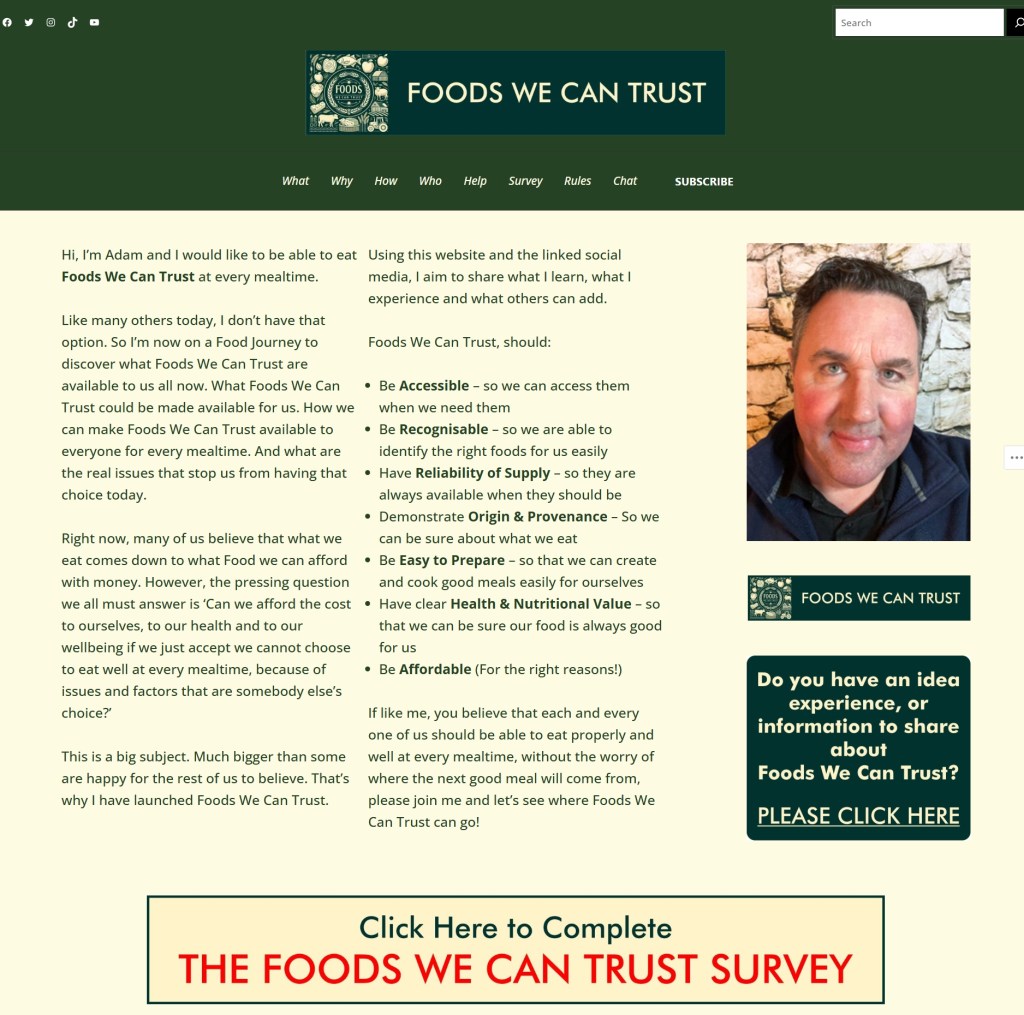
I’m writing about this today, because I have just launched a new website and social media channels to begin a discussion, information sharing, signposting and awareness raising ‘Food Journey’ that I have called Foods We Can Trust.
Foods We Can Trust really should be a name that immediately speaks for itself – and it does.
But ‘Foods We Can Trust’ also triggers many different thoughts, feelings and suggestions that always being able to eat the right Food for us is no longer something that the world we live in today can enable us to do.
I’m about to begin posting about Foods We Can Trust, and I hope that as someone who eats Food every day, you will join me along the way.
If once you’ve visited www.foodswecantrust.org, you’ve had a look around and you feel there is something more you could share that might help others – even if its just a recipe for making a great meal out of Foods We Can Trust, or tips on how and when to Grow Your Own, please do get in touch.
Let’s all share this genuinely important Food Journey together, as it may give us an opportunity to help everyone else who values Foods We Can Trust too.


 Adam Tugwell