Foods We Can Farm, Catch, Harvest and Grow Locally in and around the UK

It’s no great wonder that Foods We Can Trust are thought by many to be boring and bland, as well as being expensive and increasingly difficult to buy or access.

The alternatives often taste good. Always seem to be available whenever and wherever we want them, and in terms of the cost of everything we buy today, the most convenient Foods also appear to be the cheapest.

Ask anyone how many natural, locally or UK produced Foods they could find at a shop they regularly use to buy today, and the list will probably be short and at the same time confirm everything that I’ve just outlined above.

However, the number and variety of Foods We Can Trust that are available across the U.K. and that may be growing on a farm, in an orchard, in someone’s allotment, or perhaps are being docked at a fishing harbour near us today is much greater than many of us think.

We will talk about nutritional values, seasonality, production and other really useful things to know about how we make Foods We Can Trust available to everyone as a part of normal life in other posts.

But for now, becoming aware of and understanding the list basic Foods, or Foods that are either available or could become available to us that we can grow, farm, harvest or catch locally across the UK or around our coastline, is a very important place for us to begin.

A Work in Progress

The information that I am about to share is based on what I either know already, or what I have been able to research using sources such as those that I will link later on this page.

One of the reasons that I began Foods We Can Trust is that I hope to share information about Food Production that isn’t widely known or acknowledge about the Foods We Can Trust that are already widely available, or could be, if we decide to take a different approach.

As such, I hope that the following Tables will be updated and will in time be accompanied by posts, videos and resources that will come from other contributors.

If you notice any errors, glaring omissions or would like to add something yourself, please get in touch!

For now, the Foods We Can Farm, Catch, Harvest and Grow Locally in and around The UK will be broken down into the following groups, with a little detail to help with each:

  • Fruits
  • Vegetables
  • Crops
  • Livestock
  • Wild Livestock & Game
  • Natural Fish and Seafood Landed at UK Ports
  • Natural Fish that can be Line Caught from UK Rivers etc.
  • Dairy Products that can be made from UK produced Milk

Please note that the inclusion or exclusion of anything may not be deliberate and anything you are aware of may be added later.

Equally, inclusion is not making any statement upon the views and perspectives of any individual or group that believe certain foods should be included or excluded for ideological, religious or other reasons. This is about being practical and realistic about the food that we can grow, produce and that is otherwise available across the UK.

Table 1: Fruits that grow or can be grown in the UK

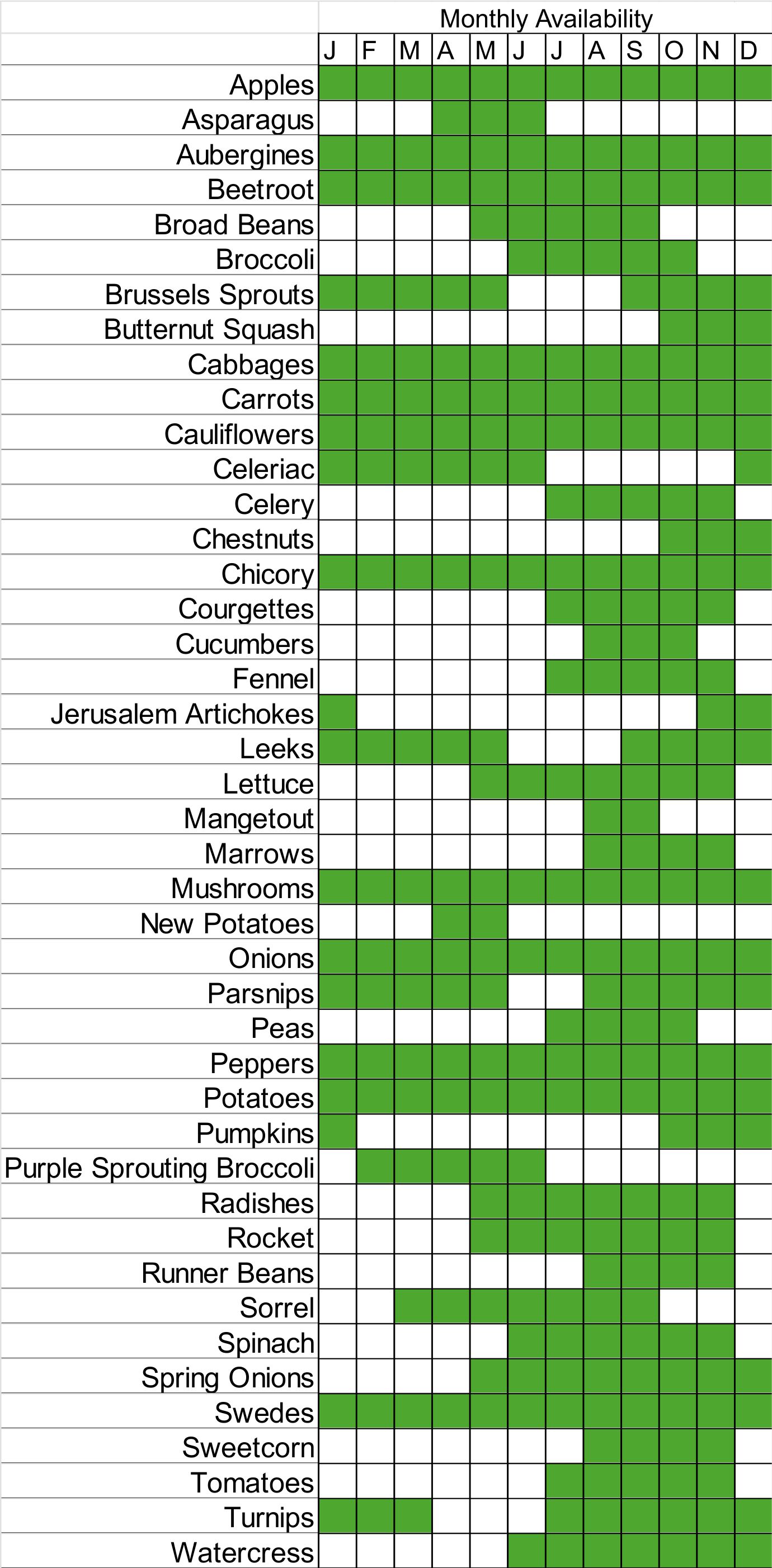
Table 2: Vegetables that grow or can be grown in the UK

Table 3: Crop Types that grow or can be grown in the UK

UK Crops
 AKAFood UseOther Uses
Barley Bread, Soups, Stews, IngredientsBrewing, Distilling, Animal Feed
Beans (Faba)  Animal Feed, Green Manure
LinseedFlaxseedBread, Biscuits, Cakes, Snack Bars, Porridges, Curries, StewsOil
Oats Porridge, Overnight Oats, Granola, Flapjacks, Flour 
Oilseed RapeCanola OilCooking Oil, Mayonnaise, Margarine, Food IngredientBiodiesel
Peas Soups, Casseroles, Pasties, CurryAnimal Feed,
Rye Flour, BreadAnimal Feed, Cover Crop
Sugar Beet Sugar 
Wheat Bread, Cakes, Biscuits, Flour 

Table 4: Livestock that is Farmed or can be Farmed in the UK

UK Livestock (Farm Produced)
 Food UseFood ProducedOther Goods
ChickensChicken, Breast, Fillet, Thighs, Drumsticks, Burgers, Cold Meet,EggsFeathers
Cattle (Cows)Beef, Joints, Ribs, Steak, Burgers, Sausages, Cold Meat, DrippingMilk (All Dairy)Leather
DeerVenison, Burgers  
DucksDuck Feathers
GeeseGoose, Goose Fat Feathers
PigsPork, Chops, Sausages, Sausage Rolls, Burgers, Ribs, Hams, Crackling  
SheepLamb, Mutton, Joints, Chops, Burgers Wool
TurkeysTurkey, Burgers, Cold Meat Feathers

Table 5: Wild Livestock & Game found in the UK

UK Livestock & Game (Wild)
 Food Use
BoarBoar
DeerVenison
GrouseGrouse
HaresHare
RabbitsRabbit
Wood PigeonPigeon
PheasantPheasant

Table 6: Natural Fish and Seafood that is or can be landed at UK Fishing Ports

UK Landed Fish (Seafood)
 AKA
Anglerfishes 
Atlantic Cod 
Atlantic Halibut 
Atlantic Herring 
Atlantic Horse Mackerel 
Atlantic Mackerel 
Ballan Wrasse 
Black Seabream 
Blonde Ray 
Brill 
CatsharksNursehounds
Clams 
Common Cuttlefish 
Common Dab 
Common Edible Cockle 
Common Octopus 
Common Prawn 
Common Shrimp 
Common Sole 
Cuckoo Ray 
CuttlefishBobtail Squid
Dogfishes and Hounds 
Edible Crab 
European Anchovy 
European Conger 
European Flat Oyster 
European Flounder 
European Hake 
European Lobster 
European PilchardSardines
European Plaice 
European Seabass 
European Smelt 
European Sprat 
European Squid 
Garfish 
Gilthead Seabream 
Great Atlantic Scallop 
Green Crab 
Grey Gurnard 
Haddock 
John Dory 
Lemon Sole 
Ling 
LumpfishLumpsucker
Manila Clam 
Megrim 
Megrims 
Mullets 
Norway Lobster 
Pacific Cupped Oyster 
Periwinkles 
Pollack 
PoutingBib
Queen Scallop 
Rabbit Fish 
Red Gurnard 
SaitheCoalfish
Sand Sole 
SandeelsSandlances
Sea Trout 
Shortfin Squids 
Small-Eyed Ray 
Small-Spotted Catshark 
Smooth-Hound 
Solen Razor Clams 
Spinous Spider Crab 
Spotted Ray 
Starry Smooth-Hound 
Thornback Ray 
Tope Shark 
Tub Gurnard 
Turbot 
Undulate Ray 
Velvet Swimming Crab 
Whelk 
Whiting 

Table 7: Natural Fish that is or can be line caught from UK Rivers and Watercourses

UK Fish (Wild/River)
Barbel
Bream
Chub
Common Bream
Common Carp
Crucian Carp
Dace
Grayling
Gudgeon
Perch
Pike
Roach
Rudd
Salmon
Silver Bream
Smelt
Tench
Trout

Please note that whilst links to information sources used to create this page are listed later under ‘Worth a Look’, I have added a link here to Gov.UK – Freshwater rod fishing rules, as there are clearly stipulated fishing allowances for anyone wishing to catch fish with a line from UK Rivers and Watercourses.

Table 8: Fish that is or can be Farmed in the UK

UK Farmed Fish (Aquaculture)
Atlantic Salmon
Lobsters
Mussels
Oysters
Rainbow Trout
Sea Bass

Table 9: Dairy Products that are or can be produced from UK Milk

UK Dairy Products
Butter
Cheese
Cream
Milk
Yoghurt

Worth a Look

I researched the content for the 9 tables listed above on 9 May 2025 using mostly Google Searches made from Cheltenham.

There are a number of very useful websites that will follow from where I sourced most of the information that I have pooled together to construct these Tables. There are others and these have been used because the information they offer is easy to use.

Please note that whilst there is every reason to believe the information linked below is both credible and from organisations considered the same, the inclusion of these links is neither an endorsement nor recommendation of the information these organisations provide. Their referencing here makes no suggestion of there being shared views or objectives, even if there are areas relevant to this page which are aligned.

The NFU (National Farmers Union) Seasonal Guide to British Fruit and Vegetables

The Vegetarian Society – Seasonal UK Grown Produce

The National Trust – Guide to Seasonal Food

DEFRA Accredited Official Statistics – Chapter 7: Crops

DEFRA Accredited Official Statistics – Chapter 8: Livestock

Marine Management Organisation – List of common species codes for Fish Landed in the United Kingdom

Gov.UK – Freshwater rod fishing rules

Overview on ‘Foods We Can Farm, Catch, Harvest and Grow Locally in and around the UK’

The information contained on this page is likely to be one of the most important parts of the Foods We Can Trust initiative.

When we remove all the noise and all the agenda-led information available about what Foods and Ingredients can be brought in from Overseas; what can be manufactured or produced in factories, and why these are the Food Sources that we can and must rely on, the reality is that it is only the Foods and the Ingredients for Meals that come from them that we can grow, catch, harvest and create from these, that have the potential to be classed as genuine Foods We Can Trust.

As this work progresses, I expect to reference this topic frequently, especially as we begin to look at different aspects of UK Food Production more closely, and at Grow Your Own and Home Growing in particular.

I am very keen to add as much information as I can in these important subject areas and will be very pleased to hear from anyone who can add to what is already here in ways that will promote awareness and understanding of the information and processes that will help everyone to have access to Food We Can Trust.

What is Food Security?

Food Security is one of the key reasons that Foods We Can Trust is here.

Because of what Food Security means to me, what I understand it to really be and most importantly, how important I believe Food Security to be in respect of everyone – and that means us all.

However, like many things about Food today and indeed pretty much every experience that we share with others beyond ourselves and what’s very personal to us alone, Food Security can mean a lot of very different things. And that difference is already doing a lot of harm.

What does Food Security mean to you?

Before we continue, could I ask you to please take a moment to stop and think about what Food Security means to you.

Is it about the Food that UK Farms produce?

Is it about being sure there is always Food available to eat?

Is it knowing that you will always have a choice of Food and whatever you want to eat?

For you, Food Security and what it means to be Food Secure could be any of these. It could be any of these in a manner of speaking. Or what Food Security means to you could be something very different, and ALL of the options could still be correct!

The things that Food Security can and does mean

It is important that we recognise and accept that different perceptions of Food Security not only exist.

To some, their own view, or what someone else like the Government refers to or considers to be ‘Food Security’ is the only thing that it can be.

Unfortunately, having any fixed or accepted meaning for Food Security can be problematic when there is a version of Food Security that everyone accepts as being what Food Security means, and those who are controlling that narrative then abuse the trust that people place in the understanding those people have of that version of Food Security and then manipulate information, statistics and even the truth, so that it can be said that either you or the UK is ‘Food Secure’, even when you are not.

In a moment, I will talk about the version of Food Security which is the establishment’s ‘accepted’ term.

I will then discuss the version of Food Security that UK Farmers and Food Producers generally think of when they talk about it.

We will then move on to discussing what Food Security should really mean, to everyone.

The Establishment view: If people can eat, they have Food Security

The way that the establishment, politicians and government operate today is built around this idea or philosophical standpoint:

If people can eat, they are Food Secure

Yes, I understand that suggesting this will annoy different people and organisations who are doing great things in the Food sphere. Because very few of us actually believe that as long as people have a meal of some kind, that’s all Food Security is about.

However, if you consider what having a meal of some kind can and regrettably does mean for so many different people in so many different ways today, you will then begin to see how those who really have control over Food policy, have come to think about their priorities and obligation to the Public in this perhaps honest, but nonetheless very unhelpful way.

If you aren’t hungry, you don’t have a problem

It sounds brutal I know, and it really is.

But with the issues that Government is really facing today – and that means the things that are really going on, rather than what the media and the narratives would suggest we believe, politicians do genuinely believe that if everyone can eat, they have done their job – no matter where our Food comes from or the Food we are eating really is.

This means that all the initiatives about healthy eating, encouraging us to eat properly and even the talk about how important our Farms and Fishing are, are really just wishful thinking and it doesn’t really matter to whoever is in power if they come to nothing. Because the only problem for them will be if people have nothing to eat and then everything as we know it stops as a result.

Foodbanks are a very uncomfortable truth

What I have just written isn’t easy to read.

I wouldn’t be surprised if it makes people feel prickly at the thought that so many parts of government, the public sector and all the organisations that are championing positive messages about Food and what we eat, are currently championing a lost cause.

But if you really want to try to get to grips with what the real priority around Food Security for politicians, the government and the establishment really is, then considering Foodbanks and the need for them – which is disputed by many – will soon begin to tell you what that priority is. And it has very little to do with Food and the role that Food does or should play in our lives.

When I was studying at the Royal Agricultural University, I wrote a paper after researching Foodbank use today and compared their role in poverty today in relation to my own experiences of poverty as a child. It’s called ‘Is Poverty Invisible to those who don’t Experience it’, and the full version can be read by following the link immediately below:

The Farmer view: Food Security is about the Food that we Produce in the UK

Whilst Food Security is a much broader set of issues than many realise, the one version of Food Security that is perhaps easiest to understand and relate to is that too much of our Food comes from overseas and outside of the UK.

Please read my last post on Foods We Can Trust ‘Rationing and Health: The Surprising Benefits’, if you would like to explore this view of Food Security and what the risks of being dependent upon Food from Overseas can mean.

The latest figures from The United Kingdom Food Security Report from November 2024 suggest that the amount of Food that the UK produces, that we consume ourselves, is 58%.

However, as you read through the detail of this Government Report, you may note that this figure relates to ‘Food by Value’, which sounds very much like a way of using statistical jargon to make the figure sound higher than it actually is.

Regrettably, this is the kind of language or political double-speak that people in power and authority use, knowing that it is the figure that members of the public will usually note, rather than the words that the figure has been deliberately wrapped with!

During the 2023-24 Academic Year, the figure that I was using for my research, reports and writing was 54%. I found sources that suggested that it was already as low as 52%. I have seen no evidence to suggest that the UK has increased the amount of Food that it produces for our own consumption during that time.

The amount of Food the UK produces and what we would all have available for us to eat in a time of national emergency where the Food Chain was impacted are two VERY different things.

The impact of the Global Food Chain

Because of the way globalism has affected Food Chains and that Food ingredients are sourced and often moved around as they are processed and manufactured to become the Foods that we often eat, it means that very few of the Farms we pass by each day or know of, actually produce Food that we could eat or prepare to eat straight away, if we found ourselves needing to buy from the Farmer direct.

Even if we accept the figure of 58% that the Government has used in its latest Food Security Report, to quantify the amount of Food that the UK produces itself, the actual figure that relates to Food Produced in the UK, that people living in the UK can actually then eat is likely to be much less. Because so much of the Food Produced across the UK goes into Food Supply Chains where it is nowhere near ready for our consumption or is otherwise transported overseas.

The figures being used are therefore an equivalent. Because we have to import the equivalent of the Food that is grown in the UK and then exported or used for other purposes – because that’s how it goes into the Food Chain, and what we actually eat comes back into the UK from overseas.

The reasons that many farms don’t grow or produce Food that is ready for us to eat are many. It may be as simple as the way we eat and prepare Food in the UK means that we don’t like certain cuts of meat. It could be that even though the UK has vastly rich reserves of Fish and Seafood, we don’t actually eat that much of it ourselves and most of it goes to Europe. Or it may be that the wheat and the flour it produces that makes the kind of bread that Supermarkets have made us all believe we all want to see on sale, is most easy to produce when it comes from overseas.

If it sounds confusing, it is. And it helps those who are benefiting from the way that the Food Chain works for it all to be very confusing too!

The bottom line is this:

If we had a crisis tomorrow and the UKs borders were shut down, meaning that no more Food could come in from anywhere overseas, it wouldn’t take long before we all experienced Food Shortages. The Food Producers and Farmers that we have in the UK would have to undergo massive structural and system changes, before they would even be close to being able to meet that need. There is no way that would be possible, overnight.

This is scary stuff I know. But its very real and there are parts of government and other organisations that are researching, studying and thinking about what they call Food Resilience, the whole time.

If you would like to look more closely, here is an interesting link:

Just in Case: 7 steps to narrow the UK civil food resilience gap – National Preparedness Commission

(Please note that this is not a recommendation or endorsement)

The UKs Food Security is at MASSIVE risk, right now

If you’ve read this far, you may be beginning to see the picture of just how vulnerable the UK Food Chain is, and that within the Food Supply that we are eating from and have available to us, the priorities of those with influence over the Food Chain are not anything like what most of us would think.

We are NOT Food Secure, anywhere in the UK today.

With global uncertainty unfolding in the way that it currently is, we could easily find ourselves experiencing Food Shortages or perhaps even worse, at any time.

Even supporting our Farmers with the Food Production related issues as they see them is not as simple and straightforward as campaigns like that driven by No Farmers No Food and some of the Farming Advocacy Organisations would suggest.

A successful outcome to any of their current aims wouldn’t be as effective for any of us, as they are suggesting the changes in government policy that they want for themselves would be. Simply because with the if the priorities remain the same, many of the Farms affected by the policies which are in the spotlight aren’t producing Food that would be of any immediate use to us to counteract Food Shortages in a crisis, anyway.

So, what does, or rather, what should Food Security really mean?

What Food Security and being ‘Food Secure’ should mean

To be fair, part of the problem, when it comes to the meaning of Food Security and being ‘Food Secure’, is that the whole subject and all of the other subjects and public policies that the issue of Food Security links to, are VERY complicated. And in many respects, deliberately so.

That’s why it’s very easy to be convinced by any soundbite we hear or read that makes some version of Food Security and what being Food Secure means to someone else, easy to get behind.

If we were to distil Food Security and what it means to be Food Secure into the simplest terms possible, it would probably be something as follows.

Namely that we will be Food Secure and have Food Security when:

Everyone can choose to eat enough of the Foods that are Good for them and that will meet their genuine needs at every mealtime, without any experiencing fear of going without or not knowing where the next meal will come from.

However, even this is open to interpretation.

Food Security will regrettably continue to be vulnerable and at risk for as long as what it means to be Food Secure can be interpreted differently by different parties, in ways that are not actually wrong. From a certain point of view.

To overcome this problem, it is likely that we all need to at least review and, in all likelihood, moderate or change the way that we think about Food Security and what it is to be Food Secure.

With this in mind, the key ingredients that together provide Food Security are that the Food Supply is:

  • Reliable and NOT under Threat
  • Available
  • Accessible
  • Meets Nutritional Needs and Health Requirements
  • Affordable

I will now add a little more detail to each, so that they and how they each interact with each other as part of the Food Security equation will hopefully begin to make more sense.

Reliable and not under Threat

Food Security can and will only be achieved when the supply of Food for everyone is not at risk.

If we are Food Secure as a Country or perhaps at the Macro level, the Food Supply cannot and will not be compromised by anything that we and our own systems of governance cannot independently address.

Today, government figures suggest that we are reliant upon at least 42% of the Food that we consume coming from Overseas. That’s before we consider that of the remaining 58%, only a fraction of that figure represents Food that any of us could eat at any time.

IF there were a national crisis and the borders shut down, this would mean that even if two thirds (66%) of the Food We Need were available to us every day, year round, that would still mean that more than 22 Million People in the UK would have to go hungry, if the rest of the population were to continue eating the same meals as they do, today.

However, we also know that even this isn’t the real figure. Because of the way that the UK Food Chain and Food Production works.

The reality is that if we were to experience a real national crisis where no Food from overseas could be brought in, the UK only has enough food AVAILABLE for everyone for perhaps a few days, before Food Shortages would cut in and people of all kinds would start to go without.

Available

We will only be Food Secure when the Food We Need is always available, to everyone.

Being available to everyone means that there is no reason that the Supply of Food can be obstructed or held up by anything that is outside of the control of the person who needs to eat that Food, or the People around them who they know and can trust.

The factors that can make Food unavailable to some are:

Cost

Food is too expensive for some people to be able to afford to eat properly at every mealtime. And the retail values of all the Food we buy today are continuing to shoot up!

To be Food Secure, the Food We Need MUST be affordable in the sense that the price to buy or exchange something for that Food is realistic and the price has not been overinflated by something like greed, profiteering or another agenda of some kind.

Supply

For most of us, the Food we are able to eat today relates directly to the Food that is supplied to the shops, websites or other sources where we buy it.

If we cannot source the Food We Need, the supply is not functioning as it should, and we are NOT Food Secure.

If the only Food Supply that we can Access will provide us with ‘Food’ that isn’t healthy for us or that we can afford to buy (with the money we have available) then that Supply is also NOT Food Secure.

To be Food Secure, we must ALL be able to Access the Foods We can Trust, without having to choose from Foods that are not good for us, as a substitute.

Religion and Ideology

Regrettably, agendas, ideas and even religion can get in the way of us being able to Access Food that is available. Because ideological restrictions can easily prevent some from accessing that Food, because others have made a ‘conscious’ choice.

This is not a matter of saying that anyone who will not eat certain Foods because of a religious or philosophical viewpoint is wrong.

It is merely a fact that many of those same people then influence the Supply of Food around them, because of the choices that they themselves make.

The agendas of other people are also important to consider. In instances such as the political pursuit of Net Zero, the choices that politicians are making and some of the worlds billionaires are using their financial resources to impose, will lead to the supply of Foods We Need being restricted and potentially stopped, only because of the ideas that they wish to pursue.

We will only be Food Secure when no other person can influence the supply of the Foods We Need, simply because they have the power, influence or financial means to do so.

Greed and Profiteering

In my recent book ‘Who Controls Our Food Controls Our Future’, we unpicked the layers of the Food Chain onion to expose just how the Food Chain that brings most of the Food we all eat today, isn’t really about the Food We Eat at all.

The Food Chain today is ultimately all about money, profit and the power and influence that go along with an entire Food System that is being increasingly used as a tool of societal control.

People, Communities and entire Nations can and will only be Food Secure when they have complete control over their Food Chain and Food Destiny.

That means Food being all about the Food and what Food really means to People and Life, rather than the Food Chain being all about money, profit, influence and control, as it is now.

Accessible

We will only be Food Secure when the Food We Need is always Accessible.

Access literally means that we can access the Food We Need for every mealtime and that no matter where we are, what transport we have available, or what physical barriers might be in the way, these factors will never get in the way or stop us from eating as and when we might like or need to.

To put this in context, most of us can access one of the well-known supermarket brands across the UK, either by being able to travel to one of their stores, or by being able to make an online order that will then be delivered to our home or wherever we are, from there.

However, our Food Access is now limited to whatever the stores we are able to access actually sell.

Food Security will not exist until we are able to access the Foods We Need, whenever and wherever we need them to be.

Meets Nutritional Needs and Health Requirements

We will not be Food Secure until the Food that is Available, Accessible and Affordable, also meets all of our Nutritional Needs and Health Requirements – not matter what we may then personally choose to buy, prepare and eat from the Food that is available.

No matter how politically convenient it might be for politicians and the establishment to work on the basis that ‘Food is Food, no matter what the Food really is’ – whether deliberate or not, the truth is that Not all Food is equal in the Food Chain today, and the greater percentage of the Food that is Affordable to everyone, isn’t actually very good for us at all!

Affordable

Whilst we have already talked about Cost and the price of the Food that we buy, there is also a much bigger and perhaps even more alarming dimension to the issue or question of the Food that people can afford to buy. It relates to the issue of the Affordability of Food itself.

If people cannot afford to feed their dependents and themselves for reasons outside of their control that mean they don’t have enough money to buy the Foods they Need, they are NOT Food Secure.

Food Security for them, is unaffordable.

It is very easy for those who can get by each week to look unfavourably upon those who cannot and to assume that anyone who doesn’t have enough money for Food – either for themselves or themselves and their dependents – will have found themselves in difficulty through their own financial mismanagement. Or because they don’t work as much as they should.

Whilst this may of course be true for some, the number which it would be accurate to describe will be significantly smaller than many might imagine.

Indeed, the reason why many people today find themselves short and in need of emergency help like that provided by Foodbanks, is because a significant part of our society does not either earn or receive an income high enough – even for working a full working week – to cover the basic cost of living and to provide themselves with the basic essentials that are necessary today, just to stand still.

In October 2023 I wrote about what it genuinely cost to live as opposed to the rate of the National Minimum Wage and calculated that the difference between what those working a full-time 40hr week on the lowest legal wage and what it would actually cost to live without claiming benefits, help from charities (Foodbanks) or getting into debt, was at least £2.50 per hour or £100.00 per week.

Although the rate of the National Minimum Wage jumped to £12.21 in April of this year, there is no reason to believe that with inflation continuing to push up the cost of living as quickly as it has, that anything is really different for anyone on the lowest wages now.

Just as serious is the reality that life for many today revolves around credit.

Those with monthly payment commitments, including even those earning what many of us would consider to be very good wages, can easily find that a list of monthly outgoings that seemed very affordable at the time the commitments were made, can suddenly become an unaffordable burden. When even the smallest of changes – perhaps to utility bills, fuel or similar takes place, and payments are raised with those higher costs automatically taken from a credit card or bank account.

As food is one of the few things that most of us still pay for, as we go, it is easy to see how the disposable income left for Food and other essentials can very quickly disappear, pretty much as we are all still asleep!

Food Security and Income are inextricably linked

The reality is that Food Security at the personal or perhaps micro level, is inextricably linked with income levels and what it costs to live.

Because government doesn’t priortise the Food Chain and Supply of Food in the way that we all really should, Food has become an afterthought in far too many ways.

No serious steps have been taken to acknowledge and certainly not to make provision for the need for everyone to be able to access and eat enough of the Food We Need, without being dependent upon the help or intervention of others to get by.

Any government that doesn’t recognise and legislate to ensure that everyone who is able to work can earn enough to cover the costs of the basics and essentials they need on a basic wage, without benefits, charity or debt, is not fulfilling its obligations or responsibilities to society at all.

Until the Food We Need is affordable for everyone – no matter how ridiculous in today’s terms that might seem, we will NOT be Food Secure!

Truth vs Truths that serve someone else’s purposes

The Food Security question and getting to grips with Food Security and what being Food Secure really is, demonstrates just how easy it has become for those with platforms and influence to speak about a subject and mean one thing, whilst knowing that to everyone else, what they have said will be heard as something very different.

Both the Establishment (Inc. Government, political, big business in the Food Chain) and the U.K. Farming industry hold positions on Food Security which are arguably right, from a certain point of view or from a manner of speaking.

Both positions on Food Security, either when:

  1. People have ‘food’ or
  2. Food should be produced on Farms in the UK

are both correct.

But they are also only partial truths.

Like any good sales tactic, a partial truth – or a sales pitch that contains an element of truth that they know will make the whole narrative, story or line sound like the whole thing is true – and is often enough to make an argument that is otherwise utterly flawed sound compelling, because we have fallen into the trap of assuming the rest!

So yes, it is certainly correct to say that we all need to eat food and if we are fed, we will not be hungry. But if the food itself isn’t good for us, is unaffordable, could potentially do us harm or comes with strings attached, it will not be Foods We Can Trust.

Equally, if only the equivalent of what we all eat is produced or grown on Farms across the UK, but is nonetheless produced with chemicals or processes that cause harm in any way, or the food grown is itself transported overseas and replaced by food that comes from overseas so that the net equation says we are producing what we eat ourselves, that also isn’t Foods We Can Trust.

Where Food Security is concerned, Farmers cannot be victim and saviour at the same time

It is important to add that I am massively pro-UK Farming. I’m just not pro-UK Farming in the sense that the industry typically functions today.

Farming today is actually part of the Food Problem. Because it has become part of the global model that is causing all the problems with Food.

Farmers understandably want help and support from everyone. But what they really want is for the establishment to change its policies so that the way farming works today stays the same, but just works better – more realistically, but also more profitably for them.

What many in the industry have not recognised yet is that UK Farming is no longer seen as being necessary to an establishment that believes it doesn’t have a problem with the Supply of Food, as long as people are being fed – no matter what they are being fed with.

Meanwhile, the people – that’s us – who desperately need UK Farmers to see the bigger picture and step up in a very different way – will lose out twice as badly if UK Farming collapses and the establishment gets its way!

If you’d like to read ‘Who Controls Our Food Controls Our Future’, a copy is available online HERE.

If you’d like to understand more about the realities that underpin the differences between what we say deliberately or innocently, and what others hear, a read of the very interesting book ‘Words that Work – It’s not what you say, It’s what people hear’ by American Pollster Dr Frank Lunz may be worth your while.

Going round in circles

You may now feel the need to circle back to the ‘as long as people aren’t hungry’ backstop – which is where without good governance and leadership, the bigger Food picture and the importance of Food and the role it should be playing in our lives usually falls down.

We can accept what others tell us. Or we can be clear that we require Foods We Can Trust to be normal life for all.

Foods We Can Trust – A Food Journey with Everyone in mind

Hi Everyone,

For a long time, I’ve been concerned about Food Security, The Food Chain and the way that the role of Food seems to have been deliberately dismissed, as if Food is not something that is essential for everyone to consume, each and every day.

I wasn’t aware that a common theme was emerging as I began writing a series of eBooks that started with Levelling Level in early 2022, and has now spanned 8 or 9 different books, essays, and blogs.

Food is so much more than being about what it costs. Even though our culture expects and encourages us to think about Food that way.

However, Food isn’t all about Farms, Food Production and the Economy either. And I have been saddened as I have watched the growing issues surrounding UK Food Production and specifically the UK Farming industry. Not because I don’t agree that our Farmers need help. But because none of the issues surrounding Food are as they appear, but everyone continues to believe that treating them as if they are, is how all our Food-related problems will be solved.

The Food Chain should be at the centre of everything. And if we were treating the importance of what we eat in the way that we should be, the way that we live and the way that we experience life would be much better than what we are living through right now.

The Growing Food Crisis

Farmers, like many others with absolutely nothing to do with Food Production who will read this, are victims of a growing Food crisis that many of us don’t even realise exists.

Everyone is being affected in different ways.

This growing Food crisis isn’t directly to do with Farmers Inheritance Tax, building on green belt land, covering productive agricultural land with solar farms, any one of the seemingly endless issues in the News causing upset, or anything you are likely to find from an internet search around foods, farms, climate change or the environment. Although it will certainly flag all sorts of stories that will be viewed by different people, differently.

These Food-related issues are all important in very specific or subjective ways.

But there is a much bigger issue at the heart of all of this that we need to consider carefully before any of the solutions that we can come up with can really work.

The real crisis about our Food and what we eat each and every day, is this:

We take Food for granted.

We take Food for granted. Not just in terms of the supply of our Food and the misplaced confidence we all seem to have that Food will always be there, on a supermarket shelf or ready to be delivered. But more significantly, because we rarely, if ever, give real thought or think consciously about what it is that we actually eat and what the ‘food’ we treat as being a normal part of our lives contains.

Yes, you may have immediately thought something like ‘It’s not that I don’t think about it. It’s just not worth it because what I eat is always about what it costs.’ And you certainly wouldn’t be alone if you did think this.

However, this and the many other thoughts and different perspectives that might be triggered by touching on this question certainly reveal or open the door to a rather uncomfortable truth: We have all allowed or just accepted that the food we consume is not as important to everyone as it should be.

The importance of The Food We Eat

Let’s be clear. Food is as important as the Air that we breathe and the Water that we drink.

Yet because the results of eating food that isn’t good for us aren’t in any way as immediate as they are if we breathe bad (or oxygen deficient) Air, or drink Water that is contaminated in some way, we really have become dangerously indifferent about the Foods that we eat.

Perhaps the easiest reason to be dismissive (or excuse not thinking consciously about our Food) is the idea that as long as we are not feeling hungry, nothing else matters when it comes to what we eat.

Yes, people do eat whatever food is available, that is accessible and fits with their lifestyle and think that if it has all been financially affordable, then as far as what they eat is concerned, that really is all there is to worry about.

We cannot and should not blame anyone for feeling that way. They are supposed to.

Regrettably, accepting the status quo and all the messaging that goes with it, without question can have and for some already has had life-changing consequences.

Mental health issues, physical health problems, obesity, compromised longevity and the many offshoots that shoot out in every direction of life are just the issues already affecting millions of lives because of the Food that we eat. And that’s before we begin to consider what our relationship with Food should really be because of the impact that it has or will have in so many other ways across our lives too.

Changing Minds Changes Lives

The importance of the Food we eat is something that we all have in common – whether we like it or not.

Once politics, idealism, religion, profiteering and other agendas and self-serving ideas are removed from the Food Chain, We are all the same. We all have the same essential needs.

We are all human beings with the same need to consume Foods at every mealtime that are genuinely good for us.

Eating properly and eating well should be normal for all of us. Just as it once was, before an endless list of apparently compelling reasons began to grow, peddling what sound like compelling stories like the one that says, ‘Good Food is too expensive to eat’.

The reason stories like these become the accepted truth is because Good Food being expensive to buy IS the experience that some people genuinely have. An apparent problem that someone else always seems happy to provide a solution to that only really benefits them in some way.

If the idea that we cannot afford good food, as opposed to the reality that we cannot afford the cost of not eating well in so many ways sounds conflicted to you, you are certainly not alone. And thinking differently about ALL of the Food that crosses our lips and that we consume at every mealtime really is the start of a Food Journey that has the ability to fix so many different things that aren’t working well for us today.

Please join me on the Foods We Can Trust Food Journey

I’m writing about this today, because I have just launched a new website and social media channels to begin a discussion, information sharing, signposting and awareness raising ‘Food Journey’ that I have called Foods We Can Trust.

Foods We Can Trust really should be a name that immediately speaks for itself – and it does.

But ‘Foods We Can Trust’ also triggers many different thoughts, feelings and suggestions that always being able to eat the right Food for us is no longer something that the world we live in today can enable us to do.

I’m about to begin posting about Foods We Can Trust, and I hope that as someone who eats Food every day, you will join me along the way.

If once you’ve visited www.foodswecantrust.org, you’ve had a look around and you feel there is something more you could share that might help others – even if its just a recipe for making a great meal out of Foods We Can Trust, or tips on how and when to Grow Your Own, please do get in touch.

Let’s all share this genuinely important Food Journey together, as it may give us an opportunity to help everyone else who values Foods We Can Trust too.

Best wishes and thank you for your support.

Adam

http://www.foodswecantrust.org

Is Poverty invisible to those who don’t experience it? | Full Text

Introduction

In the Autumn of 2023, I embarked on a new adventure into higher education, driven by my building concern around Food Security issues and the certain reality that the UK is running the increasing risk of suddenly finding itself without sufficient food supplies for all of us to eat.

The journey that had taken me to a Postgraduate Course at the Royal Agricultural University in Cirencester at the age of 50 had been a long one. I very quickly began to feel as if I was meeting all of my accumulated experience head-on, quite literally by coming at it from the other direction. Or in what is the academic, abstract or theory-based way, as opposed to the predominantly experiential route my life has typically taken me before.

It was a mixed blessing. And whilst my concern that academia looks backwards to try and work out solutions for the future may have grown, I also experienced thinking of a kind which although restrained by the machinations of the UK’s current higher education environment, certainly helped me close that circle and helped me to view the difficult periods of my own story as one that I can fully appreciate and own.

One Module of my Course of Study was being trialed in a different way. The Course Tutors invited students to undertake what might be called a mini dissertation. Doing research on the real-life implications of poverty, with the suggestion that we might relate this research to our own life experience in some way.

With the childhood experience of being in poverty, it was not many moments before the opportunity to share something deep that might benefit others was flashing across my internal thought screen. And I was very happy to embrace the project with the aim of giving it everything that I have got.

The following pages represent the completion and submission of that work.

My final Report has been reprinted with only the details that could easily identify the personal information of those taking part removed.

The main body of the work has been adapted to form an e-book published on Amazon in June 2024 and has been reset with some very minor editing for the purpose of making this PDF available as a download from my Blog www.adamtugwell.blog in late 2024, and now as a full text version online in 2025.

I have shared this content, as the work has been assessed, marked and forms part of the Postgraduate Certificate in Sustainable Agriculture and Food Security that I was awarded by the RAU in 2024.

After filming and publishing a video about Poverty in the UK which leaned heavily upon what I have learned and not least of all the understanding that You have to experience or be touched by Poverty to understand it, I have concluded that its relative popularity suggests that it will be helpful and of benefit to others if I were to publish the original (academic) work in different formats.

Poverty IS a problem that CAN be solved. It is a blight on UK society that simply shouldn’t exist. However, Poverty and our inadvertent acceptance of it is also symptomatic of the greater ills that we have to face, but which those so far untouched by Poverty are happy to avoid. Because to many, Poverty is something that happens only to other people, who are someplace else.

Thank you for reading and giving thought to what the realities of Poverty today really are.

Adam Tugwell

February 2025, Cheltenham. UK

The Structure of this Booklet

In as much as it can be, the content of this e-book reflects the structure of the academic submission that I made to the RAU in December 2023, as a requirement of my Postgraduate Course.

The process followed should be self-explanatory through Parts 1 – 3 of this Booklet.

Parts 1 – 3 are then followed by the Reference List and the 1st Appendix, which includes the list of questions that I asked as part of the research project you are about to read.

The References used include academic standard sources and it is possible that some of these may not be accessible to readers who are not currently studying or working within the UK Higher Education system, without paying a fee.

Where this is the case, and you would like to consider the wider work offered by those sources, it is likely that a full Internet search will identify alternative pathways and/or sources.

I make no apology for the ‘grey’ information referencing, such as links to pictures of mail-order catalogues and other such materials. I believe these can only be of help to someone reading about the 70’s and 80’s as a child in Poverty, without their own experience of it, attempting to picture the being there and ‘living it’ for the very first time.

AT

Part 1: How we perceive Poverty in the UK

Despite the heavily publicised cost of living crisis and 14.4 Million People in the UK living in Poverty in 2021/22 (HoC Library, April 2023), the perception that ‘poverty is something that happens to someone else’ remains prevalent.

Poverty is neither new nor a temporary phenomenon. William Beveridge’s 1942 Report suggesting ways the Government should rebuild after World War II identified Poverty as a major issue. Albeit one identified as consisting of five ‘Giant Evils’, namely ‘Want, Disease, Ignorance, Squalor and Idleness’ (BBC, 2014) which are unrecognisable in the language of today.  

However, Poverty has been recorded as a social problem since at least the 18th century (King, 2000), with the first notable legislation relating to Poverty being The Henrican Poor Law of 1536. (JSTOR)

It was the early 19th century before recognition of the need for considered legislation (UK Parliament), when work was undertaken to ensure that poor families received a basic education (Adamson).

Despite documented history, contemporary thinking suggests denial of genuine poverty. MP and Deputy Chairman of The Conservative Party Lee Anderson recently referring to ‘poverty nonsense’, stating that ‘real poverty’ was something that existed in the 1970’s. (Independent, Oct 2023)

From theories underpinning Malthusianism, where the first documented attempts were made to explain the mechanics of Poverty (Harvey & Read, 1992) to current exponential growth of Foodbanks reaching a total of 2,572 across the UK (HoC Library, Oct 2023), there is a disconnect between evidence of Poverty and the perception of what Poverty is.

My own experience of Poverty

I grew up in a one parent family, without a dad until I was a teenager. My parents separated when I was 7 months old and I was 6 when my mother secured a 3 bed ‘council house’ so my brother and I could have rooms of our own.

This was before the Child Support Agency and my father never paid any form of maintenance. My mother, brother and I were dependent upon ‘Social Security’ and ‘Family Allowance’, collected weekly, when mum walked to the Post Office to ‘cash’ a ‘Giro’, before the ritual of immediately buying whatever we were out of, or replacing anything broken that couldn’t be secured in another way such as paying a small amount weekly using the Gratton catalogue (Vintage Catalogues).

Although conscious that money was ridiculously tight, I never felt like I was going without. I didn’t miss the things other people had. Because they were things that I’d never had.

We received free school meals, had free school milk (Eastern Daily Press, Jan 2006), regular School Uniform Vouchers and I recall an emergency grant from the DHSS so that I had a proper mattress to sleep on. Hand-me-down clothes were often as cherished as I feel now about something new.

The signs of parental struggle were hidden from view, until either a distant family member had to step in financially, whilst charging a heavy emotional price, or I became aware of the abnormality of what I considered normal, like getting myself up, ready and walking the mile to my junior school, because one of the ways mum coped was to stay in bed.

The day the electricity coin meter was removed was one of celebration. I knew there was no more risk of being sent out late on a cold night to knock on doors or ride my bike to the garage to change a note for some coins.

I’ve heard it said “Privilege is invisible to those who have it” (TED, 2015). And in the context of my own life, I question, ‘Is poverty invisible to those who do not experience it?’

Considering poverty in the UK today

I believe everything to be relative to the life experience each of us has.

From this perspective and the limitations of time and scope to complete this project, I felt the most effective way to compare my experiences with the realities of poverty in the UK today, was to speak to a professional dealing with Poverty daily. Someone who could provide an objective, first-hand view of what people in poverty are experiencing, as opposed to today’s ‘accepted’ view.

Although I recall a Christmas Food Parcel from the local Church as a child, there was no regular access to Foodbanks, which have only become prevalent in the past 15 years. (HoC, Oct 2023).

Foodbanks are the obvious change in Poverty since I was a child, and I concluded this would be the ideal focus for my research.

Part 2: My Interview at a Gloucestershire Foodbank

Overview of the Foodbank

The Gloucestershire Foodbank [GFB] is housed and governed by a local Church. GFB runs as a separate organisation under the Trussell Trust umbrella, using their referral pathways and quality frameworks.

GFB operates three sites of its own within a Gloucestershire Town area, with the Salvation Army operating a linked site in the Town.

Discovery (Questions asked, Please See Appendix 1)

I asked Interviewee A (IA), for an overview of their role and what the Foodbank does. (Q1)

IA said the “Principle is that its people who are in food crisis and needing immediate support with food.” GFBs work is about “Crisis support, rather than ongoing. However, what used to be a crisis is harder to get out of, so we see people more regularly than we used to.” (Q2)

We provide an immediate food parcel that will support people for a minimum of three days and we also have Citizens Advice workers on site to provide ongoing support as well.” (IA, Q2)

The presence of Citizens Advice (CAB) on site was a surprise. CAB have been providing support for the past year and GFB would no longer continue without it. (Q2)

I then focused on the use of GFB (Questions 5 – 20). 2022/23 had been GFB’s busiest year ever with a 40% upsurge in use. Numbers had already exceeded the Covid peak (which had been the previous peak) (Q6)

Whilst the largest demographic of users are single males “Because they rarely qualify for anything else.” (IA, Q16), the most significant change in user numbers in the previous year had been a 95% increase in the number of Pensioners using GFB. (Q16)

The reasoning given by IA for the rise in numbers was “Things cost more. Basic stuff has increased hugely”. “People have seen their rents go up by at least a couple of hundred [Pounds].” “You get ‘no reason evictions’, because they [Landlords] want to put the rents up.” (IA, Q7). They then added, “There’s an increasing issue with debt, [it] exacerbates the issue further.”

The growth in the number of GFB users came primarily from the existing demographic, areas around the Town with significant social housing numbers. However, there had been an “Increase in referrals from everywhere, from people who are working and not working.” (IA, Q8) It was also notable that 10% of GFB users are working, with this number increasing. (Q8).

We moved to qualitative and experiential issues for GFB users. IA listed challenges with rent, challenges with benefits and sanctions (Q9). Debt repayment within the benefit system “Takes people over the edge with what they can manage.” (IA, Q9)

IA added, “It’s been really interesting with Citizens Advice [working on site]. They say, ‘If you work with people, you can get almost anyone out of that crisis point’. Because usually there was an [identifiable] cause of it. But there isn’t always now. Sometimes there just isn’t enough money to cover everything.” (IA, Q9)

Relating the perceptions of Poverty in the media, I asked about users abusing GFB. It was clear that whilst there is a small amount of abuse, this was attributable to people, where “Their survival technique is to work the system.” IA later added, “I don’t think for many people it would be, ‘This is the way I want to live’”. (IA, Q10).

Asked about the typical experiences of GFB users, IA was clear that those suffering food poverty would also be suffering fuel poverty [energy poverty] too, and that there are simple realities at work such as being unable to cook food without electricity or gas. (Q13)

Attempting to understand how IA perceived the view of the public, IA felt that there is a lot more public awareness than there used to be, and that lots of people really do care. (Q19).

When asked if they felt Politicians [and government] understood the need for Foodbanks, IA said “If you’ve never experienced life like that, it’s very difficult to know what it’s like to live hand to mouth, in that place of crisis.” IA then added, “The minute you are removed from the ground, it becomes theoretical.” (IA, Q18)

IA suggested the perception society has of food Poverty and the use of Foodbanks is key to any solution. IA was considerate of how the system [government] works, and felt that working with other organisations was key. IA said “If we work together, there’s a lot more hope than if people come through between different agencies.” (IA, Q17)

Foodbank users are apprehensive, feel shame, have a sense of failure and benefit from experiencing a ‘safe space’. (Q20). Foodbanks are most effective when they “Make people feel like they matter”. (IA, Q20)

Part 3: What I found – A critical review of the research, reflection and reporting process

My experience of this project was sobering. Although I lived with Poverty growing up, that experience was quickly put in the context of how a child in Poverty might feel today.

The role of cultural expectations, media advertising and the disproportionate influence of pester power on parents navigating Poverty was brought into sharp focus when IA said, “The one thing they [parents] don’t want is for their child to feel excluded again.” (Q14)

The comment took me to the experience of a schoolfriends visit to our home and being ridiculed the following week because we had a black and white TV [when it was ‘normal’ to have colour]. In no time at all, my mum did a deal with the TV repair man and bought an old colour ‘set’. One that had probably been condemned.

Whilst “The expectations of life have changed.” (Q14), it was clear the commonality in the experience of the effects of poverty, or what being in poverty feels like, are very much the same now, as when I was a child. Particularly as IA’s view of poverty was “It leaves people in a continual state of crisis, because even if there is money coming in, you are never quite sure there’s going to be enough. You are never able to have peace about the situation, so there is always that anxiety”. (IA, Q11).

I was right there, feeling Poverty, as a child. But when IA shared “If you want to move people into work, they need to be able to work; not just survive.” (Q15), I was able to relate a range of more recent life experiences too.

Is anything really different about the way we look at Poverty now?

The recognition of Poverty as a social problem from the 19th century onwards has encouraged growth in academic thinking and commentary.

Highly valued work such as Rawls ‘Veil of Ignorance’ (JSTOR, 1999) help identify that society lacks basic Poverty awareness, and that the solution will require people to think differently.

However, whilst highly regarded commentators like Daniel Chandler (Free & Equal, 2023) consider Rawls work to be groundbreaking, the use of changing perspective as a tool to instigate fairness through behaviour modification is not new. It is documented as the principle of ‘Divide and Choose’, and has references in Genesis, Chapter 13 and 1 Kings, Chapter 3. (King James Bible).

So, whilst such solutions may be ‘new’, they may only be original in so far as context or the subjectivity of the viewer is concerned.

The importance or relevance of context in understanding Poverty

It is striking that technical understanding or acknowledgement of Poverty is present throughout history, both anecdotally and documented form. Yet Poverty continues to exist.

Historically we had Workhouses and Paupers. As a child, we had ‘Social Security’, ‘Family Allowance’, Council Houses and Black, and White TV’s. Today we have Universal Benefit, Benefits sanctions, Social Housing and Xboxes.

The tools Poverty uses to touch lives are forever changing. But the impact of Poverty remains the same.

The lived experience of Poverty reflects the time and how the world around us operates.

The tools Poverty inflicts harm with can be so different, that a different language is required to fully elucidate and contextualise the lived experience of Poverty at that moment in time.

Yet knowing only this may prevent translation of the message about Poverty, that everyone needs to hear.

The experience of visiting GFB and reflecting on what I learned made clear that when an individual is not experiencing the specifics of Poverty, in that moment, even when that individual has first-hand past experience of living in poverty and arguably therefore has the ability to relate to it very well, they can and will view Poverty in a mechanical way. Rather than the emotional way that is only possible for those enduring the lived experience at that time.

I agree with IA, that “The minute you are removed from the ground, it becomes theoretical.” (IA, Q18)

Rreflections on Poverty in the UK today

I have become aware that:

  1. The technical existence of Poverty is widely accepted, but its impact and reach is not.
  2. The interpretation of Poverty is relative to the understanding of the viewer or those experiencing it.
  3. Poverty is itself is highly subjective and constantly evolving.
  4. Because the universal acceptance of Poverty is technical, no official effort is made to understand what lived experience of Poverty really is, leading to public policy solutions that make the subjective or experiential nature of Poverty considerably worse.
  5. Poverty requires a permanent solution that is objective and universal, that fully considers the subjective elements that make lived experience of Poverty real.

Whilst models for modifying collective and individual behaviour to create change exist, (Fishbein and Ajzen, 1975), it is clear the need for change must be accepted before change is possible.

Regrettably, the historic tolerance of Poverty indicates an ongoing resistance to that change.

Within the current system, paradigm or ‘the way the world works’, self-interest is an embedded value. The relationship with the value of money is prevalent in everything. Whether conscious or not, the mindset is for some to be rich; others must be poor.

It is also notable that academic work and commentary considered helpful by identifying alternative approaches, economic models, and the use of tools such as Universal Basic Income may also hinder progress. It has become common for solutions tabled on the basis of instigating voluntary change at a universal level, when that change can only create a difference within the restrictions of the existing paradigm and how today’s world and economic system works.

Ending Poverty is possible. But the need to do so is not widely accepted.

The level of change necessary to end Poverty at the objective level, rather than merely seeking to alleviate Poverty at the current technical level is one that must be appreciated objectively through a process of valuing it at the subjective and experiential level too.

The proponents of that change must be fully accepting of the universal consequences of that change.

The journey to end Poverty for everyone begins with the question of how we make the consequences of lived experience of Poverty something that everyone understands.

In Conclusion

On the basis of life experience and what I have learned about Poverty in the UK today, I conclude that the true impact of Poverty IS invisible to those who don’t experience it.


References:

The Beveridge Report, National Archives, 1942

A brief history of the Poverty Line, Adamson

Cheltenham Foodbank (Website)

Elim Church, Cheltenham (Website)

Foodbanks in the UK, Research Briefing, House of Commons Library, Oct 2023

Free and Equal, Chandler, 2023 (Book)

The History of school milk schemes, Eastern Daily Press, Jan 2006

Households Below Average Income: an analysis of the UK income distribution: FYE 1995 to FYE 2022, DWP, August 2023

The King James Bible (King James Version)

Lee Anderson plays down ‘poverty nonsense’, saying 1970s was ‘real poverty’, The Independent, 3 October 2023

Measuring Child Poverty, UNICEF, Innocenti Research Centre, Report Card 10, 2012

The Origins of Modern Social Legislation: The Henrican Poor Law of 1536, Kunze, JSTOR, 1971

Paradigms of Poverty: A Critical Assessment of Contemporary Perspectives, Pg5, Harvey & Read, JSTOR, 1992

Poverty and The Poor Law, UK Parliament

Poverty and Welfare in England 1700 -1850, A Regional Perspective, King, 2000

Poverty in the UK: Statistics, House of Commons Library, April 2023

A Theory of Justice: Revised Edition, Rawls, JSTOR, 1999

The Theory Of Reasoned Action, Fishbein And Ajzen, 1975

Vintage Catalogues, Gratton (Website)

Why Gender Equality is Good for Everyone – men included, Kimmel, TED, 2015

William Beveridge 1879 -1963, BBC History, 2014

Appendix: My Questions

  1. Please could you just confirm your name, role and that you are happy for this interview to be recorded?
  2. Please could you talk me through what you do here and how the Cheltenham Foodbank works?
  3. Why was the Cheltenham Foodbank established and what were the initial aims that were set out to achieve?
  4. Are the aims of the Cheltenham Foodbank any different now?
  5. How many people are you helping each week?
  6. Have you experienced any changes in numbers of users?
  7. What factors do you consider to have influenced the change in numbers of users?
  8. Where do your foodbank users come from?
  9. What are the typical experiences that your foodbank users are having?
  10. Do you believe that Foodbanks are being abused?
  11. How would you describe poverty today?
  12. Is it possible to measure poverty and if so, how?
  13. What do you consider to be the most common factors amongst people experiencing food poverty?
  14. Do you think that poverty in general has changed?
  15. Does the benefit system genuinely support poor and vulnerable people?
  16. What kind of people are seeing at the foodbank regularly?
  17. What could be done to remove the need for Foodbanks?
  18. Do you think politicians understand the need for Foodbanks?
  19. Do you think the wider public understand the need for Foodbanks?
  20. What are the impacts of the experience of using a foodbank on users?

The need for a collaborative approach to the UK Farming and Food Security Problem

Watching the stories unfold around UK Farming and Food Security is as frustrating as it is concerning for these following significant reasons:

  1. The Government isn’t going to change course on its overall relationship with UK Farms and Farming. Even if some media friendly concessions are made. Much like two of the UK Supermarket chains this week making public announcements that they support our Farmers over the Inheritance Tax issue, whilst at the same time taking no action to create genuine change that would help Farmers to receive an income that reflects the role that they have as a Key player in the Food Chain.
  2. Farmers are committed to ‘changing unchangeable minds’. Because of the way that the Agricultural Marketplace and the systems feeding in and out of it have been deliberately manipulated over a period exceeding 50 years.
  3. There is an industry-wide dependency upon subsidies and contract production/trading arrangements that effectively surrendered the control of UK Farms and Farming to the establishment (primarily EU ‘modelling’) and big business, which has resulted in a cultural deprogramming of some of the most creative and entrepreneurial mindsets to exist within the SME, operational business world.
  4. A situational bias exists within the UK Farming community, UK agricultural academia, UK Farming advocacy organisations and the industry media and commentariat, where the solutions to the problems that many freely elucidate and the outcomes that they desire are only considered within or relating to the structure of the existing economic paradigm and cultural deference that the general UK population has to the Public Sector, NGOs, Government, Politicians and public figures, or those in ‘a position of responsibility’ or influence.
  5. The reluctance or objection to ‘going a different way’ that adheres to UK legal requirements, but is itself not led or reliant upon government, the public sector or any industry bodies that are heavily influenced by them, is based purely upon the idea that Farmers themselves taking responsibility for investing in either the diversification of their own enterprises or collectively with other local or like businesses, will offer unacceptable levels of financial risk. Whereas waiting for the government, public sector, industry bodies and those businesses like Supermarkets to ‘wake up’ and ‘invest to save UK Farming’ will not.
  6. The latent pool of knowledge, experience and understanding that exists within the Farming community, throughout agricultural academia and the supporting sectors, has the ability to offer industry changing outcomes that would quickly return Farming and Food Production to the central role within UK Communities that it traditionally had, and still should. Based on the reality that Food is as essential as Air to breathe and Water to drink for every person, each and every day.
  7. Those members of the wider Farming community with platforms and voices to be heard remain focused on promoting the issues, solutions and outcomes as their own view and experience enables them to see them. Too often overlooking the reality that there are profound threads of commonality between every one of them which are all too often being overlooked, as the default position is for everyone to focus on what is ‘right’, only for them.
  8. This was the situation a year ago. A year before that and so on. IHT has just focused the imagination of more people than before. But could prove counterproductive.

It doesn’t stop there. But going into further reams of detail will not help anyone who is not open to the collaborative, community approach that has now become necessary for UK Farming to evolve and regenerate itself into a model of working and operation that will not just allow it to survive. But actually thrive.

As an experienced business leader who spent 12 years in frontline politics after being a local government officer and senior charity manager, then embarking on a research and thought journey that took me to complete a PGCert in Sustainable Ag and Food Security at the RAU, I have a perspective on what is happening that doesn’t conform to stereotype to say the very least.

Whilst I have written extensively about the Food Security situation, attempted to broaden others perspectives on how the Food Chain really works, suggested a way to use the issues with Red Tractor to launch a new Food Quality and Provenance Assurance Scheme to begin a revolution in UK Farming and focused on the role of Local Food Chains with the Community in the Future, I have been doing so purely with the intent of opening a door.

The door I am referring to opens to the room of collaboration and discourse where using everything as we are doing it and know it, is left behind. Because this all represents the past, and what whoever or whatever is really driving all the problems that UK Farming faces wants to happen and intends to be in place.

Although I made my misgivings clear about the aims and approach of No Farmers No Food from the start and have seen nothing yet to suggest that they are anything other than a problem awareness raising vehicle, I keep a close eye. Hoping that something will change and a touchpaper or catalyst might appear that will at least begin to bring the different ideas, views and suggested solutions together in a way that opens every mind to learning from each other’s views and most importantly, leaves the egos behind.

In a tweet yesterday, No Farmers No Food, talked up the value of marketing boards as many will remember them with the inference or suggestion that they could be of great help to UK Farming, if they were to exist now.

It was one of the rare occasions when I felt that I wanted to respond, seeing that there are principles that could be highly beneficial in the fight to save UK Farms and Food Security today, depending upon the approach taken and what the model of such organisations would be and how they would operate today.

I haven’t focused on ‘marketing boards’ in anything like the historic sense. In no small part as their demise arguably led and fed into many of the problems that the industry faces today. Because the platform they offered was not protected as it should have been by government and the public sector, and was in no small way exploited by a range of different profit driven organisatons for the levels of financial gain which have led to the crippling financial straightjacket that UK Farming now finds itself in.

However, Hector Wetherell McNeill from the George Boole Foundation Limited replied and and linked a paper to my tweet that they have recently published titled ‘Agricultural Commodity Marketing Boards’, which you will find if you follow this link HERE.

I’m grateful that Hector responded as he has done. As whilst I would suggest there is a broader picture to consider that I have touched upon in the points above, and I don’t believe that marketing boards are in and of themselves a solution to the mess that UK Farming is now in, there are a number of very valuable points and suggestions made that could be massively helpful within a cooperative operational business or some kind that has a system of governance that runs locally and outside the influence of any of the usual suspects that quickly come to mind.

I would certainly be supportive of the discussion group idea that the proposal discusses and feel sure that the communication technology that is now readily available could be used to create a discussion and ideas sharing platform that could prove to be game-changing indeed.

I will end here by saying only that there are no politicians and no political party that exists today that can or will be able to make the changes to the UK Farming industry that only Farmers and the businesses that are aligned with the sector can and have the power to do so themselves.

The only thing that is really stopping UK Farming from making the changes that are now needed is the recognition that the power to make those changes rests only with UK Farmers themselves.

Many thanks again to Hector and best wishes to you all.

Adam