
1. How does this philosophy redefine the concept of “human nature”?
Traditional economic and political systems assume humans are primarily self‑interested, competitive, and motivated by scarcity.
This philosophy rejects that framing as a structural artefact, not a biological truth.
It argues that what we call “human nature” is largely a reflection of the systems we live within.
Change the environment → change the behaviour → change the outcomes.
In this view, human nature is:
- relational
- adaptive
- cooperative under conditions of security
- meaning‑seeking
- contribution‑driven
This is a foundational departure from neoliberal and classical economic assumptions.
2. Why is security considered the precondition for contribution?
Because fear distorts behaviour.
A person in survival mode cannot:
- think long‑term
- act ethically
- participate meaningfully
- contribute creatively
- engage in community life
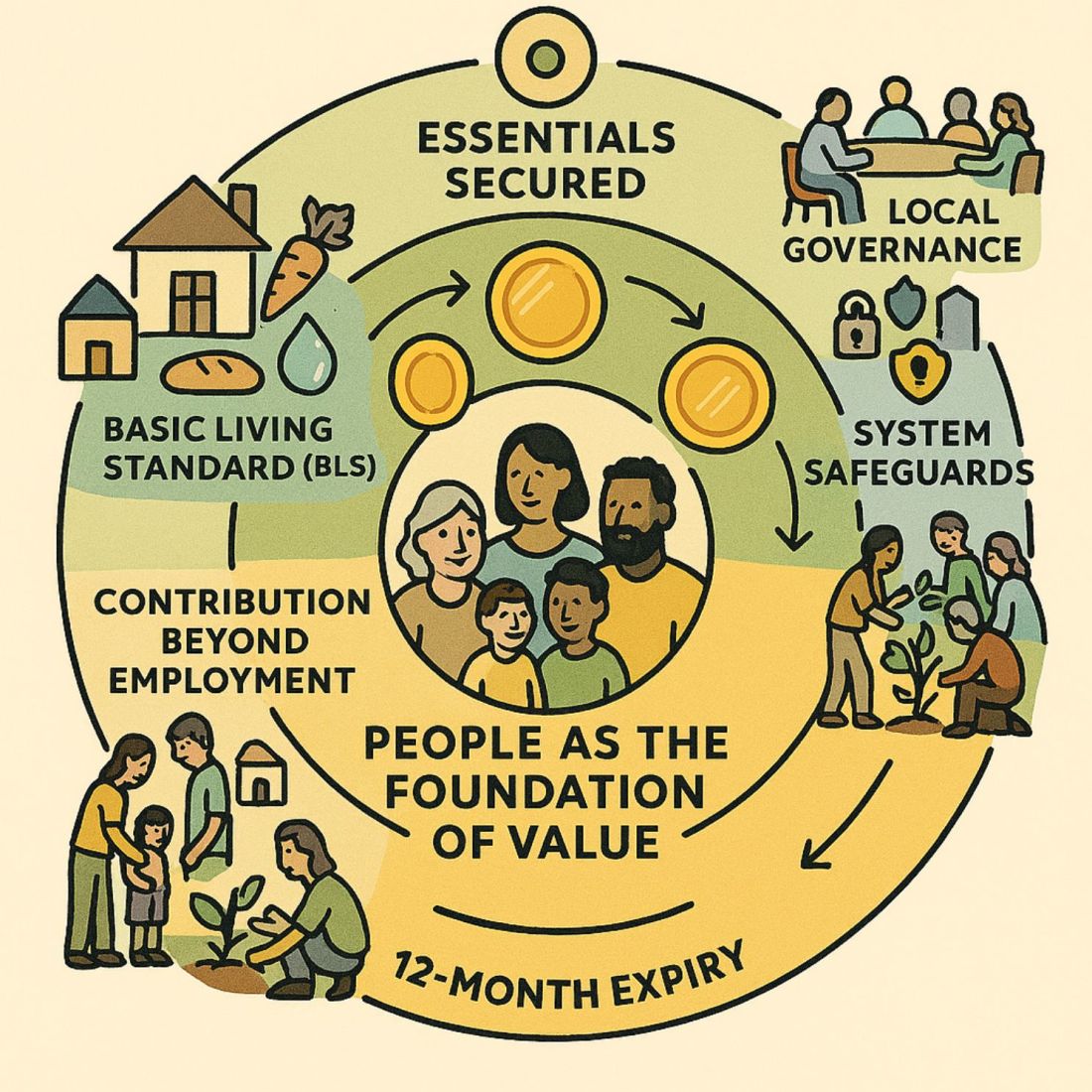
The Basic Living Standard is therefore not a welfare mechanism – it is a psychological and structural prerequisite for a functioning society.
Security → stability → contribution → community → resilience.
3. How does this philosophy reinterpret the purpose of work?
Work is not a commodity.
Work is not a transaction.
Work is not a mechanism for survival.
Work is participation in the life of the community.
This reframing dissolves the coercive relationship between employer and employee and replaces it with a contribution‑based model where:
- people work because they are part of a community
- work is meaningful
- contribution is voluntary but natural
- survival is not conditional on employment
This is a profound shift from the industrial and neoliberal worldview.
4. Why is locality the “natural scale” of human systems?
Because human beings evolved in small, relational groups where:
- accountability was direct
- decisions were transparent
- consequences were visible
- relationships were personal
Large, centralised systems create:
- abstraction
- detachment
- bureaucratic distance
- moral disengagement
- power concentration
Locality restores the natural feedback loops that keep systems ethical and functional.
5. How does this philosophy challenge the concept of economic growth?
It argues that growth is not a measure of wellbeing – it is a measure of throughput.
GDP increases when:
- people get sick
- disasters occur
- housing becomes unaffordable
- debt expands
- consumption accelerates
Growth is therefore not neutral – it rewards harm.
A People First Society replaces growth with:
- resilience
- sufficiency
- regeneration
- wellbeing
- contribution
- community health
This is a paradigm shift from extractive economics to human‑centred economics.
6. What is the philosophical justification for limiting property ownership?
Property accumulation creates power accumulation.
Power accumulation creates inequality.
Inequality creates dependency and coercion.
The philosophy argues that no person has the moral right to own more than they can use, because unused property becomes a mechanism of control over others.
Housing is therefore a right, not a commodity.
This is not ideological – it is structural ethics.
7. How does this philosophy understand value?
Value is not price.
Value is not profit.
Value is not scarcity.
Value is defined as:
anything that improves the wellbeing, freedom, dignity, or resilience of people, communities, or the environment.
This reframing collapses the entire logic of the money‑centric worldview.
8. Why does the philosophy reject interest, speculation, and financialisation?
Because they allow people to accumulate wealth without contributing anything of value.
Interest and speculation:
- extract value without creating it
- distort prices
- create artificial scarcity
- concentrate power
- destabilise communities
- reward non‑contribution
A People First Society requires that value only flows from contribution, not from ownership or manipulation.
9. How does this philosophy view governance?
Governance is not authority.
Governance is not hierarchy.
Governance is not control.
Governance is collective decision‑making about shared life.
The Circumpunct model reflects this:
- no permanent power
- no hierarchy
- no distance between decision and consequence
- leadership as service, not status
- transparency as a moral requirement
This is governance as participation, not governance as rule.
10. What role does The Revaluation play in the transition?
The Revaluation is the psychological and cultural pivot that makes systemic change possible.
It is the moment when people collectively realise:
- money is not value
- growth is not progress
- employment is not contribution
- hierarchy is not leadership
- centralisation is not stability
- scarcity is not natural
- competition is not inevitable
Without this shift, LEGS would be resisted.
With it, LEGS becomes the obvious next step.
11. How does this philosophy address the problem of power?
By dissolving the mechanisms that create it:
- property accumulation
- financial accumulation
- hierarchical governance
- centralised decision‑making
- opaque systems
- dependency structures
Power is not redistributed – it is deconstructed.
The system is designed so that no individual or organisation can accumulate disproportionate influence.
12. Is this philosophy compatible with modern technology and AI?
Yes – but only under strict conditions:
- technology must serve human agency
- AI must never replace essential human roles
- systems must remain understandable at the human scale
- digital tools must have non‑digital alternatives
- local communities must retain control
Technology is a tool, not a trajectory.
13. How does this philosophy define freedom?
Freedom is not the absence of rules.
Freedom is not consumer choice.
Freedom is not individualism.
Freedom is:
the ability to live without fear, contribute without coercion, and participate without exclusion.
This requires:
- security
- dignity
- community
- transparency
- meaningful work
- environmental stability
Freedom is therefore a collective achievement, not an individual possession.
14. What is the ultimate purpose of a People First Society?
To create the conditions in which:
- every person can live a good life
- every community can be resilient
- every environment can regenerate
- every individual can contribute meaningfully
- no one is left behind
- no one is exploited
- no one is coerced into survival
This is the philosophical north star.
15. What is the biggest misconception about this philosophy?
That it is idealistic.
In reality, the current system is the idealistic one – it assumes:
- infinite growth
- infinite resources
- infinite stability
- infinite human tolerance for inequality
This philosophy is grounded in lived reality, human psychology, ecological limits, and community logic.
It is not utopian.
It is necessary.
Further Reading:
This “Further Reading” section offers a set of resources that will deepen your understanding of the Local Economy & Governance System (LEGS), the Basic Living Standard, and the broader philosophy of a people-first society.
Each link explores a different facet of the philosophy, from practical implementation to foundational principles. Engaging with these readings will provide you with richer context, practical examples, and a more nuanced grasp of the ideas behind LEGS.
Whether you are new to these concepts or seeking to apply them, these resources will help you connect theory to practice and inspire new ways of thinking about community, governance, and human flourishing.
Ordered List of Further Reading
- The Local Economy & Governance System (LEGS) – Online Text
https://adamtugwell.blog/2025/11/21/the-local-economy-governance-system-online-text/
Summary:
This foundational text introduces the LEGS framework in detail, explaining how local economies and governance can be structured to prioritise human dignity, participation, and sustainability. It’s ideal for readers seeking a comprehensive overview of the system’s mechanics and philosophical underpinnings.
Benefit:
Start here for a solid grounding in the core ideas and practical structure of LEGS.
- The Basic Living Standard Explained
https://adamtugwell.blog/2025/10/24/the-basic-living-standard-explained/
Summary:
This article breaks down the concept of the Basic Living Standard, clarifying what it means in practice and why it is central to a people-first society. It addresses common questions and misconceptions, making it accessible for those new to the idea.
Benefit:
Read this to understand the practical implications and necessity of guaranteeing basic security for all.
- The Basic Living Standard: Freedom to Think, Freedom to Do, Freedom to Be – With Personal Sovereignty That Brings Peace to All
https://adamtugwell.blog/2025/12/15/the-basic-living-standard-freedom-to-think-freedom-to-do-freedom-to-be-with-personal-sovereignty-that-brings-peace-to-all/
Summary:
This piece explores the philosophical and ethical dimensions of the Basic Living Standard, linking it to personal sovereignty and collective peace. It’s a reflective essay that connects individual freedom with societal wellbeing.
Benefit:
Recommended for readers interested in the deeper values and ethical commitments behind the LEGS philosophy.
- From Principle to Practice: Bringing the Local Economy & Governance System to Life (Full Text)
https://adamtugwell.blog/2025/12/27/from-principle-to-practice-bringing-the-local-economy-governance-system-to-life-full-text/
Summary:
This resource provides practical guidance and real-world examples of how to implement the LEGS philosophy. It bridges the gap between theory and action, offering insights for communities and individuals ready to make change.
Benefit:
Essential for those looking to move from understanding to action, with concrete steps and inspiration for local transformation.
- Visit the LEGS Ecosystem
https://adamtugwell.blog/2025/12/31/visit-the-legs-ecosystem/
Summary:
This link offers an overview of the broader LEGS ecosystem, showcasing projects, communities, and ongoing initiatives. It’s a gateway to seeing the philosophy in action and connecting with others on the same journey.
Benefit:
Explore this to find community, resources, and inspiration for your own involvement in the LEGS movement.
 Adam Tugwell