Reflecting on the December 2025 publication and its foundations in The Local Economy & Governance System (November 2025)
This document serves as a guided companion to From Principle to Practice, published on 24 December 2025, and to its foundational predecessor, The Local Economy & Governance System, released on 20 November 2025.
Together, these two works form a coherent blueprint for a new way of organising human life – one that places People, Community, and The Environment at the centre of society.
Both books are available on Kindle and can also be read online at adamtugwell.blog
This companion is not a summary of the books, nor a replacement for reading them.
Instead, it is designed to help readers approach the material with the mindset required to truly understand it.
LEGS is not an adaptation of the existing money‑centric system. It is not a reform, a patch, or a variation on familiar economic structures.
It is a clean‑slate design – a return to natural human principles that have been obscured by centuries of systems built around accumulation, scarcity, and control.
To read the book well, the reader must be conscious of a subtle but powerful reflex: the tendency to interpret new ideas through the lens of the old system.
This reflex is not a flaw in the reader. It is a conditioned response created by a lifetime inside a system that taught us to see money as the centre of life, work as the measure of worth, and survival as something to be earned.
This companion exists to help the reader recognise that reflex, set it aside, and engage with the material as it was intended – as a fresh start.
Overview
From Principle to Practice expands the conceptual foundations laid out in the earlier LEGS publication and translates them into a complete, functioning system.
It explains how value is created, how essentials are secured, how money circulates, how contribution is shared, and how governance becomes local, transparent, and participatory.
But more importantly, it invites the reader to imagine a world not shaped by the assumptions of the money‑centric system.
It asks the reader to consider what society would look like if we designed it today – not from inherited structures, but from natural human needs and behaviours.
The book is not ideological. It is structural.
It is not theoretical. It is practical.
It is not utopian. It is human.
Key Themes
1. People as the Foundation of Value
The central premise of LEGS is that people – not money, markets, or institutions – are the true source of economic value.
This is not a metaphor. It is a structural principle.
The system quantifies value based on people, their stage of life, and their capacity for contribution.
In doing so, it restores dignity to every individual, regardless of wealth, status, or productivity.
2. Essentials as a Protected Foundation
The Basic Living Standard (BLS) is not a benefit or a safety net. It is the baseline of dignity that full‑time work must guarantee.
By securing essentials structurally, the system removes fear as the organising force of society.
When survival is no longer a commodity, people regain the freedom to think, act, and live without coercion.
3. Money as a Circulating Tool
Money in LEGS is designed to circulate, not accumulate.
It expires after 12 months, ensuring that it remains a tool of exchange rather than a store of power.
This design removes the addictive behaviours – hoarding, speculation, scarcity creation – that distort human life under the money‑centric system.
4. Contribution Beyond Employment
LEGS recognises that valuable work extends far beyond paid employment.
Caregiving, learning, community work, environmental stewardship, and social support are all essential to a healthy society.
The system acknowledges these contributions structurally, not symbolically.
5. Locality as the Anchor of Stability
Value, money, trade, and governance all operate at the community level.
This strengthens resilience, reduces dependency on distant systems, and restores the natural human scale of economic life.
6. Governance as a Participatory Practice
The Circumpunct replaces hierarchical power structures with a flat, transparent, community‑led model.
Governance becomes a living practice, not a distant authority.
7. A System Designed to Resist Capture
Every safeguard – from money expiry to fixed values for essentials – exists to prevent the system from being manipulated, centralised, or distorted.
LEGS is intentionally designed to protect itself from the very forces that corrupted previous systems.
Key Messages
1. You cannot understand LEGS by comparing it to the current system
The money‑centric system is built on scarcity, competition, and accumulation.
LEGS is built on contribution, locality, and shared responsibility.
These frameworks are incompatible. Attempting to interpret LEGS through the logic of the old system will distort it.
2. The old system creates addictive patterns
People unconsciously cling to the idea that money must accumulate, that essentials must be earned, that success is numerical, and that security must be purchased.
These patterns are not natural – they are conditioned.
LEGS requires the reader to recognise and release them.
3. LEGS is a clean‑sheet design
It is not a variation of capitalism, socialism, or communism.
It is a return to natural human principles that predate all of them.
4. The system works because it aligns with human reality
People thrive when essentials are secure, contribution is shared, governance is local, and money cannot dominate life.
LEGS restores these conditions.
Core Takeaways
1. The greatest challenge is mental carry‑over
Readers must actively notice when they are interpreting LEGS through the lens of wages, markets, profit, or hierarchy.
These assumptions belong to the system that is now collapsing and cannot be carried into a new one.
2. LEGS is a complete system
Money, value, essentials, contribution, governance, and trade are interdependent.
Understanding one requires understanding the whole.
3. Essentials are guaranteed through structure
The BLS is not charity.
It is the structural foundation of the economy.
4. Money expires to prevent harm
Expiry is not punitive. It is protective.
It ensures that money remains a tool, not a weapon.
5. Contribution is universal
Everyone contributes according to capacity.
No one is excluded or left behind.
6. Local governance prevents capture
The Circumpunct ensures that decisions remain with the people they affect.
7. LEGS is a return to natural human living
It aligns with the rhythms of community, the cycles of nature, and the realities of human behaviour.
Closing Reflection
This companion exists to help the reader approach From Principle to Practice with the mindset required to understand it.
The book is not asking the reader to imagine a slightly improved version of the world they know.
It is asking them to imagine a world built on natural principles – contribution, locality, transparency, and shared responsibility.
To see that world clearly, the reader must temporarily set aside the assumptions of the money‑centric system.
Only then does the coherence, practicality, and humanity of LEGS become visible.
You don’t need to be a trained economist to know that the model of economics the world uses and the way economics is revered like work of the gods today is wrong.
In fact, it is probably better if you aren’t, and that you aren’t involved in economics, banking or corporate wealth creation either. As you are much more likely to be objective and untainted by ‘being in the tent’ in some way.
The misplaced ingenuity of the economic system and how it works has made it as complex as it is mind boggling. But that doesn’t give any surety or guarantee that how it works and what it achieves is in any way good.
For those actually thinking about why money is the common factor in everything across the world that is now going wrong, the complexity of the economic system is being exposed to light as the smokescreen that it is giving the hallucination of credibility to all the darkness and malevolence that has been so cleverly hidden within.
How can something so clever and complex not be real, is a question that many would employ as a riposte to counter the suggestion that there is absolutely no legitimacy to the FIAT monetary system, MMT, Free Markets, Globalisation and Neoliberal Orthodoxy that we have been subjected to for 5 decades or more.
But isn’t it the case that any good game that feels good to play is only good for those playing, because of the complexities and therefore levels for ‘the players’ that are involved?
How many carrots does it cost to buy a wheel?
To really understand why the world now has got the relationship with money so wrong – even though it was deliberately made this way by corrupt interests who have changed the laws so that their crimes have been legitimised and wiped clean – we really do need to stop for a moment, count to ten and think about what money is, or rather was really intended for.
In so far as the accepted narrative of human history goes, the whole pathway of our development has been progress that moved towards today in a linear fashion, stepping off from very primitive times when man couldn’t even speak, let alone farm for food.
The point here is not to argue whether or not any accepted version of the evolution of man is true. But to set the first picture back at a point when everything was considerably more simple. Long before more and more of those complex ideas or complexities became involved in how people trade.
Then, as now; different people did different things and produced different foods, goods and services to others as the direct result of whatever it was that they did.
For the purposes of this explanation, let’s assume that there are already fishers, farmers, growers, millers, bakers, saddlers, farriers, blacksmiths, cheese and butter makers, butchers, water carriers and pretty much someone or some small business providing all the different forms of foods, goods and services that we need to provide for life, from around a village green.
Some days a baker doesn’t want fish and a fisher certainly doesn’t want a saddle or leather goods daily. Even though they probably need something made to protect them against the elements from time to time.
However, everyone needs something regularly. Whether it’s for their own consumption, or it’s there to help them complete and provide output or goods from their own work.
Bartering and exchange, or swapping goods or even hours of work are of course a very straightforward and sensible way for two parties to make a transaction when one has something available that the other needs.
But the real benefit of bartering and exchange comes from being localised. And its weakness soon showed when the transactions were required to take place over distance, or for items – like that saddle or something equally special – which in day-to-day terms, are rather obscure.
Money, or coins of some kind used at first, created a transactional value, or to be more accurate, a medium of exchange.
The creation of a medium of exchange meant that one person’s goods or efforts could be exchanged for coins that could then be exchanged for whatever that person wanted themselves. All without there being any excessive delays or the need for a very complex or convoluted chain of different transactions to be involved.
The beauty of the system, at that point, was that the money in use could only relate to the agreed value of the transaction.
It would have been good for everyone, once the related practicalities involved were ironed out, if that system had continued without further ‘progress’. The relationship we all have with money could then have remained the same in relative terms – as that unit of exchange and nothing more.
Unfortunately for mankind, progress very quickly created wealth disparity or what we call wealth inequality today.
This imbalance was itself made progressively worse by the inter-generational transfer of property and wealth (and the power it buys) which has snowballed over time. Quite literally meaning that people can be advantaged or disadvantaged by birth, even before any one of the many other factors that skew life opportunities can come into view.
One of the most unfortunate elements of the human condition is the innate desire to always possess and accumulate more. For no better reason than the basic fear we all have of experiencing lack. With the rather perverse dimension that those who have more guard it more jealously than others, probably because they believe they have much more to lose.
The power and influence that money has given people who really weren’t fit to have the responsibility they had over the lives of others, has only got worse over time.
As industry and technology has improved and made it easier and easier to avoid genuine consideration for the consequences of their actions upon others, the human cost has become increasingly irrelevant, whenever the opportunity to make more profit was involved.
When promissory notes or what we know as cash came into being, a giant leap forward was taken towards the system that we have now, where the accepted wisdom is that the value of the money – or what we are agreeing to exchange as being representative of money – is being exchanged under a mutual understanding of trust, that is shared across society, and not just between the people where the specific transactions are involved.
Trust is of course belief. And as those with power and influence at the centre of the banking system realised that having currencies pinned or anchored to anything meant that they could only ever use or suggest they were able to use the money or sensible multiples of the money that they knew they either held, were owed or could earn within a certain time frame, they knew that they would have to create a new system that would release these chains. So that in terms of the money that they could create and use in the future, the only restraints would be dictated by them.
We should be under no illusion that this process of creating an economic system that could lead to limitless wealth and the control of everything for those who controlled it, wasn’t a plan that developed overnight.
The economic system that we have today was created and implemented over decades and carefully constructed so that it would make life much easier for the interests and in particular the politicians who needed to be bought. So that the useful idiots who gained power under the illusion of democracy would obligingly pave the way with system changes that have legitimised this otherwise criminal system at every step of the way therein.
When everything is about money, the answers to every question can only be found in monetary terms.
The money we have today and the way that it comes to and is taken from us – the economy – is the direct result and design of this massive, corrupt and inhuman game that the worlds wealthy, powerful and influential – the elites, decided to play.
The money we have in our pockets, bank accounts and have the ability to earn changes value quickly at the will or as a result of the actions of others.
Meanwhile, the direction of travel for the general population has always been that we are and always would become increasingly poor, as the value of the money which is typically what the poorest in society have only been able to hold, decreases faster than the rate at which our skills and experience develop or there is any chance to earn more so that we can keep up with or counteract the fall.
It was always intended to be this way. As those with wealth always knew that the real wealth was the control of assets and anything and everything that could then rented out to everyone. All as the world became increasingly poorer and their ability to grow control and rent out everything the money they created had bought them gave them even more.
It is ironic that billionaires now have so many zeros on their balance sheets. As everyone who has been a victim of what is probably mankind’s greatest con is now beginning to realise that they have been left with zero. Or if they are lucky, a diminishing amount of liquid capital that isn’t worth a lot more.
I would like to add at this stage that this essay is not an attack on any individual for whatever it is that they may believe they possess, control or have influence over today. Many of those with excessive wealth, power and influence today have just played along with the rules of a very clever game. One that has removed the balance, Justice and morality from every part of life and has done it so successfully that the poison it has replaced values with is embedded across cultures and normal life to the point that even the academics and leaders in finance and economics believe in the legitimacy and correctness of an entire system which is bewilderingly anti-human at its very core.
In simple terms
The simplicity of the mechanics of an economic system and more specifically a monetary system that revolves around private banks creating money from nothing – a process which is carefully hidden from view – so that government always looks like it is borrowing or rather selling bonds to private interests to finance everything, whilst those banks also lend money that doesn’t exist to us through loans, finance, credit cards and even pay day loans, really do make it horrendously difficult to accept that this is one massive confidence scam. Especially as everything is hidden in plain sight by little more than the disinterest that we typically have in anything that goes beyond having our perceived needs met.
However, let’s think about it as if we were reading a story about two friends at the start of their working lives; one with the motivation to work hard and deliver through their own industry, whilst the other has had life easy and just wants to find another easy way to get more, and we can then perhaps see how this gargantuan scam rolls out when exposed to light.
The diligent and easy living friends talk one day, looking at property that they would both like to own.
The diligent friend commits to working hard and earning the money to buy what they would like to own and leaves, promising to catch up when this outcome has been achieved.
Meanwhile, the easy living friend knows that he has the contacts and ideas necessary to go away and print enough of the money he needs to buy that same property today. And that he can do this from nothing, which will work out well for him but not his friend, so long as he doesn’t speak openly about what he’s doing. Uses his contacts to change a few rules so that what he’s doing is legal. And he doesn’t keep printing more money to buy everything else so that it becomes obvious what he’s been doing all along. Afterall, nobody will know if he uses the money he then earns from renting out that property to pay all that money back…
The money that the easy living friend has created, has just increased the amount of money that exists.
This means that because there isn’t actually any more property, production or anything else with ‘real’ value that corresponds to the increasing pool of money, all of the money that’s available is now worth much less than it was.
The real world impact of this fantasy being made reality is that the diligent friend will have to worker harder, longer or both, to pay for the property that the easy living friend has just taken without effort.
What is more, the easy living friend is now offering to rent the property he’s bought to the diligent friend who now realises that he may never be able to afford to buy it.
If you can see and understand the basic mechanics of how this situation works, you only need scale up the same principles to understand how the massive, growing amount of money – and the ridiculous inflation and the growing cost of living problem we are all facing, has been created and is now growing at a ridiculous rate.
It is an unavoidable, inescapable fact that if one person or set of people are able to buy real, tangible things that have value to us – whatever those things might be – with money that doesn’t actually exist, they can take lawful possession of those things and do with them whatever they so choose – as any legitimate owner would be able to do so.
However, the illegitimate creation of the money and the legitimised theft of assets, businesses, infrastructure and everything else imaginable that it has financed means what they have been doing is just one part of a multifaceted crime against everyone else.
The crimes that follow the created money pathways include the impoverishment of the masses.
Yet they become even worse when we consider that public services and infrastructure such as utility companies have been bought up with fake money.
Entire business sectors like the pub trade and small, local shops have also all become unviable because fake money has financed industry expansion of big retail and all their centralised supply chains, that would not otherwise have been possible.
To cap that all off, markets and the practices of big business and finance have been deregulated through the drive for ‘Free Markets’. So that those making money can make more and more, because the rules that once protected us all and small independent businesses have been removed, whilst regulations that cost us, exclude us and disqualify us from our own independence and from taking part have instead been imposed under the pretence that they help and protect us.
The whole pathway of illegitimate money creation using the FIAT system leads or rather has led to the doorstep of nothing less than worldwide system control.
The only thing that now gives us the opportunity to save ourselves from a very challenging fate is the reality that those with their hands in the till have already broken too many of the rules of their own game.
The whole system is starting to collapse before the great reset or imposition of the next new world order has conclusively been imposed.
The Future of Money
I could stop there. But in lifting the stone or exposing what lies beneath it to light I am certainly not alone.
Before continuing further, I would encourage anyone who has read this far to do their own research and use as many different sources and mediums as they can to uncover and draw their own conclusions about all of this and what is really going on.
My real interest and passion is what happens next for us and for our future. Once we have got through this horrid time and whatever turbulence and challenges that we now face, once we have got to the other side and left them all behind.
What we should perhaps all be able to conclude – once we have dealt with our own addictions and attachment to the way that endless money supposedly works for us all now – is that money should never hold its own value. Should never be speculated upon, and the power of its creation and policing should never be under private control.
What is more, the value of legal currency should never be pinned to anything that can itself vary in value, especially when whatever that currency is pinned to is in short supply or can be controlled manipulatively or otherwise at will.
People are the only legitimate economic constant
If everyone did what they do, only took what they need and were happy to share or exchange what they didn’t with whoever needed it in return for something they did in return, there would never be need of money of any kind, ever again.
Whilst I can see that to many the idea that everyone just does what they do today for nothing and that in return, they get just enough of what they need of everything else in return might seem fanciful, this suggestion does nonetheless make a very important point about everyone only taking or expecting to have access to what they actually need.
Need is NOT the same thing as want.
Too much want is what has led to a situation where there are people right across the world today who don’t have access just to the things that they need.
An economy – a legitimate economy – will function only to provide for the needs of people within it.
There isn’t an argument that can counter this legitimately. Any argument made against this, no matter how compelling or well elucidated, is inevitably built upon one person being able to obtain or accumulate more things than others. Because the alternative system favours their interests more.
These are the fundamental basics of greed.
Locality based economies and economics
Everyone who can, should play their part or contribute to the function of a legitimate economy, in whatever role they are able. So that everyone who is active, then comes together to become the sum of all the parts – with the sum of those parts being the community, which because of what members can do together collaboratively, will be greater than what everyone would be able to do by working alone.
The value of a legitimate economy should therefore be based upon the number of people who are active within it and include what they input or contribute to that economy individually and therefore collectively.
If every member of the community does what they should be doing, and the needs of everyone being met are always prioritised and planned for or budgeted for as they should be, the whole system will move closely towards self-containment, with the amount of money in circulation always being closely related to the number of heads within the population.
A localised and online local market exchange system that focuses on bartering and exchange for foods, goods, services and work being made universally available alongside cash and digitally transferable money, should also exist so that everything works in a circular fashion and everyone’s particular needs are always met in ways that favour everyone.
The needs for public service, infrastructure, community activities and everything beyond should be met by everyone who is able to work volunteering the equivalent of 1/10 of their working week and their skills or experience to the community. Thereby meeting whatever needs and community income generation requirement there may then be.
Excess goods produced, surplus service capacity and over production which is specialist to the community would also be traded with other communities and traded where any additional requirements beyond the scope of community production exist.
The blight of greed-driven thinking
The only reason that an economic system that will work like this, which promotes freedom and financial independence of the masses, would not work, is because those who would no longer be able to define themselves as being different to others through the accumulation of additional and unnecessary wealth will argue that it isn’t practical and cannot work.
Even within a genuinely egalitarian approach to economics based along these lines, it is a fact that some could always do better, because they choose to do so through their own industry. Whilst many others – and the majority at that, would be happy to just make the contribution that was absolutely necessary, knowing that they would be happy, healthy, safe and secure because all of their basic and essential needs were being met.
It is part of the capitalist myth that entrepreneurialism and creativity in commerce cannot exist when the ability to earn or rather profit is capped.
The real truth of the matter is that everyone will be productive and make a valuable contribution when anything that goes beyond what it takes to look after themselves and those who depend on them is a choice and the ability to just live a normal life without dependency on anything beyond themselves hasn’t been denied by the actions of others.
Nobody has the right to take or have more than they need and certainly not when it can only come to them through the exploitation and infliction of pain and suffering of any kind upon others.
Further Reading (Updated 14/1/26):
1. Breaking the Money Myth: Rethinking Value, Exchange and Equality
https://adamtugwell.blog/2025/11/12/breaking-the-money-myth-rethinking-value-exchange-and-equality/ Summary: Challenges conventional beliefs about money, exploring how value and exchange have been distorted by modern economic systems. This article lays the groundwork for understanding why current monetary practices are problematic and why rethinking these fundamentals is essential for a fairer society.
2. The Basic Living Standard Explained
https://adamtugwell.blog/2025/10/24/the-basic-living-standard-explained/ Summary: Explains the concept of a “basic living standard” – the minimum requirements for a dignified life. It discusses how economies should prioritise meeting everyone’s essential needs, and why this principle is central to building a legitimate, people-focused economy.
3. An Economy for the Common Good (Full Text)
https://adamtugwell.blog/2025/02/24/an-economy-for-the-common-good-full-text/ Summary: Presents a comprehensive vision for an economy designed to serve the common good, rather than private interests. It explores practical models and policies that could shift economic priorities toward collective wellbeing and sustainability.
4. The Role of Barter and Exchange in the Local Economy Governance System
Building, enabling and maintaining good governance, self-sufficiency and freedom for all people and our communities
The Greek Stoic Philosopher Epictetus said “It is not possible to learn what you think you already know.”
Today, one of the greatest challenges that humanity faces is the reality that almost every one of us believes that we already understand how the world works and subsequently believe that how it works today will always continue to provide the basis of how the world will work tomorrow.
With even the most educated academics and experienced experts suffering from what can be argued as a situational bias, where virtually nobody can picture a way of living where the fundamental factors like money and the economic system that we have today aren’t exactly the same, it seems that we have just as easily slipped into the tragic and passive acceptance that the things that we want to be changed, either cannot or will not be changed. For no better reason that we refuse to give up the things that those changes will necessitate, that we still believe to profit or benefit us personally in some way.
For any speaker or writer who dares venture into the realms of sharing even just one or two layers of the massively multilayered truths that underpin the workings of today’s world using a lens or microscope to focus upon one area of life, government or business, the complexities quickly become too hard for others to believe and the label or badge of being a conspiracy theorist or perhaps worse fits just as easily whilst serving the purposes of those who ride the ‘blissful ignorance’ of the masses ridiculously well.
The truth that even the many who do accept that change has now become more than necessary cannot deal with, is that neither the majority nor the critical mass of people required to initiate meaningful levels of societal change can be reached whilst we remain ‘bought in’ to the current paradigm at any level.
Indeed, the change that our lucid moments allow us to recognise as being the only possible direction for a just, fair and balanced society and culture, will not be accepted and certainly not embraced, until enough of us have felt the real pain that the way mankind lives today will inevitably inflict upon us all. For as long as money and material wealth rule the day.
A HAPPY WORLD isn’t coin operated
The world could not only work as well as it does today. But it would actually work much better. IF everyone did what they did, without being tied into the shared belief that everything has monetary value.
Yet it doesn’t take much for any one of us to build a wall against this truth when we will almost inevitably fall into the trap of believing that whilst we might personally be able to accept a different system of values, we believe that nobody else will. Because they are selfish and coin operated. And that as such, the world will always be destined to work the same way.
What I will say to you now is that the world does not and has never needed to be coin operated or run by money. And it can no longer continue to operate in this same way.
The way that the world works today is a manmade construct. One that has fear – not happiness, peace or love at its heart.
What is more, each of us may well have had the free will to choose fear as our motivation and our guide in times past.
But when the impact and consequences of that motivation on the part of any one of us leads to a situation where the free will to choose between fear and the alternative is no longer available for others to decide, the imbalance that is created is one that will inevitably lead to inescapable pain and impoverished circumstances for those others from which it will be impossible for the world itself to hide.
The contradictory belief that unsustainable living is sustainable, because the narrative says so
Fanciful as it may sound, the reality we all face is that the unsustainable ways in which we have all been living have already gone too far.
The decisions that legislators and leaders make do not reflect what is in the best interests of humanity and everything they now do is progressively making a very bad situation even worse.
We do not and have never needed the world to work as it does now.
The benefits of a whole world and everything within it being twisted and manipulated to serve the interests of just a few, are worth nothing and do nothing but cause pain and harm to the masses.
This is an incalculable level of tragedy when we realise that the fundamental basis of everything we need, is being able to or having the ability to live a good life.
A Good Life cannot be bought
A good life isn’t created or achieved on the basis of what we have, what we accumulate or what other people think.
A good life is a state of mind.
And it is a state of mind that allows each and every one of us the opportunity to open the door and rediscover who we really are.
Those committed to the current paradigm will certainly argue that only wealth, influence, power and control can provide the circumstances where this kind of peace can be achieved.
Yet there is nothing peaceful, beneficial and certainly not spiritual about living a life that may be perceived as being good. But can only be achieved where at least one and potentially many others are having to pay some kind of cost.
Just like our bodies are an ecosystem that work to their very best when they are looked after, our communities and localities are all that groups of us need to survive and thrive, whilst showing and maintaining that same respect for all others and sharing between all of us the things that different communities can do that we cannot and vice versa, with the express belief and understanding that cooperation and collaboration rather than control are all any of us need to have very good lives.
Our Future is Local
Plenty has been said and written about the virtues of looking within ourselves rather than continually looking outside for all of the answers, truths and directions that we expect to make our lives work.
Indeed, the purpose of this work isn’t to focus upon the benefits of self-awareness and levels of self-knowing that reach way beyond any basic understanding of self-help fashions such as mindfulness which can be found in seemingly endless numbers online and on channels such as YouTube and TikTok. As that is a journey for each of us to pursue and conclude upon personally.
However, the circumstances and situations that lend themselves to that journey of personal learning and progress are a different matter altogether.
In very basic terms, the most productive and beneficial way for us to live our lives, to experience a good life and to live a life where we will know that we will genuinely succeed, is to live locally, or in ways where everything to which we attribute real value is experienced as first hand, through people we meet face to face and through life experiences which are fully lived and not accessed at any level through the equivalent of a screen.
To experience the human condition and human relationships, it is necessary to have relationships directly with other humans that will condition us to understand how and why other humans behave the way they do and how they think.
Living any other way immediately adds unnecessary levels of complexity in which the behaviours and choices that harm others can easily hide, that just like any other lie, require many other lies and layers of lies in order to protect the original lie.
Despite many convincing narratives that suggest otherwise, progress doesn’t only travel one way. Just like technology doesn’t automatically mean the redundancy and erasure of methodologies that came before it. And it certainly doesn’t mean that advances of any kind that benefit those who control them, should ever come at the cost, hardship, loss or pain of those who would have been involved in any accepted practice that came before it.
In fact, technology driven by the correct motives and the desire to improve life, rather than replace it, is representative of genuine progress, whereas technology used to replace and impoverish people so that those who own and control it can profit is most certainly not representative of any kind of progress.
Just because jobs can be replaced by technology doesn’t mean that they either need to be, or that they should be. And if money wasn’t the only real consideration that was being involved, neither would anyone believe that there would be any need to be either.
Indeed, if money were not in the equation, the need for big companies or big anything, wouldn’t even exist.
The only businesses or organisations that we would need at any level, would be those that have the structures necessary to provide for all our essential needs and the goods and services that make a genuinely good life work.
These aren’t big businesses. Because they aren’t driven by the suggestion that costs can be lowered so that more profit can be made or one business can undercut another that does the same thing, because it can do the same things more cheaply in some way.
These are businesses that exist to provide the best at what they do and provide the best experience that they can for the people that they serve.
These are businesses that are local, that are part of a local supply chain and work within a local circular economy in its truest sense, that have no need to be bigger or biggest, because the one set of values that we all share is built around the belief that every one of us is worth and has value that is exactly the same.
Our Local Future
The default setting that most of us have from the way that our lives and understanding of life has been conditioned will tell even the most learned and intelligent of us that money centric living will always be the way and that everything we are working through here is little more than some kind of utopian dream that is wholly impractical and will never come true.
Yet unsustainable living is by its very nature unsustainable at every level, at that means that to live and believe that it is sustainable is itself untrue.
Those who are looking more closely at the narratives and the truths that they hide will know that life is going to change in one way or another. It is not a question of if, but when, and the only real question that none of us can accurately answer – even though it is easy to speculate, is what event or series of events will be responsible for setting off what we can almost be sure will be a process of change, if we are not already now within it?
Because we tend to be obsessed over the journey and who has decision making control over the next step(s), rather than the outcomes of everything we do, we use outcomes in the sense of what they mean only to us as the basis of any argument over what should come next – in real terms, whose ideas and suggestions should come first.
From this perspective and the conflict that we can see as soon as we begin to be open to how everything works, it can easily feel impossible to visualise an outcome or range of outcomes that could be achievable after having gained buy-in from everyone and the pathways they are demanding, so that the result is meaningful to all as well as being something that actually works.
The paradox is of course that without being able to visualise the destination and what that destination will actually feel like, what it will be to experience it and what being there will actually mean, we don’t have a collective cat in hells chance of ever getting there or doing anything that will actually succeed.
Minded of this, I wrote Our Local Future and took the leap to create a vision or picture of what a world that works for us all would actually look like, feel like and work like. And you can read and work through the structure of Our Local Future and download a copy of the book by visiting HERE.
Putting the first steps towards tomorrow’s world in today’s terms
Whereas Our Local Future may provide the reader with a picture of what a fully functioning just, fair and balanced locality-based world would look like, whether they agree with that vision or not, it does not and will not provide a guide or map that includes all the different steps that we will collectively need to get there. For no better reason than dogmatically sticking to any plan will create more problems than it will ever solve and that in a world of complexity and contradictions like the one we are experiencing today, plans can never replace the choices made by decision makers who make the right decision in the moment, and ultimately will not work.
However, what is not only possible, but is also required with the outlook that we tend to share, is an example of the stepping off point; a signpost in the direction of travel, or rather an outline of the first steps that we could and that we arguably should be taking now. So that what we are doing to ourselves today is no longer destined to be our end, but can be the point from which we make a conscious decision to take each step, and then keep moving and changing step by step, to transform from a world that doesn’t work for everyone, into a world that works for us all, as it always should.
Who does this is not something we should worry about, unless we remain captured by that idea that the next step and who controls it is more important than the outcome or destination itself. And without recognising this, it continues to be unlikely that we will ever agree on how we will recognise that outcome, because the outcome and destination will never have become the topic of our discussion or debate.
From this perspective, I would rather have my work taken apart so that it can be improved upon by all those who can improve upon it, than for the work to have never started at all. And with this in mind, I have created and committed to digital pages An Economy for the Common Good, as a model for how we could all come together as communities and within our localities work together to make a start.
The Glos Community Project
I began this work or project in the summer of 2023, and at that point simply intended to turn an idea in to a practical or turnkey model of how a group of well-intended and appropriately motivated volunteers could begin creating a structure that would lead to a fully functioning and localised economy, that would lead to outcomes that would place localism, circular economy, sustainability and sustainable living, awakened forms of governance and therefore real democracy at its heart.
Because the whole point is about our own communities and where we live and work, I created this model around the areas in which I have lived and live today, so that it would be as realistic as it can be from the very start.
The model is called The Glos Community Project and follows in the next section of this book as a structured and self-explanatory plan that goes as far as to provide the basic adverts and job specs for the social entrepreneurs and community volunteers who are envisaged as being the leaders and pioneers of building An Economy for the Common Good.
The Glos Community Project model is only a guide, providing that first step that I have already alluded to, and one that I hope will invite every reader to think about how our world can and will operate very differently, once we have accepted and are ready to embrace that we must place people, community and the environment we live in at its heart.
The content that follows has been structured in the form of a website that can be found HERE, where comments can be added at the bottom of each page.
If you would like to make suggestions about the subjects raised, please share them there or do get in touch by email at acommunityroute@gmail.com if you would prefer not to share your thoughts publicly.
Please note that I will be happy to publish anything that is well intended and clearly shared with the intention of achieving the best outcome(s) for all, even where such an example directly improves upon the work that has been shared.
Thank you for reading and for your interest in creating An Economy for the Common Good.
Adam Tugwell
February 2025
The Glos Community Project
Introduction
Hello there!
I’m Adam and Gloucestershire is my home. Gloucestershire is the County where I was born and where my family live. It’s where I went to school, where I first worked in farming, where I first trained as a manager for an international company, where I first ran and developed projects for a charity and where I set up my first business. Gloucestershire is also where I was an elected Councillor and Member of three of Gloucestershire’s Local Authorities.
As you can already see, I have a very strong affiliation with Gloucestershire, and with Cheltenham, Cirencester, Tewkesbury and Winchcombe in particular. However, all these places are important to me, not just because of the role and part they have already played in my life. But especially so, because they are all parts of the same community and local communities of which I am or have also been a part.
Community can mean a lot of things and could easily be considered to be different, depending on who you talk to. However, to me a community is the group of people who you share all of the important things in life with, rather than being the people who you share the same things with that are important in your own life.
Community is People and Place
The Community and what the community can do has never been as important as it is becoming and as it will soon become. Given all of the turbulence and difficulties that are beginning to affect everyone in some way, right across the world.
Yes, the world is itself a community. And it would certainly be a much happier, healthier, safe and secure place, if world leaders could cast their own agendas aside, and put the benefits of what they do for the People and the communities they should be serving first.
It’s no excuse, but at the level of world or even national leadership, it’s very easy to lose sight of how important every other person’s life experience is.
That’s why when we think about the basic or essential food, goods and services that each and every one of us needs to live and have self-sufficient lives every day, it is locality, localism and keeping every part of day-to-day life as local as possible, that is going to become the key ingredient to ensuring that everyone has a balanced, fair, just and above all, meaningful life.
Recognising that The System today, isn’t about ‘us’; BUT the Future will be
The Establishment no longer works for any of us, even though the amount that we pay in taxes means that on average, we work until May or June each year and ‘Tax Freedom Day’, when any of the money we earn thereafter is actually ours to spend as if it were our own.
One way or another, the help that we now need doesn’t and will not come from those who we should be able to expect to provide it.
Necessity now requires that whatever help we and our communities now or will need, we will all have to step up and do whatever we can to help ourselves, the people who are in our lives and the way of life and everything within it in the localities that surround us.
Our power lies wherever we focus it
Asking people to help themselves or even making the suggestion that public policy is very much ours to influence and change for the better, is something that many – perhaps even you – will feel some immediate resistance to.
We are, after all, living through a period of our own, if not world history, where we have been conditioned to feel helpless and that solving problems that affect us all is something that somebody, somewhere else is responsible for and always does.
Learned helplessness is a human disaster in the making. Simply because it encourages everyone who believes they are powerless to stand still.
In the circumstances we are experiencing, standing still is like going backwards. Because those who have power are abusing it to take everything that we understand forward, in to a future, in ways that only benefit them and their kind.
However, life isn’t something that happens out there, somewhere.
Life is happening right here, right now, in your mind and in the space or spaces around you that you walk in, talk in, feel in, touch in, eat in, wash in and experience every part of life in – each and every day.
Life isn’t happening remotely in a device somewhere.
But the picture that devices give us of someone else’s life can certainly make it feel like whatever is important in the digital world, is relevant and all-encompassing within our own.
It’s not. And the most painful lesson that we all have to learn, understand and accept in real terms, is that life doesn’t work as it should for more and more of us, because we aren’t living real lives.
Our lives are being dictated by people who are completely out of touch with us and who we are. But have a pedestal, lectern and platform in front of us, just because they are on a digital screen.
The current economic model and system of power doesn’t work for us
There isn’t much that needs to be said to anyone, no matter who you are, where you come from or what you do, for us to reach agreement that there is something fundamentally wrong with the way that everything works.
Whatever your relationship with money, the chances are that you are also concerned by the creeping feeling that less and less of the aspects of your life that you used to feel in charge of, still remain within your control.
In simple terms, it works this way and will continue to get worse in this way, as every decision that’s having an impact on the value of everything we have is being made by people who we are unlikely to ever meet.
The challenge that we all face today, is that the rules that allow all the things that are going wrong for us – no matter what they are – have been created or adapted to serve the purposes of those same people, and these are the people who we have not only trusted, but also put in charge.
Out of sight is out of mind for most.
And people who have power, influence and control by the truckload, are very dangerous when they have no integrity or respect for the responsibilities they have to others.
Localism or Going Local
I’ve written a whole series of books that focus on localism and how the focus of power must be brought back to local communities and for decisions that affect our daily lives to be made as close to us as possible and by people who we know and can trust.
However, the problem that I have faced throughout, is that when talking about anything in a broader or national sense, it quickly becomes as abstract as national politics and national news streams are, even though that’s how we often judge important things to be.
The problem is, real life and what is important to us isn’t abstract.
In fact, the real things that are important and all the things that can have the biggest impact upon everything that is happening to us is not abstract and is very specific indeed.
But we have somehow allowed the abstract, or what is outside of us, to influence all of our specific choices.
With AI and technologies now forcing their way into our digital lives, with consequences that will make real life feel so much easier, whilst teaching us to forget how making decisions for ourselves and even learning new things, the choice between being led by an abstract world where the real influences are never seen or understood, or taking back control and regaining conscious choice in everything we do has never appeared to be such an easy one that is actually so very hard.
Awakening to the reality that hides in plain sight
The damage of centralisation, globalisation and of allowing decisions that affect everyone to be taken by people who are unlikely to ever visit or have reason to understand the things that are happening in our streets and neighbourhoods are very easy for us to see in the news every night.
People who have zero understanding of the consequences and impact on the policies they write for every reason other than those that they should, are condemning increasing numbers of people to harder and more challenging lives, and then blaming them for the problems that they themselves have through their own incompetence caused.
It can only work for us, if we can reach out and touch it
A genuinely self-sufficient and fully localised system of public services and the governance that underpins the systems and processes that affect and impact daily lives would not be in danger of being abused or mismanaged in this way.
Indeed, the only way that we will be able to create a genuinely level playing field of opportunity and a public or community sector that works in the way that it should will be for the full balance of power, influence and decision making to be brought back to the People and local communities and administered openly, transparently and without any bias in the way that it always should.
Real Localism is what Authentic Governance looks like and what it would be.
Localism in its real sense
The most simple way to explain the change of focus from where it is today (Global, Central, European etc.) to where it should be (Local, Community etc.), is to think of it as being a switch from a values set based on money, profit and the accumulation of power and wealth, to the alternative values set which is focused on People, humanity and what we genuinely need for everyone to be happy, healthy, secure and safe.
Real localism isn’t rocket science.
But real localism certainly meets with a lot of resistance when the true depth and scope of what it means are openly discussed, because for many who do so well out of exploiting others (whether they are aware of it or not), localism represents what they believe to be a loss.
Sadly, because the Establishment know and understand that local communities are where the power of the people and everything that supports us should be, they frequently pay lip service to the principle of ‘localism’.
But as in the case of New Labour’s ‘Devolution’ from the 1997 General Election on, and then the Cameron Conservatives ‘Localism’ in the years that have followed since 2010, the type of localism and the return of power to local people that politicians from all sides having been selling us, all add up to no such thing.
Politicians today are desperately promoting what they call localism or any one of a number of similar things, which is Regional Centralisation by another name.
We face a challenging, but achievable course of action, that requires us, our communities, charities and businesses to by-pass the Establishment and begin putting localism into everything we do and are motivated by, if we genuinely want to solve all of the societal problems that not only our communities, but the Country and the whole world faces.
We need a new Economic Model that evolves itself from the community up
If you want to learn about economics, the last person you should ask is an economist.
History – albeit history that is used as a model and translated for the contemporary age, is another thing entirely.
We do not need to return to the dark ages or some kind of feudal system to see that life worked much better for everyone when everything that was needed for day-to-day life was available locally and provided by people that everyone knew.
Simple living is far more intelligent than the ‘connected’ world that we live in where relationships are being dehumanised and we have all become little more than a number or code to every company or organisation that we have any reason to buy something from or to do business with.
We will bypass and reject the heartless and inhumane way of living we experience today by
Prioritising local growing, processing, manufacture and supply.
We will improve life for everyone dramatically by rejecting the money-based value system by
Putting People First.
We will change the world for the better by rejecting the hierarchical structures and system of governance by
Bringing power back to the most local level within our communities – creating a clean, authentic form of democracy that has never been allowed by the power hungry to exist before.
The new enlightenment that we are told we are experiencing is only enlightening for those who believe that they are in control.
People who don’t have any reason to even acknowledge the realities that many of the people whose lives they influence now face, because technology insulates them from all the pain that they cause.
PLEASE Remember: Just because technology can do so many ‘amazing’ things, it doesn’t mean that we are obliged to use it, or that we have no choice when it comes to doing so.
Priority 1: Local, Local, Local
Life isn’t a theory.
Yet we have life dictated to us as if it is.
The only way that things can really work in the best way possible for us all, is for whole supply chains, the route of food from farm to fork and how business works and money or currencies flow to be in circles that are as local as it is possible for them to be.
Forget any ideas, philosophies or narratives that identify with localism purely as ‘circular’ or ‘doughnut’ economics.
Whilst they may be well intended, these are theories that are based upon the current money-centric system continuing to be prevalent across all areas of life.
They are NOT what real localised economies are really about.
Localism and Locality Economics are about everything in life and the business streams that support life, people, communities and the environment, working locally and in a very localised way.
Priority 2: People First
Money isn’t everything. But people, our relationships and the world we live in really are.
People or human based values are in short supply, so the most effective way to change everything is to put People and our communities first.
We don’t need to make massive profits to experience happy, healthy, safe and secure lives. But we do need to have faith that changing minds – beginning with our own, is the most important step to changing the world to one that is just, fair and balanced for all – and that social enterprises that help everyone without charging more than anyone involved genuinely needs within local communities is the best place to begin.
Priority 3: Local Governance from local Communities and the grassroots up
We may have learned helplessness, but we have the ability to change things right now, by-passing the assumed behaviour that the Establishment expects and by making the system work for us and taking power back, rather than engaging in actions we have been brought up to expect which just continues to funnel power at people who abuse it and use it only to benefit themselves.
In the recent book Officially NONE OF THE ABOVE, we discussed the need for us all to act and take part so that the focus of political power is brought back to people we know and the decisions that affect us daily are made by people who have genuine skin in the game when it comes to knowing and understanding what we are experience, how we feel, and how we think.
No, we don’t need a revolution and the destruction of the current electoral system to do this. But we do all need to take part. However, in the long term, we must work towards the removal of any parts of the electoral system or system of democracy that can allow specific interests and the agendas of particular groups of people to manipulate and play the system, as is the case right now.
Social Enterprise and Community Enterprises | Bringing not-for-profit and key local businesses together to work as one
Putting People First isn’t just the long-term aim. Putting People First is the most important stepping off point in the series of practical steps that have the power to influence and deliver large scale change, even without the Establishment giving it its blessing, a green light or any kind of consent.
The way that we can do this is by creating a series of social enterprises that can immediately begin to tackle the issues that are being most acutely felt by what we today recognise as growing wealth inequality and the cost of living crisis, but in reality is a direct result of the broken economic model that the Establishment remains committed to, even though it is continuing to deliver increasing levels of harm to People from all areas and across the whole spectrum of society.
It is certainly true that many will not have even considered the realities that many of the people they pass on the street daily are facing from the growing problems that are a direct result of this broken economic model. Of those that do or are open to the existence of a problem, even more cannot see an alternative way of running a 21st century model of society where money doesn’t have its current role.
Many People genuinely believe that creating a model of society that functions around what everyone needs, rather than what the reducing few just want, cannot deliver happiness, health, security and safety in any way. This is because of the genuine belief that money always has a role to play.
But money or rather inflated prices, excess prices and the greed and profiteering that sits behind it doesn’t have a role to play in any fair, balanced and just society. The only way to demonstrate this is to show the people that need to be convinced, and that’s why those who can see and understand this truth need to be the pioneers when it comes to taking action, as well as having and maintaining a lot of faith.
We can deliver different outcomes and with them, a different life experience for people across our communities very quickly, just by making a start
That start will be social enterprises that follow similar development and growth models in every local area, along with a very small number of new multimodal charity units that provide services for those in very specific cases of need, who have no way to pay.
By passing the Establishment and organisations profiting from essential goods and services that everyone needs
There is no point in attempting to reinvent the wheel. There are already some magnificent social enterprises and not for profit organisations operating in many areas that are doing the very best to help people on a cost-related or free basis already. The Glos Community Project will not seek to replicate or replace any of these within their tangible area of operation, and where or when possible, will also seek to redirect support that might become available to them.
However, The Glos Community Project will operate in any area where we have the volunteers/social business leaders, support and resources, where no such organisation already exists.
The Establishment has had plenty of opportunity to demonstrate that it can reform and get things right. Those involved no longer have the right to demand that we keep waiting for them to get things right, or to expect that we will continue to trust them, just because of the job title or responsibility that they supposedly hold.
This time and the future are ours to decide. They have had their chance and have cast what’s good for everyone rather than just them aside.
In time, many of those from within the current Establishment will accept that there was always a better way and that they made the decision not to exercise the responsibility that they held on our behalf, to do what is right.
We cannot trust anyone from within the Establishment today, to do what is right, until they can see and accept that putting People First is the new paradigm and how everything is going to run.
Who are The Establishment?
We have mentioned the Establishment and the reality that obtaining meaningful change will require bypassing the establishment at the very least.
Knowing who the Establishment are is therefore very important.
As a rule, anyone involved with or directly employed by any of the following will represent the establishment. There are exceptions right across the board, but for the purpose of excluding as much of the risk that comes from those who are invested in obstructing change as possible, in the first instances and until there is definite evidence to support otherwise, we will not trust or knowingly engage with any of the following:
The Establishment includes (but is not limited to):
The Civil Service
Town Councils
Parish Councils
Borough Councils
District Councils
County Councils
Unitary Authorities
Schools
Colleges
Universities
Social Services
Public Services of all kinds
Non-Government Organisations (NGOs) e.g. The Highways Agency / Highways England, The Environment Agency
National Charities that are well-funded and in the public eye
Elected Councillors
Elected Mayors
Members of Parliament
Police & Crime Commissioners
Mainstream Media
Media Companies
Corporate Businesses
Most Celebrities
The Military
Why | The Glos Community Project
Right now, even on the rare occasion that politics does something positive for People, it comes and works its way through the system at a pace that is simply too slow to help and benefit people who genuinely need help in their real lives.
Gloucestershire is no different. And whilst there are at least a few politicians on the seats of local Parish, Town, The Borough and Districts and the County Council who are still genuine in their aim of putting the needs of People first, the reality is that many of them don’t even understand just how little influence they – and therefore the People who elected them – have, over the things that we are expecting them to deal with on our behalf, each and every day.
The elephant trap that we can easily fall into is to think that bitching about any of this or that following, liking and supporting people who are saying all the things that we want to hear will somehow result in change.
It won’t. And that’s why I am here – as just another person from the community we share, who loves Gloucestershire and everything about it, with the aim of connecting like-minded people and taking the very practical steps that we can by working together, to help other members of our community and take the first leaps towards making the Towns, Villages and the Countryside that we love, a much better place and one that reflects the aims, values and aspirations of us all.
We really can change things for the better by doing the things that we can, rather than losing faith because the problems look too big and we believe that we can’t.
HP | The opportunity for change will be what WE make it | The Glos Community Project
You may have already heard of something called social enterprise, businesses that are run on a not-for-profit basis, or businesses that are set up not with the aim of making money, but creating some benefit to the community in some way.
The Glos Community Project is here to explore the opportunities that already exists and that are yet to be identified that will benefit the wider community through the services or products that they provide, whilst providing opportunities for budding social entrepreneurs and practical change activists, along with work opportunities for anyone and everyone – and especially those who might feel that the world has been passing them by.
Right now, I am looking for people who want to be the pioneers of social change within Gloucestershire’s communities. Individuals who are ideally looking for the opportunity to lead and to learn, but are driven by working collaboratively and for the benefit of everyone, rather than long or short term, about what they themselves can earn.
These are voluntary opportunities in the first instance, with the only immediate cost being the time and commitment that it will take, along with the determination that any successful entrepreneur would need to set up a business from scratch – but with the benefit of having the support and guidance of someone who has seen and experienced all of the ups and downs of creating, launching and managing businesses before.
Theres nothing good about global, but local builds love for others every time
Many of us struggle with understanding and identifying the difference between the things we need in life, and the things that we want in our life.
Don’t worry, there will be no judgement coming from me or anyone else who is closely involved in what we are doing if this does or has ever applied to you. The whole system is skewed and the messaging and advertising that is being constantly pumped at all of us has helped blurred the lines so much between need and want, that unless you are awake to anything being wrong with all of this, the two have merged and become one.
In my recent Book Levelling Level, we focused on identifying the difference between basic or essential needs and what many consider to be essential – but are actually just what those people want. We also focused on the reality that with the Establishment having worked tirelessly on behalf of specific interests to make just about every supply chain you could imagine operate to make excessive profits by delivering what everyone who can afford to buy it, wants, the same people who have been responsible have also destroyed the ability of communities and even our whole Country to provide just the basic or essential foods, goods and services that we all need.
Even talking about supply chains and terms like self-sufficiency will sound like gobbledygook or some kind of esoteric language to some. One of the many challenges we face is that this is intentional too. And the myth that we have been conditioned to believe is that everything costs less for us this way, that it is a better, healthier and more enlightened way of living, and that making us all dependent upon people that we have nothing in common with, will get rid of any problems because we all think the same way.
Regrettably, the same way or same thinking is based on nothing more than shared greed, profiteering and a complete lack of care for the human cost, such as loss of local jobs, overuse and unnecessary use of natural resources, exploitation of people and less developed cultures, and the enslavement to debt that is quickly overtaking populations across the world.
Target Business areas | Foods, Goods & Services that are ESSENTIAL to life
The Glos Community Project is all about the basics. The essentials that everyone needs to be able to access each and every day, so that they can lead happy, healthy, safe and secure lives within a fair, balanced and just environment.
Humans don’t get addicted to anything that they need. But the humanity in everyone is quickly destroyed by having too much of what they want.
Whilst the aims of The Glos Community Project will have many points of controversy, depending upon who you are, it’s the definition between what we need and what is essential to life, rather that what we want that will probably get the most backs up, whilst the world is able to continue in the way that it has been.
For the sake of repeating a lot of information that is available in my other books, the basics or the essentials for everyday living look very similar to this:
Food:
Fruits and vegetables that can be grown locally, either on farms, allotments or at home
Bread made using local flour with minimal processing that can be completed by hand or traditional milling methods.
Dairy products including Milk, Cheeses and Yoghurts that are made locally using traditional methods and without chemical additives, extensive processing or refinement
Meats that are farmed, prepared, stored, dressed and retailed locally, without unnecessary miles to heavily and unnecessarily bureaucratised abattoirs and processing facilities.
Fish and seafoods, either farmed inland, or transported from the nearest UK seaport.
Goods:
Clothing (basic)
Cleaning (To keep homes and anything for personal use clean and hygienic)
Kitchen (to cook, prepare and store food and drink)
Laundry (to wash and prepare clothing)
Health & Hygiene (Essential medicines, and goods used to keep clean and healthy such as toothbrushes, toothpaste, sanitary products etc.)
Transport (Bikes, Cars) – Only where regular transport cannot be provided in another or shared way
Services:
Clothing repairs
Vehicle repairs & maintenance where vehicles are owned
Building repairs and construction
Electricity
Water
Gas
Communication (mobile phone, broadband)
Unpaid apps
Entertainment (Free channels)
Transport (where vehicles are not owned or available for essential or irregular journeys)
Banking & Currency (outside of Establishment control)
The More People involved, the more local The Glos Community Project will become
In the first instance, it is difficult to estimate how much interest there will be and which social enterprises will be the most popular, even though I have a good idea what these will be.
If one person per social enterprise model were to come forward for each of them, we would certainly begin by opening up the first of each operation to the widest number of People that it would be possible for us to do so.
However, as interest grows, covering these same areas might be difficult and result in the level of service offered being reduced because there are too many people for one business unit to serve.
When this happens, the area will be divided up, so that every service that The Glos Community Project provides will be offered to the most local area possible.
The growth of The Glos Community Project will be a pathway of decentralization in every sense, focusing on improving accessibility and transparency at each and every step of the way.
Theres nothing about The Glos Community Project that can’t be done. The voices that say otherwise are from people who just have selfish reasons not to do it
No matter how you came to discover The Glos Community Project, there is a good chance that unless you have been searching for other like-minded people to do the things that you have already been thinking about, you will read through the list of social businesses that we want to see available to every community – just to begin with, and that you will think that this is something that cannot be done.
If you have an open mind, please ask yourself the question what makes you believe that, and then follow up by asking yourself why.
Everything listed on this site is achievable. Not only that. As more People from our communities sign up, commit to our aims and provide us with whatever support they can, more and more of us will understand that putting people first is a very good, mutually beneficial and happy way to live, where the results will speak for themselves.
Whilst it will be challenging to get the first few of each social business model planned, where necessary funded, launched and then running, we will very quickly have turnkey frameworks or plans available for every new area, that only then have to be tailored to ensure that whatever is being offered, will meet that specific community’s needs.
Areas outside of Gloucestershire
I will be as happy to hear from you if you are outside of Gloucestershire as I will be if you get in touch with me from any of the communities and local areas within.
We might need to take a different approach, depending on what you are able to do, but The Glos Community Project is just a model or incubator where we can all learn, and we must aspire to a much wider roll-out if community or grassroots power is to have the revival that it now can.
If you are from outside Gloucestershire, please consider all the opportunities that have been listed on this site and then get in touch.
I will be happy to arrange a one-to-one meeting via Zoom, WhatsApp, Facetime or Teams. Or if you have a question or questions that would be helpful for others too, I will be happy to post a blog or a video to explain or discuss what we can do.
Area Organisers – Other areas
If you have been reading The Glos Community Project and feel that you might have what it would take to get the ball rolling with a like-for-like Project in your own County or Region, I would really like to hear from you.
Please e-mail me and provide me with whatever information you would want to know about me, if you were already set up in your area and were thinking about inviting me to work alongside you to set up over here in Gloucestershire right now.
Funding Opportunities
We are actively searching for philanthropic support for specific projects or to support them all.
If you would like to provide support through a donation, through sponsorship or through a grant of some kind, we would be very pleased to hear from you at the earliest opportunity.
We are aware that many substantial grants are offered on the basis of meeting very specific aims. Where possible, we will build the services offered in ways that will meet those aims, as long as doing so will not compromise the key principles and aims of The Glos Community Project.
Regrettably, we cannot accept support that would be allocated in support of any political agendas other than bringing back power to communities themselves, through the creation and development of Community Meetings.
If you would like to discuss your idea, please get in touch with Adam for a chat.
Every penny counts and if you are supportive of what we are trying to achieve, but can only afford to make a small donation, we will appreciate and value your support just the same. Please find our Crowdfunder HERE.
About You | Social Entrepreneur
The most important thing about you won’t be anything to do with how creative, innovative or entrepreneurial you are or can be. These are all words that get misused and there are lots of people who genuinely believe myths such as being self-employed means that you are an entrepreneur.
The most important fact or truth about you will be that you are driven by helping others, by genuine social change (no matter how challenging that might appear to be) and that you have accepted that change of the kind that we all need will not come from anyone that most people are expecting it to come from.
I’m not keen on bullet points for something like this, so please treat the following as a framework only, and if there are things that resonate but you are not sure about anything else, please just get in touch and we can have a chat.
You Should
Be motivated by helping others
See everyone as an equal, no matter who or what society suggests that they are
Be open to learning new things
Be able to see everything objectively and be aware of how your feelings might influence this when and if anything leaves you emotionally ‘triggered’.
Think critically – no matter the situation
See a crisis as an opportunity
Able to work in the moment, without a plan or guide to help you
Be sure that you can see commitments and agreements through, even if you are not being watched or monitored
Have a genuine passion for the type of social business(es) that you are interested in and know that you will gain a sense of achievement from being successful within it.
Be open to learning and carrying out any of the jobs or tasks that will be required to make this business run and be successful
Be comfortable with talking to people, to journalists and anyone who has a genuine interest in what you are doing
Have experience working with different social groups, either professionally or voluntarily
Be aiming to earn a wage which relates only to the genuine cost of living at the time
Understand that volunteers are not paid employees and will only do their best for you, if they enjoy and see a benefit to them or what they believe in from doing whatever you ask them to do
Be happy to sign and keep to the terms of a Non-Disclosure Agreement (NDA)
These Opportunities are unlikely to be for you if you:
Believe that someone else will solve all of society’s problems
Knowingly hold prejudices of any kind about other people
Are aiming to own your own commercial company or business
Are motivated only by the potential of what you could earn
Have any hang ups about doing any kind of job
Believe that you must be qualified to do anything
Make excuses or tell lies to cover up mistakes, problems or any issues that are outside of your control
Are already committed to any political or social agenda – no matter how good or beneficial you might consider it to be (This includes any political party, green or climate focused movements, groups with a spiritual ‘agenda’, ‘alt’ movements or anything that promotes ideologies built on ‘us vs them’ thinking at any level or of any kind.
Opportunities for Social Entrepreneurs in Gloucestershire
There are a number of different opportunities for people who would like to lead the development of a social business across Gloucestershire.
These will include:
Local News
Clothing Hire & Resale
Car and Bike Loan Hubs
Local Food Circuits
Allotments & Home Growing
Local Exchange Platforms
Local Currency
Homeless Hubs
Community Pubs
Community Brewing
Community Marketplace
Mend & Make Do Repair Centres
Community Meetings
Skills for Life Courses
Community Helpers
Farm Direct Cooperatives
Community Bakeries
Opportunities will be local community specific, with the aim that there will be at least one of every business type listed within walking distance of homes in suburban or town areas, or available and shared between no more than 4 to 6 villages in remote areas.
We will not seek to establish any new social business where a community-focused social business of the same kind, or offering a service of the same kind exists, unless it is being delivered as part of an Establishment agenda.
Opportunities for Volunteers in Gloucestershire
We are also looking for specialist project and management support
Web & Software Developers
Social Media Creation & Support
App Developers
Fundraisers
Citizen Journalists
Areas of Gloucestershire where you might be | The Glos Community Project
Forest of Dean
Coleford
Cinderford
Newent
Longhope & Mitcheldean
Newnham on Severn
Cotswold (South)
Cirencester
Tetbury
Northleach
Fairford
Lechlade
North Cotswold
Bourton on the Water
Stow on the Wold
Moreton in Marsh
Cheltenham
Town
Prestbury
Leckhampton
Hatherley
Tewkesbury (North)
Town
Winchcombe
Bishops Cleeve & Woodmancote
Tewkesbury (South)
Churchdown
Brockworth
Hucclecote
Highnam
Innsworth
Gloucester
City
Quedgeley
Longlevens
Barnwood
Tuffley
Stroud
Town
Stonehouse
Wotton under Edge
Dursley
Painswick
Berkeley & Sharpness
What you will need to provide | Social Entrepreneur
Your time and commitment are the most important requirement.
There is no requirement for you to pay any type of joining or membership fee as a The Glos Community Project Volunteer. You just need to be confident in what you are doing and be prepared to put your name on your project right from the moment you start.
Together we will build the platform that will be required to attract support and any necessary funding to get your social business started.
It is very easy for anyone considering going into business for the first time to believe that they have to buy everything new and have new everything. You don’t.
My aim is to minimalise the risk to everyone who joins The Glos Community Project in whatever role, and to build every new service and the organisation that supports it with the absolute minimum financial cost to those who get involved (i.e. you may need to pay for fuel to travel, use your phone etc.)
Local News
The news ‘industry’ has undergone a massive transformation within the past two decades.
The national news or mainstream media and regional news or what we once referred to as the ‘local papers’ – or what’s left of them all, are completely under the spell or influence of their owners, who pays them or both, and the only losers have been the general public and the people who read, watch or listen to anything that branded media companies produce.
Sadly, local news was one of the biggest casualties of the internet’s arrival, when the ‘cash cow that once was classified advertising’ dried up overnight, pushing the evening paper that everyone went to for everything online, with the outcome very quickly giving the lie to the idea that the local paper was actually about news.
Stories that are important about local life don’t get the coverage that they should do. And the absence of real-life stories from the next village or the school on the other side of the town have only served to fuel the idea that news in the mainstream is representative of real life, and that what comes from outside of our communities is the only news that there is.
Unfortunately, with most of the national or branded news, and much of the stories that come from well-known names and personalities online all being little better than opinion, people have very quickly lost touch with what real life really is.
We need to change this. And we need to make the news interesting to everyone again, without there being any kind of agenda at work.
The Opportunity to set up and contribute to new local community news platforms
We would like to set up news services in every local area, using all of the media options that are available to us to focus on all the stories that are genuine news, rather than being about what someone else wants us all to think.
Focusing on the opportunity to harness citizen journalism at its very best, I am looking for social media, tech and internet-savvy people with the ability to research and write genuine news stories objectively, and where commentary is required, to do so in ways that cover all relevant points of view.
The ability to edit other people’s work will be important, as one of the aims of these local news platforms will be to give people across our communities the opportunity to tell the stories they have that will help and inspire others.
If you are already visualising what you could do with this opportunity, it could very well be one for you.
If you are interested in this opportunity, please e-mail me and include:
Your name, contact and social media details
A copy of your current CV (If you have one)
How much time you have available to commit to The Glos Community Project
A short note explaining why local news provision is interesting to you, what your priorities would be if you were leading the development of this social business in your local area, and how you would get started.
Links to any examples of articles you have written or any media you have created that is available online.
Clothing Hire, Repair, Recycling & Resale
Everyone needs clothing. But fashion itself is one of the most obvious ‘wants’ that the age of consumerism has encouraged us to have, with very small differences existing between clothes carrying or not carrying a name, but that brand itself means that cost itself is one of the key issues when it comes to what clothes any one of us can have.
The media age creates the perceived need, whilst the banks and financiers now provide the credit that is building a time bomb of debt that only exists because of greed. Worse still, the real cost to our communities through the loss of jobs and to the planet from clothing being needlessly made thousands of miles away on the cheap, where working rules don’t exist and costs are cheap so that profit margins can be exponentially increased, really gives the lie to what globalism has really been about.
The more expensive the clothing, the less likely we are to regularly wear or even wear it. Recent data suggests that a significant percentage of new clothing is either never sold or never even worn.
Recycling clothing through apps such as Vinted is already becoming popular and clothing libraries are being tried in some places too. But we could do a lot more and with the long-term aim of returning sustainable clothing manufacture and production to the UK and our communities, we need to make good affordable clothing available to everyone for all occasions – and without the need for anyone to go into debt, whether they can afford it or not.
The opportunity to set up Clothing Libraries and Resale, Recycling and Repair hubs
We would like to set up Clothing hubs in all areas, leveraging the technology that is available, to make Recycling, Repair and Reuse of good clothing a part of normal life once again.
Focusing on creating local stores that are accessible to all, whilst using apps and the internet to make services and sales available online, I am looking for entrepreneurial leaders with a passion for clothes and the drive to make thrifty wardrobes fashionable, to help create a service that will have the ability to help people from all backgrounds in a multitude of ways.
Ideally, you will already have the ability to mend repairable clothing and be comfortable using the existing resale apps and platforms as a start. However, this is certainly one of the social business models that could easily be developed not just by one community-focused individual, but perhaps a few.
If ideas are already flowing through your mind about how clothing libraries, clothing hire and clothing recycling and repair could work even better than what people already know, this could certainly be the opportunity that is reaching out to you.
If you are interested in this opportunity, please e-mail me and include:
Your name, contact and social media details
A copy of your current CV (If you have one)
How much time you have available to commit to The Glos Community Project
If not already included in your CV, an addendum that covers any skills and experience you already have that would help you to make a clothing hub in your area to thrive
Pictures or links to anything that you have done
A short overview of what appeals to you about the concept of Community Clothing Hubs and what you believe the priorities would be at the beginning and during the stages of the early roll-out.
Community Vehicle Lending Hubs | Car and Bike Loans
Sadly, because of the impractical and tyrannical way that Green Policy, Climate Change and ridiculous Policies such as Net Zero have been rolled out and are being adopted by local authorities through polices such as the switch to EPVs, ULEZ and 15 Minute Cities, the practical reality that we don’t need 4-car households and shouldn’t be wasting money that we cannot afford on journeys that we simply don’t need to make are being overlooked and are in danger of being passed by.
We don’t need cars that sit in car parks all day and on driveways or by the sides of roads during holidays, weekends and overnight. But we do need to have access to the most appropriate forms of transport for the journeys that we need to make, as and when we need to make them, and we need a localised system that makes this happen – and happen well, for us all.
The opportunity to set up Community Vehicle Lending Hubs
I am looking for people with an interest in cars, motorbikes, epvs and emerging transport technology to help create and build local vehicle lending hubs that make shared vehicle use both normal and respectable, and in a way that means consistent quality of experience for users, with the minimization of vehicle abuse.
Whilst experience in things like fleet management, repairs, vehicle hire and areas of work like that would clearly be very helpful, starting with a clean sheet and no experience of these areas is likely to be just as helpful, as we really do need to get this offering right to create the buy-in that we need from members of our communities from the start.
If you are interested in this opportunity, please e-mail me and include:
Your name, contact and social media details
A copy of your current CV (If you have one)
How much time you have available to commit to The Glos Community Project
If not already included in your CV, an addendum that covers any skills and experience you already have that would help you to make a Community Vehicle Lending Hub in your area to thrive
A short overview of what appeals to you about the concept of Community Vehicle Lending Hubs and what you believe the priorities would be that will encourage People to trust and rely on borrowing vehicles in your local area, rather than falling back on ones that they own
Community Public Transport
Yes, we already have a large number of community transport organisations and providers such as Dial-a-rides. However, many of these are now driven by and focused upon contracts and provision that has been identified by County Councils and Government Agencies in ways that make them subservient to the Establishment, creating the perception that they are just there for ‘old people’ or children with special educational needs.
On the other hand, the ‘public transport’ that we have, which includes both buses and trains, stopped being public in the genuine sense, the moment that the operating companies, transport providers, and infrastructure companies were privatised and became tools in profit-making hands.
Yes, they provide services that are accessible to the public. But they are not in any way focused on the need for genuine public transport to be universally accessible, and they never will be for as long as private shareholder interest and earnings or dividends being paid to owners remains involved.
In the absence of any will on the part of the Establishment to take back and maintain public transport services without the involvement of privately owned companies or the influence of unions who by holding any organisation to ransom are in effect doing exactly the same thing, we must work to create a Community Public Transport Service that begins by ensuring that transport provision exists within local communities where any services that can be provided by Community Vehicle Lending Hubs ends.
The opportunity to set up a Community Public Transport Hub in your area
The big focus for developing Community Public Transport Hubs is understanding local need, creativity and innovation when it comes to meeting that need, and a very open and positive approach to working with customers from within the local community, as well as being able to engage with and build good working relationships with the stakeholders who will be unavoidably involved.
Unlike the majority of the social entrepreneur roles and opportunities listed with The Glos Community Project, this one does require that those interested already have a Full, preferably clean Driving License which will ideally include minibus driving (up to 17 seats) – NOT for Hire or Reward.
There may also be a requirement for those running or contributing to the management of our Community Public Transport services to hold or qualify for a Certificate of Professional Competence (CPC) in bus service operations, and/or that they can apply for and hold a Private Hire License, which will require a basic DBS check and no previous driving disqualifications or other forms of conviction that will exclude them from applying to or being registered by the Licensing Department at the local District or Borough Council.
If you have any past convictions or problems with your driving license, you should be able to check the Licensing Policy for Private Hire & Hackney Taxi Licenses online. Please note that we will check every existing local policy before beginning work on any new hub.
If you are interested in this opportunity, please e-mail me and include:
Your name, contact and social media details
A copy of your current CV (If you have one)
How much time you have available to commit to The Glos Community Project
If not already included in your CV, an addendum that covers any skills and experience you already have that would help you to build a very successful Community Public Transport Service within your local community area
A short overview of what appeals to you about the concept of universal transport provision and Community Public Transport, and what you believe will be necessary for People to experience daily, so that the service genuinely works.
Food Supply
By far the most important areas of the social or community businesses that The Glos Community Project is aiming to focus on is the growing, harvesting, preparation, production and supply of basic or essential foods within the shortest and most reliable supply chains possible.
Sadly, we take for granted that food will always be available either online or at the local supermarket. Even though there were some minor shortages during the Covid Pandemic and some supplies of vegetables were temporarily out of stock or in reduced supply earlier in 2023, the reality is that none of us have yet experienced the shortages and changes to the food supply that are now almost certain to come in the months and years ahead.
Globalisation, centralization and the economics of big business have made our communities and the whole of the UK itself dependent upon the supply of basic and essential foods that we could easily grow ourselves. For the sake of somebody somewhere making bigger and bigger profits, whilst power has been taken further and further away from the people so that it can be concentrated in the hands of the few, we have been sold the lie that it’s better for all of us if food comes to us across whole continents, and that it’s also better for us and will make us all happier if it comes to us in increasingly processed or ultra processed forms.
Many don’t even realize that we have become dependent on foods that are not in any way healthy for us, whilst our agricultural and growing sectors have themselves surrendered or given up the ability to grow and provide a range of food stuffs for local supply, whilst the politics of money and globalism have made farmers reliant upon incomes they have little or no influence over, whilst growing fewer and fewer things.
Farm shops are not a luxury or non-essential choice. But it serves the current economic model for us to see them that way
Many of us visit farm shops – where they are available, and do so with the belief that to do so is a luxury or a treat, because we can be fairly sure that whatever they sell to us will cost more than what we would pay for it at a supermarket – even though the levels of quality and the provenance are nowhere near being the same.
Farm shops and any retail business that sells locally made, perhaps organic, high-quality foods with the absolute minimum of processing involved seem expensive, because the way that most foods are mass produced and massively processed has made them that way. It is quite literally the economics of scale that not only appear to make food cheaper, but also guarantee that the marketplace is controlled by very few hands, and that the people involved make ridiculous profits from whatever they do.
Whilst we need affordable basic or essential foods more than ever, we do not need any part of the process that only appears to benefit us by lowering the purchase price, but then goes on to cost us in every other possible sense – including the increasing risks to our health and our lives.
If the whole of the UK Farming, Growing and Fishing Industries were reformed and restructured so that their priority and focus was always on local supply – through complete supply chains that are as local as it is possible for them to be, the price of all essential and basic foods of a much higher quality and standard would quickly come down and be accessible to everyone too.
Our Farmers are struggling because the Establishment is failing them too
One of the most regrettable parts of the Food Supply Question today is the reality that Farmers are already acutely aware that the self-sufficiency or food security of the whole of the UK is now at very high risk.
Sadly, although Farmers are some of the most creative, resourceful and entrepreneurial people you could ever meet or know, the Industry and its leaders like the National Farmers Union, is still very much committed to the misplaced belief that the Establishment will come to the rescue and provide the support they all want for whatever they currently envision as being the necessary change.
For those from the farming community who read this, it is time to realise, understand and accept that there are many different agendas at work within and beyond the Establishment, but none of them place a priority on anything like the traditional model of farming even in the way that we currently know or believe it to be.
Like so many other areas of business and life, we must now take a very practical approach and different view of food production, and continue to do so for as long as the current Establishment is able to maintain its hold.
We must bypass the Establishment food strategies and incentive plans, and point all farming and food producing businesses back to community focused production using up to date methodology and thinking, but in a very traditional, perhaps even shops-around-the-village-green kind of way.
On the current trajectory, more and more farmers will lose or have to give up farms, whilst communities will be pushed further and further away from being able to sustain themselves as we unnecessary lose more and more productive land.
Local Food Circuits
The Glos Community Project aims to work with farmers, and all locally aligned businesses to champion and recreate localised Community Food Chains that keep the growing, production, necessary processing and preparation, transport and supply of all basic and essential foods as local and as self-sufficient as possible, so that local communities can quite literally fend for themselves.
This is an ambitious task. Not least of all, because many will see the return of fully localised markets as a regressive or backwards step, simply because of the way that certain interests and the focus upon profit always being the key priority has conditioned them to think.
However, farmers, aligned business leaders and members of the wider community coming together to discuss a mutually beneficial strategy will quickly open up doors and a dialogue that very few would currently consider to be viable – but that is quickly going to make a massive amount of sense in what are very turbulent and changing times.
The Opportunity to Facilitate and Coordinate Farm Direct Cooperatives
I am actively looking for a number of social entrepreneurs who have the people skills, the ability and the motivation to knock on doors, open up and build new relationships with a range of very different people who are very worried about the future, but are at least initially likely to be very resistant to considering stepping away from the business model where the establishment makes all the rules and only they can offer any help.
You may be from the Farming or Rural Community or from outside of them. But you will have both fluency and understanding not only what farmers and growers have the ability to do, as well as what might be their needs, along with a very innovative and entrepreneurial view and understanding of what it is likely to take to get the right people, businesses and agencies together, to make robust local food supply chains work, so that the self-sufficiency and food security of local communities can be guaranteed.
It is very important to accept that the really exciting part of this social or community business platform will be just how much knowledge already exists within all of businesses that would gain from being involved and that the success of this part of The Glos Community Project will depend on getting everyone who could contribute and benefit from this, not only to open up and share their ideas, but to also commit to becoming actively involved.
If you are interested in this opportunity, please e-mail me and include:
Your name, contact and social media details
A copy of your current CV (If you have one)
How much time you have available to commit to The Glos Community Project
If not already included in your CV, an addendum that covers any skills and experience you already have that would help you to open doors within the farming community and with business leaders within the community who will all need to be inspired by the story that makes real the truth that there is another way.
A short overview of why you believe that Local Food Circuits will provide food security and what you believe the common USP will be that will engage, create buy-in and get everyone important on board
Allotments & Home Growing
Whilst farmers and the Grower community have the ability to change their working practices and to create and employ new infrastructure quickly, the industry wide change that will be needed may not happen as quickly as we might all like – once the need for this massive change really begins to hit home.
To help and support the creation, development and implementation of Local Food Circuits, there is a part that the majority of us can play in helping ourselves and contributing to the local community effort, if we are prepared to ‘Home Grow’ any foods that we can.
There are a range of ways that Home Growing from the smallest scale up to a level where you might be able to supply certain fruits or vegetables to your whole area could be possible, depending on what resources you already have access to. These might include a garden, a deep window sill, an allotment, or an area within your home where you could set up a hydroponics system.
Today, Home Growing is seen as being quirky or excentric by many. Yet it could be a very easy and quick way for everyone who is able, to ensure that they have ongoing or regular access to a source of the vital nutrition that everyone genuinely needs.
The opportunity to Facilitate and Coordinate Home Growing Hubs
To support Local Food Circuits and also feed into our new Community Marketplace, it is an aim of The Glos Community Project to support homeowners to utlise the space and resources that they have available for Home Growing, and to identify land and develop the availability of allotments so that Home Grown fruits or vegetables of one kind or another are available to everyone.
I am looking for social entrepreneurs who can either set up and run, or coordinate others to provide the following:
Purchase, sale and supply of gardening equipment
Purchase, sale and supply of hydroponics equipment
Rental, purchase, preparation and letting of allotments
Developing an online signposting service to quickly identify anything that will help
Work with our Skills for Life facilitators to provide online, classroom and one-to-one training
Like Farm Direct Facilitators and Coordinators, the ability and desire to collaborate with others who have knowledge and skills that will help is vital to the success of this role, as if having a very open mind and the ability to inspire people across the community to think about the meaning of self-sufficiency in a very different way.
If you are interested in this opportunity, please e-mail me and include:
Your name, contact and social media details
A copy of your current CV (If you have one)
How much time you have available to commit to The Glos Community Project
If not already included in your CV, an addendum that covers any skills and experience you already have that would help to demonstrate the kind of approach you would have to getting people to commit to and stay committed to Home Growing.
A short overview of what appeals to you about Home Growing and the role you see that it will play in providing food security at the most local level.
Building Local Economies
‘But we already have a local economy?’ I hear you think.
Yes, we do. But they are very much part of the national and international economy and the real question you might want to ask yourself is how does the economic system that we have really benefit or work for you?
Unless you are a) a billionaire b) a massive corporate shareholder c) playing the markets in some way or d) working for one or someone very similar to all of the above, the economic and monetary system that we have is not working for you or benefiting you in any way – whatever the common, constructed or urban myths tell you.
In my book Levelling Level, we discussed the certain reality that Money isn’t worth anything other than what any of us believe it to be. But that doesn’t stop a great many people who are otherwise probably very sensible from attributing great value to it and letting the accumulation and manipulation of it takeover their lives – all without even a second thought for the cost to everyone else.
Regrettably, the journey that the Establishment is now pushing us along toward the extinction of cash and the use of central digital bank currencies (CDBC) or government derived cryptocurrencies isn’t one that will end well for anyone whose interests aren’t closely aligned with whatever the narrative of the Establishment might be.
The immense power that will be held by people we will never meet, because they can see where every penny of our money has come from and how it is then spent is only surpassed in terms of the danger to our freedom to do whatever we legally want to, by the reality that just because they might disagree with something we have said or whatever we might believe in, they would have the power to switch our money off and prevent us from accessing it whenever they might like.
You only need to think about the political figures who are already having their banking facilities closed down and are being denied access to alternatives to see an illustration of how this will all work. It doesn’t matter whether you agree with their politics or not today, this type of action will become a growing threat to the entire population if the management of money remains in the hands of the Establishment – and that’s before we even get to the discussion about the damage a financial system where the Establishment can just create money as and when it feels like it is doing and has done to our lives already – before thinking about what absolute control and tracking of money will allow them to make it become.
Making money and currencies nothing more than a unit of exchange, once again
The value of money dictates everything today. And the value of money is in the hands of the establishment and very greedy and profit hungry people who have zero understanding and no care about the consequences that come from what they do, as long as the system continues to benefit them.
Whilst a return to the gold standard and pegged or anchored economies would be a sensible step, the reality is that the system is now so rotten and influenced by speculation and private interests that are on the make, that the governance that exists is unlikely to ever deliver a monetary or economic system that genuinely works in the best interest of us all.
We have no choice but to start the money system all over again.
People, their presence and their value and input into the economy is the method that should be the basis for all financial value, not how much anything and everything costs us, or when we possess it, it can then be considered to be worth.
Through The Glos Community Project, the long term aim will be to create a system of new, localised currencies that will be available in a cash equivalent and cryptocurrency or digital form, but will be administered locally and be geographically specific, with the national level currency only being used for transactions between areas or as the baseline that maintains a fixed value between what the basic unit of each currency is worth.
In the short term, the creation of local economies will be focused on allowing people to trade anything they want to, including their labour, their knowledge and their skills, in a way that will quickly become insulated against greed and stupidity driven forms of inflation that are quite literally on the verge of collapsing the existing financial system or ‘bringing down the bank’.
We have no choice but to go back to basics and reject a monetary system that is destroying lives whilst it manipulates all of us and abuses our trust.
Bartering and Fair Exchange
Nobody other than the individual themselves, should be able to define and police a system of values that can exclude or disenfranchise them, based on issues that are outside of their own influence.
With increasing numbers of people missing meals or being forced to make the conscious decision between what essentials they can or can no longer afford, the return to a system where everything can be traded openly and fairly has never been needed by so many as it is right now.
The Glos Community Project is focusing upon bartering and exchange of new and used goods, basic and essential foods and the services that People genuinely need so that anything and everything that any person has or is able to legally able to offer for sale or for exchange can be traded for something that they need, or for a monetary or currency value that is based solely on what the trading parties agree that the specific item or offering is worth.
Community Marketplaces & Local Exchanges
The New Local Economy is built around Local Exchanges, where all goods and services are available and accessible to all, whether they are provided by a business or an individual.
Membership is open to everyone from within the area of the community and trading is available both at a Local Exchange Hub and online with any costs being covered by a membership and/or access fee on a not-for-profit basis.
Local Currency
The ultimate aim is that each local community will have its own currency that will be available in both a cash equivalent and digital or cryptocurrency form.
The local currency will be fixed in value so that outside influences are then unable to profit from trading the currency or damage the stability of the Local Economy by either crashing or over inflating the total value of the money that is in circulation, held by any person or business and in use.
Local currencies will be the normal method of exchange within the community, but will be interchangeable with the national currency.
The only circumstances where the value of the currency will be negotiable would be within the circumstances of essential international trade
Building The Community Marketplace
Increasing numbers of People are unable to afford to buy the basic food, essential goods and services that they need, just to remain healthy, safe and secure.
Communities must take the steps necessary to help everyone who needs to turn the food they grow, the goods they make or no longer want, or the spare time that they have into whatever they need most, without middle men or profit-making businesses inflating the costs of anything and everything they touch.
The Glos Community Project is building a Community Marketplace that will pivot around a Local Exchange that is both physical and online, and will be supported by a fixed value local currency that will be available in both cash and digital forms.
The opportunity to Facilitate and Coordinate the Community Marketplace
I am looking for social entrepreneurs who already have a good practical understanding of the real economy, as well as the basic theories that underpin both classical and neoclassical economics in the sense that they relate to how the world works today.
However, that in itself is not enough. Being visionary in your outlook, you must be able to look beyond a world where money is the common factor in everything, and replace it with a much happier and healthier one where people and humanity are the common factor instead.
Stepping through and navigating between the world as most people see it today, and how it’s going to be, you will become a key collaborator, helping to develop the Community Marketplace person by person and business by business, as we complete the design and planning of the Local Exchanges and Currencies that will provide the necessary infrastructure, and then roll the whole system out.
Able to work as easily with the abstract as well as the practical, whilst making allowances for how others may not easily be able to do the same, any knowledge of cryptocurrencies, software and app design as well as existing trading and auction sites online will all be a great help.
Above all, like all the roles working with others within The Glos Community Project, it’s the relationship with people and understanding how others think and what influences them to do so that will help you most of all.
If you are interested in this opportunity, please e-mail me and include:
Your name, contact and social media details
A copy of your current CV (If you have one)
How much time you have available to commit to The Glos Community Project
If not already included in your CV, an addendum that covers any skills and experience you already have that would help show your fluency in economics and money management,
A short overview of what appeals to you about Community Marketplaces whilst demonstrating that you not only grasp but are fully committed to the principle of building community tools that put People First too.
Mend & Make Do | Repair Centres
Recycle, Reuse, Repair, Restore, Refurbish, Reclaim, Revitalise are all words that our current throw-away culture has taught us to look down on, unless you are either trying to make some kind of statement about your values, or you already have no choice but to recognise the value that remains within all sorts of goods that we use every day, but would otherwise just replace.
Those who still have the luxury of being able to afford and access goods that in many cases have deliberately been created with planned obsolescence or the ongoing need for them to be replaced in mind, rarely consider the reality that the option of recycling, reusing and repairing exists. Yet beyond the waste of money that every new purchase that could have been avoided really is, these are too often the same people that tell us they are the champions of green and ethical issues that run completely contrary to the profit driven exploitation and overuse of natural resources that their buying habits have legitimized, and that the greater percentage of all purchases made today are for goods that they want, but don’t actually need.
Theres nothing wrong with making maximum use of everything that we need. Ultimately, we must embrace a new view of standards for all goods so that quality will ensure longevity, and ongoing reuse, so that industry only delivers the goods that we need them too, and returns to both a size, standard and locality that works for our communities and our country as it should.
The Glos Community Project aims to promote the Make Do and Mend or Mend and Make do mindset, that successfully got British People through the very challenging period that surrounded the Second World War, but also demonstrated that there is nothing wrong with making the best of everything that we have – and that the problems only arise when narratives change or the messages that are shared publicly suggest that this isn’t a healthy way to think.
We want anyone and everyone who has goods, clothes or equipment that they have previously thrown away to start thinking again, and to start thinking recycle, repair, reuse, even if they don’t need them for their own use and then sell or exchange them, so that those items can then make someone else happy elsewhere.
The Opportunity to Coordinate and facilitate Local Repair & Refurbishment Hubs
These are roles that will work closely with the Facilitators & Coordinators of our Local Market Exchanges and Clothing Libraries and depending upon the skills and background of the applicant, they could oversee the development and management of both.
For stand-alone operations, I am looking for socially entrepreneurial people who have a background as a professional, voluntarily or even as a hobby, in repairing furniture, bikes, electrical goods and general household items to a very high standard – and to meet legislative requirements where necessary.
Repair Hubs are likely to run better with a number of people pooling their different skills and experience together, and it is therefore likely that applicants can expect to be collaborating with others very closely, from very early on.
If you are interested in this opportunity, please e-mail me and include:
Your name, contact and social media details
A copy of your current CV (If you have one)
How much time you have available to commit to The Glos Community Project
If not already included in your CV, an addendum that covers any skills and experience you already have that makes clear any technical training, experience and time served that you have.
A short overview of what appeals to you about being a champion of ‘Make Do and Mend’ thinking, and how making a social business out of the processes involved is a very exciting prospect for you.
Skills for Life Courses
Regrettably, education has lost sight of the relationship between being able to live a good, healthy and self-sufficient life, and what political and academic idealism currently dictates that it should be.
The problems that many people face throughout their lifetimes, just because a one-size-fits-all model has been imposed on a significant part of the population that either has a very different learning style, or for reasons outside of conscious control aren’t engaged with schooling in the way they are currently expected, do not fit a modern society that champions equality in all things.
In the longer term, the consequences of not having an education system that genuinely respects the reality that all young people of school age are generally either heads or hands, will be addressed by forms of government that actually do what public representation says it will on the box.
Until then we need to create new ways to help not only young people, but people of all ages to learn skills for life that the education system failed to give them, or doesn’t even offer any of us as standard anyway.
Life skills are predominantly practical or about the way that we perceive the world or think about it. So, unless the objectivity of academically trained or qualified teachers is clearly demonstrated, using ‘teachers’ to ‘teach’ anyone these skills or guide them to achieve this kind of understanding isn’t likely to be the best way.
The Glos Community Project aims to create an experientially led syllabus of skills and ideas that can be accessed and delivered locally within the community, by people from that community who genuinely have things that will be of use to others to share.
Courses are planned and will include:
Politics and how Politics and Government works
Basic Economics and how the current economy works
Critical Thinking and the dangers of Groupthink
Living without being influenced by AI
Surviving Social Media
Growing your own Food
Planning your own work-from-home business
Spiritual & Religious Independence
The Opportunity to Coordinate and Facilitate Community Skills for Life Hubs
I am looking for socially entrepreneurial people who have an understanding of education, but also see the value in providing learning opportunities in a more tailored form.
Openly bypassing the Establishment education offering for young people and adults of all ages and abilities, you will be able to speak credibly and create learning tools that are objective and give an accurate view of the areas you specialise in.
Where necessary, you will have a technical understanding that can be demonstrated by qualifications, by experience or both. But whatever background you have, you will be committed to The Glos Community Project principles of freedom of the person and freedom of thought.
If you are interested in this opportunity, please e-mail me and include:
Your name, contact and social media details
A copy of your current CV (If you have one)
How much time you have available to commit to The Glos Community Project
If not already included in your CV, an addendum that covers any skills and experience you already have that makes clear you have skills and experience that will be of great value to others when shared (If you’ve read this far and sharing your learning with others is what interests you, please don’t be put off if this question makes you feel like you might not be qualified. Just tell me what you thought of when the question came to you ‘what can you share?’
Other Opportunities
If you don’t feel able or wouldn’t have the time to take on a facilitation or coordination role, we are also seeking people from all backgrounds to share their experience with others.
The list of planned Course above is also by no means exhaustive. So, if you have recognised the need for some kind of training that can be shared and will be genuinely beneficial for everyone within your community – without any kind of aim to influence the way that they think in some way, please get in touch.
Other Project Services The Glos Community Project is working on
As you will already realise, having read this far, we are very motivated by the prospect of what people within our communities coming together have the power to deliver and to do.
We have lots of ideas that we would like to consider, discuss and flesh out with the input of anyone and everyone who feels they can bring useful ideas, knowledge and understanding to the table, so that we can go on to achieve all the things that we would like to.
The list below only represents what we are going to begin looking more carefully at next.
If you have ideas about any of these, or are already considering or working on a social enterprise or charity project in Gloucestershire that sounds like it might overlap with any of these in some way, please get in touch and lets have a chat about how we might be able to help or collaborate so that together, we can achieve our mutual aims.
Community Helpers
Homeless Hubs
Community Pubs
Community Brewing
Community Supermarket
Community Bakery
And there will be more…
Community Meetings | Building a Real Democracy
Politics is the subject that we love to hate and we hate politics for all of the reasons that have made the way that politics is being done across the UK so very wrong.
Whilst it has not been publicly recognised, a very different way of doing politics in the UK exists right now, that has the ability to deliver very different outcomes for us all – just by working together from within our communities, to ensure that when elections are called, we have proper community representatives on the ballot paper, rather than someone or some organisations self-interested choice.
For those who want to see real political change and for us to have public representatives who actually represent the public, once they have been elected, there are opportunities across every community to set up and facilitate Community Meetings where communities can select and appoint candidates for all elections, who are qualified and endorsed as the community choice.
The whole process is covered in my recent book Officially NONE OF THE ABOVE, which is available as a book for Kindle on Amazon, or can be read without cost if you would like to visit my Blog, HERE.
I will be very happy to offer the same kind of help and support to anyone who has read through the whole book and feels that the process tabled is one that they can commit to and follow.
Please get in touch, if you would like to discuss the book and the opportunity to collaborate on this very exciting community building project.
How we will create and develop each social enterprise
The really exciting part for anyone joining The Glos Community Project as a social entrepreneur, is we will step off and into this journey in the same way that you would have to alone, if you were about to set up a business of your own from scratch.
The difference is that I will be there as a mentor, advisor, sounding board and strategic guide to help in every possible way.
Yes, there are many different things that we will need to look at very closely and consider. But we will go through the process of researching and writing the business plan that your specific local community will need and this will be there to help us as we get to work and build the relationships that we need to, as well as being a formal document, presentation and application tool for us to use in gaining any specific kinds of support such as grants and licenses that might be needed, to make sure that everything will work as it should, and that everything is done the right way from the start.
You will be required to play a significant part in this process and you must be ready to apply a very open mind to every experience that creating a new business in these circumstances is likely to throw your way.
This is a prospect that should excite you, rather than intimidate you. Getting it right will be fantastic for you and as the ideas and the effort that you contribute begin to make this new social business take shape, the only thing that will feel better than recognising your own success and the outcome from the work you have done, will be seeing the benefits to so many others make a difference to other People’s lives.
Aims
Immediate Aim 1
To address poverty and the growing shortages of basic essentials with practical solutions delivered for the community by members of the community
Immediate Aim 2
To counter the narrative that only the Establishment can help and overcome learned helplessness by demonstrating that the help we need will come from us ourselves
Immediate Aim 3
To begin the process of creating New Local Economies, championing self-sufficiency, food security and the relocalisation of all supply chains that meet the basic and essential needs of life
Immediate Aim 4
To engage everyone in the process of taking back political decision making from centralised government, focusing the centre of power to the most localised and people-centric form
Principles
Local buy, Local supply
No speculation, agents or middle men
People First
Money or Currency is a unit of exchange and doesn’t vary in value
Technology is there to support roles, not to replace them
Just because we can, doesn’t mean we should
The lowest paid should be able to support themselves fully and provide all the basic essentials for life that they need on the equivalent of the basic or minimum weekly wage, without going into debt or requiring third party support of any kind.
Power must be as local to the people and the community in which they live and contribute as much as possible
Collaborate and make it even better
If any part of all of The Glos Community Project proposal is ringing bells or making sense to you and you can see a way we can improve on what you can see, or extend into a service offering that you are currently unable to see, please get in touch and share your thoughts.
We are not precious about the offer we are making. It’s a beginning and certainly not the end. So, by the time we are really off and running and in the business of delivering real change, we appreciate and value the input that will inevitably come from many different people and sources.
You really don’t have to join as a social entrepreneur or volunteer a specific set of skills to be able to help. The only thing we will insist on is that you really can live by and embrace the approach that whoever we are and wherever we are from, we are all 100% in this together, and that any advice, support or direction is given freely and without any form of direction or conditions attached.
Can we help you with a project that has similar aims?
If you are already working on a project serving your community that is aligned with The Glos Community Project offering in any way, we would be very happy to consider supporting you and collaborating with you wherever you are.
Regrettably, we cannot support projects or work where specific agendas or political motives are involved – no matter how good or harmless you may consider them to be.
An Economy for the Common Good and The Glos Community Project were not written in isolation and are part of a series of books that I began writing about three years ago in early 2022.
Each of the following list of Books is a variation on a theme, but works very much under the principle that it is not only possible but actually healthy to be able to understand, value and even hold different views or perspectives of the same situation or set of circumstances at the same time, whether that be in the Past, Present or Future tense.
Equally, it is also important to be able to consider different pathways for the future that sit beyond what many consider to be the obvious, simply because the obvious itself is usually inextricably linked with what has already been done and what sits in the past.
All of the following titles are available to purchase as complete eBooks for Kindle from Amazon using the links provided.
Where indicated, titles may also be available to download FREE as PDF Copies from my Blogsite in different forms, using the links provided.
If you would like to discuss any of the works listed, please get in touch.
When we hear the word ‘economics’ or ‘economy’, what does it make us think?
Money, business, growth, commerce, profit, wealth, trade are all likely to be terms that will spring to mind.
But what if the way we think about economics and what an economy or the economy really are is completely wrong?
What if a genuine economy were not about money or any type of material gain and instead had people, community, the environment, living good happy lives and the common good at its heart?
An Economy for the Common Good opens the door to thinking differently about the role of money, finance and economics in our lives and provides examples of the steps that we could take at any time to begin the creation of a new localised economic system that will lead to us all having much better experiences of everything in our lives.
To download a FREE to read PDF copy of An Economy for the Common Good, please follow the link immediately below. If you would like to download a copy for Kindle for the price of £1.99 (UK – correct at time of publication), please follow the link to Amazon at the bottom.
I’ve just published another free-to-read version of a booklet that I have put together as a website that you will find at www.ourlocalfuture.com
Our Local Future is available as a Kindle Book too, and runs through the key changes to the way society functions that would make everything work much better for everyone and create a happy, healthy, safe and secure environment for us all.
I’ve written this latest Book, because I’m fed up of listening to everyone who knows this or knows that, wasting valuable time arguing that only they know the next steps we, as a culture and society should take, to put everything right.
People who should really know better are focused only on the journey and who controls it. Instead of considering the destination and what the outcomes will be that solve all our problems and create a world and culture where Balance, Fairness and Justice can be experienced by all.
Meanwhile, the constant debates over who or what is to blame; whether problems like climate change and the need for Foodbanks are real; or who is right vs who is wrong are just making everything that’s already wrong exponentially worse.
More often than not, these ‘blockers’ who let their egos get in the way, are the very same people who hear a new idea or proposal and immediately say ‘It won’t work’. Usually, because they only want change for everyone else, IF they can be certain that they will gain in some way, or at the very least don’t believe that they could lose.
Change is no longer a choice. It’s happening around all of us right now. And the difficulties we face are going to get worse before there’s any chance that things will get better.
The unspoken truth or secret ingredient that we all have to accept is that by embracing change that will help to make sure everyone has the best experience of life that they can, we will all end up with a system of governance and way of life that works in every good way that we could possibly wish for ourselves.

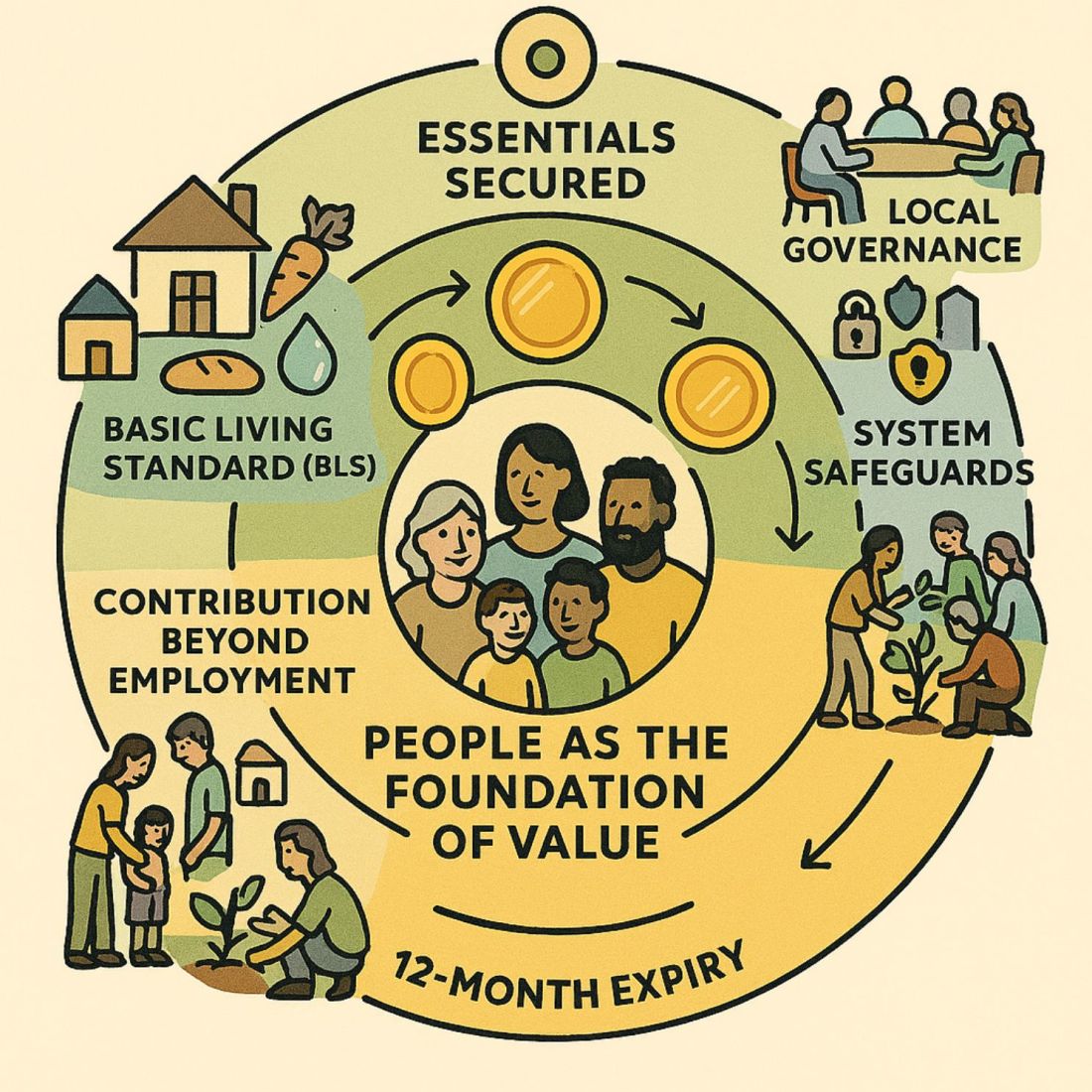


 Adam Tugwell