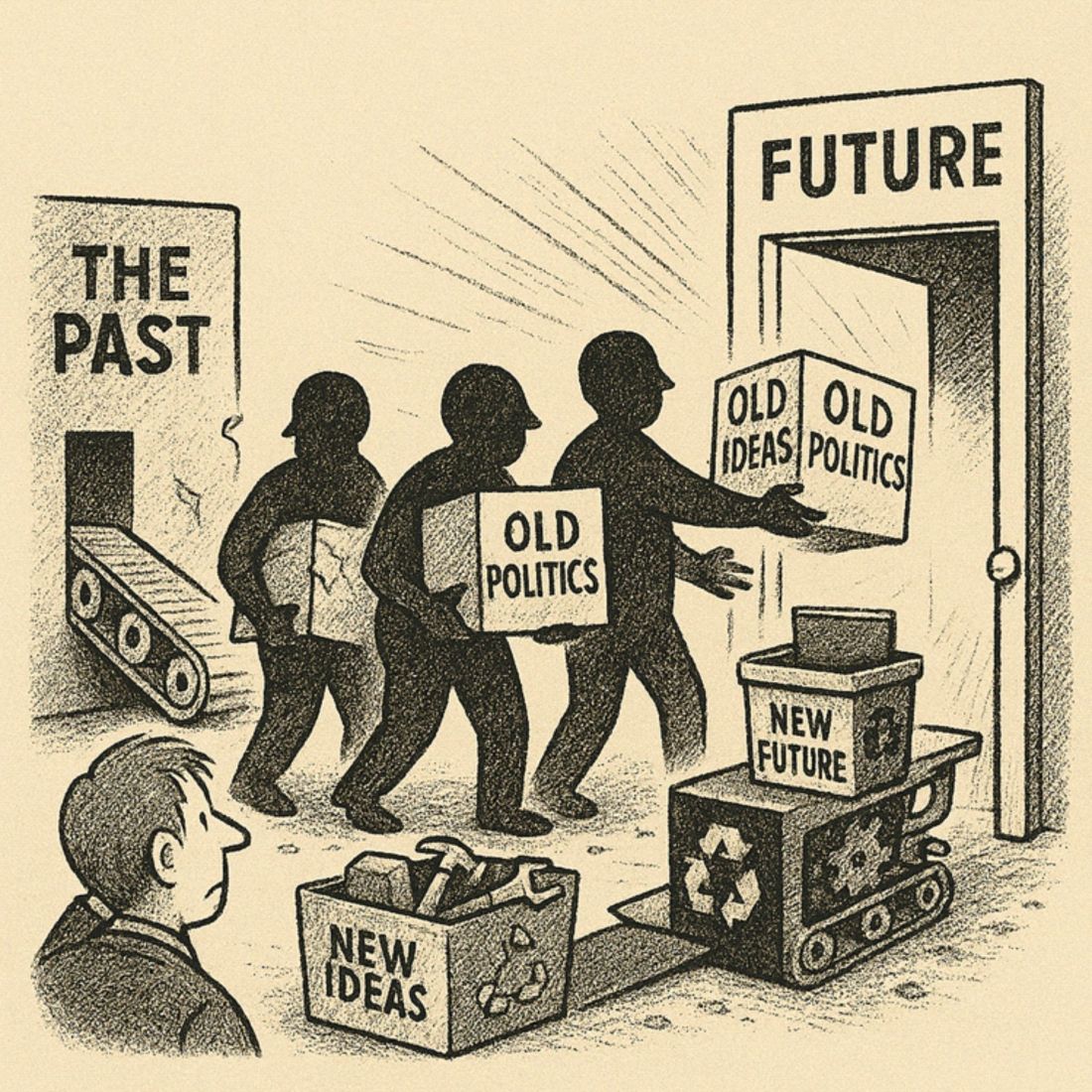
Plastic Productivity and the Debt Trap: What the November Budget Won’t Fix

Governments do not collapse in the same way that individuals or businesses do. If they did, the United Kingdom would have gone under financially long ago. Instead, the state continues to function by rolling debt forward, reshaping obligations, and presenting the appearance of stability. For ordinary people, however, the rules are very different. When we cannot meet our commitments, we fail — unless someone steps in to bail us out.

Meeting financial obligations requires honesty. You must know whether you can truly pay your debts or whether survival depends on wishful thinking. Throughout history, people and businesses have thrived or failed for both good and bad reasons. As long as they appear to function, few question what lies beneath.

For tradesmen, small business owners, and entrepreneurs, the reality is harsh. None of us are “too big to fail.” Once obligations can no longer be met, collapse follows unless a benefactor intervenes.

We like to believe the same standards apply to everyone, whether sweeping streets or running government. Yet elites have always bent rules to their advantage. They forget that all people, high or low, share the same human experience. Power corrupts, and politicians often forget they were elected simply to fill a seat, not because they are uniquely qualified to decide what is best for everyone.

The shift to fiat money in 1971 changed everything. It allowed governments, banks, and corporations to manipulate the system, creating the illusion of endless funds. Behind closed doors, decisions were shaped by business and banking interests, while politicians no longer had to worry about the true responsibilities of leadership.

Debt became hidden behind GDP figures. Growth and transaction volumes disguised the reality of an exploding debt pile. To the untrained eye, it looked as though debt was shrinking, when in fact it was spiralling out of control.

This illusion was sustained by what might be called “plastic productivity.”* Assets and infrastructure were bought cheaply, production was outsourced overseas, and consumers were encouraged to buy more and more goods they didn’t need. People became indebted to the same banks that lent to government, yet could just about service their loans. It seemed as though prosperity was endless, and few questioned the narrative.

But the system was never sustainable. Its architects knew it would transfer wealth and ownership to a small elite. By making money and material wealth addictive, they ensured control. With industries hollowed out, productivity now depends almost entirely on expanding debt — by government, business, and individuals alike.

Politicians face a broken system. To keep the machinery of government running, they must tax normal people more heavily. Yet much of public spending delivers little benefit. Policies have been rewritten, words twisted, and meanings changed to allow politicians to cling to power while the wealthy grow richer. Assets of real value have been transferred to people who could never have owned them otherwise.

If the system collapses, the establishment will impose new rules. They may impoverish citizens further, leaving people no choice but to accept whatever is dictated. Many politicians may not even understand the system they oversee. They follow instructions blindly, blamed for decisions that are not theirs, lacking the skills to lead differently.

The situation could drag on for months or years. Collapse may come when the public finally says “enough,” or when the establishment has drained the country dry. Even if a new government is elected — Reform UK, Nigel Farage, or anyone else — they will face the same reality. Cutting spending or taxes cannot fix a nation that is broke and owns nothing. Wealth has already been transferred to lenders.

The system is broken. We must either accept subjugation under a corrupt structure built on trickery, or take a leap of faith and start again from scratch.

***

*”Plastic productivity” refers to the illusion of economic growth created by outsourcing production, encouraging over‑consumption, and sustaining debt, rather than building genuine, sustainable value. It’s not about plastics as a material, but about a system that mimics productivity while hollowing out real industries and transferring wealth.

Yes, Reform are looking good. But the Tories could out reform Reform, IF they can remember what being conservative really is

Reform’s performance in the Local and Helsby and Runcorn by Elections really does look good.

Anyone looking on can immediately see why so many of the political pundits and members of the opinionati are now backing Reform for a similarly groundbreaking General Election result in 2029.

The uncomfortable truth that many supporters will fail to recognise is the only reason that Reform could achieve a seismic turnaround of the kind that would instantaneously drop Nigel Farage into No.10, would be that when compared to all the others, Reform could still be the only real unknown quantity, and therefore different enough to hoover up the majority of a very fatigued Electorates votes.

Unfortunately for the Electorate, without a significant change in their direction, voting Reform into power at the next General Election would once again be voting without due regard for the Law of Unintended Consequences. Just as it was last July when those who did vote put Labour into Government.

Nonetheless, it could and may well happen.

The real depth and direction of Reform are being hidden by Britain’s Political Perfect Storm

It won’t matter what problems the new Reform Administrations in Local Government create, being directed from Reform HQ, as if everything must now be run and controlled from the very top.

The unavoidable disintegration of the UK public sector that is already well underway will almost certainly hide whatever Reform Councils do from public scrutiny and view.

Because Labour, the Tories and Lib Dem Councils are going to struggle in this climate either not to go bankrupt or find other ways to avoid royally stuffing things up.

Reform aren’t reforming anything other than the public discourse over the issues that the majority of people can see and associate with the effects of the problems that are effecting society.

No matter how far detached those perspectives might be focused from the real cause.

Farage’s approach might at best be viewed as becoming increasingly aligned with the establishment and the global thinking that sits behind so many of the problems and the direction of travel that even this Labour government has.

The irony of this should not be lost, that whilst the parts of the political right that are falling in behind Reform either believe Brexit didn’t happen or that under a Reform government Brexiteers will get to finish the job, the reality is that everything that drove the EU project that Farage’s UKIP and Brexit Party so vocally championed against, also had globalism and the centralised global political model at its heart.

Once it becomes clear that a UK version of the Trumpian DOGE (Department of Government Efficiency) has no basis within the realities that underpin how our current dysfunctional public sector works, there may well be a moment when those Reformers with elected roles, who are taking their responsibilities to local electors seriously, will realise that there are many things that can still be done. Whilst there are many others that simply cannot.

At some point, the rather large penny must drop, that there is a very careful and considered game to be played that without otherwise torching the entire system and structure of government delivery and bringing it all to a halt, will require the buy-in of key Government officers, nonetheless.

To those watching closely, Farage has already shown his hand.

Whilst it might not be prudent to visit the bookies and begin trying to get odds just yet, as far as the next General Election goes, whenever that actually will be, the perfect storm that has engulfed British politics may well deliver a Reform win.

But it will be the U.K. and our people, rather than whatever is left of the political opposition, that will lose in that Election if Reform have ‘won’ under their current modus operandi and plans.

A Zero-Sum Game?

A rather interesting perspective of the seemingly unassailable position that Reform now has, is that as far as the future goes for the Tories, they currently face a zero-sum game. One that applies whether they capitulate to Reform or carry on as they have done before. As they clearly are continuing to do so, now.

Yes, there remains truth in the suggestion that Reform might never govern without the cooperation or collaboration of today’s Tories in some way.

However, Farage is unlikely to ever accept anything less than remaining in control. And as head of any collaboration and apparent PM in waiting, the real difficulties will begin for us all just as soon as the leadership has a lucid post-victory moment. Probably not unlike like Starmer et al did on the 5th of July last year, when those who had arrived in No.10 realised that unless they were big enough to risk precipitating an immediate collapse of the entire system, pretty much everything would still need to go on as before, and that even though they were in government, they themselves would be required simply to do as they are told.

Picture it now; a coalition that includes what is left of the Conservative Party, all subservient to a government of the kind that will almost certainly be filled with very angry activists. Ideologues who will have been promised much from outside of power, who took it all at face value; all without any of the understanding of how government really works. People who will quickly be looking for someone else to blame.

Now may be the Tories only available Watershed Moment

To say that the choice the Tories have sits between change immediately or die, might sound extreme. But it is a genuine reflection on where the future of this once revered political machine now lies.

The way the Tories would now out reform Reform, would be to reject and distance themselves from the establishment, globalist and accepted positions on just about everything. And not just say, but put everything about the UK and our people, first.

The choice to change cannot mean anything other than putting people and our communities back at the very heart of everything they do.

The Conservatives must return to the basic principles of conservatism and remember what it is to lead and deliver for others, selflessly, and with the key motivation to conserve.

The caveat would be that the Conservatives will also be required to restore and return a model of U.K. governance and related infrastructure to us that can recapture the sense of cultural belonging and shared feeling that our system is fair, balanced and just.

The point being missed across all of British politics today, is that by engaging the public correctly and re enfranchising people and communities appropriately and restoring real trust, people would quickly focus on a very different model of political engagement.

They would not need the myths, false promises and clever narratives to explain away the pain that disenfranchisement has caused for so many before.

Can the Tories actually change, rather than just talk it up?

Whilst being able to stand up and say ‘We have for too long got this all wrong’ is a very important part of getting any credibility back, it will be the actions of Today’s Conservative Party that count.

The rump of what’s left of the Conservative Party must stop pretending that with the level of uncertainty in the world as we have now, they actually have 4 years to try out and give wasted chances to new leaders who still believe that all the Tories need do to remain relevant, is wait until the political merry-go-round does its thing and it’s ‘their turn’ to return to power, once again.

No politician who is a genuine public servant has time to waste. And as it would be correct to say to any would-be political leaders who are ready and willing to do the right thing by the people who put them there, the time to change and begin working as they always should have, is now.

Our Communities are the only place that a workable political solution can begin

Any Political Solution to the crisis we are in must develop and grow from our communities and grassroots; NOT from any existing Party that still wants to rule everyone Top-Down

One of the key problems with UK Politics today is that it operates as almost the mirror image of wider culture, where most people fall into the trap of believing that their own perspective is the right one. But that anyone with an alternative view of any kind – even in just the smallest of ways, is or will be fundamentally wrong about everything else, too.

Yes, you could easily argue that this is how tribes and groups work.

But politics or rather the UK political system is supposed to be about delivering public policy that is created and then implemented in the best interests of ALL British People.

The one thing that we can be sure of is that when it comes to the political classes who have been running Westminster and our local Councils for decades, there is very little about any of it – apart from the Election campaigns, that has anything to do with or what is best for us.

As I have been discussing in some of my recent blogs, time has now run out for the way that government and our economic system runs. Neoliberalism and everything such as MMT, FIAT money, and the increasingly illogically impractical schemes like Net Zero and everything that pushes people and businesses into being reliant on credit are no longer sustainable.

That is why everything is now in the process of crashing around the Labour Government’s head.

Yes, the politicians in power are incompetent.

No, the mess we are in didn’t begin the day after Labour were elected to power and Starmer arrived in No.10.

And No, not Labour, nor the Tories, the Liberal Democrats, Reform or any other group of politicians currently looking ahead to the next General Election are going to offer and deliver to us anything different. Certainly not in any way that the UK actually needs.

For a time, I was open to the idea that Reform could find itself pursuing a different way. One that would offer the cross-tribal consensus and answers that the UK now needs.

Instead, it has become clear that the mechanics of this 4th evolution of the anti-EU movement certainly hasn’t moved on in any kind of people-centric direction.

Instead, Reform is just reforming itself, but in ways that have a very familiar likeness to political parties that have been in power before, who have increasingly aligned themselves and been led by the machinations of the establishment instead.

The mess over Rupert Lowe and the inescapable optics suggesting that at every level of the Reform Party, the whole thing is all about Nigel Farage, really does speak volumes for itself.

That’s before taking the time to read the outpourings of words from former party activists and ‘officers’ who have recently walked away. Just like better known voices associated with Reform such as those of Howard Cox and Ben Habib.

If any of the names instantly trigger feelings that suggest you have taken a side as you read – no matter the reason, it is exactly that kind of emotion that is our collective problem.

Disagreement over the smallest of things shuts so many of us down to the reality that we all have views about different things that we might never agree on. But when it comes down to all the things that are actually important, there is an awful lot of commonalities between all of us to be found.

Difficult to hear though it might be, it is the division that is deliberately sown between us over issues that we do have in common – by them being presented in ways that make them appear and trigger us as if they are something else – that really plays into the hands of the incompetent political classes that we regrettably have.

As things stand, and without a lot of us choosing to approach our relationship with politics very differently, the same people dividing us and guiding us to hate people we should not have any hate for, are set to keep guiding the ship that we are all beginning to sink on. And they will happily continue to do so, until the whole thing actually goes down.

Westminster is just the tip of the ruling iceberg that we can actually see.

Behind central government sits all the things like power, influence and the wealth accumulation that money controls and which is carefully kept outside of open view.

Because the truth is that the only people who benefit from us continuing to elect politicians who are under the spell of the establishment are those politicians and all those who are benefiting from the continuation of the establishment itself.

Whilst there is very good reason to believe that the wheels could fall off this broken bus at any moment in time, for those who have been aware and watching the direction of travel of the UK (and for that matter the whole of the Western world) for a considerable period of time, both the Global Financial Crisis and then the responses to the Covid Pandemic could, and arguably should, have already been the catalysts that introduced a genuinely new way of doing governance to the UK.

That these two massive events didn’t doesn’t indicate that change cannot or will not come.

The fact that we have been led to believe that what the politicians have done in response is in any way normal just tells us even more about how deeply embedded those who genuinely believe or work with this Top-Down, them vs us culture really are, right across the establishment.

We can see just how far they are prepared to take things in their attempts to stop the whole thing from crashing down, even now. Indeed, they are growing so desperate to maintain The System, they are even attacking the people who their ‘tribe’ have always typically helped.

Whilst the talk of absolutes will certainly sound like a contradiction to the words used as I began writing this Blog above, the one dividing line that we really do have no choice but to observe and then decide upon, is which side we sit between the establishment and all it stands for, and on the other side, the people and what putting people, our communities and the environment surrounding the places where we live and work, first.

Whilst even the Tories are successfully making themselves sound very plausible, just 8 months on from losing power, in the context of everything that the Labour Government is doing wrong, none of these political parties – and that almost certainly now includes Reform, show any sign of genuinely offering an alternative to establishment-directed public policy today.

However, it isn’t today and what is now past that we need to worry about. The most important thing is the future, and specifically what happens when we reach the next General Election and what must be ‘our time’.

The UK and we as its people cannot afford another General Election result that delivers power to any group – whether elected directly, or assembled as a result of some kind of post-election ‘deal’, that then goes on to do whatever the hell it likes.

No political party out there today, currently canvassing for votes in this years Local Elections is offering to do anything in any different kind of way.

We know this, because the way that they are running their election campaigns right now; how they are communicating and most importantly, how they are engaging with real people outside the bubbles of their own members and activists, is exactly the same as it has always been before.

To put it bluntly, we can no longer afford to take the risk that comes with accepting a choice of political candidates in any election, that not us, but the political parties themselves actually choose.

Change will not come in the way that we now so desperately need it, if we keep on doing politics at every level in the UK in exactly the same way!

It is our communities and the people who are around us every day who should be selecting the people who will represent us at all levels of government.

Not people we don’t know beyond the pictures, websites, social media and TV screens.

We need public representatives to represent us who have genuine skin in our game. People who are answerable only to us and who are committed to delivering locality-centric democracy, that is the only way that democracy can genuinely thrive, survive and most importantly, work.

Whilst government and the public sector really do now need to undergo massive change, the reality is that our communities could be working together to select and elect non-party candidates in all elections, right now.

We certainly don’t need any kind of change to the electoral system that just favours the election of more incompetent candidates. Ambitious and self-serving politicians whose actions will be made even worse by the guaranteed requirement for compromise on public policy that schemes like Proportional Representation as a replacement for First Past the Post would bring.

Power MUST come back to the people. Not through carefully crafted labels like ‘devolution’ and ‘devolved power’ that is nothing more than Regional Centralisation sold to us with a very misleading name.

The power – OUR POWER is already ours and that power can be made to work for us right now. IF we choose to use it. Look beyond the manufactured differences. And focus on working together, on the important things that we all have in common, and to deliver a new world and way of being that is happy, healthy, safe, secure and governs life with fairness, balance and justice for us all.

Anyone can begin this process of change and the appointment of new candidates to become the public representatives and politicians who will create and deliver our new future, right now. And we need them to, IF we are going to experience beneficial change.

That change  will only be certain if we all change the way that we think. What we can be sure of, however, is that a good future for us all doesn’t and will not start where anything ‘new’ for the politicians and voices that we already recognise as public figures begins.

A New Political Party needs to be new in every meaningful sense. That means leaving the fixed ideas and the egos in the incompetent politics bin too

Warfare within the Reform UK Party has broken in to full view this week, with what appears to be an exquisitely well-timed revelation about MP Rupert Lowe’s behaviour bursting into the open alongside a complaint to the Police, just a day after talk picked up suggesting that the Reform MP could be an alternative to Nigel Farage as Prime Minister.

With the polls appearing to have settled or even calmed in recent days, indicating that there is some kind of status quo manifesting around the current public view of the political establishment, and Reform apparently failing to pick up any one of 9 seats in council by elections this week, it is reasonable to believe that the momentum that the seemingly unstoppable party has had since last July’s General Election is already beginning to cross its peak and that this will have began to ruffle feathers within what exists of the Party hierarchy.

Rupert Lowe has been making demonstrable waves in the form of being the kind of representative presence that all voters should be able to expect of their MP as an absolute minimum.

In itself, this has been shining a light on the shadows created by what much of Nigel Farage actually does, and it would appear that the fragility of the egos that have been driving the 4th evolution of what at its core was always an anti-EU movement, have finally began to wrestle with the reality that the model of politics that they wish to pursue isn’t in any way hard hitting enough.

Fundamentally, the motives and drive of Reform appear to be just an echo, mirror or parroting of what drives all the politicians in Westminster, who have already been written off for their incompetence and self-serving ambitions.

Doing what we’ve always done with our political system is no longer going to wash.

Labour are sinking in every way. Not just because they are Labour. But because everything touched by public policy has been heading this way for decades, and the current crop of politicians on the government benches are really just the unfortunate fools who found themselves without a comfy seat as the music begins to stop.

Solving the growing list of problems that the UK now has will need adults back in the room and most people are waking up to this. So, one party getting a whopping majority, just because they are a different choice, isn’t all that likely to happen again.

Whilst the Reform rhetoric has been like sweet music to the growing number of politically disenfranchised from around the UK, who come from across all political and demographic backgrounds, and the movement of big names and former Tories to the Reform ranks, together make it appear that the right is really going the Reform way, the reality is that in terms of policy, outreach and wider public engagement at the very least, the talk and the stories being shared are direct messages that reflect how those choosing to follow them today now feel, and little more.

Reform policy suggestions give no indication that the party strategy is based on anything real or that connects with the realities that ANY political party in the UK will now face IF it gains power and is then determined enough to do EVERYTHING necessary to achieve all that needs to be done.

Whilst the end result may end up being about what can and what will change in Westminster, IF and WHEN the next General Election comes, no political party and certainly not a new one (or one that calls itself new) is going to create the seismic change and win the cross-tribal support and mandate for what will be very painful and far-reaching change, without turning everything political on its head.

At the very minimum, this means putting the relationship with voters and what life experience is like for everyone, first.

Yes, Reform could still do this. But the chances are that with what we have seen already, the Party is already too entrenched with a philosophy that tells their active members that they are not only different to everyone else, but their cause and what they are doing is right in a way that makes everyone who disagrees, wrong.

If you take time to look at the social media streams this morning, you will see the suggestions that Rupert Lowe join up with people like Ben Habib, Katie Hopkins and other names who any number of different people might currently see being the kind of person they would like or see best to lead.

The problem is that whilst some cannot see and many others simply will not accept it, the world has changed even since July. It is also continuing to change very quickly and that’s before we take into consideration any one of a number of possible events and outcomes that have the potential to unfold in the days, weeks and months that lie ahead.

Anything new and meaningful that has the genuine capability and structure to gain enough credibility to win outright at the next general election, MUST forget the personalities, the loud voices and the great media players and focus on what people need and what is best for the people, first.

There’s no question that people many would already recognise nationally and locally too will have a role to play in our political future.

But the way that politics today is politics for politics-sake, and everything is all about some agenda that is out of touch with real people and something that nobody apart from those who are ‘in on it’ will ever see, is over. It just hasn’t ended yet.

No, the UK doesn’t need DOGE. We need an entirely different approach to restoring Public Service provision

Depending upon which side of the fashionable side of the divide you currently sit on, you could be looking in horror at the work and changes that Elon Musk has already made to US Federal or government spending structures.

Alternatively, and as many on the right of the UKs political spectrum currently are, you might be so enthralled by how the sweeping changes of the new Trump administration looks, that you are already championing a similar approach for the UKs Public Sector, just as soon as the next government has been installed.

That wastage, the pursuit of projects that should never have been pursued, and the existence of many public servants who have never once served the best interests of the public at all is a problem across government, public services, NGOs and anywhere that the public purse picks up the bill across the UK, is most certainly true.

However, to suggest that ‘the problem’ would be solved, merely by taking an arbitrary glance at what money has and is being spent on, then stopping the cheques without question where anything doesn’t resonate, is utterly foolish.

Expecting some unseen force to pick up the slack from any action that could shut down public service provision overnight, is the food upon which anarchy and civil unrest are built on.

Those seriously minded about finding the solutions to the mess that the UK is now in would do well to remember that sharing a language and words that we use with our American cousins is in many respects where the real similarities between the way that we are governed and how our very different countries are run simply ends.

Whilst many of us fall into the trap at election time of believing that we are voting for one Prime Minister or another, the UK doesn’t have a Presidential system like the United States.

Even though it can be interpreted as being exactly that way, when one minute Rishi Sunak goes and is replaced just an hour later by Keir Starmer in No.10.

The sweeping powers that the American President appears to have just don’t manifest in the UK in anything like the same way – even if that’s how they genuinely work in the USA.

A mistake that we can be reasonably confident that most of the Prime Ministers over the past 3 decades are likely to have made would be that they have headed from The Palace to No.10, with the belief that once the famous door closes behind them, it will be as simple as saying whatever they want to say, and that whatever they then goes’.

No decision can be made in any form of government without consequences – as many of us like our Farmers are now openly in the process of finding out.

Yet many would be amazed at how simple many of the politicians that we have today really believe that making reasoned and meaningful change in and across government really is.

To say that the public sector is a monster of our politicians’ own making would be an understatement of seismic proportions.

But to begin to understand what anyone who really wants to ‘fix’ anything is up against, it is essential to recognise that the public sector is little more than a patchwork of massive, money-burning fiefdoms, where nothing more than overarching ‘policy’ direction is set and paid for by central government (That’s the Westminster lot).

Every little thing that can be interpreted and managed in some way differently, will be. To suit the needs of an overwhelmingly protectionist sector that has truly forgotten what it was created for.

Decisions overtly made by public representatives are followed and implemented in ways that would only ever be recognised as being corrupt if and when it could be proven that the decisions made were directly paid for.

If the reader can appreciate this, it is also just as important to understand that very little of anything the public sector does is technically or legally wrong. Because the system, the rules, the regulations and the directions that they are given have evolved over decades of time so that all of these organisations can apparently be run in any way that those managing them choose, as long as it appears that they are doing what they have been told.

The reason that the public sector serves itself isn’t because the Councillors, Mayors, Boards, CEOs and Executives have all decided that they will go it alone.

It’s because the UK has been a rudderless ship when it comes to leadership at the very top of government for so long that the system is now one that it is almost impossible for anyone at the very top to lead.

The UKs public sector and system of government delivery has become far too centralised and hierarchical for the distance between decision maker and decision implementor to work efficiently and work in the best interests of all those who genuinely need it in any way.

No, it’s not as simple as placing someone at the head of government who means what they say. Even though there are many existing and would-be politicians who are desperate for us all to see it that way.

Besides the fact that the UKs ‘executive’ really should always understand what they are doing, the technical structure of government and service delivery it ‘leads’ also needs to be of a size and nature where decision making is genuinely in touch with reality.

Public delivery systems need to respond and feedback in ways that are not only seen as being effective, but actually do work.

If you are minded that it’s the delivery that is the most important thing when it comes to Public Service provision, you may also be able to see that it’s the way that our government is structured, that is and has led to the problems that we now have, right from the very start.

Centralisation of power has created circumstances where poor politicians can hide the poor decisions that they make. Because the chain of authority is simply too big for whoever is genuinely responsible for the damage that is caused by ineptitude to take the blame.

Lack of real accountability is a problem throughout the public sector as a direct result. And when public servants look for an example to follow, many see what today’s politicians are doing, rather than what they are saying they are doing, and then interpret that model of behaviour as being perfectly acceptable to define how they approach their own workload.

So, whilst the talk coming from Reform, what is left of the Tories and what we identify currently as the ‘right’ may be suggesting that they all intend taking an axe to all that’s wrong with the UKs public sector, the hard truth that sits behind the veil of electioneering rhetoric is the problems we face are much more severe and structurally embedded than anyone is currently prepared to publicly admit.

Knee-jerk cost reducing strategies enacted in isolation will end up hurting people, if not actually leading to chaos. And as public policy solutions go, a DOGE for the UK will not really take anyone wishing to be successful in government all that far at all.

The correct solutions for everyone are not always obvious. But fools with power will inevitably believe that they are.

The problem also isn’t a new one. It’s just that it is becoming clearer to normal people today in ways that it never has done before.

The system works as it does, because it benefits certain interests for it to do so. People have always missed out. But the number has steadily increased to the level where the problems caused can be seen today. Because every lie has to be hidden by many others, until no lie can hide the others anymore.

***

I first saw these issues over 25 years ago running charity-based services that were funded by public sector partners and then as a local government officer where I designed and set up a service to benefit not-for-profit organisations. I quickly realised that the system at that time was likely to have been four times as productive with a quarter of the people, if it wasn’t protectionist in every conceivable sense and encouraged public servants to serve the public rather than the organisations themselves.

Twelve years as a Councillor with four as a Licensing Chair served to develop my view and understanding much further and I have previously written in detail about the problem and will link those blogs below.