Writing about people, systems and the realities that shape our lives
Tag: Wealth Inequality
Discussing the wealth divide, wealth inequality, the cost of living, the cost of living crisis, poverty, hunger, disadvantage, social exclusion, social mobility issues, being underpaid, unemployment,
Wealth is the only major difference between human beings that humans themselves create, manipulate, and distribute. We do not choose our biology, our innate abilities, or the circumstances of our birth. But wealth – its accumulation, its distribution, and its meaning – is entirely a human invention. And because it is human‑made, it is also subject to human abuse.
Across history, whenever wealth has been allowed to concentrate excessively, societies have fractured. Today, we are witnessing the same pattern repeat on a global scale. The imbalance created by extreme accumulation is no longer just an economic issue; it is a structural risk to the stability of communities, nations, and even the long‑term viability of humanity.
Excess Wealth Is Never Neutral
Those who display an excess of material wealth rarely acquire it through neutral means.
The ability to accumulate far beyond one’s needs almost always depends on taking more than is necessary, inflating value beyond what is reasonable, or benefiting from systems that reward disproportionate gain.
This is not an argument against wealth itself. It is an argument against the illusion that extreme wealth can be innocent.
Common sense tells us that nobody needs luxury versions of goods, services, or experiences. A cheaper alternative would meet the same purpose.
The difference between the two is not necessity – it is access. And access is determined by systems that allow some to accumulate far more than others.
History Shows What Happens When Wealth Concentrates
Extreme inequality has destabilised societies for thousands of years.
In ancient civilisations, concentrated land ownership displaced ordinary people and contributed to political collapse.
In pre‑revolutionary France, privilege and wealth were held by a tiny minority while the majority struggled, fuelling unrest that reshaped the nation.
During the Industrial Revolution, vast fortunes were built on the back of exploited labour, leading to social upheaval and demands for reform.
Periods of extreme wealth concentration have repeatedly coincided with instability, unrest, and systemic breakdown.
The pattern is consistent: when wealth becomes too concentrated, societies become fragile.
Wealth as a Human‑Made Difference
Unlike physical ability, intelligence, or personality, wealth is not a natural trait. It is a social construct. It exists because humans invented it, assigned value to it, and built systems around it.
This means:
Wealth can be redistributed
Wealth can be regulated
Wealth can be hoarded
Wealth can be weaponised
And when it is abused – as it has been throughout history – it creates divisions that threaten the stability of society itself.
The Modern Wealth Divide Is Not Accidental
Today’s wealth divide is not the result of individual virtue or failure. It is the product of systems that reward accumulation over contribution, speculation over labour, and ownership over participation. Markets, tax structures, labour practices, and financial mechanisms all play a role in concentrating wealth upward.
When someone accumulates far beyond their needs, that surplus does not appear from nowhere. It is extracted – from labour, from communities, from the environment, and from future generations.
The Cost of Excess Is Now Impossible to Ignore
We are living in a moment where the consequences of extreme wealth concentration are visible everywhere:
Housing markets distorted by investment capital
Essential workers priced out of the communities they serve
Environmental damage driven by patterns of overconsumption
Political systems influenced by wealth rather than democratic will
Social fragmentation as inequality erodes trust and cohesion
There is no innocent way to consume or possess far beyond one’s needs when the social and environmental costs are so clear.
A Threat to the Foundations of Mankind
When wealth becomes the primary measure of human worth, and when access to it becomes increasingly unequal, the result is instability.
History shows that societies cannot sustain extreme inequality indefinitely. Eventually, the imbalance becomes too great, and the system breaks – through revolution, collapse, or transformation.
Wealth is the only major human difference that humans themselves control. When we allow that difference to grow unchecked, we create a hierarchy that undermines the very idea of shared humanity.
The question is no longer whether inequality is unfair. The question is whether it is survivable.
For months I’ve been writing about The Local Economy & Governance System (LEGS) and The Basic Living Standard. Yet I’m always aware of a deeper challenge: until people truly see the mechanics of the money‑centric system we live in – not just the symptoms, but the structure – the need for a paradigm shift can feel abstract.
The irony is that the evidence sits in front of us every day. The system hides in plain sight. But because we have been conditioned to treat money as the unquestionable centre of life, we rarely recognise how deeply it shapes our behaviour, our morality, our relationships, our communities, and even our understanding of what it means to be human.
Money today is not simply a medium of exchange. It has become the organising principle of society – the lens through which value is defined, the gatekeeper of freedom, the arbiter of worth, and the mechanism through which power is accumulated. And because money has been elevated to this position, the consequences extend far beyond currency itself. They reach into motivation, identity, governance, and the very structure of our lives.
This is why centralisation exists.
This is why it grows.
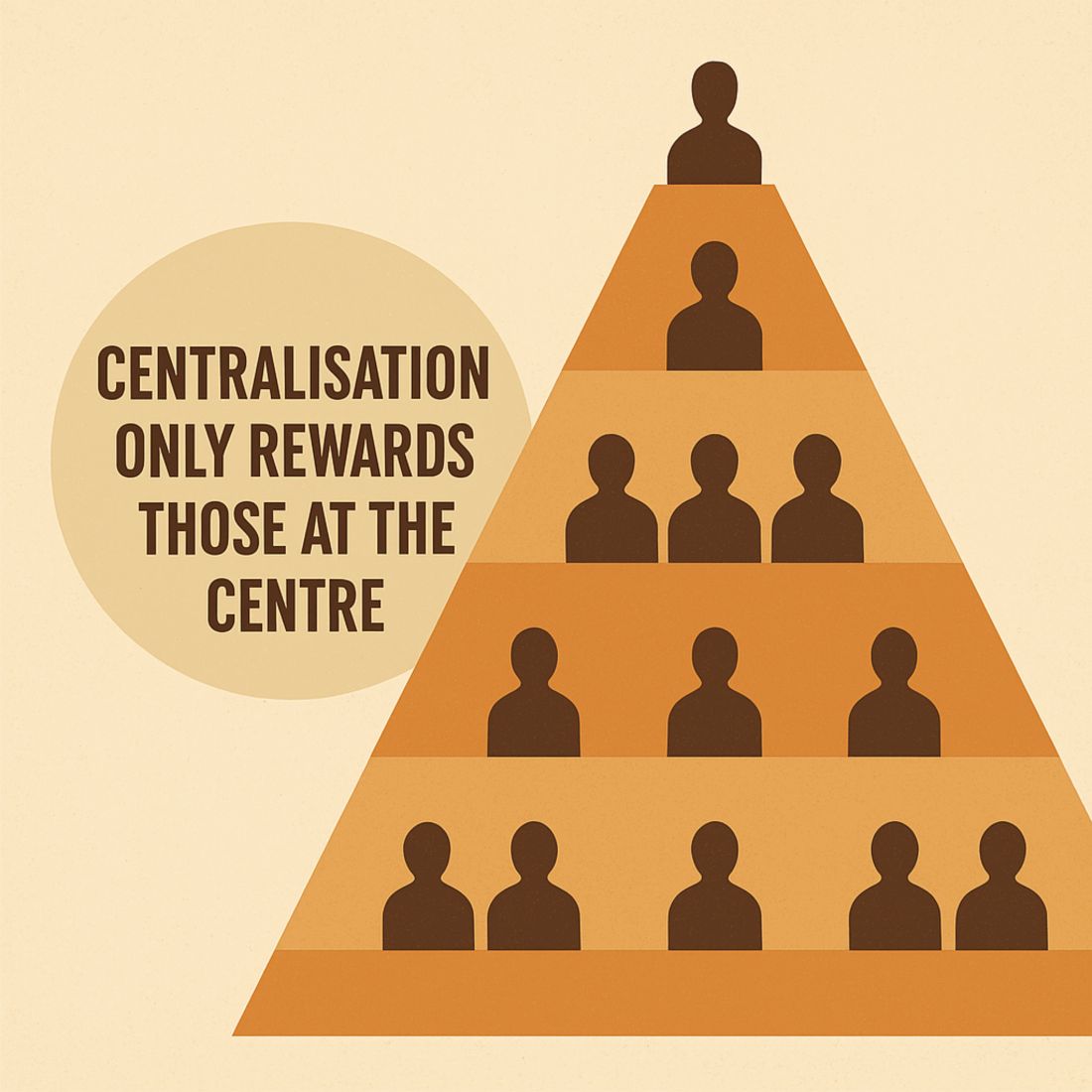
This is why it always rewards those at the centre – and harms everyone else.
The money–power–centralisation equation
The relationship is simple:
Money → Wealth → Power → Control → Centralisation
Everyone understands this at some level. Even those with the least money know that having money gives them more control over their own lives.
But as you move up the hierarchy of the money‑centric system, the dynamic changes. Money no longer gives control over your own life – it gives control over other people’s lives.
And once that dynamic exists, centralisation becomes inevitable.
Centralisation is not an accident.
It is not a side‑effect.
It is the natural outcome of a system built on scarcity, hierarchy, and accumulation.
The more money someone has, the more they can centralise power. The more power they centralise, the more money they can extract.
The cycle feeds itself.
This is the architecture of the money‑centric paradigm.
What centralisation really is
People often imagine centralisation as a simple chain of command. But in reality, it is a network of overlapping chains – each one transferring power, ownership, and influence upward, away from the people affected by decisions and toward a distant centre.
Every chain works the same way:
power flows upward
responsibility flows downward
accountability disappears
humanity is lost
And because these chains replicate across every sector – politics, business, food, media, technology, governance – they form a vast web of dependency and control.
Centralisation is not just structural.
It is psychological. It is cultural. It is economic. It is moral.
It is the mechanism through which the money‑centric system maintains itself.
The trick: centralisation is sold as “efficiency”
One of the most effective illusions of the money-centric system is the way centralisation is presented as:
reasonable
intelligent
cost‑effective
efficient
modern
inevitable
People are told that centralisation “reduces duplication”, “streamlines services”, “saves money”, or “improves coordination”.
But the truth is simple:
Centralisation always reduces the number of people with power.
It always increases the distance between decision‑makers and those affected.
It always concentrates wealth and influence in fewer hands.
And because distance removes empathy, centralisation always leads to dehumanisation.
Where we see centralisation at work
You can see the pattern everywhere:
Politics – power pulled upward into party machines, donor networks, and distant executives.
Government – “devolution” used as a cover for regional centralisation, reducing local representation and increasing control from Westminster.
Globalisation – local economies hollowed out as production and decision‑making move offshore.
Corporate structures – small businesses replaced by multinational giants.
Supply chains – farmers and producers trapped by supermarket monopolies.
In every case, the story is the same:
Centralisation removes local agency and transfers power upward.
The dehumanisation effect
As centralisation grows, the number of links between people and the centre increases. Each link removes a layer of humanity.
When decision‑makers have no direct contact with the people affected by their decisions, they stop seeing them as people at all.
This is why:
Policies harm communities without anyone taking responsibility
Corporations exploit workers and environments without remorse
Governments impose rules without understanding consequences
Systems become cold, bureaucratic, and indifferent
Centralisation creates distance.
Distance removes empathy.
Lack of empathy enables harm.
This is the psychological architecture of the money‑centric world.
The damage centralisation has caused
We have been told for decades that centralisation “makes life easier” and “reduces cost”. But the lived reality is the opposite:
People cannot afford to live independently on a minimum wage.
Communities have lost identity, cohesion, and purpose.
Local businesses have been replaced by corporate monoliths.
Supply chains have become fragile and exploitative.
The environment has been degraded for profit.
Wealth has been transferred upward at unprecedented speed.
Centralisation has not reduced cost.
It has redistributed cost – downward.
Onto the people least able to bear it.
This is not a glitch. It is the design.
Localisation: the antithesis of centralisation
Centralisation only exists because the system is built on hierarchy, scarcity, and accumulation.
Remove those foundations, and centralisation has no purpose.
This is why genuine localisation – not the fake “devolution” offered by governments, but true community‑level autonomy – is the natural alternative.
Local systems:
Operate without hierarchy
Are built on relationships
Are grounded in lived reality
Prioritise needs over profit
Are transparent and accountable
Reconnect people to the consequences of decisions
People trust local leadership because it is human, visible, and accountable.
They do not trust distant leaders they never meet, cannot reach, and did not choose.
Locality is the natural scale of human systems. Centralisation is the unnatural one.
Why this matters now
Centralisation is not just a political or economic issue.
It is the structural expression of the money‑centric worldview.
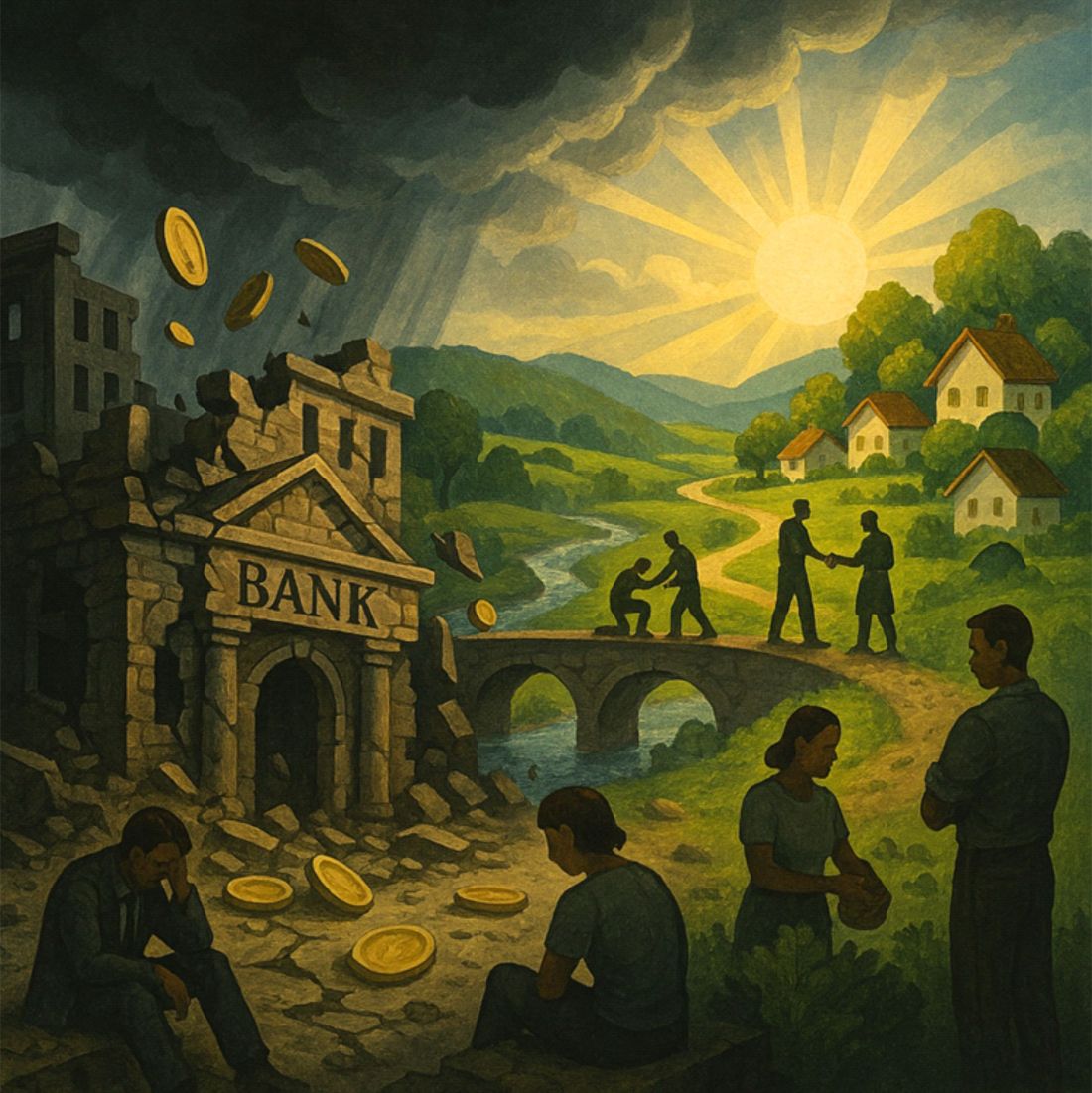
And because the money‑centric system is collapsing – financially, socially, environmentally, morally – the centralised structures built upon it are collapsing too.
This is the doorway moment.
We can continue rearranging the furniture inside a collapsing room.
Or we can step through the doorway into a new paradigm – one built on locality, contribution, community, and human dignity.
Centralisation is the problem.
Localisation is the solution.
LEGS is the structure that makes localisation possible.
The Basic Living Standard is the foundation that makes it humane.
The Revaluation is the shift in consciousness that makes it visible.
Once you see the doorway, you cannot unsee it.
And once you understand centralisation, you understand why nothing will change until we leave the old room behind.
It is regrettable that most people avoid confronting uncomfortable truths about the crisis we’re in.
Many actively ignore or dismiss what they know deep down to be true, preferring comfort over honesty.
But this habit of hiding from inconvenient realities isn’t new. It’s been passed down for generations. People have often chosen what feels good over what’s obviously right, leading us to our current predicament.
Pretending everything is normal, focusing only on ourselves, and letting others make decisions for us has brought us to the brink of systemic collapse.
The comfortable system we rely on is failing, and we must face this reality.
The Source of the Problem: Money
Many prefer to hear hard truths from trusted figures like academics or politicians, but deep down, we know the truth doesn’t depend on who says it.
It’s time to think, research, and analyse for ourselves.
At the heart of our problems is the money system. We’ve been conditioned to believe money is everything, shaping our choices and values around financial cost, reward, and status.
Yet, the money system itself is artificial. A belief system manipulated by private bankers, big businesses, and the politicians they control.
They change the rules to enrich themselves, transferring wealth and ownership away from ordinary people, all under the guise of normality.
Imminent System Collapse
Politicians obsess over “growth.” But for them, growth means increasing the size of the economy (GDP). Not helping small businesses or working people.
Real productivity has vanished as industries and assets have been sold off to those who profit from the system, while jobs have been outsourced.
GDP figures are misleading, counting money created through private finance and government borrowing multiple times. Politicians have tried to spend their way out of trouble, but even that strategy is failing.
With rising unemployment due to AI and unproductive sectors and a government so possessed by fear that they are regularly changing their minds, lenders are now worried the scam will be exposed.
Desperation has set in, and the government seems set to resort to ever-increasing taxes, hoping to keep the system afloat and their secrets hidden.
The System Enriches the Few
Prices keep rising while wages lag behind, making it harder for most people to keep up.
This isn’t new—it’s how the system was designed.
Once, a single working adult could support a family. But now, financial independence is reserved for the wealthy, while dependence and poverty are imposed on the rest of us.
The Myth of the Minimum Wage
The national minimum wage is misleading. It’s not enough to live on, but rather the lowest acceptable wage set by those in power, regardless of the real cost of living.
However, even the average wage isn’t enough for genuine financial freedom.
Financial Freedom Is the Solution
Almost every social problem can be traced back to the fact that the lowest-paid jobs don’t pay enough for people to live independently.
Admitting this would expose the system’s flaws and those who benefit from it.
The system survives by prioritizing money over people. Every decision made by those in power serves the money system. Not human needs.
Choosing People Over Money
If we want a better world, we must redirect government, business, and our rules to prioritize people, not money or the economy.
Unfortunately, our political leaders hide the truth instead of addressing it, covering up the growing cracks in the system.
Collapse Is Inevitable. But We Have a Choice
Systemic collapse is inevitable. But we can choose what comes next and who benefits.
If we do nothing, things will only get worse.
Those who created this mess believe they can protect themselves with wealth and security, but ordinary people will lose freedom.
The powerful will restrict our freedoms to protect their own interests.
Paradoxically, a collapse could be an opportunity.
If we embrace it, we can build a freer, fairer system for everyone. Something only possible when the current corrupt system is removed.
Whilst so-called socialists and capitalists alike will continue to argue that their destination would have been different, until whoever is in power takes the rap for destroying everything at the time – and then the other tries desperately to convince everyone that there’s still time for them, just to be sure, the very perverse and somewhat disturbing truth that is now coming into our view of reality is that the direction of both left and right political thinking takes humanity to exactly the same place.
What all these ‘philosophies’ – the ideas of academics, thinkers, economists, industrialists, tech moguls, agitators, the aggrieved, life’s bitter victims, entitled shirkers, greedy and selfish bastards – have in common, is the centralisation of power into the hands of one or just a select few – who for whatever purpose intended – control everything, so that they can enjoy their own lives and positions more than anyone they see as different to themselves and therefore as being a threat.
Verging on enlightened thinking, as many will surely argue their heroes and inspirations to have written these works will have been, enlightenment doesn’t revolve around creating environments that centre purely on a beneficial vacancy at the top. Which the design of these solutions surely was the intention, resulting from whatever experiences the authors had themselves experienced up until the time of writing.
None of these accepted visionaries were wrong. Or at least they were not wrong in the sense that we all are the sum of our experiences and our position looking upon or perception of life in any given moment will be correct, for us personally, in terms of what those experiences have taught us and what we have therefore concluded that they should be, right up to that same moment in time.
Let’s face it. The world is a very shitty place to be. Whether you have nothing and cannot escape poverty because of the boot that rides rough-shod over you; or at the other extreme you are as financially wealthy as it is possible to be and all you quietly worry about is protecting yourself, your wealth and how you are going to accumulate even more.
The pain that hides behind our eyes hasn’t changed over decades and centuries in human time.
Yes, the surroundings, clothes, transport, technology and everything else may seem different. But the nature of the experiences we are all having on our different pathways are in relative terms very much the same.
Wherever we may sit across this spectrum, 200 or more years ago at the dawning of the Industrial Revolution or right now as we are being prepared for the AI takeover, we all have an idea of what the perfect world for us would be.
It is regrettable that only some of us find ourselves able to share those ideas and thoughts and have them taken seriously by enough others for them to be seen to matter – which itself doesn’t mean they are genuinely enlightened or of benefit to greater humankind.
It’s simply the case that even when complete idiots or utterly selfish bastards are heard, their thoughts and views are swallowed up like nectar by people who themselves have a back catalogue of difficult experiences that identify with what they read or hear.
They pick those ideas – those philosophies – up and run with them, no matter how twisted or damaging in the longer term they might be. Leaving ideas behind in the dirt that the chaos they unleash leaves behind to fester for years and possibly centuries, that would otherwise deliver for the good of everyone when implemented.
We must be clear that all the ideas and philosophies for the world, whether they fall under the socialist or capitalist umbrellas or not, are without fail just ideas and suggestions.
Whether well intended or not, these philosophies were all packaged with the pretense that they were the ingredients, nuts and bolts or technicalities of a model of the perfect working world, for all people.
As history has demonstrated only too well, the actions of those underneath these umbrellas lead to both the imprisonment and oppression of the masses under the yoke of world elites.
We are fooled into believing there is a difference in outcomes because one system gets straight to work by enforcing its ideologies on people and the systems of the world as it tightens its grip and pushes those who are left into the cage. Meanwhile, the other drugs everyone with every conceivable high that they believe they like, creating mass addiction to ways of living that mean there is little hope of sobriety for anyone who has bought in and become addicted, until the very heavy jail cell door will have already slammed shut behind us all.
Centralisation is the flaw in all of these philosophies. Because it is impossible to centralise every part of life, for every single person across every country and across the entire world, without life, values, happiness, health, wellbeing and all the mechanics of essential function and civic society collapsing in their wake.
The clever tools and devices used by capitalists, globalists and neoliberals are ultimately no different to the level-playing-fields, street revolutions and guns employed by communists and socialists to enforce and police their point.
The painful outcomes that these forms of idealistic thinking inflict upon the masses always have agendas behind them, and none of those paying the real cost of these ideological-turned-material crimes ever agreed to the world being run this way.
The elites and those behind all of this have of course been aided by technological advances and the many different ways that the world has opened up and the distances between us all have been bridged.
Yet the point has always and pretty much systematically been missed that humanity and our morality based values system do not need and never needed to change to keep up with the material changes in the world, which have always been about the things that appear to be important beyond and outside of people.
Indeed, the changes that have been made to our frameworks for behaviour have always been made to suit those in power, with influence and who are directly benefitting from those changes. Those who perceive that the only way they can benefit more is for the old ways or ways that benefit others with fairness and balance must be left behind. Because they will otherwise get in the way.
So, was there ever a point in history where humanity genuinely got the whole thing right?
There is good reason to believe not. Or that if that moment of genuine balance has ever existed so far, it was momentary and could only really have been so, because the opportunity didn’t actually then exist to end the self-interest, anger, frustration, greed and every other dark part of the human condition that drives generation after generation to ingeniously, creatively and ignorantly to exactly the same things over and over again.
We may not see it, nor appreciate nor even find value in the suggestion. But a centuries-long pathway of humanity being led and controlled by interests that are not in any way genuinely shared, has led us all to a place where those who have benefited from that control and the generations following behind them, can no longer maintain that control. Because the whole pathway is about to have gone too far, before that door can be slammed shut and the final adjustments to the oppressed fate of humankind can be made.
The intention underlying of all these ideologies was that everything and everyone would be controlled throughout the journey, until that control was necessary no more.
Yet the systems we have been conditioned into accepting, like the out of control value of money, the rules that are supposedly there to protect and help whilst they disadvantage us, and the process of making very intelligent people doubt themselves or force them to believe and support ideas which run contrary to common sense or that are completely untrue, have all contributed to a situation where many already know the world is out of balance. People know that whatever is behind all of this has gone too far.
Natural, universal, unspoken rules have always existed that require each and every one of us to have the freedom to learn, to grow and to develop if we so choose to do so.
Because of the persistent actions of these patriarchal few and those who have followed them, that freedom for everyone to learn grow and develop, no matter their background or position in life, no longer exists. Because the way the system of the world has been developed now means that many no longer have the opportunity to experience the personal sovereignty to which every man is entitled. No matter how, where or to whom they were born.
A collapse is coming. That collapse is already underway. We are all within it and experiencing it at subjective levels that keep us from the objectivity that would make it much easier to define.
The critical point that is now approaching will be the moment that something happens, that could be civil unrest, financial collapse, the extension of foreign wars, civil war or something else, when each and every one of us realises and accepts that we have a Choice. And that we no longer have to be passengers or passively accept whatever someone else has engineered to be our fate.
The curse of overcentralisation is the never-ending desire of those who are at the centre of that centralisation process to centralise even more. Simply because of the greater rewards and control that they believe it will bring.
The outcome of the overcentralisation is that nobody ever has enough of any of the things they really need. When in a world and time when we have so much available to everyone, this has become a first-hand tragedy for us all to experience indeed.
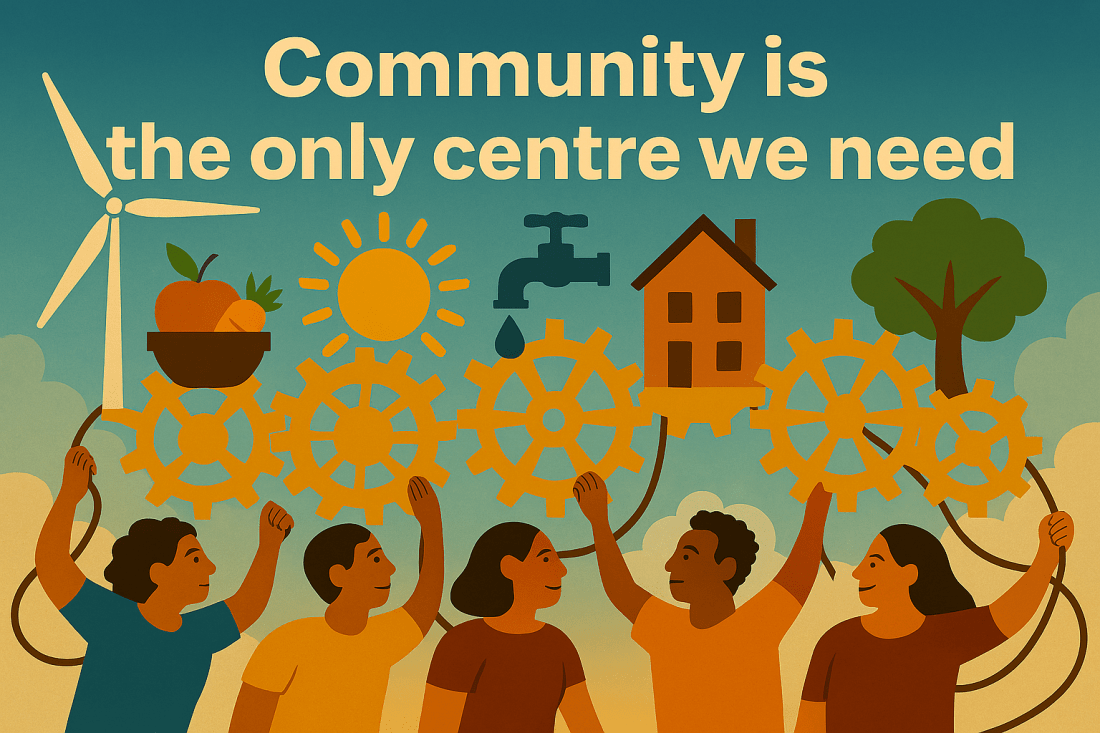
The only centre that we need and that we should ever seek is the community, locality and to share responsibility for everything amongst the people we see face to face and interact with each day.
This is real life that doesn’t come to us through media channels, digital technology or through rules that have been made by some name without a face.
This system is the only resource and ecosystem that we need to sustain us, that we need contribute to and that can be relied upon to create frameworks and governance for life that will always be in our best interests.
It is the only system that will provide and leave us with the genuine freedom necessary to enjoy every aspect of a good life, as the majority of us would want and like to experience.
The decision to make this change and embrace the power to do so is ours already, if we actually want it.
There is no need for hierarchies, for top-down systems and procedures, for political parties, financial markets and devices, globalised business and supply chains, or anything else that makes life cheaper. When life being cheapened any further is the very last thing that any of us need.
Local communities that are genuinely local and locality driven, and the ecosystems and self contained economies that they will create, offer us everything that we will need to have to experience valuable lives, where the basics and essentials are always in place.
Locality driven communities offer a system of governance meaning that no matter the life choices any one of us makes, we can all live independently of help – and therefore will not experience the forms of lack that are responsible for so many of societies social problems as their root cause.
The value of every one of us is exactly the same and nothing can change this.
No matter what we do, wear, what we have or how we are seen to be, not one of us should be positioned to advantage ourselves by disadvantaging others.
This is where the fundamental basis and genesis of a new world philosophy must be able to begin. One that is designed by us all for everyone rather than by a few who want everything controlled and for that control to be in the hands of one.
***
Over the past 3 years, I have been writing about the different aspects of what is happening; what is likely to happen and how we can all get from here to a much better place.
Whilst the rules and frameworks that govern a new world that will genuinely be of benefit to everyone, must be designed and agreed freely by us all, we still need an idea or vision of the outcomes that we can expect.
Our Local Future is a model for future life that I believe to capture this, which I would invite you to consider. Before someone else has considered and though out an alternative, that when the time has come to make the choice that is genuinely good for us, will instead steal that opportunity and take its place.
Whatever you do next, please remember to beware the many false prophets who are shouting the attractiveness of populism and anarchy now.
Don’t listen to those who tell you they are putting people first.
Keep watching for those who are doing so.
The only centre we need is within our communities themselves. Everything will make sense when everything important throughout our lives revolves around everything we can experience daily at first hand in this way.

 Adam Tugwell