Money IS The Greatest Crime of Our Time

Money Is the Only Bubble

The money used to acquire assets, fund lavish lifestyles, and build business empires—ultimately shaping the marketplace and its problems—was never real.

It was a construct, a fiction sustained by systems designed to benefit a few at the expense of many.

From the manipulation of legal frameworks to the invention of financial instruments, the expansion of credit, and the unchecked printing of currency, this entire process amounts to a crime against humanity.

What makes it even more tragic is that many of its architects believed their actions were morally justified simply because they were legal.

This illusion of legitimacy has allowed the system to flourish, while millions suffer consequences so distant and abstract, they’re barely recognised as harm.

Excess is only possible when a system enables it. But the existence of such a system does not make its outcomes just. Those who have gained from it are not necessarily right—only advantaged by a structure built to serve their interests.

Money Isn’t Real—and It Can’t Be Permanent If Life Is to Be Fair

Money lies at the root of nearly every problem society faces today.

The relentless pursuit of more—more wealth, more control—has become a corrosive force, infiltrating every corner of life.

So deeply embedded is this obsession that many no longer recognize how money has replaced meaning as the dominant value system.

But money is not natural. It never was. It’s a human invention—an abstraction—designed to facilitate exchange, not to define worth. And yet, it has been deliberately shaped and deployed in ways that make it appear inevitable, even sacred.

To treat money as permanent is to elevate illusion over reality. It distracts us from what truly matters: relationships, community, creativity, and the tangible richness of life.

Money is a symbol, not a substance. Mistaking it for something real is like confusing the map for the terrain—an error that leads us away from what is essential and toward a world ruled by shadows.

Redefining What Things Are Worth

Many political groups, movements, and activists advocate for wealth redistribution as a path to restoring fairness in society. But there’s a flaw in what may seem to socialists like an unshakable argument: the money we use today is only worth what people believe it to be.

The deeper issue lies in how we assign monetary value to everything outside ourselves—objects, experiences, even property.

These values are rarely based solely on the intrinsic worth of the item. Instead, they’re shaped by layers of influence: creators, suppliers, marketers, and increasingly, intermediaries who add nothing of substance but inflate the price through financial manipulation.

This simplification—that everything has a financial value—makes it easy for anyone involved in a transaction to feel they’ve suffered a loss simply by paying too much or receiving too little.

Our relationship with money encourages a constant craving for more: more income, more for what we sell, more for the work we do. More becomes a measure of superiority.

Somewhere along the way, the line between reality and illusion blurred. We moved beyond what we need into what we want and were actively encouraged to do so by a system that insists it’s not just acceptable—but admirable—to want more.

Money has become the default value system, replacing ethical and moral principles. Even laws—once meant to reflect justice—are now shaped to serve the interests of lawmakers and their benefactors and are deemed moral simply because they are legal. These laws underpin the financial mechanisms that justify explosive inflation and guarantee profit, even when the cost to consumers exceeds what they can reasonably afford.

The truth that’s long been overlooked is this: money has no inherent value. Its worth exists only in relation to what it can be exchanged for. The things we truly need have been repurposed—not as tools for living, but as instruments for generating profit.

To build a fair and equal society, we must reject the illusion that our current relationship with money is real or necessary. We must erase the financial values imposed on every tangible thing and release ourselves from the grip money holds over our lives.

The Coming Collapse and The Revaluation of Everything Needed to Regain Personal Freedom and Control

The Revaluation

Shifting People, Communities, and the Environment toward a New Way of Living—Secured by a Governance Framework for a Better Future

The Revaluation marks a transformative period—a shift in thinking, behaviour, and systems. It represents the transition from a money-centric, neoliberal, and globalised world model to one that prioritises people, human values, and local communities. In this new paradigm, everything is reimagined to support meaningful, positive life experiences for all.

Traditionally, “revaluation” refers to reassessing monetary or financial worth. However, the term has long applied to any kind of review or reassessment—of objects, actions, or opportunities—where the value we assign influences our decisions and actions.

In essence, anything with value can be revalued. Within the context of the global systems that have shaped and often harmed humanity, The Revaluation is a comprehensive transformation. It aims to build a world that is truly better for everyone. This includes the development of new systems, processes, and governance tools that not only secure and sustain this improved future but also prevent any return to the corrupt, inhumane, and damaging structures of the past.

Why The Revaluation Is Necessary

Restoring Our Moral Compass and Reclaiming Humanity from a System That Has Lost Its Way

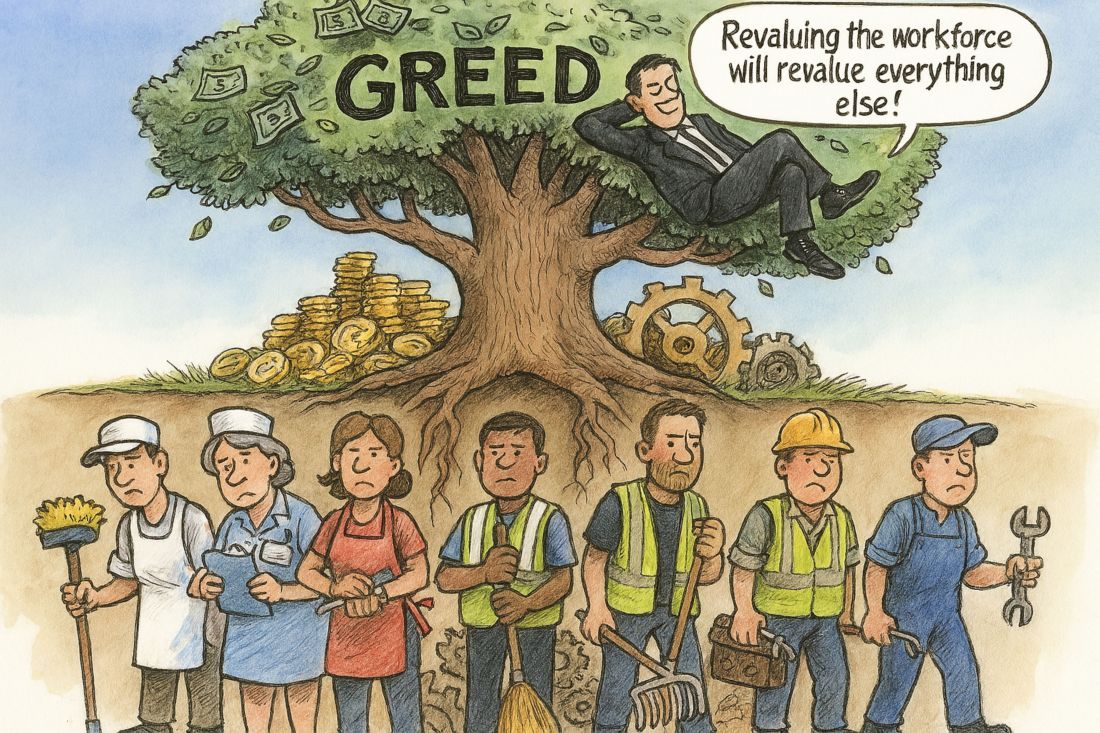
For too long, we’ve neglected our moral responsibility to consider others—people, communities, and the environment beyond ourselves. Even those most vulnerable, including the lowest-paid and those reliant on the state, have come to believe that success and survival require putting oneself first. This mindset has made it easy to overlook how those with power and resources have taken this pursuit of “more” to extreme and damaging lengths.

Exploitation—of people, systems, and nature—has become so normalised that many instinctively withdraw from acknowledging social problems, especially when solutions might come at a personal financial cost. Money has become the dominant tool for shaping behaviour, influencing every aspect of life—even those that seem unrelated to finance. It has replaced genuine values with a single benchmark: monetary worth.

This relentless pursuit of profit, wealth, and control by a privileged few has led to the collapse of communities, the erosion of human dignity, and the destruction of the environment. The natural systems that once sustained us have been disregarded, and the principle of sustainable living—once a cornerstone of generational survival—has been cast aside. The result is a world where ordinary people struggle to live independently within systems that no longer serve them.

Tragically, this outcome has not been accidental. It stems from deliberate strategies designed to exploit the masses, with depopulation seen as a desirable end once those in control have extracted all they can. By making life superficially easier, they’ve masked harmful changes and encouraged people to embrace their own diminishing value.

The most insidious part of this strategy is the willing participation of the public. Many still refuse to believe that those driving these harmful agendas have been openly declaring their intentions for decades. Our own selfishness has been weaponised—used to distract us and blind us to the truth hidden in plain sight.

When the truth finally becomes undeniable, few will challenge those responsible. Their defence will be simple: “We told you what we were doing, and you chose to go along.” This complicity is deepened by the addictive nature of money-centric living. Money has become not just a tool, but the ultimate goal—an addiction that feeds itself, offering fleeting satisfaction while eroding real happiness and human connection.

Addiction leaves little room for reflection or accountability. Many reject the uncomfortable truth about their relationship with money and its consequences. The illusion of comfort is easier to accept than the responsibility that comes with waking up and choosing a different path.

Spelling It Out: How Life Doesn’t Work

A Breakdown of some of the Systemic Failures We’re Living With

  • The minimum wage is not enough for anyone to live independently. Without benefits, charity support (like food banks), or debt, survival is nearly impossible.
  • It’s cheaper to buy food shipped from across the world than to purchase locally grown produce—despite the environmental and social costs.
  • Retailers are more focused on selling finance packages than the actual products or services we go to them for.
  • Politicians promise whatever they think we want to hear, deliver none of it, and then do as they please until the next election, when the cycle repeats.
  • Local councils seem more interested in fining residents for minor offences than in providing meaningful services that help people live well.
  • Police forces often appear uninterested in tackling real crime.
  • People are expected to self-censor their thoughts, speech, and actions to avoid offending anyone who insists their personal worldview must be universally accepted.
  • We’re told that if technology can do something, human involvement is no longer necessary—regardless of the consequences for displaced workers, shuttered communities, or the unsustainable use of resources.
  • Individuals are increasingly treated as reference numbers—valued only for their potential to generate income for those who can exploit them.
  • Through the influence of big business, government, and the establishment, we’re being led to believe that farms are no longer necessary to produce food.
  • Money has become more important than people, values, or the planet.
  • Private companies and individuals can own and charge rent for access to natural resources that should belong to everyone.
  • Blame is always shifted elsewhere, even though accountability is one of the most powerful tools for learning and growth.
  • We’re told to champion diversity, yet the way it’s framed often reinforces divisions between people and communities that might otherwise not exist.

What Will the Revaluation Look and Feel Like?

Understanding the Transformation We’re Already Living Through

The Revaluation—and the process leading up to it—is already underway. We are living through it now.

It’s profoundly difficult to recognise this transformation for what it is, precisely because we’re immersed in it.

Every part of it is unfolding around us and within our individual lives in deeply personal ways.

This makes it nearly impossible to take an objective view—much like walking through a forest and only seeing the trees immediately around us, rather than standing on a hillside and seeing the entire landscape.

The changes we’re experiencing—best described as the gradual disintegration of the system we’re leaving behind—are happening bit by bit, affecting each of us differently. Yet a growing sense of shared experience is emerging.

Increasingly, people are recognising that governments and public services are no longer functioning as they should, and that our current system of governance is in disarray.

This doesn’t mean a dramatic event or series of events won’t occur. In fact, it’s likely that such disruptions are already on the horizon. At some point, the system we’re all riding—like a train—will derail.

We’ll then face a choice: attempt to repair and continue on the same damaged track or accept that our future requires a new direction—one not bound by tracks laid by others and not limited by a system incapable of change.

In truth, we’ve come far enough to know that change is inevitable. The real question is whether we’ll embrace meaningful transformation that could benefit everyone or resist it out of fear—clinging to the comfort of a train we’ve grown dangerously accustomed to.

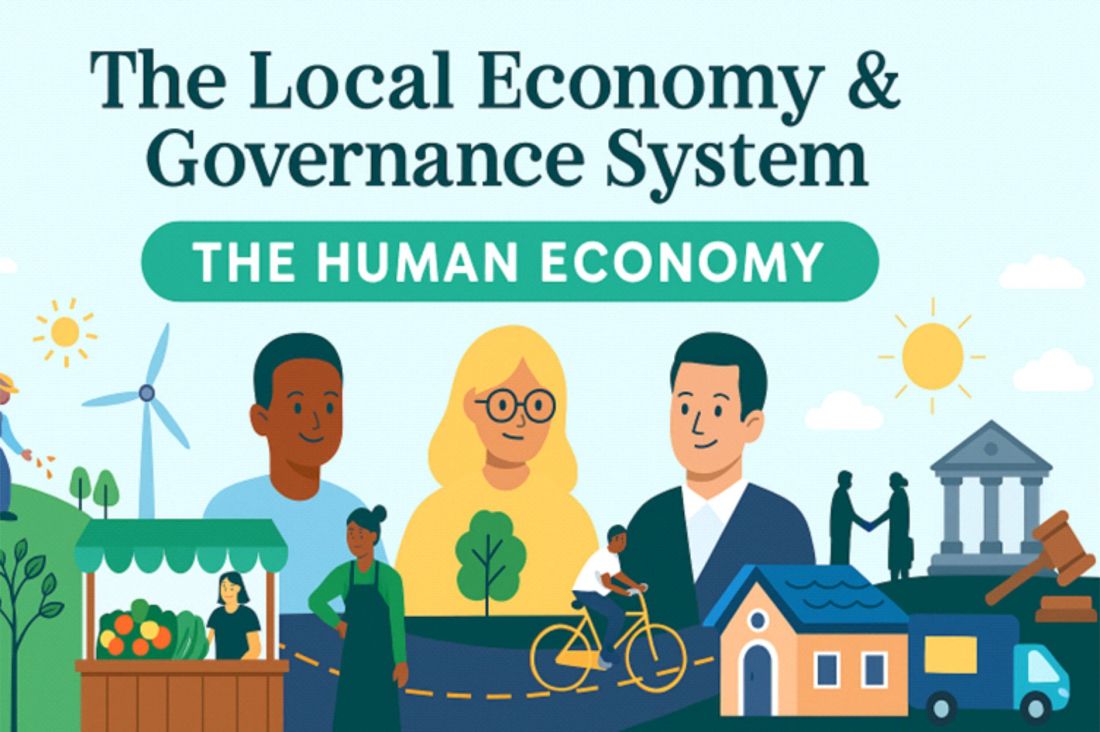
The opportunity to engage in conversations and act toward building a Local Economic and Governance System is already available to us.

While the defining milestones of The Revaluation may not yet have arrived, they are surely close. Now is the time to explore, plan, and consider how a fully localised, people-centric system can work—for us and for everyone.

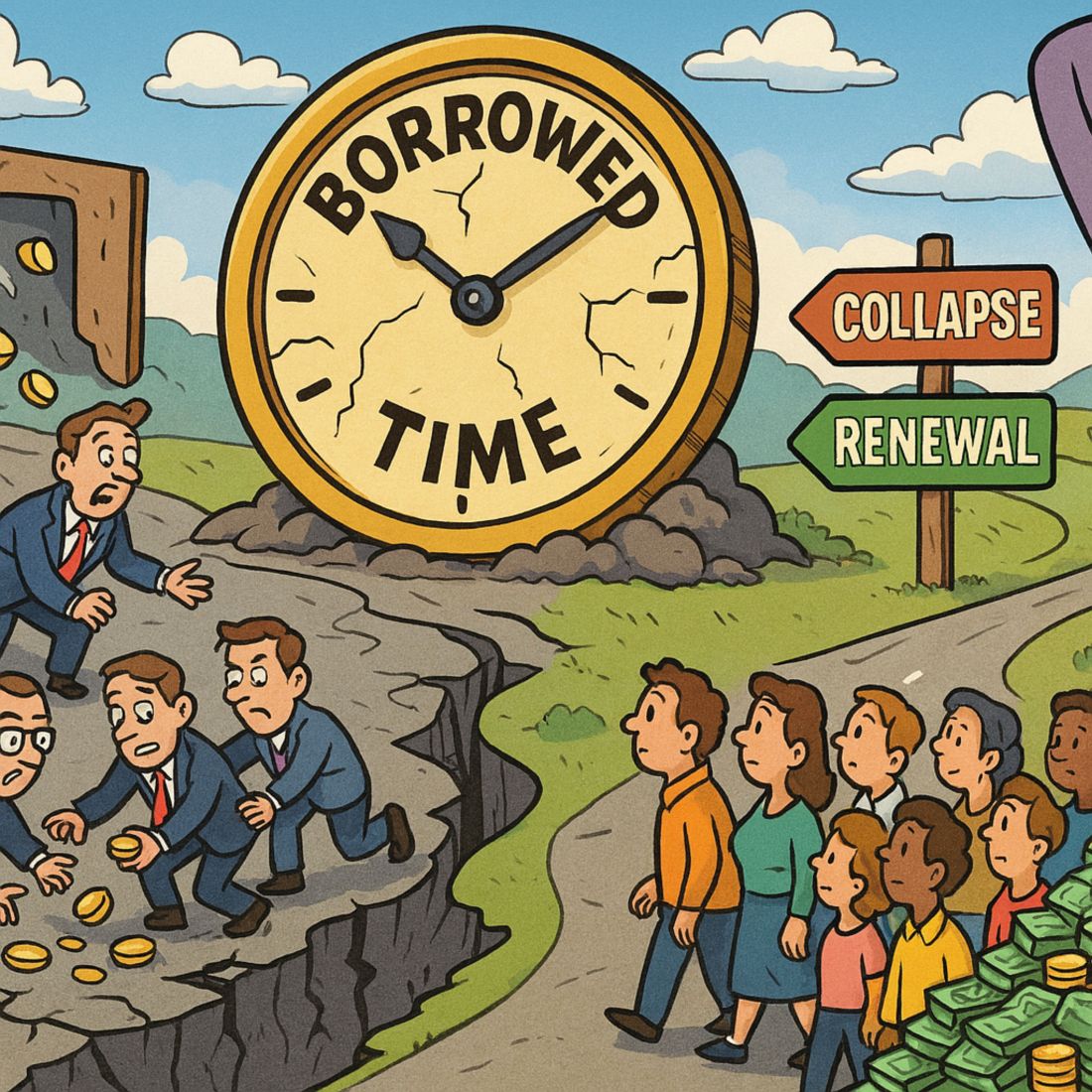
Government is Broke(n): Collapse Now or Collapse Later?

Tuesday marked the rather strange pre-budget speech or open warning call from the Labour government, shouting all too loudly that Tax rises are inevitable and heading our way.

Whilst Farage attempted to get ahead of the game by making bold a bold statement on Monday about a future Reform government cutting spending on Welfare, and then Kemi Badenoch followed Reeves online with a speech that pretty much adds up to the same, the commonality between the positions of all these politicians will be missed by many for being remarkably similar, if indeed not the same.

Yes, you may ask yourself how exactly this could actually be. But the key element of one party raising Taxes whilst failing to cut spending, whilst others promise to cut spending whilst freezing or lowering taxes is fundamentally the same – because these approaches are all about saving the economic system and the economy that we have – and absolutely nothing to do with putting people and the lives of people first.

Few realise and even fewer understand that Reeves really isn’t the architect of the problem the U.K. (and the wider world) now faces.

That responsibly has been held and passed through many different hands over a period that exceeds decades of time, whilst a monetary and economic system has been introduced and then encouraged to take over every part of life and what we know as economy, with laws, regulation and even the legal system itself abused and manipulated to make money work in a way which suggests that its supply is endless.

Meanwhile, everything that has productive value to the U.K. and its economy has been destroyed, or outsourced, leaving almost nothing that can be used to sustain a sovereign nation behind. And now, even our ability to feed ourselves with our own farms on an accelerated pathway to being destroyed.

The growth that politicians obsess about has not been through any genuine notion or understanding of growth as everyday people and small business owners understand it but has instead been borne of the fear of people who should never have held the reins of power.

Politicians who fall over themselves to find, create and manipulate ways to ‘borrow’ more and more money in the form of the bonds that the government sells, which when funnelled into the right areas of public spending will multiply many times over as each pound changes hands between different business, with each transaction then meaning just the one pound is counted against GDP and ‘growth’, multiple times.

GDP then facilitates the accounting trick of all accounting tricks. Where public debt is never paid off but is cleverly reduced as a percentage of the ‘growing’ GDP balance, meaning that other than paying ‘interest’ on that ‘borrowing’, what is supposed to be a debt that gets smaller in relation to the U.K. productivity or GDP, should never actually need to be paid off at all.

What the politicians never understood – beyond agreeing to facilitate and legalise a system that basically made being in power as being as simple as a) doing what whoever pulls the strings tells you, and b) having to do nothing else other than save or spend, is the corrupt money and economic system that they have legitimised through deregulation and changes in all sorts of laws and rules, has legalised the theft of the business and infrastructure that once made the UK great, also enabled this Country to be able to pay its own way through the natural methods of productivity or what we might see as things like industry, which up until the Second World War were ours, and only ours.

Finding ways to create ‘growth’ has become progressively more desperate. Not just for Starmer, Reeves and co; but for every politician who has been anywhere near real power for a very long time. All as part of a process that dates back to at least 1971, when the FIAT money lie was properly embedded and the last remnants of the gold standard were left behind.

The same money and economic system that has been used to disproportionately enrich the few, whilst giving them the power to exploit and impoverish the masses, is also the reason why growing numbers of people can no longer afford to live. It’s why we have a minimum wage that doesn’t actually provide those who earn it anywhere near enough money to live independently and have lives which we would recognise as being their own.

As we now watch the welfare bill spiralling out of control – not because people don’t want to work – but because the system we have has pushed them and in many cases held them there – we are staring down the barrel of the gun that is the AI takeover, where many millions more jobs will be lost. Not because they need to be. But so those controlling this shit show can earn and profit even more.

The government is broke and broken. Raising taxes is the only way that they can service the forlorn hope that enough growth can be create that will turn on the taps of borrowed money once more, so that the real damage that is now bursting into open sight from decades of mismanagement and yes treachery can hopefully be hidden.

Then the politicians can resume taking their happy place in the limelight of the Westminster merry go round and the wheels of money myths will spin for another day and avoid hitting the ground of reality once more.

Unfortunately for us all, the reality that the U.K. has pretty much zero productivity left means that the money, cash, property and ownership we have of anything is the only potential saviour in terms of financial resources that out of their depth politicians actually have available to them.

If a new politician or political leads were able to take over today and face up to the situation and see and be honest about all of this for what it really is, they would recognise that the choice they have is to either embrace the collapse which has been inevitable from the moment that private interests took over money and the economy, or keep playing along – which means taxing and taking from everyone and everything, until everything collapses anyway, and nobody has anything left worth having – because the need to save their own skin and position dictated that there was simply no other way.

Overview

Key Messages Simplified

• The UK government is financially broken, and politicians are trapped between two bad options: accept collapse now or prolong it by taxing and impoverishing the public.

• Rachel Reeves’ pre-budget speech signals inevitable tax rises, driven by a £50bn shortfall and falling productivity.

• Other parties, like Reform UK and the Conservatives, offer economic strategies, whether through spending cuts or tax freezes, that are all variations of the same flawed approach: preserving the current economic system at the public’s expense.

Core Arguments

1. The Economic System Is Rigged

• Decades of deregulation and manipulation have created a monetary system that benefits the wealthy while hollowing out UK productivity.

• GDP growth is an illusion, inflated by repeated transactions rather than genuine value creation.

• Public debt is never truly repaid—it’s masked by GDP growth, allowing borrowing to continue indefinitely.

2. Political Consensus Protects the System, Not the People

• Whether politicians raise taxes or cut spending, they’re all trying to save the same broken system, not improve lives.

• Reeves, Farage, and Badenoch are functionally aligned, despite different rhetoric.

3. Collapse Is Inevitable Without Radical Change

• UK productivity has been destroyed, with industries outsourced and even UK agriculture now being undermined.

• AI-driven job losses will worsen inequality. Not because they’re necessary, but because they’re profitable for elites.

• The only remaining assets people and small businesses have —cash, property, and ownership—are now becoming the last financial lifelines for the government and politicians who simply shouldn’t have the power that they do.

Final Warning

• Politicians must either confront collapse honestly or continue taxing until everything collapses anyway.

• New leadership must be willing to reject the current system, rather than perpetuate it for personal or political survival.

Why People Can’t Just “Get a Job”

This morning, Chancellor of the Exchequer Rachel Reeves delivered her pre-budget statement ahead of the Autumn Budget, scheduled for 26th November.

Despite mounting welfare costs, Reeves offered no meaningful solutions — only strong hints that taxes will rise, paired with blame deflected onto everything and everyone except the government itself.

It’s no surprise, then, that Nigel Farage rushed out a bold announcement promising welfare cuts if Reform wins the next general election yesterday, while Tory leader Kemi Badenoch quickly followed Reeves with an online broadcast that, in substance, amounted to much the same.

As the government flounders, it seems poised to announce little of substance of savings on benefits or public services — yet millions already trapped in a financial vice not of their own making will see the cost of living rise again, working harder for ever-diminishing returns.

The Tories — who helped engineer the current crisis over their 14-year tenure up to summer 2024 — and Reform — now visibly undergoing their own establishmentisation makeover — aren’t offering help to people either. They’re offering help to the economy.

And that’s precisely where the problems began for those whose lives revolve around the benefits system today.

There are hard truths here. Truths that many untouched by poverty still find just a little too uncomfortable to believe.

There will always be people who are:

• Out of work for valid reasons

• Unable to work due to illness, disability, or caring responsibilities

But there are also many people who want to work and are able to work — yet still can’t. Why? Because:

• They can’t find jobs that match their experience

• They can’t find roles that fit their qualifications

• They simply don’t “fit” the mould employers are looking for

It’s easy to assume that anyone who wants a job can get one — any job, at any time. And it’s just as easy to judge those who don’t take “any job” as lazy, entitled, or abusing the benefits system.

But those who make these judgments often haven’t experienced what it’s like to be unemployed and dependent on state support.

The Reality of Benefits

Let’s be clear: basic benefits are not enough to live on.

We’re surrounded by comforting myths — stories we rarely question unless we’re forced to confront the truth. One of the most dangerous myths is that the National Minimum Wage is enough to live on independently.

Here’s the reality in November 2025:

• Universal Credit: Between £316.98 and £628.10 per month, depending on your circumstances

• Minimum Wage: £12.21/hour. For a 40-hour week, that’s about £2,116.40/month

• Actual cost of living: To live independently, a single person likely needs £16–£17/hour — around £2,773.33/month

That’s a shortfall of over £600/month, even for someone working full-time on minimum wage.

The Impossible Choice

Now imagine you’re unemployed, with no savings or support, and your only option is to claim £628.10/month. What do you do?

• Take a job that still doesn’t cover your basic needs?

• Or claim every benefit you can, just to survive?

For many, working full-time in a low-paid job — often under poor conditions and public judgment — while still needing benefits just doesn’t make sense.

The Myth of the “Benefits Culture”

The idea that claiming benefits is an easy ride is a myth. Genuine claimants are treated the same as those gaming the system. The rules are rigid, often making it harder — not easier — to find meaningful work.

Pushing people into low-paid jobs that still leave them reliant on benefits, food banks, or debt might reduce one type of welfare cost. But it could as easily increase the others — through the problems that an ill-considered attempt to push everyone into ‘work’ will create, like mental health issues, workplace burnout, and long-term poverty.

The AI Displacement Problem

A growing wave of joblessness is being driven not by lack of talent, but by the unnecessary and unchecked takeover of roles by artificial intelligence.

Skilled, experienced professionals — once vital to their industries — are being sidelined by automation that prioritizes cost-cutting over human value.

As more capable workers are pushed into the job queue, many will find themselves forced to claim benefits, not because they lack ability, but because the system no longer has space for them.

The Bigger Problem

Most people on benefits aren’t lazy — they’re surviving.

When life becomes a daily struggle, the benefits system can feel like the only option.

But simply cutting benefits without creating real alternatives — like jobs that pay enough to live on — risks pushing thousands into homelessness and crisis.

The Psychology of Work and Pay

Most people don’t need prestige — they need security.

If lower-paid or less challenging jobs guaranteed that workers could meet all their financial obligations and live with dignity, many would take them without hesitation.

The problem isn’t the work itself — it’s that the pay doesn’t match the cost of living.

When people know they can cover rent, bills, food, and essentials every month, they’re far more willing to contribute, even in roles that society undervalues.

What Needs to Change

We can’t fix the benefits system without fixing the economic system that creates the need for it.

If we want fewer people on benefits, we must:

• Build an economy where full-time work pays enough to live on — without top-ups

• Stop supporting a system that enriches a few by impoverishing the many.

Until the government legislates for a fairer system — one where the lowest-paid can live independently on a full day’s work — poverty will persist.

That’s where real change begins.

The Basic Living Standard Explained

The Basic Living Standard is a foundational guarantee that ensures every individual earning the lowest legal weekly wage can afford all essential costs of living—without falling into debt, relying on welfare, or turning to charity.

It defines the minimum threshold of financial independence, where core needs—such as food, housing, utilities, healthcare, transport, clothing, communication, and modest social participation—are fully covered by earned income alone. It also includes provision for savings, unexpected costs, and fair contributions to society.

This standard is not aspirational—it is structural. It affirms that full-time work at the lowest wage must equate to full dignity, autonomy, and security.

***

No food banks. No emergency loans. No skipped prescriptions or unpaid bills. Just a life that’s livable, sustainable, and free from poverty.