The Government’s Biodiversity & National Security Report Misses the Real Threat: Our Food System is Already on the Brink

A response to HM Government – Global biodiversity loss, ecosystem collapse and national security: A National Security Assessment (Published 20 January 2026)

When the UK Government publishes a national security assessment warning that global biodiversity loss and ecosystem collapse threaten our food supply, you would expect honesty, clarity, and a sober assessment of the risks we face.

Instead, the report released on 20 January 2026 offers a strange mixture of stark warnings and comforting illusions – particularly around the UK’s food security.

It acknowledges that ecosystem degradation could destabilise global food production, disrupt supply chains, and trigger geopolitical competition for food. All of that is true.

But then it slips in a familiar, misleading reassurance:

“The UK imports 40% of its food.”

This figure is presented as if it reflects our real‑world vulnerability. It doesn’t.

It’s a net figure, not a resilience figure.

And it hides the truth that the UK is far more dependent on foreign food systems than the report admits.

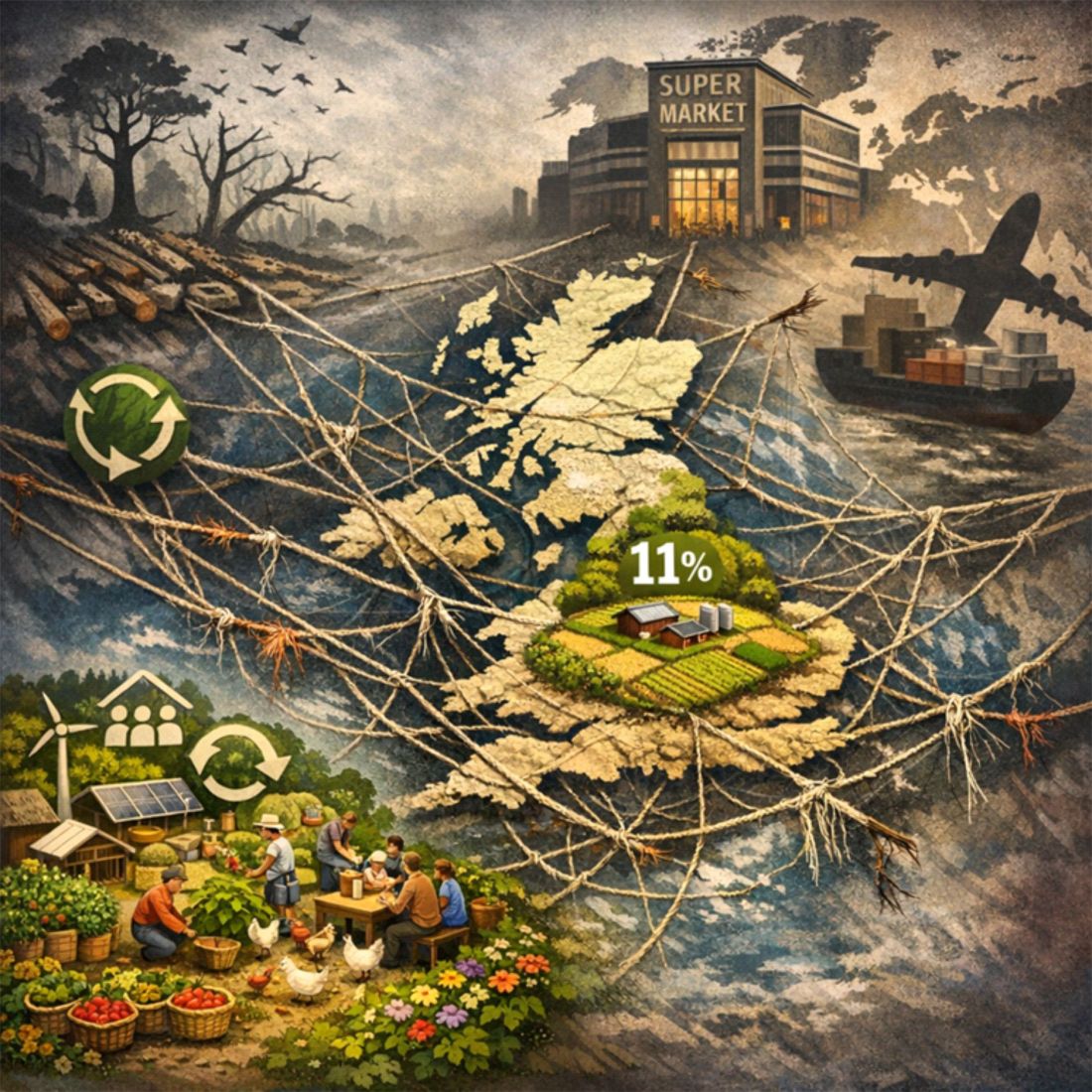
In fact, if the UK’s borders closed tomorrow, the amount of food immediately available for the population is closer to 11%.

That is the real national security threat – and it has nothing to do with future ecosystem collapse.

It is the result of decades of political choices, corporate control, and a food system designed around globalisation rather than public need.

The 40% Myth: A Convenient Political Fiction

The government’s “40% import dependence” statistic is based on food by value, not food by:

  • calories
  • volume
  • nutritional availability
  • immediate edibility
  • or domestic accessibility

It also ignores the dynamic reality of the UK food chain:

1. UK‑produced food is routinely exported

Much of what we grow or rear here is not eaten here.

We export beef, lamb, dairy, fish, cereals, and vegetables – then import substitutes.

2. “British food” often depends on foreign inputs

Even domestic harvests rely on imported:

  • fertiliser
  • feed
  • seed
  • chemicals
  • machinery
  • packaging
  • labour

A UK-grown crop is not a UK-secure crop.

3. The UK’s food system is globally entangled

Ingredients cross borders multiple times before becoming something we can eat.

A “British” ready meal may contain components from 10–20 countries.

4. The UK cannot feed itself under current systems

Even the report admits:

“The UK cannot currently produce enough food to feed its population based on current diets.”

But it fails to explain why:

Because the UK no longer has a food system designed to feed its own people.

The Real National Security Threat is Already Here

The government frames biodiversity loss as a future risk. But the UK’s food insecurity is a present reality, engineered over decades.

This is the uncomfortable truth:

The UK dismantled its own food resilience long before ecosystems began collapsing.

  • Traditional farming was replaced by industrial, globalised supply chains.
  • Local food systems were hollowed out.
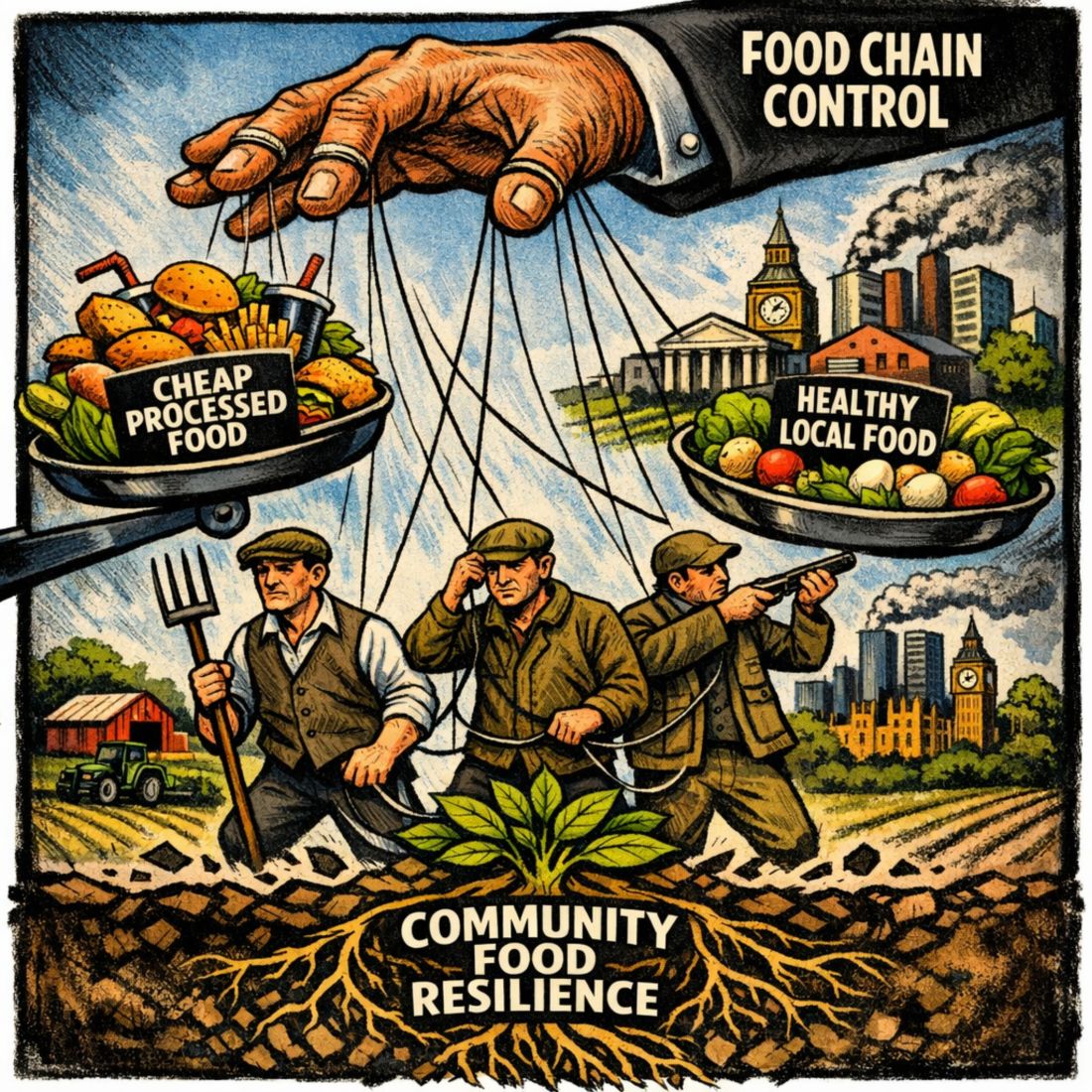
  • Supermarkets and processors gained total control over production.
  • Farmers became contract‑bound suppliers rather than independent producers.
  • Policy after policy pushed the UK away from self-sufficiency.

The result?

A nation that produces food – but cannot feed itself.

This is why the 11% figure matters.

It reflects the food that is:

  • edible immediately
  • consumed domestically
  • not dependent on foreign inputs
  • not locked into export contracts
  • not reliant on overseas processing

This is the food that would still be available if global supply chains failed.

And it is terrifyingly small.

Biodiversity Collapse Will Hurt Us – But It Will Hit a System Already Broken

The government report is right about one thing:

Ecosystem collapse will make global food production more volatile.

But the UK’s vulnerability is not caused by ecological decline.

It is caused by:

  • globalisation
  • supermarket dominance
  • financialisation of land
  • industrialised processing
  • loss of local food infrastructure
  • policy choices that prioritised profit over people

Ecosystem collapse will simply expose the fragility we have already created.

The Missing Piece: A Food System Built Around People, Not Profit

The report warns that the UK must “increase food system resilience”.

But it offers no meaningful pathway to achieve it.

It talks about:

  • lab-grown protein
  • AI
  • alternative proteins
  • technological innovation

But it barely mentions the one thing that actually works:

Traditional, regenerative, localised farming.

The kind of farming that:

  • Builds soil
  • Restores biodiversity
  • Strengthens communities
  • Reduces dependency on imports
  • Shortens supply chains
  • Produces real food, not processed substitutes
  • Keeps value circulating locally
  • Increases national resilience

This is the farming model that the UK abandoned.

And it is the farming model we must return to.

LEGS: A Framework for the Food Security We Actually Need

The Local Economy & Governance System (LEGS) offers exactly the kind of structural shift the government report refuses to contemplate.

Under LEGS:

Food is treated as a Public Good

Not a commodity.

Not a profit centre.

Not a tool of corporate control.

Local farming is prioritised

Communities produce the food they eat.

Farmers regain independence.

Supply chains shrink.

Resilience grows.

Traditional and regenerative methods become the norm

Because they work.

Because they protect ecosystems.

Because they feed people.

Because they build long-term security.

The economy becomes circular and local

Value stays within communities.

Food sovereignty becomes real.

Dependency on global systems collapses.

People, Community, and The Environment become the organising principles

Not money.

Not shareholder value.

Not global trade flows.

This is the only credible pathway to genuine food security.

The Government Report Is a Warning – But Not the One It Thinks It Is

The report warns that biodiversity loss threatens our food supply.

It’s right.

But the deeper warning is this:

The UK’s food system is already so fragile that any external shock – ecological, geopolitical, or economic – could collapse it.

We do not need to wait for the Amazon to fall or coral reefs to die.

We are already exposed.

The real national security threat is not future ecosystem collapse.

It is the current food system, built on:

  • Global dependency
  • Corporate control
  • Industrial processing
  • Financialised land
  • Political complacency

We cannot fix this with technology, trade deals, or emergency stockpiles.

We fix it by rebuilding the one thing that has always fed people:

Local, traditional, community-rooted farming.

And we fix it by adopting a governance and economic model – like LEGS – that puts food, people, and the environment back at the centre of national life.

If the Government Is Serious About Food Security, It Must Change Course Now

The UK cannot continue:

  • Exporting food we need
  • Importing food we could grow
  • Relying on global supply chains
  • Allowing supermarkets to dictate farming
  • Treating food as a commodity
  • Ignoring the collapse of local food systems

If we want real food security, we must:

  • Rebuild local food production
  • Restore traditional farming
  • Shorten supply chains
  • Treat food as a public good
  • Prioritise people over profit
  • Adopt community‑based governance
  • Embrace the principles of LEGS

Because the truth is simple:

A nation that cannot feed itself is not secure.

A nation that depends on global systems is not resilient.

A nation that abandons its farmers abandons its future.

The government’s report is a wake‑up call.

But the real alarm has been ringing for years.

It’s time we listened.

Further Reading: Navigating the Real Threats to UK Food Security

The blog’s central argument is that the UK’s food system is already dangerously fragile -not just because of future biodiversity loss, but due to decades of policy choices that prioritised global supply chains and corporate control over local resilience.

The following resources are curated to help readers move from understanding the government’s official stance, through critical analysis, to actionable frameworks for rebuilding food security.

1. Official Context: The Government’s Assessment

Nature security assessment on global biodiversity loss, ecosystem collapse and national security

https://www.gov.uk/government/publications/nature-security-assessment-on-global-biodiversity-loss-ecosystem-collapse-and-national-security
Summary:
This is the UK Government’s own national security assessment, published on 20 January 2026. It warns that global biodiversity loss and ecosystem collapse threaten food supply and national security. While it acknowledges risks to food production and supply chains, the report is critiqued in this blog for offering misleading reassurances about UK food resilience and failing to address the deeper, present-day vulnerabilities in the food system.

(Please note that a copy of the Report can be downloaded as a PDF below)

2. Critical Analysis & Solutions: The Author’s Portfolio

Adam’s Food and Farming Portfolio: A Guide to Books, Blogs, and Solutions

https://adamtugwell.blog/2025/12/18/adams-food-and-farming-portfolio-a-guide-to-books-blogs-and-solutions/
Summary:
This curated portfolio gathers key writings, books, and practical solutions from the blog’s author. It’s designed for readers who want to go beyond critique and discover actionable ideas for food system reform, regenerative agriculture, and community-based resilience. The portfolio reflects the blog’s ethos: prioritising people, local economies, and ecological health over profit and global dependency.

3. Deep Dive: The LEGS Ecosystem

Visit the LEGS Ecosystem

https://adamtugwell.blog/2025/12/31/visit-the-legs-ecosystem/
Summary:
LEGS (Local Economy & Governance System) is the framework proposed in the blog as the structural shift needed for genuine food security. This resource introduces LEGS in detail, showing how it treats food as a public good, rebuilds local farming, and fosters circular economies. It’s essential reading for those interested in systemic change and practical pathways to resilience.

4. In-Depth Reference: LEGS Online Text

The Local Economy Governance System – Online Text

https://adamtugwell.blog/2025/11/21/the-local-economy-governance-system-online-text/
Summary:
For readers seeking a comprehensive understanding of the LEGS framework, this online text provides the full theoretical and practical foundation. It expands on the principles outlined in the blog, offering guidance for communities, policymakers, and advocates aiming to rebuild food sovereignty and resilience from the ground up.

Guidance for Readers

Start with the government’s official report to understand the mainstream narrative and its limitations.

Move to the author’s portfolio for critical analysis and practical solutions.

Explore the LEGS resources to discover a transformative framework for food security rooted in local economies and regenerative practices.

This order will help readers progress from context, through critique, to concrete action – mirroring the blog’s call for urgent, systemic change in the UK’s approach to food and farming.

UK Farmers’ Inheritance Tax Changes: What does the Government’ Christmas Announcement Really Mean for Food Security?

This morning, I was asked by someone who grew up in farming and knows what I do whether I thought the government’s announcement about changes to the farmers’ inheritance tax threshold and transfer allowance would be the end of it.

My immediate reply was that, given the Spring Budget or Statement date had been announced only the day before, the whole thing seemed suspicious to say the very least.

That’s before we even consider the timing: just before Christmas, and only days after the Batters Farming Profitably Review (FPR) was published.

As I suggested in my follow‑up blog, the FPR told many truths about the downward spiral that U.K. farming is now in, but it did so firmly within the context and framing that government and the wider establishment have set.

That’s only helpful if you believe that having the truth spelled out about the things killing an industry – and by default, UK food security – is the same as being heard. And that being heard – if you actually are – will lead to meaningful change rather than simply becoming more words added to the pile.

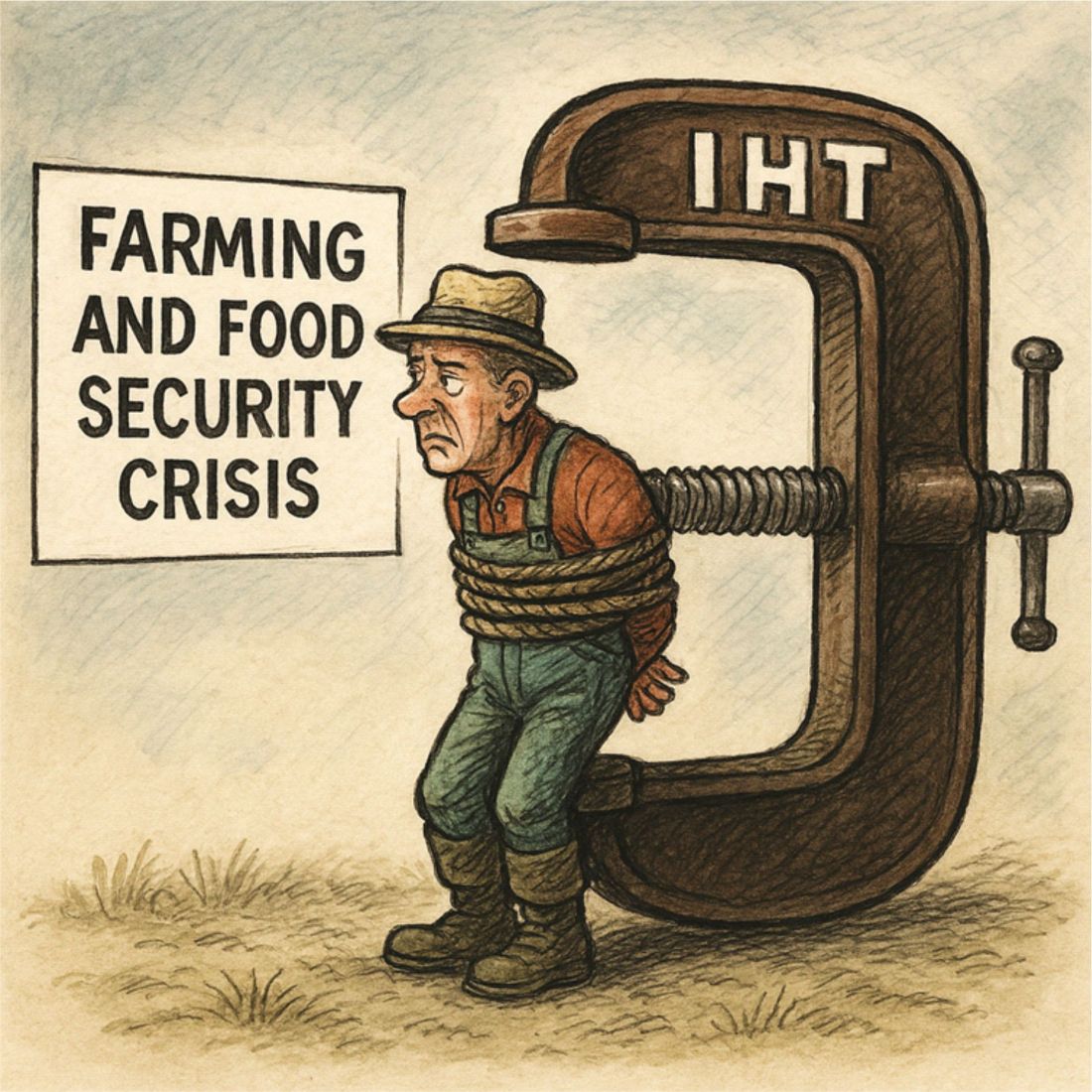
Whilst the news will bring some comfort to those who see the extension of the IHT window as a kind of Christmas gift, the regrettable truth is that even a complete U‑turn by the government on this single policy won’t change the direction of travel.

Nor will it alter the wide range of influences and pressures – many of which were identified in the FPR – that are tightening like a thumb screw and will ultimately destroy independent and traditional farming methods in this country.

The question, regrettably, given that everyone is still moving in the same direction, when you look at what their legs rather than what their lips are doing, is this: what will be the real cost of a story that grabs just enough attention to make people believe the farming and food‑security crisis is suddenly heading somewhere different?

Further Reading: Understanding the Context and Challenges Facing UK Farming

To help you dive deeper into the issues discussed in this blog – especially the government’s inheritance tax changes, the Batters Farming Profitably Review, and the broader crisis in UK food security – here’s a recommended list of Adam’s articles.

Each summary highlights the relevance of the link to the ongoing debate and the future of British farming.

1. https://adamtugwell.blog/2025/12/19/a-few-thoughts-on-minette-batters-farming-profitability-review-fpr/

A critical analysis of the FPR, this post explores the truths revealed about the downward spiral in UK farming, while questioning whether simply acknowledging the problems will lead to meaningful change. It sets the stage for understanding the policy environment and the pressures facing farmers today.

2. https://adamtugwell.blog/2025/08/14/farm-inheritance-tax-was-always-about-wrecking-independent-uk-food-production-thats-why-it-defies-common-sense/

This article delves into the history and intent behind farm inheritance tax, arguing that it has long undermined independent food production in the UK. It provides essential background for readers seeking to understand why inheritance tax remains such a contentious issue.

3. https://adamtugwell.blog/2025/11/22/risk-and-responsibility-why-farmers-must-choose-to-rebuild-the-uk-food-system-before-its-too-late/

This post emphasises the urgency for farmers to take proactive steps in rebuilding the UK food system. It discusses the risks involved and the responsibilities that fall on those within the industry to drive change before the situation becomes irreversible.

4. https://adamtugwell.blog/2025/11/23/understanding-who-controls-our-food-controls-our-future-everything-you-need-to-know/

An exploration of the power dynamics in UK food production, this article explains how control over food systems shapes the nation’s future. It’s a vital read for those interested in the intersection of policy, industry, and food security.

5. https://adamtugwell.blog/2025/01/18/the-need-for-a-collaborative-approach-to-the-uk-farming-and-food-security-problem/

This piece advocates for collaboration among farmers, policymakers, and stakeholders to address the complex challenges facing UK farming and food security. It offers practical insights and solutions for building a more resilient system.

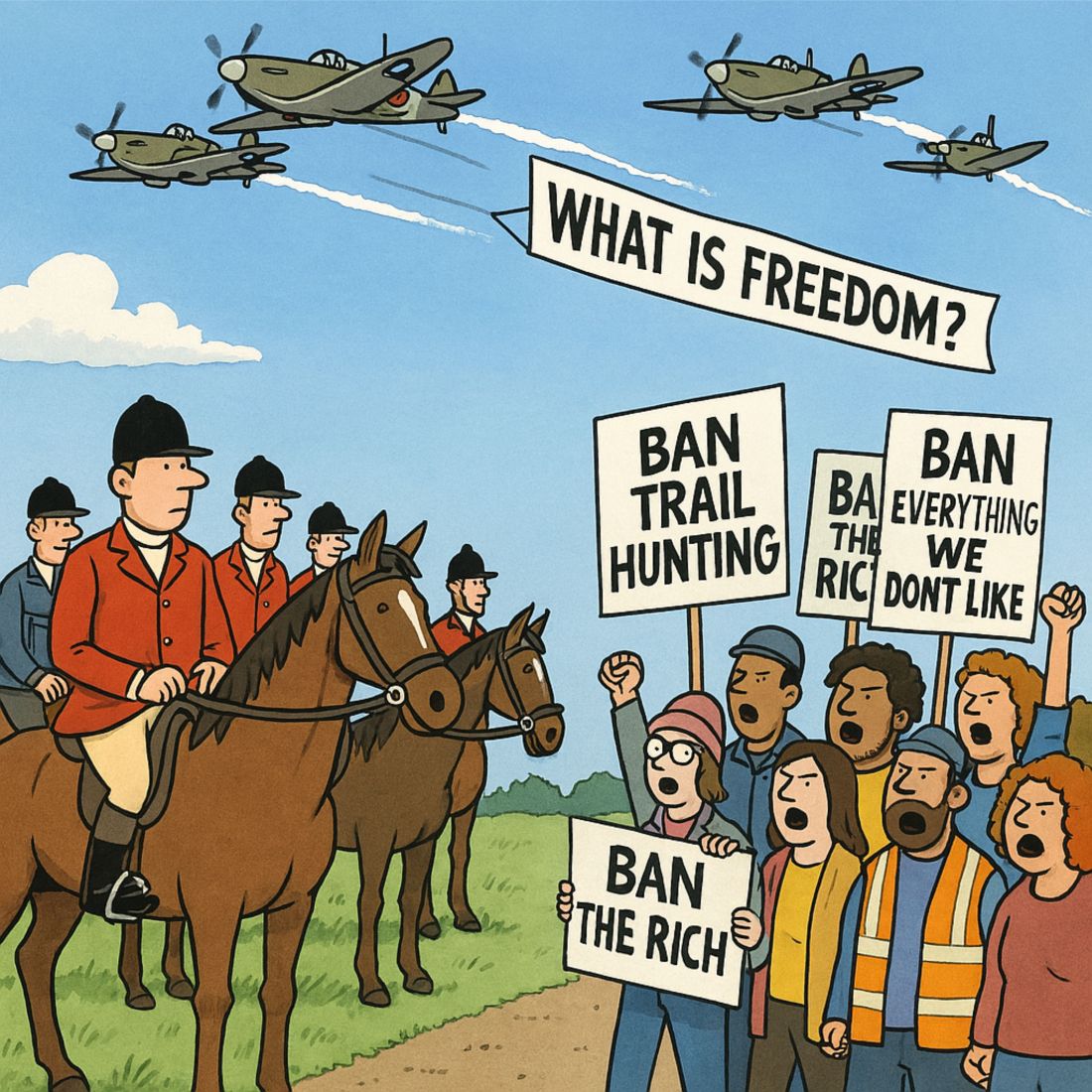
6. https://adamtugwell.blog/2025/12/22/how-the-trail-hunting-ban-exposes-a-bigger-battle-for-britain/

Broadening the discussion, this article connects rural policy battles – like the trail hunting ban- to the larger struggle over Britain’s countryside, farming, and food systems. It provides context for understanding the wider political and cultural forces at play.

7. https://adamtugwell.blog/2025/12/18/adams-food-and-farming-portfolio-a-guide-to-books-blogs-and-solutions/

A comprehensive guide to further reading and resources, this portfolio is ideal for readers who want to explore more about UK farming, food security, and potential solutions.

How the Trail Hunting Ban Exposes a Bigger Battle for Britain

Trying to unpick what looks like the sudden announcement that the government intends to ban trail hunting in the upcoming animal welfare strategy is far more complicated than it first appears.

The easy explanation is to fall back on the familiar left‑vs‑right framing – the tired them‑vs‑us narrative that has shaped the hunting debate for decades. But that framing has always obscured more than it has revealed.

Across the UK today, some will feel they have won and others will feel they have lost. Yet this moment isn’t new, nor is the opportunity to take a different path.

As I argued in my blog published on Christmas Day in 2017, the solutions that could have kept young people, rural voters, and the wider public onside have been hiding in plain sight for years.

Knowing people who hunt and people who don’t – and many who sit somewhere in between – I feel exactly as I did when I wrote that piece.

There was always a workable middle ground. The model we have today could have functioned well and kept most people broadly content, if only all sides had been willing to look beyond their own entrenched positions.

Instead of trying to rewrite the rules of the game or cling to the past as if personal belief were a universal right to impose on others, they could have chosen a bigger‑picture approach that protected both rural culture and public confidence.

But we live in a time when being “right” has become more important than being effective.

That mindset pushes people into emotional trenches, where the goal becomes defeating the other side rather than understanding what winning actually looks like in a changing world.

As the years have passed, since the ‘Hunting Ban’ came into force, the battle lines have hardened. Few have stopped to consider how easily self‑made traps can spring shut. And the hunting community, through its own shortcuts, diversions, and refusal to adapt, has handed the government the perfect excuse to act.

This is the same government that has already shown its willingness to undermine British rural life – the illogical Farm IHT rule being a prime example. Now, with trail hunting, they have been gifted a justification that many outside the community will accept without hesitation.

Many will still refuse to see what is happening. But when a government is openly delaying local elections, it is not unreasonable to expect they may attempt the same with the next general election if they can cling to power until 2029.

At the heart of this is a belief that everyone else is wrong and they alone are right.

If they succeed in pushing this change through before they lose power – assuming they haven’t already managed to entrench themselves further – the concern is that this will mark the true end of hunting as a living part of our culture and heritage.

Once an outright ban, or anything that functions as one, is in place, reversing it will be nowhere near the top of anyone’s agenda. Not with the scale of the political, economic, and social mess we have building up ahead.

Further Reading:

A Few Thoughts on Minette Batters’ Farming Profitability Review (FPR)

Expectations of the FPR

The Farming Profitability Review, authored by Minette Batters, was finally released yesterday. Like many others, I downloaded the 150‑page document hoping it might herald positive change for our farmers.

Given Minette’s respected tenure as NFU president, many anticipated that this review would provide a clear, unvarnished account of the situation.

Authored and presented by one of their own, it was expected to carry the weight and credibility needed to push government support for UK farming back to where it belongs.

On that basis, the content does read as a genuine set of proposals rooted in what the industry itself recognises as urgent needs. Phrases such as “A New Deal for Profitable Farming”, the FARM proposal, and the assertion that “The UK is widely regarded as one of the most prized food markets in the world” will sound like music to many ears. Yet they also underscore the uncomfortable question: why, when everyone in the UK needs food every day, are farm businesses failing or closing?

Industry Context & Policy

The report covers the expected themes – profitability, overseas trade, nutrition, and more. But context is everything.

The elephant in the room is that farming policy continues to follow the establishment’s agenda: serving government and big business interests rather than what is genuinely best for farmers, and therefore for all of us.

This is where major food and farming advocacy organisations, and their champions old and new, fall short. They continue to operate within the framework defined by government, addressing symptoms rather than causes, and avoiding the deeper realities of the industry’s decline.

Documents of this kind often reveal the underlying truths driving government thinking. One of the clearest comes early in the Foreword, where Minette reminds readers that politicians dismiss farming because it represents only 0.6% of GDP. This stark figure highlights that, for politicians, the economy and money matter far more than farming, food security or the human issues as most normal people see them.

An industry valued at just 0.6% of GDP, reliant on grants and subsidies that do little to boost GDP, is not seen as an engine of growth. Ministers repeatedly emphasise their obsession with economic output, because under the current financial system – broken and rapidly failing as it is – growth is the only measure that sustains their positions while allowing them to avoid responsibility.

Profitability: Competing Definitions

The fact that the review is overtly about profitability says it all – not least because the term carries very different meanings depending on who is using it.

For farmers and small business owners, profitability means staying in the black: running a viable enterprise that pays wages and hopefully leaves a little extra. For politicians, however, profitability is measured in terms of supermarket margins and GDP contributions.

This warped definition highlights how broken the system has become: profitability is reduced to a metric of economic growth, rather than the lived reality of whether farms can survive.

In this way, farming is forced to fit into an economic narrative that serves government borrowing and spending priorities, rather than the needs of those who produce our food.

Economic Pressures and Regulatory Burdens

The figures in the report speak volumes: machinery costs have risen by 31%, and compliance with new regulations demands massive investment.

Though introduced under the guise of improving standards, these rules inevitably push more farmers and allied businesses out of the market because they cannot compete – and that reality bears much of the truth that lies behind the journey that UK farming has been on since the early 70’s.

Put bluntly, farming within this framework is not viable – and was never intended to be.

The establishment does not want traditional, independent farms to survive.

Even Minette’s more positive suggestions, however well‑intentioned, cannot succeed in this context. They risk becoming distractions – “dead cats” -designed to maintain the illusion that government is invested in the UK food chain and food security, when the evidence clearly shows otherwise.

What I would have liked to see is a stronger message about the importance of UK food production and the need to move towards self‑sufficiency.

Feeding the British public with fresh, healthy, nutritious food that is accessible and affordable should not be an aspiration – it should already be the baseline.

With food as vital as it is, and every one of us needing at least two meals a day, this is surely more important than abstract questions of GDP growth.

Harsh though it may sound, this report feels more like a whitewash than a clean shet. It’s exactly the kind of document political and establishment leaders hope for to cover their tracks and agendas.

Knowing how those from the farming advocacy organisations play along with government to stay close to power rather than risk friction, it stands to reason that the review may have been genuine and well‑intentioned but never risked being positioned to create problems for politicians by tabling the full truth. Regrettably, it fails to grapple with the central issue: the government’s relationship with farming is not about food, farming, or feeding the nation – it is simply about money and the transfer of power and wealth.

Government is not deaf to farmers – it simply does not care. That indifference is the real crisis.

The current approach to UK Agricultural and Food Policy, embedded long before this Labour government, is dismantling our food production capability by making it impossible for farmers to continue. This is a growing risk to everyone.

If borders closed tomorrow and external food supplies were cut off, around only 12% of the UK’s food supply would be immediately available to consumers.

The rest – despite the UK producing 52–58% the equivalent of what it consumes – would not be any good to the public for a considerable time, because the UK farming is subservient to and fits within the Euro‑Global food chain.

The majority of our People could go hungry in a real crisis and this is the reality we should be confronting – not how profits and therefore more helpful statistics are made.

A Call for Farmer-Led Change

Ultimately, only the farming industry can save itself – and that means taking immediate risks.

However, taking risks while there is still an industry left worth risking must surely be better than passively watching its demise until every independent and family farm in the UK has been shut down.

Summary & Key Takeaways:
Adam offers a critical perspective on the Farming Profitability Review, highlighting both its intentions and its limitations from the viewpoint of UK farmers and food producers.

Key Points

  • High Expectations, Mixed Delivery:
    Farmers and industry stakeholders anticipated a transformative report, given Minette Batters’s reputation and leadership. The FPR presents genuine suggestions but remains constrained by establishment narratives.
  • Profitability Framed by Policy:
    The FPR’s focus on profitability is shaped by government priorities – specifically, farming’s small contribution to GDP. This economic lens overshadows broader issues like food security and the viability of independent farms.
  • Systemic Challenges:
    Rising costs (e.g., machinery up 31%) and regulatory burdens are pushing more farmers out of business. The FPR acknowledges these pressures but doesn’t fully address their root causes.
  • Establishment Influence:
    The FPR is too aligned with government and the aims of large corporate organisations that influence the food chain, lacking the independent advocacy needed to truly represent farmers’ interests.
  • Food Security Concerns:
    Adam’s response stresses the importance of UK food self-sufficiency, noting that current policies leave the nation vulnerable if external supply chains are disrupted.
  • Call for Farmer-Led Solutions:
    Ultimately, Adam argues that only the farming industry itself can safeguard its future, urging collective action and risk-taking to preserve independent and family farms.

Further Reading:

The resources below have been selected to help you explore the central themes discussed in this response.
Key topics include:

  • The roles and priorities of farmers and consumers in UK food production
  • The impact of government policy, economic pressures, and systemic challenges on farming
  • The importance of food security and community resilience
  • Practical solutions and future directions for rebuilding and sustaining the UK food system

1. Understanding UK Food Production & Stakeholders

2. Policy, Economics & Systemic Challenges

3. Solutions, Action & Future Directions