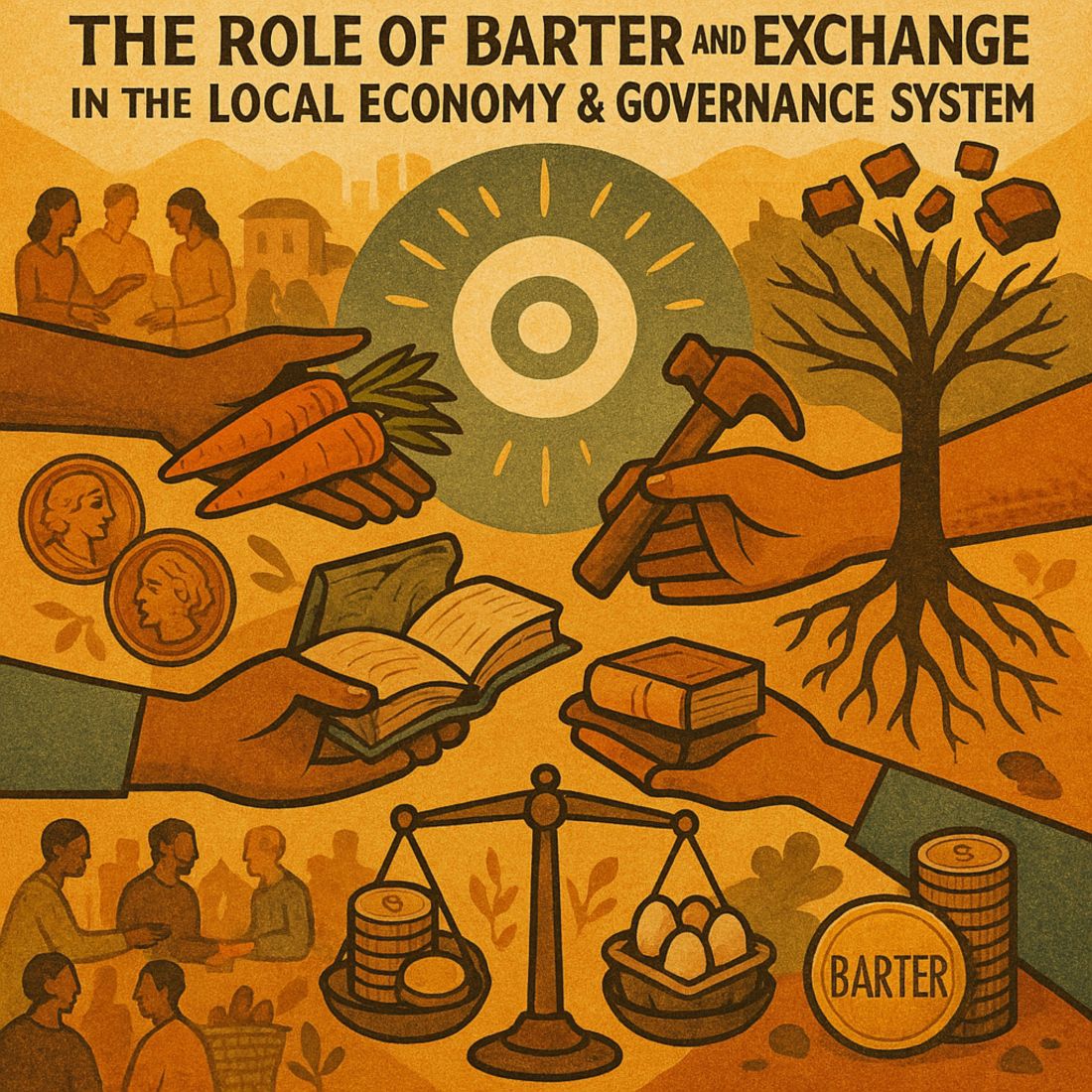
The Role of Barter and Exchange in The Local Economy & Governance System

Introduction: Understanding Key Dimensions of Trade Through the Lens of LEGS

In today’s money‑centric Old World system, barter and direct exchange are rarely practiced or legitimised. This absence disadvantages those who could benefit most from trading their goods and skills directly for the things they need, in ways that are simple and achievable.

An economy built on the recognition of human value safeguards and embraces contributions that cannot be measured or constrained by volume or transactional worth in universally accepted terms, while also accommodating goods, services, and contributions that can be.

At its core, the Local Economy & Governance System upholds The Basic Living Standard, affirming that economic value resides in people themselves. It must never be surrendered to the control of any third party – however legitimised or credible – that might manipulate the worth of individual contributions or exclude people altogether by imposing rules over a value system it dictates for universal use.

Money becomes a corrupt, authoritarian policeman when distance erases integrity and the wrong, out of sight forces are in control

The Local Economy & Governance System (LEGS) challenges us to rethink every part of how society functions – from governance and public services to food, housing, and work.

Trade is no exception. If we are to build a fair, resilient, and people‑centred society, we must re‑examine the foundations of how value moves between individuals, businesses, and communities.

For too long, trade has been defined exclusively through money. This narrow view has distorted our understanding of value, restricted our autonomy, and placed unnecessary barriers between people and the things they need.

The belief that money is the only legitimate medium of exchange has allowed governments and financial institutions to centralise control, monitor every transaction, and shape economic life in ways that benefit the few at the expense of the many.

Barter and Exchange offer a different path – one that aligns with the principles of LEGS and restores the freedom to trade directly, fairly, and without interference. They allow value to circulate locally, strengthen community resilience, and empower people to meet their needs through cooperation rather than dependency on distant systems.

This article develops the discussion already begun within LEGS by exploring the mechanics of trade in a fair society. It explains why Barter and Exchange are essential, how they work within the Local Market Exchange (LME), and how they support the wider transformation toward a system built on People, Community, and The Environment.

1. Why Barter Matters: Reclaiming the Meaning of Value

The Psychology of Value and Exchange

Money-centric society has conditioned us to believe that value exists only when expressed in money.

This belief is so deeply embedded that many struggle to imagine a world where value can be recognised or exchanged without a price tag.

Yet value is not inherent in money.

Value is inherent in people, skills, time, and the things we create.

Direct exchange restores:

  • Human‑scale value – worth defined by usefulness, not speculation
  • Relational value – trust, cooperation, and mutual respect
  • Intrinsic value – meaning that exists beyond financial measurement

Barter is not primitive. It is profoundly human.

2. The Ethical Foundation of Direct Exchange

Legitimacy Beyond Money

The Moneyocracy created the illusion that all legitimate trade must pass through regulated currency. This allowed governments and financial institutions to monitor, tax, and control every aspect of what they sanctioned and identified as economic life.

Within LEGS, the ethical foundation for Barter and Exchange is clear:

  • People have the inherent right to exchange value directly
  • Communities have the right to determine how value circulates locally
  • No authority has the moral right to restrict non‑monetary exchange when the essential needs are met

Barter is not a loophole.

It is a legitimate, ethical, community‑centred form of trade that compliments an economy with People, Community and The Environment at its heart.

3. How Barter Works: Everyday Practical Examples

Person‑to‑Person, Business‑to‑Business, and Mixed Exchanges

Barter is practical, flexible, and already familiar to most people.

Person‑to‑Person

  • A neighbour repairs a bicycle in exchange for vegetables
  • A retired teacher tutors a child in return for gardening help

Business‑to‑Business

  • A café trades baked goods with a farmer for eggs
  • A carpenter exchanges shelving units with a printing shop for marketing materials

Mixed Exchanges

  • Working time, plus local currency for a refurbished smartphone
  • Goods plus working time to settle a larger exchange

Community‑Level

  • Seasonal swap days – exchanging additional time and skills for goods and services
  • Collective repair events where the community provides people with home repair or servicing of equipment for additional community contributions
  • Multi‑party trades facilitated by the LME

Barter adapts to any scale and any need.

4. Barter as a Pillar of Local Resilience

Strengthening Communities Through Direct Exchange

Barter strengthens local systems by:

  • Reducing dependency on external supply chains
  • Encouraging repair, reuse, and resourcefulness
  • Keeping value circulating locally
  • Building trust and cooperation
  • Providing stability during economic shocks

When money becomes scarce, barter continues.

When supply chains fail, local exchange thrives.

5. Barter and Local Currency: A Complementary System

How the LME Balances Flexibility and Stability

Barter and local currency are complementary tools.

Local currency exists to:

  • Facilitate exchanges where direct barter is impractical
  • Provide a stable, community‑governed medium of exchange
  • Prevent speculation or hoarding
  • Keep value circulating locally

Barter is ideal when two parties have mutually desired goods or services.

Local currency is ideal when they do not.

The LME allows both to operate seamlessly.

6. Safeguards and Fairness in the LME

Preventing Abuse, Hoarding, and Manipulation

The LME incorporates safeguards to ensure fairness:

  • Prohibition of hoarding essential goods
  • Transparent values for Basic Living Standard items
  • Community oversight through The Circumpunct
  • Limits on accumulation of local currency and/or property ownership beyond essential use
  • Rules preventing speculation or artificial scarcity
  • Open dispute resolution

These measures ensure Barter and Exchange remain tools for empowerment.

7. Transitioning from Money to Exchange

Practical Pathways for Individuals, Businesses, and Communities

Transition is gradual and supported by community infrastructure.

Individuals

  • Start with small exchanges
  • Use the LME to find trading partners
  • Combine barter with local currency

Businesses

  • Accept partial payment in goods or services
  • Use barter to reduce waste
  • Join and promote the LME network

Communities

  • Host swap events
  • Encourage local producers to list goods
  • Integrate barter into community projects

Transition is organic, practical, and accessible.

8. Addressing Common Concerns and Misconceptions

Removing Barriers to Understanding

“Barter is too complicated.”

The LME simplifies valuation and facilitates multi‑party exchanges.

“How do you ensure fairness?”

Community‑agreed values and transparent governance prevent exploitation.

“What if someone cheats?”

Dispute resolution is local and immediate.

“Isn’t this going backwards?”

Barter restores autonomy and resilience, recognising that progress is not one dimensional and does not erase actions and processes that work in the best interests of all.

“What about large transactions?”

Barter can be combined with local currency or working time.

Objections dissolve through experience.

9. The Historical and Anthropological Argument for Barter & Exchange

Why Barter Is Not Primitive – It Is Proven

Historically:

  • Communities relied on mixed economies of barter, gifting, and shared labour
  • Money became dominant not because barter failed, but because it seemed easier and its use was encourage or coerced as elites sought control
  • Many societies used barter alongside currency for centuries
  • Modern barter networks thrive during crises

Barter aligns with human social instincts far more closely than money ever did.

10. The Philosophy of Exchange

Barter as an Expression of Human Connection

Barter reflects:

  • Reciprocity
  • Trust
  • Mutual recognition
  • Shared purpose
  • Community interdependence

Money reduces relationships to transactions.

Barter restores relationships to relationships.

It is not simply a method of trade. It is a philosophy for living.

Conclusion: The Return of Human‑Centred Trade

Barter and Exchange are essential components of a fair, resilient, and people‑centred economy.

They restore autonomy, strengthen community bonds, and ensure that value circulates locally rather than being extracted by distant systems.

This article demonstrates that within the LEGS Human Economy model:

  • Value is defined by people, not money
  • Direct exchange empowers individuals and communities
  • Barter strengthens resilience and reduces dependency
  • Local currency complements barter within the LME
  • Safeguards ensure fairness and prevent abuse
  • Transition is practical and accessible
  • Barter reflects the deeper philosophy of LEGS

And that

  • History and anthropology validate mixed economies

Trade, when reclaimed from the distortions of money-centric economics, becomes a tool for dignity, cooperation, and shared prosperity.

Barter and Exchange are not relics of the past.

They are the foundations of a future where fairness, autonomy, and community define how we live and trade together.

Discover a Blueprint for Fair, Sustainable Communities: Introducing the Local Economy & Governance System (LEGS)

Are you searching for a fresh vision of society—one that puts people, community, and the environment first? The new book, The Local Economy & Governance System offers a transformative framework for reimagining how we live, work, and govern together.

Why Read This Book?

  • A Timely Critique and Practical Blueprint: LEGS doesn’t just highlight what’s broken in today’s world—it lays out actionable steps for building a society where everyone’s essential needs are guaranteed, and collective wellbeing is the top priority.
  • People, Community, Environment: These three principles guide every aspect of the LEGS framework, from local governance and economic models to daily life and public policy.
  • Personal Sovereignty: LEGS places strong emphasis on empowering every individual to live freely, responsibly, and authentically. Personal Sovereignty is recognized as the foundation for dignity, ethical living, and genuine freedom within the community.
  • Authentic Governance: Say goodbye to distant, hierarchical leadership. LEGS champions local, democratic decision-making, where leadership is earned through service and accountability—not status.
  • Basic Living Standard for All: Imagine a world where full-time work at the lowest wage covers all core living costs—no more poverty, reliance on charity, or skipped essentials.
  • Community Contributions: Every working member gives back 10% of their week to support local services and charity, replacing traditional public sector staffing with a community-led workforce.
  • Ethical Business & Economy: Businesses exist to serve the public good, not profit. Social enterprises fill gaps where private business doesn’t meet essential needs, and wealth is distributed equitably among contributors.
  • Responsible Technology & AI: LEGS strictly regulates technology to ensure it serves humanity and never replaces human agency. All essential services have human-led, non-digital alternatives.

Who Should Read LEGS?

  • Community leaders, policymakers, and activists seeking practical models for local empowerment.
  • Anyone concerned about inequality, environmental sustainability, or the future of governance.
  • Readers interested in social innovation, ethical business, and resilient communities.

Get Involved

LEGS is more than a book—it’s an invitation to participate in shaping a fairer, more compassionate world. Start conversations, challenge old systems, and take practical steps in your own community. The journey to a better future begins with the choices we make and the values we uphold.

The Basic Living Standard: Not a Fix for a Collapsing Money-Centric System, but the People-Centric Foundation of a New One

Although initially overlooked after I first introduced it in my book Levelling Level, published on Amazon on 31 March 2022, the Basic Living Standard (BLS) has increasingly attracted interest from readers and visitors to my blog.

However, I have noticed that when people search for BLS using AI, a whole chain of stories and information—often including quotes attributed to me—has emerged, much of which is either out of context or entirely fabricated.

This is concerning, especially when those outside the mainstream are trying to share solutions and perspectives that challenge the compliance and blindness of today’s system.

We must recognise that the so-called AI takeover is being built on delivery levels that, in many cases, are no better than the efforts of a lazy teenager responding to an encouraging parent. And the outright creation of false information and narratives—even regarding work from independent voices—is troubling.

Given that AI now tells those seeking a quick overview that the Basic Living Standard is a way to fix our broken economic system, I feel it is time to clarify: while I believe BLS is a pivotal solution, it cannot and will not work within the current economic paradigm.

The integral priority of BLS is to put people, not money, first.

The Basic Living Standard: Not Intended for the Current Economic System

I have never created or published financial models or projections to ‘cost’ or predict the impact of BLS on the current economy or financial system, because the two are mutually exclusive.

BLS was not designed to be part of, or to work within, the existing paradigm, which makes it impossible to do so.

Decision-makers, legislators, and their influencers will not openly admit that our system is structured against equity and equality.

It is only because the system works progressively against these values that the disproportionate levels of wealth and benefits enjoyed by those in power can exist as they do.

Paying Lip Service to Parity

While the National Minimum Wage should be the benchmark or minimum earnings floor necessary for financial independence, the reality is that no person can be financially independent or live free of benefits, charity, or debt on this wage when working a typical 40-hour full-time week.

The current economic and financial system survives because the National Minimum Wage does not reflect the genuine cost of living for the lowest paid, who must then be subsidised by government benefits, seek help from charities such as food banks, or go into debt to meet the growing cost of living.

The FIAT, Neoliberal, Global-Driven Money System: The Perfect Crime?

A hard truth about our broken and collapsing system is that its design centres on wealth transfer and impoverishment, relying on the ongoing creation and addition of new money to the economy.

Currency debasement devalues the worth and ownership of the masses, while creating additional wealth for the elites and enabling them to secure property, public infrastructure, and ownership of everything devalued by their actions.

System Collapse and the Choice We Must Make

The finite lifetime of what may one day be considered one of the greatest ongoing crimes against humanity is fast approaching its end.

How the masses respond to financial and systemic collapse will dictate whether the Basic Living Standard, or a similar benchmark, forms the basis of a new people-centric economic and governance system.

This new system would put people back at the heart of everything, rather than the money-centric focus we have now.

The current system is collapsing because it is fundamentally corrupt and wrong.

Introducing a system like BLS within the current system—even under the name National Minimum Wage—could not achieve its true purpose, because implementing it honestly would speed up, if not immediately collapse the current money-centric system – and that’s why nobody in power today who benefits from this system will ever agree or willingly help for it to be done.

Embracing the Shift: Making Life About People, Not Money

If we accept and adopt an economy and governance system cantered on People, Community, and Environment, we will naturally move away from financial modelling, projections, profit margins, and all the tools that reinforce money as the only important value in life.

The Basic Living Standard provides a clear focus for the paradigm shift from money-centric beliefs to what everyone needs—not wants—and establishes the basic standard for independent living without dependency.

However, BLS is not a policy that can work in isolation or as an add-on to the current system. It is a fundamental building block of the universal change we must choose and embrace, because we cannot fix what cannot be fixed.

The Basic Living Standard: The Basis of a New Way of Living

By restarting, reestablishing, regenerating, reforming, and replacing our economic and governance systems, the Basic Living Standard becomes the benchmark for guaranteeing that the lowest paid can sustain themselves and be financially independent in return for a standard working week.

It requires all businesses, organisations, and systems within a new framework of economy and governance to realign with ensuring that every person experiences this minimum standard as the foundation of society, business, and culture.

Improving lives today really should be as simple as creating a Minimum Wage and changing everything for those who need help in one day. But changing perceptions is not the same as changing the way everyone thinks.

That is why the introduction of a system that genuinely works for everyone cannot be openly embraced before the pain of collapse and the reality it brings.

Everything we know today exists because of a system built around money as a value set—a flawed belief system we have all been conditioned to accept.

Only when this system fails and excludes people, step by step, do those affected awaken to the reality that something is fundamentally wrong.

Yet those excluded are often viewed by those still inside the system as the ones who are guilty and wrong.

Out of Our Problems, an Opportunity Awaits

The collapse offers a moment when the balance can flip, and those who have been excluded may reach a critical mass that signals to everyone participating in the money game that a better, equitable way exists.

However, ordinary people must see, understand, and accept this en masse.

Whatever happens next will lead to wholesale change—whether we choose it or simply go along with it.

Only by being aware and honest about what we need, rather than what we want, can we take the leap of faith necessary to change everything and contribute to the creation of a new system where people, community, and environment come first.

The Basic Living Standard offers a benchmark for the frameworks and opportunities of a new way of living. Yet, it will remain unknown and inaccessible to those unwilling to step away from the comfort of an unsustainable relationship with the past.

Money, democracy, ownership, business priorities, and practices are just the tip of the iceberg when it comes to the breadth and depth of necessary change.

Everyone must own and be part of the transformation ahead, because the change is about the needs of everyone, not just the wants of a privileged few.

There’s More…

In the coming days, and hopefully as soon as this week, my next book will be published, building on all I have been writing and sharing for over three and a half years.

Evolving directly from Our Local Future, first published in summer 2024, this latest work brings more detail and focus to the mechanics of implementing a new system for economy and governance, while simplifying previous concepts to make them more accessible and relatable.

The Basic Living Standard lies at its heart, and I am confident that we can flip everything to work for People, Community, and Economy, once we see the benefits and share the determination to implement a system and new code for life that truly works with equity and equality for all.

Facing the Economic Collapse: the Real Crisis Behind Money, Wages, and Freedom

Facing Uncomfortable Truths

It is regrettable that most people avoid confronting uncomfortable truths about the crisis we’re in.

Many actively ignore or dismiss what they know deep down to be true, preferring comfort over honesty.

But this habit of hiding from inconvenient realities isn’t new. It’s been passed down for generations. People have often chosen what feels good over what’s obviously right, leading us to our current predicament.

Pretending everything is normal, focusing only on ourselves, and letting others make decisions for us has brought us to the brink of systemic collapse.

The comfortable system we rely on is failing, and we must face this reality.

The Source of the Problem: Money

Many prefer to hear hard truths from trusted figures like academics or politicians, but deep down, we know the truth doesn’t depend on who says it.

It’s time to think, research, and analyse for ourselves.

At the heart of our problems is the money system. We’ve been conditioned to believe money is everything, shaping our choices and values around financial cost, reward, and status.

Yet, the money system itself is artificial. A belief system manipulated by private bankers, big businesses, and the politicians they control.

They change the rules to enrich themselves, transferring wealth and ownership away from ordinary people, all under the guise of normality.

Imminent System Collapse

Politicians obsess over “growth.” But for them, growth means increasing the size of the economy (GDP). Not helping small businesses or working people.

Real productivity has vanished as industries and assets have been sold off to those who profit from the system, while jobs have been outsourced.

GDP figures are misleading, counting money created through private finance and government borrowing multiple times. Politicians have tried to spend their way out of trouble, but even that strategy is failing.

With rising unemployment due to AI and unproductive sectors and a government so possessed by fear that they are regularly changing their minds, lenders are now worried the scam will be exposed.

Desperation has set in, and the government seems set to resort to ever-increasing taxes, hoping to keep the system afloat and their secrets hidden.

The System Enriches the Few

Prices keep rising while wages lag behind, making it harder for most people to keep up.

This isn’t new—it’s how the system was designed.

Once, a single working adult could support a family. But now, financial independence is reserved for the wealthy, while dependence and poverty are imposed on the rest of us.

The Myth of the Minimum Wage

The national minimum wage is misleading. It’s not enough to live on, but rather the lowest acceptable wage set by those in power, regardless of the real cost of living.

However, even the average wage isn’t enough for genuine financial freedom.

Financial Freedom Is the Solution

Almost every social problem can be traced back to the fact that the lowest-paid jobs don’t pay enough for people to live independently.

Admitting this would expose the system’s flaws and those who benefit from it.

The system survives by prioritizing money over people. Every decision made by those in power serves the money system. Not human needs.

Choosing People Over Money

If we want a better world, we must redirect government, business, and our rules to prioritize people, not money or the economy.

Unfortunately, our political leaders hide the truth instead of addressing it, covering up the growing cracks in the system.

Collapse Is Inevitable. But We Have a Choice

Systemic collapse is inevitable. But we can choose what comes next and who benefits.

If we do nothing, things will only get worse.

Those who created this mess believe they can protect themselves with wealth and security, but ordinary people will lose freedom.

The powerful will restrict our freedoms to protect their own interests.

Paradoxically, a collapse could be an opportunity.

If we embrace it, we can build a freer, fairer system for everyone. Something only possible when the current corrupt system is removed.

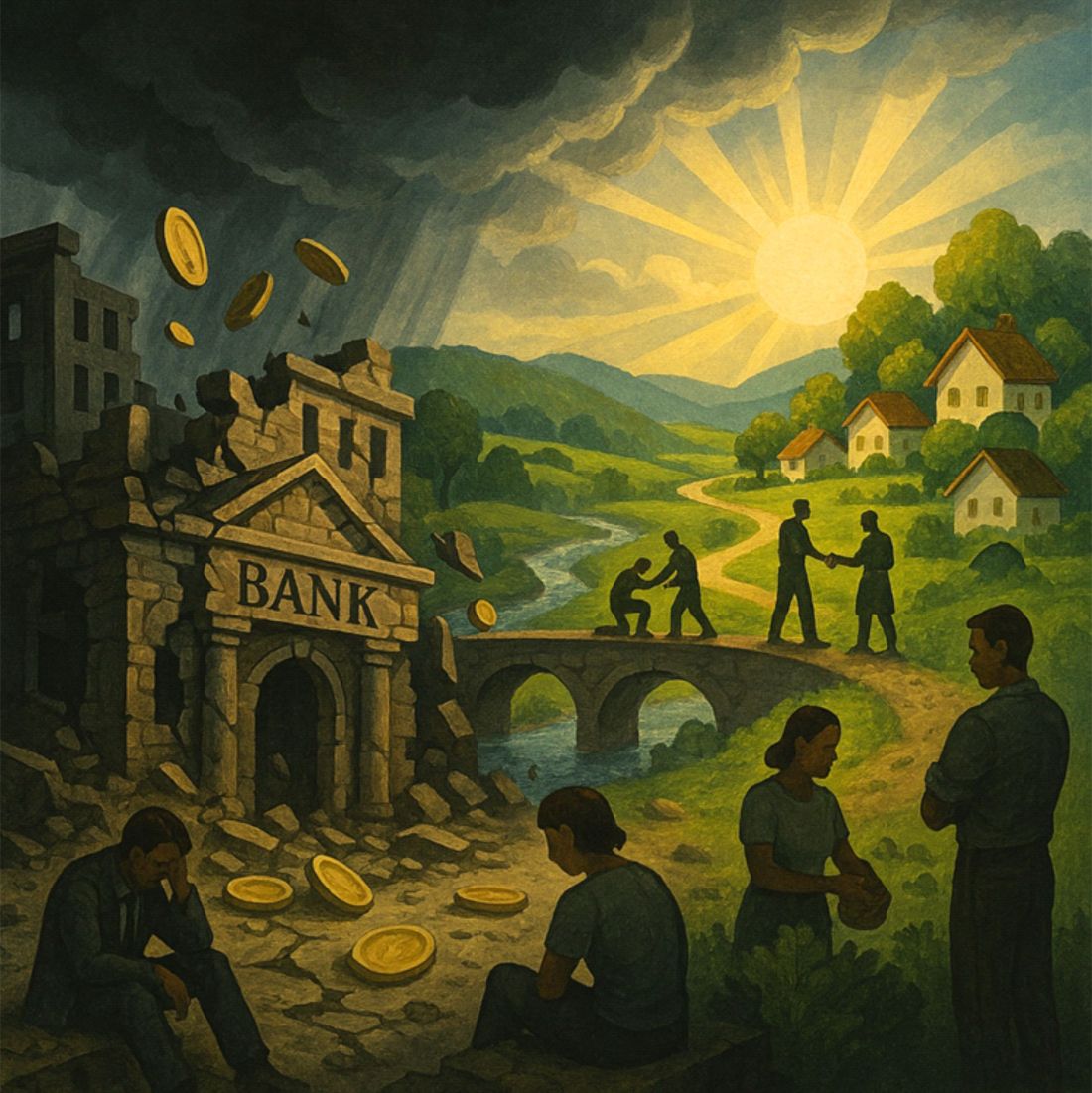
The Coming Collapse and The Revaluation of Everything Needed to Regain Personal Freedom and Control

The Revaluation

Shifting People, Communities, and the Environment toward a New Way of Living—Secured by a Governance Framework for a Better Future

The Revaluation marks a transformative period—a shift in thinking, behaviour, and systems. It represents the transition from a money-centric, neoliberal, and globalised world model to one that prioritises people, human values, and local communities. In this new paradigm, everything is reimagined to support meaningful, positive life experiences for all.

Traditionally, “revaluation” refers to reassessing monetary or financial worth. However, the term has long applied to any kind of review or reassessment—of objects, actions, or opportunities—where the value we assign influences our decisions and actions.

In essence, anything with value can be revalued. Within the context of the global systems that have shaped and often harmed humanity, The Revaluation is a comprehensive transformation. It aims to build a world that is truly better for everyone. This includes the development of new systems, processes, and governance tools that not only secure and sustain this improved future but also prevent any return to the corrupt, inhumane, and damaging structures of the past.

Why The Revaluation Is Necessary

Restoring Our Moral Compass and Reclaiming Humanity from a System That Has Lost Its Way

For too long, we’ve neglected our moral responsibility to consider others—people, communities, and the environment beyond ourselves. Even those most vulnerable, including the lowest-paid and those reliant on the state, have come to believe that success and survival require putting oneself first. This mindset has made it easy to overlook how those with power and resources have taken this pursuit of “more” to extreme and damaging lengths.

Exploitation—of people, systems, and nature—has become so normalised that many instinctively withdraw from acknowledging social problems, especially when solutions might come at a personal financial cost. Money has become the dominant tool for shaping behaviour, influencing every aspect of life—even those that seem unrelated to finance. It has replaced genuine values with a single benchmark: monetary worth.

This relentless pursuit of profit, wealth, and control by a privileged few has led to the collapse of communities, the erosion of human dignity, and the destruction of the environment. The natural systems that once sustained us have been disregarded, and the principle of sustainable living—once a cornerstone of generational survival—has been cast aside. The result is a world where ordinary people struggle to live independently within systems that no longer serve them.

Tragically, this outcome has not been accidental. It stems from deliberate strategies designed to exploit the masses, with depopulation seen as a desirable end once those in control have extracted all they can. By making life superficially easier, they’ve masked harmful changes and encouraged people to embrace their own diminishing value.

The most insidious part of this strategy is the willing participation of the public. Many still refuse to believe that those driving these harmful agendas have been openly declaring their intentions for decades. Our own selfishness has been weaponised—used to distract us and blind us to the truth hidden in plain sight.

When the truth finally becomes undeniable, few will challenge those responsible. Their defence will be simple: “We told you what we were doing, and you chose to go along.” This complicity is deepened by the addictive nature of money-centric living. Money has become not just a tool, but the ultimate goal—an addiction that feeds itself, offering fleeting satisfaction while eroding real happiness and human connection.

Addiction leaves little room for reflection or accountability. Many reject the uncomfortable truth about their relationship with money and its consequences. The illusion of comfort is easier to accept than the responsibility that comes with waking up and choosing a different path.

Spelling It Out: How Life Doesn’t Work

A Breakdown of some of the Systemic Failures We’re Living With

  • The minimum wage is not enough for anyone to live independently. Without benefits, charity support (like food banks), or debt, survival is nearly impossible.
  • It’s cheaper to buy food shipped from across the world than to purchase locally grown produce—despite the environmental and social costs.
  • Retailers are more focused on selling finance packages than the actual products or services we go to them for.
  • Politicians promise whatever they think we want to hear, deliver none of it, and then do as they please until the next election, when the cycle repeats.
  • Local councils seem more interested in fining residents for minor offences than in providing meaningful services that help people live well.
  • Police forces often appear uninterested in tackling real crime.
  • People are expected to self-censor their thoughts, speech, and actions to avoid offending anyone who insists their personal worldview must be universally accepted.
  • We’re told that if technology can do something, human involvement is no longer necessary—regardless of the consequences for displaced workers, shuttered communities, or the unsustainable use of resources.
  • Individuals are increasingly treated as reference numbers—valued only for their potential to generate income for those who can exploit them.
  • Through the influence of big business, government, and the establishment, we’re being led to believe that farms are no longer necessary to produce food.
  • Money has become more important than people, values, or the planet.
  • Private companies and individuals can own and charge rent for access to natural resources that should belong to everyone.
  • Blame is always shifted elsewhere, even though accountability is one of the most powerful tools for learning and growth.
  • We’re told to champion diversity, yet the way it’s framed often reinforces divisions between people and communities that might otherwise not exist.

What Will the Revaluation Look and Feel Like?

Understanding the Transformation We’re Already Living Through

The Revaluation—and the process leading up to it—is already underway. We are living through it now.

It’s profoundly difficult to recognise this transformation for what it is, precisely because we’re immersed in it.

Every part of it is unfolding around us and within our individual lives in deeply personal ways.

This makes it nearly impossible to take an objective view—much like walking through a forest and only seeing the trees immediately around us, rather than standing on a hillside and seeing the entire landscape.

The changes we’re experiencing—best described as the gradual disintegration of the system we’re leaving behind—are happening bit by bit, affecting each of us differently. Yet a growing sense of shared experience is emerging.

Increasingly, people are recognising that governments and public services are no longer functioning as they should, and that our current system of governance is in disarray.

This doesn’t mean a dramatic event or series of events won’t occur. In fact, it’s likely that such disruptions are already on the horizon. At some point, the system we’re all riding—like a train—will derail.

We’ll then face a choice: attempt to repair and continue on the same damaged track or accept that our future requires a new direction—one not bound by tracks laid by others and not limited by a system incapable of change.

In truth, we’ve come far enough to know that change is inevitable. The real question is whether we’ll embrace meaningful transformation that could benefit everyone or resist it out of fear—clinging to the comfort of a train we’ve grown dangerously accustomed to.

The opportunity to engage in conversations and act toward building a Local Economic and Governance System is already available to us.

While the defining milestones of The Revaluation may not yet have arrived, they are surely close. Now is the time to explore, plan, and consider how a fully localised, people-centric system can work—for us and for everyone.