Safe Shores: The Pathway That Led to The Local Economy & Governance System and the Basic Living Standard

Making sense of a system that isolates and divides – and building a fair, functional system that stands as a real alternative for everyone.

A Note from Adam

For nearly four years, I’ve been publishing books and blogs about change – why we need it, what’s wrong with the world as it stands, and why those wrongs keep repeating.

I’ve written knowing full well that only a small number of people were truly interested in the perspective I was offering. Not because the ideas lacked value, but because they don’t fit neatly within the way the world currently works. They challenge assumptions. They question the foundations. They ask us to look at the system itself, not just the symptoms.

And yet, despite the limited audience, I’ve felt compelled to keep writing.

Part of that comes from a long‑held understanding that the world we know has been living on borrowed time. The cracks have been visible for years – widening, deepening, accelerating – and it has been impossible for me to ignore them.

Much of the time, I didn’t even know that another book would follow the one I had just finished. I would wrap up a manuscript, thinking the work was complete, only for a new structure, a new purpose, a new piece of the puzzle to arrive almost immediately. And so I would begin again.

A few of you have been with me from the very beginning, quietly following each step of this journey.

Others have joined along the way. And now, more than ever, I sense a growing number of people recognising what I have felt for a long time: we cannot shape a new future by using the same shape that created everything that’s wrong.

After publishing The Basic Living Standard Explained, LEGS, and From Principle to Practice, it felt like the right moment to share a little more of the experience that has driven this work – the lived reality, the observations, the research, and the personal journey that have informed every page.

Not because my story is important in itself, but because I do not doubt that for many, understanding the path will help to illuminate the destination.

This work has become important – and yes, urgent – in ways I could never have anticipated when I began.

Even if only a few of you are reading, reflecting, and engaging with these ideas, that is enough. Change has always begun with those who are willing to see and lead by thinking differently.

My hope is that what follows here will give you a clear insight into how LEGS came into being, and perhaps offer a sense of the depth and scope of the thinking that has shaped it along the way.

Thank you for being here.

Thank you for reading.

And thank you for caring enough to imagine something better.

Introduction

This work did not begin with a single idea, a political moment, or a sudden revelation. It began with a pattern – one that kept appearing no matter where I stood or what role I was in.

Whether I was a councillor working with public policy, developing services for charities and local authorities, running businesses, or volunteering within communities, I kept seeing the same thing: people were being pushed, pulled, and shaped by forces they didn’t control and often couldn’t even see.

Problems were treated as isolated issues, when in reality they were symptoms of the same failing system. And the system itself – fragmented, money‑centric, hierarchical, and blind to human reality – had no idea it was failing.

At some point, the realisation became impossible to ignore:

I came to see that all of us are in different boats, shaped by our own circumstances, yet all being blown around by the same winds – economic forces, political decisions, and pressures we never chose.

Most people have no control over where they’re heading or even realise when they’re drifting toward danger.

LEGS and the Basic Living Standard are about giving people an engine of their own, the power to steer their own direction, and the ability to reach safe shores they define for themselves, where a new world that works for everyone can begin.

That image stayed with me because it captured exactly what I had witnessed throughout my life. People weren’t failing. They were navigating a storm in vessels that were never built for them, under a system that blamed them for every wave that hit.

My own childhood gave me the first glimpse of this truth. Growing up in a one‑parent family, I didn’t know we were “poor” until the world told me.

What I did know – even then – was that life felt harder than it should, and that the rules seemed to work differently for different people.

Later, when I found myself working with public policy, charity development, local government projects, business operations, and voluntary roles, that early awareness became a lens. I could see the system from both sides: the side that created the rules, and the side that lived with the consequences.

The more I saw, the clearer it became that the system wasn’t malfunctioning. It was functioning exactly as designed – and that design no longer works for the world we live in.

A research project on my Postgraduate Course in 2023 confirmed what experience had already taught me. Inside a Gloucestershire foodbank, I heard stories that revealed the same structural truth: people were not struggling because of personal failure, but because the system had made survival itself a calculation that no longer added up.

‘The minute you step away from the ground, everything becomes theoretical.’

And that is exactly how the system hides its own contradictions.

This four-years body of work – from Levelling Level to The Basic Living Standard, From Here to There Through Now, The Way of Awakened Politics, The Grassroots Manifesto, A Community Route, and the conceptual foundation I call The Revaluation – is the result of following that pattern to its root.

Each step revealed another layer. Each layer made the next step unavoidable. And together, they led to one conclusion:

You cannot fix a system that is designed to protect itself from change.

But you can build a new one.

LEGS – the Local Economy & Governance System – is that new system.

The Basic Living Standard is its foundation.

And the work that follows is the framework or map.

This introduction is not an argument for ideology. It is an invitation to see the world differently – to recognise that the future is not predetermined, and that the systems we live within are Then when when choices, not inevitabilities.

If we choose differently, if we choose people first, if we choose dignity, locality, fairness, and responsibility, then the world that follows will be one worth living in.

This is the beginning of that choice.

SECTION 1 – The Real Problem: A System That Fragments Everything

When people ask me why I’ve spent the past four years working on this – writing, researching, building, refining – the answer isn’t simple. It certainly isn’t ideological. And it didn’t arrive in a single moment of inspiration.

It came from years of watching the same pattern repeat itself in every direction I looked.

Whether I was working in public policy, regulatory environments, the voluntary sector, or running businesses and operations, the same truth kept revealing itself:

We treat every problem as if it exists in isolation.

But nothing in real life works that way.

We talk about the cost-of-living crisis as if it’s separate from housing.

We talk about housing as if it’s separate from wages.

We talk about wages as if they’re separate from business models.

We talk about business models as if they’re separate from governance.

We talk about governance as if it’s separate from values.

We talk about values as if they’re separate from community.

We talk about community as if it’s separate from the economy.

And on it goes – endlessly dividing, categorising, isolating.

This fragmentation is not accidental. It’s built into the way the system thinks.

A money‑centric system can only see problems in terms of:

  • cost
  • efficiency
  • productivity
  • risk
  • compliance
  • metrics
  • optics

It cannot see people.
It cannot see relationships.
It cannot see interconnectedness.
It cannot see the whole.

And because it cannot see the whole, it cannot fix the whole.

So instead, it breaks everything into pieces – and then blames the people trapped in those pieces for the consequences.

If you’re struggling with rent, the problem is you.
If you’re struggling with food, the problem is you.
If you’re struggling with debt, the problem is you.
If you’re struggling with work, the problem is you.
If you’re struggling with mental health, the problem is you.
If you’re struggling with anything at all, the problem is always you.

This is the great sleight of hand of the money‑centric paradigm:

It creates the crisis, then convinces you that you are the crisis.

And because every crisis is treated as a separate issue, the system never has to confront the truth:

All of these problems come from the same place.

They are symptoms of the same design.

They are outputs of the same worldview.

This is why I’m doing this.

Because once you’ve seen the interconnectedness – once you’ve watched the same pattern play out in public policy, in regulation, in business, in community life, in governance, in economics – you can’t unsee it.

And once you’ve seen it, you realise something else:

No amount of tinkering will fix a system that is designed to fragment reality.

The only solution is to build a system that sees the whole.

That is where this journey began.

SECTION 2 – How the System Turns Symptoms Into “Individual Problems”

One of the most revealing things I’ve learned – not just from research, but from many years of working with charities, in politics, regulatory environments, and business, is that the system has a remarkable ability to turn its own failures into your failures.

It doesn’t matter whether the issue is:

  • poverty
  • housing
  • food insecurity
  • debt
  • mental health
  • loneliness
  • precarious employment
  • small business collapse
  • community breakdown
  • environmental decline

The pattern is always the same.

The system creates the conditions.

The system produces the harm.

And then the system convinces the individual that they are the cause.

If you can’t afford rent, it’s because you “didn’t plan well enough.”

If you can’t afford food, it’s because you “budget badly.”

If you’re struggling with debt, it’s because you “made poor choices.”

If you’re overwhelmed, it’s because you “aren’t resilient enough.”

If you’re exhausted, it’s because you “aren’t working the right way.”

If you’re anxious, it’s because you “aren’t coping.”

If you’re drowning, it’s because “you didn’t swim fast enough.”

This is the quiet violence of a money‑centric system.

It isolates every problem.
It personalises every struggle.
It individualises every consequence.

And in doing so, it hides the truth:

These are not personal failures. They are systemic outputs.

They are the predictable, inevitable consequences of a system that:

  • prioritises money over people
  • treats human needs as market variables
  • reduces life to transactions
  • fragments every issue into separate categories
  • refuses to see the whole
  • refuses to take responsibility

And because each problem is treated as a standalone issue, the system never has to confront the deeper reality:

All of these crises are connected.

They come from the same root.

They are symptoms of the same design.

This is why people feel overwhelmed.
This is why people feel alone.
This is why people feel like they’re failing.

Because the system has trained us to see only the part we’re trapped in – not the whole structure that created it.

And this is where the cruelty becomes almost elegant in its simplicity:

When you’re struggling, the struggle becomes your entire world.

And that is exactly how the system keeps itself hidden.

If you’re fighting to pay rent, you don’t have the bandwidth to question why housing is unaffordable in the first place.

If you’re juggling three jobs, you don’t have time to question why wages don’t cover basic living costs.

If you’re relying on foodbanks, you don’t have the energy to question why food insecurity exists in a wealthy country.

If you’re drowning in debt, you don’t have the clarity to question why debt is built into the economic model.

If you’re exhausted, you don’t have the strength to question why the system demands exhaustion as a condition of survival.

This is not accidental.
This is not incidental.
This is not unfortunate.

This is structural.

A system that fragments problems keeps people fragmented.

A system that isolates problems keeps people isolated.

A system that personalises problems keeps people powerless.

And this is the point where my own lived experience – and later, my research – began to collide with everything I had seen in politics, government, charities and business.

Because once you recognise the pattern, you start to see it everywhere.

You see it in the way government talks about “helping the vulnerable” while designing systems that create vulnerability.

You see it in the way businesses talk about “opportunity” while structuring work so people can never get ahead.

You see it in the way regulators talk about “fairness” while enforcing rules that entrench inequality.

You see it in the way society talks about “personal responsibility” while ignoring the structural conditions that shape every choice people can make.

And you realise something that changes everything:

People are not failing.

The system is failing.

And people are carrying the cost.

This is the moment the narrative shifts.
This is the moment the illusion cracks.
This is the moment you stop seeing isolated problems and start seeing the architecture behind them.

And once you see the architecture, you can no longer pretend that any single issue – poverty included – can be solved on its own.

Because the truth is simple:

You cannot fix symptoms in a system that is designed to produce them.

You can only fix the system itself.

And that is where the next part of this story begins.

SECTION 3 – Seeing the System from the Inside: My Lived Experience

Long before I ever worked in charities, public policy, regulatory environments, politics or business, I had already seen the system from the ground level – not through theory, but through lived experience.

I grew up in a one‑parent family, in circumstances that would now be described as poverty. At the time, I didn’t have the language for it. I didn’t have the context. I didn’t have the comparisons. I simply lived it.

And that’s the thing about childhood poverty: you don’t know you’re “poor” until the world tells you.

You don’t feel deprived if you’ve never had the things other people take for granted.

You don’t feel different until someone points out the difference.

You don’t feel the weight of the system until it presses down on you.

Looking back, what strikes me most is not the lack of money – it’s the normality of it all.

The rituals of stretching every pound.
The quiet calculations.
The constant trade‑offs.
The small victories that felt enormous.
The moments of shame that arrived without warning.

But the most important part – the part that shaped everything that came later – was this:

When you grow up inside a system that doesn’t work for you, you learn to see the system differently.

You learn to notice the gaps.

You learn to feel the pressure points.

You learn to sense the contradictions.

You learn to recognise when something is being presented as “your fault” when it clearly isn’t.

You learn, very early on, that the world is not designed with everyone in mind.

And once you have it, that awareness never really leaves you.

It sits quietly in the background as you move through life.

It colours the way you see decisions being made.

It shapes the way you interpret policy.

It influences the way you understand power.

It sharpens your sense of fairness.

It makes you pay attention to the things other people overlook.

Later in life, whether I was chairing licensing hearings, building services for charities, developing operational models for a county council, running businesses, or volunteering in roles that put me shoulder‑to‑shoulder with people on the ground, I kept encountering the same pattern from different angles.

And the more I saw, the more I recognised the same pattern I had lived through as a child:

The system creates the conditions.

The system produces the harm.

And then the system tells people the harm is their fault.

This wasn’t just about poverty.

It was about everything.

Housing.
Work.
Food.
Debt.
Health.
Education.
Community.
Governance.
Opportunity.
Security.
Dignity.

Every part of life touched by the system carried the same signature.

And that’s when the realisation began to take shape – slowly at first, then with increasing clarity:

The problem isn’t the people.

The problem is the system.

And the system cannot see itself.

My lived experience didn’t give me the answers. But it gave me the ability to see the questions that weren’t being asked.

It gave me the ability to recognise when a policy was designed to look good rather than do good.

It gave me the ability to sense when a decision was made for optics rather than outcomes.

It gave me the ability to understand why people were struggling even when the numbers said they shouldn’t be.

It gave me the ability to see the human cost behind the spreadsheets, the metrics, the targets, the narratives.

And it gave me something else – something that would become essential later:

The understanding that lived experience is not subjective noise.

It is data.

It is evidence.

It is truth.

This is why, when I began writing Levelling Level in 2022, I wasn’t writing from theory.

I was writing from a lifetime of seeing the system from both sides – the side that suffers its consequences, and the side that creates them.

And that dual perspective became the foundation for everything that followed.

SECTION 4 – Contemporary Evidence of Systemic Failure: My 2023 Research

By the time I began my postgraduate research project in 2023, I had already spent years seeing the system from multiple angles – as a child living within its consequences, and later as an adult working in professional and voluntary roles reaching across the different sectors.

But nothing prepared me for how starkly the system would reveal itself when I stepped into a Gloucestershire foodbank as part of my project.

I didn’t go there to confirm a theory, or qualify my own experience from decades before.

I went there to understand the lived reality of poverty today – to see how it feels, how it functions, and how it is being experienced by the people who have no choice but to navigate it.

What I found was not simply a story about food insecurity. It was a window into the architecture of the entire system.

Because the foodbank wasn’t just a place where people came for food. It was a place where the consequences of the system gathered in one room.

And the experience I had there crystallised something I had sensed for years:

The system is failing people in real time, every day – and it cannot see that it is failing.

A comment I heard from just one of the many professionals supporting people through Foodbanks across the UK today still echoes in my mind:

Sometimes there just isn’t enough money to cover everything.

Not because people are irresponsible.

Not because they are lazy.

Not because they are making poor choices.

But because the system is designed in such a way that survival itself has become a calculation that no longer adds up.

Another stream of words struck me even harder:

The minute you are removed from the ground, it becomes theoretical.

This wasn’t just about politicians and public sector employees.

It was about the entire structure of decision‑making itself.

It was about the distance between those who design policy and those who live with its consequences.

It was about the blindness that comes from never having to experience the realities your decisions create.

It was about the way the system fragments problems so completely that even those working within it struggle to see the whole.

And then there was this:

What used to be a crisis is harder to get out of… we see people more regularly than we used to.

Foodbanks were never meant to be structural.

They were meant to be emergency support.

But the system has normalised crisis.

It has institutionalised scarcity.

It has made emergency provision part of the everyday landscape.

And the people who walk through those doors carry not just hunger, but shame, fear, exhaustion, and a sense of personal failure – even though the failure is not theirs.

One of the most revealing insights came when the foodbank worker said:

If you work with people, you can get almost anyone out of that crisis point… but sometimes there just isn’t enough money to cover everything.

This is the system in a single sentence:

  • The problem is not the person.
  • The problem is not the behaviour.
  • The problem is not the choices.
  • The problem is the structure.
  • The problem is the design.
  • The problem is the system itself.

And yet, the system continues to treat each case as an individual failing – a budgeting issue, a lifestyle issue, a motivational issue – anything except a structural issue.

This is the same pattern I had seen in every sector I’d worked in.

But here, in the foodbank, it was laid bare.

Poverty is not the cause.

Poverty is the evidence.

Poverty is the symptom of a system that no longer works.

And the most important realisation of all was this:

The experience of poverty becomes the entire world for the person living it.

And that is exactly how the system hides the bigger picture.

Because when you are fighting to survive, you cannot step back far enough to see the architecture that created the fight.

This research didn’t change my understanding.

It confirmed it.

It showed me that the fragmentation I had seen in government, politics, business, regulation, and community life was not theoretical.

It was lived.

It was real.

It was happening now.

And it was happening everywhere.

It showed me that the system is not broken in one place – it is broken in every place.

And because it is broken everywhere, it cannot see its own failures anywhere.

This was the moment the work I had been doing since February 2022 shifted from important to unavoidable.

Because once you have seen the system clearly – once you have seen how it behaves, how it hides, how it blames, how it fragments, how it isolates – you realise something that changes everything:

You cannot fix a system that is designed to produce the very problems it claims to solve.

You can only build a new one.

And that is where the next part of this story begins.

SECTION 5 – The Realisation: The System Cannot Be Fixed From Within

By the time I completed and submitted my research project in late 2023, something had become unmistakably clear:

the system wasn’t just failing – it was incapable of recognising its own failures.

And once you see that, you can no longer pretend that reform, tinkering, or “better management” will make any meaningful difference.

Because the truth is this:

You cannot fix a system from within when the system is designed to protect itself from change.

This wasn’t an abstract conclusion.

It was something I had watched unfold repeatedly across every environment I had worked in:

  • In politics, where decisions were shaped by narratives rather than needs.
  • In regulatory structures, where rules were written to preserve the system, not improve outcomes.
  • In charity development, where services existed to fill gaps the system refused to acknowledge.
  • In local government, where bureaucracy replaced responsibility.
  • In business operations, where profit dictated priorities even when it harmed people.
  • In voluntary roles, where the human cost of systemic failure was impossible to ignore.

Everywhere I looked, the same pattern emerged:

The system treats symptoms as isolated problems because acknowledging the cause would require changing itself.

This is why poverty is treated as a budgeting issue.

Why housing is treated as a supply issue.

Why food insecurity is treated as a charity issue.

Why debt is treated as a personal responsibility issue.

Why mental health is treated as an individual resilience issue.

Why community breakdown is treated as a behavioural issue.

Why governance failure is treated as a political issue.

Every problem is reframed in a way that keeps the system intact.

And this is where the realisation becomes unavoidable:

The system is not malfunctioning. It is functioning exactly as designed.

A money‑centric system will always:

  • prioritise money over people
  • fragment problems into isolated categories
  • blame individuals for structural failures
  • reward behaviours that harm the collective
  • centralise power away from communities
  • treat human needs as market variables
  • hide its own contradictions
  • resist any change that threatens its logic

This is why the system cannot be repaired.

It can only be replaced.

And this is the point where my earlier work – the books I had written since February 2022 – suddenly made sense as a single, coherent journey.

Levelling Level was the first attempt to articulate the breadth of the problem – to show that no issue exists in isolation, and that political soundbites like “Levelling Up” were distractions from the deeper systemic failures.

The Basic Living Standard emerged because I realised that dignity cannot depend on charity, debt, or government intervention – it must be built into the structure of the economy itself.

From Here to There Through Now explored the transition – the bridge between paradigms – because you cannot leap from a failing system to a new one without understanding the steps in between.

The Way of Awakened Politics for Good Government confronted the reality that governance itself must change – that unconscious decision‑making is the root of systemic harm, and that awakened, values‑based leadership is essential.

A Community Route provided the frameworks – the practical structures that allow communities to lead, decide, and shape their own futures without hierarchy or centralised control.

The Revaluation articulated the paradigm shift – the moment where we stop measuring life through money and begin valuing people, community, and environment as the foundations of a functioning society.

Each book was a step.

Each step revealed another layer.

Each layer exposed another truth.

And together, they led to the same conclusion:

The system cannot be fixed.

But a new system can be built.

A system that sees the whole.

A system that understands interconnectedness.

A system that puts people first.

A system that restores locality, dignity, and responsibility.

A system that treats human needs as non‑negotiable.

A system that values contribution over accumulation.

A system that works with human nature, not against it.

This is the moment where the idea of LEGS – the Local Economy & Governance System – stopped being a concept and became a necessity.

Not because it was perfect.

Not because it was easy.

Not because it was fashionable.

But because once you see the system clearly, you realise:

There is no alternative.

Not if we want a future that works for everyone.

And that is where the next part of this story begins.

SECTION 6 – The Journey Since February 2022: How Each Step Built the Foundations of LEGS

When I look back at the work I’ve produced since February 2022, it’s tempting to see each book as a separate project – a standalone piece responding to a particular moment or question.

But that isn’t what happened.

What actually unfolded was a process of discovery.

A gradual revealing.

A step‑by‑step evolution of understanding.

Each book was written because the one before it raised a deeper question.

Each question led to a clearer insight.

Each insight exposed another layer of the system. And each layer made the next step unavoidable.

None of this was planned.

It emerged.

It unfolded.

It evolved.

And that evolution is the reason LEGS exists at all.

Levelling Level – Seeing the System Clearly for the First Time

Levelling Level was the moment I became certain that the problems we face cannot be solved one at a time.

It exposed:

  • the fragmentation of public policy
  • the blindness of political soundbites
  • the illusion of “Levelling Up”
  • the failure of both Left and Right
  • the structural nature of inequality
  • the way money distorts every decision

It was the first time I articulated the truth that would underpin everything that followed:

You cannot fix a system by treating its symptoms.

You must understand the system as a whole.

Levelling Level was the diagnosis.

The Basic Living Standard – Defining the First Universal Framework

Once I understood the system, the next question was obvious:

What does fairness actually look like in practice?

The Basic Living Standard answered that question.

It introduced the idea that:

  • dignity must be built into the economic structure
  • survival cannot depend on charity, debt, or government intervention
  • the lowest legal wage must be enough to live on
  • the economy must serve people, not the other way around

This was the first practical framework – the first building block of a new system.

From Here to There Through Now – Understanding the Transition

The next question was equally unavoidable:

How do we get from a failing system to a functioning one?

From Here to There Through Now explored the transition – the bridge between paradigms.

It recognised that:

  • change is a process, not an event
  • people need a way to move from the old to the new
  • the system cannot be replaced overnight
  • the steps matter as much as the destination

This book was the bridge.

The Way of Awakened Politics for Good Government – Redefining Governance Itself

Once the transition was clear, another question emerged:

What kind of governance can actually deliver fairness, balance, and justice?

The Way of Awakened Politics for Good Government answered that.

It showed that:

  • unconscious decision‑making is the root of systemic harm
  • politics today is reactive, self‑interested, and blind
  • awakened, values‑based leadership is essential
  • governance must be human, not hierarchical
  • good government is a method, not an ideology

This book provided the philosophical foundation for a new form of governance.

The Grassroots Manifesto – The Turning Point

And then came the moment where everything shifted.

The Grassroots Manifesto was both a continuation of the journey and a turning point.

It was the first time I articulated:

  • a fully Grassroots‑Up model of democracy
  • Local Assemblies and Community Assemblies
  • the rejection of Top‑Down governance
  • the principle that power flows from the individual outward
  • the idea that communities must shape their own futures
  • the early frameworks that later became A Community Route
  • the recognition that the future must be built from the bottom up

This was the moment where the governance philosophy became a governance structure.

It was the moment where the idea of a new system stopped being conceptual and started becoming real.

A Community Route – The Practical Frameworks

Once the Grassroots model was clear, the next step was to define the practical structures that would make it work.

A Community Route introduced:

  • the 11 Principal Frameworks
  • Economic Localism
  • People First
  • No hierarchies
  • Local decision‑making
  • Fixed‑value currency
  • Technology as a tool, not a master
  • Community‑centred governance

This was the operational blueprint – the practical architecture of a new system.

The Revaluation – The Paradigm Shift (Unpublished but Foundational)

Alongside the published works, another body of thinking was developing – not as a book, but as a deeper conceptual foundation.

I called it The Revaluation.

It wasn’t written for publication.

It wasn’t structured as a standalone work.

It was a set of ideas, reflections, and insights that shaped everything else.

It explored:

  • the shift from money‑centric to people‑centric
  • the collapse of the old paradigm
  • the need to revalue everything
  • the centrality of community, locality, and stewardship
  • the philosophical foundation of LEGS

It was the internal work – the thinking beneath the thinking – that made the rest possible.

And then came LEGS – The Local Economy & Governance System

By the time all these pieces were in place, LEGS – developing from its first evolution Our Local Future, was not just an idea.

It was the inevitable conclusion of everything that had come before.

LEGS is:

  • the synthesis of the diagnosis
  • the application of the frameworks
  • the embodiment of the values
  • the structure of the governance
  • the architecture of the economy
  • the practical expression of the paradigm shift

It is the system that sees the whole.

The system that understands interconnectedness.

The system that puts people first.

The system that restores locality, dignity, and responsibility.

The system that works with human nature, not against it.

And it exists because the journey demanded it.

SECTION 7 – Introducing LEGS & the Basic Living Standard as the Systemic Alternative

By the time the journey had unfolded – through lived experience, professional experience, research, reflection, and the evolution of ideas across multiple works – one truth had become impossible to ignore:

The system we live in today cannot deliver fairness, balance, or dignity.

Not because the people within it are bad.

But because the system itself is built on the wrong foundations.

A money‑centric system will always:

  • prioritise accumulation over contribution
  • reward extraction over value
  • centralise power away from communities
  • fragment problems into isolated categories
  • blame individuals for structural failures
  • treat human needs as market variables
  • measure life in terms of cost rather than meaning

You cannot reform a system that is designed this way.

You cannot tweak it.
You cannot patch it.
You cannot “fix” it from within.

You have to build something different.

Something that starts from a different premise.

Something that begins with a different question.

Something that places value where value actually lives.

And that is where LEGS – the Local Economy & Governance System – comes in.

The LEGS Paradigm Shift

LEGS begins with one simple, radical shift: People First.

Not as a slogan.
Not as a political promise.
Not as a moral aspiration.

But as the structural foundation of the entire system.

In LEGS, people are not variables in an economic model.

They are not units of productivity.
They are not cost centres.
They are not data points.

They are the purpose of the system.

Everything else – the economy, governance, community structures, technology, currency – exists to serve people, not the other way around.

This is the inversion that changes everything.

The Basic Living Standard – The First Framework of a People‑First System

If people come first, then dignity must be non‑negotiable.

And dignity begins with the ability to live – not survive, not scrape by, not rely on charity or debt – but live a stable, healthy, balanced life.

That is what the Basic Living Standard guarantees.

It is not welfare.
It is not subsidy.
It is not a handout.
It is not a political gesture.

It is a structural rule:

Anyone working the lowest legal full‑time wage must be able to afford all essential costs of living – without debt, without charity, without government intervention.

This single framework:

  • eliminates structural poverty
  • removes the need for foodbanks
  • restores dignity to work
  • stabilises communities
  • reduces dependency
  • rebalances the economy
  • forces businesses to operate ethically
  • aligns value with contribution
  • anchors prices to reality
  • prevents exploitation
  • removes the hidden subsidies that currently prop up the system

It is the foundation stone of a humane society.

And it is only the beginning.

LEGS is not a policy.

LEGS is a system.

A whole system.

A joined‑up system.

It integrates:

  • Economic Localism – because real life happens locally
  • People‑First Governance – because decisions must be made by those who live with the consequences
  • Grassroots Democracy – because power must flow from the individual outward
  • Fixed‑Value Currency – because money must be a tool, not a weapon
  • Community‑Centred Services – because people know what their communities need
  • Frameworks Instead of Rules – because principles endure, bureaucracy does not
  • Technology as a Tool – because innovation must serve humanity, not replace it
  • Local Markets & Supply Chains – because resilience begins at home
  • Values‑Based Decision‑Making – because the system must reflect what matters

LEGS is not a utopia.
It is not abstract.
It is not theoretical.

It is practical.
It is grounded.
It is human.
It is achievable.

And it is built on the understanding that:

When you design a system around people, everything else begins to work.

Work becomes meaningful.

Communities become resilient.

Governance becomes accountable.

Economies become stable.

Technology becomes ethical.

Value becomes real.

Life becomes balanced.

Dignity becomes universal.

This is not a dream.
It is a design.

A design that emerged not from ideology, but from experience.
Not from theory, but from reality.
Not from abstraction, but from lived truth.

And it is the only system that answers the question that began this entire journey:

How do we build a world that works for everyone?

LEGS is the answer.

SECTION 8 – The Future We Choose

When people ask why I’ve spent years working on this – writing, researching, building, refining – the answer isn’t found in any single moment, book, or experience.

It’s found in the pattern that emerged when all of those moments were placed side by side.

A pattern that revealed a simple truth:

The world we live in today is not inevitable.

It is designed.

And anything designed can be redesigned.

We have been conditioned to believe that the system is too big to change, too complex to understand, too entrenched to challenge.

But systems are not living things.
They do not have consciousness.
They do not have agency.
They do not have power of their own.

People give systems power.
People maintain them.
People enforce them.
People accept them.

And people can choose differently.

That is the quiet truth that sits beneath everything I’ve written, everything I’ve researched, everything I’ve lived:

We are not powerless. We have simply forgotten our power.

The system we have today – the money‑centric, fragmented, hierarchical, centralised system – is not the natural order of things.

It is one way of organising life.
One interpretation.
One design.

And it is failing.

Not because people are failing within it, but because the design itself no longer works for the world we live in.

It cannot see people.
It cannot see communities.
It cannot see interconnectedness.
It cannot see value beyond money.
It cannot see dignity beyond productivity.
It cannot see humanity beyond metrics.

And so it produces outcomes that reflect its own blindness.

But the future does not have to be an extension of the present.
It does not have to be a continuation of the same logic.
It does not have to be a slightly improved version of what we already have.

We can choose differently.

We can choose a system that begins with people, not money.

A system that sees the whole, not the fragments.

A system that values contribution, not accumulation.

A system that restores locality, dignity, and responsibility.

A system that works with human nature, not against it.

A system that treats communities as the foundation, not the afterthought.

A system that understands that fairness is not a luxury – it is the basis of a functioning society.

That system is LEGS.

Not because it is perfect.
Not because it is easy.
Not because it is fashionable.

But because it is built on the only foundation that has ever worked:

People first. Always.

The Basic Living Standard ensures dignity.

Economic Localism ensures resilience.

Grassroots governance ensures accountability.

Frameworks ensure fairness.

Community ensures belonging.

Values ensure direction.

And together, they create something the current system cannot:

A future that works for everyone.

Not a utopia.
Not a fantasy.
Not a dream.

A practical, grounded, human future – built from the bottom up, shaped by the people who live in it, and guided by principles that endure.

This is why I’m doing this.

Not because I believe I have all the answers.

Not because I think I’m the one who will lead the change.

Not because I imagine myself at the centre of anything.

But because I believe in people.

I believe in communities.
I believe in fairness.
I believe in dignity.
I believe in responsibility.
I believe in the possibility of a better world.

And I believe that when people are given the tools, the frameworks, and the opportunity, they will build something extraordinary.

The future is not predetermined.

It is not fixed.

It is not written.

It is chosen.

And the choice begins now – with us, with our communities, with the way we think, the way we act, and the way we imagine what comes next.

The future we need begins with the values we choose today.

And if we choose well – if we choose people, community, dignity, fairness, and truth – then the world that follows will be one worth living in.

The Work Ahead

As you reach the end of this work, it’s worth pausing to recognise something important: nothing in these pages is theoretical. Nothing here is abstract. Nothing here is written for the sake of argument, ideology, or intellectual exercise.

Everything in this book comes from lived experience, from real people, from real communities, from real consequences, and from the realisation that the world we live in today is not the world we have to accept.

The system we inherited was not designed with us in mind. It was built for a different time, a different set of values, and a different understanding of what life should be.

It has served some, harmed many, and shaped all of us in ways we rarely stop to question.

But systems are not permanent. They are not natural laws. They are not immovable truths.

Systems are choices.

And choices can be changed.

LEGS and the Basic Living Standard are not the final answer. They are the beginning of a new conversation – one that starts with people, not power; with communities, not hierarchies; with dignity, not dependency.

They offer a way to rebuild the foundations of society so that everyone has the chance to live a stable, meaningful, and self‑directed life.

But no system, no framework, no set of ideas – no matter how well‑designed – can change the world on its own.

Change happens when people choose to see differently, think differently, act differently, and believe that a better future is not only possible, but necessary.

If this work has done anything, I hope it has shown you that the problems we face are not isolated, accidental, or inevitable. They are connected. They are structural. And because they are structural, they can be rebuilt.

The future will not be shaped by the loudest voices at the top, but by the quiet decisions made in communities, homes, workplaces, and everyday lives.

It will be shaped by people who refuse to drift any longer, who refuse to be pushed around by winds they never chose, and who decide to take hold of the engine that has always been theirs.

A new world does not begin with governments, institutions, or declarations.

It begins with people.

It begins with us.

The work ahead is not easy. It will not be quick. It will not be perfect. But it will be real. And it will be ours.

If we choose it.

This is the end of the LEGS story.

But it is the beginning of the journey itself.

Further Reading:

Seeing the System Clearly

Laying the Foundations: The Basic Living Standard

Rethinking Governance and Power

Building Community and Local Solutions

Turning Principles Into Practice

A Broader Vision for the Future

An Economy for the Common Good
https://adamtugwell.blog/2025/02/24/an-economy-for-the-common-good-full-text/
A vision for an economy that serves everyone, not just a few – rooted in fairness, community, and the belief that we can choose a better way.
A Reader’s Companion to From Principle to Practice: Bringing The Local Economy & Governance System to Life

Reflecting on the December 2025 publication and its foundations in The Local Economy & Governance System (November 2025)

This document serves as a guided companion to From Principle to Practice, published on 24 December 2025, and to its foundational predecessor, The Local Economy & Governance System, released on 20 November 2025.

Together, these two works form a coherent blueprint for a new way of organising human life – one that places People, Community, and The Environment at the centre of society.

Both books are available on Kindle and can also be read online at adamtugwell.blog

This companion is not a summary of the books, nor a replacement for reading them.

Instead, it is designed to help readers approach the material with the mindset required to truly understand it.

LEGS is not an adaptation of the existing money‑centric system. It is not a reform, a patch, or a variation on familiar economic structures.

It is a clean‑slate design – a return to natural human principles that have been obscured by centuries of systems built around accumulation, scarcity, and control.

To read the book well, the reader must be conscious of a subtle but powerful reflex: the tendency to interpret new ideas through the lens of the old system.

This reflex is not a flaw in the reader. It is a conditioned response created by a lifetime inside a system that taught us to see money as the centre of life, work as the measure of worth, and survival as something to be earned.

This companion exists to help the reader recognise that reflex, set it aside, and engage with the material as it was intended – as a fresh start.

Overview

From Principle to Practice expands the conceptual foundations laid out in the earlier LEGS publication and translates them into a complete, functioning system.

It explains how value is created, how essentials are secured, how money circulates, how contribution is shared, and how governance becomes local, transparent, and participatory.

But more importantly, it invites the reader to imagine a world not shaped by the assumptions of the money‑centric system.

It asks the reader to consider what society would look like if we designed it today – not from inherited structures, but from natural human needs and behaviours.

The book is not ideological. It is structural.

It is not theoretical. It is practical.

It is not utopian. It is human.

Key Themes

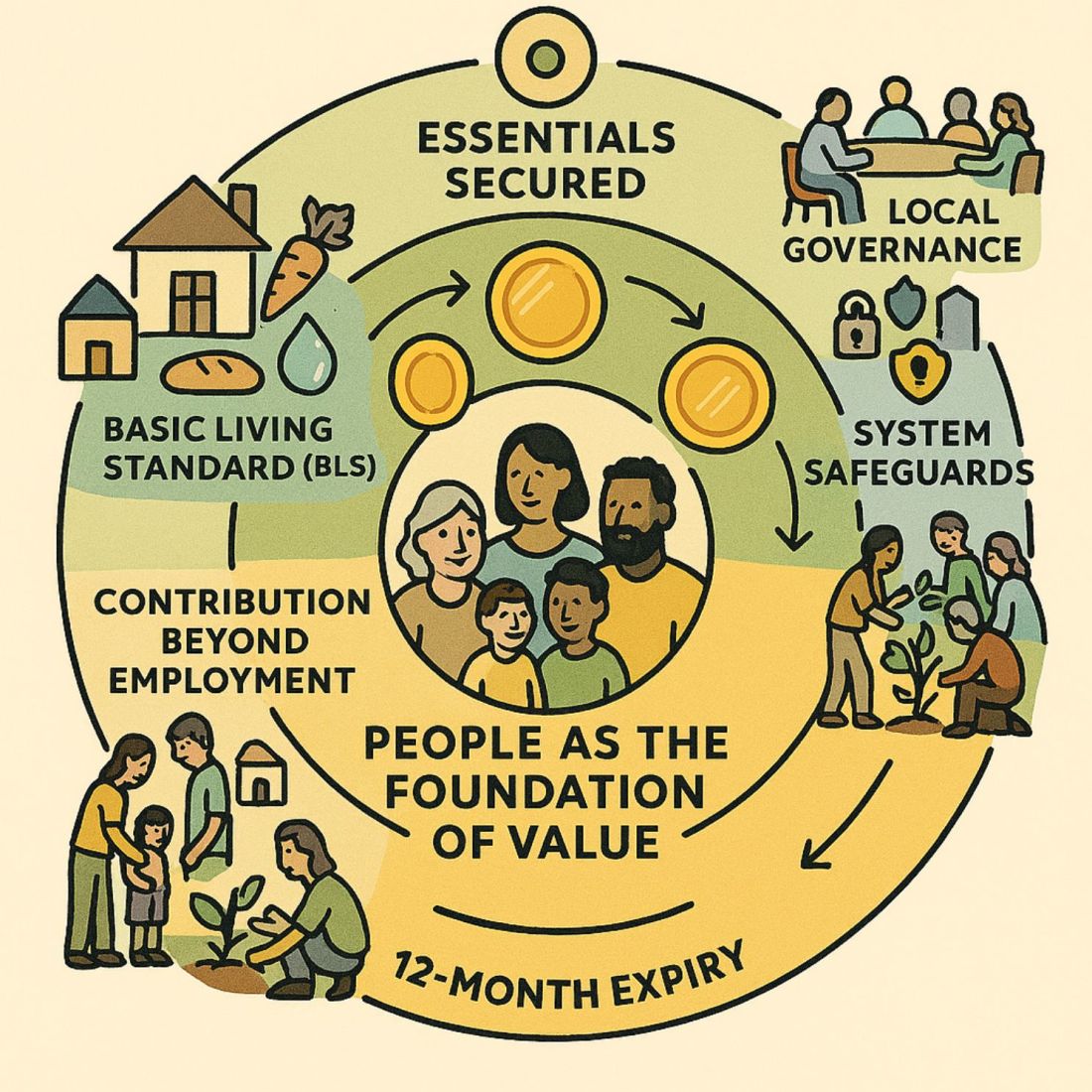
1. People as the Foundation of Value

The central premise of LEGS is that people – not money, markets, or institutions – are the true source of economic value.

This is not a metaphor. It is a structural principle.

The system quantifies value based on people, their stage of life, and their capacity for contribution.

In doing so, it restores dignity to every individual, regardless of wealth, status, or productivity.

2. Essentials as a Protected Foundation

The Basic Living Standard (BLS) is not a benefit or a safety net. It is the baseline of dignity that full‑time work must guarantee.

By securing essentials structurally, the system removes fear as the organising force of society.

When survival is no longer a commodity, people regain the freedom to think, act, and live without coercion.

3. Money as a Circulating Tool

Money in LEGS is designed to circulate, not accumulate.

It expires after 12 months, ensuring that it remains a tool of exchange rather than a store of power.

This design removes the addictive behaviours – hoarding, speculation, scarcity creation – that distort human life under the money‑centric system.

4. Contribution Beyond Employment

LEGS recognises that valuable work extends far beyond paid employment.

Caregiving, learning, community work, environmental stewardship, and social support are all essential to a healthy society.

The system acknowledges these contributions structurally, not symbolically.

5. Locality as the Anchor of Stability

Value, money, trade, and governance all operate at the community level.

This strengthens resilience, reduces dependency on distant systems, and restores the natural human scale of economic life.

6. Governance as a Participatory Practice

The Circumpunct replaces hierarchical power structures with a flat, transparent, community‑led model.

Governance becomes a living practice, not a distant authority.

7. A System Designed to Resist Capture

Every safeguard – from money expiry to fixed values for essentials – exists to prevent the system from being manipulated, centralised, or distorted.

LEGS is intentionally designed to protect itself from the very forces that corrupted previous systems.

Key Messages

1. You cannot understand LEGS by comparing it to the current system

The money‑centric system is built on scarcity, competition, and accumulation.

LEGS is built on contribution, locality, and shared responsibility.

These frameworks are incompatible. Attempting to interpret LEGS through the logic of the old system will distort it.

2. The old system creates addictive patterns

People unconsciously cling to the idea that money must accumulate, that essentials must be earned, that success is numerical, and that security must be purchased.

These patterns are not natural – they are conditioned.

LEGS requires the reader to recognise and release them.

3. LEGS is a clean‑sheet design

It is not a variation of capitalism, socialism, or communism.

It is a return to natural human principles that predate all of them.

4. The system works because it aligns with human reality

People thrive when essentials are secure, contribution is shared, governance is local, and money cannot dominate life.

LEGS restores these conditions.

Core Takeaways

1. The greatest challenge is mental carry‑over

Readers must actively notice when they are interpreting LEGS through the lens of wages, markets, profit, or hierarchy.

These assumptions belong to the system that is now collapsing and cannot be carried into a new one.

2. LEGS is a complete system

Money, value, essentials, contribution, governance, and trade are interdependent.

Understanding one requires understanding the whole.

3. Essentials are guaranteed through structure

The BLS is not charity.

It is the structural foundation of the economy.

4. Money expires to prevent harm

Expiry is not punitive. It is protective.

It ensures that money remains a tool, not a weapon.

5. Contribution is universal

Everyone contributes according to capacity.

No one is excluded or left behind.

6. Local governance prevents capture

The Circumpunct ensures that decisions remain with the people they affect.

7. LEGS is a return to natural human living

It aligns with the rhythms of community, the cycles of nature, and the realities of human behaviour.

Closing Reflection

This companion exists to help the reader approach From Principle to Practice with the mindset required to understand it.

The book is not asking the reader to imagine a slightly improved version of the world they know.

It is asking them to imagine a world built on natural principles – contribution, locality, transparency, and shared responsibility.

To see that world clearly, the reader must temporarily set aside the assumptions of the money‑centric system.

Only then does the coherence, practicality, and humanity of LEGS become visible.

A Few Thoughts on Minette Batters’ Farming Profitability Review (FPR)

Expectations of the FPR

The Farming Profitability Review, authored by Minette Batters, was finally released yesterday. Like many others, I downloaded the 150‑page document hoping it might herald positive change for our farmers.

Given Minette’s respected tenure as NFU president, many anticipated that this review would provide a clear, unvarnished account of the situation.

Authored and presented by one of their own, it was expected to carry the weight and credibility needed to push government support for UK farming back to where it belongs.

On that basis, the content does read as a genuine set of proposals rooted in what the industry itself recognises as urgent needs. Phrases such as “A New Deal for Profitable Farming”, the FARM proposal, and the assertion that “The UK is widely regarded as one of the most prized food markets in the world” will sound like music to many ears. Yet they also underscore the uncomfortable question: why, when everyone in the UK needs food every day, are farm businesses failing or closing?

Industry Context & Policy

The report covers the expected themes – profitability, overseas trade, nutrition, and more. But context is everything.

The elephant in the room is that farming policy continues to follow the establishment’s agenda: serving government and big business interests rather than what is genuinely best for farmers, and therefore for all of us.

This is where major food and farming advocacy organisations, and their champions old and new, fall short. They continue to operate within the framework defined by government, addressing symptoms rather than causes, and avoiding the deeper realities of the industry’s decline.

Documents of this kind often reveal the underlying truths driving government thinking. One of the clearest comes early in the Foreword, where Minette reminds readers that politicians dismiss farming because it represents only 0.6% of GDP. This stark figure highlights that, for politicians, the economy and money matter far more than farming, food security or the human issues as most normal people see them.

An industry valued at just 0.6% of GDP, reliant on grants and subsidies that do little to boost GDP, is not seen as an engine of growth. Ministers repeatedly emphasise their obsession with economic output, because under the current financial system – broken and rapidly failing as it is – growth is the only measure that sustains their positions while allowing them to avoid responsibility.

Profitability: Competing Definitions

The fact that the review is overtly about profitability says it all – not least because the term carries very different meanings depending on who is using it.

For farmers and small business owners, profitability means staying in the black: running a viable enterprise that pays wages and hopefully leaves a little extra. For politicians, however, profitability is measured in terms of supermarket margins and GDP contributions.

This warped definition highlights how broken the system has become: profitability is reduced to a metric of economic growth, rather than the lived reality of whether farms can survive.

In this way, farming is forced to fit into an economic narrative that serves government borrowing and spending priorities, rather than the needs of those who produce our food.

Economic Pressures and Regulatory Burdens

The figures in the report speak volumes: machinery costs have risen by 31%, and compliance with new regulations demands massive investment.

Though introduced under the guise of improving standards, these rules inevitably push more farmers and allied businesses out of the market because they cannot compete – and that reality bears much of the truth that lies behind the journey that UK farming has been on since the early 70’s.

Put bluntly, farming within this framework is not viable – and was never intended to be.

The establishment does not want traditional, independent farms to survive.

Even Minette’s more positive suggestions, however well‑intentioned, cannot succeed in this context. They risk becoming distractions – “dead cats” -designed to maintain the illusion that government is invested in the UK food chain and food security, when the evidence clearly shows otherwise.

What I would have liked to see is a stronger message about the importance of UK food production and the need to move towards self‑sufficiency.

Feeding the British public with fresh, healthy, nutritious food that is accessible and affordable should not be an aspiration – it should already be the baseline.

With food as vital as it is, and every one of us needing at least two meals a day, this is surely more important than abstract questions of GDP growth.

Harsh though it may sound, this report feels more like a whitewash than a clean shet. It’s exactly the kind of document political and establishment leaders hope for to cover their tracks and agendas.

Knowing how those from the farming advocacy organisations play along with government to stay close to power rather than risk friction, it stands to reason that the review may have been genuine and well‑intentioned but never risked being positioned to create problems for politicians by tabling the full truth. Regrettably, it fails to grapple with the central issue: the government’s relationship with farming is not about food, farming, or feeding the nation – it is simply about money and the transfer of power and wealth.

Government is not deaf to farmers – it simply does not care. That indifference is the real crisis.

The current approach to UK Agricultural and Food Policy, embedded long before this Labour government, is dismantling our food production capability by making it impossible for farmers to continue. This is a growing risk to everyone.

If borders closed tomorrow and external food supplies were cut off, around only 12% of the UK’s food supply would be immediately available to consumers.

The rest – despite the UK producing 52–58% the equivalent of what it consumes – would not be any good to the public for a considerable time, because the UK farming is subservient to and fits within the Euro‑Global food chain.

The majority of our People could go hungry in a real crisis and this is the reality we should be confronting – not how profits and therefore more helpful statistics are made.

A Call for Farmer-Led Change

Ultimately, only the farming industry can save itself – and that means taking immediate risks.

However, taking risks while there is still an industry left worth risking must surely be better than passively watching its demise until every independent and family farm in the UK has been shut down.

Summary & Key Takeaways:
Adam offers a critical perspective on the Farming Profitability Review, highlighting both its intentions and its limitations from the viewpoint of UK farmers and food producers.

Key Points

  • High Expectations, Mixed Delivery:
    Farmers and industry stakeholders anticipated a transformative report, given Minette Batters’s reputation and leadership. The FPR presents genuine suggestions but remains constrained by establishment narratives.
  • Profitability Framed by Policy:
    The FPR’s focus on profitability is shaped by government priorities – specifically, farming’s small contribution to GDP. This economic lens overshadows broader issues like food security and the viability of independent farms.
  • Systemic Challenges:
    Rising costs (e.g., machinery up 31%) and regulatory burdens are pushing more farmers out of business. The FPR acknowledges these pressures but doesn’t fully address their root causes.
  • Establishment Influence:
    The FPR is too aligned with government and the aims of large corporate organisations that influence the food chain, lacking the independent advocacy needed to truly represent farmers’ interests.
  • Food Security Concerns:
    Adam’s response stresses the importance of UK food self-sufficiency, noting that current policies leave the nation vulnerable if external supply chains are disrupted.
  • Call for Farmer-Led Solutions:
    Ultimately, Adam argues that only the farming industry itself can safeguard its future, urging collective action and risk-taking to preserve independent and family farms.

Further Reading:

The resources below have been selected to help you explore the central themes discussed in this response.
Key topics include:

  • The roles and priorities of farmers and consumers in UK food production
  • The impact of government policy, economic pressures, and systemic challenges on farming
  • The importance of food security and community resilience
  • Practical solutions and future directions for rebuilding and sustaining the UK food system

1. Understanding UK Food Production & Stakeholders

2. Policy, Economics & Systemic Challenges

3. Solutions, Action & Future Directions

The Future of Work: Redefining Value, Meaning, and Human-Centric Employment in the Age of AI and Economic Change

AI’s Crossroads: Choosing a Human-Centric Future for Work and Society

Artificial intelligence is rapidly transforming the world of work, automating roles created by money-driven systems and exposing the fragility of an economy built on profit and status rather than genuine human need.

Without a deliberate change in direction, society risks deepening inequality, eroding community, and reducing work to a function of control and dependency.

The current trajectory, shaped by decades of economic and technological planning, threatens to devalue essential contributions and undermine the foundations of freedom and dignity.

But this path is not inevitable. There is an alternative: a future where work is meaningful, communities are empowered, and the economy serves people – not the other way around.

This work challenges the prevailing narrative and introduces The Local Economy and Governance System (LEGS) – a model for a human economy built on the basic living standard.

LEGS offers a practical framework for restoring value to real work, strengthening local governance, and ensuring that technological progress enriches lives rather than diminishes them.

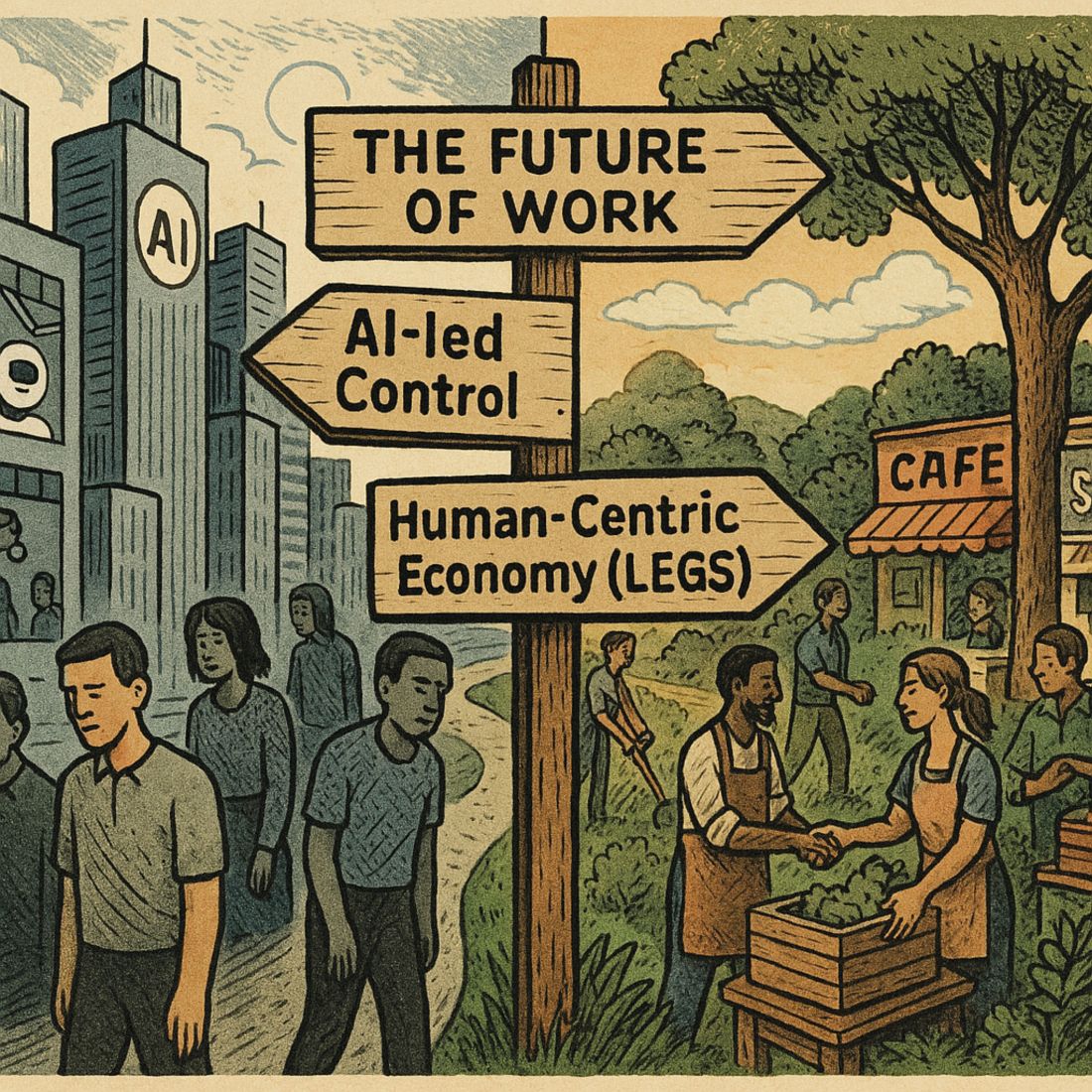
The choice is ours: continue down the AI-led road of exclusion and control, or embrace a system that prioritizes human well-being, fairness, and genuine prosperity for all.

Rethinking Work in a Human-Centric Future

Beyond Money-Driven Roles

The work and employment of a better, human‑centric future will be real, tangible, and deeply meaningful. Unlike many roles today that exist primarily to prioritise the flow of money, this future will focus on impact, purpose, and the enrichment of human life.

The Challenge of New Realities

The near future is poised to introduce truths, realities, and perspectives about our lives that many will find extremely difficult to accept.

This difficulty arises because true freedom – freedom to do, freedom to think, and freedom to be – requires us to revalue everything: how we see, how we interact, and how we set expectations.

These expectations will need to operate in a completely different, yet ultimately rewarding, way.

Shifting Perceptions of Good and Bad

In this transformation, what seems good today may quickly be seen as bad, while what appears deficient or undesirable now may suddenly reveal itself as profoundly valuable.

One of the most striking areas where this reversal will become evident is in our daily relationship with work – what we do, and how we define the very act of working.

The Distortion of Work by Money

The concept of work itself has become twisted by its association with money and the reward of money for labour.

Work is widely accepted as “work” only if it pays a wage.

Within this framework, society has conditioned us to undervalue technical, hands‑on, manual, and physically demanding forms of labour.

These roles, despite their essential contribution, are treated as if they hold little real value.

The Rise of Professional Roles

Meanwhile, a whole range of so‑called “professional” roles – many of which either had no necessity or no clear purpose until recently – have emerged and now dominate the employment landscape.

Some of these roles did not even exist a few decades ago, yet they are rewarded and elevated far above the practical, human‑centric work that sustains daily life.

The Devaluation of Real Work in a Money-Centric Culture

When Real Jobs Lost Their Value

Money‑centric culture has made “non‑jobs” real while rendering real jobs valueless in the eyes of society.

Historically, work was simply whatever it took to make life function. People played different roles – some paid, some unpaid – to sustain a household.

There was an unspoken recognition that it takes diverse contributions from everyone to enjoy life together, no matter what those contributions might be.

The Shift to Consumerism and Financial Systems

This balance changed with the rise of consumerism and the adoption of the moneocratic FIAT financial system, reinforced by GDP metrics and decades of law and regulatory changes.

These shifts progressively pushed households into a world where every member had to work for financial reward before the essential tasks of maintaining a home could even be addressed.

Even self‑sufficiency – achieved through both employment and domestic work – was no longer enough to live on if one was engaged in “real jobs.”

Such jobs now attract only ‘minimum wage’, a measure that has never represented the true benchmark of what it takes for a household to live independently and for its members to experience genuine financial freedom and the peace of mind that it facilitates.

The Mechanics of Wealth Transfer

With an economic system so fundamentally bogus, it should come as little surprise that its clever mechanics were designed to transfer wealth to those in control.

To achieve this, the system had to create a mindset that persuaded the masses to facilitate what is, in reality, a crime against humanity – not only against those they were conditioned to believe were ‘lesser’, but ultimately also against themselves.

This required that people be “bought in” to a value set where a select few and those who took every step necessary to be like them, could become disproportionately rich by doing ‘jobs’ that required little effort – or none at all.

The Creation of Jobs and Economies of Scale

Jobs were reshaped and split off from existing roles as money began to demand output.

Economies of scale, hailed as progress, destroyed local businesses and community systems that had worked perfectly well and had the ability to facilitate self-sustained models of family life.

These practices imposed a new slavery to money, progressively making it our master.

Careers as Money Machines

Jobs that supported the growth of money‑centric culture became the new measure of success.

Young people have shifted from more traditional aims of living a balanced, all‑round life to pursuing careers defined not by trade, service, or goods, but by the pursuit of money.

Careers have become all about making money, expanding the ways to make money, and protecting every part of the machinery involved.

Quality of customer experience and the delivery that brings it seldom now sit at any industry or profession’s heart.

Entitlement and the Multigenerational Workforce

The splitting of systems into job categories defined people not by the real work they did, but by the possessions and status attached to their roles.

This slowly created a culture of entitlement.

A multigenerational workforce has emerged that takes much in life for granted, including the myth that wealth can only grow while jobs become less like work.

The belief that “what one wants is what one deserves” has spread, with the expectation that such entitlement can be imposed upon everyone encountered without consequence – even in the digital, parallel world.

Sleight of Hand at Scale

Those in created jobs believe life can only get easier, while those performing the essential tasks that make life work for everyone cannot earn enough to escape the constraints of their labour.

These ideas and the narratives that underpin them are little more than a distraction – a sleight of hand on an epic scale – deliberately hiding what has truly been happening at the cost of everyone involved.

The Switch in Values

The shift from valuing people and the work required to live, to valuing money as the only important thing, has made society lazy, entitled, and ill‑prepared.

People now accept change passively, no matter how illogical or damaging, even when the same destructive process repeats with increasingly bizarre and counterintuitive outcomes.

These changes almost always come at a cost to people, communities, and the environment, whilst being presented as having the best interests of everyone at their heart.

The Direction of Travel that the World as we know it is on

The Difficulty of Belief

People often find it hard to accept that all of this was deliberately planned by others.

Yet money – and the possession of wealth, power, control, and influence – is an extraordinarily powerful motivator.

For those who become addicted to it, there is almost no limit to what they will attempt or achieve.

The Mechanics of Power

When such individuals hold power, or gain access to those who do, they can reshape systems so that authority itself works in their best interests.

Slowly, almost imperceptibly, they change the structures of life so that everything begins to function in ways that serve them.

Long-Term Planning

The plans that have brought the world to its current state have not emerged overnight.

They have been underway for well over 150 years, steadily unfolding across generations.

This long trajectory has seen massive changes in the way international business is conducted. Changes that were only made possible through the upheaval of two world wars.

Unseen Problems Do Not Cease to Exist just because they are Unseen

The Hidden Nature of Change

Just because we cannot see or fully understand a problem does not mean it does not exist.

The adoption of a financial system that has created unprecedented wealth transfer – not only in the value of money itself, has also resulted in the ownership of business, property, and infrastructure, which has all steadily shifted into the hands of the few – at what could now be a disastrous cost to us all.

Technology as a Companion to Wealth Transfer

Alongside this financial transformation, technological progress has advanced in lockstep.

The chronology of events, from digital systems to information technology and hardware innovations, shows that these developments did not simply arrive at the moment we first experienced them.

They were planned, anticipated, and in many cases known to be possible for long periods of time.

Artificial Intelligence, and the AI takeover we now hear so much about, is not an isolated phenomenon. It is part of this broader strategy and plan, woven into the same trajectory that has shaped finance, ownership, and control.

The AI Takeover and Its First Victims

It is no accident that the first jobs to disappear in the AI takeover are those that are tied directly to the money project itself.

These roles, created and sustained by a system designed to prioritise financial mechanics and the transfer of wealth over human value, were always the most vulnerable to replacement.

Collective Choice and the Future of Work

The loss of other jobs, however, is not predetermined. It is our collective choice.

How we respond, adapt, and redefine the meaning of work in response to what is happening around us will ultimately determine the direction of the future.

Opening Ourselves to an Alternative Future

Awakening to a New Reality

Influencers are now beginning to ask the pressing question: “What happens to everyone whose job is taken by AI?”

At the same time, members of the elite openly declare that many jobs will no longer be needed within a decade.

People are slowly awakening to a new reality – one where the expectations we have been spoon‑fed and accepted so willingly, because life has seemed distractingly good, no longer add up.

This awakening is compounded by the fact that the economy itself sits on a knife edge.

Governments, behaving with illogical static rigidity, offer no meaningful response.

The contradictions are glaring, and the narrative no longer holds together.

The World Envisioned by the Few

The architects of this system – the people who designed and intend to run the world as they envisage it – have exploited and legitimised the theft of wealth, resources, and tools from the masses.

Through this process, they have been creating the foundations of a new world order built on control and deprivation.

Technology, ownership, and finance have been reshaped not to empower humanity, but to strip it of independence and place power firmly in the hands of the few.

The promise of “you will own nothing and be happy” is not a utopian vision. It is the culmination of a strategy that has taken from everyone to enrich the few, ensuring that the majority remain dependent while the architects consolidate control.

Systematic Devaluation of Real Work

It was purposefully engineered that people in manual, technical, and real jobs have been systematically devalued.

This devaluation has been reinforced by every institution and system.

Governments have deliberately abused their mechanisms to top up and subsidise wages, hiding the reality that the lowest paid wages are insufficient.

At best, this is exploitation; at worst, it is slavery – successfully concealed from view.

The True Value of Real Jobs

These real jobs are the ones that should be paying what it actually costs to live.

Yet the people in these roles – the very ones the new system will still need – will not willingly participate in servicing its demands if they are free to choose otherwise, especially when everyone else has been effectively cast aside.

Freedom as the Ultimate Threat

Freedom itself is the greatest threat to greed and to the furtherance of the moneycratic system.

Everything aligned with that system depends upon control.

True freedom undermines it, exposes it, and ultimately resists it.

Choosing Jobs That Make Life Work Rather Than Making Life Out of Work

The Dystopian System Already in Place

The dystopian system you may now be able to visualise is already baked in.

Within this dynamic, all the “non‑jobs” that the system has encouraged us to hero‑worship will inevitably disappear, replaced by AI.

The flow of money and wealth these roles facilitated has already reached its destination.

The elites are openly telling us this, and they are not trying to hide it.

The Fate of Technical Work

Yet not all jobs will vanish on the same timeline.

Technical roles – or at least a restricted number of them – will remain for longer than the created non jobs will.

This reality matters. It may be the knowledge of which jobs endure, and why, that provides people with the opportunity to resist and to choose a new direction, rather than surrendering to what otherwise appears to be a very dark fate.

All Jobs Must Have Meaning for People to Understand Their Value

The Illusion of a Life Without Work

Whilst we may like the idea of never working again and having every conceivable need met, there is nothing about this that is real.

The reality of being provided for in this way requires conformity and restricted behaviour.

No matter what toys or distractions we are given, such a life would resemble what we recognise today as being no different to that of a caged pet.

Activity as the Source of Value

Activity that contributes to a good life is not only necessary; it is fundamental to the value we each hold.

In the alternative future we must now consider seriously, contribution matters not because it is labelled as “work” or “employment,” but because it makes life good.

Any act that sustains or enriches life carries meaning, regardless of whether it fits the narrow definitions imposed by what the current system teaches us, or not.

The Irony of Non‑Jobs

It is ironic that people in high‑flying “non‑jobs” today often dream of simpler lives -baking cakes, crafting cheese, keeping animals, growing food, building with bricks and wood, or fabricating metal – rather than being controlled by the rules of a game and chained to a city desk.

The truth is that jobs with meaning are those that provide or support the provision of life’s essentials.

This is what every form of work, employment, or contribution should actually be about.

A Future That Serves People, Not Money

The future that serves people instead of money will be built upon direct relationships and locality.

 In such a future, everything will be transparent, and people will work and provide only for the people, communities, and environments that directly touch their own lives.

This is the foundation of meaningful work: activity that sustains life, nurtures community, and strengthens the bonds between people and the world around them.

Quality of Customer Experience and Locality Will Define Business Sizes – Not the Myth That Bigger Is Best

Freedom Through Localised Business

To choose freedom from the unnecessary oppression and exclusion that serves the few – and exists only by design – requires that we create businesses and operations focused on people, community, the environment, and their genuine needs.

True freedom lies in resisting the structures that prioritise profit over humanity and in building enterprises that serve life directly.

Rethinking Work and Economy

Some question how a future can exist where everyone works and still has enough.

Yet when work is about life rather than money, the realisation emerges that there is indeed enough of everything for everyone – provided we focus on need rather than the want that money‑centric thinking encourages for the benefit of the few.

In such a system, the economy ceases to be about job titles and power; it becomes about what we all do and achieve together.

Enough for Everyone

Everyone can work. Everyone can have a job. And everyone can have their needs met if we accept that there is no legitimate reason for any person to accumulate more than what meets their own needs.

Exploiting even the smallest advantage to gain whatever one desires undermines fairness and perpetuates inequality.

Integrity, Fairness, and Justice

Balance, fairness, and justice require integrity.

Everyone must act with the awareness that their choices affect others.

Taking more than one needs – no matter the opportunity, no matter how easy it may seem – always results in others having less. Even when the outcome is invisible to the one who takes.

Work With Meaning, Not Slavery

Work is necessary for everyone. But fulfilling work – work that sustains life and community – is not the same as financial slavery, where greed and exploitation are the only measures of value.

The future must be built on meaningful contribution, not on the hollow pursuit of wealth which can never and was never intended to be made available to and shared by everyone.

Key Takeaways

Before moving on to further resources, here are the central messages and insights from this work.

  • AI is Transforming Work: Artificial intelligence is rapidly automating roles created by money-driven systems, exposing the weaknesses of an economy built on profit and status rather than genuine human need.
  • Current Trajectory is Unsustainable: Without a deliberate change, society risks deepening inequality, eroding communities, and reducing work to a function of control and dependency.
  • Devaluation of Real Work: Essential manual and technical roles have been systematically undervalued, while “nonjobs” and money-centric careers have been elevated, distorting the meaning and value of work.
  • Freedom and Dignity at Stake: The existing system undermines freedom and dignity, making people passive in the face of damaging change and reinforcing cycles of exploitation and dependency.
  • A Human-Centric Alternative Exists: The Local Economy and Governance System (LEGS) offers a practical, human-centred framework for restoring value to real work, strengthening local governance, and ensuring that technological progress enriches lives rather than diminishes them.
  • The Choice is Ours: Society can continue down the AI-led path of exclusion and control, or embrace a system that prioritises human well-being, fairness, and genuine prosperity for all.

Further Reading

The following works are arranged to guide you through a clear progression: beginning with the foundational principles that challenge the myths of money and value, moving through critiques of collapse and exploitation, examining the role of technology and AI, and finally presenting the Local Economy Governance System (LEGS) as a practical blueprint for transformation. Taken together, they form a journey from diagnosis of the problem to the design of solutions, and ultimately to the vision of a sustainable, human‑focused future.

Foundations of Change

  1. One Rule Changes Everything – full text (20 December 2024)
    Introduces the single guiding principle that underpins systemic change, framing the rest of the discussion.
  2. Future economics must be tied only to people, their contribution, what is important to sustain good, fair and balanced lives – and legal currency must never again be open to speculation and manipulation (25 July 2025)
    Outlines the foundational principle that economics must serve people directly, not speculation or manipulation.
  3. The basic living standard explained (24 October 2025)
    Defines what a fair and sustainable living standard should look like in practice.

Collapse and Critique

  1. Breaking the money myth: rethinking value, exchange and equality (12 November 2025)
    Challenges the myths surrounding money and explores alternative ways of defining value and fairness.
  2. Money is the greatest crime of our time (12 November 2025)
    A powerful critique of how money has been weaponised against society and freedom.
  3. The coming collapse and the revaluation of everything needed to regain personal freedom and control (12 November 2025)
    Explores the inevitability of collapse and how revaluing essentials can restore freedom.
  4. Facing the economic collapse: the real crisis behind money, wages and freedom (14 November 2025)
    Examines the deeper crisis of wages, freedom, and exploitation hidden beneath economic collapse.

Technology and AI

  1. People need jobs more than AI and the tech revolution (1 September 2025)
    Argues that human work is essential for dignity and meaning, beyond the promises of automation.
  2. Technology and artificial intelligence should only fill jobs when no humans are available (13 November 2025)
    Argues for a human‑first approach to work, with AI as a last resort rather than a replacement.

Workforce and Revaluation

  1. Revaluing the workforce: escaping the grip of greed (26 November 2025)
    Calls for a revaluation of the workforce, freeing people from exploitation and restoring dignity to work.

LEGS and Transformation

  1. The Local Economy Governance System – online text (21 November 2025)
    Provides the full text of the Local Economy Governance System (LEGS) as a framework for change.
  2. LEGS – The Human Economy: a blueprint for transformation (1 December 2025)
    Introduces LEGS as a practical blueprint for building a human‑centric economy.
  3. The Local Economy Governance System (LEGS): escaping the AI takeover and building a human future (4 December 2025)
    Explains how LEGS can resist the AI takeover and create a sustainable, human‑focused future.

Closing Note

Taken together, these works reveal both the depth of the crisis and the clarity of the solutions.

They show how money has distorted value, how collapse is inevitable under the current system, and how technology – if left unchecked – will accelerate exploitation rather than liberation.

Yet they also illuminate a path forward: one built on fairness, locality, transparency, and human‑centric governance.

The choice is ours. By engaging with these ideas, we prepare ourselves not only to understand the scale of what is happening, but to act with integrity and courage in shaping a future that serves people, community, and the environment above all else.

The Local Economy & Governance System (LEGS): Escaping the AI Takeover and Building a Human Future

The Future Is No Longer Distant

There is growing disquiet, fear, and quiet concern about the turbulence we are experiencing in the world, alongside a deep, intrinsic sense that nothing is as it should be – and that it will never be the same again.

Yet at the heart of this unsettling feeling lies confusion. The prevailing narratives insist that with AI now here, and the technology it commands about to permeate every conceivable part of our lives, humanity should be grateful.

We are told we stand on the cusp of a new age, where surrendering to AI will deliver a dream life unlike anything mankind has ever known.

Some are already suspicious, beginning to question what the rollout of this digital revolution will truly mean.

Others believe the only way to progress – or to feel in control of either the real or digital worlds – is to recapture what they perceive as the “good times,” attempting to fix everything as if it were possible to freeze life and live forever in a single moment of the past.

Uncomfortable as it may be, the time has arrived for everyone to begin asking the hard questions: what happens next, and where will we find ourselves in a future that is no longer a distant shadow on the horizon, but already towering above us right now.

The Watershed Moment We Cannot Ignore

The Coming Crisis of Agency & Survival

The answer to the question so many wish to avoid is that, if we continue on our current path, ordinary people will be left with no means to provide for themselves. They will have no income to pay others to do so, and neither government nor business will exist with the resources or the intent to supply even the basic essentials necessary for the masses to survive.

Everything we know – whether or not we recognise its connection to our current reality – has been moving in this direction for as long as most of us have been alive.

There has been a steady erosion of agency, independence, and self‑resourcefulness for ordinary human beings, first through the transfer of all forms of wealth, and now, taking place through the progressive takeover of every aspect of working life and function by both existing and rapidly emerging forms of AI.

Whilst many today spend quiet moments fearing the apparent opening of immigration floodgates and the erasure of Western culture, society, and life as we know it, others, for reasons seemingly unknown, appear to have embraced a suicidal empathy that insists the only correct behaviour of Western society is to destroy itself in order to prioritise all others.

AI’s Encroachment on Everyday Life

Yet everyone fails to see that the impending and critical threat to everything we hold dear has already been welcomed into our governments, our businesses, our technology, and the very functionality of daily life, and is so deeply embedded that it now resides in our computers and our phones.

The Myth of Effortless Utopia

AI, along with the robotics and technology now emerging to support it, is becoming the option of choice for carrying out the majority – if not all – tasks across what we currently understand as life.

This development will soon mean that, for the majority of us, there will soon be no reason for work to continue to exist.

Exploitation and Systemic Transformation

Whilst many of us hear talk of the AI takeover, the reduction in new hiring and training opportunities across numerous professions and industries, and the replacement of jobs of all kinds, we fail to connect these developments with the rising welfare bill as people find themselves with no choice but to accept a life of unemployment.

The New Divide: Inclusion and Exclusion

Nor do we pause for a moment to consider the pressing question: What does it mean when there is no job left for you?

The Last Chance for Human Agency

Yes, many truly believe the stories openly shared by members of the elite community driving this change – that in no time at all, life will become cheap and effortless for everyone because AI and machines can do everything.

The Value of Effort and Contribution

People really do believe we are about to step into a new and previously unrecognisable utopia, where the system has eliminated the need for human industry, effort, and value in the form of contribution, and instead provides everything we can imagine, free of charge and experienced as if life were one giant, permanent holiday for us all.

Historic Patterns and Systemic Endgame

Such benevolence, hinted at in the form of words from these few, and the feeling it inspires about our future, is one that few can fail to imagine.

Indeed, the words and the ease with which life now comes at us makes it very easy to accept the disproportionate levels of wealth for the few that has been encouraged by the progress of this new technical revolution.

People are taking for granted that once the evolution of everything needed to perform every task that human beings carried out across all functions of life is complete, these are the very same few who will then happily smile and sit back while everything they own and have developed works and provides for all of us in return for absolutely nothing. All whilst we continually maintain an everimproving standard of life and receive a universal basic income that covers every requirement beyond the luxurious permanence of 24hour leisure, which is somehow ever present and that we somehow believe we would actually enjoy.

In truth, we do not need to understand how or why we arrived here to see the situation for what it really is. The fundamental truths are already available for us all to observe, consider, and comprehend, hiding in plain sight: the masses have been used and exploited to create the very means that will ultimately be implemented to destroy humanity as we know it.

As this has all progressed, we have all been fed and indoctrinated with stories, technology, forms of easy wealth, and advances convincing us that things can only ever improve along this path and that a golden age awaits.

At the same time, we have given our consent to puppet politicians who have willingly changed and enforced every rule necessary to facilitate this under the veil of progress -driven not by principle, but by submission to those with power and self‑serving agendas, lured by promises of glory and gain that appeal to their true, hidden selves.

Many struggle to believe that those we have elected, and those who have grown rich or benefitted so greatly from the rewards of leadership in a modern world and society, could truly be so cruel. Yet does it matter whether we – or even they – accept that as truth, when the outcome fast approaching, without a change in our direction, will inevitably be exactly the same?

Within the world and its structures – The System as it operates, functions, and controls every part of life today – the true divide of them and us lies between those whom the system will continue to carry and cater for once the concept of human independence no longer exists, and the masses who have no further use, whom the system will either choose to exclude or find some means to remove.

This is neither a horror story nor a work of fiction. The only uncertainty – without a change in direction – lies in when and how events will unfold that bring about the critical period of transition.

Today, humanity still possesses agency, choice, and the power to pursue an alternative pathway – even though so many of us are sleep‑running toward the end of freedom’s existence, actively embracing and welcoming the very tools that will soon replace the need for us within our own lives.

The fundamental truth of any life worth living is that there can be no reward without effort, and that effort itself is the pathway to reward when life is grounded in truth.

We hold no value to anyone or anything if we do not contribute or participate when we are able. There are no free rides for anyone or anything, unless they come in the form of charity – or unless we ourselves assume the role, if deemed desirable, of pets.

History repeats this truth time and again. We need only look further to see how power is abused by the powerful—how they seek to control everything they find useful, and how quickly they dispose of it when they do not.

Everything about the moneocratic, money‑centric, top‑down, centralised, hierarchical, and patriarchal system was ultimately designed to end this way.

The arrival of technology – and finally AI – has brought humanity to a genuine watershed moment, an endgame in which we must either abandon the unsustainable way of life to which we have become addicted and embrace one that restores balance, fairness, and justice for all, or continue living the lie created by those who profit from our subservience.

If we choose the latter, we will participate in it until the moment we realise we no longer hold any value, and the destiny imposed upon us by others has arrived.

The Alternative Pathway

The temptation for many, upon realising what has happened and what is happening, is to believe that all we need to do is step back a few years and remove the most corrosive technological advances that have entered our lives.

As simple as the removal of AI might seem – even if we were able to overhaul politics and replace politicians with those who agree – the real damage to society and culture has not come from technology or its advances themselves. It comes from the reasoning, motives, intent, and forms of control behind them.

These forces have long been at work, reshaping how everything functions across society – manipulating and redirecting life so that what we have already become is accepted as normal.

The way we live, work, conduct business, relate to others, and even relate to ourselves must return, rediscover, and recreate a way of being that transforms our system of values.

Our entire value set must shift so that we understand and expect meaning from life in ways that, by today’s standards, may seem counterintuitive or even alien.

The Human Value Imperative:

  1. We must embrace the reality that everyone is equal, and that the only difference between us lies in our roles, functions, and contributions within society—roles that are always dynamic and open to change.
  2. We all need to accept that differences do not make us different when it comes to what is ethically, morally, and fundamentally right.
  3. We all need to accept, understand, and embrace that no person should be advantaged over another by circumstances beyond their own efforts or control.
  4. We must accept that deviation or allowances beyond these principles will always lead to growing unfairness—even when special circumstances seem justified or privileges are believed not to be abused.
  5. We must accept that hierarchies are not a natural system of order, even though the need for order in society means that some will naturally take the lead.
  6. We all need to share responsibility and take part in collective choices that shape the aspects of life we share.
  7. We all need to contribute to the community in whatever ways we can.
  8. We all need to work and actively contribute to shared life whenever we are genuinely able.
  9. We must live by the principle that the responsibility we have toward others is the same responsibility we owe to ourselves.
  10. We all need to accept that once our needs are met, nothing is gained if any one of us seeks to have, take, or control more.
  11. We must accept that true abundance means having as much as we need, not everything we want.
  12. We must accept that people are the greatest source of value, and that real economics should be centred on that value.
  13. We must embrace the reality that full employment is both natural and normal when employment is defined by all forms of contribution, not just financial return.
  14. We must welcome and protect the truth that locality, and the transparency it brings to every kind of relationship, is key to maintaining and benefiting from a system we can trust to be fair, balanced, and just.
  15. We must ensure that AI and all technologies are used only to support human life and enhance working practices—not to replace jobs or create circumstances in which any human being is considered useless.

When we commit to all of these principles, we can begin to envision a society and way of life that truly functions as it should with equity, equality and accountability for all – one that is transformed in almost every possible way.

The Turning Point: Choosing Freedom and a Better Future

For many of us, the uncomfortable reality we must face is that passive inaction – or continuing to accept life under the control of others, believing things will simply carry on as they are – poses an existential threat that is all too real. It is a danger that extends beyond the confines of Orwell’s 1984 and, for those who truly value their lives, could mean something far worse.

The choice – while we still have one- is to not only accept but to embrace an alternative path.

This path, though carrying forward some familiar aspects of the world around us, demands that every part of our lives be lived in a fundamentally different way: a way where people, community, and the environment come first; where power rests with the individual, their freedom, and their personal sovereignty; and where the whole experience of life unfolds in a completely new direction.

The Local Economy & Governance System Framework: A Path to Empowerment

Exploring the Local Economy & Governance System

Visualising a different world – how it operates, what it requires of us, what we must give, how we work together, and how frameworks of rules function (rather than laws that micromanage every part of life, as is increasingly the case today) – may sound simple. Yet their adoption, interpretation, and our response to them within a system centred on empowering every person, rather than controlling them in every conceivable way, will be fundamentally different.

This shift will inevitably provoke resistance, not least because we have become addicted to the unsustainable, money‑centric way of living that dominates our lives today.

The Local Economy & Governance System provides a detailed picture of these frameworks, showing how this new people‑centric model will look and how it can be implemented.

Perhaps the most important element of this new world is that it will be built upon direct, participatory democracy – a system entirely unlike the hollow or pretend democracy that defines the moneyocratic world we currently inhabit.

Participatory Democracy: Power in the Hands of People

Participatory democracy means that everyone takes part in the decision‑making processes that shape public policy.

It ensures that we all hold the power to change or remove the public representatives we choose and appoint.

This requires a level of accountability and participation that is not only regular and personal, but far greater than the limited choice we currently have – voting every four or five years for candidates selected by someone else.

There is much to consider about the processes that enable true participatory democracy and how it can work effectively and diligently.

One of the most striking differences between this future system and what we have today is that there will be no political parties.

Instead, public representatives will be chosen directly by the community – respected individuals with proven commitment to serving the best interests of everyone involved.

To learn more about The Local Economy & Governance System, please visit: The Local Economy & Governance System Online Text or support my work by purchasing the book for Kindle.

From Possibility to Reality: A System That Works for Everyone

The Local Economy & Governance System will work because it prioritises people, community, and the environment in ways that may seem inconceivable today.

It places value on personal sovereignty and the freedom that comes from living lives defined by who we truly are, rather than by external factors and reference points that remain under someone else’s control.

Yes, the practical mechanics of LEGS will work – and they will work well – if we choose to embrace them.

After all, the dysfunctional world we inhabit today has appeared to “work” only because we came to believe in it, even as it has harmed so many of us.

We must not underestimate the ability, ingenuity, and creativity of humankind to deliver and implement solutions that succeed under any circumstances, when motivated and convinced it is right to do so.

Together, we can reclaim power and value and build a new world and system that functions with equity, equality, and open accountability for everyone – just as a truly civilised society always should.

Together, we can turn possibility into reality and create a society that truly works for everyone.

The Choice Before Us

We stand at a decisive moment in human history.

The turbulence we feel, the erosion of agency, and the encroachment of systems that strip away our independence are not distant threats. They are realities already shaping our lives.

The arrival of AI and the technologies that support it has brought us to a genuine watershed: either we continue down the path of dependency and control, or we choose to reclaim balance, fairness, and justice through new systems built on empowerment, community, and sovereignty.

The Local Economy & Governance System, grounded in participatory democracy and people‑centric values, offers a practical and principled alternative.

It is not a utopia promised by elites, nor a nostalgic return to the past, but a framework for living that restores meaning to contribution, accountability, and shared responsibility.

Human ingenuity has always risen to meet the greatest challenges. If we believe it right to do so, we can build a society that works for everyone – where equity, equality, and open accountability are not ideals but lived realities.

The choice is ours. To continue sleepwalking into a future where humanity holds no value, or to awaken and embrace the possibility of a new civilisation. One that honours freedom, restores dignity, and ensures that life itself remains worth living.