Making sense of a system that isolates and divides – and building a fair, functional system that stands as a real alternative for everyone.
A Note from Adam
For nearly four years, I’ve been publishing books and blogs about change – why we need it, what’s wrong with the world as it stands, and why those wrongs keep repeating.
I’ve written knowing full well that only a small number of people were truly interested in the perspective I was offering. Not because the ideas lacked value, but because they don’t fit neatly within the way the world currently works. They challenge assumptions. They question the foundations. They ask us to look at the system itself, not just the symptoms.
And yet, despite the limited audience, I’ve felt compelled to keep writing.
Part of that comes from a long‑held understanding that the world we know has been living on borrowed time. The cracks have been visible for years – widening, deepening, accelerating – and it has been impossible for me to ignore them.
Much of the time, I didn’t even know that another book would follow the one I had just finished. I would wrap up a manuscript, thinking the work was complete, only for a new structure, a new purpose, a new piece of the puzzle to arrive almost immediately. And so I would begin again.
A few of you have been with me from the very beginning, quietly following each step of this journey.
Others have joined along the way. And now, more than ever, I sense a growing number of people recognising what I have felt for a long time: we cannot shape a new future by using the same shape that created everything that’s wrong.
After publishing The Basic Living Standard Explained, LEGS, and From Principle to Practice, it felt like the right moment to share a little more of the experience that has driven this work – the lived reality, the observations, the research, and the personal journey that have informed every page.
Not because my story is important in itself, but because I do not doubt that for many, understanding the path will help to illuminate the destination.
This work has become important – and yes, urgent – in ways I could never have anticipated when I began.
Even if only a few of you are reading, reflecting, and engaging with these ideas, that is enough. Change has always begun with those who are willing to see and lead by thinking differently.
My hope is that what follows here will give you a clear insight into how LEGS came into being, and perhaps offer a sense of the depth and scope of the thinking that has shaped it along the way.
Thank you for being here.
Thank you for reading.
And thank you for caring enough to imagine something better.
Introduction
This work did not begin with a single idea, a political moment, or a sudden revelation. It began with a pattern – one that kept appearing no matter where I stood or what role I was in.
Whether I was a councillor working with public policy, developing services for charities and local authorities, running businesses, or volunteering within communities, I kept seeing the same thing: people were being pushed, pulled, and shaped by forces they didn’t control and often couldn’t even see.
Problems were treated as isolated issues, when in reality they were symptoms of the same failing system. And the system itself – fragmented, money‑centric, hierarchical, and blind to human reality – had no idea it was failing.
At some point, the realisation became impossible to ignore:
I came to see that all of us are in different boats, shaped by our own circumstances, yet all being blown around by the same winds – economic forces, political decisions, and pressures we never chose.
Most people have no control over where they’re heading or even realise when they’re drifting toward danger.
LEGS and the Basic Living Standard are about giving people an engine of their own, the power to steer their own direction, and the ability to reach safe shores they define for themselves, where a new world that works for everyone can begin.
That image stayed with me because it captured exactly what I had witnessed throughout my life. People weren’t failing. They were navigating a storm in vessels that were never built for them, under a system that blamed them for every wave that hit.
My own childhood gave me the first glimpse of this truth. Growing up in a one‑parent family, I didn’t know we were “poor” until the world told me.
What I did know – even then – was that life felt harder than it should, and that the rules seemed to work differently for different people.
Later, when I found myself working with public policy, charity development, local government projects, business operations, and voluntary roles, that early awareness became a lens. I could see the system from both sides: the side that created the rules, and the side that lived with the consequences.
The more I saw, the clearer it became that the system wasn’t malfunctioning. It was functioning exactly as designed – and that design no longer works for the world we live in.
A research project on my Postgraduate Course in 2023 confirmed what experience had already taught me. Inside a Gloucestershire foodbank, I heard stories that revealed the same structural truth: people were not struggling because of personal failure, but because the system had made survival itself a calculation that no longer added up.
‘The minute you step away from the ground, everything becomes theoretical.’
And that is exactly how the system hides its own contradictions.
This four-years body of work – from Levelling Level to The Basic Living Standard, From Here to There Through Now, The Way of Awakened Politics, The Grassroots Manifesto, A Community Route, and the conceptual foundation I call The Revaluation – is the result of following that pattern to its root.
Each step revealed another layer. Each layer made the next step unavoidable. And together, they led to one conclusion:
You cannot fix a system that is designed to protect itself from change.
But you can build a new one.
LEGS – the Local Economy & Governance System – is that new system.
The Basic Living Standard is its foundation.
And the work that follows is the framework or map.
This introduction is not an argument for ideology. It is an invitation to see the world differently – to recognise that the future is not predetermined, and that the systems we live within are Then when when choices, not inevitabilities.
If we choose differently, if we choose people first, if we choose dignity, locality, fairness, and responsibility, then the world that follows will be one worth living in.
This is the beginning of that choice.
SECTION 1 – The Real Problem: A System That Fragments Everything
When people ask me why I’ve spent the past four years working on this – writing, researching, building, refining – the answer isn’t simple. It certainly isn’t ideological. And it didn’t arrive in a single moment of inspiration.
It came from years of watching the same pattern repeat itself in every direction I looked.
Whether I was working in public policy, regulatory environments, the voluntary sector, or running businesses and operations, the same truth kept revealing itself:
We treat every problem as if it exists in isolation.
But nothing in real life works that way.
We talk about the cost-of-living crisis as if it’s separate from housing.
We talk about housing as if it’s separate from wages.
We talk about wages as if they’re separate from business models.
We talk about business models as if they’re separate from governance.
We talk about governance as if it’s separate from values.
We talk about values as if they’re separate from community.
We talk about community as if it’s separate from the economy.
And on it goes – endlessly dividing, categorising, isolating.
This fragmentation is not accidental. It’s built into the way the system thinks.
A money‑centric system can only see problems in terms of:
cost
efficiency
productivity
risk
compliance
metrics
optics
It cannot see people. It cannot see relationships. It cannot see interconnectedness. It cannot see the whole.
And because it cannot see the whole, it cannot fix the whole.
So instead, it breaks everything into pieces – and then blames the people trapped in those pieces for the consequences.
If you’re struggling with rent, the problem is you. If you’re struggling with food, the problem is you. If you’re struggling with debt, the problem is you. If you’re struggling with work, the problem is you. If you’re struggling with mental health, the problem is you. If you’re struggling with anything at all, the problem is always you.
This is the great sleight of hand of the money‑centric paradigm:
It creates the crisis, then convinces you that you are the crisis.
And because every crisis is treated as a separate issue, the system never has to confront the truth:
All of these problems come from the same place.
They are symptoms of the same design.
They are outputs of the same worldview.
This is why I’m doing this.
Because once you’ve seen the interconnectedness – once you’ve watched the same pattern play out in public policy, in regulation, in business, in community life, in governance, in economics – you can’t unsee it.
And once you’ve seen it, you realise something else:
No amount of tinkering will fix a system that is designed to fragment reality.
The only solution is to build a system that sees the whole.
That is where this journey began.
SECTION 2 – How the System Turns Symptoms Into “Individual Problems”
One of the most revealing things I’ve learned – not just from research, but from many years of working with charities, in politics, regulatory environments, and business, is that the system has a remarkable ability to turn its own failures into your failures.
It doesn’t matter whether the issue is:
poverty
housing
food insecurity
debt
mental health
loneliness
precarious employment
small business collapse
community breakdown
environmental decline
The pattern is always the same.
The system creates the conditions.
The system produces the harm.
And then the system convinces the individual that they are the cause.
If you can’t afford rent, it’s because you “didn’t plan well enough.”
If you can’t afford food, it’s because you “budget badly.”
If you’re struggling with debt, it’s because you “made poor choices.”
If you’re overwhelmed, it’s because you “aren’t resilient enough.”
If you’re exhausted, it’s because you “aren’t working the right way.”
If you’re anxious, it’s because you “aren’t coping.”
If you’re drowning, it’s because “you didn’t swim fast enough.”
This is the quiet violence of a money‑centric system.
It isolates every problem. It personalises every struggle. It individualises every consequence.
And in doing so, it hides the truth:
These are not personal failures. They are systemic outputs.
They are the predictable, inevitable consequences of a system that:
prioritises money over people
treats human needs as market variables
reduces life to transactions
fragments every issue into separate categories
refuses to see the whole
refuses to take responsibility
And because each problem is treated as a standalone issue, the system never has to confront the deeper reality:
All of these crises are connected.
They come from the same root.
They are symptoms of the same design.
This is why people feel overwhelmed. This is why people feel alone. This is why people feel like they’re failing.
Because the system has trained us to see only the part we’re trapped in – not the whole structure that created it.
And this is where the cruelty becomes almost elegant in its simplicity:
When you’re struggling, the struggle becomes your entire world.
And that is exactly how the system keeps itself hidden.
If you’re fighting to pay rent, you don’t have the bandwidth to question why housing is unaffordable in the first place.
If you’re juggling three jobs, you don’t have time to question why wages don’t cover basic living costs.
If you’re relying on foodbanks, you don’t have the energy to question why food insecurity exists in a wealthy country.
If you’re drowning in debt, you don’t have the clarity to question why debt is built into the economic model.
If you’re exhausted, you don’t have the strength to question why the system demands exhaustion as a condition of survival.
This is not accidental. This is not incidental. This is not unfortunate.
This is structural.
A system that fragments problems keeps people fragmented.
A system that isolates problems keeps people isolated.
A system that personalises problems keeps people powerless.
And this is the point where my own lived experience – and later, my research – began to collide with everything I had seen in politics, government, charities and business.
Because once you recognise the pattern, you start to see it everywhere.
You see it in the way government talks about “helping the vulnerable” while designing systems that create vulnerability.
You see it in the way businesses talk about “opportunity” while structuring work so people can never get ahead.
You see it in the way regulators talk about “fairness” while enforcing rules that entrench inequality.
You see it in the way society talks about “personal responsibility” while ignoring the structural conditions that shape every choice people can make.
And you realise something that changes everything:
People are not failing.
The system is failing.
And people are carrying the cost.
This is the moment the narrative shifts. This is the moment the illusion cracks. This is the moment you stop seeing isolated problems and start seeing the architecture behind them.
And once you see the architecture, you can no longer pretend that any single issue – poverty included – can be solved on its own.
Because the truth is simple:
You cannot fix symptoms in a system that is designed to produce them.
You can only fix the system itself.
And that is where the next part of this story begins.
SECTION 3 – Seeing the System from the Inside: My Lived Experience
Long before I ever worked in charities, public policy, regulatory environments, politics or business, I had already seen the system from the ground level – not through theory, but through lived experience.
I grew up in a one‑parent family, in circumstances that would now be described as poverty. At the time, I didn’t have the language for it. I didn’t have the context. I didn’t have the comparisons. I simply lived it.
And that’s the thing about childhood poverty: you don’t know you’re “poor” until the world tells you.
You don’t feel deprived if you’ve never had the things other people take for granted.
You don’t feel different until someone points out the difference.
You don’t feel the weight of the system until it presses down on you.
Looking back, what strikes me most is not the lack of money – it’s the normality of it all.
The rituals of stretching every pound. The quiet calculations. The constant trade‑offs. The small victories that felt enormous. The moments of shame that arrived without warning.
But the most important part – the part that shaped everything that came later – was this:
When you grow up inside a system that doesn’t work for you, you learn to see the system differently.
You learn to notice the gaps.
You learn to feel the pressure points.
You learn to sense the contradictions.
You learn to recognise when something is being presented as “your fault” when it clearly isn’t.
You learn, very early on, that the world is not designed with everyone in mind.
And once you have it, that awareness never really leaves you.
It sits quietly in the background as you move through life.
It colours the way you see decisions being made.
It shapes the way you interpret policy.
It influences the way you understand power.
It sharpens your sense of fairness.
It makes you pay attention to the things other people overlook.
Later in life, whether I was chairing licensing hearings, building services for charities, developing operational models for a county council, running businesses, or volunteering in roles that put me shoulder‑to‑shoulder with people on the ground, I kept encountering the same pattern from different angles.
And the more I saw, the more I recognised the same pattern I had lived through as a child:
The system creates the conditions.
The system produces the harm.
And then the system tells people the harm is their fault.
Every part of life touched by the system carried the same signature.
And that’s when the realisation began to take shape – slowly at first, then with increasing clarity:
The problem isn’t the people.
The problem is the system.
And the system cannot see itself.
My lived experience didn’t give me the answers. But it gave me the ability to see the questions that weren’t being asked.
It gave me the ability to recognise when a policy was designed to look good rather than do good.
It gave me the ability to sense when a decision was made for optics rather than outcomes.
It gave me the ability to understand why people were struggling even when the numbers said they shouldn’t be.
It gave me the ability to see the human cost behind the spreadsheets, the metrics, the targets, the narratives.
And it gave me something else – something that would become essential later:
The understanding that lived experience is not subjective noise.
It is data.
It is evidence.
It is truth.
This is why, when I began writing Levelling Level in 2022, I wasn’t writing from theory.
I was writing from a lifetime of seeing the system from both sides – the side that suffers its consequences, and the side that creates them.
And that dual perspective became the foundation for everything that followed.
SECTION 4 – Contemporary Evidence of Systemic Failure: My 2023 Research
By the time I began my postgraduate research project in 2023, I had already spent years seeing the system from multiple angles – as a child living within its consequences, and later as an adult working in professional and voluntary roles reaching across the different sectors.
But nothing prepared me for how starkly the system would reveal itself when I stepped into a Gloucestershire foodbank as part of my project.
I didn’t go there to confirm a theory, or qualify my own experience from decades before.
I went there to understand the lived reality of poverty today – to see how it feels, how it functions, and how it is being experienced by the people who have no choice but to navigate it.
What I found was not simply a story about food insecurity. It was a window into the architecture of the entire system.
Because the foodbank wasn’t just a place where people came for food. It was a place where the consequences of the system gathered in one room.
And the experience I had there crystallised something I had sensed for years:
The system is failing people in real time, every day – and it cannot see that it is failing.
A comment I heard from just one of the many professionals supporting people through Foodbanks across the UK today still echoes in my mind:
Sometimes there just isn’t enough money to cover everything.
Not because people are irresponsible.
Not because they are lazy.
Not because they are making poor choices.
But because the system is designed in such a way that survival itself has become a calculation that no longer adds up.
Another stream of words struck me even harder:
The minute you are removed from the ground, it becomes theoretical.
This wasn’t just about politicians and public sector employees.
It was about the entire structure of decision‑making itself.
It was about the distance between those who design policy and those who live with its consequences.
It was about the blindness that comes from never having to experience the realities your decisions create.
It was about the way the system fragments problems so completely that even those working within it struggle to see the whole.
And then there was this:
What used to be a crisis is harder to get out of… we see people more regularly than we used to.
Foodbanks were never meant to be structural.
They were meant to be emergency support.
But the system has normalised crisis.
It has institutionalised scarcity.
It has made emergency provision part of the everyday landscape.
And the people who walk through those doors carry not just hunger, but shame, fear, exhaustion, and a sense of personal failure – even though the failure is not theirs.
One of the most revealing insights came when the foodbank worker said:
If you work with people, you can get almost anyone out of that crisis point… but sometimes there just isn’t enough money to cover everything.
This is the system in a single sentence:
The problem is not the person.
The problem is not the behaviour.
The problem is not the choices.
The problem is the structure.
The problem is the design.
The problem is the system itself.
And yet, the system continues to treat each case as an individual failing – a budgeting issue, a lifestyle issue, a motivational issue – anything except a structural issue.
This is the same pattern I had seen in every sector I’d worked in.
But here, in the foodbank, it was laid bare.
Poverty is not the cause.
Poverty is the evidence.
Poverty is the symptom of a system that no longer works.
And the most important realisation of all was this:
The experience of poverty becomes the entire world for the person living it.
And that is exactly how the system hides the bigger picture.
Because when you are fighting to survive, you cannot step back far enough to see the architecture that created the fight.
This research didn’t change my understanding.
It confirmed it.
It showed me that the fragmentation I had seen in government, politics, business, regulation, and community life was not theoretical.
It was lived.
It was real.
It was happening now.
And it was happening everywhere.
It showed me that the system is not broken in one place – it is broken in every place.
And because it is broken everywhere, it cannot see its own failures anywhere.
This was the moment the work I had been doing since February 2022 shifted from important to unavoidable.
Because once you have seen the system clearly – once you have seen how it behaves, how it hides, how it blames, how it fragments, how it isolates – you realise something that changes everything:
You cannot fix a system that is designed to produce the very problems it claims to solve.
You can only build a new one.
And that is where the next part of this story begins.
SECTION 5 – The Realisation: The System Cannot Be Fixed From Within
By the time I completed and submitted my research project in late 2023, something had become unmistakably clear:
the system wasn’t just failing – it was incapable of recognising its own failures.
And once you see that, you can no longer pretend that reform, tinkering, or “better management” will make any meaningful difference.
Because the truth is this:
You cannot fix a system from within when the system is designed to protect itself from change.
This wasn’t an abstract conclusion.
It was something I had watched unfold repeatedly across every environment I had worked in:
In politics, where decisions were shaped by narratives rather than needs.
In regulatory structures, where rules were written to preserve the system, not improve outcomes.
In charity development, where services existed to fill gaps the system refused to acknowledge.
In local government, where bureaucracy replaced responsibility.
In business operations, where profit dictated priorities even when it harmed people.
In voluntary roles, where the human cost of systemic failure was impossible to ignore.
Everywhere I looked, the same pattern emerged:
The system treats symptoms as isolated problems because acknowledging the cause would require changing itself.
This is why poverty is treated as a budgeting issue.
Why housing is treated as a supply issue.
Why food insecurity is treated as a charity issue.
Why debt is treated as a personal responsibility issue.
Why mental health is treated as an individual resilience issue.
Why community breakdown is treated as a behavioural issue.
Why governance failure is treated as a political issue.
Every problem is reframed in a way that keeps the system intact.
And this is where the realisation becomes unavoidable:
The system is not malfunctioning. It is functioning exactly as designed.
A money‑centric system will always:
prioritise money over people
fragment problems into isolated categories
blame individuals for structural failures
reward behaviours that harm the collective
centralise power away from communities
treat human needs as market variables
hide its own contradictions
resist any change that threatens its logic
This is why the system cannot be repaired.
It can only be replaced.
And this is the point where my earlier work – the books I had written since February 2022 – suddenly made sense as a single, coherent journey.
Levelling Level was the first attempt to articulate the breadth of the problem – to show that no issue exists in isolation, and that political soundbites like “Levelling Up” were distractions from the deeper systemic failures.
The Basic Living Standard emerged because I realised that dignity cannot depend on charity, debt, or government intervention – it must be built into the structure of the economy itself.
From Here to There Through Now explored the transition – the bridge between paradigms – because you cannot leap from a failing system to a new one without understanding the steps in between.
The Way of Awakened Politics for Good Government confronted the reality that governance itself must change – that unconscious decision‑making is the root of systemic harm, and that awakened, values‑based leadership is essential.
A Community Route provided the frameworks – the practical structures that allow communities to lead, decide, and shape their own futures without hierarchy or centralised control.
The Revaluation articulated the paradigm shift – the moment where we stop measuring life through money and begin valuing people, community, and environment as the foundations of a functioning society.
Each book was a step.
Each step revealed another layer.
Each layer exposed another truth.
And together, they led to the same conclusion:
The system cannot be fixed.
But a new system can be built.
A system that sees the whole.
A system that understands interconnectedness.
A system that puts people first.
A system that restores locality, dignity, and responsibility.
A system that treats human needs as non‑negotiable.
A system that values contribution over accumulation.
A system that works with human nature, not against it.
This is the moment where the idea of LEGS – the Local Economy & Governance System – stopped being a concept and became a necessity.
Not because it was perfect.
Not because it was easy.
Not because it was fashionable.
But because once you see the system clearly, you realise:
There is no alternative.
Not if we want a future that works for everyone.
And that is where the next part of this story begins.
SECTION 6 – The Journey Since February 2022: How Each Step Built the Foundations of LEGS
When I look back at the work I’ve produced since February 2022, it’s tempting to see each book as a separate project – a standalone piece responding to a particular moment or question.
But that isn’t what happened.
What actually unfolded was a process of discovery.
A gradual revealing.
A step‑by‑step evolution of understanding.
Each book was written because the one before it raised a deeper question.
Each question led to a clearer insight.
Each insight exposed another layer of the system. And each layer made the next step unavoidable.
None of this was planned.
It emerged.
It unfolded.
It evolved.
And that evolution is the reason LEGS exists at all.
Levelling Level – Seeing the System Clearly for the First Time
Levelling Level was the moment I became certain that the problems we face cannot be solved one at a time.
It exposed:
the fragmentation of public policy
the blindness of political soundbites
the illusion of “Levelling Up”
the failure of both Left and Right
the structural nature of inequality
the way money distorts every decision
It was the first time I articulated the truth that would underpin everything that followed:
You cannot fix a system by treating its symptoms.
You must understand the system as a whole.
Levelling Level was the diagnosis.
The Basic Living Standard – Defining the First Universal Framework
Once I understood the system, the next question was obvious:
What does fairness actually look like in practice?
The Basic Living Standard answered that question.
It introduced the idea that:
dignity must be built into the economic structure
survival cannot depend on charity, debt, or government intervention
the lowest legal wage must be enough to live on
the economy must serve people, not the other way around
This was the first practical framework – the first building block of a new system.
From Here to There Through Now – Understanding the Transition
The next question was equally unavoidable:
How do we get from a failing system to a functioning one?
From Here to There Through Now explored the transition – the bridge between paradigms.
It recognised that:
change is a process, not an event
people need a way to move from the old to the new
the system cannot be replaced overnight
the steps matter as much as the destination
This book was the bridge.
The Way of Awakened Politics for Good Government – Redefining Governance Itself
Once the transition was clear, another question emerged:
What kind of governance can actually deliver fairness, balance, and justice?
The Way of Awakened Politics for Good Government answered that.
It showed that:
unconscious decision‑making is the root of systemic harm
politics today is reactive, self‑interested, and blind
awakened, values‑based leadership is essential
governance must be human, not hierarchical
good government is a method, not an ideology
This book provided the philosophical foundation for a new form of governance.
The Grassroots Manifesto – The Turning Point
And then came the moment where everything shifted.
The Grassroots Manifesto was both a continuation of the journey and a turning point.
It was the first time I articulated:
a fully Grassroots‑Up model of democracy
Local Assemblies and Community Assemblies
the rejection of Top‑Down governance
the principle that power flows from the individual outward
the idea that communities must shape their own futures
the early frameworks that later became A Community Route
the recognition that the future must be built from the bottom up
This was the moment where the governance philosophy became a governance structure.
It was the moment where the idea of a new system stopped being conceptual and started becoming real.
A Community Route – The Practical Frameworks
Once the Grassroots model was clear, the next step was to define the practical structures that would make it work.
A Community Route introduced:
the 11 Principal Frameworks
Economic Localism
People First
No hierarchies
Local decision‑making
Fixed‑value currency
Technology as a tool, not a master
Community‑centred governance
This was the operational blueprint – the practical architecture of a new system.
The Revaluation – The Paradigm Shift (Unpublished but Foundational)
Alongside the published works, another body of thinking was developing – not as a book, but as a deeper conceptual foundation.
I called it The Revaluation.
It wasn’t written for publication.
It wasn’t structured as a standalone work.
It was a set of ideas, reflections, and insights that shaped everything else.
It explored:
the shift from money‑centric to people‑centric
the collapse of the old paradigm
the need to revalue everything
the centrality of community, locality, and stewardship
the philosophical foundation of LEGS
It was the internal work – the thinking beneath the thinking – that made the rest possible.
And then came LEGS – The Local Economy & Governance System
By the time all these pieces were in place, LEGS – developing from its first evolution Our Local Future, was not just an idea.
It was the inevitable conclusion of everything that had come before.
LEGS is:
the synthesis of the diagnosis
the application of the frameworks
the embodiment of the values
the structure of the governance
the architecture of the economy
the practical expression of the paradigm shift
It is the system that sees the whole.
The system that understands interconnectedness.
The system that puts people first.
The system that restores locality, dignity, and responsibility.
The system that works with human nature, not against it.
And it exists because the journey demanded it.
SECTION 7 – Introducing LEGS & the Basic Living Standard as the Systemic Alternative
By the time the journey had unfolded – through lived experience, professional experience, research, reflection, and the evolution of ideas across multiple works – one truth had become impossible to ignore:
The system we live in today cannot deliver fairness, balance, or dignity.
Not because the people within it are bad.
But because the system itself is built on the wrong foundations.
A money‑centric system will always:
prioritise accumulation over contribution
reward extraction over value
centralise power away from communities
fragment problems into isolated categories
blame individuals for structural failures
treat human needs as market variables
measure life in terms of cost rather than meaning
You cannot reform a system that is designed this way.
You cannot tweak it. You cannot patch it. You cannot “fix” it from within.
You have to build something different.
Something that starts from a different premise.
Something that begins with a different question.
Something that places value where value actually lives.
And that is where LEGS – the Local Economy & Governance System – comes in.
The LEGS Paradigm Shift
LEGS begins with one simple, radical shift: People First.
Not as a slogan. Not as a political promise. Not as a moral aspiration.
But as the structural foundation of the entire system.
In LEGS, people are not variables in an economic model.
They are not units of productivity. They are not cost centres. They are not data points.
They are the purpose of the system.
Everything else – the economy, governance, community structures, technology, currency – exists to serve people, not the other way around.
This is the inversion that changes everything.
The Basic Living Standard – The First Framework of a People‑First System
If people come first, then dignity must be non‑negotiable.
And dignity begins with the ability to live – not survive, not scrape by, not rely on charity or debt – but live a stable, healthy, balanced life.
That is what the Basic Living Standard guarantees.
It is not welfare. It is not subsidy. It is not a handout. It is not a political gesture.
It is a structural rule:
Anyone working the lowest legal full‑time wage must be able to afford all essential costs of living – without debt, without charity, without government intervention.
This single framework:
eliminates structural poverty
removes the need for foodbanks
restores dignity to work
stabilises communities
reduces dependency
rebalances the economy
forces businesses to operate ethically
aligns value with contribution
anchors prices to reality
prevents exploitation
removes the hidden subsidies that currently prop up the system
It is the foundation stone of a humane society.
And it is only the beginning.
LEGS is not a policy.
LEGS is a system.
A whole system.
A joined‑up system.
It integrates:
Economic Localism – because real life happens locally
People‑First Governance – because decisions must be made by those who live with the consequences
Grassroots Democracy – because power must flow from the individual outward
Fixed‑Value Currency – because money must be a tool, not a weapon
Community‑Centred Services – because people know what their communities need
Frameworks Instead of Rules – because principles endure, bureaucracy does not
Technology as a Tool – because innovation must serve humanity, not replace it
Local Markets & Supply Chains – because resilience begins at home
Values‑Based Decision‑Making – because the system must reflect what matters
LEGS is not a utopia. It is not abstract. It is not theoretical.
It is practical. It is grounded. It is human. It is achievable.
And it is built on the understanding that:
When you design a system around people, everything else begins to work.
Work becomes meaningful.
Communities become resilient.
Governance becomes accountable.
Economies become stable.
Technology becomes ethical.
Value becomes real.
Life becomes balanced.
Dignity becomes universal.
This is not a dream. It is a design.
A design that emerged not from ideology, but from experience. Not from theory, but from reality. Not from abstraction, but from lived truth.
And it is the only system that answers the question that began this entire journey:
How do we build a world that works for everyone?
LEGS is the answer.
SECTION 8 – The Future We Choose
When people ask why I’ve spent years working on this – writing, researching, building, refining – the answer isn’t found in any single moment, book, or experience.
It’s found in the pattern that emerged when all of those moments were placed side by side.
A pattern that revealed a simple truth:
The world we live in today is not inevitable.
It is designed.
And anything designed can be redesigned.
We have been conditioned to believe that the system is too big to change, too complex to understand, too entrenched to challenge.
But systems are not living things. They do not have consciousness. They do not have agency. They do not have power of their own.
People give systems power. People maintain them. People enforce them. People accept them.
And people can choose differently.
That is the quiet truth that sits beneath everything I’ve written, everything I’ve researched, everything I’ve lived:
We are not powerless. We have simply forgotten our power.
The system we have today – the money‑centric, fragmented, hierarchical, centralised system – is not the natural order of things.
It is one way of organising life. One interpretation. One design.
And it is failing.
Not because people are failing within it, but because the design itself no longer works for the world we live in.
It cannot see people. It cannot see communities. It cannot see interconnectedness. It cannot see value beyond money. It cannot see dignity beyond productivity. It cannot see humanity beyond metrics.
And so it produces outcomes that reflect its own blindness.
But the future does not have to be an extension of the present. It does not have to be a continuation of the same logic. It does not have to be a slightly improved version of what we already have.
We can choose differently.
We can choose a system that begins with people, not money.
A system that sees the whole, not the fragments.
A system that values contribution, not accumulation.
A system that restores locality, dignity, and responsibility.
A system that works with human nature, not against it.
A system that treats communities as the foundation, not the afterthought.
A system that understands that fairness is not a luxury – it is the basis of a functioning society.
That system is LEGS.
Not because it is perfect. Not because it is easy. Not because it is fashionable.
But because it is built on the only foundation that has ever worked:
People first. Always.
The Basic Living Standard ensures dignity.
Economic Localism ensures resilience.
Grassroots governance ensures accountability.
Frameworks ensure fairness.
Community ensures belonging.
Values ensure direction.
And together, they create something the current system cannot:
A future that works for everyone.
Not a utopia. Not a fantasy. Not a dream.
A practical, grounded, human future – built from the bottom up, shaped by the people who live in it, and guided by principles that endure.
This is why I’m doing this.
Not because I believe I have all the answers.
Not because I think I’m the one who will lead the change.
Not because I imagine myself at the centre of anything.
But because I believe in people.
I believe in communities. I believe in fairness. I believe in dignity. I believe in responsibility. I believe in the possibility of a better world.
And I believe that when people are given the tools, the frameworks, and the opportunity, they will build something extraordinary.
The future is not predetermined.
It is not fixed.
It is not written.
It is chosen.
And the choice begins now – with us, with our communities, with the way we think, the way we act, and the way we imagine what comes next.
The future we need begins with the values we choose today.
And if we choose well – if we choose people, community, dignity, fairness, and truth – then the world that follows will be one worth living in.
The Work Ahead
As you reach the end of this work, it’s worth pausing to recognise something important: nothing in these pages is theoretical. Nothing here is abstract. Nothing here is written for the sake of argument, ideology, or intellectual exercise.
Everything in this book comes from lived experience, from real people, from real communities, from real consequences, and from the realisation that the world we live in today is not the world we have to accept.
The system we inherited was not designed with us in mind. It was built for a different time, a different set of values, and a different understanding of what life should be.
It has served some, harmed many, and shaped all of us in ways we rarely stop to question.
But systems are not permanent. They are not natural laws. They are not immovable truths.
Systems are choices.
And choices can be changed.
LEGS and the Basic Living Standard are not the final answer. They are the beginning of a new conversation – one that starts with people, not power; with communities, not hierarchies; with dignity, not dependency.
They offer a way to rebuild the foundations of society so that everyone has the chance to live a stable, meaningful, and self‑directed life.
But no system, no framework, no set of ideas – no matter how well‑designed – can change the world on its own.
Change happens when people choose to see differently, think differently, act differently, and believe that a better future is not only possible, but necessary.
If this work has done anything, I hope it has shown you that the problems we face are not isolated, accidental, or inevitable. They are connected. They are structural. And because they are structural, they can be rebuilt.
The future will not be shaped by the loudest voices at the top, but by the quiet decisions made in communities, homes, workplaces, and everyday lives.
It will be shaped by people who refuse to drift any longer, who refuse to be pushed around by winds they never chose, and who decide to take hold of the engine that has always been theirs.
A new world does not begin with governments, institutions, or declarations.
It begins with people.
It begins with us.
The work ahead is not easy. It will not be quick. It will not be perfect. But it will be real. And it will be ours.
If we choose it.
This is the end of the LEGS story.
But it is the beginning of the journey itself.
Further Reading:
Seeing the System Clearly
Levelling Level https://adamtugwell.blog/2025/03/03/levelling-level-full-text/ This was where I first put words to the patterns I’d witnessed for years – the fragmentation, the blind spots, and the way our system keeps us from seeing the whole. If you want to understand why I believe no single issue can be solved in isolation, start here.
Community is not a place, but a practice – built each day by the choices we make, the care we offer, and the hope we refuse to surrender.
PREFACE
This work began with a simple question: Why does a world with so much possibility leave so many people struggling to live?
It is a question that has echoed across generations, yet the answers offered by the money‑centric system have always been the same: work harder, compete more, accept inequality, and trust that the system knows best.
But the system does not know best.
It was not designed for human wellbeing.
It was designed for efficiency, extraction, and control.
Over time, this system has shaped not only our economies, but our identities, our relationships, and our understanding of what it means to live a good life.
It has normalised fear, scarcity, and dependency. It has convinced people that freedom is a privilege, not a birthright.
This book challenges that belief.
The Local Economy & Governance System (LEGS) and the Basic Living Standard (BLS) presented here are not theoretical constructs or ideological positions. They are practical, human‑centred designs rooted in the natural principles that have sustained communities for thousands of years: contribution, locality, transparency, and shared responsibility.
This work is not about tearing down the world we know.
It is about remembering what we have forgotten.
It is about restoring what is natural.
It is about building a society where people, community, and the environment are placed at the centre of life – not at the margins.
The ideas in these pages are not mine alone. They come from conversations, observations, lived experience, and the quiet recognition that something fundamental has been missing from modern life. They come from the belief that human beings are capable of more than survival – we are capable of meaning, connection, and freedom.
This book is an invitation to imagine a different future.
A future built by design, not by default.
A future where dignity is guaranteed, contribution is shared, and freedom is real.
If you read these pages with openness, curiosity, and a willingness to question what you have been taught to accept as normal, you may discover that the world you have always hoped for is not only possible – it is practical.
And it begins in the smallest of places: a community, a conversation, a choice.
About This Book
This book presents a complete framework for a different way of organising human life – one that places people, community, and the environment at the centre of society.
It introduces the Local Economy & Governance System (LEGS) and the Basic Living Standard (BLS), two interconnected designs that together form a practical, humane alternative to the money‑centric system that dominates the modern world.
The purpose of this book is not to offer abstract theory or political ideology. It is to provide a clear, grounded, and actionable model for communities that want to live differently.
Every concept in these pages is rooted in natural human behaviour, local decision‑making, and the principles that have sustained healthy societies throughout history.
The book is structured to guide the reader through a complete journey:
First, it examines the assumptions and pressures of the money‑centric system, revealing how it shapes behaviour, limits freedom, and creates dependency.
Next, it introduces the core components of LEGS – value, essentials, contribution, money, trade, and governance – and explains how each part functions.
Then, it explores the deeper philosophy behind the system: freedom, sovereignty, dignity, and the natural balance between self and community.
Finally, it addresses common misunderstandings, presents a clear system diagram, and concludes with a vision for a society built on stability, fairness, and human connection.
This book is designed to be read in full, but each section also stands on its own.
Readers can move through it linearly or return to specific chapters as needed.
The glossary and system diagram at the end provide quick reference points for key terms and structures.
Above all, this book is an invitation – not to accept a new ideology, but to reconsider what is possible. It asks the reader to look beyond the assumptions of the manufactured world and imagine a society built on natural principles: contribution, locality, transparency, and shared responsibility.
The ideas here are not speculative.
They are practical.
They are grounded.
They are human.
This book exists to show that a different future is not only imaginable – it is achievable, and it begins with understanding the system that makes it possible.
INTRODUCTION
We live in a time of extraordinary contradiction.
Technology has advanced beyond anything previous generations could imagine. Global communication is instant. Information is abundant. Productivity is higher than at any point in human history.
And yet, people are more anxious, more isolated, and more financially insecure than ever before.
The money‑centric system has created a world where survival depends on wages, where dignity depends on affordability, and where freedom depends on purchasing power.
It has shaped a society where people compete for the basics of life, where communities fracture under pressure, and where the environment is treated as a resource to be consumed rather than a living system to be protected.
Most people feel that something is wrong, but they cannot quite name it.
They sense the imbalance, the pressure, the quiet coercion – but the system is so deeply woven into daily life that alternatives seem unimaginable.
This book exists to make the alternative imaginable.
The Local Economy & Governance System (LEGS) is a complete redesign of how communities organise themselves, how value is created, how essentials are secured, and how people live together.
It is not a reform of the existing system. It is a return to the natural principles that have always sustained human life.
LEGS is built on three foundational truths:
People are the source of all value. Without people, there is no economy, no community, no society.
Essentials must be protected, not commodified. When survival is secure, fear dissolves and freedom becomes possible.
Governance must be local, transparent, and participatory. Decisions belong to the people they affect.
From these truths emerges a system that is stable, fair, and human.
A system where money circulates instead of accumulates.
A system where contribution replaces exploitation.
A system where communities thrive because people thrive.
This introduction is not an argument for abandoning the world we know. It is an argument for recognising that the world we know was built by design – and therefore, it can be redesigned.
The chapters that follow will guide you through the mechanics, philosophy, and lived experience of LEGS and the Basic Living Standard. They will show how a society built on dignity, contribution, and locality is not only possible, but practical.
This is not a vision of utopia.
It is a blueprint for a humane society.
And like all blueprints, it begins with understanding the foundations.
How to Read This Book
This Book is not a policy document, a manifesto, or an academic exercise. It is a blueprint for a different way of living – one that places People, Community, and The Environment at the centre of everything.
It challenges assumptions that most of us have carried all our lives, not because we chose them, but because we inherited them from a system that taught us to see the world through its lens.
To read this paper well, you must allow yourself to step outside that lens.
This work is structured to take you on a journey – from the world we know, through the mechanics of a new system, and into the deeper philosophy that makes it possible.
Each section builds on the last. Each idea connects to the whole. You do not need specialist knowledge to understand it. You only need the willingness to question what you have been taught to accept as normal.
Here are a few principles that will help you navigate the pages ahead:
1. Read with openness, not defensiveness
Some ideas in this Book will challenge long‑held beliefs about money, work, freedom, and society. That discomfort is natural. It is also necessary. The system we live in today was designed to feel inevitable. It is not.
2. Follow the structure – it is intentional
The Book begins with the foundations of value and the failures of the current system. It then introduces the mechanics of LEGS – money, essentials, contribution, governance, and trade. Only after the structure is clear does it explore the deeper philosophy of freedom and personal sovereignty. This order matters.
3. Treat each section as part of a whole
No single chapter stands alone. The LEGS Coin makes sense only when understood alongside the Basic Living Standard. The LME only works when contribution is shared. Governance only functions when essentials are protected.
LEGS is a system – not a collection of ideas.
4. Notice the difference between what is natural and what is normal
Much of what we consider “normal” today is not natural at all. It is the product of a money‑centric system that shapes behaviour, limits freedom, and creates dependency.
LEGS returns society to the natural principles that have always sustained human life.
5. Read slowly – this is a shift in worldview
This paper is not designed to be skimmed. It is designed to be absorbed.
Many readers find that ideas which seem radical at first become obvious once the full system is understood.
6. Hold your questions until the end
Questions will arise as you read – about fairness, practicality, transition, or risk.
Almost all of them are answered later in the paper.
The system is complete. Let it unfold.
7. Remember that this is not theory – it is a practical design
Every mechanism described here is grounded in lived experience, natural law, and the realities of human behaviour.
LEGS is not an idealistic dream. It is a workable, scalable, community‑driven model for a society that functions.
8. Most importantly: read with the understanding that change is possible
The world we live in today was built by design.
The world we need can be built the same way.
This Book shows how.
SECTION 1 – Foundations of a People‑Centric Economy
The Local Economy & Governance System begins with a simple but transformative truth: People are the value of the economy.
Not money. Not markets. Not institutions. People.
Everything else – currency, trade, governance, and even the concept of “value” itself -exists only to serve human life, community wellbeing, and the environment that sustains us.
When these priorities are reversed, society becomes distorted. When they are restored, society becomes whole.
For generations, we were taught to believe that money was the centre of economic life.
We were told that growth, profit, and accumulation were the markers of success.
We were encouraged to measure our worth in numbers, not in contribution, character, or community.
This belief system – what we now call the Moneyocracy – reshaped the world around us, often at the expense of the very people it claimed to serve.
LEGS turns this model the right way up.
Instead of treating people as units of labour feeding a financial machine, LEGS recognises that every person carries inherent value simply by being part of the community.
This value is not abstract. It is measurable, structural, and forms the basis of the entire economic system.
To understand this shift, we begin with the natural cycle that governs all life: the year.
The Annual Cycle of Value
In LEGS, the circulation of money is tied directly to the natural calendar year – 365 days, divided into 12 months.
This is not an arbitrary choice. It reflects the rhythms of food production, seasonal work, environmental cycles, and the lived experience of communities.
Where the money centric system allowed money to accumulate indefinitely – often in the hands of the few – LEGS ensures that money remains a living tool, circulating continuously and returning to the community that created it.
Every unit of currency has a lifespan of 12 months. After that, it expires.
Not as a punishment, but as a design principle.
Money is a tool, not a treasure.
Tools wear out. Tools are replaced.
Tools serve a purpose, not themselves.
By aligning money with the annual cycle, LEGS ensures that value flows through the community rather than stagnating above it.
It prevents hoarding, speculation, and the artificial scarcity that once defined economic life. It keeps the economy grounded in the real world – in the seasons, in the soil, in the work of people’s hands.
The Basic Living Standard as the Economic Benchmark
At the heart of the system lies the Basic Living Standard (BLS) – the minimum threshold of dignity and independence that every person must be able to achieve through full‑time work at the lowest legal wage.
The BLS is not a benefit.
It is not welfare.
It is not charity.
It is a structural guarantee that earned income alone must cover:
Food
Accommodation
Utilities
Healthcare
Transport
Clothing
Communication
Modest social participation
Savings and unexpected costs
Community contribution
This standard is the foundation upon which the entire economy is built. It defines the weekly, monthly, and annual value of economic participation:
Week: 100 units (= The Basic Living Standard or ‘X’)
Month: 433.333 units (=4.33333X)
Year: 5,200 units (=52X)
These values are not symbolic – they are the anchor for the valuation of people within the economy.
People as the Measure of Economic Value
In LEGS, the size of the economy is determined by the number of people within it.
Each person contributes value simply by being part of the community, and this value is expressed through a clear, proportional system:
Citizen A (Working adult, 21+): 52X
Citizen B (Contributing adult): 52X
Citizen C (Young person in education or training, 14+): 26X
Citizen D (Nonproductive person): 13X
The total economic value or value of the economy (Y) is therefore:
Y = 52X(∑A) + 52X(∑B) + 26X(∑C) + 13X(∑D)
This formula is not merely mathematical. It is philosophical. It affirms that:
Every person has value.
Value is proportional to contribution and stage of life.
No one is excluded.
No one is left behind.
The economy grows or prospers not through profit, but through people.
A System Rooted in Locality
The LEGS Coin – the currency of the community – is issued locally, circulates locally, and expires locally.
It is not a speculative asset. It is not a commodity. It is a tool for exchange, grounded in the principle that locality is everything.
Work, goods, and services can be traded directly or through the LEGS Coin.
The Local Market Exchange – both physical and digital -ensures that value remains within the community, supporting local production, local relationships, and local resilience.
This is not isolationism.
It is empowerment.
Communities that control their own economic tools are communities that can meet their own needs, support their own people, and protect their own environment.
A Return to Human-Centred Living
This first section lays the foundation for the system that follows. LEGS is not simply an economic model. It is a way of living that restores balance between people, community, and the environment.
It rejects the idea that money should dictate the shape of society.
It restores the truth that society should dictate the shape of money.
In the sections that follow, we will explore how this system functions in practice – how money circulates, how value is exchanged, how governance supports the community, and how every person contributes to a society built on dignity, fairness, and shared purpose.
SECTION 2 – The Population‑Based Valuation Model
If the foundation of LEGS is the principle that people are the value of the economy, then the population‑based valuation model is the mechanism that makes this principle real.
It is the structural expression of a truth that the Moneyocracy forgot: an economy is only as strong as the people who live within it.
For centuries, economic value was defined by markets, speculation, and the accumulation of wealth by those who controlled the flow of money.
Human beings were reduced to labour units, consumers, or data points – useful only insofar as they generated profit for someone else.
This distortion created a world where the wellbeing of people was secondary to the demands of the system.
LEGS reverses this relationship.
Here, the value of the economy is not determined by financial markets, GDP, or corporate performance. It is determined by the people themselves, and by the contribution each person makes to the life of the community.
This is not symbolic. It is measurable, structural, and embedded in the design of the system.
Every Person Has Value
In LEGS, every individual contributes to the value of the economy simply by being part of the community.
This contribution is recognised through four categories, each reflecting a stage of life and capacity for participation:
Citizen A – Working Adult (21+) Full economic contributor Value: 52X
Citizen B – Contributing Adult Contributes through work or equivalent community roles Value: 52X
Citizen C – Young Person in Education or Training (14+) Developing skills, supporting work, preparing for adulthood Value: 26X
Citizen D – Nonproductive Person Unable to work or contribute economically, but still part of the community Value: 13X
These values are not judgements. They are acknowledgements of the different roles people play at different times in their lives.
A child learning, a young person training, a parent caring, an elder mentoring, a disabled person contributing in non‑economic ways – all are recognised as part of the community’s value.
No one is excluded.
No one is invisible.
No one is disposable.
The Formula for Economic Value
The total value of the local economy is calculated through a simple, transparent formula:
Y = 52X(∑A) + 52X(∑B) + 26X(∑C) + 13X(∑D)
This formula does something profound:
it makes the economy human‑centred by design.
It ensures that:
The economy grows when the community grows.
Value increases when people participate.
Young people are recognised as future contributors.
Those unable to work are still valued.
No one’s worth is tied to wealth, status, or profit.
This stands in stark contrast to the Moneyocracy, where economic value was often inflated by speculation, debt, and artificial growth – none of which improved the lives of ordinary people.
In LEGS, value is grounded in reality.
It is grounded in people.
Why 52X, 26X, and 13X?
These values are tied directly to the Basic Living Standard (BLS), which defines the weekly, monthly, and annual value of economic participation:
Week: 100 units
Month: 433.333 units
Year: 5,200 units
A full contributor (Citizen A or B) justifies 52 units of BLS value per year – one for each week of contribution. A young person in training justifies half of that. A nonproductive person justifies a quarter.
This proportionality reflects:
The time available for contribution
The stage of life
The level of dependency
The community’s responsibility to support each person
It is not a hierarchy.
It is a recognition of reality.
A 14‑year‑old cannot contribute the same as a 40‑year‑old.
A person with severe disability cannot contribute the same as someone in full health.
An elder who has contributed for decades still carries value, even if they no longer work.
The model honours contribution without punishing those who cannot give equally.
A Transparent, Honest Economy
One of the greatest failures of the money-centric system was the opacity of economic value. People were told that the economy was “too complex” to understand, that markets were mysterious forces, and that only experts could interpret the numbers.
This was never true.
It was a narrative designed to maintain control.
LEGS replaces this opacity with clarity.
Anyone can calculate the value of their local economy.
Anyone can understand how value is created.
Anyone can see how their contribution fits into the whole.
This transparency builds trust. Trust builds participation. Participation builds community.
Contribution Beyond Work
In LEGS, contribution is not limited to paid employment. It includes:
Community Contributions (10% of time)
Caregiving
Mentoring
Environmental stewardship
Social support
Family responsibilities
Learning and training
Community‑productive roles
This reflects a truth the Moneyocracy ignored: not all valuable work is economically productive.
Raising children, caring for elders, supporting neighbours, maintaining community spaces – these are the foundations of a healthy society.
LEGS recognises them as such.
A System That Cannot Be Manipulated
Because the value of the economy is tied to people, not money, it cannot be inflated, deflated, or manipulated through:
speculation
debt creation
artificial scarcity
market distortion
political interference
The economy grows when people grow.
It strengthens when people participate.
It stabilises when people are supported.
This is the opposite of the money centric system, where economic value could be created or destroyed by the decisions of a few, often with devastating consequences for the many.
A Return to Human Reality
The population‑based valuation model is not just a mechanism. It is a statement of intent.
It says:
We see you.
You matter.
Your life has value.
Your contribution is recognised.
Your community depends on you.
You depend on your community.
It restores the dignity that the Moneyocracy stripped away.
It rebuilds the social fabric that was torn apart by competition and scarcity.
It creates an economy that reflects the true nature of human life: interdependent, collaborative, and rooted in shared purpose.
SECTION 3 – The LEGS Coin and the 12‑Month Money Cycle
If people are the value of the economy, then the LEGS Coin is the tool that allows that value to circulate.
It is not the centre of the system, nor the measure of success. It is simply the medium through which contribution, exchange, and community life are made practical.
In the Moneyocracy, money became something else entirely. It became a symbol of power, a measure of status, and a weapon used to control the lives of others.
It was hoarded, manipulated, and worshipped. It accumulated in the hands of the few, while the many were left to struggle for the basics of life.
LEGS rejects this distortion.
Here, money is returned to its rightful place: a tool for exchange, nothing more.
It has no inherent value.
It does not define worth.
It does not determine status.
It does not accumulate power.
It exists to serve the community, and it is designed so that it cannot be used against the people it was created to support.
Money as a Tool – Not a Treasure
The LEGS Coin is issued by the community itself, through the Circumpunct.
It is created when needed, used when needed, and returned when its purpose is complete.
It is not owned by banks, governments, or private institutions.
It is not lent at interest. It is not a commodity to be traded or speculated upon.
Money is a tool like a spade, a hammer, or a pair of hands.
And like any tool, it has a lifespan.
In LEGS, money expires after 12 months.
Not because it is faulty, but because it has fulfilled its purpose.
This single design choice transforms the entire economic landscape. It prevents hoarding. It prevents accumulation. It prevents the creation of artificial scarcity. It ensures that money flows continuously through the community, supporting the people who give it value.
Money that is not returned to the Circumpunct within 12 months becomes valueless to the holder.
Its value does not disappear – it simply returns to the community that created it.
This is not punishment.
It is balance.
It ensures that money cannot be used to dominate, manipulate, or control.
It ensures that money remains a servant, not a master.
The Annual Cycle of Money
The 12‑month lifespan of the LEGS Coin aligns with the natural cycle of the year.
This is not symbolic – it is practical.
Human life is seasonal.
Food production is seasonal.
Energy use is seasonal.
Work patterns are seasonal.
Community needs are seasonal.
By tying money to the annual cycle, LEGS ensures that the economy reflects the real world, not abstract financial models.
Money is issued by the community.
It circulates through work, trade, and contribution.
It returns to the community through repayment, exchange, and expiry.
The cycle begins again.
This creates a living economy – one that breathes, grows, and renews itself in harmony with the people it serves.
Issuance and Repayment
Money enters circulation when individuals or businesses borrow it from the community.
This borrowing is not debt in the money-centric system sense. There is no interest. There is no penalty. There is no profit motive.
Borrowing simply means:
“I need this tool to do something useful for the community.”
Repayment means:
“The value I created has now returned to the community.”
This process ensures that:
Money is created only when needed.
Money is used only for productive or essential purposes.
Money returns to the community naturally.
The economy remains stable and grounded in real activity.
There is no inflationary pressure.
There is no deflationary collapse.
There is no speculative bubble.
There is no debt trap.
The system is self‑balancing because it is tied to people, not profit.
Money Cannot Be Extended or Preserved
In the Moneyocracy, wealth was preserved indefinitely. Money could be stored, hidden, invested, or passed down through generations.
This created vast inequalities, entrenched privilege, and allowed a small number of people to control the lives of millions.
LEGS breaks this cycle.
Money cannot be extended.
Money cannot be preserved.
Money cannot be exchanged for new money to reset its lifespan.
When its time is up, it expires.
This ensures that:
No one can accumulate wealth at the expense of others.
No one can hoard resources that belong to the community.
No one can use money to gain power over others.
No one can distort the economy for personal gain.
The only lasting value in the system is contribution, relationship, and community.
Digital and Voucher Forms
The LEGS Coin exists in two forms:
Digital blockchain currency
Physical vouchers
Both forms are localised to the community. Both are transparent. Both are secure. Both are traceable – not to monitor people, but to ensure that money remains within the community and cannot be siphoned away by external interests.
Digital currency supports:
everyday transactions
business operations
community contributions
transparent accounting
Voucher currency supports:
those without digital access
local markets
small exchanges
community events
Together, they ensure that everyone can participate fully in the economy, regardless of age, ability, or technological access.
Money and the Local Market Exchange
While retail and direct business‑to‑business transactions operate normally, all other forms of trade – particularly informal, community‑based, or small‑scale exchanges – flow through the Local Market Exchange.
This marketplace, both physical and digital, ensures that:
value remains local
trade is fair
prices are transparent
essentials remain accessible
community needs are prioritised
The LEGS Coin is the medium that supports this ecosystem, but it is not the only one.
Barter, exchange, and mixed transactions are equally valid.
Money is simply one tool among many.
A Currency That Serves the Community
The LEGS Coin is not designed to make people rich. It is designed to make people secure.
It is not designed to create winners and losers. It is designed to ensure that everyone can live with dignity.
It is not designed to accumulate. It is designed to circulate.
It is not designed to control. It is designed to empower.
By returning money to its rightful place – as a tool, not a treasure – LEGS creates an economy that reflects the true nature of human life: cooperative, interdependent, and grounded in shared purpose.
SECTION 4 – Exchange, Barter, and the Local Market Exchange
If money is only a tool, then exchange is the living expression of value within the community. It is the way people meet their needs, support one another, and circulate the contributions that make life possible.
In the money centric system, this simple truth was buried beneath layers of financial systems, regulations, and narratives that insisted money was the only legitimate medium of trade.
LEGS restores what humanity has always known: value exists in people, not in money.
And people can exchange value in many ways.
Barter, exchange, and mixed transactions are not relics of the past. They are the foundations of a resilient, human‑centred economy – one that cannot be controlled, distorted, or captured by distant systems.
They are the antidote to the Moneyocracy’s obsession with monetising every interaction and measuring every contribution through a single, centralised lens.
In LEGS, exchange is liberated.
Value is reclaimed.
And trade becomes human again.
The Return of Human‑Scale Value
The Moneyocracy conditioned people to believe that value only existed when expressed in money. This belief was so deeply embedded that many could no longer imagine a world where value could be recognised without a price tag.
Yet value is not created by currency. Value is created by people.
A repaired bicycle, a basket of vegetables, an hour of tutoring, a day of childcare – these acts carry meaning that money can never fully capture.
They are expressions of skill, time, care, and community.
They are the real economy.
Barter restores:
Human‑scale value – worth defined by usefulness, not speculation
Relational value – trust, cooperation, and mutual respect
Intrinsic value – meaning that exists beyond financial measurement
Barter is not primitive. It is profoundly human.
The Ethical Foundation of Direct Exchange
The money centric system insisted that all legitimate trade must pass through money.
This allowed governments and financial institutions to monitor, tax, and control every aspect of economic life.
It created dependency, restricted autonomy, and placed unnecessary barriers between people and the things they needed.
LEGS rejects this authoritarian view.
Here, the ethical foundation is clear:
People have the inherent right to exchange value directly
Communities have the right to determine how value circulates locally
No authority has the moral right to restrict non‑monetary exchange
Barter is legitimate, ethical, and essential
Barter is not a loophole. It is a birthright.
It is the natural expression of a society built on People, Community, and The Environment.
How Barter Works in Everyday Life
Barter is flexible, intuitive, and already familiar to most people. It adapts to any scale and any need.
Person‑to‑Person
A neighbour repairs a bicycle in exchange for vegetables
A retired teacher tutors a child in return for gardening help
Business‑to‑Business
A café trades baked goods with a farmer for eggs
A carpenter exchanges shelving units with a printer for marketing materials
Mixed Exchanges
Working time plus LEGS Coin for a refurbished smartphone
Goods plus working time to settle a larger exchange
Community‑Level
Seasonal swap days
Collective repair events
Multiparty trades facilitated by the Local Market Exchange
Barter is not a replacement for money. It is a complement to it – one that strengthens autonomy and reduces dependency.
The Local Market Exchange (LME)
The Local Market Exchange is the beating heart of community trade. It exists both physically and digitally, ensuring that everyone – regardless of age, ability, or access – can participate fully in the economy.
The LME:
Facilitates barter, exchange, and mixed transactions
Connects people with goods, services, and skills
Ensures transparency and fairness
Keeps value circulating locally
Strengthens community resilience
It is not a marketplace in the money-centric sense.
It is a community tool – open, accessible, and governed by the people.
The LME ensures that trade remains human‑centred, not profit‑centred.
It prevents exploitation, artificial scarcity, and the accumulation of power through economic control.
Barter and Local Currency: A Complementary System
Barter and the LEGS Coin are not competing systems. They are complementary tools that serve different purposes.
Barter is ideal when:
Two parties have mutually desired goods or services
The exchange is relational or ongoing
Money is unnecessary or impractical
The LEGS Coin is ideal when:
Direct barter is not possible
Timing or availability does not align
A stable medium of exchange is needed
The LME allows both to operate seamlessly, ensuring that value flows freely and fairly.
Safeguards and Fairness
To protect the integrity of trade, the LME incorporates community‑agreed safeguards:
No hoarding of essential goods
Transparent values for Basic Living Standard items
Community oversight through the Circumpunct
Limits on accumulation of currency or property beyond essential use
Prohibition of speculation or artificial scarcity
Open, local dispute resolution
These safeguards ensure that exchange remains a tool for empowerment, not exploitation.
Barter as a Pillar of Local Resilience
Barter strengthens communities by:
Reducing dependency on external supply chains
Encouraging repair, reuse, and resourcefulness
Keeping value circulating locally
Building trust and cooperation
Providing stability during economic shocks
When money becomes scarce, barter continues.
When supply chains fail, local exchange thrives.
When distant systems collapse, communities endure.
Barter is not a fallback. It is a foundation.
Addressing Misconceptions
Many concerns about barter come from misunderstanding:
“Barter is too complicated.” The LME simplifies everything.
“How do you ensure fairness?” Community‑agreed values and transparent governance.
“What if someone cheats?” Disputes are resolved locally, immediately.
“Isn’t this going backwards?” Progress is not one‑directional.
We keep what works.
We discard what harms.
“What about large transactions?” Barter can be combined with currency or working time.
Objections dissolve through experience.
The Philosophy of Exchange
Barter is more than a method of trade. It is a philosophy for living.
It reflects:
Reciprocity
Trust
Mutual recognition
Shared purpose
Community interdependence
Money reduces relationships to transactions.
Barter restores relationships to relationships.
It is the practical expression of a society built on dignity, cooperation, and shared prosperity.
A Human‑Centred Economy
Barter and Exchange are essential pillars of the Local Economy & Governance System. They restore autonomy, strengthen community bonds, and ensure that value circulates locally rather than being extracted by distant systems.
They remind us that:
Value is defined by people, not money
Exchange is a human act, not a financial one
Communities thrive when they control their own trade
Resilience grows from cooperation, not competition
Barter is not the past. It is the future – rediscovered.
SECTION 5 – Basic Essentials, Fixed Values, and the Role of the Circumpunct
Every society reveals its true values through the way it treats the essentials of life.
Food, shelter, warmth, health, communication, and the ability to move freely – these are not luxuries. They are the foundations of human dignity.
Yet in the Moneyocracy, these essentials were treated as commodities, subject to profit, speculation, and the whims of distant markets.
The result was predictable: those with the least suffered the most.
Prices rose not because costs rose, but because profit demanded it.
Housing became an investment vehicle rather than a home.
Food became a tool for wealth creation rather than nourishment.
Utilities became opportunities for extraction rather than public service.
Healthcare became a privilege rather than a right.
LEGS rejects this distortion completely.
Here, the essentials of life are recognised as Public Goods – non‑negotiable, non‑commodified, and protected from manipulation.
Their value is fixed, stable, and governed by the community itself through the Circumpunct.
This is not simply an economic choice. It is a moral one.
The Basic Essentials: A Foundation for Dignity
The Basic Living Standard (BLS) defines the essential categories that every person must be able to afford through earned income alone.
These essentials form the backbone of the economy and the structure of daily life:
Basic & Essential Food — 20%
Accommodation — 20%
Utilities — 10%
Healthcare — 5%
Transport — 5%
Clothing — 5%
Communication — 5%
Entertainment — 5%
Savings, Investments & Other — 15%
Taxation / Community Contribution — 10%
These proportions are not arbitrary. They reflect the real cost of living with dignity, independence, and security.
They ensure that no one is forced into debt, charity, or welfare simply to survive.
The essentials are the anchor of the economy.
They are the guarantee that no one falls through the cracks.
Fixed Values: Stability in a Human‑Centred Economy
In LEGS, the value of basic essentials is fixed.
It does not fluctuate with markets, speculation, or profit motives. It does not rise because someone sees an opportunity to extract more from those who have less.
Fixed values ensure:
Stability – people can plan their lives without fear of sudden increases
Fairness – no one is priced out of essential goods
Transparency – everyone knows the cost of living
Security – essentials remain accessible regardless of external conditions
The only time values may be adjusted is when dealing with perishables – foods or goods that cannot be used before they expire. Even then, adjustments are made solely to prevent waste and ensure fairness, not to generate profit.
This stability is one of the most profound differences between LEGS and the Moneyocracy.
In the money centric system, essentials were often the first to rise in price and the last to fall.
In LEGS, they are protected from manipulation entirely.
The Circumpunct: Guardian of the Public Good
The Circumpunct is the community’s decision‑making body, and its role in safeguarding the essentials is central to the integrity of the system.
It ensures that:
Basic essentials remain fixed in value
Adjustments are made only when necessary
Community needs are prioritised
Transparency is maintained
No individual or business can exploit essential goods
The Circumpunct does not act as a government in the centralised, hierarchical sense. It does not impose authority from above. It is a practical, transparent, community‑driven structure that ensures fairness and protects the Public Good.
Its role is not to control people.
Its role is to protect them.
Why Essentials Must Be Fixed
Fixing the value of essentials is not an economic constraint. It is an ethical safeguard.
When essentials are subject to profit:
People become vulnerable
Families become unstable
Communities become fragile
Inequality becomes inevitable
When essentials are protected:
People thrive
Communities strengthen
Local economies stabilise
Trust grows
The Moneyocracy taught us that leaving essentials to the market leads to exploitation.
LEGS ensures that essentials remain outside the reach of those who would use them for personal gain.
The Relationship Between Essentials and the BLS
The Basic Living Standard is not simply a measure of income. It is the structural guarantee that essentials remain accessible.
Because essentials are fixed in value, the BLS becomes a stable, reliable benchmark for economic participation.
This creates a self‑balancing system:
The BLS defines the value of contribution
Contribution defines the value of the economy
The economy supports the essentials
The essentials support the people
The people sustain the community
It is a circular, human‑centred model – one that cannot be distorted by external forces.
Preventing Manipulation and Scarcity
The Circumpunct ensures that:
No business can inflate the price of essentials
No individual can hoard essential goods
No external market can distort local value
No scarcity can be artificially created
This is not regulation in the centralised, hierarchical sense. It is stewardship.
It is the community protecting itself from the forces that once exploited it.
A System Built on Trust and Transparency
By fixing the value of essentials and placing their stewardship in the hands of the community, LEGS creates an environment where trust can flourish.
People know that their basic needs will always be met.
They know that no one can manipulate the essentials for personal gain.
They know that the community is committed to fairness, dignity, and shared wellbeing.
This trust is the foundation of a healthy society. It is the soil in which cooperation grows. It is the antidote to fear, insecurity, and competition.
The Essentials as a Moral Compass
The way a society treats its essentials reveals its soul.
In the Moneyocracy, essentials were exploited. In LEGS, essentials are protected.
This difference is not technical. It is moral.
It reflects a shift from profit to people, from extraction to stewardship, from competition to community.
It is the embodiment of the principle that guides the entire system:
People, Community, The Environment.
SECTION 6 – Work, Contribution, and the Social Roles of the Community
In the Moneyocracy, work became a measure of worth. People were valued not for who they were, but for what they produced, how much they earned, or how efficiently they could be used by employers, institutions, or systems.
This distortion reduced human beings to economic units, stripping work of its dignity and turning contribution into a commodity.
LEGS restores the truth that work is simply one form of contribution – not the definition of a person’s value.
Contribution is broader, deeper, and more human than employment ever was. It includes care, learning, teaching, mentoring, supporting, creating, maintaining, and participating in the life of the community. It recognises that every person has something meaningful to offer, and that contribution changes naturally throughout life.
In LEGS, everyone contributes if they can, and everyone is supported when they cannot.
This is not a slogan. It is a structural principle.
Work Is Part of Life – Not the Purpose of Life
The Moneyocracy taught people to believe that work was the centre of existence.
Careers became identities. Productivity became morality. Exhaustion became a badge of honour. Retirement became the promise of freedom – a freedom that many never reached.
LEGS rejects this narrative.
Here:
Work is a part of life, not the purpose of life
Contribution is shared, not exploited
Time is valued equally, regardless of role
No one is expected to give more than anyone else
No one is left behind
The goal is not to maximise output.
The goal is to maximise wellbeing.
The Natural Roles of Life
Every stage of life carries its own form of contribution. LEGS recognises these roles as natural, valuable, and essential to the health of the community.
Children (0–13)
The role of children is to learn, explore, and grow.
Their contribution is curiosity, development, and the joy they bring to the community.
Young People (14+)
The role of young people is to support work and train.
They begin to contribute through learning, apprenticeships, and helping within families and communities.
Productive Adults
The role of productive adults is to contribute through work – whether economically productive or community productive.
Their contribution sustains the essentials of community life.
Nonproductive Adults
The role of those who cannot work is to contribute in ways that reflect their abilities – through presence, wisdom, care, or simply by being part of the community.
Their value is never diminished.
Elders
The role of elders is to guide, mentor, and support families.
Their contribution is experience, perspective, and continuity.
These roles are not rigid categories. They are fluid, human, and grounded in the reality that life changes – sometimes gradually, sometimes suddenly.
LEGS adapts to people, not the other way around.
Contribution Beyond Employment
In LEGS, contribution is not limited to paid work.
It includes:
Childcare
Care of the elderly and incapacitated
Skills for life training
Social skills development
Life mentoring
Environmental stewardship
Community support roles
Family responsibilities
Participation in community events
Learning and training
These contributions are not secondary.
They are foundational.
The money centric system dismissed them because they did not generate profit.
LEGS honours them because they generate community.
No One Contributes More Time Than Anyone Else
One of the most radical and humane principles of LEGS is that no one contributes more time than anyone else.
This ensures fairness, prevents exploitation, and eliminates the hierarchy that once defined the world of work.
Whether someone is:
a farmer
a teacher
a builder
a caregiver
a mentor
a community organiser
a young person in training
or an elder offering guidance
Their time is valued equally.
This principle dismantles the Moneyocracy’s obsession with status, salary, and hierarchy.
It creates a society where contribution is measured by participation, not by power.
The End of Retirement as We Knew It
In the Moneyocracy, retirement was seen as the reward for a lifetime of labour – a period of rest after decades of exhaustion.
But this model was built on the assumption that work was inherently burdensome, and that life only began once work ended.
LEGS offers a different vision.
There is no retirement in the traditional sense because there is no need for it.
Contribution is balanced, humane, and sustainable throughout life.
People contribute according to their ability, not according to economic demand.
Elders are not pushed aside. They are integrated, valued, and supported.
Contribution becomes a natural rhythm, not a burden.
Those Who Can No Longer Contribute
A humane society recognises that not everyone can contribute equally – or at all – at every moment.
Illness, disability, crisis, or age may limit a person’s ability to participate.
In LEGS:
Those who cannot contribute are supported by those who can
Their value is never questioned
Their dignity is never compromised
Their needs are met without stigma or judgement
This is not charity.
It is community.
It is the recognition that every person is part of the whole, and that the whole is responsible for every person.
Parallel Contribution: The Community‑Productive Roles
Not all contribution is economically productive. Many of the most essential roles in society are community‑productive – roles that sustain the social fabric, support families, and maintain the wellbeing of the community.
These include:
Childcare
Elder care
Support for incapacitated individuals
Life skills training
Social development
Mentoring
Environmental care
Community Contribution support
These roles are not “extras.”
They are the backbone of a healthy society.
In the money centric system, they were undervalued or ignored because they did not generate profit.
In LEGS, they are recognised as essential Public Goods.
A Society Built on Shared Responsibility
Work and contribution in LEGS are not about productivity. They are about responsibility – shared, fair, and humane.
Everyone contributes if they can.
Everyone is supported when they cannot.
Everyone’s time is valued equally.
Everyone’s role is recognised.
Everyone belongs.
This is the foundation of a society built on People, Community, and The Environment.
SECTION 7 – Community Contributions and the 10% Principle
A society built on People, Community, and The Environment cannot rely on distant institutions or centralised authorities to provide the services that sustain daily life.
It must rely on itself – on the people who live within it, who understand its needs, and who share responsibility for its wellbeing.
This is the purpose of Community Contributions.
Community Contributions are not taxes. They are not charity. They are not an obligation imposed from above.
They are the practical expression of shared responsibility – the recognition that a healthy, functioning society requires everyone to participate in the work that benefits all.
In LEGS, every contributor gives 10% of their working time – the equivalent of half a day each week – to support the community.
This principle is simple, fair, and transformative.
It ensures that:
essential services are always staffed
community needs are always met
no one is overburdened
no one is excluded
everyone participates in the life of the community
This is not a burden.
It is a privilege – the privilege of shaping and being accountable to the society you live in.
Why 10%? The Principle of Shared Responsibility
The 10% principle is grounded in fairness. It ensures that no one contributes more time than anyone else, regardless of their role, skill, or economic activity.
It creates a level playing field where contribution is measured by participation, not by status.
Ten percent is enough to:
support essential community services
maintain local infrastructure
provide care and support
strengthen social bonds
ensure resilience
And it is small enough that:
no one is overwhelmed
work remains balanced
contribution remains sustainable
The money centric system relied on taxes, bureaucracy, and underpaid public workers to maintain society. LEGS relies on people – equally, fairly, and with dignity.
What Community Contributions Support
Community Contributions form the backbone of what LEGS calls Community Provision – the redefined public sector.
This includes:
local administration
community care
environmental stewardship
education support
food and resource distribution
community events
maintenance of shared spaces
support for vulnerable individuals
mediation and governance support
These roles are not “extras.” They are essential to a society built on cooperation and shared purpose.
In the money centric system, these services too often became underfunded, understaffed, or neglected.
In LEGS, they are prioritised, supported, and delivered by the community itself.
Parallel Contribution: When Work Is Community Work
Not everyone contributes through economically productive work. Many people contribute directly to the community through roles that sustain families, support vulnerable individuals, or maintain the social fabric.
These community‑productive roles include:
childcare
elder care
support for incapacitated individuals
life skills training
social development
mentoring
environmental care
community support roles
For those in these roles, their contribution is already aligned with the purpose of Community Contributions. Their work is the work of the community.
They do not give “extra.” They are already giving.
How Community Contributions Strengthen Society
The 10% principle creates a society that is:
Resilient
Because essential services are always supported by the people who rely on them.
Connected
Because people work alongside neighbours, elders, young people, and families.
Empowered
Because the community controls its own services, rather than outsourcing them to distant institutions.
Fair
Because everyone contributes equally in time, regardless of income or status.
Sustainable
Because the workload is shared, balanced, and humane.
Community Contributions transform society from a system of dependency into a system of participation.
The End of Outsourcing Community Life
In the Moneyocracy, communities outsourced their wellbeing to governments, corporations, and institutions.
This created distance, dependency, and disconnection.
People became passive recipients rather than active participants.
LEGS reverses this.
Here, the community is responsible for itself.
Not through coercion, but through shared purpose. Not through taxation, but through contribution. Not through bureaucracy, but through cooperation.
This is not a return to the past.
It is a return to what works.
The Social Value of Shared Work
When people contribute together, something profound happens:
Trust grows
Relationships deepen
Skills are shared
Isolation decreases
Community identity strengthens
People feel ownership of their environment
Shared work creates shared life.
It dissolves the artificial divisions created by wealth, status, or occupation. It reminds people that they are part of something larger than themselves – a community that depends on them, and that they can depend on in return.
Supporting Those Who Cannot Contribute
A humane society recognises that not everyone can give 10% at all times. Illness, disability, crisis, or age may limit a person’s ability to participate.
In LEGS:
Those who cannot contribute are supported
Their dignity is protected
Their value is recognised
Their needs are met without stigma
Contribution is never a condition of worth. It is simply a shared practice of those who are able.
A Culture of Participation
Community Contributions are not a policy.
They are a culture.
A culture where:
people show up for one another
responsibility is shared
contribution is normal
community is lived, not theorised
This culture is the foundation of a society built on People, Community, and The Environment.
It is the practical expression of the belief that we are stronger together than we could ever be alone.
SECTION 8 – The Philosophy of Freedom, Personal Sovereignty, and the Basic Living Standard
Freedom is one of the most misunderstood ideas of the money centric system.
People believed they were free because they could choose what to buy, where to work, or how to spend their time.
Yet beneath these surface choices lay a deeper truth: almost every decision was shaped, constrained, or dictated by money – a system designed by others, controlled by others, and used to influence every part of life.
LEGS exposes this illusion and replaces it with something real:
freedom rooted in dignity, sovereignty, and the guarantee of essential needs.
This section explores the philosophy behind that transformation – the shift from a world where money governs life, to a world where people govern themselves.
The Illusion of Freedom in the Moneyocracy
In the money centric system, people believed they were free because they were not physically imprisoned. They could speak, move, work, and live as they wished – or so it seemed.
But beneath the surface, freedom was quietly eroded by:
rules that dictated acceptable speech
narratives that shaped acceptable thought
contracts that controlled acceptable behaviour
financial systems that determined acceptable choices
People policed their own words, moderated their own opinions, and shaped their own identities to avoid conflict, judgement, or exclusion.
Freedom became conditional – granted only when it aligned with the expectations of those who controlled the system.
This was not freedom.
It was compliance disguised as choice.
Money as the Gatekeeper to Life
The greatest restriction on freedom was not law or culture.
It was money.
Money determined:
where people lived
what they ate
how they dressed
what they could learn
how they travelled
whether they could rest
whether they could care for their families
whether they could participate in society
Money became the gatekeeper to life itself – a gatekeeper controlled by institutions, markets, and systems that ordinary people had no influence over.
The result was a world where:
survival depended on debt
security depended on wages
dignity depended on affordability
identity depended on appearance
relationships depended on status
peace of mind depended on financial luck
This was not freedom.
It was dependency.
Fear as the Final Driver
The Moneyocracy thrived on fear – the fear of not having enough, of falling behind, of losing status, of being unable to provide.
This fear shaped behaviour more powerfully than any law.
People worked jobs they hated.
They accepted conditions they despised.
They sacrificed time, health, and relationships.
They judged themselves and others by wealth.
They lived in quiet turmoil, believing this was normal.
Fear was the invisible architecture of society.
The Basic Living Standard: The Foundation of Real Freedom
The Basic Living Standard breaks this architecture completely.
By guaranteeing that every person can meet their essential needs through earned income alone, the BLS removes the fear that once governed life.
It ensures that:
no one can be coerced by poverty
no one is trapped by debt
no one is excluded from society
no one is forced to choose survival over dignity
no one’s freedom depends on wealth
The BLS is not charity.
It is not welfare.
It is not a handout.
It is the structural guarantee of freedom.
Freedom to Think
When survival is no longer at stake, the mind opens.
People begin to:
question narratives
explore ideas
reflect on their values
learn without fear
speak without self‑censorship
see life through a clearer lens
Freedom to think is the foundation of personal sovereignty.
It is impossible when fear governs the mind.
Freedom to Do
When essentials are secure, people gain the freedom to act – not recklessly, but authentically.
They can:
pursue meaningful work
contribute without exploitation
learn new skills
support others
participate in community life
make mistakes without catastrophic consequences
Freedom to do is the foundation of growth.
It is impossible when every action carries financial risk.
Freedom to Be
The greatest freedom is the freedom to be oneself – without fear, judgement, or dependency.
This freedom emerges when:
survival is guaranteed
contribution is valued
community is present
dignity is protected
sovereignty is respected
Freedom to be is the foundation of peace.
It is impossible when identity is shaped by money.
Personal Sovereignty: The Balance Between Self and Community
Personal sovereignty is not isolation.
It is not selfishness.
It is not the rejection of responsibility.
It is the ability to make meaningful choices that affect only oneself, while contributing fairly to the wellbeing of the community.
In LEGS:
sovereignty is protected
contribution is shared
responsibility is mutual
freedom is universal
This balance is the essence of a humane society.
A Life Beyond Survival
When freedom is real, life expands.
People rediscover:
hobbies
sports
creativity
relationships
community events
shared experiences
joy
Time becomes abundant.
Relationships become deeper.
Life becomes meaningful.
This is not luxury. It is humanity restored.
The Future of Freedom Under LEGS
The Basic Living Standard and the Local Economy & Governance System create a world where:
freedom is not bought
dignity is not conditional
sovereignty is not rare
peace is not a privilege
community is not optional
They dismantle the illusion of freedom and replace it with the real thing – a life where people can think, do, and be without fear.
This is the freedom that the Moneyocracy could never offer.
This is the freedom that LEGS makes possible.
SECTION 9 – The Local Market Exchange: The Centre of Community Trade
Every healthy economy has a centre – not a centre of power, but a centre of connection.
A place where people meet, exchange, trade, share, and participate in the life of the community.
In the money centric, centralised and hierarchical system, this centre was replaced by supermarkets, online platforms, and financial institutions that extracted value rather than circulating it.
Trade became distant, impersonal, and controlled by forces far removed from the people they affected.
LEGS restores the natural centre of economic life through the Local Market Exchange (LME) – a physical and digital marketplace designed to keep value circulating locally, empower individuals, and strengthen community resilience.
The LME is not a marketplace in the traditional sense. It is a living system – a hub where money, barter, skills, time, and community all meet.
It is the practical expression of a people‑centred economy.
The Purpose of the Local Market Exchange
The LME exists to ensure that:
value remains within the community
trade is fair, transparent, and accessible
people can exchange goods, services, and time without barriers
local production is prioritised
essential needs are met sustainably
the economy reflects the real lives of the people it serves
It is the antidote to the Moneyocracy’s centralised, profit‑driven model of trade.
Where the money centric system extracted value, the LME circulates it. Where the money centric system created dependency, the LME creates autonomy. Where the money centric system disconnected people, the LME reconnects them.
A Marketplace for All Forms of Exchange
The LME is designed to support every legitimate form of exchange within the community:
1. Barter
Direct exchange of goods or services between individuals or businesses.
2. Mixed Exchange
A combination of goods, services, working time, and LEGS Coin.
3. LEGS Coin Transactions
Digital or voucher‑based currency used when direct barter is impractical.
4. Community Contributions
Coordinated through the LME to match community needs with available skills and time.
5. Multiparty Exchanges
Complex trades involving several participants, facilitated by the LME’s digital platform.
6. Seasonal and Community Events
Swap days, repair cafés, food exchanges, and skill‑sharing gatherings.
The LME is not limited to one mode of trade. It is a flexible, adaptive system that reflects the diversity of human contribution.
The LME as a Physical Space
The physical LME is a community hub – a place where people gather, trade, talk, learn, and support one another. It is a space that restores the social dimension of economic life.
Here, people can:
bring goods to exchange
offer services
find help
share skills
participate in community events
meet neighbours
build relationships
The physical LME is not just a marketplace.
It is a social anchor – a place where community identity is lived, not theorised.
The LME as a Digital Platform
The digital LME extends the physical marketplace into a continuous, accessible, community‑wide network. It ensures that:
everyone can participate, regardless of mobility or schedule
trades can be arranged easily
multiparty exchanges can be coordinated
community needs can be matched with available skills
transparency is maintained
essential goods remain accessible
The digital LME is not a commercial platform. It is a community tool – free from advertising, manipulation, or profit motives.
Fairness, Transparency, and Community Oversight
The LME is governed by the community through the Circumpunct.
This ensures that:
essential goods cannot be hoarded
prices for essentials remain fixed
no one can manipulate supply
no one can exploit scarcity
disputes are resolved locally and fairly
the marketplace reflects community values
The LME is not regulated by distant authorities.
It is stewarded by the people who use it.
Supporting Local Production and Reducing Dependency
The LME strengthens local resilience by:
prioritising local producers
reducing reliance on external supply chains
encouraging repair, reuse, and resourcefulness
keeping value circulating within the community
supporting small‑scale and home‑based enterprises
enabling people to meet needs without money when necessary
When global systems fail, the LME continues. When supply chains break, the LME adapts. When money is scarce, barter thrives.
The LME is the community’s economic safety net.
The LME and the LEGS Coin
The LEGS Coin and the LME are designed to work together:
The LEGS Coin provides stability and structure.
The LME provides flexibility and human connection.
Together, they create a balanced, resilient economy.
The LEGS Coin ensures that essentials remain accessible. The LME ensures that value circulates freely.
Neither system dominates the other. Both serve the community.
The LME as a Cultural Centre
Beyond economics, the LME is a cultural space. It is where:
traditions are shared
skills are passed down
young people learn from elders
community events take place
celebrations are held
collective identity is strengthened
The LME is not just a marketplace. It is a living expression of community.
A Return to Human‑Centred Trade
The Local Market Exchange represents a profound shift in how society understands trade.
It restores autonomy, strengthens relationships, and ensures that value remains where it belongs – with the people who create it.
It reflects the core principles of LEGS:
People first
Community first
The Environment first
The LME is not a nostalgic return to the past. It is a forward‑looking model that combines the best of human tradition with the tools of the present.
It is the centre of a fair, resilient, and people‑centred economy.
SECTION 10 – Governance and the Circumpunct
A society built on People, Community, and The Environment cannot be governed through hierarchy, distance, or authority imposed from above.
The centralised hierarchical system relied on these structures – centralised power, political elites, and institutions that grew increasingly disconnected from the people they claimed to serve.
This distance created mistrust, manipulation, and a culture where decisions were made for people, not with them.
LEGS replaces this model with a form of governance that is transparent, participatory, and rooted in locality.
At the heart of this system is the Circumpunct – a practical and symbolic structure that ensures decisions are made openly, fairly, and in the best interests of the community.
The Circumpunct is not a council, a parliament, or a government in the traditional sense. It is a process – a way of gathering, listening, deliberating, and deciding that reflects the values of the community and the principles of LEGS.
It is governance returned to the people.
The Purpose of the Circumpunct
The Circumpunct exists to ensure that:
decisions are made transparently
leadership arises naturally, not through status
every voice can be heard
the community governs itself
essential values are protected
no individual or group can dominate the process
It is the antidote to the Moneyocracy’s hierarchical structures.
Where the Moneyocracy centralised power, the Circumpunct decentralises it. Where the Moneyocracy relied on authority, the Circumpunct relies on participation. Where the Moneyocracy created distance, the Circumpunct creates connection.
The Structure: A Circle, Not a Pyramid
The Circumpunct is arranged as a circle – physically, symbolically, and philosophically.
This structure reflects the belief that:
no one stands above anyone else
leadership is a role, not a rank
wisdom can come from any direction
contribution is everything shared. It is not about the individual; it is the centre of the community
In the centre of the circle is the point – the focus of discussion, the issue at hand, the shared purpose. The point is not a person. It is the matter being considered.
This structure ensures that attention is directed toward the issue, not toward personalities or power.
Flat Hierarchies and Natural Leadership
In LEGS, leadership is not assigned through elections, titles, or authority.
It arises naturally through:
experience
wisdom
contribution
trust
the respect of the community
This is what LEGS calls a flat hierarchy – a structure where roles differ, but no role is elevated above another.
Leadership is fluid, contextual, and grounded in service.
A person may lead in one discussion and listen in the next. A young person may guide a conversation on technology. An elder may guide a conversation on community history. A parent may guide a conversation on childcare. A grower may guide a conversation on food.
Leadership is not a position. It is a function.
The Circumpunct in Practice
The Circumpunct operates through open community meetings where:
issues are presented
perspectives are shared
concerns are voiced
solutions are explored
decisions are made collectively
There is no adversarial debate.
No party politics. No competition for influence. No hidden agendas.
The process is guided by:
listening
respect
clarity
shared purpose
the principles of People, Community, and The Environment
The goal is not to win.
The goal is to understand and decide together.
The Circumpunct as Guardian of the Public Good
The Circumpunct has a specific responsibility: to protect the Public Good.
This includes:
the Basic Living Standard
the fixed value of essentials
the integrity of the LEGS Coin
the fairness of the Local Market Exchange
the ethical use of technology
the stewardship of natural resources
the wellbeing of vulnerable individuals
the transparency of community decisions
The Circumpunct does not control the community. It safeguards it.
Local Legislature and Local Law
The Circumpunct also functions as the community’s practical legislature.
It does not create laws in the centralised, hierarchical sense – rigid, punitive, and imposed from above.
Instead, it establishes guiding principles, community agreements, and practical rules that reflect shared values.
These principles are:
simple
transparent
grounded in lived experience
adaptable
focused on fairness and safety
When disputes arise, the Circumpunct facilitates conclusive mediation – a process that seeks understanding, resolution, and restoration, not punishment.
Legal representation is not adversarial.
It is supportive.
Its purpose is clarity, not victory.
The Universal Parish (Uniparish)
The Circumpunct is the governance structure of the Universal Parish – the foundational unit of society in LEGS.
Each Parish is:
self‑contained
locally governed
economically independent
socially interconnected
environmentally responsible
Parishes collaborate with one another, but they do not surrender their autonomy. Locality is everything.
A Governance System That Cannot Be Captured
Because the Circumpunct is:
local
transparent
participatory
non‑hierarchical
grounded in shared values
…it cannot be captured by elites, institutions, or external forces.
There is no position to seize.
No authority to corrupt. No hierarchy to climb. No power to accumulate.
Governance becomes what it was always meant to be: a shared responsibility, not a tool of control.
Governance as a Living Practice
The Circumpunct is not a static institution.
It is a living practice – one that evolves with the community, adapts to new challenges, and grows through experience.
It reflects the belief that:
people are capable of governing themselves
wisdom emerges through participation
community is strengthened through shared responsibility
governance must serve life, not dominate it
This is Authentic Governance – governance that is human, transparent, and rooted in the lived reality of the people.
SECTION 11 – System Dynamics: How Money, Value, and Contribution Flow Through the Economy
A society is not defined by its structures alone. It is defined by the way those structures interact – the flow of value, the movement of contribution, the rhythm of daily life.
In the money centric system, these flows were distorted by distance, hierarchy, and systems designed to extract rather than circulate.
Money moved upward, value was siphoned away, and communities were left with the fragments.
LEGS restores a natural, human‑centred flow.
It creates a living system where:
money circulates and returns
value is created and shared
contribution moves through the community
essentials remain stable
governance supports the whole
people remain at the centre
This section explores how these flows work together – not as isolated mechanisms, but as a unified system.
The Flow of Money: A Living Cycle
In LEGS, money is not a static store of wealth. It is a tool that moves, circulates, and returns to the community.
Its 12‑month lifespan ensures that:
money cannot be hoarded
money cannot accumulate power
money cannot distort the economy
money always returns to the Circumpunct
The flow is simple:
Money is issued by the community when needed.
Money circulates through work, trade, and exchange.
Money returns through repayment, contribution, or expiry.
The cycle renews each year.
This creates a stable, predictable, and self‑balancing economy – one that reflects the real needs of the people.
The Flow of Value: People as the Source
Value in LEGS does not originate from markets, speculation, or financial instruments. It originates from people – their time, skills, care, creativity, and participation.
The population‑based valuation model ensures that:
every person contributes to the value of the economy
value is proportional to stage of life and capacity
no one is excluded
no one’s worth is tied to wealth
Value flows through:
work
learning
caregiving
community support
environmental stewardship
participation in the LME
Community Contributions
This flow is constant, human, and grounded in reality.
The Flow of Contribution: Shared Responsibility
Contribution in LEGS is not limited to employment. It is the shared responsibility of everyone who is able. The 10% Community Contribution principle ensures that:
essential services are always supported
no one is overburdened
community life is sustained
participation is equal in time, not status
Contribution flows through:
childcare
elder care
community care
environmental work
local administration
mentoring
skill‑sharing
community events
This flow strengthens the social fabric and ensures that the community remains resilient.
The Flow of Essentials: Stability and Security
The fixed value of essentials creates a stable foundation for the entire system. Essentials do not fluctuate with markets or profit motives. They remain constant, predictable, and accessible.
This stability ensures that:
the BLS remains reliable
people can plan their lives
no one is priced out of basic needs
the economy remains grounded
Essentials flow through:
local production
the LME
community provision
the LEGS Coin
direct exchange
This flow protects dignity and prevents exploitation.
The Flow of Governance: Transparency and Participation
Governance in LEGS is not a top‑down system. It is a participatory process rooted in the Circumpunct.
Decisions flow through:
open discussion
shared understanding
natural leadership
community agreement
transparent mediation
This flow ensures that:
governance remains local
power cannot be centralised
decisions reflect lived experience
the Public Good is protected
Governance becomes a living practice, not a distant authority.
The Flow of Trade: Local, Fair, and Human
Trade flows through the Local Market Exchange, which integrates:
barter
mixed exchange
LEGS Coin transactions
multiparty trades
community events
This flow ensures that:
value remains local
trade is fair and transparent
people can meet needs without dependency
local production is prioritised
resilience is strengthened
The LME is the circulatory system of the local economy.
The Flow of Support: A Community That Cares
Support flows naturally through the system because:
contribution is shared
essentials are protected
governance is local
trade is human
money cannot dominate
Support flows through:
families
neighbours
community networks
the Circumpunct
Community Contributions
the LME
This flow ensures that no one is left behind.
A Self‑Balancing System
The genius of LEGS is that each flow reinforces the others:
Money flows because value flows.
Value flows because contribution flows.
Contribution flows because essentials are secure.
Essentials are secure because governance protects them.
Governance works because trade is local and transparent.
Trade thrives because money is a tool, not a master.
This creates a self‑balancing, self‑sustaining system – one that cannot be captured, distorted, or corrupted by external forces.
It is a system designed for people, not profit.
A system designed for community, not control. A system designed for life, not for markets.
A Living Economy
LEGS is not a theoretical model. It is a living economy – one that breathes, adapts, and grows with the people it serves.
Its flows are natural. Its structures are human. Its purpose is dignity. Its foundation is community. Its strength is shared responsibility.
This is what an economy looks like when people are the value. This is what governance looks like when community is the centre. This is what society becomes when the environment is respected.
This is the Local Economy & Governance System.
SECTION 12 – Implementation Considerations and Transition Pathways
Transforming a society is not a matter of flipping a switch. It is a process – gradual, deliberate, and rooted in the lived experience of the people who choose to walk that path.
LEGS is not imposed from above, nor is it a theoretical model waiting for perfect conditions. It is a practical system designed to emerge from the ground up, through communities that recognise the need for change and choose to act together.
This section explores how that transition unfolds: the catalysts, the challenges, the practical steps, and the mindset required to move from the Moneyocracy to a people‑centred society.
The Catalyst for Change
Change rarely begins with comfort. It begins with recognition – the moment when people see that the money centric system no longer serves them, no longer protects them, and no longer reflects their values.
The tipping point may come from:
financial collapse
systemic failure
political instability
social unrest
environmental crisis
or simply the accumulation of everyday injustices
But the true catalyst is not crisis itself.
It is the collective decision to respond differently.
LEGS emerges when people choose to stop waiting for distant authorities to fix what they repeatedly break, and instead take responsibility for shaping their own future.
The Psychological Shift: From Dependency to Participation
The greatest barrier to implementation is not structural. It is psychological.
For generations, people were conditioned to believe that:
governance must come from above
money must be controlled by institutions
value must be defined by markets
public services must be delivered by the state
expertise must be centralised
change must be authorised
This conditioning created dependency – a belief that ordinary people cannot govern themselves, cannot manage their own economy, and cannot shape their own society.
Transitioning to LEGS requires a shift from:
passive expectation to active participation
dependency to sovereignty
isolation to community
fear to trust
This shift does not happen overnight.
It happens through experience – through doing, not theorising.
Starting Small: The First Steps of Implementation
Communities do not adopt LEGS all at once. They begin with small, practical steps that build confidence, trust, and momentum.
1. Establishing a Local Group
A small group of committed individuals begins exploring LEGS principles, identifying local needs, and building relationships.
2. Creating a Community Meeting
The first Circumpunct‑style gatherings begin – informal, open, and focused on listening.
3. Mapping Local Needs and Local Capacity
Communities identify:
essential needs
local producers
available skills
community assets
vulnerable individuals
environmental considerations
This mapping becomes the foundation of local planning.
4. Introducing Barter and Exchange
Small‑scale barter events, swap days, and skill‑sharing sessions begin to normalise non‑monetary exchange.
5. Establishing the Local Market Exchange
A simple physical or digital platform is created to facilitate local trade.
6. Piloting Community Contributions
Voluntary contributions begin – small tasks, shared responsibilities, community projects.
7. Introducing the LEGS Coin
Only when the community is ready, the local currency is introduced in limited form, supporting specific exchanges or community projects.
These steps are not rigid. They are organic, adaptive, and shaped by local context.
Building Trust Through Transparency
Trust is the currency of transition. Without it, no system can function.
LEGS builds trust through:
open meetings
transparent decision‑making
clear communication
shared responsibility
visible fairness
community oversight
People trust what they can see.
They trust what they participate in. They trust what they help build.
The Role of Early Adopters
Every transition begins with a few – the individuals who see the possibility before others do.
Their role is not to lead in the hierarchical sense, but to:
model participation
share knowledge
support others
demonstrate fairness
build confidence
maintain integrity
Early adopters are catalysts, not authorities.
They hold space for others to step forward.
Integrating LEGS with Existing Structures
Communities do not need to wait for national change. LEGS can operate alongside existing systems during transition.
This means:
people continue using national currency while adopting the LEGS Coin locally
public services continue while Community Contributions grow
local governance coexists with national structures
barter and exchange operate alongside traditional markets
Transition is not a rupture.
It is a gradual shift in where people place their trust, time, and energy.
Overcoming Resistance and Misunderstanding
Not everyone will understand LEGS immediately. Some will resist out of fear, habit, or attachment to the money centric system. This resistance is natural.
Communities address it through:
patience
clarity
demonstration
inclusion
transparency
lived experience
People do not adopt new systems because they are convinced by arguments.
They adopt them because they see them working.
Scaling Up: From Parish to Network
As more communities adopt LEGS, they begin to collaborate:
sharing resources
coordinating production
supporting one another
exchanging knowledge
resolving disputes
building regional resilience
This network is not hierarchical. It is cooperative – a constellation of autonomous Parishes connected by shared values.
The Point of Autonomy
A community reaches the point of Autonomy when:
essentials are locally secured
the LME is functioning
the LEGS Coin is circulating
Community Contributions are normalised
governance is participatory
trust is established
dependency on external systems has diminished
At this point, LEGS is no longer a transition.
It is the new normal.
A Future Built by Choice
The transition to LEGS is not forced. It is chosen.
It is chosen by communities that recognise the failures of the Moneyocracy. It is chosen by people who want dignity, fairness, and autonomy. It is chosen by those who believe that society can be better – and are willing to build it.
This is how LEGS emerges:
Not through revolution, but through evolution. Not through ideology, but through practicality. Not through authority, but through community.
SECTION 13 – Risks, Safeguards, and System Integrity
Every system, no matter how well‑designed, must be protected from the forces that could distort it.
The money centric system taught us this lesson repeatedly: even the most promising ideas can be corrupted when power accumulates, when money becomes a tool of control, or when distance erodes accountability.
LEGS is built to avoid these failures.
Not through complexity, but through clarity.
Not through enforcement, but through design.
Not through authority, but through community.
This section explores the risks that any society faces, and the safeguards within LEGS that prevent those risks from undermining the system.
The Primary Risk: Recreating the money-centric system
The greatest danger is not external. It is internal.
It is the temptation to recreate the very structures that LEGS was designed to replace:
hierarchy
centralisation
accumulation
dependency
distance
control
These patterns are familiar. They feel safe because they are known.
But they are the root of the Moneyocracy – the system that placed profit above people, and power above community.
LEGS protects against this risk by ensuring that:
power cannot accumulate
money cannot be hoarded
governance cannot be captured
essentials cannot be commodified
value cannot be distorted
leadership cannot become authority
The system is designed to remain human‑centred, even as it grows.
Safeguard 1: The Expiry of Money
The 12‑month lifespan of the LEGS Coin is one of the most powerful safeguards in the system.
It prevents:
hoarding
accumulation
speculation
wealth concentration
financial manipulation
Money cannot become a tool of control because it cannot be preserved.
It must circulate. It must return. It must serve the community.
This single design choice eliminates the core mechanism through which the money centric system created inequality.
Safeguard 2: Fixed Values for Essentials
When essentials are protected from price manipulation, the entire society becomes stable. Fixed values prevent:
exploitation
artificial scarcity
inflation of basic goods
profit‑driven pricing
vulnerability of the poor
The Circumpunct ensures that essentials remain accessible, predictable, and fair.
This safeguard protects the dignity of every person and prevents the economy from being weaponised against the community.
Safeguard 3: Local Governance Through the Circumpunct
The Circumpunct prevents the centralisation of power by ensuring that:
governance is local
decisions are transparent
leadership is natural, not positional
no hierarchy can form
no authority can dominate
no external force can capture the system
Because governance is participatory and rooted in locality, it cannot be corrupted by distant interests or political elites.
The Circumpunct is not a gatekeeper.
It is a guardian.
Safeguard 4: The 10% Community Contribution Principle
Shared responsibility prevents:
dependency on external institutions
underfunded public services
social fragmentation
neglect of vulnerable individuals
the rise of a professionalised class of “public servants” disconnected from the community
When everyone contributes, no one can monopolise service provision. When everyone participates, no one can dominate.
This safeguard ensures that community life remains in the hands of the community.
Safeguard 5: The Local Market Exchange
The LME protects the economy from:
external market shocks
supply chain failures
corporate monopolies
price manipulation
extraction of local value
By keeping trade local, transparent, and human‑centred, the LME ensures that value circulates within the community rather than being siphoned away.
It is both an economic safeguard and a cultural one.
Safeguard 6: The Population‑Based Valuation Model
Because the value of the economy is tied to people, not money, it cannot be inflated, deflated, or manipulated by:
financial markets
political decisions
speculative bubbles
corporate interests
The economy grows when the community grows.
It stabilises when the community stabilises. It reflects reality, not financial fiction.
This safeguard ensures that the economy remains grounded in human life.
Safeguard 7: Transparency as a Cultural Norm
Transparency is not a policy in LEGS. It is a culture.
It prevents:
corruption
secrecy
manipulation
misinformation
power imbalances
When decisions are made openly, trust grows.
When trust grows, participation increases.
When participation increases, the system strengthens.
Transparency is the immune system of the community.
Safeguard 8: Locality as a Structural Principle
Locality prevents:
distant control
external interference
centralised authority
dependency on global systems
the erosion of community identity
When communities govern themselves, they cannot be captured by forces that do not share their values.
Locality is not isolation.
It is sovereignty.
Safeguard 9: The Ethical Framework of People, Community, and The Environment
This triad is the moral compass of LEGS.
Every decision, policy, and practice is evaluated through these principles.
This prevents:
exploitation
environmental degradation
prioritisation of profit
neglect of vulnerable individuals
decisions that harm the community
It ensures that the system remains aligned with its purpose.
Safeguard 10: The Inability to Accumulate Power
Because:
money expires
leadership is natural
governance is local
essentials are fixed
contribution is shared
trade is transparent
value is population‑based
…there is no mechanism through which power can accumulate.
This is the ultimate safeguard.
It ensures that LEGS cannot be captured, corrupted, or weaponised.
A System Designed to Protect Itself
LEGS does not rely on enforcement. It relies on design.
It does not rely on authority. It relies on participation.
It does not rely on trust in institutions. It relies on trust in people.
The safeguards are not add‑ons. They are woven into the fabric of the system.
They ensure that LEGS remains what it was created to be: a fair, balanced, and just society built on People, Community, and The Environment.
SECTION 14 – Long‑Term Vision and the Future of LEGS
A society does not transform simply by changing its structures. It transforms when its people begin to live differently – when their relationships shift, when their priorities realign, and when their understanding of value evolves.
LEGS is not merely a new economic model or a new form of governance. It is a new way of living, grounded in principles that honour human dignity, community resilience, and environmental stewardship.
This section explores what the future looks like when LEGS is fully established – not as an idealised fantasy, but as the natural outcome of a system designed around people rather than profit.
A Society Rooted in Human Dignity
In the long‑term vision of LEGS, dignity is not conditional. It is not earned through employment, wealth, or status. It is inherent.
This means:
no one fears homelessness
no one fears hunger
no one fears being unable to heat their home
no one fears medical bills
no one fears old age
no one fears being left behind
The Basic Living Standard ensures that every person can live independently and securely.
Essentials are protected. Contribution is shared. Community is present.
Dignity becomes the baseline, not the aspiration.
A Community‑Centred Economy
In the future shaped by LEGS, the economy is not a distant force. It is local, visible, and human.
This means:
value circulates within the community
trade strengthens relationships
local production is prioritised
the LME becomes a cultural hub
money serves people, not the other way around
The economy becomes a reflection of community life, not a system imposed upon it.
A Culture of Participation
When everyone contributes, everyone belongs.
When everyone belongs, everyone cares.
When everyone cares, society becomes resilient.
In the long‑term vision of LEGS:
Community Contributions are second nature
people know their neighbours
families support one another
elders are integrated, not isolated
young people learn through participation
shared responsibility becomes a cultural norm
Participation replaces passivity.
Community replaces isolation.
Cooperation replaces competition.
A Governance System That Reflects the People
The Circumpunct becomes the natural centre of decision‑making – not because it holds power, but because it holds trust.
In the long‑term:
governance is transparent
leadership is natural
decisions are made collectively
disputes are resolved locally
the Public Good is protected
no hierarchy can form
Governance becomes a shared practice, not a distant authority.
A Society Free from the Fear of Scarcity
Scarcity was the defining psychological tool of the Moneyocracy. It created fear, competition, and dependency.
LEGS dismantles this fear by ensuring that essentials are protected, money cannot be hoarded, and value is created through people, not markets.
In the long‑term:
essentials remain stable
communities are self‑reliant
local production reduces vulnerability
barter and exchange provide resilience
the LEGS Coin circulates continuously
Scarcity loses its power.
Fear loses its grip.
Environmental Stewardship as a Way of Life
A society built on People, Community, and The Environment cannot treat nature as a resource to be exploited. It treats it as a partner, a responsibility, and a source of life.
In the long‑term:
local food systems thrive
waste is reduced through repair and reuse
natural resources are stewarded, not owned
environmental care is part of daily contribution
communities live within ecological limits
Sustainability becomes the natural outcome of a system that values life over profit.
A Future Where Technology Serves Humanity
Technology in LEGS is not a tool of surveillance, manipulation, or centralised control. It is a tool of empowerment.
In the long‑term:
digital systems support the LME
blockchain ensures transparency
AI is used ethically and locally
personal sovereignty is protected
technology enhances, rather than replaces, human contribution
Technology becomes a servant, not a master.
A Society That Cannot Be Captured
Because LEGS is built on:
locality
transparency
shared responsibility
fixed essentials
expiring money
natural leadership
community governance
…it cannot be captured by elites, corporations, or political interests.
There is no hierarchy to seize.
No wealth to accumulate. No authority to corrupt. No centralised system to infiltrate.
The future of LEGS is a future where power remains where it belongs – with the people.
A World Built on Connection, Not Control
The long‑term vision of LEGS is not utopian. It is practical, grounded, and achievable. It is a world where:
people live without fear
communities thrive
the environment is respected
governance is participatory
value is human
trade is fair
contribution is shared
dignity is universal
It is a world built on connection, not control.
On cooperation, not competition.
On stewardship, not exploitation.
This is the future that becomes possible when we choose to build a society around the principles that matter most:
People, Community, and The Environment.
SECTION 15 – Common Misunderstandings and Clarifications
Whenever a new system challenges the foundations of the world people have grown up in, misunderstandings are inevitable.
Most of these misunderstandings arise not from the ideas themselves, but from the assumptions people carry from the money‑centric system – assumptions about work, value, freedom, responsibility, and what it means to live a good life.
This section addresses the most common misconceptions about the Basic Living Standard (BLS) and the Local Economy & Governance System (LEGS) and clarifies what the system does and does not represent.
“Is this communism or socialism?”
No.
Communism and socialism centralise ownership and decision‑making.
LEGS decentralises everything.
There is no state ownership of property.
There is no central authority controlling production.
There is no political class directing society.
There is no ideology imposed on people.
LEGS is a local, human‑centred system where communities govern themselves, produce for themselves, and trade fairly with one another.
It is the opposite of centralisation.
“Does this remove private property?”
No.
People still own their homes, tools, possessions, and personal items.
What changes is the purpose of ownership.
Under LEGS:
property is not used to extract wealth
housing is not a speculative asset
land is stewarded, not exploited
essentials cannot be monopolised
Private property remains – but predatory ownership does not.
“Does this eliminate ambition or personal success?”
Not at all.
It removes fear‑driven ambition – the kind that comes from survival pressure – and replaces it with purpose‑driven ambition.
People can still:
master skills
innovate
create
build
lead
excel
But they do so because they want to, not because they must chase money to survive.
Success becomes meaningful, not extractive.
“Does everyone earn the same?”
No.
LEGS is not a system of equal earnings.
It is a system of equal access to essentials.
People contribute differently based on:
skills
interests
capacity
stage of life
But no one is punished with poverty or insecurity for contributing in a different way.
“Is this a welfare state?”
No.
Welfare is a top‑down system that creates dependency.
The BLS is a bottom‑up guarantee that creates independence.
Welfare says: “You cannot survive without help.”
The BLS says: “You can survive because the system is fair.”
Everyone contributes. Everyone receives what they need.
No stigma. No dependency.
“Won’t people stop working if their essentials are guaranteed?”
This is a misunderstanding rooted in the money‑centric worldview, where work is something people endure to survive.
In LEGS:
work is contribution
contribution is shared
community depends on participation
people are valued for what they bring
When survival is secure, people don’t stop working – they stop suffering.
They work with purpose, not fear.
“Does this mean no one can have more than they need?”
People can have more, but they cannot accumulate power through money.
You can:
create
trade
innovate
exchange
enjoy non‑essentials
What you cannot do is:
hoard money
exploit others
monopolise essentials
accumulate influence through wealth
The system protects fairness, not sameness.
“Is this anti‑business?”
No. It is anti‑exploitation.
Businesses exist to:
meet essential needs
serve the community
operate sustainably
remain local in scale
They do not exist to:
extract wealth
grow endlessly
dominate markets
accumulate power
Business becomes service, not empire.
“Is this unrealistic?”
Only from the perspective of the manufactured world.
LEGS is built on:
natural human behaviour
local decision‑making
shared responsibility
transparent governance
stable essentials
non‑accumulative money
The money‑centric system is the unrealistic one – requiring infinite growth, endless debt, and perpetual scarcity.
LEGS is the return to what is natural.
“Does this remove freedom?”
It removes the illusion of freedom and replaces it with the real thing.
Real freedom is impossible when:
survival depends on wages
debt shapes decisions
fear governs behaviour
money dictates identity
LEGS restores:
freedom to think
freedom to do
freedom to be
This is not less freedom.
It is more freedom than the money‑centric system ever allowed.
“Is this too idealistic?”
No. It is practical, grounded, and built on the realities of human life.
What is idealistic is believing that:
infinite growth is possible
inequality can be managed
centralised systems can remain fair
money can be the measure of value
fear can produce a healthy society
LEGS is not idealism.
It is realism.
SECTION 16 – Frequently Asked Questions (FAQ)
1. What is LEGS in simple terms?
LEGS stands for the Local Economy & Governance System. It is a practical, community-driven framework for organizing economic life and governance so that people, community, and the environment are at the centre – not money, markets, or distant authorities.
2. How is LEGS different from socialism or communism?
LEGS is not socialism or communism. It decentralizes ownership and decision-making, keeping control at the local level. There is no central authority, state ownership of property, or imposed ideology. Communities govern and provide for themselves.
3. Does LEGS eliminate private property?
No. People still own their homes, tools, and personal items. What changes is that essentials cannot be monopolized or used for exploitation. Ownership serves community wellbeing, not speculation.
4. Will people stop working if their essentials are guaranteed?
No. LEGS redefines work as contribution. When survival is secure, people are motivated by purpose, not fear. Contribution is shared, and community participation is valued over profit-driven labour.
5. What is the Basic Living Standard (BLS)?
The BLS is a structural guarantee that everyone can meet their essential needs – food, shelter, energy, water, clothing, healthcare, and participation in society – through earned income alone. It is not welfare or charity, but the foundation of dignity and independence.
6. How does money work in LEGS?
LEGS uses a local currency called the LEGS Coin, which is issued by the community, circulates locally, and expires after 12 months. This prevents hoarding and ensures money remains a tool for exchange, not a store of power.
7. What are community contributions and parallel contributions?
Community contributions are the shared responsibility of every able person to give 10% of their working time to support essential community needs. Parallel contributions are roles (like caregiving or mentoring) that already fulfil this responsibility; those in these roles do not give extra – they are already contributing.
8. How does governance work in LEGS?
Governance is local, transparent, and participatory, organized through the Circumpunct – a circular, non-hierarchical process where decisions are made collectively and openly, with no central authority or hierarchy.
9. How can a community start implementing LEGS?
Communities can begin with small steps: forming a local group, holding open meetings, mapping local needs and assets, starting barter and exchange events, and gradually introducing the LEGS Coin and community contributions. The process is organic and adapts to local context.
10. Is LEGS realistic?
LEGS is grounded in natural human behaviour, local decision-making, and shared responsibility. It is designed to be practical, scalable, and adaptable – not utopian or theoretical. The book provides pathways for gradual transition and real-world application.
SECTION 17 – Conclusion: Choosing a Future Built on People, Community, and The Environment
The journey through this work has revealed a truth that many have sensed but few have been able to articulate:
The world we live in today is not free. It is not fair. It is not natural. It is a system built on fear, dependency, and the quiet coercion of money – a system designed to keep people compliant, disconnected, and competing for the basics of life.
This system did not emerge by accident.
It was built by design.
And it continues by design.
But the fact that it was designed means something profound:
it can be redesigned.
The Local Economy & Governance System (LEGS) is that redesign – a return to the natural order of human life, where people are the value, community is the foundation, and the environment is the context in which all life exists.
It is not a theory. It is not an ideology. It is a practical, human‑centred system built on the principles that have always sustained healthy societies.
Throughout this work, we have explored:
how value originates in people
how money becomes a tool, not a master
how essentials are protected through fixed values
how contribution replaces exploitation
how governance becomes participatory and local
how trade becomes fair, transparent, and human
how the LEGS Coin circulates without accumulation
how the LME anchors community life
how the BLS guarantees dignity and independence
how personal sovereignty emerges when fear disappears
Together, these elements form a coherent whole – a system that cannot be captured, corrupted, or distorted because its design prevents the accumulation of power, wealth, or influence.
LEGS is not simply an alternative.
It is the antidote.
A Society Beyond Fear
When essentials are guaranteed, fear dissolves.
When fear dissolves, people begin to think clearly.
When people think clearly, they begin to act freely.
When people act freely, they begin to live authentically.
This is the transformation that the Basic Living Standard makes possible.
It restores:
the freedom to think
the freedom to do
the freedom to be
It restores personal sovereignty – the ability to make meaningful choices without coercion, dependency, or fear of loss.
This is the foundation of peace.
Not peace imposed from above, but peace lived from within.
A Society Beyond Scarcity
Scarcity has been the psychological weapon of the Moneyocracy – the invisible force that kept people competing, consuming, and complying.
LEGS dismantles this weapon by ensuring that:
essentials are fixed in value
money cannot be hoarded
contribution is shared
trade is local
value is human
governance is transparent
When scarcity loses its power, abundance becomes natural – not the manufactured abundance of accumulation, but the real abundance of security, dignity, and community.
A Society Beyond Inequality
Inequality is not a flaw of the money centric system.
It is its purpose.
LEGS removes the mechanisms that create inequality:
no accumulation of wealth
no hierarchy of power
no commodification of essentials
no exploitation of labour
no distance between decision‑makers and the people
no dependency on external systems
When everyone contributes fairly and takes only what they need, inequality disappears
— not through force, but through design.
A Society Beyond Isolation
Human beings are social creatures. We are not meant to live in isolation, competition, or fear.
LEGS restores the natural bonds of community through:
shared work
shared responsibility
shared governance
shared trade
shared experience
The Local Market Exchange becomes the centre of daily life – a place where people meet, trade, talk, learn, and support one another.
Relationships deepen. Social skills return. Community becomes real again.
This is not nostalgia.
It is human nature.
A Society That Works Because It Is Human
LEGS works because it is built on the natural laws of human life:
people need dignity
communities need connection
environments need stewardship
societies need fairness
economies need balance
governance needs transparency
These are not ideological positions. They are truths.
When systems align with truth, they function.
When systems oppose truth, they collapse.
The Moneyocracy is collapsing because it opposes truth. LEGS endures because it is built upon it.
The Choice Before Us
The choice is not between left and right, public and private, or old and new.
The choice is between:
fear or dignity
scarcity or security
dependency or sovereignty
competition or cooperation
hierarchy or community
exploitation or contribution
illusion or truth
The Basic Living Standard and LEGS offer a future where freedom is real, sovereignty is universal, and peace is shared.
This is not utopia.
It is simply what happens when people are placed at the centre of the system designed to serve them.
The world we have was built by design. The world we need can be built the same way.
The choice is ours.
SECTION 18 – Glossary of Key Terms
This glossary provides clear definitions of the core concepts, mechanisms, and principles that shape the Local Economy & Governance System (LEGS) and the Basic Living Standard (BLS).
It is designed to help readers navigate the system with clarity and confidence.
Basic Living Standard (BLS)
The universal guarantee that every person can meet their essential needs — food, shelter, energy, water, clothing, healthcare, and participation in society — through earned income alone.
The BLS is not welfare or charity. It is the structural foundation of dignity, independence, and real freedom.
Barter
A direct exchange of goods or services without the use of money. Barter is a natural, flexible form of trade that thrives within the Local Market Exchange.
Centralised, Hierarchical System
The governance and economic structure of the money‑centric world, characterised by top‑down authority, distant decision‑making, and institutional control. Used to describe the structural failures that LEGS replaces.
Circumpunct
The participatory governance process at the heart of LEGS. A circular, non‑hierarchical structure where decisions are made openly, collectively, and transparently.
Leadership is natural, not positional, and the focus is always the issue – not the individual.
Community Contributions (10% Principle)
The shared responsibility of every able person to contribute 10% of their working time to community needs.
This ensures essential services are always supported, no one is overburdened, and community life remains strong.
Community Provision
The redefined public sector under LEGS.
Includes local administration, care, environmental stewardship, education support, and essential community services – all delivered through shared contribution rather than centralised bureaucracy.
Contribution Economy
An economy where value is created through participation, not accumulation.
Work is measured by its role in sustaining people, community, and the environment – not by wages or profit.
Essential Needs / Essentials
The goods and services required for a dignified, independent life: food, shelter, energy, water, clothing, healthcare, and basic participation.
Under LEGS, essentials have fixed values and cannot be manipulated for profit.
Expiry of Money (12‑Month Cycle)
The design principle that ensures money cannot be hoarded, accumulated, or used as a tool of control.
All LEGS Coin expires after 12 months, guaranteeing continuous circulation and preventing wealth concentration.
Fixed Value of Essentials
A core safeguard of LEGS.
Essential goods and services have stable, community‑set values that do not fluctuate with markets or profit motives.
This protects dignity and prevents exploitation.
Local Market Exchange (LME)
The centre of community trade – both physical and digital.
Supports barter, mixed exchange, LEGS Coin transactions, multiparty trades, and community events.
The LME keeps value circulating locally and strengthens community resilience.
Locality
The principle that governance, trade, production, and decision‑making should occur as close to the people as possible.
Locality prevents centralised control and ensures systems remain human‑centred.
Manufactured World
A term describing the artificial, manipulated environment created by the money‑centric system – where freedom is an illusion, choices are shaped by narratives, and dependency is engineered.
Contrasts with the natural, human‑centred design of LEGS.
Mixed Exchange
A flexible form of trade combining goods, services, time, and LEGS Coin.
Reflects the diverse ways people contribute and meet needs within the LME.
Money‑Centric System
The dominant global system in which money – not people – is the measure of value, freedom, and survival.
Characterised by dependency, scarcity, inequality, and the illusion of choice.
Moneyocracy
A sharper term used to describe the deliberate architecture of control within the money‑centric system.
Highlights how elites, institutions, and financial structures shape society for their own benefit.
Multiparty Exchange
A coordinated trade involving several participants, facilitated by the LME.
Allows complex exchanges to occur without traditional currency.
Natural Leadership
Leadership that arises organically through experience, wisdom, and trust – not through status, elections, or hierarchy.
A defining feature of the Circumpunct.
Parish
The foundational unit of society under LEGS.
A self‑contained, locally governed community that manages its own economy, governance, and essential services.
LEGS Coin
The local currency used within LEGS.
Issued by the community, expiring after 12 months, and used primarily for non‑essential trade.
Designed to circulate, not accumulate.
People‑Centred Economy
An economic model where people – not money – are the source of value.
Work, contribution, and community wellbeing form the basis of economic life.
Personal Sovereignty
The ability to make meaningful, independent choices without coercion, dependency, or fear.
Made possible when essential needs are guaranteed and contribution is shared.
Population‑Based Valuation
The principle that the value of the economy is tied to people, not markets.
Each person contributes to the total value of the Parish based on stage of life and capacity.
Real Freedom
Freedom rooted in security, dignity, and sovereignty – not in purchasing power.
Made possible when survival is guaranteed and fear is removed from daily life.
Shared Responsibility
The understanding that everyone contributes to the wellbeing of the community, and the community ensures the wellbeing of everyone.
The foundation of the BLS and LEGS.
System of Dependency
A descriptive term for the psychological and economic trap created by the money‑centric system – where survival depends on wages, debt, and external control.
Transparency
A cultural and structural principle of LEGS.
All decisions, processes, and exchanges are open to the community, preventing corruption and building trust.
Universal Parish (Uniparish)
The broader network of autonomous Parishes that collaborate, share resources, and support one another without centralised authority.
SECTION 19 – LEGS System Diagram
A structural overview of how the Local Economy & Governance System functions as a complete, self‑balancing model.
1. People – The Source of All Value
People → Human Value Principle → Population‑Based Valuation → Total Value of the Parish
People create value. The economy grows as the community grows.
One of the biggest misunderstandings of the time and culture we live in is the way we understand, respond to, and relate to what freedom really is.
Many of us believe that we are free: that we can do what we want, think what we want, say what we want, and be what we want.
Yet we all live under rules that must be followed – rules which few would deny are becoming more intrusive, more prescriptive, and increasingly powerful in the consequences they impose if we fail to use our “freedom” in the way someone else has dictated it must be perceived and lived.
The Everyday Policing of Speech
Some reading this may respond with something like “Tell me something I don’t know.” And that would be fair enough, given the growing body of anecdotal evidence confirming that freedom of speech is not what it seems.
Almost everyone we might consider “ordinary” – those without an agenda, simply wishing to get on with their lives – now finds themselves policing their own relationships and interactions with the outside world.
Speaking truths rooted in common sense, or even in the way things have always been, increasingly risks offending those who demand the world operate according to their own design.
The Marginalisation of Independent Thought
Even reflecting on what is, at best, the marginalisation of independent thinking – and at worst, the steady criminalisation of individual thought – opens up a maze of debates.
These debates inflame questions about the role, scope, and power of groupthink, and how establishment narratives are not only shaping, but increasingly dictating blueprints for how everyone must live their lives.
Encroachment by the Establishment
To believe we are free in a world, country, and culture where the establishment seeks not merely to encroach but to manage every part of life is alarming enough.
Yet it becomes even more disturbing when we recognise that these restrictions and attacks on freedom are not created for the common good, but to benefit someone else.
The Role of Money as Gatekeeper to Life, Peace, Happiness and Freedom that is Governed by Someone and Something Else
Freedom Defined by Money, Not Ourselves
Yes, we are already in a fight for those freedoms outlined above.
The fight is increasingly hard because a division has already been created between what we believe freedom is, and what we believe we already know it to be – which itself isn’t what we are experiencing.
That we continually look outside of ourselves for validation should make sense, because when we think about the difference between what we imagine freedom to be – doing whatever we want – and what society actually allows us to do, shaped by those who create the narratives that control society, we quickly begin to see that there is a significant difference involved.
The Manipulation of Meaning
Creating circumstances where somebody can change the meaning of something so that a word comes to mean something very different from what we know it to be could never happen in an environment where people are confident in who they are, their communities, their culture, and what it ultimately means just to be themselves.
We have now reached the point where even the term common sense is being brought into question, sometimes considered offensive or demeaning.
This is because the fundamental basics of life – the value set that upholds the framework for a good life – have been replaced by a system that places money at the heart of everything.
Money at the Centre of Every Choice
Money has become so ingrained in every part of life that, without even questioning our motives, it dictates the decisions and choices we make.
Everything in life is based on what we can afford, earn, save, accumulate, or the cost and risk of cost.
Jobs are about what we earn now and in the future. Insurance is about betting against risk. Education is about securing a career that pays more than a working wage. The house we live in depends on the mortgage and deposit we can save or borrow. What we own depends on money already earned or borrowed. Holidays depend on savings or loans. Cars depend on leases or borrowing, unless bought outright.
Contracts Before Basic Essentials
It doesn’t matter who we are or what we earn. The world now requires us to sign up, subscribe, or rent services and products we once simply bought.
These arrangements are backed by contracts that must be paid before any income can be considered disposable.
Only food and basic essentials remain in the realm of pay-as-you-go – and even those are increasingly tied to credit cards, buy-now-pay-later schemes, or payday loans.
Judgement Through Wealth and Appearance
We judge people by their appearance, their property, their clothes, or their transport – signals of “who the world tells us they are.” And when we consider how much future earnings and financial security matter, even ordinary people outside the elites evaluate partners and marriage commitments based on what a potential partner can afford.
The Private Turmoil of Dependence
Few can see just how powerful, overwhelming, and controlling money has become.
Fewer still talk about it comprehensively.
Yet the reality is that what we do, what we have, how we are perceived, and whether we are accepted or rejected all revolves around money.
This leaves us in private turmoil and pain – what some might call or know as hell – because parts of life, or what is respected as life today, are cut off or restricted by money’s role.
The System’s Sick Success
This system is not natural. It has been deliberately created for the benefit of those who already have much more than they will ever need.
Its success lies in convincing the masses that freedom and status are directly proportional to wealth.
Meanwhile, the mechanics of the system ensure that resources flow away from those who have every right to them, leaving them dependent on credit and enslaved by debt.
In return, people have unwittingly surrendered property, ownership, and the peace of mind that comes only from self-sufficiency.
Fear as the Final Driver
Everything in life is driven by money – or more precisely, by the fear of not having it.
Everyone, at every level, makes decisions and behaves according to financial implications.
When people or businesses are pushed into dependence on external finance, even reason itself is abandoned. Questions of viability or self-sufficiency are ignored, as survival becomes the only priority.
When this mindset dominates, it doesn’t matter who someone is or what position they hold. They become vulnerable to the power and control of whoever influences what happens next.
This is the world we live in today. The plans, strategies, and changes overtaking life – many of which defy common sense – have taken hold because someone, somewhere, intended and created it to be this way.
This Is by Design
Where this all becomes difficult to accept is in recognising that nothing about the journey which has brought the world to this point is accidental.
It is by design.
The reason is simple: people who know they are free, cannot be controlled.
Freedom Cannot Be Controlled
If people cannot be controlled, they will not accept, take part in, or contribute to a system that is stripping away everything from them.
Everything that should, and always will, remain naturally theirs.
The Drive to Own and Control
Those who want more – who want to control more, own more, and take everything from everyone else – cannot succeed unless they first control people themselves.
They cannot take everything away unless they make the process appear legitimate.
Control must come first, because without it, the system suffocates and then collapses, under the weight of its own injustice.
Freedom Does Not Look Like This
Because most of us are not physically imprisoned and we face each day with choices that seem to be ours, many believe we are free and living free lives.
However, what we are experiencing – where we are coerced by narratives, advertising, groupthink, the media, and even the “free-minded” influencers we follow online to keep up – is not freedom at all.
Coercion Disguised as Choice
Beyond the natural requirement to meet the basic and essential needs of maintaining human life, anything that influences our behaviour or sets frameworks for “acceptable” choices is not freedom.
It is an infringement upon freedom.
At its most basic level, it is simply doing what we are told.
Money as the Measure of Freedom
Because of the way the money system has been designed, people believe they are free if they have enough money to do what they want or to buy what they think will meet their needs, as the system suggests them to be.
But money has become the value itself – rather than the work, the products, the property, the services, or the people involved.
We now believe we can only have anything, whether it is to meet needs or wants, if we have or can obtain the money to pay for it – and that these things are all the same.
Our freedom is dictated entirely by our relationship with money.
The Illusion of Value
If money were as real as we believe it to be, the value of the money in our pockets or the salary we earn would not reduce without us doing anything that changes anything.
Yet it does.
And the value of our money changes, because money is under someone else’s control.
The game, or rather the whole deck of life, is stacked in someone else’s favour.
The Mathematics of Decline
In the UK, inflation typically reduces the value of the £Pound by 2–3% each year.
This means prices rise, and your money buys less over time.
Inflation is measured by the Consumer Price Index (CPI).
If inflation is 3%, £100 today will buy only what £97 did a year ago.
The effect compounds: after 5 years at 3% inflation, £100 is worth about £85.87 in real terms.
Year
Real Value (£100 Start)
0
£100.00
1
£97.00
2
£94.09
3
£91.27
4
£88.53
5
£85.87
To keep up, your income must rise at least as fast as inflation. Otherwise, your purchasing power declines each year. And in truth, when we look more closely at the figures against what it costs to buy the things that we rally need, inflation seems to be putting those prices up a whole lot more.
Running to Stand Still (Revised)
Because inflation in the UK typically reduces the value of the £Pound by at least 2–3% each year, you must increase your income by at least this amount just to maintain your current standard of living.
The effect compounds: after five years at 3% inflation, £100 is worth only about £85.87 in real terms.
This means you are running uphill simply to stay in the same place.
Of course, this is assuming the official rate of inflation is accurate – if the real rate is higher, the decline in purchasing power is even greater.
It Doesn’t Have to Be This Way – The Alternative Is The Basic Living Standard and an economy that puts People First
Because money sits at the heart of everything in life, very few of us can visualise a way of living that works differently. And as we’ve already discussed, you aren’t supposed to – because this is how you come to believe you are free, when in fact you have been enslaved.
Its genius lies in the way it convinces people to participate in, and even further, the very crime being committed against themselves.
In this system, money is the only god. But it is not benevolent or caring.
It is unjust, unfair, and strikes no balance when it comes to equity, equality, or what is good for mankind.
Two Masters Cannot Be Served
Man cannot have two masters.
For as long as money and the money system remain the only god, people, community, the environment, and basic human values will never be what life is truly about.
The system is designed to keep us dependent, fearful, and compliant. Whilst it slowly takes or destroys everything that is genuinely important and of value to us all.
The Alternative: The Basic Living Standard
There is an alternative. And although it may sound radical to suggest that one rule changes everything, the truth is that a future awaits where real freedom is not only possible for some, but becomes the way of the world for all.
The Basic Living Standard (BLS) is that rule.
It guarantees that everyone’s essential needs – food, shelter, energy, water, clothing, healthcare, and the means to participate in society – are met.
It is not charity, welfare, or a handout. It is a universal right, paired with universal responsibility.
Real Freedom Through Self-Sustainability
By meeting everyone’s basic and essential needs, the BLS creates the foundation for self-sustainability and genuine freedom.
It dismantles the false god of money by ensuring that survival is no longer dependent on debt, wages, or exploitation.
This is the only way to achieve real freedom: freedom to think, freedom to do, freedom to be, and personal sovereignty that gives peace to all.
What Financial Freedom Is and What It Means
The simple difference between the world that is destroying us and the world we need is this principle: We should only take what we need to meet our basic and essential needs, and reject completely the idea that there is anything good in accumulation, control, or influence beyond that.
No person or organisation should have the right hold or control any more than they need for themselves or those they have direct and meaningful responsibility for.
Abundance
Natural abundance is the state of having our basic needs met and knowing they will continue to be met through our contribution and work – without interference or control from others.
Yet what we have come to believe abundance to be is wholly manufactured. It equates to accumulating, owning, and controlling as much as possible, regardless of the cost to others or to the environment.
When we recognise that true abundance is simply safety, security, health, happiness, and the basics that sustain them, we will also understand that these are the real foundations of inner peace. And peace is what abundance is really all about.
The Peace to Relax
Think carefully about how you feel when you no longer have to worry about what you will earn, borrow, or buy; how people will judge your clothes or job title; or anything else that creates fear of loss, anxiety about the future, or depression about what you think you may have already lost.
Yes, life has its own natural anxieties – relationships, health, and personal challenges.
But these are not manufactured to benefit someone else or a system that exploits us in every conceivable way.
When you have natural peace – because you are not in a constant race to keep up (while condemned to fall behind unless you add more than 3% value to your financial ‘worth’ each year) – if you are not already too far behind – you begin to see life through an entirely different lens.
Freedom to Think
When we have the freedom to think, we have the freedom to learn what life is really about.
We can be open to joys and pleasures that appear too simple or meaningless when we are trapped in pursuit of someone else’s agenda.
These joys hold value and meaning that help us grow into the human beings we truly are.
With this level of freedom, we see life’s mechanisms and systems in a healthier way.
Our expectations become simple. We develop patience with others and understand that we are not defined by what we have or earn, but by how we treat and respect others – even when there is no advantage to gain.
Freedom brings the ability to experience natural joy, not happiness sanctioned by someone else’s criteria.
It allows us to make and learn from mistakes, seeing them as value rather than cost – a perspective denied by the money-centric world.
Personal Sovereignty
Freedom on this level opens the door for us to be exactly who we are meant to be.
It facilitates personal sovereignty – the ability to make real, independent, and meaningful choices that affect only us, without fear of consequences from outside of ourselves.
This sovereignty exists beyond the participation and contribution required of us within the community to do our part, ensuring that everyone’s basic and essential needs are met.
It is the balance between individual freedom and collective responsibility, and it is the essence of financial freedom.
The Framework for a People-Centred Life
The Basic Living Standard is the formulaic basis of the life we all need.
It guarantees that everyone has access to everything necessary to meet their basic and essential needs, in return for each person contributing through work and activity to ensure that every necessary process – and yes, every business – is completed so that everyone’s needs are met.
Businesses That Serve Needs, Not Greed
The entire system revolves around this formula.
Businesses and organisations exist only where a basic or essential need must be met.
They never grow beyond the size necessary to serve the community in which they are located and involved.
This ensures that the purpose of business is not accumulation or profit, but service to people and the environment.
Technology as Support, Not Replacement
In this system, people are supported and aided — but not replaced — by technology and AI. The need for human contribution remains central, because participation is not about money or profit. It is about people, community, and the environment around which our lives revolve, and the experiences we share together.
The Same Rules Must Apply to Everyone
For fairness, balance, and justice to exist, the same rules must apply to all.
Part of the human condition is the instinct to survive – an instinct that quickly evolves into selfishness.
It drives us to use any advantage, whether through opportunity or design, to take more, hold more, or obtain power over more than we actually need.
We often justify this behaviour by believing it makes us special compared to others, or by using it to visibly demonstrate superiority.
Survival Instinct vs. Shared Responsibility
Yes, it can be argued that this is how humanity naturally behaves.
But just because it appears to be the default response to fear of lack, it does not mean it is right.
When there is enough of everything for everyone, and when we have the knowledge and understanding to build and manage a world that works for all – as we now have, the pursuit of excess is neither natural nor justified.
The True Depth of the Basic Living Standard
In this sense, the Basic Living Standard is not just a benchmark or guarantee of dignity and financial independence.
It is also a framework that requires everyone and everything to function with its principles in mind.
Every process, system, and mechanism must flow from and to its implementation.
The BLS is not simply about meeting needs – it is about ensuring that the way society operates is aligned with fairness and responsibility.
No Special Rules, No Hierarchies, No Excerptions
There can be no special rules for anyone. No exceptions or hierarchies where some hold more power or influence than others. No materially based differences that allow one person to be perceived as fundamentally different from another.
Only when everyone and everything plays by these basic but essential rules, can the integrity of the system be assured.
Integrity Between Person, Community, and Environment
Ultimately, it is the integrity of the relationship between person, community, and environment that must be protected.
This integrity ensures that fairness is not just an ideal, but a lived reality – one that sustains balance and justice for all.
The Local Economy & Governance System (LEGS)
The Local Economy & Governance System offers the framework and societal structure that enables the Basic Living Standard to function.
It ensures that everyone can thrive and enjoy the freedom to think, to be, and to do – the personal sovereignty that guarantees peace for all.
A Human Economy
LEGS is a human economy.
Everyone who can, works or contributes, and contribution replaces currency as the foundation of exchange.
This means that the value of each person’s effort is measured not in money, but in the way it sustains people, community and the environment.
The End of Inequality
Most of the social issues we experience today are the effects of inequality – wealth inequality, social inequality, and the distortions created by a money-centric system.
In LEGS, these issues disappear. They no longer exist because the system is built on fairness and the natural law of cause and effect: when everyone contributes and takes fairly, everyone’s needs are met.
Businesses That Serve Communities
As described in the Basic Living Standard framework, businesses and organisations exist only to meet essential needs.
They remain the size necessary to serve their communities, never expanding into monopolies or profit-driven empires.
This ensures that resources are not hoarded, and that abundance is measured by access, not accumulation.
Technology as a Partner, Not a Master
Technology and AI support people but do not replace them.
The purpose of contribution is not profit, but participation.
Work is about sustaining life, community, and environment – not about chasing growth or accumulation.
In this way, LEGS ensures that human dignity and responsibility remain at the centre of society.
A System Built for People
The Basic Living Standard cannot work within the collapsing money-centric system that we have today.
It requires a new foundation – and LEGS provides that foundation.
By reorienting governance and economy around people, community, and environment, LEGS makes possible a society where freedom is real, sovereignty is respected, and peace is shared.
Benefits of the Basic Living Standard and LEGS
The benefits of the Basic Living Standard (BLS) and the Local Economy & Governance System (LEGS) are wide-ranging.
They work not only at the individual level, but also across communities and the environment.
Together, they create a framework where fairness, responsibility, and sustainability replace fear, inequality, and exploitation.
Reducing Crime
When everyone’s essential needs are guaranteed, desperation disappears.
Crime rooted in poverty, scarcity, or inequality declines because survival is no longer at stake.
Contentment and Peace of Mind
True abundance is not accumulation, but having enough.
By ensuring that everyone has what they need, BLS and LEGS foster contentment.
People are free to live without constant anxiety about money, status, or survival, creating peace of mind and stability across society.
Removing the Mental Health Crisis
Much of today’s mental health crisis is driven by insecurity, debt, and the relentless pressure to “keep up.”
With BLS, those pressures dissolve. Freedom to think, be, and do allows people to experience natural joy, rather than manufactured happiness tied to wealth or possessions.
Ending the Benefits Problem
The current welfare system is built on dependency and stigma.
BLS replaces this with a universal guarantee: everyone has what they need, and everyone contributes what they can.
This ends the cycle of benefits, bureaucracy, and inequality, creating dignity and independence for all.
Sustainable Living and the End of Overuse
Because businesses under LEGS exist only to meet essential needs, they never grow beyond the size and capacity required by the communities they serve.
This prevents monopolies, overproduction, and exploitation of resources.
Communities consume sustainably, and the environment is protected.
Work and Contribution as Valid Beyond Pay
Contribution replaces currency. Work is valued not by wages, but by its role in sustaining the community.
Whether paid or not, every contribution matters – from caring for others to maintaining essential services.
Valuing Every Kind of Work
In a system where survival is guaranteed, people see the value in every kind of work.
No job is “beneath” anyone, because all jobs contribute to sustaining life.
Happiness in Any Role
People become happy and content to do any kind of job, because work is no longer about survival or status.
It is about contribution, community, and purpose.
Experience as a Shared Tool
Life experience itself becomes valued as a tool for the benefit of all.
Wisdom, skills, and lessons learned are shared within communities, enriching collective wellbeing.
Care Rooted in Community
Care for those who may be too young, too old or unable to contribute for any other reason is carried out by members of the community who are best able, and who still receive what they need to meet their basic and essential needs.
This ensures that care is not commodified or dependent on profit, but is a natural part of community life.
A System That Benefits All
The benefits of BLS and LEGS extend beyond individuals.
They strengthen communities, restore dignity to work, protect the environment, and create peace of mind.
By removing scarcity, inequality, and fear, they build a society where freedom, sovereignty, and justice are not privileges, but universal realities.
Life Beyond Survival
Freedom Creates Time for Life
When freedom and personal sovereignty are real — when the compulsion to “keep up” is gone – something remarkable happens. Time and space open up.
Social activities, sports, and hobbies stop being luxuries or calculated uses of “spare” time that isn’t really spare at all. They become normal parts of everyday life.
The Basic Living Standard and LEGS make this possible by removing the constant pressure of survival and competition.
Instead of chasing money or status, people can invest their energy in pursuits that bring joy, health, and connection.
Communities thrive when individuals have the freedom to play, to create, and to participate in activities that enrich life rather than drain it.
Yet the greatest gift of this freedom is not only the chance to do more, but the chance to be more.
With peace of mind and comfort secured, people gain the space to think differently and expansively about who they are and what their existence really means.
Freed from fear and scarcity, we can explore our true selves, discover new perspectives, and embrace the human experience in full.
Rediscovering Real Relationships
Equally important is the refocusing and repurposing of face-to-face, in-person, real-life relationships.
In the money-centric system, digital interactions and transactional exchanges have all too often replaced genuine human connection. But under the Basic Living Standard, relationships regain their rightful place at the centre of life.
The priceless social skills and social learning that come from real-world interaction equip every person for a happy, healthy life.
They foster empathy, cooperation, and understanding – qualities that cannot be replicated by algorithms or screens.
When survival is guaranteed and competition is replaced by contribution, people are free to build communities rooted in trust and shared experience.
This is not just a benefit of the system; it is its very purpose.
Human beings are not data points or consumers. We are social creatures, and our wellbeing depends on the strength of our relationships.
Conclusion: A Future Built on Real Freedom
The journey through this essay has shown that what we call freedom today is little more than an illusion.
Rules, narratives, and the money system have combined to create a world where survival is dictated by fear, debt, and inequality.
Yet this system is not natural – it is by design, and it benefits only those who already have more than they will ever need.
The Basic Living Standard and the Local Economy & Governance System offer a different path.
Together, they dismantle the false god of money and replace it with a framework built on fairness, contribution, and sustainability.
They guarantee that everyone’s essential needs are met, that businesses serve communities rather than greed, and that technology supports rather than replaces people.
The benefits of this transformation are not limited to crime reduction, mental health, or dignity in work. They reach far wider – across personal wellbeing, community strength, and environmental sustainability.
They reshape how we understand abundance, how we value relationships, and how we live in balance with the world around us.
They restore the integrity of the relationship between person, community, and environment, ensuring that freedom is not just an individual experience but a shared reality.
Beyond these practical gains, BLS and LEGS deliver something even greater – the freedom to live fully.
Time for hobbies, sports, and social activities becomes normal, not a luxury. Real relationships are rediscovered, and the social skills that equip us for happy, healthy lives are restored.
This is not utopia. It is a practical, people‑centred system that aligns with the natural law of cause and effect: when everyone contributes, everyone’s needs are met.
It is a vision of a world where freedom is not defined by money, but by sovereignty; where justice is not a privilege, but a universal reality; and where peace is not manufactured, but lived.
The choice before us is simple. We can continue down the path of fear, inequality, and exploitation and the destruction of humanity that it guarantees. Or we can embrace the Basic Living Standard and LEGS, and build a future where freedom, fairness, and community are the foundations of life.
The Basic Living Standard and LEGS create a human economy, where balance, fairness, and justice underpin life. They place people before money, with priorities fixed upon community and environment. The BLS is the simple benchmark rule — the rule of all rules – upon which all systems of trade and commerce are aligned. By recognising abundance in its natural form, where everyone has enough to meet their needs but not their wants, the dynamics of life are transformed. Every need beyond the tangible can then be met, because peace, freedom, and personal sovereignty flow from financial independence. This is what allows each of us to enjoy and learn from the human experience in full.
Glossary of Key Terms
Basic Living Standard (BLS): A universal framework that guarantees everyone’s essential needs—such as food, shelter, energy, water, clothing, healthcare, and the means to participate in society—are met. It is not charity or welfare, but a right paired with responsibility.
Local Economy & Governance System (LEGS): A proposed societal structure that replaces currency with contribution, ensuring that the value of each person’s effort is measured by its impact on people, community, and environment. LEGS supports the BLS and aims to eliminate inequality and exploitation.
Personal Sovereignty: The ability to make real, independent, and meaningful choices that affect only oneself, without fear of external consequences. It is the balance between individual freedom and collective responsibility.
Contribution Economy: An economic system where work and participation are valued by their role in sustaining the community, not by monetary reward. Contribution replaces currency as the foundation of exchange.
Universal Rights and Responsibilities: The principle that everyone has the right to have their basic needs met, and the responsibility to contribute to the wellbeing of the community so that others’ needs are also met.
Abundance (Natural): A state where basic needs are met and will continue to be met through contribution and work, without interference or control from others. True abundance is defined by safety, security, health, and happiness—not accumulation or control.
Money-Centric System (Moneyocracy): A societal structure where money is at the heart of every decision, relationship, and opportunity, often leading to inequality, dependence, and loss of freedom.
Groupthink: The tendency for collective narratives or establishment views to shape and dictate how individuals think and behave, often at the expense of independent thought and personal freedom.
Self-Sustainability: The ability for individuals and communities to meet their own basic needs without reliance on debt, wages, or exploitation. It is a foundation for genuine freedom.
Universal Guarantee: A commitment that everyone’s essential needs will be met, removing the stigma and dependency associated with traditional welfare systems.
Further Reading:
To help deepen understanding of the ideas behind the Basic Living Standard (BLS) and the Local Economy & Governance System (LEGS), the following resources are grouped by theme.
This structure will help you explore the foundational critiques, proposed solutions, mindset shifts, economic mechanisms, and personal perspectives that underpin the vision for a fairer, people-centred society.
Each link includes a brief summary to guide your reading.
The Basic Living Standard Explained Introduces the BLS framework, guaranteeing everyone’s essential needs are met, and explains how it differs from charity or welfare by emphasizing universal rights and responsibilities. https://adamtugwell.blog/2025/10/24/the-basic-living-standard-explained/
The November budget, with its push toward higher taxation, is not simply a matter of fiscal policy. It is a warning sign, a flare in the night sky that tells us the system we live under is running out of road.
Few people recognise what this shift truly signals, and fewer still are willing to confront it. That blindness is not accidental. Our economy has been carefully designed to mislead, to disguise its fragility, and to keep even the sharpest minds chasing illusions.
For decades, governments have expanded the flow of money, not by creating genuine value, but by inflating the system.
They bailed out the banks that caused the crash of 2007- 08, rewarding failure with public funds. Later, they unleashed torrents of money during the Covid pandemic, not to rebuild resilience, but to keep the machine ticking over.
These interventions did not repair the foundations; they merely propped up a broken structure. The result is a distorted reality in which the government can no longer borrow what it needs to sustain public services. Instead, it faces crises that today’s politicians are neither prepared nor equipped to lead us through.
To keep the illusion alive – to make it appear that everything is functioning as normal – the government must find money somewhere.
If banks cannot provide it (and in truth, they never had it to lend in the first place), then the state will take it from us. Taxation becomes not a tool of governance but a desperate grab for survival, a way to scrape together whatever can be found to keep the plates spinning.
This is the trap of the political class. They value their positions and the power they believe they hold more than the consequences of their choices.
Whether they admit the truth now or continue draining the public first, the end is the same: collapse.
The system is already hurting millions, and it cannot endure indefinitely. The only uncertainty is whether we lose what remains of our wealth before the collapse, or when it finally arrives.
The bitter irony is that our money is tied to nothing of real value. That emptiness is what has allowed politicians and elites to manipulate the system for so long. Could anyone become an overnight billionaire if wealth were grounded in tangible worth? Of course not. Their fortunes exist because people buy into offerings with money that, in essence, does not even exist.
This government – and likely the next one too – is living on borrowed time. Real change will only come when leaders emerge who understand the true nature of the crisis and are willing to act decisively to rebuild on solid ground.
Until then, the charade continues – as does the damage that it causes.
Few will welcome the upheaval that is coming, but it is inevitable: the world will soon operate very differently than it does today.
That shift need not be catastrophic. We still have choices, and we still have the chance to take a better path.
But this requires honesty. It requires accepting that the obsession with money at the centre of everything must end.
Unlike the politicians driving the UK bus towards the cliff, we must recognise that we have already reached a place called stop.
From here, the only way forward is to put people first.
It is regrettable that most people avoid confronting uncomfortable truths about the crisis we’re in.
Many actively ignore or dismiss what they know deep down to be true, preferring comfort over honesty.
But this habit of hiding from inconvenient realities isn’t new. It’s been passed down for generations. People have often chosen what feels good over what’s obviously right, leading us to our current predicament.
Pretending everything is normal, focusing only on ourselves, and letting others make decisions for us has brought us to the brink of systemic collapse.
The comfortable system we rely on is failing, and we must face this reality.
The Source of the Problem: Money
Many prefer to hear hard truths from trusted figures like academics or politicians, but deep down, we know the truth doesn’t depend on who says it.
It’s time to think, research, and analyse for ourselves.
At the heart of our problems is the money system. We’ve been conditioned to believe money is everything, shaping our choices and values around financial cost, reward, and status.
Yet, the money system itself is artificial. A belief system manipulated by private bankers, big businesses, and the politicians they control.
They change the rules to enrich themselves, transferring wealth and ownership away from ordinary people, all under the guise of normality.
Imminent System Collapse
Politicians obsess over “growth.” But for them, growth means increasing the size of the economy (GDP). Not helping small businesses or working people.
Real productivity has vanished as industries and assets have been sold off to those who profit from the system, while jobs have been outsourced.
GDP figures are misleading, counting money created through private finance and government borrowing multiple times. Politicians have tried to spend their way out of trouble, but even that strategy is failing.
With rising unemployment due to AI and unproductive sectors and a government so possessed by fear that they are regularly changing their minds, lenders are now worried the scam will be exposed.
Desperation has set in, and the government seems set to resort to ever-increasing taxes, hoping to keep the system afloat and their secrets hidden.
The System Enriches the Few
Prices keep rising while wages lag behind, making it harder for most people to keep up.
This isn’t new—it’s how the system was designed.
Once, a single working adult could support a family. But now, financial independence is reserved for the wealthy, while dependence and poverty are imposed on the rest of us.
The Myth of the Minimum Wage
The national minimum wage is misleading. It’s not enough to live on, but rather the lowest acceptable wage set by those in power, regardless of the real cost of living.
However, even the average wage isn’t enough for genuine financial freedom.
Financial Freedom Is the Solution
Almost every social problem can be traced back to the fact that the lowest-paid jobs don’t pay enough for people to live independently.
Admitting this would expose the system’s flaws and those who benefit from it.
The system survives by prioritizing money over people. Every decision made by those in power serves the money system. Not human needs.
Choosing People Over Money
If we want a better world, we must redirect government, business, and our rules to prioritize people, not money or the economy.
Unfortunately, our political leaders hide the truth instead of addressing it, covering up the growing cracks in the system.
Collapse Is Inevitable. But We Have a Choice
Systemic collapse is inevitable. But we can choose what comes next and who benefits.
If we do nothing, things will only get worse.
Those who created this mess believe they can protect themselves with wealth and security, but ordinary people will lose freedom.
The powerful will restrict our freedoms to protect their own interests.
Paradoxically, a collapse could be an opportunity.
If we embrace it, we can build a freer, fairer system for everyone. Something only possible when the current corrupt system is removed.


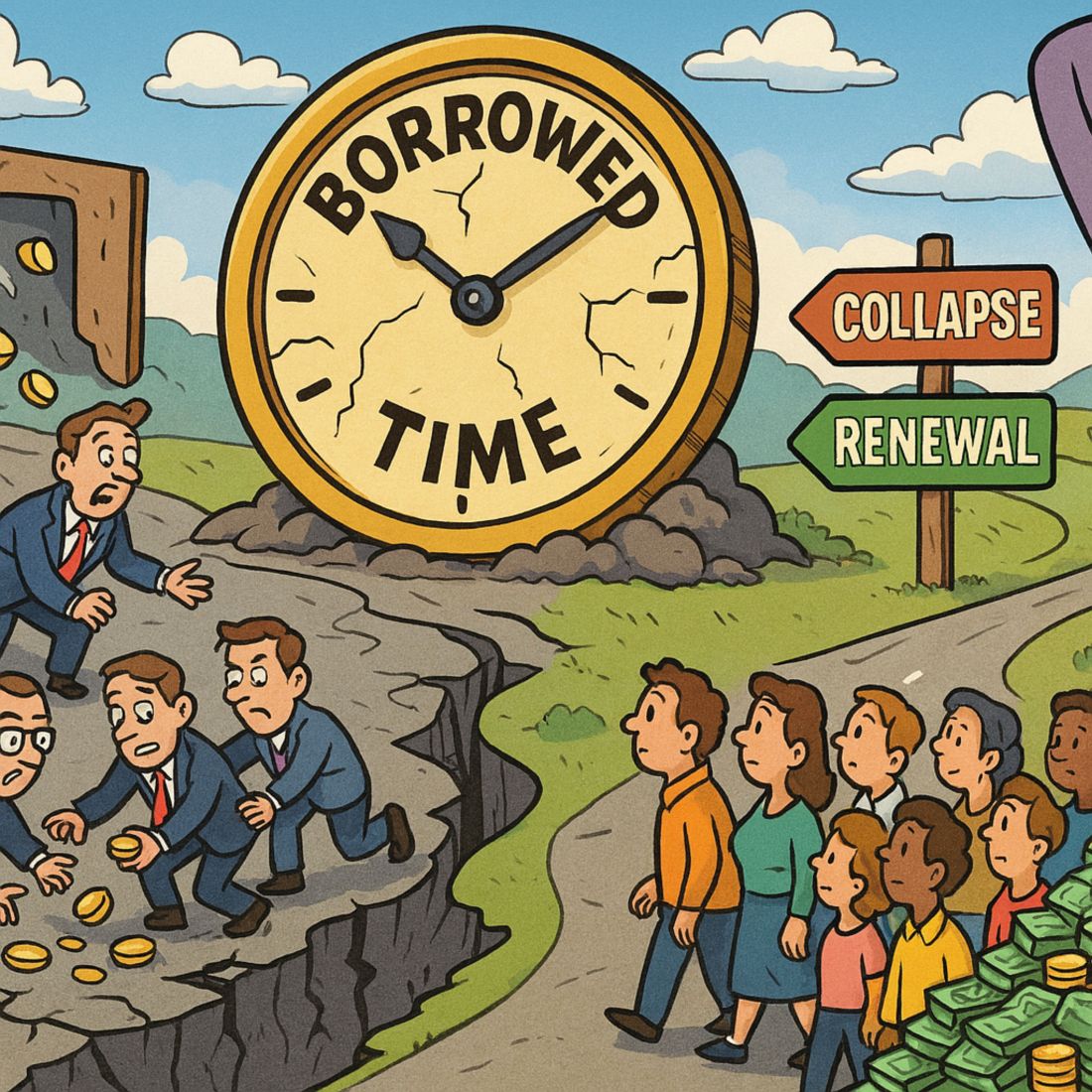
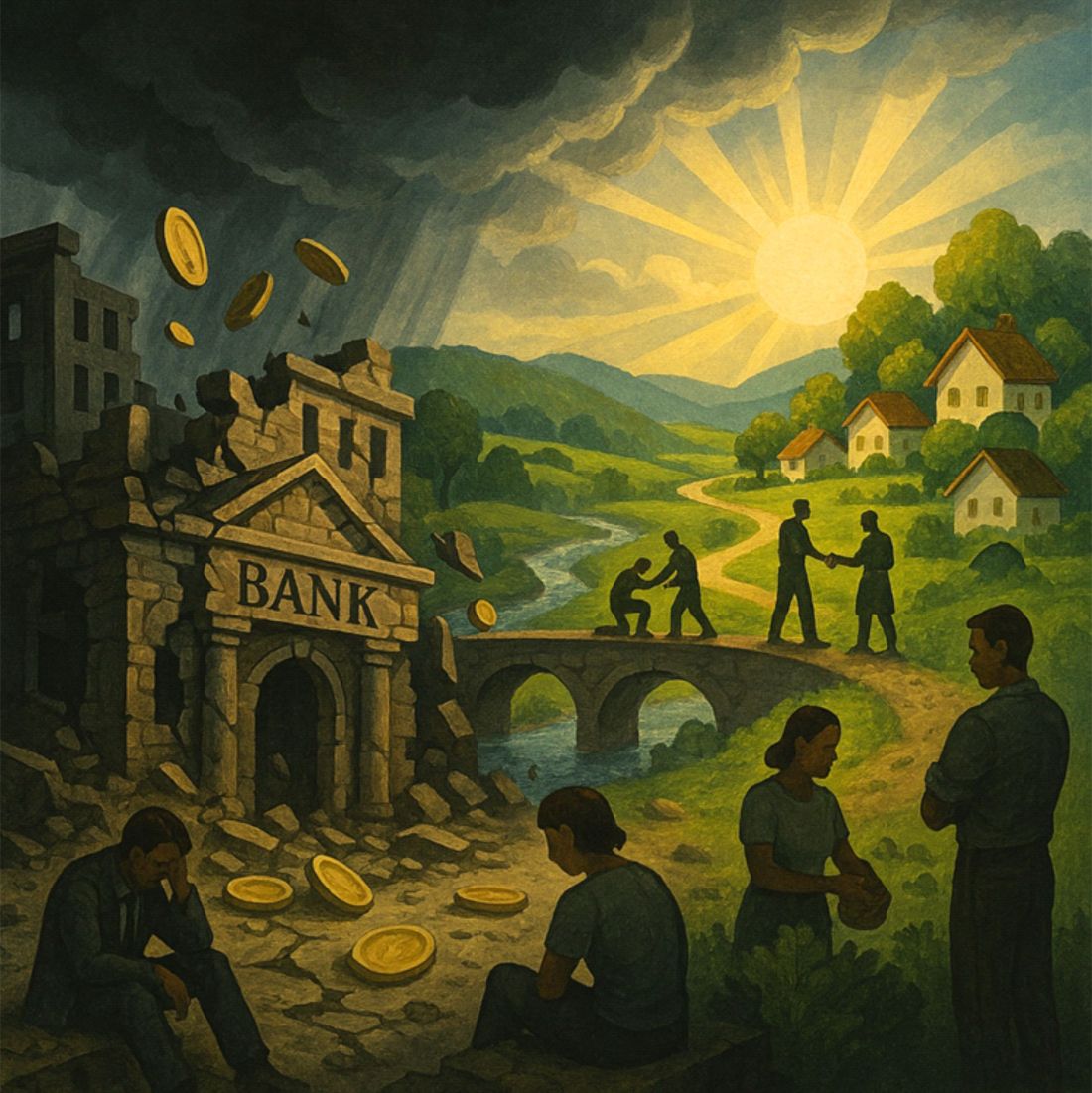
 Adam Tugwell