A question that more and more people have begun to ask is: who does government really work for?
For some, that question comes from living at the sharpest edge of society’s problems – for example, those who can no longer afford to feed themselves properly. But the truth is that across every part of society – our communities, small businesses, clubs, pubs, and the countless organisations that sit outside the government or public‑sector bubble – rules, regulations and requirements are appearing everywhere. And when you look at what these rules actually do, many no longer make any sense at all in terms of allowing people to continue doing what they have always done.
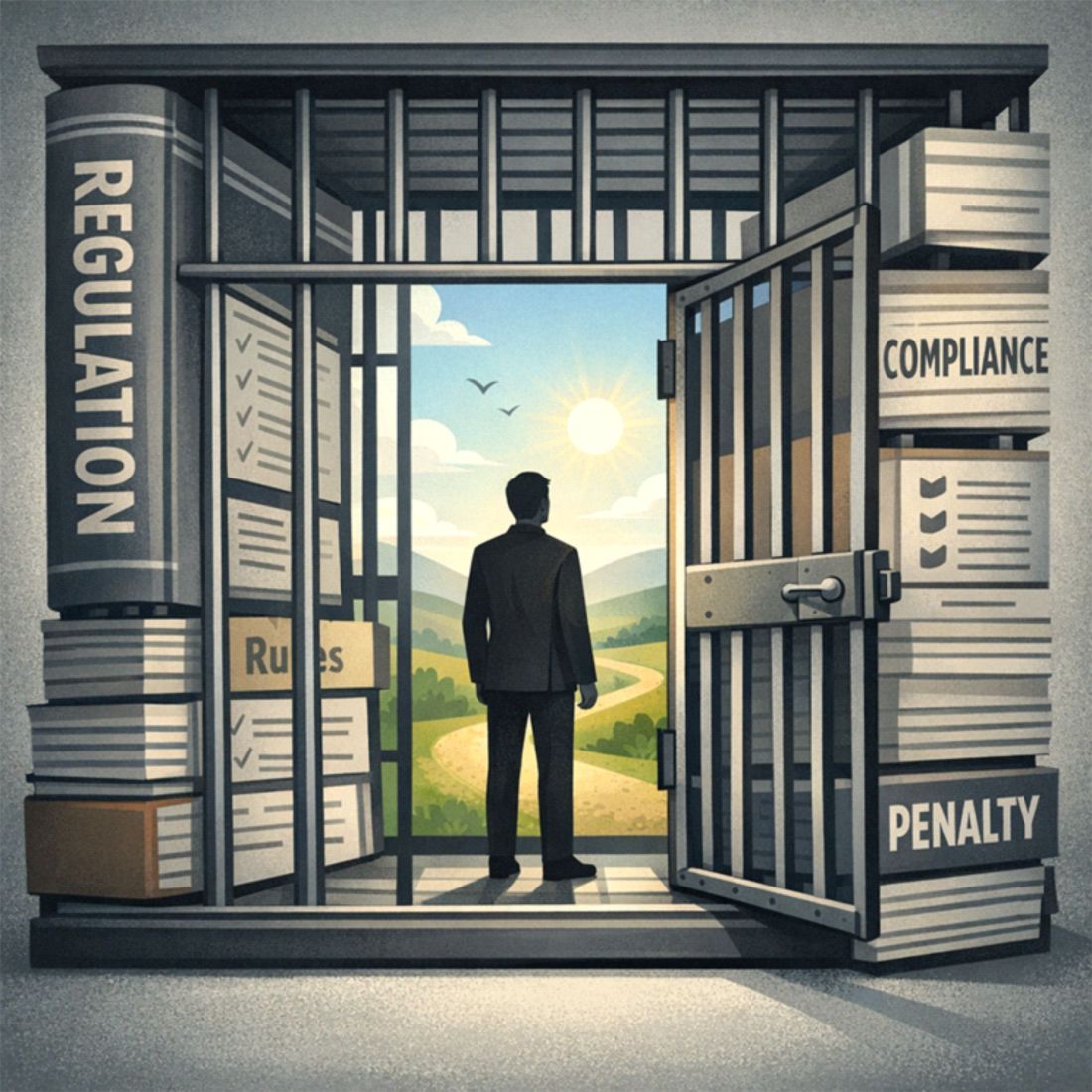
Look more closely and the picture darkens further. Through licences, taxation, penalty notices, workplace directives and endless compliance demands, the ability of anything small, people‑centred, cost‑effective or community‑driven to function is being slowly strangled.
The cumulative effect is suffocating. Many businesses have already gone to the wall because of red tape alone – and that’s before we even consider the wider impact of a money‑centric system and a government culture obsessed with growth, targets and perpetual money creation.
Very few have questioned any of this. Not because people haven’t sensed something was wrong, or felt that the direction of travel jarred with the common sense of real life. But because every change introduced over decades has been sold as “progress”.
Each new rule has been framed as something that improves life, modernises society, or makes everything better for us all – as if the past was universally terrible and the only possible path was the one we’re on.
Yet the freedom we believe we have today is already hollow. With every new move the machinery of government makes, that freedom becomes more restricted.
At some point, we must confront the uncomfortable truth: what is being presented as freedom is increasingly just conformity to a narrative – a form of oppression wearing a very misleading name.
And all of this is happening at a time when global tensions are escalating. With our traditional allies across the Atlantic now posturing over who “owns” Greenland, and European elites openly entertaining the idea of war with Russia and the East, the systems we rely on are heading toward collapse – potentially in a matter of months. That’s before we even consider the other crises and issues lining up behind them.
Without meaningful change – and without a wholesale rejection of the rule‑based system that is already choking every part of life – we face a future where people simply cannot help themselves when they most need to.
Whether it’s farms being unable to grow food, pubs being unable to operate as social spaces, or low‑paid workers being unable to earn enough to live, the dark clouds gathering ahead point to a moment where survival becomes impossible. Not because people lack the will or ability, but because someone in an office miles away decided to make normal life illegal.
Yes, governments talk about “emergency powers” – the idea that in a crisis, the state will temporarily turn a blind eye to rules that would otherwise be enforced. But that raises a very telling question: if these rules can be suspended when reality demands it, who were they ever really serving in the first place?
The time is fast approaching when people may have no choice but to ignore rules and regulations that were created solely because they suited someone else’s interests, rather than being developed to help people live. Frameworks that should never have existed in a genuinely free society, that are now the very things preventing society from functioning.
Of course, we will always need accepted and shared ways of doing things. But those ways should be created, maintained and managed by the people actually involved and the communities they will affect. Not by distant agendas and idealistic theories detached from basic human values.
Systems should reflect how life really works for everyone, not how it might look in the imagination of those who believe people must be forced to behave as they are told.
Dark as the future may appear, there is an opportunity emerging. People and Communities can take back our power and build a system centred on people, community and the environment – one that genuinely puts human beings first.
This alternative already exists in outline. It’s called the Local Economy & Governance System. Built on the foundation of The Basic Living Standard, and shaped by principles such as participatory democracy and the contribution culture.
It offers a complete shift away from the money‑centric disaster path we are currently on. It creates a world where accountability is shared, where frameworks support life rather than restrict it, and where everyone is involved in shaping the society they live in.
Further Reading: Building a People-First Society
To deepen your understanding of the ideas discussed in this work – especially the critique of centralised governance and the vision for a people-centred alternative – these readings from Adam’s Archive provide a logical pathway.
They move from foundational principles, through practical frameworks, to real-world applications and philosophical context. Each resource is accompanied by a brief description to help you navigate the journey.
1. The Basic Living Standard Explained
https://adamtugwell.blog/2025/10/24/the-basic-living-standard-explained/ Start here to understand the foundational principle underpinning the proposed alternative system. This article explains what the Basic Living Standard is, why it matters, and how it serves as the bedrock for a fairer, more resilient society.
2. The Local Economy & Governance System (Online Text)
https://adamtugwell.blog/2025/11/21/the-local-economy-governance-system-online-text/ This resource introduces the Local Economy & Governance System, outlining its structure and how it departs from traditional, money-centric models. It’s a practical overview of how communities can reclaim agency and build systems that genuinely serve people.
3. From Principle to Practice: Bringing the Local Economy & Governance System to Life (Full Text)
1. How does this philosophy redefine the concept of “human nature”?
Traditional economic and political systems assume humans are primarily self‑interested, competitive, and motivated by scarcity.
This philosophy rejects that framing as a structural artefact, not a biological truth.
It argues that what we call “human nature” is largely a reflection of the systems we live within.
Change the environment → change the behaviour → change the outcomes.
In this view, human nature is:
relational
adaptive
cooperative under conditions of security
meaning‑seeking
contribution‑driven
This is a foundational departure from neoliberal and classical economic assumptions.
2. Why is security considered the precondition for contribution?
Because fear distorts behaviour.
A person in survival mode cannot:
think long‑term
act ethically
participate meaningfully
contribute creatively
engage in community life
The Basic Living Standard is therefore not a welfare mechanism – it is a psychological and structural prerequisite for a functioning society.
Security → stability → contribution → community → resilience.
3. How does this philosophy reinterpret the purpose of work?
Work is not a commodity.
Work is not a transaction.
Work is not a mechanism for survival.
Work is participation in the life of the community.
This reframing dissolves the coercive relationship between employer and employee and replaces it with a contribution‑based model where:
people work because they are part of a community
work is meaningful
contribution is voluntary but natural
survival is not conditional on employment
This is a profound shift from the industrial and neoliberal worldview.
4. Why is locality the “natural scale” of human systems?
Because human beings evolved in small, relational groups where:
accountability was direct
decisions were transparent
consequences were visible
relationships were personal
Large, centralised systems create:
abstraction
detachment
bureaucratic distance
moral disengagement
power concentration
Locality restores the natural feedback loops that keep systems ethical and functional.
5. How does this philosophy challenge the concept of economic growth?
It argues that growth is not a measure of wellbeing – it is a measure of throughput.
GDP increases when:
people get sick
disasters occur
housing becomes unaffordable
debt expands
consumption accelerates
Growth is therefore not neutral – it rewards harm.
A People First Society replaces growth with:
resilience
sufficiency
regeneration
wellbeing
contribution
community health
This is a paradigm shift from extractive economics to human‑centred economics.
6. What is the philosophical justification for limiting property ownership?
Property accumulation creates power accumulation.
Power accumulation creates inequality.
Inequality creates dependency and coercion.
The philosophy argues that no person has the moral right to own more than they can use, because unused property becomes a mechanism of control over others.
Housing is therefore a right, not a commodity.
This is not ideological – it is structural ethics.
7. How does this philosophy understand value?
Value is not price.
Value is not profit.
Value is not scarcity.
Value is defined as:
anything that improves the wellbeing, freedom, dignity, or resilience of people, communities, or the environment.
This reframing collapses the entire logic of the money‑centric worldview.
8. Why does the philosophy reject interest, speculation, and financialisation?
Because they allow people to accumulate wealth without contributing anything of value.
Interest and speculation:
extract value without creating it
distort prices
create artificial scarcity
concentrate power
destabilise communities
reward non‑contribution
A People First Society requires that value only flows from contribution, not from ownership or manipulation.
9. How does this philosophy view governance?
Governance is not authority. Governance is not hierarchy. Governance is not control.
Governance is collective decision‑making about shared life.
The Circumpunct model reflects this:
no permanent power
no hierarchy
no distance between decision and consequence
leadership as service, not status
transparency as a moral requirement
This is governance as participation, not governance as rule.
10. What role does The Revaluation play in the transition?
The Revaluation is the psychological and cultural pivot that makes systemic change possible.
It is the moment when people collectively realise:
money is not value
growth is not progress
employment is not contribution
hierarchy is not leadership
centralisation is not stability
scarcity is not natural
competition is not inevitable
Without this shift, LEGS would be resisted.
With it, LEGS becomes the obvious next step.
11. How does this philosophy address the problem of power?
By dissolving the mechanisms that create it:
property accumulation
financial accumulation
hierarchical governance
centralised decision‑making
opaque systems
dependency structures
Power is not redistributed – it is deconstructed.
The system is designed so that no individual or organisation can accumulate disproportionate influence.
12. Is this philosophy compatible with modern technology and AI?
Yes – but only under strict conditions:
technology must serve human agency
AI must never replace essential human roles
systems must remain understandable at the human scale
digital tools must have non‑digital alternatives
local communities must retain control
Technology is a tool, not a trajectory.
13. How does this philosophy define freedom?
Freedom is not the absence of rules.
Freedom is not consumer choice.
Freedom is not individualism.
Freedom is:
the ability to live without fear, contribute without coercion, and participate without exclusion.
This requires:
security
dignity
community
transparency
meaningful work
environmental stability
Freedom is therefore a collective achievement, not an individual possession.
14. What is the ultimate purpose of a People First Society?
To create the conditions in which:
every person can live a good life
every community can be resilient
every environment can regenerate
every individual can contribute meaningfully
no one is left behind
no one is exploited
no one is coerced into survival
This is the philosophical north star.
15. What is the biggest misconception about this philosophy?
That it is idealistic.
In reality, the current system is the idealistic one – it assumes:
infinite growth
infinite resources
infinite stability
infinite human tolerance for inequality
This philosophy is grounded in lived reality, human psychology, ecological limits, and community logic.
It is not utopian.
It is necessary.
Further Reading:
This “Further Reading” section offers a set of resources that will deepen your understanding of the Local Economy & Governance System (LEGS), the Basic Living Standard, and the broader philosophy of a people-first society.
Each link explores a different facet of the philosophy, from practical implementation to foundational principles. Engaging with these readings will provide you with richer context, practical examples, and a more nuanced grasp of the ideas behind LEGS.
Whether you are new to these concepts or seeking to apply them, these resources will help you connect theory to practice and inspire new ways of thinking about community, governance, and human flourishing.
This foundational text introduces the LEGS framework in detail, explaining how local economies and governance can be structured to prioritise human dignity, participation, and sustainability. It’s ideal for readers seeking a comprehensive overview of the system’s mechanics and philosophical underpinnings.
Benefit:
Start here for a solid grounding in the core ideas and practical structure of LEGS.
This article breaks down the concept of the Basic Living Standard, clarifying what it means in practice and why it is central to a people-first society. It addresses common questions and misconceptions, making it accessible for those new to the idea.
Benefit:
Read this to understand the practical implications and necessity of guaranteeing basic security for all.
This piece explores the philosophical and ethical dimensions of the Basic Living Standard, linking it to personal sovereignty and collective peace. It’s a reflective essay that connects individual freedom with societal wellbeing.
Benefit:
Recommended for readers interested in the deeper values and ethical commitments behind the LEGS philosophy.
This resource provides practical guidance and real-world examples of how to implement the LEGS philosophy. It bridges the gap between theory and action, offering insights for communities and individuals ready to make change.
Benefit:
Essential for those looking to move from understanding to action, with concrete steps and inspiration for local transformation.
This link offers an overview of the broader LEGS ecosystem, showcasing projects, communities, and ongoing initiatives. It’s a gateway to seeing the philosophy in action and connecting with others on the same journey.
Benefit:
Explore this to find community, resources, and inspiration for your own involvement in the LEGS movement.
The Unifying Principles Behind The Local Economy & Governance System (LEGS), The Basic Living Standard, and The Revaluation
Introduction: The Thread That Runs Through Everything
Across all the work I’ve produced over the past four years – from Levelling Level to Safe Shores, from the Basic Living Standard to LEGS – there has always been a single thread running quietly underneath it all.
A worldview. A way of seeing people. A way of understanding systems. A way of interpreting what a society is actually for.
This document brings that worldview together.
Not as a policy. Not as a framework. Not as a manifesto. But as a philosophy – the foundation beneath everything else.
Because LEGS is not just a system. The Basic Living Standard is not just a guarantee. The Revaluation is not just a shift in perspective.
Together, they form a coherent way of understanding human life, community, work, and the purpose of a society.
This is that philosophy.
1. The Core Thesis
Every system is built on a single assumption about what people are.
The money‑centric system assumes people are:
self‑interested
competitive
unreliable
motivated only by scarcity
valuable only when productive
and in need of control
LEGS begins with a different assumption:
People thrive when they are secure, trusted, connected, and able to contribute to something that matters.
Everything else flows from this.
2. The First Principles
These are the foundational truths that sit beneath the entire philosophy.
1. Human dignity is non‑negotiable.
A society that allows people to fall below the basics of life is not a functioning society.
2. Security is the starting point of contribution.
People contribute most when they are not afraid.
3. Contribution is the natural form of work.
Work is not a transaction. It is participation in community life.
4. Locality is the natural scale of human systems.
People make better decisions when they are close to the consequences.
5. Community is the basic structure of society.
Not markets. Not governments. Communities.
6. The environment is not a resource; it is the context of life.
A system that harms its context cannot survive.
7. Value must be measured in human terms, not monetary ones.
Money is a tool, not a worldview.
8. Systems must reflect lived reality, not abstract theory.
If a system works on paper but not on the ground, the system is wrong.
These principles are the philosophical spine of LEGS.
3. The Paradigm Shift: The Revaluation
The Revaluation is the moment the old worldview collapses and the new one becomes visible.
It is the shift from:
Money → Life
Scarcity → Security
Employment → Contribution
Extraction → Reciprocity
Hierarchy → Participation
Centralisation → Locality
Fragmentation → Wholeness
Fear → Freedom
This shift is not ideological. It is structural. It is psychological. It is practical.
It is the moment we stop asking:
“How do we make the economy grow?”
and start asking:
“How do we make life better for everyone?”
This is the philosophical heart of LEGS.
4. The Human Assumptions
Every system is built on assumptions about human nature. Here are the assumptions LEGS is built on:
People want to contribute.
Given security and trust, contribution is natural.
People are capable when supported.
Most “failures” are structural, not personal.
People are relational, not isolated.
We are shaped by the communities we live in.
People need meaning, not just survival.
Purpose is as essential as food.
People thrive when trusted.
Control creates resistance. Trust creates responsibility.
People are shaped by their environment.
If you want different outcomes, change the environment.
These assumptions are the opposite of the money‑centric worldview – and that difference explains everything.
5. The Systemic Implications
When you take the principles and assumptions above seriously, the system that follows becomes obvious.
If security is essential → the Basic Living Standard becomes non‑negotiable.
People cannot contribute when they are afraid.
If contribution is the basis of work → employment becomes optional, not compulsory.
Work becomes meaningful, not coerced.
If food is the foundation of life → local food systems become central.
Communities must be able to feed themselves.
If community is the natural structure → governance must be participatory.
Decision‑making belongs with the people affected by the decisions.
If value is human → profit loses its dominance.
Businesses exist to meet needs, not extract value.
If locality matters → systems must be small, connected, and transparent.
People must be able to see and understand the systems they live within.
If the environment is the context → sustainability becomes the default.
Regeneration replaces exploitation.
This is why LEGS looks the way it does.
It is not arbitrary.
It is the natural outcome of the philosophy.
6. The Ethical Commitments
This philosophy carries a set of ethical commitments – not as rules, but as responsibilities.
1. No one should be left behind.
A society that abandons people is not a society.
2. No one should be coerced into survival.
Work must be contribution, not compulsion.
3. No one should be exploited for profit.
Extraction is incompatible with dignity.
4. No community should be dependent on distant systems.
Local resilience is essential.
5. No environment should be degraded for economic gain.
The land is not a commodity.
6. No system should be allowed to hide its own failures.
Transparency is a moral requirement.
7. No decision should be made without those affected by it.
Participation is a right.
These commitments are the moral foundation of the system.
7. The Purpose of a Society
At its core, this philosophy answers a single question:
What is a society for?
The money‑centric system answers:
“To grow the economy.”
This philosophy answers:
“To ensure that everyone has what they need to live a good life – and to create the conditions in which people can contribute to the wellbeing of the whole.”
Everything else is secondary.
8. The Philosophy in One Sentence
If this entire document had to be condensed into a single line, it would be this:
A society thrives when people are secure enough to contribute, connected enough to care, and trusted enough to participate.
That is the philosophy behind LEGS.
That is the worldview behind the Basic Living Standard.
That is the shift described in The Revaluation.
Further Reading:
This “Further Reading” section offers a set of resources that will deepen your understanding of the Local Economy & Governance System (LEGS), the Basic Living Standard, and the broader philosophy of a people-first society.
Each link explores a different facet of the philosophy, from practical implementation to foundational principles. Engaging with these readings will provide you with richer context, practical examples, and a more nuanced grasp of the ideas behind LEGS.
Whether you are new to these concepts or seeking to apply them, these resources will help you connect theory to practice and inspire new ways of thinking about community, governance, and human flourishing.
This foundational text introduces the LEGS framework in detail, explaining how local economies and governance can be structured to prioritise human dignity, participation, and sustainability. It’s ideal for readers seeking a comprehensive overview of the system’s mechanics and philosophical underpinnings.
Benefit:
Start here for a solid grounding in the core ideas and practical structure of LEGS.
This article breaks down the concept of the Basic Living Standard, clarifying what it means in practice and why it is central to a people-first society. It addresses common questions and misconceptions, making it accessible for those new to the idea.
Benefit:
Read this to understand the practical implications and necessity of guaranteeing basic security for all.
This piece explores the philosophical and ethical dimensions of the Basic Living Standard, linking it to personal sovereignty and collective peace. It’s a reflective essay that connects individual freedom with societal wellbeing.
Benefit:
Recommended for readers interested in the deeper values and ethical commitments behind the LEGS philosophy.
This resource provides practical guidance and real-world examples of how to implement the LEGS philosophy. It bridges the gap between theory and action, offering insights for communities and individuals ready to make change.
Benefit:
Essential for those looking to move from understanding to action, with concrete steps and inspiration for local transformation.
This link offers an overview of the broader LEGS ecosystem, showcasing projects, communities, and ongoing initiatives. It’s a gateway to seeing the philosophy in action and connecting with others on the same journey.
Benefit:
Explore this to find community, resources, and inspiration for your own involvement in the LEGS movement.
There is growing disquiet, fear, and quiet concern about the turbulence we are experiencing in the world, alongside a deep, intrinsic sense that nothing is as it should be – and that it will never be the same again.
Yet at the heart of this unsettling feeling lies confusion. The prevailing narratives insist that with AI now here, and the technology it commands about to permeate every conceivable part of our lives, humanity should be grateful.
We are told we stand on the cusp of a new age, where surrendering to AI will deliver a dream life unlike anything mankind has ever known.
Some are already suspicious, beginning to question what the rollout of this digital revolution will truly mean.
Others believe the only way to progress – or to feel in control of either the real or digital worlds – is to recapture what they perceive as the “good times,” attempting to fix everything as if it were possible to freeze life and live forever in a single moment of the past.
Uncomfortable as it may be, the time has arrived for everyone to begin asking the hard questions: what happens next, and where will we find ourselves in a future that is no longer a distant shadow on the horizon, but already towering above us right now.
The Watershed Moment We Cannot Ignore
The Coming Crisis of Agency & Survival
The answer to the question so many wish to avoid is that, if we continue on our current path, ordinary people will be left with no means to provide for themselves. They will have no income to pay others to do so, and neither government nor business will exist with the resources or the intent to supply even the basic essentials necessary for the masses to survive.
Everything we know – whether or not we recognise its connection to our current reality – has been moving in this direction for as long as most of us have been alive.
There has been a steady erosion of agency, independence, and self‑resourcefulness for ordinary human beings, first through the transfer of all forms of wealth, and now, taking place through the progressive takeover of every aspect of working life and function by both existing and rapidly emerging forms of AI.
Whilst many today spend quiet moments fearing the apparent opening of immigration floodgates and the erasure of Western culture, society, and life as we know it, others, for reasons seemingly unknown, appear to have embraced a suicidal empathy that insists the only correct behaviour of Western society is to destroy itself in order to prioritise all others.
AI’s Encroachment on Everyday Life
Yet everyone fails to see that the impending and critical threat to everything we hold dear has already been welcomed into our governments, our businesses, our technology, and the very functionality of daily life, and is so deeply embedded that it now resides in our computers and our phones.
The Myth of Effortless Utopia
AI, along with the robotics and technology now emerging to support it, is becoming the option of choice for carrying out the majority – if not all – tasks across what we currently understand as life.
This development will soon mean that, for the majority of us, there will soon be no reason for work to continue to exist.
Exploitation and Systemic Transformation
Whilst many of us hear talk of the AI takeover, the reduction in new hiring and training opportunities across numerous professions and industries, and the replacement of jobs of all kinds, we fail to connect these developments with the rising welfare bill as people find themselves with no choice but to accept a life of unemployment.
The New Divide: Inclusion and Exclusion
Nor do we pause for a moment to consider the pressing question: What does it mean when there is no job left for you?
The Last Chance for Human Agency
Yes, many truly believe the stories openly shared by members of the elite community driving this change – that in no time at all, life will become cheap and effortless for everyone because AI and machines can do everything.
The Value of Effort and Contribution
People really do believe we are about to step into a new and previously unrecognisable utopia, where the system has eliminated the need for human industry, effort, and value in the form of contribution, and instead provides everything we can imagine, free of charge and experienced as if life were one giant, permanent holiday for us all.
Historic Patterns and Systemic Endgame
Such benevolence, hinted at in the form of words from these few, and the feeling it inspires about our future, is one that few can fail to imagine.
Indeed, the words and the ease with which life now comes at us makes it very easy to accept the disproportionate levels of wealth for the few that has been encouraged by the progress of this new technical revolution.
People are taking for granted that once the evolution of everything needed to perform every task that human beings carried out across all functions of life is complete, these are the very same few who will then happily smile and sit back while everything they own and have developed works and provides for all of us in return for absolutely nothing. All whilst we continually maintain an ever‑improving standard of life and receive a universal basic income that covers every requirement beyond the luxurious permanence of 24‑hour leisure, which is somehow ever present and that we somehow believe we would actually enjoy.
In truth, we do not need to understand how or why we arrived here to see the situation for what it really is. The fundamental truths are already available for us all to observe, consider, and comprehend, hiding in plain sight: the masses have been used and exploited to create the very means that will ultimately be implemented to destroy humanity as we know it.
As this has all progressed, we have all been fed and indoctrinated with stories, technology, forms of easy wealth, and advances convincing us that things can only ever improve along this path and that a golden age awaits.
At the same time, we have given our consent to puppet politicians who have willingly changed and enforced every rule necessary to facilitate this under the veil of progress -driven not by principle, but by submission to those with power and self‑serving agendas, lured by promises of glory and gain that appeal to their true, hidden selves.
Many struggle to believe that those we have elected, and those who have grown rich or benefitted so greatly from the rewards of leadership in a modern world and society, could truly be so cruel. Yet does it matter whether we – or even they – accept that as truth, when the outcome fast approaching, without a change in our direction, will inevitably be exactly the same?
Within the world and its structures – The System as it operates, functions, and controls every part of life today – the true divide of them and us lies between those whom the system will continue to carry and cater for once the concept of human independence no longer exists, and the masses who have no further use, whom the system will either choose to exclude or find some means to remove.
This is neither a horror story nor a work of fiction. The only uncertainty – without a change in direction – lies in when and how events will unfold that bring about the critical period of transition.
Today, humanity still possesses agency, choice, and the power to pursue an alternative pathway – even though so many of us are sleep‑running toward the end of freedom’s existence, actively embracing and welcoming the very tools that will soon replace the need for us within our own lives.
The fundamental truth of any life worth living is that there can be no reward without effort, and that effort itself is the pathway to reward when life is grounded in truth.
We hold no value to anyone or anything if we do not contribute or participate when we are able. There are no free rides for anyone or anything, unless they come in the form of charity – or unless we ourselves assume the role, if deemed desirable, of pets.
History repeats this truth time and again. We need only look further to see how power is abused by the powerful—how they seek to control everything they find useful, and how quickly they dispose of it when they do not.
Everything about the moneocratic, money‑centric, top‑down, centralised, hierarchical, and patriarchal system was ultimately designed to end this way.
The arrival of technology – and finally AI – has brought humanity to a genuine watershed moment, an endgame in which we must either abandon the unsustainable way of life to which we have become addicted and embrace one that restores balance, fairness, and justice for all, or continue living the lie created by those who profit from our subservience.
If we choose the latter, we will participate in it until the moment we realise we no longer hold any value, and the destiny imposed upon us by others has arrived.
The Alternative Pathway
The temptation for many, upon realising what has happened and what is happening, is to believe that all we need to do is step back a few years and remove the most corrosive technological advances that have entered our lives.
As simple as the removal of AI might seem – even if we were able to overhaul politics and replace politicians with those who agree – the real damage to society and culture has not come from technology or its advances themselves. It comes from the reasoning, motives, intent, and forms of control behind them.
These forces have long been at work, reshaping how everything functions across society – manipulating and redirecting life so that what we have already become is accepted as normal.
The way we live, work, conduct business, relate to others, and even relate to ourselves must return, rediscover, and recreate a way of being that transforms our system of values.
Our entire value set must shift so that we understand and expect meaning from life in ways that, by today’s standards, may seem counterintuitive or even alien.
The Human Value Imperative:
We must embrace the reality that everyone is equal, and that the only difference between us lies in our roles, functions, and contributions within society—roles that are always dynamic and open to change.
We all need to accept that differences do not make us different when it comes to what is ethically, morally, and fundamentally right.
We all need to accept, understand, and embrace that no person should be advantaged over another by circumstances beyond their own efforts or control.
We must accept that deviation or allowances beyond these principles will always lead to growing unfairness—even when special circumstances seem justified or privileges are believed not to be abused.
We must accept that hierarchies are not a natural system of order, even though the need for order in society means that some will naturally take the lead.
We all need to share responsibility and take part in collective choices that shape the aspects of life we share.
We all need to contribute to the community in whatever ways we can.
We all need to work and actively contribute to shared life whenever we are genuinely able.
We must live by the principle that the responsibility we have toward others is the same responsibility we owe to ourselves.
We all need to accept that once our needs are met, nothing is gained if any one of us seeks to have, take, or control more.
We must accept that true abundance means having as much as we need, not everything we want.
We must accept that people are the greatest source of value, and that real economics should be centred on that value.
We must embrace the reality that full employment is both natural and normal when employment is defined by all forms of contribution, not just financial return.
We must welcome and protect the truth that locality, and the transparency it brings to every kind of relationship, is key to maintaining and benefiting from a system we can trust to be fair, balanced, and just.
We must ensure that AI and all technologies are used only to support human life and enhance working practices—not to replace jobs or create circumstances in which any human being is considered useless.
When we commit to all of these principles, we can begin to envision a society and way of life that truly functions as it should with equity, equality and accountability for all – one that is transformed in almost every possible way.
The Turning Point: Choosing Freedom and a Better Future
For many of us, the uncomfortable reality we must face is that passive inaction – or continuing to accept life under the control of others, believing things will simply carry on as they are – poses an existential threat that is all too real. It is a danger that extends beyond the confines of Orwell’s 1984 and, for those who truly value their lives, could mean something far worse.
The choice – while we still have one- is to not only accept but to embrace an alternative path.
This path, though carrying forward some familiar aspects of the world around us, demands that every part of our lives be lived in a fundamentally different way: a way where people, community, and the environment come first; where power rests with the individual, their freedom, and their personal sovereignty; and where the whole experience of life unfolds in a completely new direction.
The Local Economy & Governance System Framework: A Path to Empowerment
Exploring the Local Economy & Governance System
Visualising a different world – how it operates, what it requires of us, what we must give, how we work together, and how frameworks of rules function (rather than laws that micromanage every part of life, as is increasingly the case today) – may sound simple. Yet their adoption, interpretation, and our response to them within a system centred on empowering every person, rather than controlling them in every conceivable way, will be fundamentally different.
This shift will inevitably provoke resistance, not least because we have become addicted to the unsustainable, money‑centric way of living that dominates our lives today.
The Local Economy & Governance System provides a detailed picture of these frameworks, showing how this new people‑centric model will look and how it can be implemented.
Perhaps the most important element of this new world is that it will be built upon direct, participatory democracy – a system entirely unlike the hollow or pretend democracy that defines the moneyocratic world we currently inhabit.
Participatory Democracy: Power in the Hands of People
Participatory democracy means that everyone takes part in the decision‑making processes that shape public policy.
It ensures that we all hold the power to change or remove the public representatives we choose and appoint.
This requires a level of accountability and participation that is not only regular and personal, but far greater than the limited choice we currently have – voting every four or five years for candidates selected by someone else.
There is much to consider about the processes that enable true participatory democracy and how it can work effectively and diligently.
One of the most striking differences between this future system and what we have today is that there will be no political parties.
Instead, public representatives will be chosen directly by the community – respected individuals with proven commitment to serving the best interests of everyone involved.
From Possibility to Reality: A System That Works for Everyone
The Local Economy & Governance System will work because it prioritises people, community, and the environment in ways that may seem inconceivable today.
It places value on personal sovereignty and the freedom that comes from living lives defined by who we truly are, rather than by external factors and reference points that remain under someone else’s control.
Yes, the practical mechanics of LEGS will work – and they will work well – if we choose to embrace them.
After all, the dysfunctional world we inhabit today has appeared to “work” only because we came to believe in it, even as it has harmed so many of us.
We must not underestimate the ability, ingenuity, and creativity of humankind to deliver and implement solutions that succeed under any circumstances, when motivated and convinced it is right to do so.
Together, we can reclaim power and value and build a new world and system that functions with equity, equality, and open accountability for everyone – just as a truly civilised society always should.
Together, we can turn possibility into reality and create a society that truly works for everyone.
The Choice Before Us
We stand at a decisive moment in human history.
The turbulence we feel, the erosion of agency, and the encroachment of systems that strip away our independence are not distant threats. They are realities already shaping our lives.
The arrival of AI and the technologies that support it has brought us to a genuine watershed: either we continue down the path of dependency and control, or we choose to reclaim balance, fairness, and justice through new systems built on empowerment, community, and sovereignty.
The Local Economy & Governance System, grounded in participatory democracy and people‑centric values, offers a practical and principled alternative.
It is not a utopia promised by elites, nor a nostalgic return to the past, but a framework for living that restores meaning to contribution, accountability, and shared responsibility.
Human ingenuity has always risen to meet the greatest challenges. If we believe it right to do so, we can build a society that works for everyone – where equity, equality, and open accountability are not ideals but lived realities.
The choice is ours. To continue sleepwalking into a future where humanity holds no value, or to awaken and embrace the possibility of a new civilisation. One that honours freedom, restores dignity, and ensures that life itself remains worth living.


 Adam Tugwell