Overtaxed, Overburdened, Overpowered: The role of the UK State has become all bread and no jam for too many of us, and we are fast approaching a place called stop

Each of us see the problems this country is facing from different points of view.

Whilst conversations about the crisis now unfolding with a range of different people would almost certainly deliver a range of common themes, the emphasis, value or meaning of each of them will almost certainly be different.

However, the one commonality, which isn’t about anything that we all have in common at all, would be the solutions that almost all of us will have based on our own world view, that in the bigger scheme of things, may be in no way similar at all.

Ironically, because so many of us have so many interpretations of the whys, hows and whats that have got us all here, and share them with what will be a relative few, we spend next to no time – if indeed any time at all, thinking about any of the common problems that we all really do share.

We certainly don’t think about the ways we can work together to create a better way of life for everyone and then how we get the leaders and mechanisms in place that will actually get us there.

The devil is in the detail

It really is no accident that the UK is in the kind of mess that it is. Because life has become so very complicated – and deliberately so.

The more detail, the more distracting and the more impossible a solution to just about anything might seem. Even to those amongst us who really can see that the status quo cannot continue and that no matter how bought into the things we like about the way we live – which we want to keep but don’t recognise that they are actually the part of the problem that’s making everything so impossible to fix – we really do need to snap out of the fixation with noise that’s doing none of us any good.

We must recognise that the things that work well for everyone and will work even better for everyone are much simpler than what we have been convinced we need.

It is inevitable that we will keep tripping ourselves up each and every time we think of the next step as being only about putting our own self-interest first.

Unfair, Unjust and Unworkable living, demonstrated best by Tax

Perhaps the best example of how we get lost and misdirected by the detail of what needs to change for us, rather than focusing on what needs to change so that it works for everyone, relates to the question of tax, taxation and everything else that means people like you and I are stumping up cash that we could often do with being able to spend, just so we can live without debt or in some cases rely on handouts or even food banks.

Yes, even framing the ‘tax issue’ this way will make some prickly – and that really is the point.

The UK Tax code is today thought to be over 21,000 pages and 10 million words long, giving everyone the distinct impression that the subject of how the bill for government action and delivery gets paid for (ostensibly on our behalf), needs to be tailored specially to everyone as if bespoke governance is the only kind of governance that’s really fair to everyone.

Have you heard of Tax Freedom Day?

This is ‘The day when Britons stop paying tax and start putting their earnings into their own pocket’. Or alternatively, the final day of the year when every penny we’ve earned goes to the government – if we start counting on January 1st, which was this year (2025) calculated as being June 11th by the Adam Smith Institute.

The reason I’m using this figure isn’t to piss anyone off by drawing attention to the fact that as an average, we arguably all work for no other reason than to keep the wheels of government turning every year for at least 5 months.

I’m doing so because it may be the only way to look at the relationship all taxpayers have with the government in the same way. Given how easy it is to get sidetracked by the question of what everyone earns!

June 11th 2025 was the 162nd day of the year (as 2025 is not a leap year), and with 365 days in 2025, this means that in comparative terms, people are giving over 44% of their earnings (162 days divided by 365 days), before they can even begin to think about what they need to spend money on, in turn before anything that they might actually want.

For a moment, let’s forget the amount anyone is actually earning for themselves, as we know that some have considerably more than others, whilst many just don’t have anywhere near what it takes to live without struggling to make ends meet, and then take it as read that everyone is giving up 44 Pence in every Pound they earn (£0.44).

After realising just how much of everything we do have taken from wages and then what we pay for that includes some form of tax, it doesn’t take much to realise that government or rather the model of government that we have is simply unaffordable, unsustainable and that we must do everything we can to find a different and much better way to pay for the things that we share.

Regrettably, the complexity of rules and regulations supposedly there to benefit and protect us don’t stop at taxation.

One of the reasons that every part of life, that doesn’t already relate to the question of financial affordability in some way, seems so difficult or restricted, is because our freedoms and therefore our independence from the system and government are already being actively controlled in many different silent rules that have deliberately been put there using the excuses like health and safety, and protecting us or someone in some way.

Even if we aren’t actively being followed around by a police officer all the time the fact that we are aware of and abiding by these rules usually adds up to being the same.

Government isn’t what it should or was ever supposed to be

Whilst many would actually like to see the wealthiest in our society directly paying at least 44% of their income to the government to help run everything outside of our front doors, we still need to keep some perspective when it comes to the obvious question we will come back to in a moment about who pays and begin with the question, ‘Does government actually work?’

Government certainly functions. Even the deepest or most vocally critical of what government in the UK does will find it difficult to argue otherwise.

Because no matter the organisation or service that comes under the rather large umbrella of government, they all continue to do something. Even if they are not delivering what we might agree to be the correct results. And that’s the only reason it can be argued that it all works.

However, functioning and succeeding are not the same thing.

The time is long overdue that we all took a very hard and questioning  look at every part of government and decided what, if anything, public services should or could be; just exactly where the scope and reach of government should end, and then and only then, what many believe to be the most important question of all, ‘How whatever government and the public sector does is paid for and by whom’.

Whilst it remains the case that there are services, infrastructure and even public facing roles that every modern society needs to be provided by the community, so that everyone can have universal experiences and opportunities which will always be the same, no matter who, where or what you are, the practical approach to not-for-profit service delivery – which this really should in almost all cases be, is not the same as the public sector and system of governance that we have today.

Every part of government and the public sector that we have today is focused on delivering (political) and therefore biased agendas which will inevitably advantage some people more than others in some way. Or is all about the jobs, terms and conditions for whoever the incumbent employees are who currently have the jobs.

There have always been politicians, officers and suppliers who for many reasons have chosen to advantage themselves in some way, if and where they failed to have the integrity to exercise their roles properly. And regrettably, it’s the position of trust we gave them all that enabled them to behave in such questionable ways.

Yet even more shocking reality that we all face today is that the whole public sector and everything that runs within it is now dysfunctional in terms of delivery in some of the most critical ways.

It has only been able to become this way because decisions have either been made (or not made) at the very top by people who really should have known better, and whose actions have allowed or facilitated everything that serves the public unwinding in this way.

Money before People

Regrettably, like so many areas of life today, the role of money – which stretches far beyond the scope of the tax question that we’ve already considered – is also the key element within the dysfunctionality of government and public services across the UK. Because the poor leaders that we have are obsessed with the idea that the only way any problem can and will be fixed is by having enough money to spend – no matter where it comes from, which is itself is these days even better for some politicians who dare not do anything which could restrict what they are already committed to spend.

Idealism and agendas cost a lot of money. Because their implementation requires the creation of systems, rules and infrastructure somebody wants but nobody needs.

The very perverse outcome from decades of government and the public sector serving itself, its people and whoever or whatever influences them, is that the changes that have been made in every way imaginable to support this are now costing too much for either the Taxpayer or government itself to sustain.

We have a VERY BIG problem. Because nobody in government or who wishes to form one either can or will be honest about the true depth and breadth of the mess that the UK is now in.

With Tax rises thought to be well on their way this coming Autumn, the reality that too many of us face is the 44% (or probably much more) that we are already contributing to this public sector black hole through so many of the things that we buy, pay for or earn, are set to keep going up.

All to cover the exploding costs of incompetence, waste and the furtherance of playing up to what are very dangerous egos. Because somewhere in amongst all of this the point has been lost that government does not and never did have the right to exist over the people that it was created to represent.

For any kind of government to be unrepresentative of the people it represents, would by its very nature and intended purpose mean that it represents someone or something else.

Money: The drug wrecking everything to enrich and empower the few

The way that money actually works, how it is controlled and worst but not least, how it is actually created at will, is the truth that sits behind everything bad, that few of us will willingly believe.

It’s much easier to believe that it is all good rather than even having the potential to be bad – even when almost everyone can see the destruction that money or the lack of it is causing to everyone in some way or form.

At the heart of the money tree and its root and branch system sits the mechanisms that supposedly fund government, but actually do so by doing everything to help grow the volume of money that is in circulation, so that the public spending – and the only way that politicians know how to get themselves out of trouble, can leverage ‘growth’ so that the entire shitshow can be hid.

Unfortunately for all of us, the exponential growth of the ‘money’ that has entered circulation, particularly since the responses of government to the Global Financial Crisis of 2008 and the Covid Pandemic of 2020, has wildly contributed to the inflationary spiral that accompanies such an expansion of available cash.

The creation of money that doesn’t relate to anything else like productivity or output devalues the money and incomes that normal people already have, as well as what they have the ability to earn.

It does so at breakneck speed whilst the real value of everything is funnelled towards those who control and benefit from what is a fully legal, legitimised but nevertheless completely corrupt system that appears real, because they have typically become millionaires and billionaires in the process.

Put simply, the lowest paid and most vulnerable now have zero chance of ever being able to earn enough to live independently of benefits, charity, debt or worse.

For as long as the money madness continues, the bubble containing all of those who are branded as being a drain on the system will rapidly continue to expand.

The leadership void or black hole

When a country has such shit, incompetent leadership, and has done for the period of time that the UK has, it wouldn’t be unfair for any of us to be asking, ‘How did we get them?’ and ‘How did they get to where they are?’.

However, as we all need to realise, very few of us do ask these questions or indeed any questions that are like them. And because we don’t, each time an election takes place locally or nationally, we are, as a majority, making the same mistakes over and over again.

We are chewing at the very same shit sandwich with the bits just wrapped differently with words, rosettes and faces – all hiding the same miserable self-interested and dangerously incompetent content that always delivers outcomes that are the same.

Because we have a very bad, self-destructive habit of going along with the idea that the political fairies come along and give us all a genuine choice at election time – as all good democracies surely would, we have not only accepted that government after government and council after council has worked on all of our behalf. We have also jumped into an elephant trap of our own making that tells us these same fairies will deliver the politicians to choose from at the next election, who will sort out and solve the very same mess that they and their own kind created (with a little help from their friends) in the first place.

Sadly, there are no exceptions to the reality that we must face that there are no real leaders in politics today.

The so-called leadership we see, and what the people we identify as leaders say, is much more likely to be aligned with us hearing and seeing whatever we need to fuel our own confirmation biases than it either is or ever will be about the solutions and outcomes that we might not be ready to hear about, but nonetheless actually need.

Victim or Victimiser: There is no longer an in between

As a society and culture, we are collectively suffering what might be the worst type of addiction of all. Simply because it is majority of us are addicted rather than the few.

Meaning that that same majority is completely out of touch with the realities of what that addiction does and will remain so, until the supply runs out – which is where all those who cannot afford to live independently within the current system have or are beginning to find out.

Money, or rather the way that money is used by those who control the system – and that means government and politicians, who are very much under their control too, has become the key factor in every equation and consideration in our lives.

The role of money and its reach has dehumanised everything to the point where money and the power, influence and control it is perceived to give at every level of life has become more important than the value of life and community itself.

Few realise just how their lives are completely at the mercy of the ability to spend, borrow and achieve the momentary of transitory hit that this money centric, Moneyocracy we inhabit demands of everyone and which is enforced by the barrage of non stop marketing and remote, typical digital pressure which comes at us constantly and demands that we all conform.

Money; what it does, what it can do and what it says about you is the qualification and gatekeeper that runs through every part of functional life and if you are in, you are in and if you are out, you really are all the way out and fully at the mercy of those who continue to be ‘in’.

The tragedy of the system is the ruthless and methodical way that human behaviour has been used against the masses by the few and the experts they pay who understand it.

The sweeties and trinkets that have been flowing towards for decades have only been bettered by what has appeared to be the endless ability to secure more and more credit to buy it with, all the time becoming more and more essential to secure as real earnings and wealth have been stripped by the printing of all this extra ‘pretend’ or non existent money that even relatively wealthy people have no chance of keeping up with.

The irony is that those of us who continue to believe we benefit from what the establishment is doing and therefore acquiesce or go along with it are – through our actions – making those who cannot the victims.

All for no better reason than this whole situation could not exist without the elites treating the masses as a resource that is not real. But is instead just like oil, coal, precious metals, forests, farms, land and even animals – and just something else for those who ‘own them’ to exploit.

We all need to contribute to what we share in life. But real life cannot continue if we are required to contribute everything we have

Whilst we must all accept it is correct for everyone to contribute to the upkeep and maintenance of the systems and infrastructure that serve us all, from the moment we step onto the pavement or road outside of our homes, what we share is not and never should become more important than the right to have a fully independent, functioning and self supported life experience.

The system that we have discussed is at breaking point and cannot continue as it has, or as it is today.

Those in charge don’t know how to do anything other than borrow or tax us. And as the system can no longer sustain the borrowing that idealism and agendas have made necessary, the current government are now looking at everything they can tax beyond everything they already do.

One way or another, the system is going to collapse. Because we are all living unsustainably in a system that itself is unsustainable and at the centre of which is a plague which is the absence of real leadership, replaced with what is instead no better than incompetent management that makes it the most unsustainable part of it all.

Real life and a money-centric economy are mutually exclusive outcomes

Government already costs us way too much – even at 44%.

That’s before we even begin to consider the work and additional value to public service that charities and other nonprofit organisations bring, that we are all in one way or another contributing to too.

The whole model of economics needs to be restructured and redeveloped so that it supports life, rather than feeding off it like the giant parasite that the financial system and the role that government plays in it now is.

A realistic level for everyone to contribute to ‘the community’ would be around 10% – without any form of exception for anyone.

We should also be considering the added requirement that everyone able to work also contributes the equivalent of 10% of their working time and the skills and experience they offer, to help make our communities, their governance and infrastructure work.

Thereby creating real buy-in and ownership for what we all share, whilst drastically cutting the scope and influence of an out-of-control sector, and the ballooning costs that are actually paying for lots of agendas snd idealistic ideas, but very little that is actually about people and certainly nothing that’s doing everyone equally any good.

The identity, qualification and process of finding good leaders

Good public leaders, public representatives and public servants, would not facilitate or contribute to the creation, implementation and furtherance of agendas, ideologies and idealism that doesn’t serve the genuine best interests of those who they have been elected, appointed or recruited to serve.

Yet we have been experiencing decades of exactly that. And we have no hope that this will change if we continue to rely on a system that needs to change giving us the leaders who will then do the right thing when it comes to the delivery of that change.

Contrary to accepted thought, we do not need money to play the role across society that it has been deliberately engineered to do.

Power and control are certainly not a gift that should be secured within the hands of a distant, faceless, unanswerable few who we will never meet and whether intended or not, are treating humanity as a resource and no better than a numbers game that they can do with as they like. All as if they are now, as the result of decades of manipulating the system and bending it to their will, the new gods of everything with everyone else’s destiny theirs and only theirs to decide.

The truth that few see is that the centralisation and push for remote control of everything that globalisation and everything that walks alongside it has been, has been the active and complete restructuring of our society and culture, so that nothing can or will work without the say so and direction of those who make all the decisions.

None of this was accidental. Locality, local relationships, local businesses, local supply chains, local decision making and everything that goes with it promotes sovereignty and independence. It encourages and grows a living environment and cultural model that is good for everyone other than those who want to advantage themselves and be in power or control.

Meanwhile, the downsides of centralisation and everything that goes with it are the for every one of us to see.

However, despite the various attempts, compelling rhetoric and highly credible narratives that work so well when playing up to the addiction for material living that we currently have, there is an alternative and much better alternative to running life and everything that we and our communities need. And the real upside of this real alternative is that it centres completely around putting normal people and our local communities back in control.

The fact that generations of political leaders and those they favour or are influenced by have misused and abused their position to create a system with faux legitimacy – simply by legalising immorality to make it appear moral and therefore unquestionable, doesn’t make it right. And it certainly doesn’t become right, just because those in power today continue to insist and behave as if it is so.

We have a legitimate right to hold power and control over our own destiny.

The power of collective decision making should sit as part of a new structure of governance within our communities, amongst people and representatives who we ourselves select and know we can trust.

A moral obligation arguably also exists to reset the entire system and the various devices such as money and the tools of governance the existing system uses, so that we once again bring the focus of everything in life back to people, to humanity and to creating the best kind of environment that we can to ensure that every person has the life experience that everyone – and not just a selective few should have.

However, nobody else will step up or step in to do this for us – no matter how compelling or necessary this might seem.

Whether addicted or not, the choice and the steps necessary to return power to people and to our communities, and with it the creation of a genuine democracy we can all trust and believe in, are ours and only ours to take.

Nobody in the public sphere today can or will do this. None of them will give us back the influence that is rightly ours. Because they all imagine themselves as leaders who can only lead by having absolute control over everyone and everything else.

We don’t have a roadmap agreed for the future.

But there are plenty of ideas we can share about the outcomes that will serve all of us equally well and in a balanced, fair and just way.

This is where the conversation should start.

The one thing we can be sure of is that real leaders do actually lead. But also know that it is real equality, balance, fairness and justice that applies equally to everyone where the pathway to everything good for everyone really starts.
Links:

The Growing UK Food Problem

In early 2022, I embarked on the writing project ‘Levelling Level’.

The initial aim was to provide a written view of the then Tory Government Levelling Up Agenda, its genuine purpose, and to discuss what is really going on.

The published work focused the social and public policy problems the UK faces. How they came into being, and what is likely to happen if politicians, leaders and the government and/or the public sector system that they ‘lead’, think and operate, doesn’t change its approach or ‘narrative’.

The direction of Levelling Level paid particular attention to the growing possibility of a yet to come black swan event. One that most likely includes or is triggered by a financial crash and circumstances that resemble a contemporary equivalent of The Great Depression.

With future outcomes and the potential need to ‘survive and thrive’ through a coming period of unpredictable change, I wrote extensively of the need to refocus and repurpose our approach to Food Production.

If we were to adopt voluntary changes to the UK Food Chain now, it could mean the provision and supply of basic or essential foods (healthy, nutritious and grown as locally as possible) would be available, pre-crisis.

But also, that the available infrastructure and resources could be repurposed as quickly as possible to ensure that communities are fed within a future emergency period that follow unforeseen events or be available to us all through a prolonged period of instability where the availability of imported food is reduced or stopped for any reason.

The suggestions tabled within Levelling Level included the use of allotments, gardens, window boxes and home-based hydroponic systems. As home growing could provide immediate and shorter turnaround Food Production support, whilst agricultural land and facilities are repurposed for localised production and a fully transparent, short-as-possible food supply chain is implemented, that will be necessitated by such a crisis.

Levelling Level, the series of books that have followed and its more recent version ‘Days of Ends and New Beginnings’ have covered a generalist approach to the causes of problems across public policy.

However, it is clear that no matter the approach taken towards change that prioritises People, Food should be at the centre of everything. But is nonetheless taken for granted just as the air we breathe and the water we drink are, today.

Ultimately, the Books I have written work towards the proposal of using the current electoral and democratic system more effectively and democratically, with the series then proposing an entirely different, locally centric system of government. One where citizen power is embraced fully or would resemble what some are now calling ‘grassroots up’ governance.

Whilst a key takeaway of Levelling Level and the following Books was the proposal of a complete  public policy related values or ethics shift, to pivoting future policy development around the societal and economic benchmark called ‘The Basic Living Standard’, it is the ability of people to feed themselves and to be able to access healthy, nutritious, basic (or essential) foods that will become the primary indicator of whether public policy is succeeding or has succeeded in alleviating food poverty.

It is fair to say that countless societal issues are likely to be resolved quickly, if and when governance is built upon the principle of ‘getting the right outcomes for Everyone’.

Food: The difficulties we see and the problem we don’t

Awareness of a ‘food supply problem’ certainly exists within the UK Farming Industry where the National Farmers Union (NFU) has been regularly championing the supply side issue.

However, the UK is now considered to be producing around the equivalent of around only 54% of the food the UK Population consumes.

Whilst it can be argued that the issue of Food Security fragility is now in the public consciousness, because the term has made it into the common lexicon via the ‘mainstream news’, a more discerning audience will understand that this statement indicates that the UK only produces the equivalent of 54% of our food.

Indeed, stating the level of ‘self-production’ of UK Food at 54% doesn’t consider or reveal that the UK supply chain could not supply even a fraction of the food that the UK Population would need to survive, if for any reason, UK borders were to become closed for any prolonged period of time.

The Challenge that we all now face

The perception of farmers and industry is one thing.

The Food Security ‘problem’ that the general public perceives and understand is another altogether.

This is well illustrated by the 2023 Report from the Food, Farming and Countryside Commission (FFCC) ‘Citizens are Hungry for Change’ which provided an accurate picture of public perception.

This work was researched from amongst those members of our society who are aware of a food problem. Whatever the specifics of that food problem might appear to be, to them.

Perception is everything. And certainly so, where the potential for societal change is concerned

Where the current narrative, economic or political paradigm are concerned, the views, experience and meaning that underpin the concerns of the Farming Industry, Interest Groups and the wider general public represent many different perspectives and priorities, and just as many different truths.

Different truths fuel very different agendas. And as pet agendas compete for oxygen, their champions do not take into consideration the bigger picture that is at work.

Those who are emotionally tied to furthering their own solutions and agendas remain oblivious to what really motivates, drives and creates the purpose underpinning ‘The System’ itself.

This means that work like that undertaken by the FFCC and lobbying pressure tabled by membership organisations like the NFU will only be used as a political football at best.

Nobody from outside Westminster is playing the same game that Westminster is playing and Westminster plays by rules which only it has so far framed.

Like many research projects that have been completed and published over decades, ‘credible research’ targeted at the political class of today can only result in token gestures which will only be about the creation of political capital. Rather than being about real, meaningful change or outcomes that are good for us all.

It is an uncomfortable truth we have yet to accept that the politicians and ‘leaders’ we have elected to represent us, cannot and will not rationalize the danger that the UK faces. Nor will they embrace the power that they actually have to change things for the better, today.

Learned helplessness: The foolish expectation that those with responsibility will do the right thing – because they are supposed to

The hard truth

UK Farmers and Food Producers have become reliant upon financial incentives from government and contractual arrangements from big businesses which have silently worked hand in hand to destabilize UK Food Production over a period now exceeding 50 years.

The issue of UK Food Security and Food Sustainability was never questioned during our Membership of the EU regionalized global political ‘project’.

Yet this is when the real damage to UK Food Production was done.

Everyone – including Farmers, were led to believe that globalized food chains would always meet the UKs Food needs.

Indeed, a constant flow of media reports about butter mountains, wine lakes and numerous other tales about ‘overproduction’ across The Common Market, European Economic Community and then The EU itself only served to endorse the myths that had  been created suggesting that UK Farming was in decline and that UK Farmers could only thrive by ‘going with the flow’, in effect, complying with whatever they were told to grow, to produce, or to any commercial offer that seemed to provide income security of some kind.

What many who understand the wider rural community across the UK will know, is this approach is very much at odds with real life.

The UKs Farming, Rural, Fishing and Food Producing communities are culturally entrepreneurial and very creative in their approach to business, and to operational management in particular.

However, UK Farmers and Food Producers have been reprogrammed to believe that no such thing as a viable, fully-independent Food Producing Business exists.

Even though every person alive needs at least two healthy, nutritious meals every day.

Meanwhile, the conditioned position of deference to elected representatives and establishment figures has created a situation where the general population realise and understand that there are significant problems and perhaps even risks to the UK Food Supply. However, they also believe that the creation of solutions and the action it will take to deliver them are something that someone, somewhere else has the responsibility to do, and that those with that responsibility will do it too.

We are in the potentially disastrous situation where Farmers and Consumers, the two key stakeholders in the UK Food Supply Chain, do not accept that there is an alternative way that would be much better for Farmers and Consumers alike. Because every information source that is considered to be credible continues to tell us all that there isn’t any other way than the dysfunctional one that we have right now.

The risk we are running is that neither the Public nor Food Producers will accept the need for change until People across the UK are going hungry and the UK Farming Industry has been reduced to a form where it no longer has the ability to function in the alternative way that we actually need.

‘The absence of proof does not mean proof of absence.’

There is massive a massive risk of Food Shortages, if the UK waits until change is necessary before taking action.

If the UK waits to be led by events, we run the considerable risk of there being a gap in UK Food Production and Supply that could effect well in excess of 50% of the UK population.

Otherwise, it could easily reduce the access to Essential or Basic Foods for the entire UK Population.

However, most likely, the Population of the UK will experience a mixture of both. (Without considering the influence of ‘black market’ activity and the explosive levels of inflation that would appear, allowing those who have enough money to continue buying whatever they like, for as long as that money continues to hold value).

How power and influence work across the UK Food Chain today

One of the most challenging aspects of the creation or instigation of meaningful change, is getting everyone to consider the alternative, an alternative system or an alternative way of doing things that doesn’t relate to The System that we all know and believe we understand.

The UK Population still expect ‘The System’ to provide the solutions to the societal problems that we have. Even though objective observation will almost certainly lead to the conclusion that it will not.

The majority of the UK Population, including experts, academics and many of those working in government departments or across the public sector do not understand that Public Policy is determined in ways that run completely contrary to what any of us should be able to expect.

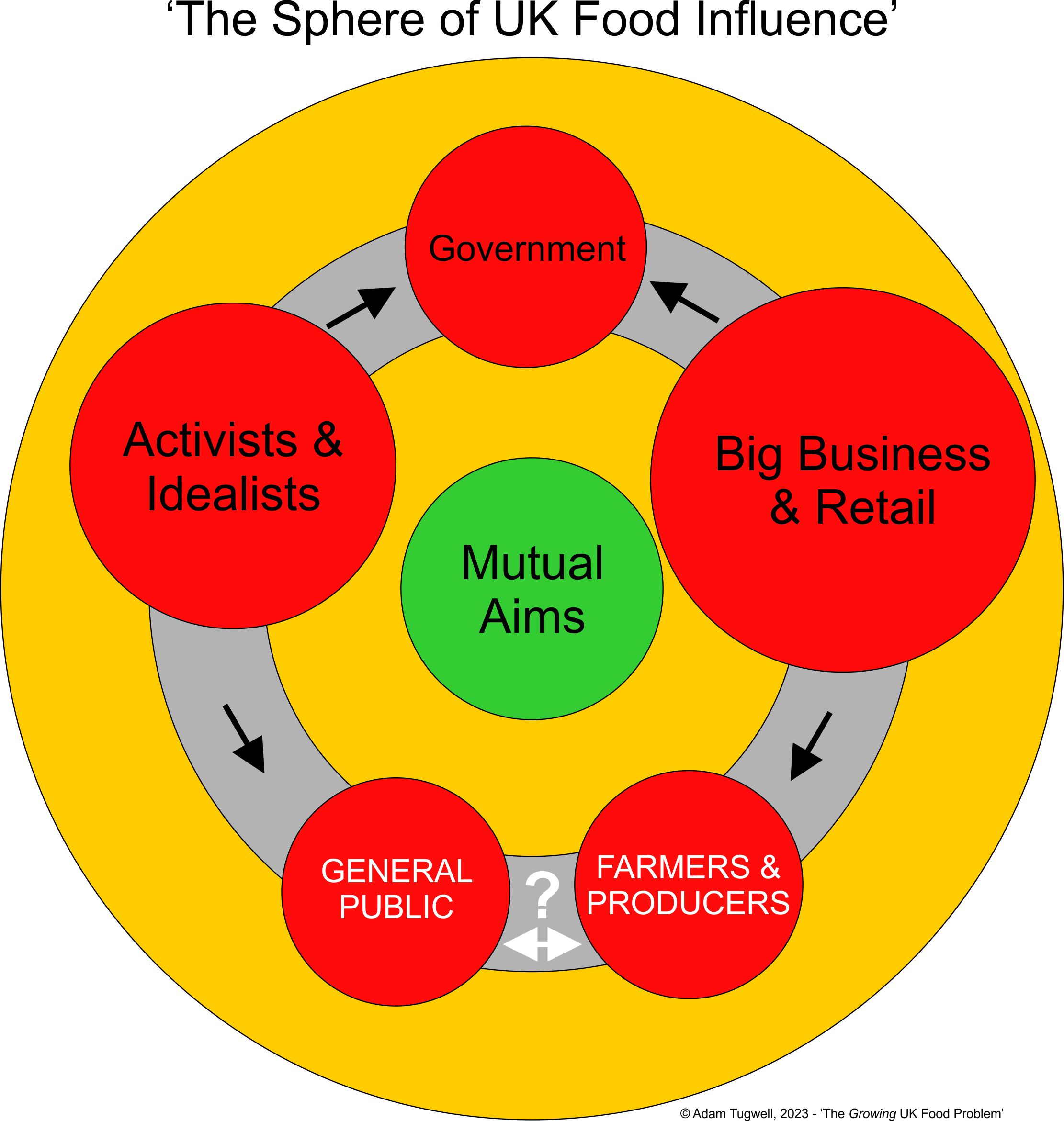
Big Business and Big Retail have by far the biggest influence on both Government and the Food Supply Chain, either directly or indirectly. Because The System focuses on ‘growth’ as part of an economic model that prioritises profit for businesses over the needs of the Population itself.

Likewise, within the political and public sector sphere, those with influence who have ears to hear, give considerably more weight to fashionable activist and idealist causes (i.e., those with a louder voice), than the majority of the population or the Consumers themselves, who are the key stakeholders, alongside the producers themselves.

Most disconcertingly, whilst the relationship between Farmers and the Consumers they ultimately supply should be the most definable and robust of all within ‘The Sphere of UK Food Influence’, the relationship between the two Key Stakeholders is weakened to the point that it only genuinely exists beyond lip service where a local and direct farm-to-consumer ‘retail’ relationship exists.

And this itself will be subject to affordability and other accessibility factors that make it almost impossible to recognise in any meaningful way at all.

The Current Mindset or ‘Paradigm’

The System operates as it does because life is driven by the following key factors:

  • Money and wealth-based power and influence.
  • A cultural mindset that functions with a conditioned and steadily decreasing need for self-awareness and the respect for the law of consequence or law of cause and effect that this facilitates.

We are, to all intents and purposes living and existing within a Moneyocracy.

As the purpose of this work is to focus on UK Food Security issues, there is little to be gained from a diversion into the mindset or psychology that sits behind the leadership and influence-based problems that the UK faces here.

However, the distilled or filtered down version of every social and economic problem the UK faces relate to human nature. And specifically, how the majority of people without self-awareness and without an intrinsic values set behave when life revolves the financial value that can be attributed to every transaction or ‘thing’ outside of ‘the self’.

Forward Thinking and A Food Supply Solution for The Future

A Safe, Secure and Sustainable Food Supply that can service the needs of all UK Communities adequately, can only come from a refocused, repurposed, revitalised and above all Localised System of Farming and Food Production across the UK.

Regrettably, it is the case that beyond agenda-driven bubbles, of which there are indeed many, there is simply no interest in taking proactive steps to create an alternative and robust sustainable supply chain.

The need for the focus on outcomes and results is continually being lost on arguing about who runs things, or who’s solution and therefore agenda, is best.

Once we have stepped beyond the obsessive preoccupation of The Moneyocracy and are ready to embrace a People-centric economic model, we will be able to consider systems of Authentic Governance as suggested by my recent work ‘Our Local Future’. Also by The Glos Community Project, a proposal for a system of community owned and ‘franchised’ social enterprises, which I first published in July 2023, that had the creation of new, not-for-profit localised food production and retail cooperatives at its core.

The ’Glos Community’ Food Production model would sit between the two extremes that at one end is driven by regenerative, ‘sustainable’ and micro-farming principles and the extreme version where the current direction of travel is perhaps best described by bigger is better in every sense that this can mean.

The Sticking Point

The problem we face is that UK Farmers and all parts of the UK Food Chain are unlikely to embrace what is today viewed by the profit-obsessed as a backward way of thinking about advances in Farming and Food production.

This will continue until such time as the value set has shifted from money and ‘what’s important to me’, to one where basic values are restored and value is achieved in producing for the purpose of meeting basic needs, rather than what those with monetary power and influence want.

By adopting a public policy model based around Locality and Authentic Governance, all systems of business would ultimately refocus to a system that would see a localised and balanced Food Production and supply system as the most logical, sensible and practical to have. Because the motives, incentives and drivers will have fundamentally changed.

The barrier to change – that would be pivotal in so many profound ways, is that few will accept the need for this change or be willing to embrace the changes that will make it possible voluntarily.

The problems with Food Supply and Food Security are directly related to the current paradigm and the way that The Moneyocracy has effectively addicted everyone to measuring success, failure and happiness in terms of financial and material gain.

As with any genuine addiction, those addicted must accept that they are suffering an addiction before any action can be taken to address it. And when the majority of the Population are suffering from that same addiction to one or other level or degree, the voices that speak out or that are taken seriously when it comes to the process of healing, are very few and far between, indeed.

We face a reality where only an event of system-changing proportions or what would facilitate a genuine ‘paradigm shift’ will prove enough for business, communities and people to embrace the level of change necessary for a truly sustainable and secure system of UK food production to work.

How we will know when we have a Food Supply that works for us, rather than against us

The true health and wellbeing of society can be measured most effectively by everyone’s access to the supply of Basic and Essential Foods and the eradication of food poverty, where the eradication of food poverty is itself defined by access to an adequate, affordable, unhindered and properly prepared supply of Fresh, Basic, Healthy and Nutritious foods without recourse to using benefits, accessing charity or going into debt.

The current UK Food Paradigm

Whilst few will accept the reality that we currently face, we cannot and will not make progress towards the UK being genuinely ‘Food Secure’, unless and until we face up to some difficult truths:

  1. UK Agriculture and Food Producers are not capable of ‘feeding the country’ in an emergency.
  2. With the current dependence on government centric incentives and policy derived from specific interests, UK Agriculture and Food Supply will remain tied to the current narrative – no matter how destructive that will become at individual Farm Business level.
  3. UK Farmers and Food Producers will not embrace collective change voluntarily.
  4. The downward trajectory will continue until such an emergency or event takes place that makes change necessary.
  5. The immediate risk to us all is that the UK Farming Sector will reach a crisis point where it is incapable of being restored to a local supply chain model.
  6. Economic and societal change of the kind necessary to alleviate the social and financial issues experienced at the level of the individual require a values-based shift from money and profit, to one where fairness and equity to all individuals is prioritised.
  7. The most simple and effective policy tool to enable such a shift would be the implementation of a People-centric, Localised and Community-based system of Authentic Governance that places Food Production and Supply at the heart of everything.

The Future UK Food Paradigm

It is only with a realignment of values to those that will assure the self-sufficiency of every healthy, working adult, of all business systems and specifically those processes related to Food Production and Supply being Localised to support this that the UK can become ‘Food Secure’.

We must all become People-centric, rather than profit-centric, for sure.

Technological advances must not under any circumstances be allowed or encouraged to replace natural food growing and production and should be relied upon only to improve human life, health and experience.

The hard truth about UK Farming and Food Production we face today

We must regrettably consider and face up to the reality that whilst politicians, big business and the establishment will pay lip service to a growing crisis in UK Food Security, Farmers, Growers, other UK food producing sectors and those businesses aligned with them will likewise not accept that the solutions to a critical problem at both industry and Farm or Business level can come in any way other than from within the existing paradigm and mind-set itself.

The default position of the Industry today is: “it’s all about the bottom line. Government makes the rules and must therefore pay for the changes. Once they have accepted they are necessary.”

Sadly, this rather difficult truth can only lead to the conclusion that no matter how loudly those within and aligned with UK Agriculture sound the alarm and criticise those who we should all be able to expect to deliver on our behalf, Farmers and Food-producing business owners will neither accept and are not prepared to take the initiative and risk that will certainly secure the UKs Food Security, but will ultimately secure the future of many more of our farmers, and themselves too.

Economic and social change of the kind necessary that provide a safe, secure, happy and healthy environment, and with it a safe, secure accessible and affordable supply of fresh, local, nutritious and healthy food for the UK Population is therefore not possible without a paradigm shift that can only be created by a significant national or world event that ends both the ‘belief’ and with it the ‘addiction’ to the current money-based, profit-obsessed system that we are very unlucky to have.

The future is abstract. Because Today’s way of Life is the root cause of Our problems and We will only have a Tomorrow if we leave it behind

On Monday, I published ‘Our Local Future’, a new booklet that is free to read, broken down into page-based topics online, or downloadable as a Book for Kindle for less than the price of a coffee in one of today’s UK high street branded shops.

I’ve already had a number of conversations about Our Local Future.

Feedback from people on all the subjects I have been writing about, discussing and that I have continued to explore is always interesting.

Not because framing those conversations this way wraps up disagreement in some kind of polite and therefore palatable way.

But because by far the most common response – and a very quick one too, is for something to come back that says ‘This sounds like’, or perhaps, ‘I watched a video that mentioned that’, or ‘Isn’t that the same thing as’.

I went through a similar experience when I joined a postgraduate course at a British University last year so that I could look more closely at the mechanics of the UK Food Security issues and the many parts of life that the issues of Food Production and access to the Basic Essentials in Life really does reflect or touch.

In many ways, I was gobsmacked by how closed-down to anything other than existing work, publications or reference points the part of ‘The System’ where the thinking is supposed to be happening really is.

But I was, most importantly, deeply concerned, by how thinkers and visionaries seem able only to visualise the future of our world and how everything works or rather will work, in terms of what we already know and accept.

It’s a situation that is not unlike the whole of the post-European Referendum stages of the Brexit debacle that were handled so badly. Fundamentally because the stepping-off point was considered to be where the UK was or had been, rather than where it would actually be, whenever the genuine point of the UKs departure from Membership of the EU would come.

Nobody in government stepped outside of the accepted, backwards-looking paradigm and began to consider that you cannot have a new way of being, if you don’t leave the old one behind.

Perhaps they did. And that’s an important point for us all to consider too.

Having a future System for life that has solved all the problems that we have today; that runs effectively in the ways that it should and most importantly which creates and maintains an experience of life and living which is Balanced, Fair and Just for all, has very little in common with what we have and what we are experiencing in this ‘Old World’, today.

A Future that works for all is an abstract concept in todays terms. Not least of all, because experiencing the level of change needed, that will benefit everyone, AND taking the stuff from today that so may want to keep because they think its special and benefits them, are mutually exclusive pathways.

These are journeys that lead to two very different destinations, that will in every sense deliver alternative outcomes that are worlds apart.

The future is about empowerment, re-enfranchisement, sovereignty and the restoration of accountability and respect for everyone at the individual or personal level, all within the local community and environmental sense itself.

It is alarming, because Fairness, Balance, Justice and a world that gives everyone the ability to be Happy, Healthy, Safe and Secure does not resemble anything that the masses are genuinely experiencing beyond all the carefully crafted narratives, now.

Those who are ‘high on The System’ that we have in this ‘Old World’ immediately visualise such suggestions as being a threat to what they ‘have’ today.

And they guard what they have jealously too. Because they believe it is their right to have more and to be able to have even more.

So much of what is wrong for so many of us today is itself the direct, indirect and often many times removed impact of some having lives that work disproportionately well for them. Whilst the often-unseen consequence is very little that is good across all areas of an otherwise unnecessarily hard life for so many more of us.

We MUST put People at the heart of everything and leave all that is bad from today’s Old World Moneyocracy behind.

We cannot and will not achieve this, if those who have more than they need today, will not accept that everyone can have a great life, IF we all have unhindered access to all that we need too.

The Future that will work for us all, is about us all.

The Future will work for each of us in very different ways to how we see and experience the whole thing now.

The question is how we disentangle ourselves or what will happen that will disentangle us all from everything that is wrong with the world today, and stop us manifesting everything bad that will keep us in the darkest parts of the past.

Our Future IS Local

Hi Everyone,

I’ve just published another free-to-read version of a booklet that I have put together as a website that you will find at www.ourlocalfuture.com

Our Local Future is available as a Kindle Book too, and runs through the key changes to the way society functions that would make everything work much better for everyone and create a happy, healthy, safe and secure environment for us all.

I’ve written this latest Book, because I’m fed up of listening to everyone who knows this or knows that, wasting valuable time arguing that only they know the next steps we, as a culture and society should take, to put everything right.

People who should really know better are focused only on the journey and who controls it. Instead of considering the destination and what the outcomes will be that solve all our problems and create a world and culture where Balance, Fairness and Justice can be experienced by all.

Meanwhile, the constant debates over who or what is to blame; whether problems like climate change and the need for Foodbanks are real; or who is right vs who is wrong are just making everything that’s already wrong exponentially worse.

More often than not, these ‘blockers’ who let their egos get in the way, are the very same people who hear a new idea or proposal and immediately say ‘It won’t work’. Usually, because they only want change for everyone else, IF they can be certain that they will gain in some way, or at the very least don’t believe that they could lose.

Change is no longer a choice. It’s happening around all of us right now. And the difficulties we face are going to get worse before there’s any chance that things will get better.

The unspoken truth or secret ingredient that we all have to accept is that by embracing change that will help to make sure everyone has the best experience of life that they can, we will all end up with a system of governance and way of life that works in every good way that we could possibly wish for ourselves.

Best Wishes, Adam

Why we need a Good Dictator, and our phoney democracy should take a rest

In the immediate run up to the December 2019 General Election, I wrote and published The Makeshift Manifesto, here online and as an e-book that’s available on Amazon.

Even though the political terrain was different, from the point of view that the British Electorate were days away from trusting Boris Johnson with an Election Result that very few saw coming because the Conservatives promised to get Brexit done, the truth of the matter was that many areas of the UKs public policy had already gone massively wrong.

Regrettably, it had been doing so for a time that has spanned many different governments, led by different political parties, before.

Within months, we were all subjected to the stupidity and poor leadership that manifested itself in the form of both the Government and the wider political response to Covid 19 and the Covid Pandemic.

We are unlikely to have experienced all the fall-out and consequences of such levels of incompetence and political delinquency that were set in motion, even now.

However, back in early December 2019, I decided to commit all the things a ‘good’ government would actually do to paper. I then shared it with the world.

Since then, The Makeshift Manifesto seems to have been a popular read. So, earlier this year, as I contemplated the run up to the coming General Election, I began to question whether I should revisit the book and update it to reflect what has changed and where the further problems with Public Policy have developed over the 4+ years of time since the first edition was published.

With the original work set up on a screen and being sat ready to dive straight in, it didn’t take many moments for me to realise that if ‘good’ policy was no more than a wish list at the time of the last General Election, because of the quality  of the politicians we had back then, the uncomfortable fact is that with the political options we have available today, such suggestions would be pretty much impossible to deliver through the current structure of government, in any meaningful way.

I’d written about the concept of and asked the question ‘Is it possible to have a Good Dictator’ before.

But at this point I realised, that without people being open to the change that is possible now and which I covered in the book Officially None Of The Above, or there being some kind of Black Swan event that has the power to change everyone’s minds, the only way that meaningful change could be delivered throughout government, the public sector and within every area of Public Policy itself, would be with pure single-mindedness. The kind that could only be achieved if it was driven and directed by one person with the power necessary to command and dictate that massive scale of change.

I worked this thorough as briefly as it was possible to do so.

Leaning on different books that I have written and published over the past two years that included A Community Route and The Grassroots Manifesto, I also added a policy wish list that would be good for everyone, but that in today’s reality, it would only be possible for Good Dictator to deliver and achieve.

There remains a very big question about whether the individual exists who:

  1. Would have the knowledge and experience necessary to change such a massively broken system for the better
  2. Has the desire, drive, motivation and public spiritedness to see it through
  3. Possesses the ethics, morality and principles to stay true to the public cause, when there would be so much temptation to cast what’s in the best interests of others aside

After completing and publishing the book, I concluded that in times as we face today, where politicians and those who aspire to be politicians don’t see any route other than their own, and the public itself has surrendered to the idea that all ‘public’ problems are the responsibility of someone, somewhere else, if nothing else should change in the way we view the importance of the things that are common to us all, the solution of having a Good Dictator, might end up being the only way forward for us all.