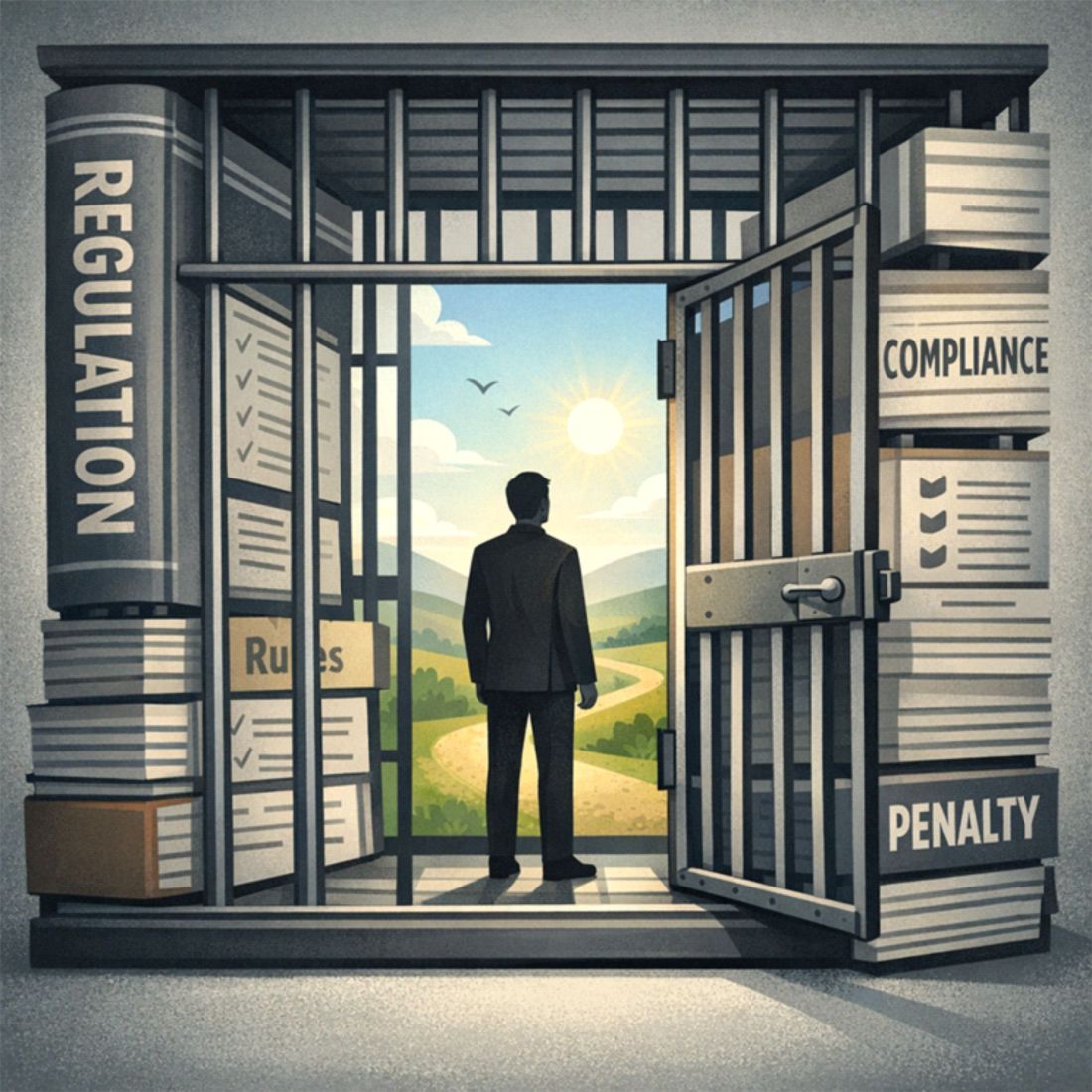
When you can see that rules and laws prevent basic survival, you will understand that centralised governance has gone too far

A question that more and more people have begun to ask is: who does government really work for?

For some, that question comes from living at the sharpest edge of society’s problems – for example, those who can no longer afford to feed themselves properly. But the truth is that across every part of society – our communities, small businesses, clubs, pubs, and the countless organisations that sit outside the government or public‑sector bubble – rules, regulations and requirements are appearing everywhere. And when you look at what these rules actually do, many no longer make any sense at all in terms of allowing people to continue doing what they have always done.

Look more closely and the picture darkens further. Through licences, taxation, penalty notices, workplace directives and endless compliance demands, the ability of anything small, people‑centred, cost‑effective or community‑driven to function is being slowly strangled.

The cumulative effect is suffocating. Many businesses have already gone to the wall because of red tape alone – and that’s before we even consider the wider impact of a money‑centric system and a government culture obsessed with growth, targets and perpetual money creation.

Very few have questioned any of this. Not because people haven’t sensed something was wrong, or felt that the direction of travel jarred with the common sense of real life. But because every change introduced over decades has been sold as “progress”.

Each new rule has been framed as something that improves life, modernises society, or makes everything better for us all – as if the past was universally terrible and the only possible path was the one we’re on.

Yet the freedom we believe we have today is already hollow. With every new move the machinery of government makes, that freedom becomes more restricted.

At some point, we must confront the uncomfortable truth: what is being presented as freedom is increasingly just conformity to a narrative – a form of oppression wearing a very misleading name.

And all of this is happening at a time when global tensions are escalating. With our traditional allies across the Atlantic now posturing over who “owns” Greenland, and European elites openly entertaining the idea of war with Russia and the East, the systems we rely on are heading toward collapse – potentially in a matter of months. That’s before we even consider the other crises and issues lining up behind them.

Without meaningful change – and without a wholesale rejection of the rule‑based system that is already choking every part of life – we face a future where people simply cannot help themselves when they most need to.

Whether it’s farms being unable to grow food, pubs being unable to operate as social spaces, or low‑paid workers being unable to earn enough to live, the dark clouds gathering ahead point to a moment where survival becomes impossible. Not because people lack the will or ability, but because someone in an office miles away decided to make normal life illegal.

Yes, governments talk about “emergency powers” – the idea that in a crisis, the state will temporarily turn a blind eye to rules that would otherwise be enforced. But that raises a very telling question: if these rules can be suspended when reality demands it, who were they ever really serving in the first place?

The time is fast approaching when people may have no choice but to ignore rules and regulations that were created solely because they suited someone else’s interests, rather than being developed to help people live. Frameworks that should never have existed in a genuinely free society, that are now the very things preventing society from functioning.

Of course, we will always need accepted and shared ways of doing things. But those ways should be created, maintained and managed by the people actually involved and the communities they will affect. Not by distant agendas and idealistic theories detached from basic human values.

Systems should reflect how life really works for everyone, not how it might look in the imagination of those who believe people must be forced to behave as they are told.

Dark as the future may appear, there is an opportunity emerging. People and Communities can take back our power and build a system centred on people, community and the environment – one that genuinely puts human beings first.

This alternative already exists in outline. It’s called the Local Economy & Governance System. Built on the foundation of The Basic Living Standard, and shaped by principles such as participatory democracy and the contribution culture.

It offers a complete shift away from the money‑centric disaster path we are currently on. It creates a world where accountability is shared, where frameworks support life rather than restrict it, and where everyone is involved in shaping the society they live in.

Further Reading: Building a People-First Society

To deepen your understanding of the ideas discussed in this work – especially the critique of centralised governance and the vision for a people-centred alternative – these readings from Adam’s Archive provide a logical pathway.

They move from foundational principles, through practical frameworks, to real-world applications and philosophical context. Each resource is accompanied by a brief description to help you navigate the journey.

1. The Basic Living Standard Explained

https://adamtugwell.blog/2025/10/24/the-basic-living-standard-explained/
Start here to understand the foundational principle underpinning the proposed alternative system. This article explains what the Basic Living Standard is, why it matters, and how it serves as the bedrock for a fairer, more resilient society.

2. The Local Economy & Governance System (Online Text)

https://adamtugwell.blog/2025/11/21/the-local-economy-governance-system-online-text/
This resource introduces the Local Economy & Governance System, outlining its structure and how it departs from traditional, money-centric models. It’s a practical overview of how communities can reclaim agency and build systems that genuinely serve people.

3. From Principle to Practice: Bringing the Local Economy & Governance System to Life (Full Text)

https://adamtugwell.blog/2025/12/27/from-principle-to-practice-bringing-the-local-economy-governance-system-to-life-full-text/
Building on the previous readings, this article explores how the Local Economy & Governance System can be implemented in real communities. It bridges the gap between theory and action, offering concrete steps and examples.

4. The Contribution Culture: Transforming Work, Business, and Governance for Our Local Future (With Legs)

https://adamtugwell.blog/2025/12/30/the-contribution-culture-transforming-work-business-and-governance-for-our-local-future-with-legs/
This piece delves into the “contribution culture”- a key principle of the new system. It explains how shifting focus from profit to meaningful participation can transform work, business, and governance at the local level.

5. A Deep Dive Guide to the Philosophy of a People-First Society

https://adamtugwell.blog/2026/01/03/a-deep-dive-guide-to-the-philosophy-of-a-people-first-society/
Conclude your exploration with this philosophical guide, which ties together the practical and ethical dimensions of a people-first society. It offers a reflective look at the values and vision driving the movement for systemic change.

Adam’s Food and Farming Portfolio: A Guide to Books, Blogs and Solutions

Welcome to Building Better Futures: Food, Community, and Beyond – a portfolio that brings together a diverse collection of blogs and books dedicated to shaping resilient communities and thriving local economies through the lens of food and farming.

This area of work is a vital part of my broader professional journey, reflecting a commitment to practical solutions, thoughtful analysis, and transformative ideas.

Within this collection, you’ll find a wide range of resources – many of which are available as downloadable PDFs at each link, making it easy to access and share insights.

A number of the books are also available for purchase as Kindle editions on Amazon, offering flexible ways to engage with the material.

Central to this portfolio is my belief that food sits at the very heart of future communities and local economies. This vision is explored within the works listed here, with each section delving into how food systems, sustainable agriculture, and collaborative local action can empower individuals and strengthen society.

From foundational essays on the importance of farming, through analyses of current challenges and policy barriers, to practical blueprints for resilient food systems, these resources invite you to reimagine what’s possible for our shared future.

Please explore the links below to discover actionable ideas, innovative models, and a vision for building better futures – starting with food, and reaching far beyond.

1. Foundations: The Importance of Food and Farming

Introduction:
This section lays the groundwork for understanding why food and farming are central to the wellbeing of communities and nations. These pieces highlight the fundamental role of agriculture and the urgent need to recognise and support those who produce our food.


Having established the essential role of food and farming in society, the next section delves into the pressing challenges and threats facing the UK’s food system today.

These entries reveal why urgent attention and action are needed to safeguard our agricultural foundations.

2. Current Challenges: Crisis, Policy, and Threats

Introduction:
This section examines the mounting pressures and systemic issues threatening UK food security. The entries here analyse the causes and consequences of the current crisis, urging immediate action to prevent further decline.


Understanding the scope of the crisis leads naturally to an exploration of the political and economic barriers that hinder progress.

The following pieces critique the policies and market forces that shape – and often obstruct – efforts to build a resilient food system.

3. Political and Economic Barriers

Introduction:
This section explores the political and economic obstacles that hinder progress in food and farming. The entries critique current policies and highlight the need for a shift toward self-sufficiency and local resilience.


With the obstacles clearly outlined, attention turns to how farmers and their allies are responding.

This section examines the spectrum of advocacy and activism, highlighting both the risks and the opportunities for constructive change.

4. Farmer Responses: Advocacy, Militancy, and New Directions

Introduction:
This section discusses how farmers and their supporters are responding to challenges. It encourages constructive, peaceful approaches and warns against divisive or counterproductive activism.


Moving beyond reaction, the next section focuses on solutions. Here, collaboration and local action take centre stage, offering practical pathways to strengthen food security and empower communities.

5. Building Solutions: Collaboration and Localisation

Introduction:
This section presents constructive approaches for improving food security and farming. It emphasizes collaboration, local action, and practical steps to build a resilient food system.


As collaborative efforts gain momentum, the conversation expands to consider new models for local economic governance. These entries introduce innovative mechanisms – such as barter and exchange – that can underpin a more resilient and equitable food system.

6. Economic Systems: Local Governance and Exchange

Introduction:
This section introduces new models for local economic governance, focusing on food as a central pillar. It explores alternative mechanisms like barter and exchange, and proposes frameworks for economies that prioritize collective wellbeing.


Finally, the collection concludes by examining the deeper questions of control and power within food systems.

This last section analyses who holds influence, how policy shapes outcomes, and what it will take to build trustworthy, future-proof food systems for all.

7. Control, Power, and the Future

Introduction:
This section concludes the collection by examining who holds power in food systems and what that means for the future. These entries analyse policy, strategy, and the blueprint for building trustworthy, resilient food systems.

Let’s Continue the Conversation

Thank you for taking the time to explore Building Better Futures: Food, Community, and Beyond.

If the ideas, resources, or practical solutions here have sparked your interest, I would be delighted to hear from you. Whether you have questions, wish to discuss any of the topics in more depth, or are interested in collaborating, please feel free to get in touch.

I am always happy to share insights, exchange perspectives, and support your work. If you’re organizing an event or discussion where these themes are relevant, I welcome invitations to speak and contribute.

Let’s build better futures together – starting with food, and reaching far beyond.

Discover a Blueprint for Fair, Sustainable Communities: Introducing the Local Economy & Governance System (LEGS)

Are you searching for a fresh vision of society—one that puts people, community, and the environment first? The new book, The Local Economy & Governance System offers a transformative framework for reimagining how we live, work, and govern together.

Why Read This Book?

  • A Timely Critique and Practical Blueprint: LEGS doesn’t just highlight what’s broken in today’s world—it lays out actionable steps for building a society where everyone’s essential needs are guaranteed, and collective wellbeing is the top priority.
  • People, Community, Environment: These three principles guide every aspect of the LEGS framework, from local governance and economic models to daily life and public policy.
  • Personal Sovereignty: LEGS places strong emphasis on empowering every individual to live freely, responsibly, and authentically. Personal Sovereignty is recognized as the foundation for dignity, ethical living, and genuine freedom within the community.
  • Authentic Governance: Say goodbye to distant, hierarchical leadership. LEGS champions local, democratic decision-making, where leadership is earned through service and accountability—not status.
  • Basic Living Standard for All: Imagine a world where full-time work at the lowest wage covers all core living costs—no more poverty, reliance on charity, or skipped essentials.
  • Community Contributions: Every working member gives back 10% of their week to support local services and charity, replacing traditional public sector staffing with a community-led workforce.
  • Ethical Business & Economy: Businesses exist to serve the public good, not profit. Social enterprises fill gaps where private business doesn’t meet essential needs, and wealth is distributed equitably among contributors.
  • Responsible Technology & AI: LEGS strictly regulates technology to ensure it serves humanity and never replaces human agency. All essential services have human-led, non-digital alternatives.

Who Should Read LEGS?

  • Community leaders, policymakers, and activists seeking practical models for local empowerment.
  • Anyone concerned about inequality, environmental sustainability, or the future of governance.
  • Readers interested in social innovation, ethical business, and resilient communities.

Get Involved

LEGS is more than a book—it’s an invitation to participate in shaping a fairer, more compassionate world. Start conversations, challenge old systems, and take practical steps in your own community. The journey to a better future begins with the choices we make and the values we uphold.