Making sense of a system that isolates and divides – and building a fair, functional system that stands as a real alternative for everyone.
A Note from Adam
For nearly four years, I’ve been publishing books and blogs about change – why we need it, what’s wrong with the world as it stands, and why those wrongs keep repeating.
I’ve written knowing full well that only a small number of people were truly interested in the perspective I was offering. Not because the ideas lacked value, but because they don’t fit neatly within the way the world currently works. They challenge assumptions. They question the foundations. They ask us to look at the system itself, not just the symptoms.
And yet, despite the limited audience, I’ve felt compelled to keep writing.
Part of that comes from a long‑held understanding that the world we know has been living on borrowed time. The cracks have been visible for years – widening, deepening, accelerating – and it has been impossible for me to ignore them.
Much of the time, I didn’t even know that another book would follow the one I had just finished. I would wrap up a manuscript, thinking the work was complete, only for a new structure, a new purpose, a new piece of the puzzle to arrive almost immediately. And so I would begin again.
A few of you have been with me from the very beginning, quietly following each step of this journey.
Others have joined along the way. And now, more than ever, I sense a growing number of people recognising what I have felt for a long time: we cannot shape a new future by using the same shape that created everything that’s wrong.
After publishing The Basic Living Standard Explained, LEGS, and From Principle to Practice, it felt like the right moment to share a little more of the experience that has driven this work – the lived reality, the observations, the research, and the personal journey that have informed every page.
Not because my story is important in itself, but because I do not doubt that for many, understanding the path will help to illuminate the destination.
This work has become important – and yes, urgent – in ways I could never have anticipated when I began.
Even if only a few of you are reading, reflecting, and engaging with these ideas, that is enough. Change has always begun with those who are willing to see and lead by thinking differently.
My hope is that what follows here will give you a clear insight into how LEGS came into being, and perhaps offer a sense of the depth and scope of the thinking that has shaped it along the way.
Thank you for being here.
Thank you for reading.
And thank you for caring enough to imagine something better.
Introduction
This work did not begin with a single idea, a political moment, or a sudden revelation. It began with a pattern – one that kept appearing no matter where I stood or what role I was in.
Whether I was a councillor working with public policy, developing services for charities and local authorities, running businesses, or volunteering within communities, I kept seeing the same thing: people were being pushed, pulled, and shaped by forces they didn’t control and often couldn’t even see.
Problems were treated as isolated issues, when in reality they were symptoms of the same failing system. And the system itself – fragmented, money‑centric, hierarchical, and blind to human reality – had no idea it was failing.
At some point, the realisation became impossible to ignore:
I came to see that all of us are in different boats, shaped by our own circumstances, yet all being blown around by the same winds – economic forces, political decisions, and pressures we never chose.
Most people have no control over where they’re heading or even realise when they’re drifting toward danger.
LEGS and the Basic Living Standard are about giving people an engine of their own, the power to steer their own direction, and the ability to reach safe shores they define for themselves, where a new world that works for everyone can begin.
That image stayed with me because it captured exactly what I had witnessed throughout my life. People weren’t failing. They were navigating a storm in vessels that were never built for them, under a system that blamed them for every wave that hit.
My own childhood gave me the first glimpse of this truth. Growing up in a one‑parent family, I didn’t know we were “poor” until the world told me.
What I did know – even then – was that life felt harder than it should, and that the rules seemed to work differently for different people.
Later, when I found myself working with public policy, charity development, local government projects, business operations, and voluntary roles, that early awareness became a lens. I could see the system from both sides: the side that created the rules, and the side that lived with the consequences.
The more I saw, the clearer it became that the system wasn’t malfunctioning. It was functioning exactly as designed – and that design no longer works for the world we live in.
A research project on my Postgraduate Course in 2023 confirmed what experience had already taught me. Inside a Gloucestershire foodbank, I heard stories that revealed the same structural truth: people were not struggling because of personal failure, but because the system had made survival itself a calculation that no longer added up.
‘The minute you step away from the ground, everything becomes theoretical.’
And that is exactly how the system hides its own contradictions.
This four-years body of work – from Levelling Level to The Basic Living Standard, From Here to There Through Now, The Way of Awakened Politics, The Grassroots Manifesto, A Community Route, and the conceptual foundation I call The Revaluation – is the result of following that pattern to its root.
Each step revealed another layer. Each layer made the next step unavoidable. And together, they led to one conclusion:
You cannot fix a system that is designed to protect itself from change.
But you can build a new one.
LEGS – the Local Economy & Governance System – is that new system.
The Basic Living Standard is its foundation.
And the work that follows is the framework or map.
This introduction is not an argument for ideology. It is an invitation to see the world differently – to recognise that the future is not predetermined, and that the systems we live within are Then when when choices, not inevitabilities.
If we choose differently, if we choose people first, if we choose dignity, locality, fairness, and responsibility, then the world that follows will be one worth living in.
This is the beginning of that choice.
SECTION 1 – The Real Problem: A System That Fragments Everything
When people ask me why I’ve spent the past four years working on this – writing, researching, building, refining – the answer isn’t simple. It certainly isn’t ideological. And it didn’t arrive in a single moment of inspiration.
It came from years of watching the same pattern repeat itself in every direction I looked.
Whether I was working in public policy, regulatory environments, the voluntary sector, or running businesses and operations, the same truth kept revealing itself:
We treat every problem as if it exists in isolation.
But nothing in real life works that way.
We talk about the cost-of-living crisis as if it’s separate from housing.
We talk about housing as if it’s separate from wages.
We talk about wages as if they’re separate from business models.
We talk about business models as if they’re separate from governance.
We talk about governance as if it’s separate from values.
We talk about values as if they’re separate from community.
We talk about community as if it’s separate from the economy.
And on it goes – endlessly dividing, categorising, isolating.
This fragmentation is not accidental. It’s built into the way the system thinks.
A money‑centric system can only see problems in terms of:
- cost
- efficiency
- productivity
- risk
- compliance
- metrics
- optics
It cannot see people.
It cannot see relationships.
It cannot see interconnectedness.
It cannot see the whole.
And because it cannot see the whole, it cannot fix the whole.
So instead, it breaks everything into pieces – and then blames the people trapped in those pieces for the consequences.
If you’re struggling with rent, the problem is you.
If you’re struggling with food, the problem is you.
If you’re struggling with debt, the problem is you.
If you’re struggling with work, the problem is you.
If you’re struggling with mental health, the problem is you.
If you’re struggling with anything at all, the problem is always you.
This is the great sleight of hand of the money‑centric paradigm:
It creates the crisis, then convinces you that you are the crisis.
And because every crisis is treated as a separate issue, the system never has to confront the truth:
All of these problems come from the same place.
They are symptoms of the same design.
They are outputs of the same worldview.
This is why I’m doing this.
Because once you’ve seen the interconnectedness – once you’ve watched the same pattern play out in public policy, in regulation, in business, in community life, in governance, in economics – you can’t unsee it.
And once you’ve seen it, you realise something else:
No amount of tinkering will fix a system that is designed to fragment reality.
The only solution is to build a system that sees the whole.
That is where this journey began.
SECTION 2 – How the System Turns Symptoms Into “Individual Problems”
One of the most revealing things I’ve learned – not just from research, but from many years of working with charities, in politics, regulatory environments, and business, is that the system has a remarkable ability to turn its own failures into your failures.
It doesn’t matter whether the issue is:
- poverty
- housing
- food insecurity
- debt
- mental health
- loneliness
- precarious employment
- small business collapse
- community breakdown
- environmental decline
The pattern is always the same.
The system creates the conditions.
The system produces the harm.
And then the system convinces the individual that they are the cause.
If you can’t afford rent, it’s because you “didn’t plan well enough.”
If you can’t afford food, it’s because you “budget badly.”
If you’re struggling with debt, it’s because you “made poor choices.”
If you’re overwhelmed, it’s because you “aren’t resilient enough.”
If you’re exhausted, it’s because you “aren’t working the right way.”
If you’re anxious, it’s because you “aren’t coping.”
If you’re drowning, it’s because “you didn’t swim fast enough.”
This is the quiet violence of a money‑centric system.
It isolates every problem.
It personalises every struggle.
It individualises every consequence.
And in doing so, it hides the truth:
These are not personal failures. They are systemic outputs.
They are the predictable, inevitable consequences of a system that:
- prioritises money over people
- treats human needs as market variables
- reduces life to transactions
- fragments every issue into separate categories
- refuses to see the whole
- refuses to take responsibility
And because each problem is treated as a standalone issue, the system never has to confront the deeper reality:
All of these crises are connected.
They come from the same root.
They are symptoms of the same design.
This is why people feel overwhelmed.
This is why people feel alone.
This is why people feel like they’re failing.
Because the system has trained us to see only the part we’re trapped in – not the whole structure that created it.
And this is where the cruelty becomes almost elegant in its simplicity:
When you’re struggling, the struggle becomes your entire world.
And that is exactly how the system keeps itself hidden.
If you’re fighting to pay rent, you don’t have the bandwidth to question why housing is unaffordable in the first place.
If you’re juggling three jobs, you don’t have time to question why wages don’t cover basic living costs.
If you’re relying on foodbanks, you don’t have the energy to question why food insecurity exists in a wealthy country.
If you’re drowning in debt, you don’t have the clarity to question why debt is built into the economic model.
If you’re exhausted, you don’t have the strength to question why the system demands exhaustion as a condition of survival.
This is not accidental.
This is not incidental.
This is not unfortunate.
This is structural.
A system that fragments problems keeps people fragmented.
A system that isolates problems keeps people isolated.
A system that personalises problems keeps people powerless.
And this is the point where my own lived experience – and later, my research – began to collide with everything I had seen in politics, government, charities and business.
Because once you recognise the pattern, you start to see it everywhere.
You see it in the way government talks about “helping the vulnerable” while designing systems that create vulnerability.
You see it in the way businesses talk about “opportunity” while structuring work so people can never get ahead.
You see it in the way regulators talk about “fairness” while enforcing rules that entrench inequality.
You see it in the way society talks about “personal responsibility” while ignoring the structural conditions that shape every choice people can make.
And you realise something that changes everything:
People are not failing.
The system is failing.
And people are carrying the cost.
This is the moment the narrative shifts.
This is the moment the illusion cracks.
This is the moment you stop seeing isolated problems and start seeing the architecture behind them.
And once you see the architecture, you can no longer pretend that any single issue – poverty included – can be solved on its own.
Because the truth is simple:
You cannot fix symptoms in a system that is designed to produce them.
You can only fix the system itself.
And that is where the next part of this story begins.
SECTION 3 – Seeing the System from the Inside: My Lived Experience
Long before I ever worked in charities, public policy, regulatory environments, politics or business, I had already seen the system from the ground level – not through theory, but through lived experience.
I grew up in a one‑parent family, in circumstances that would now be described as poverty. At the time, I didn’t have the language for it. I didn’t have the context. I didn’t have the comparisons. I simply lived it.
And that’s the thing about childhood poverty: you don’t know you’re “poor” until the world tells you.
You don’t feel deprived if you’ve never had the things other people take for granted.
You don’t feel different until someone points out the difference.
You don’t feel the weight of the system until it presses down on you.
Looking back, what strikes me most is not the lack of money – it’s the normality of it all.
The rituals of stretching every pound.
The quiet calculations.
The constant trade‑offs.
The small victories that felt enormous.
The moments of shame that arrived without warning.
But the most important part – the part that shaped everything that came later – was this:
When you grow up inside a system that doesn’t work for you, you learn to see the system differently.
You learn to notice the gaps.
You learn to feel the pressure points.
You learn to sense the contradictions.
You learn to recognise when something is being presented as “your fault” when it clearly isn’t.
You learn, very early on, that the world is not designed with everyone in mind.
And once you have it, that awareness never really leaves you.
It sits quietly in the background as you move through life.
It colours the way you see decisions being made.
It shapes the way you interpret policy.
It influences the way you understand power.
It sharpens your sense of fairness.
It makes you pay attention to the things other people overlook.
Later in life, whether I was chairing licensing hearings, building services for charities, developing operational models for a county council, running businesses, or volunteering in roles that put me shoulder‑to‑shoulder with people on the ground, I kept encountering the same pattern from different angles.
And the more I saw, the more I recognised the same pattern I had lived through as a child:
The system creates the conditions.
The system produces the harm.
And then the system tells people the harm is their fault.
This wasn’t just about poverty.
It was about everything.
Housing.
Work.
Food.
Debt.
Health.
Education.
Community.
Governance.
Opportunity.
Security.
Dignity.
Every part of life touched by the system carried the same signature.
And that’s when the realisation began to take shape – slowly at first, then with increasing clarity:
The problem isn’t the people.
The problem is the system.
And the system cannot see itself.
My lived experience didn’t give me the answers. But it gave me the ability to see the questions that weren’t being asked.
It gave me the ability to recognise when a policy was designed to look good rather than do good.
It gave me the ability to sense when a decision was made for optics rather than outcomes.
It gave me the ability to understand why people were struggling even when the numbers said they shouldn’t be.
It gave me the ability to see the human cost behind the spreadsheets, the metrics, the targets, the narratives.
And it gave me something else – something that would become essential later:
The understanding that lived experience is not subjective noise.
It is data.
It is evidence.
It is truth.
This is why, when I began writing Levelling Level in 2022, I wasn’t writing from theory.
I was writing from a lifetime of seeing the system from both sides – the side that suffers its consequences, and the side that creates them.
And that dual perspective became the foundation for everything that followed.
SECTION 4 – Contemporary Evidence of Systemic Failure: My 2023 Research
By the time I began my postgraduate research project in 2023, I had already spent years seeing the system from multiple angles – as a child living within its consequences, and later as an adult working in professional and voluntary roles reaching across the different sectors.
But nothing prepared me for how starkly the system would reveal itself when I stepped into a Gloucestershire foodbank as part of my project.
I didn’t go there to confirm a theory, or qualify my own experience from decades before.
I went there to understand the lived reality of poverty today – to see how it feels, how it functions, and how it is being experienced by the people who have no choice but to navigate it.
What I found was not simply a story about food insecurity. It was a window into the architecture of the entire system.
Because the foodbank wasn’t just a place where people came for food. It was a place where the consequences of the system gathered in one room.
And the experience I had there crystallised something I had sensed for years:
The system is failing people in real time, every day – and it cannot see that it is failing.
A comment I heard from just one of the many professionals supporting people through Foodbanks across the UK today still echoes in my mind:
Sometimes there just isn’t enough money to cover everything.
Not because people are irresponsible.
Not because they are lazy.
Not because they are making poor choices.
But because the system is designed in such a way that survival itself has become a calculation that no longer adds up.
Another stream of words struck me even harder:
The minute you are removed from the ground, it becomes theoretical.
This wasn’t just about politicians and public sector employees.
It was about the entire structure of decision‑making itself.
It was about the distance between those who design policy and those who live with its consequences.
It was about the blindness that comes from never having to experience the realities your decisions create.
It was about the way the system fragments problems so completely that even those working within it struggle to see the whole.
And then there was this:
What used to be a crisis is harder to get out of… we see people more regularly than we used to.
Foodbanks were never meant to be structural.
They were meant to be emergency support.
But the system has normalised crisis.
It has institutionalised scarcity.
It has made emergency provision part of the everyday landscape.
And the people who walk through those doors carry not just hunger, but shame, fear, exhaustion, and a sense of personal failure – even though the failure is not theirs.
One of the most revealing insights came when the foodbank worker said:
If you work with people, you can get almost anyone out of that crisis point… but sometimes there just isn’t enough money to cover everything.
This is the system in a single sentence:
- The problem is not the person.
- The problem is not the behaviour.
- The problem is not the choices.
- The problem is the structure.
- The problem is the design.
- The problem is the system itself.
And yet, the system continues to treat each case as an individual failing – a budgeting issue, a lifestyle issue, a motivational issue – anything except a structural issue.
This is the same pattern I had seen in every sector I’d worked in.
But here, in the foodbank, it was laid bare.
Poverty is not the cause.
Poverty is the evidence.
Poverty is the symptom of a system that no longer works.
And the most important realisation of all was this:
The experience of poverty becomes the entire world for the person living it.
And that is exactly how the system hides the bigger picture.
Because when you are fighting to survive, you cannot step back far enough to see the architecture that created the fight.
This research didn’t change my understanding.
It confirmed it.
It showed me that the fragmentation I had seen in government, politics, business, regulation, and community life was not theoretical.
It was lived.
It was real.
It was happening now.
And it was happening everywhere.
It showed me that the system is not broken in one place – it is broken in every place.
And because it is broken everywhere, it cannot see its own failures anywhere.
This was the moment the work I had been doing since February 2022 shifted from important to unavoidable.
Because once you have seen the system clearly – once you have seen how it behaves, how it hides, how it blames, how it fragments, how it isolates – you realise something that changes everything:
You cannot fix a system that is designed to produce the very problems it claims to solve.
You can only build a new one.
And that is where the next part of this story begins.
SECTION 5 – The Realisation: The System Cannot Be Fixed From Within
By the time I completed and submitted my research project in late 2023, something had become unmistakably clear:
the system wasn’t just failing – it was incapable of recognising its own failures.
And once you see that, you can no longer pretend that reform, tinkering, or “better management” will make any meaningful difference.
Because the truth is this:
You cannot fix a system from within when the system is designed to protect itself from change.
This wasn’t an abstract conclusion.
It was something I had watched unfold repeatedly across every environment I had worked in:
- In politics, where decisions were shaped by narratives rather than needs.
- In regulatory structures, where rules were written to preserve the system, not improve outcomes.
- In charity development, where services existed to fill gaps the system refused to acknowledge.
- In local government, where bureaucracy replaced responsibility.
- In business operations, where profit dictated priorities even when it harmed people.
- In voluntary roles, where the human cost of systemic failure was impossible to ignore.
Everywhere I looked, the same pattern emerged:
The system treats symptoms as isolated problems because acknowledging the cause would require changing itself.
This is why poverty is treated as a budgeting issue.
Why housing is treated as a supply issue.
Why food insecurity is treated as a charity issue.
Why debt is treated as a personal responsibility issue.
Why mental health is treated as an individual resilience issue.
Why community breakdown is treated as a behavioural issue.
Why governance failure is treated as a political issue.
Every problem is reframed in a way that keeps the system intact.
And this is where the realisation becomes unavoidable:
The system is not malfunctioning. It is functioning exactly as designed.
A money‑centric system will always:
- prioritise money over people
- fragment problems into isolated categories
- blame individuals for structural failures
- reward behaviours that harm the collective
- centralise power away from communities
- treat human needs as market variables
- hide its own contradictions
- resist any change that threatens its logic
This is why the system cannot be repaired.
It can only be replaced.
And this is the point where my earlier work – the books I had written since February 2022 – suddenly made sense as a single, coherent journey.
Levelling Level was the first attempt to articulate the breadth of the problem – to show that no issue exists in isolation, and that political soundbites like “Levelling Up” were distractions from the deeper systemic failures.
The Basic Living Standard emerged because I realised that dignity cannot depend on charity, debt, or government intervention – it must be built into the structure of the economy itself.
From Here to There Through Now explored the transition – the bridge between paradigms – because you cannot leap from a failing system to a new one without understanding the steps in between.
The Way of Awakened Politics for Good Government confronted the reality that governance itself must change – that unconscious decision‑making is the root of systemic harm, and that awakened, values‑based leadership is essential.
A Community Route provided the frameworks – the practical structures that allow communities to lead, decide, and shape their own futures without hierarchy or centralised control.
The Revaluation articulated the paradigm shift – the moment where we stop measuring life through money and begin valuing people, community, and environment as the foundations of a functioning society.
Each book was a step.
Each step revealed another layer.
Each layer exposed another truth.
And together, they led to the same conclusion:
The system cannot be fixed.
But a new system can be built.
A system that sees the whole.
A system that understands interconnectedness.
A system that puts people first.
A system that restores locality, dignity, and responsibility.
A system that treats human needs as non‑negotiable.
A system that values contribution over accumulation.
A system that works with human nature, not against it.
This is the moment where the idea of LEGS – the Local Economy & Governance System – stopped being a concept and became a necessity.
Not because it was perfect.
Not because it was easy.
Not because it was fashionable.
But because once you see the system clearly, you realise:
There is no alternative.
Not if we want a future that works for everyone.
And that is where the next part of this story begins.
SECTION 6 – The Journey Since February 2022: How Each Step Built the Foundations of LEGS
When I look back at the work I’ve produced since February 2022, it’s tempting to see each book as a separate project – a standalone piece responding to a particular moment or question.
But that isn’t what happened.
What actually unfolded was a process of discovery.
A gradual revealing.
A step‑by‑step evolution of understanding.
Each book was written because the one before it raised a deeper question.
Each question led to a clearer insight.
Each insight exposed another layer of the system. And each layer made the next step unavoidable.
None of this was planned.
It emerged.
It unfolded.
It evolved.
And that evolution is the reason LEGS exists at all.
Levelling Level – Seeing the System Clearly for the First Time
Levelling Level was the moment I became certain that the problems we face cannot be solved one at a time.
It exposed:
- the fragmentation of public policy
- the blindness of political soundbites
- the illusion of “Levelling Up”
- the failure of both Left and Right
- the structural nature of inequality
- the way money distorts every decision
It was the first time I articulated the truth that would underpin everything that followed:
You cannot fix a system by treating its symptoms.
You must understand the system as a whole.
Levelling Level was the diagnosis.
The Basic Living Standard – Defining the First Universal Framework
Once I understood the system, the next question was obvious:
What does fairness actually look like in practice?
The Basic Living Standard answered that question.
It introduced the idea that:
- dignity must be built into the economic structure
- survival cannot depend on charity, debt, or government intervention
- the lowest legal wage must be enough to live on
- the economy must serve people, not the other way around
This was the first practical framework – the first building block of a new system.
From Here to There Through Now – Understanding the Transition
The next question was equally unavoidable:
How do we get from a failing system to a functioning one?
From Here to There Through Now explored the transition – the bridge between paradigms.
It recognised that:
- change is a process, not an event
- people need a way to move from the old to the new
- the system cannot be replaced overnight
- the steps matter as much as the destination
This book was the bridge.
The Way of Awakened Politics for Good Government – Redefining Governance Itself
Once the transition was clear, another question emerged:
What kind of governance can actually deliver fairness, balance, and justice?
The Way of Awakened Politics for Good Government answered that.
It showed that:
- unconscious decision‑making is the root of systemic harm
- politics today is reactive, self‑interested, and blind
- awakened, values‑based leadership is essential
- governance must be human, not hierarchical
- good government is a method, not an ideology
This book provided the philosophical foundation for a new form of governance.
The Grassroots Manifesto – The Turning Point
And then came the moment where everything shifted.
The Grassroots Manifesto was both a continuation of the journey and a turning point.
It was the first time I articulated:
- a fully Grassroots‑Up model of democracy
- Local Assemblies and Community Assemblies
- the rejection of Top‑Down governance
- the principle that power flows from the individual outward
- the idea that communities must shape their own futures
- the early frameworks that later became A Community Route
- the recognition that the future must be built from the bottom up
This was the moment where the governance philosophy became a governance structure.
It was the moment where the idea of a new system stopped being conceptual and started becoming real.
A Community Route – The Practical Frameworks
Once the Grassroots model was clear, the next step was to define the practical structures that would make it work.
A Community Route introduced:
- the 11 Principal Frameworks
- Economic Localism
- People First
- No hierarchies
- Local decision‑making
- Fixed‑value currency
- Technology as a tool, not a master
- Community‑centred governance
This was the operational blueprint – the practical architecture of a new system.
The Revaluation – The Paradigm Shift (Unpublished but Foundational)
Alongside the published works, another body of thinking was developing – not as a book, but as a deeper conceptual foundation.
I called it The Revaluation.
It wasn’t written for publication.
It wasn’t structured as a standalone work.
It was a set of ideas, reflections, and insights that shaped everything else.
It explored:
- the shift from money‑centric to people‑centric
- the collapse of the old paradigm
- the need to revalue everything
- the centrality of community, locality, and stewardship
- the philosophical foundation of LEGS
It was the internal work – the thinking beneath the thinking – that made the rest possible.
And then came LEGS – The Local Economy & Governance System
By the time all these pieces were in place, LEGS – developing from its first evolution Our Local Future, was not just an idea.
It was the inevitable conclusion of everything that had come before.
LEGS is:
- the synthesis of the diagnosis
- the application of the frameworks
- the embodiment of the values
- the structure of the governance
- the architecture of the economy
- the practical expression of the paradigm shift
It is the system that sees the whole.
The system that understands interconnectedness.
The system that puts people first.
The system that restores locality, dignity, and responsibility.
The system that works with human nature, not against it.
And it exists because the journey demanded it.
SECTION 7 – Introducing LEGS & the Basic Living Standard as the Systemic Alternative
By the time the journey had unfolded – through lived experience, professional experience, research, reflection, and the evolution of ideas across multiple works – one truth had become impossible to ignore:
The system we live in today cannot deliver fairness, balance, or dignity.
Not because the people within it are bad.
But because the system itself is built on the wrong foundations.
A money‑centric system will always:
- prioritise accumulation over contribution
- reward extraction over value
- centralise power away from communities
- fragment problems into isolated categories
- blame individuals for structural failures
- treat human needs as market variables
- measure life in terms of cost rather than meaning
You cannot reform a system that is designed this way.
You cannot tweak it.
You cannot patch it.
You cannot “fix” it from within.
You have to build something different.
Something that starts from a different premise.
Something that begins with a different question.
Something that places value where value actually lives.
And that is where LEGS – the Local Economy & Governance System – comes in.
The LEGS Paradigm Shift
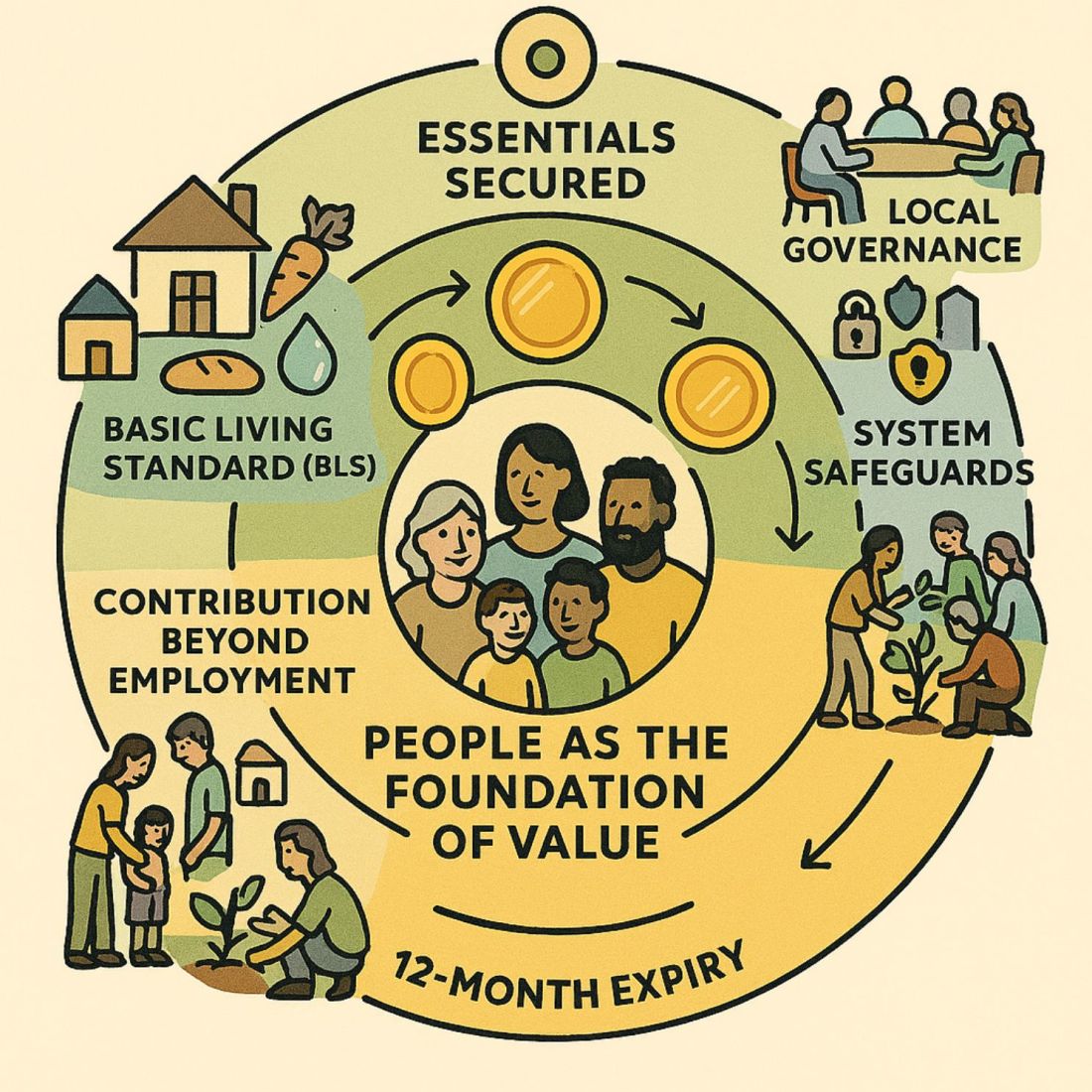
LEGS begins with one simple, radical shift: People First.
Not as a slogan.
Not as a political promise.
Not as a moral aspiration.
But as the structural foundation of the entire system.
In LEGS, people are not variables in an economic model.
They are not units of productivity.
They are not cost centres.
They are not data points.
They are the purpose of the system.
Everything else – the economy, governance, community structures, technology, currency – exists to serve people, not the other way around.
This is the inversion that changes everything.
The Basic Living Standard – The First Framework of a People‑First System
If people come first, then dignity must be non‑negotiable.
And dignity begins with the ability to live – not survive, not scrape by, not rely on charity or debt – but live a stable, healthy, balanced life.
That is what the Basic Living Standard guarantees.
It is not welfare.
It is not subsidy.
It is not a handout.
It is not a political gesture.
It is a structural rule:
Anyone working the lowest legal full‑time wage must be able to afford all essential costs of living – without debt, without charity, without government intervention.
This single framework:
- eliminates structural poverty
- removes the need for foodbanks
- restores dignity to work
- stabilises communities
- reduces dependency
- rebalances the economy
- forces businesses to operate ethically
- aligns value with contribution
- anchors prices to reality
- prevents exploitation
- removes the hidden subsidies that currently prop up the system
It is the foundation stone of a humane society.
And it is only the beginning.
LEGS is not a policy.
LEGS is a system.
A whole system.
A joined‑up system.
It integrates:
- Economic Localism – because real life happens locally
- People‑First Governance – because decisions must be made by those who live with the consequences
- Grassroots Democracy – because power must flow from the individual outward
- Fixed‑Value Currency – because money must be a tool, not a weapon
- Community‑Centred Services – because people know what their communities need
- Frameworks Instead of Rules – because principles endure, bureaucracy does not
- Technology as a Tool – because innovation must serve humanity, not replace it
- Local Markets & Supply Chains – because resilience begins at home
- Values‑Based Decision‑Making – because the system must reflect what matters
LEGS is not a utopia.
It is not abstract.
It is not theoretical.
It is practical.
It is grounded.
It is human.
It is achievable.
And it is built on the understanding that:
When you design a system around people, everything else begins to work.
Work becomes meaningful.
Communities become resilient.
Governance becomes accountable.
Economies become stable.
Technology becomes ethical.
Value becomes real.
Life becomes balanced.
Dignity becomes universal.
This is not a dream.
It is a design.
A design that emerged not from ideology, but from experience.
Not from theory, but from reality.
Not from abstraction, but from lived truth.
And it is the only system that answers the question that began this entire journey:
How do we build a world that works for everyone?
LEGS is the answer.
SECTION 8 – The Future We Choose
When people ask why I’ve spent years working on this – writing, researching, building, refining – the answer isn’t found in any single moment, book, or experience.
It’s found in the pattern that emerged when all of those moments were placed side by side.
A pattern that revealed a simple truth:
The world we live in today is not inevitable.
It is designed.
And anything designed can be redesigned.
We have been conditioned to believe that the system is too big to change, too complex to understand, too entrenched to challenge.
But systems are not living things.
They do not have consciousness.
They do not have agency.
They do not have power of their own.
People give systems power.
People maintain them.
People enforce them.
People accept them.
And people can choose differently.
That is the quiet truth that sits beneath everything I’ve written, everything I’ve researched, everything I’ve lived:
We are not powerless. We have simply forgotten our power.
The system we have today – the money‑centric, fragmented, hierarchical, centralised system – is not the natural order of things.
It is one way of organising life.
One interpretation.
One design.
And it is failing.
Not because people are failing within it, but because the design itself no longer works for the world we live in.
It cannot see people.
It cannot see communities.
It cannot see interconnectedness.
It cannot see value beyond money.
It cannot see dignity beyond productivity.
It cannot see humanity beyond metrics.
And so it produces outcomes that reflect its own blindness.
But the future does not have to be an extension of the present.
It does not have to be a continuation of the same logic.
It does not have to be a slightly improved version of what we already have.
We can choose differently.
We can choose a system that begins with people, not money.
A system that sees the whole, not the fragments.
A system that values contribution, not accumulation.
A system that restores locality, dignity, and responsibility.
A system that works with human nature, not against it.
A system that treats communities as the foundation, not the afterthought.
A system that understands that fairness is not a luxury – it is the basis of a functioning society.
That system is LEGS.
Not because it is perfect.
Not because it is easy.
Not because it is fashionable.
But because it is built on the only foundation that has ever worked:
People first. Always.
The Basic Living Standard ensures dignity.
Economic Localism ensures resilience.
Grassroots governance ensures accountability.
Frameworks ensure fairness.
Community ensures belonging.
Values ensure direction.
And together, they create something the current system cannot:
A future that works for everyone.
Not a utopia.
Not a fantasy.
Not a dream.
A practical, grounded, human future – built from the bottom up, shaped by the people who live in it, and guided by principles that endure.
This is why I’m doing this.
Not because I believe I have all the answers.
Not because I think I’m the one who will lead the change.
Not because I imagine myself at the centre of anything.
But because I believe in people.
I believe in communities.
I believe in fairness.
I believe in dignity.
I believe in responsibility.
I believe in the possibility of a better world.
And I believe that when people are given the tools, the frameworks, and the opportunity, they will build something extraordinary.
The future is not predetermined.
It is not fixed.
It is not written.
It is chosen.
And the choice begins now – with us, with our communities, with the way we think, the way we act, and the way we imagine what comes next.
The future we need begins with the values we choose today.
And if we choose well – if we choose people, community, dignity, fairness, and truth – then the world that follows will be one worth living in.
The Work Ahead
As you reach the end of this work, it’s worth pausing to recognise something important: nothing in these pages is theoretical. Nothing here is abstract. Nothing here is written for the sake of argument, ideology, or intellectual exercise.
Everything in this book comes from lived experience, from real people, from real communities, from real consequences, and from the realisation that the world we live in today is not the world we have to accept.
The system we inherited was not designed with us in mind. It was built for a different time, a different set of values, and a different understanding of what life should be.
It has served some, harmed many, and shaped all of us in ways we rarely stop to question.
But systems are not permanent. They are not natural laws. They are not immovable truths.
Systems are choices.
And choices can be changed.
LEGS and the Basic Living Standard are not the final answer. They are the beginning of a new conversation – one that starts with people, not power; with communities, not hierarchies; with dignity, not dependency.
They offer a way to rebuild the foundations of society so that everyone has the chance to live a stable, meaningful, and self‑directed life.
But no system, no framework, no set of ideas – no matter how well‑designed – can change the world on its own.
Change happens when people choose to see differently, think differently, act differently, and believe that a better future is not only possible, but necessary.
If this work has done anything, I hope it has shown you that the problems we face are not isolated, accidental, or inevitable. They are connected. They are structural. And because they are structural, they can be rebuilt.
The future will not be shaped by the loudest voices at the top, but by the quiet decisions made in communities, homes, workplaces, and everyday lives.
It will be shaped by people who refuse to drift any longer, who refuse to be pushed around by winds they never chose, and who decide to take hold of the engine that has always been theirs.
A new world does not begin with governments, institutions, or declarations.
It begins with people.
It begins with us.
The work ahead is not easy. It will not be quick. It will not be perfect. But it will be real. And it will be ours.
If we choose it.
This is the end of the LEGS story.
But it is the beginning of the journey itself.
Further Reading:
Seeing the System Clearly
Laying the Foundations: The Basic Living Standard
Rethinking Governance and Power
Building Community and Local Solutions
Turning Principles Into Practice
A Broader Vision for the Future
An Economy for the Common Good
https://adamtugwell.blog/2025/02/24/an-economy-for-the-common-good-full-text/
A vision for an economy that serves everyone, not just a few – rooted in fairness, community, and the belief that we can choose a better way.

 Adam Tugwell