Our Future IS Local

Hi Everyone,

I’ve just published another free-to-read version of a booklet that I have put together as a website that you will find at www.ourlocalfuture.com

Our Local Future is available as a Kindle Book too, and runs through the key changes to the way society functions that would make everything work much better for everyone and create a happy, healthy, safe and secure environment for us all.

I’ve written this latest Book, because I’m fed up of listening to everyone who knows this or knows that, wasting valuable time arguing that only they know the next steps we, as a culture and society should take, to put everything right.

People who should really know better are focused only on the journey and who controls it. Instead of considering the destination and what the outcomes will be that solve all our problems and create a world and culture where Balance, Fairness and Justice can be experienced by all.

Meanwhile, the constant debates over who or what is to blame; whether problems like climate change and the need for Foodbanks are real; or who is right vs who is wrong are just making everything that’s already wrong exponentially worse.

More often than not, these ‘blockers’ who let their egos get in the way, are the very same people who hear a new idea or proposal and immediately say ‘It won’t work’. Usually, because they only want change for everyone else, IF they can be certain that they will gain in some way, or at the very least don’t believe that they could lose.

Change is no longer a choice. It’s happening around all of us right now. And the difficulties we face are going to get worse before there’s any chance that things will get better.

The unspoken truth or secret ingredient that we all have to accept is that by embracing change that will help to make sure everyone has the best experience of life that they can, we will all end up with a system of governance and way of life that works in every good way that we could possibly wish for ourselves.

Best Wishes, Adam

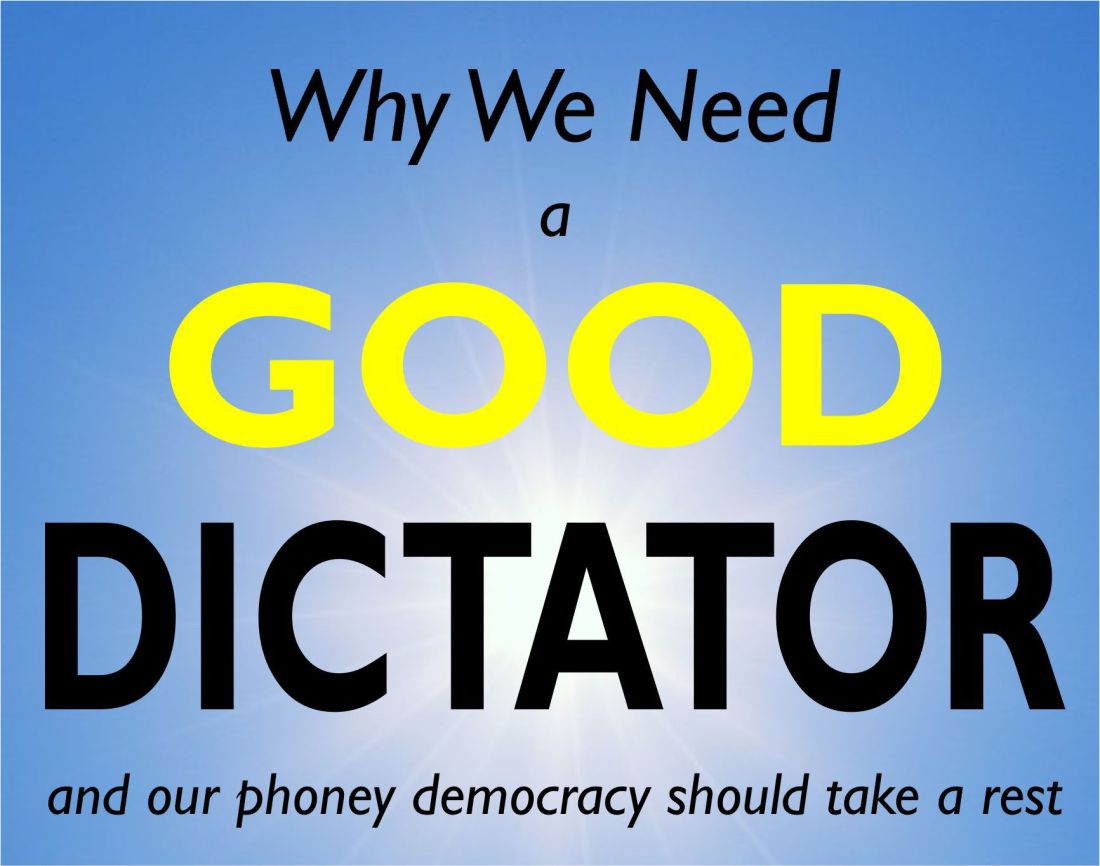
Why we need a Good Dictator, and our phoney democracy should take a rest

In the immediate run up to the December 2019 General Election, I wrote and published The Makeshift Manifesto, here online and as an e-book that’s available on Amazon.

Even though the political terrain was different, from the point of view that the British Electorate were days away from trusting Boris Johnson with an Election Result that very few saw coming because the Conservatives promised to get Brexit done, the truth of the matter was that many areas of the UKs public policy had already gone massively wrong.

Regrettably, it had been doing so for a time that has spanned many different governments, led by different political parties, before.

Within months, we were all subjected to the stupidity and poor leadership that manifested itself in the form of both the Government and the wider political response to Covid 19 and the Covid Pandemic.

We are unlikely to have experienced all the fall-out and consequences of such levels of incompetence and political delinquency that were set in motion, even now.

However, back in early December 2019, I decided to commit all the things a ‘good’ government would actually do to paper. I then shared it with the world.

Since then, The Makeshift Manifesto seems to have been a popular read. So, earlier this year, as I contemplated the run up to the coming General Election, I began to question whether I should revisit the book and update it to reflect what has changed and where the further problems with Public Policy have developed over the 4+ years of time since the first edition was published.

With the original work set up on a screen and being sat ready to dive straight in, it didn’t take many moments for me to realise that if ‘good’ policy was no more than a wish list at the time of the last General Election, because of the quality  of the politicians we had back then, the uncomfortable fact is that with the political options we have available today, such suggestions would be pretty much impossible to deliver through the current structure of government, in any meaningful way.

I’d written about the concept of and asked the question ‘Is it possible to have a Good Dictator’ before.

But at this point I realised, that without people being open to the change that is possible now and which I covered in the book Officially None Of The Above, or there being some kind of Black Swan event that has the power to change everyone’s minds, the only way that meaningful change could be delivered throughout government, the public sector and within every area of Public Policy itself, would be with pure single-mindedness. The kind that could only be achieved if it was driven and directed by one person with the power necessary to command and dictate that massive scale of change.

I worked this thorough as briefly as it was possible to do so.

Leaning on different books that I have written and published over the past two years that included A Community Route and The Grassroots Manifesto, I also added a policy wish list that would be good for everyone, but that in today’s reality, it would only be possible for Good Dictator to deliver and achieve.

There remains a very big question about whether the individual exists who:

  1. Would have the knowledge and experience necessary to change such a massively broken system for the better
  2. Has the desire, drive, motivation and public spiritedness to see it through
  3. Possesses the ethics, morality and principles to stay true to the public cause, when there would be so much temptation to cast what’s in the best interests of others aside

After completing and publishing the book, I concluded that in times as we face today, where politicians and those who aspire to be politicians don’t see any route other than their own, and the public itself has surrendered to the idea that all ‘public’ problems are the responsibility of someone, somewhere else, if nothing else should change in the way we view the importance of the things that are common to us all, the solution of having a Good Dictator, might end up being the only way forward for us all.

Universal Basic Income won’t genuinely help anyone, least of all our Farmers

There’s no such thing as a free lunch. So, when it comes to giving away money, anyone who thinks that a Universal Basic Income is going to help anyone and in particular our farmers, either has an agenda they aren’t sharing, or they don’t have any real understanding of the true cost of making UBI work.

UBI is certainly well intended. A lot of research and thinking has gone into the trials and projects where a localised equivalent of a guaranteed basic income has been tried.

The problem is UBI is a solution that uses the creation or printing of money to enable it to work.

Money creation or printing is an essential part of the FIAT monetary system that we have today. The same system that is the root cause of all the money related and inflationary problems that we and our farmers are facing.

It is ironic that giving cash handouts to farmers would only build upon the culture of dependency that now exists, where the conditioned over reliance on subsidies and guaranteed contracts have made farmers vulnerable to the greed underpinning big money and profiteering retailers. Corporate interests that are not only taking all the profit that would be available from the food chain if it were accurately priced, but they are also using their market positions to inflate prices even further so that they can continue to take even more, without giving a damn about the impact and consequences for us all.

Minded that every one of us needs food every day in pretty much the same way that we need water and the air that we breathe, it defies sense or logic that British Farmers should be in a situation where they cannot have a secure, financially sound and fair-income-paying business, in return for providing a service which really should be considered a public good.

That farmers cannot survive and there are now organisations suggesting that UBI is the answer makes very clear that the working model or operational platform for British Agriculture is broken.

This reality  is all the more alarming given the fact that in a time of growing world crisis, we only grow the equivalent of around 52% of our own food in the U.K.

Regrettably, the farming problem isn’t one that good politicians would be able to fix in isolation. Because the issues farmers are facing are interconnected with many other areas of public policy that are breaking down today. All for no bigger reason than we have now had decades of politicians and the political parties they represent that have become increasingly poor.

If good politicians were representing us all as they should be today, the focus on farming would be to use legislation to immediately end the profiteering, price manipulation and speculation taking place that keeps taking money from the food chain without adding any form of value.

The next step would likely be to provide financial support and other legislation to help farmers transform food production and the pathway to retail to a system which is a contemporary version of what we had historically, where food was produced and consumed locally and in much more original, unprocessed and therefore healthier forms.

However, we don’t have good politicians and when the eagerly anticipated General Election comes, we will not have the option of good politicians to choose from even then.

This leaves farmers with a very difficult choice. To remain at the mercy of poor politicians who say lots but do very little. Or step back from conformity with the current broken system, take the risk of funding change themselves and then taking the lead and working closely with consumers who are the other key stakeholders in the food chain, so that food security, healthy nutritious food, and viable food producing businesses supplying every one of our local communities are brought back.

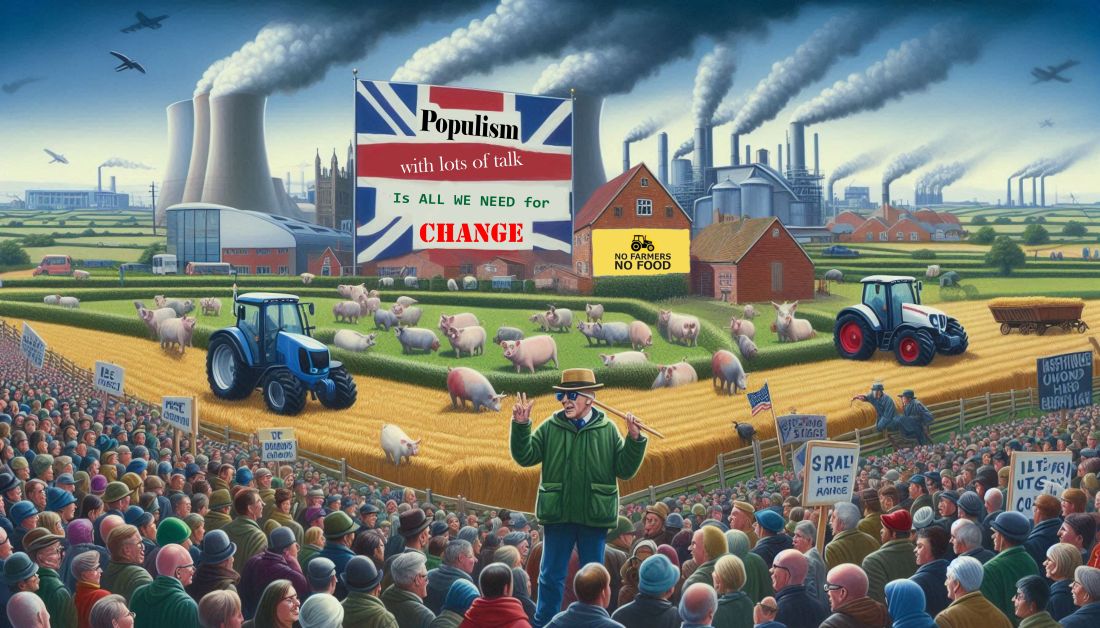
Populism will not save Farming. But practicality can and will

The one thing that everyone linked to U.K. Agriculture and Food Production will agree on is that the industry is in crisis. But what the crisis is, what caused it, what will fix it and what approach or what thinking must be prioritised to do so are very different things.

The stakes could not be higher. Farming is quickly becoming unviable for growing numbers of farmers. The land they vacate is coming out of production and not being passed to the next generation or anyone fighting to find their way in. Retailers are exhaustively abusing their relationships with farmers and growers, and the establishment remains blithely confident that the U.K. will never be short of supplies.

Because countries as far away as Australia and New Zealand will always be there to step into the gap and meet every shortfall.

All of this whilst the latest figures suggest that the amount of food that the U.K. produces for its own use only reaches around 52-54%.

That the food we all eat just seems to keep on coming gives the lie to what the real food crisis is. And the fragility of our food supply is hiding in plain sight.

The complexity of the issues involved regrettably mean it is increasingly easy for anyone within the industry who is worried about the future, to be looking for a banner or message to get behind. One that relates enough to their own experience and makes sense of whatever they believe everyone else going through the same experience needs to do.

Unfortunately, messages that can become such a point of focus are therefore very dangerous. They deceive people into believing in a shared purpose that isn’t necessarily there.

This means that time, energy and perhaps even risks or gambles are taken on political vehicles or strands of unanchored activism that sound as if they will deliver results and perhaps even become the next big thing.

Some call this populism. It’s happening within farming right now, fuelled in no small part by the growing unrest involving farmers across Europe who have even gone as far as laying a meadow along once of the key routes into Paris.

Ploughing roads, fertilising the walls of ministry offices, shutting down travel or even manning the barricades might sound very attractive to people even beyond the farming and food production community itself. But what would be the purpose? What would U.K. farmers be trying to achieve? What would it all be for?

Everyone has a different perspective on the issues; what is happening and what really needs to happen, to get the result and to sort all the problems out.

By rushing to protest, no matter how inspiring the pictures from Europe might seem, the real opportunity could be so easily lost. The growing power of the frustration, impatience and lack of trust of the establishment, retailers and big money, who are collectively causing so much harm and distress, could too easily be lost. Worse still, misdirection of this untapped potential could too easily be used against what’s left of the power the industry has to influence its own future.

Protests without purpose will also always fail. Wasting a lot of time and probably money that few can really afford. However, the real cost of responding to the dog whistles rarely blown by those with skin in the game, will be the future of UK Farming and Food Production itself.

Any form of protest that isn’t really thought out in terms of what it needs to achieve and then fails, will inevitably be seen as a whimsical exercise by people ‘on the extreme’.

There is a high probability that any form of mass protest implemented without thought will be repurposed by the establishment to fit the narrative that UK Agriculture is archaic in its current form and must adhere to new ways of thinking and practices. Systems and ways of working that in the longer term, don’t feature what you and I recognise as Farming in any relevant form.

I wish that I could say that the alternative way to facilitate change is easy, and just as easy to understand.

There are people working within and supporting the industry who in some cases have overseen massively useful work on the future of farming in the UK and what needs to change.

The evidence is there to demonstrate that a whole range of problems genuinely exists.

Some of the work done is incredibly good and well-informed. But even in the case of those working very closely with Government, politicians and industry leaders every day, there is not enough appreciation of just how complex the political-government-establishment-public sector relationship and the interaction between them has become.

Worse still, there is very little focus on how the massively misled expectations of members of the public as well as industry professionals and small business owners can possibly be met, when the realities of the future we face are now undoubtedly facing in a very different way.

There are barriers to progress everywhere, and the lens of best intentions doesn’t see these for the problem that they really are. Yet we have years of disappointments with public policy to confirm that it is so.

The control of food is power.

Once we are able to understand the role of food in every one of its aspects and forms, we then and only then, have a chance to recognise that the whole direction of farming and the current production and output-based focus it has, is constructed of policies that simply make no economic sense. We can see what they are really there for.

UK Agriculture has no power and no say in its future today. This must change.

Over the past 40-50 years, all that power and influence has been slowly and yes, deliberately been drained away to wherever we think the money still is, and then beyond.

The future of farming that works for us all is one that fits with and interacts closely with the benefits of production and supply to the surrounding community fixed firmly in mind.

Its form more closely resembles the kind of farm structures and sizes that older generations will remember well. It builds upon community, true localism and a healthy relationship with social enterprises or not-for-profit cooperatives in every potential form.

However, the narratives we overwhelmingly hear today tell us that progress can only ever go one way.

Yet the progress the establishment is driving us all towards isn’t focused on humans, on health, on being happy. It’s all about money, and the wealth of an ever smaller few.

But as the friction in the markets, the talk of politicians and the cost-of-living crisis keep warning us, the monetary and financial system that we have, has actually had its day.

The real progress that will keep farmers farming and people healthy and fed adequately with what they need, isn’t based on a direction where money and all the forces that drive it can continue to be in the driving seat for very long.

The future of food and food production is about community, locality, smaller or more tradition scale and about people working in and around food production being remunerated properly for doing proper, fulfilling jobs.

Local Farms and the role they will play in providing many of the foods, drinks and goods that will make that possible, are at the heart of the future of Food Production.

Farmers have the power to influence this change of direction in a very practical way. But government and the big money interests riding off the destruction of UK farming aren’t going to pay for it.

It’s time for the industry to take a worthwhile risk on its future.

Otherwise, it won’t be long before there isn’t anything left taking a risk for.

Sustainable Agriculture is part of the pathway to UK Food Security. But it wont work well for anyone until it works for everyone in the same way

My focus on Agri politics and the mass of issues that surround UK Food Security, Sustainable Agriculture and the growing problem of Food Poverty in the UK has made the past few months and my time at the Royal Agricultural University highly beneficial. Especially as I have began to look further and further outside my own social and professional circles to see if the troubling patterns that I already recognised, were evident in the same way elsewhere.

I have to be blunt and say that nothing I have experienced has given me any comfort. In all honesty, everything that I have seen has made me realise that the UKs Food Security and self-sustainability issues are significantly worse than I’d already concluded, and they are getting worse the whole time.

As you will have already read, Sustainability and Sustainable Agriculture are issues that are important to what I wish to share. However, the English language, the way that we multipurpose words and the obsession with subtext that most of us have, make communicating difficult issues that need to easily be grasped very difficult. Especially when alternative terms and their meanings can be used as a barrier that allow emotional ties to get in the way of progress and constructive dialogue.

There are very important distinctions to be made about Sustainable Farming in the context of what sustainability really is. Given that terms such as Regenerative Agriculture, Conservation Agriculture and Rewilding have been pushing their way into the Rural, Green, Environmental and Agricultural lexicon. As despite what should be very distinctive threads of commonality running throughout all of them, the differences between them and more importantly what everyone believes to be the most important priorities of each of them, are endlessly getting in the way.

Misunderstanding, misinterpreting and misrepresenting key benefits and issues is preventing everyone coming together to build upon shared commonality to identify and implement ways of working for the future that are meaningful and beneficial for everyone involved.

To add to the complication of addressing these issues, there is also a need to focus on methods and thinking that are likely to seem counterintuitive in a way that requires many of the most logical and business minded people that we could meet, to think about a future that looks very different to how it does today. A comfort zone we are resistant to leaving where every system, policy and story we encounter tell us all that the basics of everything that we accept without thinking, are always set to remain the same.